


EN 1996-1-2:2024
(Main)Eurocode 6 - Design of masonry structures - Part 1-2: Structural fire design
Eurocode 6 - Design of masonry structures - Part 1-2: Structural fire design
1.1 Scope of prEN 1996-1-2
(1) This document gives rules for the design of masonry structures for the accidental situation of fire exposure. This document only identifies differences from, or supplements to, normal temperature design.
(2) This document applies to structures, or parts of structures, that are within the scope of EN 1996-1-1 or EN 1996-3 and are designed accordingly.
(3) This document gives rules for the design of structures for specified requirements in respect of the aforementioned functions and the levels of performance.
(5) This document does not cover masonry built with natural stone units according to EN 771-6.
(6) This document deals with:
- non-loadbearing internal walls;
- non-loadbearing external walls;
- loadbearing internal walls with separating or non-separating functions;
- loadbearing external walls with separating or non-separating functions.
1.2 Assumptions
(1) The assumptions of EN 1990 and EN 1996-1-1 apply to this document.
(2) This document is intended to be used together with EN 1990, EN 1991-1-2, EN 1996-1-1, EN 1996 2 and EN 1996-3.
(3) In addition to the general assumptions of EN 1990 and EN 1996-1-1, the following assumptions apply:
- the choice of the relevant design fire scenario is made by appropriate qualified and experienced personnel, or is given by the relevant national regulation;
- any fire protection measure taken into account in the design will be adequately maintained.
Eurocode 6 - Bemessung und Konstruktion von Mauerwerksbauten -Teil 1-2: Tragwerksbemessung für den Brandfall
(1) Dieses Dokument enthält Regeln für die Bemessung und Konstruktion von Mauerwerksbauten für den außergewöhnlichen Lastfall der Brandbeanspruchung. Dieses Dokument behandelt nur Unterschiede bzw. Ergänzungen zur Bemessung bei normaler Temperatur.
(2) Dieses Dokument bezieht sich auf Tragwerke oder Teiltragwerk, die in den Anwendungsbereich von EN 1996-1-1 oder EN 1996-3 fallen und nach diesen Normen bemessen und konstruiert sind.
(3) Dieses Dokument enthält Regeln für die Bemessung und Konstruktion von Bauwerken für bestimmte Anforderungen mit Bezug auf die zuvor genannten Funktionen und die Anforderungsniveaus.
(5) Mauerwerk aus Natursteinen nach EN 771-6 fällt nicht in den Anwendungsbereich dieses Dokuments.
(6) Dieses Dokument behandelt Folgendes:
- nichttragende Innenwände;
- nichttragende Außenwände;
- tragende raumabschließende oder nichtraumabschließende Innenwände;
- tragende raumabschließende oder nichtraumabschließende Außenwände.
1.2 Annahmen
(1) Für dieses Dokument gelten die Annahmen von EN 1990 und EN 1996-1-1.
(2) Dieses Dokument ist dafür vorgesehen, zusammen mit EN 1990, EN 1991-1-2, EN 1996-1-1, EN 1996-2 und EN 1996-3 angewendet zu werden.
(3) Zusätzlich zu den allgemeinen Annahmen von EN 1990 und EN 1996-1-1 gelten die folgenden Annahmen:
- die Auswahl der maßgebenden Bemessungsbrandfälle wird durch ausreichend qualifiziertes und erfahrenes Personal getroffen oder ist in entsprechenden nationalen Vorschriften angegeben;
- alle in der Bemessung berücksichtigten Brandschutzmaßnahmen werden in geeigneter Weise instand gehalten.
Eurocode 6 - Calcul des ouvrages en maçonnerie - Partie 1-2 : Calcul du comportement au feu
1.1 Domaine d'application du prEN 1996-1-2
(1) Le présent document donne des règles de calcul des ouvrages de maçonnerie pour la situation accidentelle d'exposition au feu. Le présent document identifie uniquement les différences avec le calcul à température normale, ou lui apporte des compléments.
(2) Le présent document s'applique aux structures, ou aux parties de structures, relevant du domaine d'application de l'EN 1996-1-1 ou de l'EN 1996-3 et conçues en conséquence.
(3) Le présent document donne les règles relatives au calcul des structures par rapport aux exigences spécifiées eu égard aux fonctions mentionnées ci-dessus et aux niveaux de performances.
(5) Le présent document ne couvre pas les éléments de maçonnerie en pierre naturelle conforme à l'EN 771-6.
(6) Le présent document traite des éléments suivants :
- les murs intérieurs non porteurs ;
- les murs extérieurs non porteurs ;
- les murs intérieurs porteurs avec ou sans fonction séparatrice ;
- les murs extérieurs porteurs avec ou sans fonction séparatrice.
1.2 Hypothèses
(1) Les hypothèses de l'EN 1990 et de l'EN 1996-1-1 s'appliquent au présent document.
(2) Le présent document est conçu pour être utilisé conjointement avec l'EN 1990, l'EN 1991-1-2, l'EN 1996-1-1, l'EN 1996-2 et l'EN 1996-3.
(3) Outre les hypothèses générales définies dans l'EN 1990 et l'EN 1996-1-1, les hypothèses suivantes s'appliquent :
- le choix du scénario de feu de calcul pertinent est fait par un personnel possédant une qualification et une expérience appropriées, ou est indiqué par la réglementation nationale concernée ;
- les mesures de protection contre l'incendie dont le calcul tient compte font l'objet d'un entretien approprié.
Evrokod 6 - Projektiranje zidanih konstrukcij - 1-2. del: Splošna pravila - Požarnoodporno projektiranje
General Information
- Status
- Published
- Publication Date
- 24-Sep-2024
- Technical Committee
- CEN/TC 250 - Structural Eurocodes
- Drafting Committee
- CEN/TC 250/SC 6 - Eurocode 6: Design of masonry structures
- Current Stage
- 6060 - Definitive text made available (DAV) - Publishing
- Start Date
- 25-Sep-2024
- Due Date
- 30-Jul-2021
- Completion Date
- 25-Sep-2024
Relations
- Effective Date
- 02-Oct-2024
- Effective Date
- 19-Jan-2023
- Effective Date
- 28-Jan-2026
- Effective Date
- 28-Jan-2026
- Effective Date
- 28-Jan-2026
- Effective Date
- 28-Jan-2026
- Effective Date
- 28-Jan-2026
- Effective Date
- 28-Jan-2026
- Effective Date
- 28-Jan-2026
- Effective Date
- 28-Jan-2026
- Effective Date
- 28-Jan-2026
- Effective Date
- 28-Jan-2026
- Effective Date
- 28-Jan-2026
- Effective Date
- 28-Jan-2026
- Referred By
EN 1366-3:2009 - Fire resistance tests for service installations - Part 3: Penetration seals - Effective Date
- 28-Jan-2026
Overview
EN 1996-1-2:2024 - Eurocode 6: Design of masonry structures - Part 1-2: Structural fire design provides rules for designing masonry elements subjected to accidental fire exposure. It identifies the differences from, or supplements to, normal-temperature design and applies to masonry structures within the scope of EN 1996-1-1 and EN 1996-3. The standard excludes masonry built with natural stone units covered by EN 771-6.
This Eurocode part is intended to be used together with EN 1990, EN 1991-1-2, EN 1996-1-1, EN 1996-2 and EN 1996-3 and allows national choices to be recorded in a National Annex.
Key topics and technical requirements
- Scope of application
- Covers non-loadbearing internal and external walls and loadbearing internal and external walls (both separating and non-separating).
- Does not cover natural stone masonry per EN 771-6.
- Basis of design
- Rules for selecting nominal and physically based fire exposures and for actions during fire scenarios.
- Emphasis that the relevant design fire scenario must be selected by qualified personnel or national regulation.
- Material properties
- Thermal and mechanical properties at elevated temperatures are addressed.
- Guidance on emissivity, thermal conductivity, specific heat and specific weight for masonry materials.
- Verification and analysis
- Member-level, part-of-structure and global structural analysis methods for fire situations.
- Verification methods and design values for material properties in fire.
- Tabulated data and annexes
- Annex A: Tabulated fire resistance values for different masonry types (clay, calcium silicate, dense/lightweight concrete, autoclaved aerated concrete, manufactured stone).
- Annex B: Input parameters and temperature-dependent thermal/mechanical data for calculation models.
- Annex C: Examples of detailing and connections that meet fire-design requirements.
- Detailing and execution
- Requirements for junctions, joints, fixtures, pipes, cables and head-joint execution to maintain fire performance.
- Assumptions
- Fire protection measures taken into account in design must be adequately maintained.
Applications
- Design of masonry walls and loadbearing elements where fire resistance or structural performance in fire is required.
- Preparation of structural design documentation for buildings subject to fire safety regulations.
- Input for fire safety engineering, performance-based design, and compliance checking with national fire codes.
Who uses this standard
- Structural engineers and designers working on masonry buildings
- Fire safety engineers and consultants
- Architects, contractors and manufacturers of masonry materials
- Code regulators and certification bodies implementing Eurocode-based national rules
Related standards
- EN 1990 (Basis of structural design)
- EN 1991-1-2 (Actions on structures - Fire)
- EN 1996-1-1, EN 1996-2, EN 1996-3 (Other parts of Eurocode 6)
- EN 771-6 (natural stone units) - excluded from this part
Keywords: EN 1996-1-2:2024, Eurocode 6, structural fire design, masonry fire resistance, design of masonry structures, CEN.

Get Certified
Connect with accredited certification bodies for this standard

ICC Evaluation Service
Building products evaluation and certification.

NSF International
Global independent organization facilitating standards development and certification.

QAI Laboratories
Building and construction product testing and certification.
Sponsored listings
Frequently Asked Questions
EN 1996-1-2:2024 is a draft published by the European Committee for Standardization (CEN). Its full title is "Eurocode 6 - Design of masonry structures - Part 1-2: Structural fire design". This standard covers: 1.1 Scope of prEN 1996-1-2 (1) This document gives rules for the design of masonry structures for the accidental situation of fire exposure. This document only identifies differences from, or supplements to, normal temperature design. (2) This document applies to structures, or parts of structures, that are within the scope of EN 1996-1-1 or EN 1996-3 and are designed accordingly. (3) This document gives rules for the design of structures for specified requirements in respect of the aforementioned functions and the levels of performance. (5) This document does not cover masonry built with natural stone units according to EN 771-6. (6) This document deals with: - non-loadbearing internal walls; - non-loadbearing external walls; - loadbearing internal walls with separating or non-separating functions; - loadbearing external walls with separating or non-separating functions. 1.2 Assumptions (1) The assumptions of EN 1990 and EN 1996-1-1 apply to this document. (2) This document is intended to be used together with EN 1990, EN 1991-1-2, EN 1996-1-1, EN 1996 2 and EN 1996-3. (3) In addition to the general assumptions of EN 1990 and EN 1996-1-1, the following assumptions apply: - the choice of the relevant design fire scenario is made by appropriate qualified and experienced personnel, or is given by the relevant national regulation; - any fire protection measure taken into account in the design will be adequately maintained.
1.1 Scope of prEN 1996-1-2 (1) This document gives rules for the design of masonry structures for the accidental situation of fire exposure. This document only identifies differences from, or supplements to, normal temperature design. (2) This document applies to structures, or parts of structures, that are within the scope of EN 1996-1-1 or EN 1996-3 and are designed accordingly. (3) This document gives rules for the design of structures for specified requirements in respect of the aforementioned functions and the levels of performance. (5) This document does not cover masonry built with natural stone units according to EN 771-6. (6) This document deals with: - non-loadbearing internal walls; - non-loadbearing external walls; - loadbearing internal walls with separating or non-separating functions; - loadbearing external walls with separating or non-separating functions. 1.2 Assumptions (1) The assumptions of EN 1990 and EN 1996-1-1 apply to this document. (2) This document is intended to be used together with EN 1990, EN 1991-1-2, EN 1996-1-1, EN 1996 2 and EN 1996-3. (3) In addition to the general assumptions of EN 1990 and EN 1996-1-1, the following assumptions apply: - the choice of the relevant design fire scenario is made by appropriate qualified and experienced personnel, or is given by the relevant national regulation; - any fire protection measure taken into account in the design will be adequately maintained.
EN 1996-1-2:2024 is classified under the following ICS (International Classification for Standards) categories: 13.220.50 - Fire-resistance of building materials and elements; 91.010.30 - Technical aspects; 91.080.30 - Masonry. The ICS classification helps identify the subject area and facilitates finding related standards.
EN 1996-1-2:2024 has the following relationships with other standards: It is inter standard links to EN 1996-1-2:2005/AC:2010, EN 1996-1-2:2005, EN 1366-4:2021, EN 1363-2:1999, EN 1364-1:2015, EN 1991-1-2:2024, EN 1996-1-1:2022, EN 1997-1:2024, EN 13107:2015, EN 1991-4:2006, EN 1990:2023, CEN/TR 16886:2016, EN 12699:2015, EN 1996-2:2024, EN 1366-3:2009. Understanding these relationships helps ensure you are using the most current and applicable version of the standard.
EN 1996-1-2:2024 is associated with the following European legislation: EU Directives/Regulations: 305/2011; Standardization Mandates: M/515. When a standard is cited in the Official Journal of the European Union, products manufactured in conformity with it benefit from a presumption of conformity with the essential requirements of the corresponding EU directive or regulation.
EN 1996-1-2:2024 is available in PDF format for immediate download after purchase. The document can be added to your cart and obtained through the secure checkout process. Digital delivery ensures instant access to the complete standard document.
Standards Content (Sample)
SLOVENSKI STANDARD
oSIST prEN 1996-1-2:2022
01-december-2022
Evrokod 6 - Projektiranje zidanih konstrukcij - 1-2. del: Splošna pravila -
Požarnoodporno projektiranje
Eurocode 6 - Design of masonry structures - Part 1-2: General rules - Structural fire
design
Eurocode 6 - Bemessung und Konstruktion von Mauerwerksbauten -Teil 1-2: Allgemeine
Regeln - Tragwerksbemessung für den Brandfall
Eurocode 6 - Calcul des ouvrages en maçonnerie - Partie 1-2 : Règles générales -
Calcul du comportement au feu
Ta slovenski standard je istoveten z: prEN 1996-1-2
ICS:
13.220.50 Požarna odpornost Fire-resistance of building
gradbenih materialov in materials and elements
elementov
91.010.30 Tehnični vidiki Technical aspects
91.080.30 Zidane konstrukcije Masonry
oSIST prEN 1996-1-2:2022 en,fr,de
2003-01.Slovenski inštitut za standardizacijo. Razmnoževanje celote ali delov tega standarda ni dovoljeno.
oSIST prEN 1996-1-2:2022
oSIST prEN 1996-1-2:2022
DRAFT
EUROPEAN STANDARD
prEN 1996-1-2
NORME EUROPÉENNE
EUROPÄISCHE NORM
September 2022
ICS 13.220.50; 91.010.30; 91.080.30 Will supersede EN 1996-1-2:2005
English Version
Eurocode 6 - Design of masonry structures - Part 1-2:
General rules - Structural fire design
Eurocode 6 - Calcul des ouvrages en maçonnerie - Eurocode 6 - Bemessung und Konstruktion von
Partie 1-2 : Règles générales - Calcul du comportement Mauerwerksbauten -Teil 1-2: Allgemeine Regeln -
au feu Tragwerksbemessung für den Brandfall
This draft European Standard is submitted to CEN members for enquiry. It has been drawn up by the Technical Committee
CEN/TC 250.
If this draft becomes a European Standard, CEN members are bound to comply with the CEN/CENELEC Internal Regulations
which stipulate the conditions for giving this European Standard the status of a national standard without any alteration.
This draft European Standard was established by CEN in three official versions (English, French, German). A version in any other
language made by translation under the responsibility of a CEN member into its own language and notified to the CEN-CENELEC
Management Centre has the same status as the official versions.
CEN members are the national standards bodies of Austria, Belgium, Bulgaria, Croatia, Cyprus, Czech Republic, Denmark, Estonia,
Finland, France, Germany, Greece, Hungary, Iceland, Ireland, Italy, Latvia, Lithuania, Luxembourg, Malta, Netherlands, Norway,
Poland, Portugal, Republic of North Macedonia, Romania, Serbia, Slovakia, Slovenia, Spain, Sweden, Switzerland, Türkiye and
United Kingdom.
Recipients of this draft are invited to submit, with their comments, notification of any relevant patent rights of which they are
aware and to provide supporting documentation.
Warning : This document is not a European Standard. It is distributed for review and comments. It is subject to change without
notice and shall not be referred to as a European Standard.
EUROPEAN COMMITTEE FOR STANDARDIZATION
COMITÉ EUROPÉEN DE NORMALISATION
EUROPÄISCHES KOMITEE FÜR NORMUNG
CEN-CENELEC Management Centre: Rue de la Science 23, B-1040 Brussels
© 2022 CEN All rights of exploitation in any form and by any means reserved Ref. No. prEN 1996-1-2:2022 E
worldwide for CEN national Members.
oSIST prEN 1996-1-2:2022
prEN 1996-1-2:2022 (E)
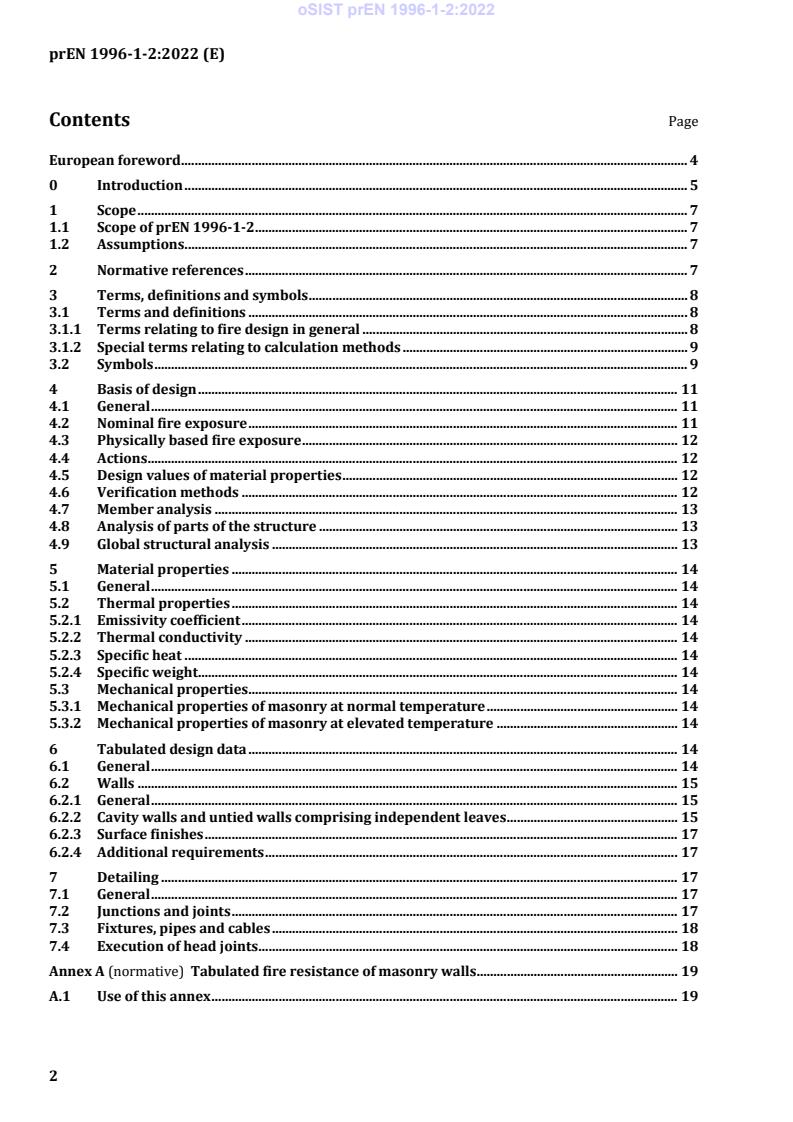
Contents Page
European foreword . 4
0 Introduction . 5
1 Scope . 7
1.1 Scope of prEN 1996-1-2 . 7
1.2 Assumptions . 7
2 Normative references . 7
3 Terms, definitions and symbols . 8
3.1 Terms and definitions . 8
3.1.1 Terms relating to fire design in general . 8
3.1.2 Special terms relating to calculation methods . 9
3.2 Symbols . 9
4 Basis of design . 11
4.1 General . 11
4.2 Nominal fire exposure . 11
4.3 Physically based fire exposure . 12
4.4 Actions . 12
4.5 Design values of material properties . 12
4.6 Verification methods . 12
4.7 Member analysis . 13
4.8 Analysis of parts of the structure . 13
4.9 Global structural analysis . 13
5 Material properties . 14
5.1 General . 14
5.2 Thermal properties . 14
5.2.1 Emissivity coefficient . 14
5.2.2 Thermal conductivity . 14
5.2.3 Specific heat . 14
5.2.4 Specific weight . 14
5.3 Mechanical properties . 14
5.3.1 Mechanical properties of masonry at normal temperature . 14
5.3.2 Mechanical properties of masonry at elevated temperature . 14
6 Tabulated design data . 14
6.1 General . 14
6.2 Walls . 15
6.2.1 General . 15
6.2.2 Cavity walls and untied walls comprising independent leaves . 15
6.2.3 Surface finishes . 17
6.2.4 Additional requirements . 17
7 Detailing . 17
7.1 General . 17
7.2 Junctions and joints . 17
7.3 Fixtures, pipes and cables . 18
7.4 Execution of head joints . 18
Annex A (normative) Tabulated fire resistance of masonry walls . 19
A.1 Use of this annex . 19
oSIST prEN 1996-1-2:2022
prEN 1996-1-2:2022 (E)
A.2 Scope and field of application . 19
A.3 General . 19
A.4 Clay masonry . 20
A.5 Calcium silicate masonry . 34
A.6 Dense and lightweight aggregate concrete masonry . 42
A.7 Autoclaved aerated concrete masonry . 56
A.8 Manufactured stone masonry . 62
Annex B (informative) Input parameters for calculation models . 63
B.1 Use of this informative annex . 63
B.2 Scope and field of application . 63
B.3 Thermal and physical properties of masonry as a function of temperature . 63
B.4 Mechanical properties . 67
B.4.1 General . 67
B.4.2 Determination of the mechanical property functions of temperature by test . 68
B.4.3 Pre-set mechanical property as functions of temperature . 70
Annex C (informative) Examples of connections that meet the requirements for detailing . 81
C.1 Use of this informative annex . 81
C.2 Scope and field of application . 81
C.3 Examples . 81
Bibliography . 86
oSIST prEN 1996-1-2:2022
prEN 1996-1-2:2022 (E)
European foreword
This document (prEN 1996-1-2:2022) has been prepared by Technical Committee CEN/TC 250
“Structural Eurocodes”, the secretariat of which is held by BSI. CEN/TC 250 is responsible for all
Structural Eurocodes and has been assigned responsibility for structural and geotechnical design matters
by CEN.
This document is currently submitted to the CEN Enquiry.
This document will supersede EN 1996-1-2:2005.
The first generation of EN Eurocodes was published between 2002 and 2007. This document forms part
of the second generation of the Eurocodes, which have been prepared under a Mandate M/515 given to
CEN by the European Commission and the European Free Trade Association.
The Eurocodes have been drafted to be used in conjunction with relevant execution, material, product
and test standards, and to identify requirements for execution, materials, products and testing that are
relied upon by the Eurocodes.
The Eurocodes recognize the responsibility of each Member State and have safeguarded their right to
determine values related to regulatory safety matters at national level through the use of National
Annexes.
oSIST prEN 1996-1-2:2022
prEN 1996-1-2:2022 (E)
0 Introduction
0.1 Introduction to the Eurocodes
The Structural Eurocodes comprise the following standards generally consisting of a number of Parts:
— EN 1990, Eurocode: Basis of structural and geotechnical design
— EN 1991, Eurocode 1: Actions on structures
— EN 1992, Eurocode 2: Design of concrete structures
— EN 1993, Eurocode 3: Design of steel structures
— EN 1994, Eurocode 4: Design of composite steel and concrete structures
— EN 1995, Eurocode 5: Design of timber structures
— EN 1996, Eurocode 6: Design of masonry structures
— EN 1997, Eurocode 7: Geotechnical design
— EN 1998, Eurocode 8: Design of structures for earthquake resistance
— EN 1999, Eurocode 9: Design of aluminium structures
— New parts are under development, e.g. Eurocode for design of structural glass.
The Eurocodes are intended for use by designers, clients, manufacturers, constructors, relevant
authorities (in exercising their duties in accordance with national or international regulations),
educators, software developers, and committees drafting standards for related product, testing and
execution standards.
NOTE Some aspects of design are most appropriately specified by relevant authorities or, where not specified,
can be agreed on a project-specific basis between relevant parties such as designers and clients. The Eurocodes
identify such aspects making explicit reference to relevant authorities and relevant parties.
0.2 Introduction to EN 1996 (all parts)
EN 1996 (all parts) applies to the design of building and civil engineering works, or parts thereof, in
unreinforced, reinforced, prestressed and confined masonry.
EN 1996 (all parts) deals only with the requirements for resistance, serviceability, and durability of
structures. Other requirements, for example, concerning thermal or sound insulation, are not considered.
EN 1996 (all parts) does not cover the special requirements of seismic design. Provisions related to such
requirements are given in EN 1998, which complements, and is consistent with EN 1996.
EN 1996 (all parts) does not cover numerical values of the actions on building and civil engineering works
to be taken into account in the design. They are provided in EN 1991.
0.3 Introduction to prEN 1996-1-2
This document, together with EN 1991-1-2, supplements EN 1996-1-1 so that the design of masonry
structures complies with fire requirements.
oSIST prEN 1996-1-2:2022
prEN 1996-1-2:2022 (E)
0.4 Verbal forms used in the Eurocodes
The verb “shall" expresses a requirement strictly to be followed and from which no deviation is permitted
in order to comply with the Eurocodes.
The verb “should” expresses a highly recommended choice or course of action. Subject to national
regulation and/or any relevant contractual provisions, alternative approaches could be used/adopted
where technically justified.
The verb “may” expresses a course of action permissible within the limits of the Eurocodes.
The verb “can” expresses possibility and capability; it is used for statements of fact and clarification of
concepts.
0.5 National Annex for prEN 1996-1-2
National choice is allowed in this standard where explicitly stated within notes. National choice includes
the selection of values for Nationally Determined Parameters (NDPs).
The national standard implementing this document can have a National Annex containing all national
choices to be used for the design of buildings and civil engineering works to be constructed in the relevant
country.
When no national choice is given, the default choice given in this standard is to be used.
When no national choice is made and no default is given in this standard, the choice can be specified by a
relevant authority or, where not specified, agreed for a specific project by appropriate parties.
National choice is allowed in prEN 1996-1-2 through notes to the following clauses:
4.5(1) 5.2.2(1) 5.2.3(1) A.4(1)
A.5(1) A.6(1) A.7(1) A.8(1)
National choice is allowed in prEN 1996-1-2 on the application of the following informative annexes:
Annex B Annex C
The National Annex can contain, directly or by reference, non-contradictory complementary information
for ease of implementation, provided it does not alter any provisions of the Eurocodes.
oSIST prEN 1996-1-2:2022
prEN 1996-1-2:2022 (E)
1 Scope
1.1 Scope of prEN 1996-1-2
(1) This document gives rules for the design of masonry structures for the accidental situation of fire
exposure. This document only identifies differences from, or supplements to, normal temperature design.
(2) This document applies to structures, or parts of structures, that are within the scope of EN 1996-1-1
or EN 1996-3 and are designed accordingly.
(3) This document gives rules for the design of structures for specified requirements in respect of the
aforementioned functions and the levels of performance.
(5) This document does not cover masonry built with natural stone units according to EN 771-6.
(6) This document deals with:
— non-loadbearing internal walls;
— non-loadbearing external walls;
— loadbearing internal walls with separating or non-separating functions;
— loadbearing external walls with separating or non-separating functions.
1.2 Assumptions
(1) The assumptions of EN 1990 and EN 1996-1-1 apply to this document.
(2) This document is intended to be used together with EN 1990, EN 1991-1-2, EN 1996-1-1, EN 1996-2
and EN 1996-3.
(3) In addition to the general assumptions of EN 1990 and EN 1996-1-1, the following assumptions apply:
— the choice of the relevant design fire scenario is made by appropriate qualified and experienced
personnel, or is given by the relevant national regulation;
— any fire protection measure taken into account in the design will be adequately maintained.
2 Normative references
The following documents are referred to in the text in such a way that some or all of their content
constitutes requirements of this document. For dated references, only the edition cited applies. For
undated references, the latest edition of the referenced document (including any amendments) applies.
NOTE See the Bibliography for a list of other documents cited that are not normative references, including
those referenced as recommendations (i.e. in ‘should’ clauses), permissions (‘may’ clauses), possibilities ('can'
clauses), and in notes.
EN 772-13, Methods of test for masonry units — Part 13: Determination of net and gross dry density of
masonry units (except for natural stone)
EN 1363-2, Fire resistance tests — Part 2: Alternative and additional procedures
EN 1364-1, Fire resistance tests for non-loadbearing elements — Part 1: Walls
EN 1366-4, Fire resistance tests for service installations — Part 4: Linear joint seals
EN 1990, Eurocode — Basis of structural and geotechnical design
oSIST prEN 1996-1-2:2022
prEN 1996-1-2:2022 (E)
prEN 1991-1-2:2021, Eurocode 1: Actions on structures — Part 1-2: General actions — Actions on
structures exposed to fire
EN 1996-1-1, Eurocode 6 — Design of masonry structures — Part 1-1: General rules for reinforced and
unreinforced masonry structures
EN 1996-2, Eurocode 6 — Design of masonry structures — Part 2: Design considerations, selection of
materials and execution of masonry
EN 1996-3, Eurocode 6 — Design of masonry structures — Part 3: Simplified calculation methods for
unreinforced masonry structures
3 Terms, definitions and symbols
3.1 Terms and definitions
For the purposes of this document, the terms and definitions given in EN 1990, in EN 1991-1-2, EN 1996-
1-1 and the following apply.
3.1.1 Terms relating to fire design in general
3.1.1.1
fire protection material
any material or combination of materials applied to a structural member for the purpose of increasing its
fire resistance
3.1.1.2
impact
M
ability of a separating wall, when exposed to fire, to resist horizontal loading according to EN 1363-2
3.1.1.3
fire wall
wall separating two spaces (generally two fire compartments or buildings) that is designed for fire
resistance and structural stability, and may include resistance to horizontal loading (criterion M) such
that in case of fire and failure of the structure on one side of the wall, fire spread beyond the wall is
avoided
Note 1 to entry: A fire wall is designated with REI-M or EI-M.
3.1.1.4
loadbearing wall
flat, membrane-like component predominantly subjected to compressive stress, for supporting vertical
and horizontal loads
Note 1 to entry: Examples of vertical loads include floor loads. Examples of horizontal loads include wind loads.
3.1.1.5
non-loadbearing wall
flat membrane-like building component loaded predominantly only by its self-weight, and which does
not provide bracing for loadbearing walls
Note 1 to entry: It may, however, be required to transfer horizontal loads acting on its surface to loadbearing
building components such as walls or floors.
oSIST prEN 1996-1-2:2022
prEN 1996-1-2:2022 (E)
3.1.1.6
separating wall
wall exposed to fire on one side only
Note 1 to entry: External walls with a length of 1,0 m or more can be treated as separating walls for the purposes
of fire design.
3.1.1.7
non-separating wall
loadbearing wall exposed to fire on two or more sides
3.1.1.8
normal temperature design
ultimate limit state design for ambient temperatures in accordance with EN 1996-1-1
3.1.1.9
part of structure
isolated part of an entire structure with appropriate support and boundary conditions
3.1.2 Special terms relating to calculation methods
3.1.2.1
structural failure of a wall in the fire situation
when the wall loses its ability to carry a specified load after a certain period of time
3.1.2.2
maximum stress level
for a given temperature, the stress level at which the stress-strain relationship of masonry is truncated
to a yield plateau
3.2 Symbols
For the purposes of this document, the material-independent symbols given in EN 1990, the material-
dependent symbols given in EN 1991-1-2, EN 1996-1-1 and the following symbols apply.
Latin upper case letters
E 30 or E 60 member meeting the integrity criterion, E, for 30, or 60 minutes in standard fire
exposure
I 30 or I 60 member meeting the thermal insulation criterion, I, for 30, or 60 minutes in
standard fire exposure
M 90 or M 120 member meeting the mechanical resistance criterion, M, for 90, or 120 minutes in
standard fire exposure
A fitting parameter based on experimental data to represent the value of a generic
mechanical property at room temperature
fitting parameter based on experimental data to represent the variation of a generic
A1
mechanical property with the temperature θ
A fitting parameter based on experimental data to represent the variation of a generic
mechanical property with the square of the temperature θ
N Design load in the fire situation
Ed,fi
N Design resistance in the fire situation at time t = 0
Rd,fi,0
oSIST prEN 1996-1-2:2022
prEN 1996-1-2:2022 (E)
S(·) summation function
SD standard deviation of the compressive strength readings f
θi M,𝜃𝜃i,j
X generic strength or deformation property of the material (e.g. f ) for normal
c
temperature design to EN 1996-1-1
X Design values of mechanical (strength and stiffness) material properties for the fire
fi,d
situation
X is the characteristic value of the strength or deformation property of the material
k
(e.g. f ) at normal temperature design to EN 1996-1-1
k
Latin lower case letters
c specific heat capacity of masonry
a
ct combined thickness of webs and shells (given as a percentage of the width of a unit)
f compressive strength of the j-th sample tested at the temperature θ
mat,θi,j i
f mean compressive strength of all samples tested at the temperature θ
mat,θi,m i
f characteristic compressive strength of all samples tested at the temperature θ
mat,θi,k i
k generic modification factor for a strength or deformation property (e.g. X /X ), dependent
θ k,θ k
on the temperature
modification factor for the characteristic compressive strength
kfmat,k
k modification factor for the mean value of the compressive strength
fmat,m
k modification factor for the ultimate strain in absence of preload
εmat,u
l length at 20 °C
l length of a wall for a period of fire resistance
F
n dimensionless factor used to define the shape of stress-strain curves
M
n number of samples tested at the temperature θ
s i
n number of tested temperatures θ
θ i
nvg no value given
t thickness of a wall for a period of fire resistance
F
time of fire classification (e.g. 30 minutes) for a standard fire in accordance with EN 1363
tfi,d
Greek upper case letters
Δt time interval
ΔΘ average temperature rise of the unexposed side
ΔΘ maximum temperature rise of the unexposed side at any point
Greek lower case letters
α the ratio of the applied design load on the wall to the design resistance of the wall
ε free thermal strain
T
ε ultimate strain in absence of preload of the masonry material (unit or mortar) determined
mat,u
on cylindrical samples in accordance with EN 12390-1
oSIST prEN 1996-1-2:2022
prEN 1996-1-2:2022 (E)
ε ultimate strain in absence of preload of the j-th sample tested at the temperature θ
mat,u,θi,j i
ε mean ultimate strain in absence of preload of all samples tested at the temperature θ
mat,u,θi,m i
σ design value of the compressive stress
d
θ temperature
θ i-th test temperature
i
η reduction factor for design load level in the fire situation
fi
λ thermal conductivity
a
μ degree of utilisation at time t = 0
ρ gross dry density of the masonry units, measured in accordance with EN 772-13
4 Basis of design
4.1 General
(1) Where mechanical resistance is required, masonry structures shall be designed and constructed in
such a way that they maintain their loadbearing function during the relevant fire exposure.
(2) Where compartmentation is required, the elements forming the boundaries of the fire compartment,
including joints, shall be designed and constructed in such a way that they maintain their separating
function during the relevant fire exposure and to ensure that:
— integrity failure does not occur;
— insulation failure does not occur.
4.2 Nominal fire exposure
(1) For standard fire exposure, elements shall comply with the following functions defined in
EN 1991-1-2:
— loadbearing function: loadbearing capacity, mechanical resistance (R);
— separating function: integrity (E) and, when requested, insulation (I);
— separating and loadbearing functions: (R), (E) and, when requested, (I).
NOTE 1 The loadbearing function (R) is assumed to be satisfied when the loadbearing capacity is maintained
during the required time of fire exposure.
NOTE 2 The separating function is assumed to be satisfied when integrity and, when requested, insulation, are
maintained.
NOTE 3 The separating function (E) is assumed to be maintained when a separating element of building
construction, exposed to fire on one side, prevents the passage through it of flames and hot gases and the occurrence
of flames on the unexposed side.
NOTE 4 The insulation function (I) is assumed to be maintained when the average temperature rise over the
whole of the unexposed surface is limited to 140 K, and the maximum temperature rise at any point of that surface
does not exceed 180 K.
(2) With the external fire exposure curve the same functions (R, E, I) shall apply. However, the reference
to this specific curve shall be identified by the letters “ef”.
oSIST prEN 1996-1-2:2022
prEN 1996-1-2:2022 (E)
(3) With the hydrocarbon fire exposure curve the same functions (R, E, I) shall apply. However, the
reference to this specific curve shall be identified by the letters “HC”.
(4) Where a wall with or without loadbearing function has to comply with impact resistance requirement
(ciriterion M), the wall shall resist a horizontal impact load as specified in EN 1363-2.
4.3 Physically based fire exposure
(1) The loadbearing function shall be ensured to prevent collapse during the complete duration of the
fire, including the cooling phase, or during a required period of time according to prEN 1991-1-2:2021,
4.4 (4).
(2) For the verification of the separating function the following applies, assuming that the normal
temperature is 20 °C:
— the average temperature rise of the unexposed side of the construction should be limited to 140 K
and the maximum temperature rise of the unexposed side should not exceed 180 K during the
heating phase until the maximum temperature in the fire compartment is reached;
— the average temperature rise of the unexposed side of the construction should be limited to 200 K
and the maximum temperature rise of the unexposed side should not exceed 240 K during the cooling
phase.
4.4 Actions
(1) The thermal and mechanical actions shall be obtained from EN 1991-1-2.
4.5 Design values of material properties
(1) Design values of mechanical (strength and stiffness) material properties for the fire situation X shall
fi,d
be derived as follows:
X = kX /γ (4.1)
fi,d θ k M,fi
where
X is the characteristic value of a strength or stiffness property (generally f or E) for normal
k k
temperature design according to EN 1996-1-1;
k is the temperature-dependent modification factor (X / X ) for a strength or stiffness
θ k,θ k
property;
γ is the partial factor for the relevant mechanical material property for the fire situation.
M,fi
NOTE The value of γ is 1,0 unless the National Annex gives a different value.
M,fi
(2) Design values of thermal material properties for the fire situation should be taken equal to their
characteristic values.
NOTE The characteristic values of thermal properties correspond to mean values.
4.6 Verification methods
(1) The model of the structural system adopted for design shall reflect the performance of the structure
in the fire situation.
(2) Mechanical resistance shall be verified for the required duration of fire exposure according to
Formula (4.2):
E ≤ R (4.2)
d,fi d,t,fi
oSIST prEN 1996-1-2:2022
prEN 1996-1-2:2022 (E)
where
E is the design effect of actions for the fire situation, determined in accordance with
d,fi
EN 1991-1-2, including effects of thermal expansions and deformations;
R is the corresponding design resistance in the fire situation.
d,t,fi
(3) The structural analysis for the fire situation should be carried out according to prEN 1990:2021,
7.1.5.
NOTE For verifying resistance requirements based on the standard fire curve a member analysis is sufficient,
unless otherwise specified.
(4) The following design methods may be used in order to satisfy 4.6(2):
— use of tabulated design data for specific types of members, see Clause 6;
— use of the results of fire tests.
4.7 Member analysis
(1) The design effect of actions should be determined for time t = 0 using combination factors according
to prEN 1991-1-2:2021, 6.3.
(2) The reduction factor η for the design load level for the fire situation as defined in prEN 1991-1-
fi
2:2021, 6.3, should be taken as 0,65, except for imposed loads according to category E as given in
EN 1991-1-1 (areas susceptible to accumulation of goods, including access areas) where the value η =
fi
0,7 should be used.
(3) In buildings with timber floors η may be taken as 0,60 according to EN 1995-1-2.
fi
(4) The effects of thermal deformations resulting from thermal gradients across the cross-section shall
be considered.
(5) The effects of axial or in-plane thermal expansions may be neglected.
(6) The kinematic boundary conditions at supports and ends of member, applicable at time t = 0, may be
assumed to remain unchanged throughout the fire exposure.
(7) Tabulated design data given in Annex A should be used for verifying members under fire conditions.
4.8 Analysis of parts of the structure
(1) The design effect of actions should be determined for time t = 0 using combination factors according
to prEN 1991-1-2:2021, 6.3.
(2) As an alternative to 4.8(1), the reactions at supports and internal forces and moments at boundaries
of part of the structure may be obtained from a structural analysis for normal temperature design as
given in 4.7.
(3) Within the part of the structure to be analysed, the relevant failure mode in fire, the temperature-
dependent material properties and member stiffness, effects of thermal expansions and deformations
(indirect fire actions) shall be taken into account.
(4) The part of the structure to be analysed should be specified on the basis of the potential thermal
expansions and deformations such that their interaction with other parts of the structure can be
approximated by time-independent support and boundary conditions during fire exposure.
4.9 Global structural analysis
(1) A global structural analysis for the fire situation shall take into account:
— the relevant failure mode in fire exposure;
oSIST prEN 1996-1-2:2022
prEN 1996-1-2:2022 (E)
— the temperature-dependent material properties and member stiffness;
— effects of thermal expansions and deformations (indirect fire actions).
5 Material properties
5.1 General
(1) Unless given as design values, the values of material properties given in Clause 5 shall be treated as
characteristic values.
5.2 Thermal properties
5.2.1 Emissivity coefficient
(1) The emissivity of a masonry surface should be taken as defined in EN 1991-1-2.
5.2.2 Thermal conductivity
(1) The thermal conductivity, λ , should be determined from tests or from a database.
a
NOTE Graphs of thermal conductivity for some materials are given in Annex B.
5.2.3 Specific heat
(1) The specific heat capacity of masonry, c , should be determined from tests or from a database.
a
NOTE Graphs of specific heat capacity for some materials are given in Annex B.
5.2.4 Specific weight
(1) The specific weight of masonry should be obtained from the specific weight of the masonry materials,
as given in EN 1991-1-1.
(2) The specific weight of masonry may be considered to be independent of the masonry temperature.
5.3 Mechanical properties
5.3.1 Mechanical properties of masonry at normal temperature
(1) The mechanical properties of masonry at 20 °C shall be taken as those given in EN 1996-1-1 for
normal temperature design.
5.3.2 Mechanical properties of masonry at elevated temperature
(1) The mechanical properties of masonry at elevated temperatures may be obtained from tests for a
project or from a database.
NOTE A method to determine the mechanical properties at elevated temperatures is given in Annex B.
6 Tabulated design data
6.1 General
(1) Tabulated design data relate to member analysis according to 4.7. They shall be used only for the
standard fire exposure and the same temperature distribution is assumed to exist along the length of the
structural members.
oSIST prEN 1996-1-2:2022
prEN 1996-1-2:2022 (E)
6.2 Walls
6.2.1 General
(1) Assessment of masonry walls may be carried out using Tables A.4 to A.8 in Annex A, which give the
minimum thickness of masonry required, for the relevant criterion, to achieve the stated period of fire
resistance, when constructed using units of the material, Group and density given.
NOTE In the tables, the minimum wall thickness given is for fire resistance purposes only. The thickness
required for other considerations as defined in EN 1996-1-1, or which is needed to meet other requirements, for
example acoustic performance, is not taken into account.
(3) For all types of masonry walls and columns, the fire resistance may be obtained from tests made in
accordance with EN 1363-1, EN 1363-2, EN 1364-1, EN 1365-1 and EN 1365-4 where appropriate
6.2.2 Cavity walls and untied walls comprising independent leaves
(1) When both leaves of a cavity wall are loadbearing and carry approximately equal loads, the fire
resistance of a cavity wall with leaves of approximately equal thickness should be taken as the fire
resistance of an equivalent single leaf wall of thickness equal to the sum of the thicknesses of the two
leaves, (see Figure 6.1, a), providing that no combustible material is included in the cavity.
oSIST prEN 1996-1-2:2022
prEN 1996-1-2:2022 (E)
a) Cavity wall (both leaves loaded) b) Cavity wall (one leaf loaded)
d) Untied wall
c) Cavity wall (non-loadbearing)
(loadbearing or non-loadbearing)
Key
1 Wall ties or bed joint reinforcement
2 Cavity unfilled or partially filled
3 Untied wall
Figure 6.1 — Illustration of cavity walls and double leaf walls
(2) When only one leaf of a cavity wall is loadbearing, the fire resistance of the cavity wall should be taken
at least as high as the resistance of the loadbearing leaf plastered on the side of the non-loadbearing leaf.
(3) The fire resistance of a cavity wall comprising two non-loadbearing leaves (Figure 6.1, c) may be taken
as the sum of the fire resistances of the individual leaves, limited to a maximum of 240 min when fire
resistance time is determined according to this document.
(4) For untied walls comprising independent leaves, the fire resistance of the wall shall be determined by
reference to the appropriate table in Annex A for the single leaf wall (see Figure 6.1, d) which is to be
assessed as being exposed to fire.
oSIST prEN 1996-1-2:2022
prEN 1996-1-2:2022 (E)
6.2.3 Surface finishes
(1) The fire resistance of masonry walls may be increased by the application of a layer of a suitable surface
finish, for example:
— gypsum premixed plaster in accordance with EN 13279-1;
— plaster type GP, OC, LW or T in accordance with EN 998-1.
(2) For cavity and untied walls, the surface finish shall be provided only on the outside faces of the leaves
and not between the two leaves.
(3) A cavity wall with plaster on one side and a masonry leaf on the other side may be treated as a wall
plastered on both sides.
6.2.4 Additional requirements
(1) Any supporting, or stiffening, part of a structure shall have at least the same fire resistance as the
structure being supported.
(2) Combustible thin damp proof materials incorporated into a wall may be ignored in assessing fire
resistance.
(3) Masonry units containing holes through the unit should not be laid so that the holes are at right angles
to the face of the wall, i.e. the wall should not be penetrated by the holes of the masonry units.
(4) A non-combustible thermal insulation system used on a single leaf external wall may be considered
as a suitable surface finish to apply the values for plastered wall in the tables in Annex A.
(5) Stiffening elements, such as cross walls, floors, beams, columns or frames, shall have at least the same
fire resistance as the wall under consideration.
NOTE If assessment shows that the failure of the stiffening elements on one side of a fire wall would not lead
to a failure of the fire wall, the stiffening elements do not need fire resistance.
(6) Lintels shall have at least the same EI classification as the structure being supported.
7 Detailing
7.1 General
(1) The detailing of masonry in a structure shall not reduce the fire resistance of the construction.
7.2 Junctions and joints
(1) Floors or the roof shall provide lateral support to the top and bottom of the wall, unless stability under
normal conditions is provided by other means, for example buttresses or special ties.
(2) Joints, including movement joints, in walls, or between walls and other fire separating members, shall
be designed and constructed so as to achieve the fire resistance requirement of the walls.
(3) Where fire insulating layers are required in movement joints, they shall consist of mineral based
materials having a melting point of not less than 1 000 °C. Any joints should be tightly sealed with non-
combustible material so that movement of the wall shall not adversely affect the fire resistance. If other
materials are to be used, it shall be shown by testing that they meet criteria E and I in accordance with
EN 1366-4.
(4) Detailing for connections between non-loadbearing masonry walls should be according to EN 1996-
2.
NOTE Examples of connections are given in Annex C.
oSIST prEN 1996-1-2:2022
prEN 1996-1-2:2022 (E)
(5) Detailing for connections between loadbearing masonry walls should be according to in EN 1996-1-1.
(6) Connections of fire walls to reinforced, unreinforced concrete and masonry structures which are
required to fulfil mechanical requirements (i.e., connections which are required to fulfil the mechanical
impact requirement M in accordance with EN 1363-2) should be constructed with joints that are
completely filled with mortar or concrete or they should be constructed with properly protected
mechanical fixings. Where connections are not required to provide mechanical resistance, they may be
built in accordance with (4) or (5) as appropriate.
7.3 Fixtures, pipes and cables
(1) The presence of recesses and chases, as permitted by EN 1996-1-1 in loadbe
...
Questions, Comments and Discussion
Ask us and Technical Secretary will try to provide an answer. You can facilitate discussion about the standard in here.
Loading comments...