

EN 16582-1:2015+A1:2021
(Main + Amendment)Domestic swimming pools - Part 1: General requirements including safety and test methods
- Abstract
This European Standard specifies the general safety and quality requirements and test methods for domestic swimming pools. These requirements and test methods are applicable to inground, aboveground or recessed swimming pool structures, including their installation and means of access.
This standard does not apply to:
- pools for public use covered by EN 15288-1;
- spas for domestic or public use;
- paddling pools according to EN 71-8.
- Status
- Published
- Publication Date
- 11-May-2021
- Withdrawal Date
- 29-Nov-2021
- Technical Committee
- CEN/TC 402 - Private family Swimming Pools and related materials/equipment and accessories
- Drafting Committee
- CEN/TC 402/WG 1 - Pool structure - design, product and installation
- Current Stage
- 6060 - Definitive text made available (DAV) - Publishing
- Start Date
- 12-May-2021
- Completion Date
- 12-May-2021

Overview
EN 16582-1:2015+A1:2021 is the European standard that sets general safety and quality requirements and test methods for domestic swimming pools. It applies to inground, aboveground and recessed pool structures, their installation and means of access. The standard covers safety-related design, material performance, accessibility and consumer information, and it incorporates Amendment A1 (approved December 2020, published May 2021).
Key topics and requirements
The standard addresses broad technical and safety subjects relevant to domestic pools, including:
- General requirements and tolerances for pool construction and installation.
- Water leakage testing and criteria for pool structures.
- Material performance: minimum requirements and test methods for corrosion resistance, osmosis resistance of composites/polymers and durability of wood (normative reference EN 350‑2).
- Injury risk reduction: controls for small parts, sharp edges, corners and permissible openings to prevent cuts, entrapment and other hazards.
- Accessibility and secure access: requirements for means of access and egress, including detailed provisions for ladders, recessed or raised bearing points, submerged stairs and handrails.
- Means of access testing: slip resistance testing, crushing/entrapment hazard assessments, ladder dimensioning, load-bearing and lateral stability tests.
- Entrapment test methods: normative methods for head, neck, finger, toe, hand and foot entrapment (see Annex C).
- Consumer information and documentation: point-of-purchase details, installation/commissioning and operating/maintenance manuals, plus safety signage and owner’s manual content (see Annex B).
- Aesthetic and maintenance guidance for composite shells (informative Annex D).
Practical applications
EN 16582-1 gives manufacturers, designers and installers a harmonized baseline for designing and delivering safer domestic pools. Practical uses include:
- Verifying pool structure and materials meet durability and corrosion resistance criteria.
- Designing safe means of access (ladders, stairs, handrails) that comply with slip-resistance and entrapment test methods.
- Preparing compliant consumer documentation, warnings and maintenance instructions.
- Supporting conformity assessment and national implementation across CEN member states.
Who should use this standard
- Pool manufacturers and component suppliers
- Installers, contractors and pool builders (B2B/B2C)
- Retailers and distributors providing point-of-purchase information
- Testing laboratories assessing pool safety and durability
- Regulators and certifiers integrating European requirements into national rules
Related standards
- EN 16582-2 (inground pools) and EN 16582-3 (aboveground pools) - specific requirements that supplement Part 1
- EN 15288-1 - covers pools for public use (not applicable to this document)
- EN 71-8 - covers paddling pools (excluded)
- EN 350-2 - durability of wood (normative reference)
Keywords: EN 16582-1:2015+A1:2021, domestic swimming pools standard, pool safety, test methods, pool installation, ladders, entrapment tests, inground pools, aboveground pools.
Relations
- Effective Date
- 18-Jan-2023
- Effective Date
- 23-Dec-2020
- Effective Date
- 25-Aug-2026
- Effective Date
- 09-Feb-2026
- Refers
EN ISO 9227:2022 - Corrosion tests in artificial atmospheres - Salt spray tests (ISO 9227:2022) - Effective Date
- 28-Jan-2026
- Effective Date
- 28-Jan-2026
- Effective Date
- 28-Jan-2026
- Effective Date
- 28-Jan-2026
- Effective Date
- 28-Jan-2026
- Effective Date
- 28-Jan-2026
- Effective Date
- 28-Jan-2026
- Effective Date
- 28-Jan-2026
- Effective Date
- 28-Jan-2026
- Refers
EN 16165:2021 - Determination of slip resistance of pedestrian surfaces - Methods of evaluation - Effective Date
- 28-Jan-2026
- Effective Date
- 28-Jan-2026
Frequently Asked Questions
EN 16582-1:2015+A1:2021 is a standard published by the European Committee for Standardization (CEN). Its full title is "Domestic swimming pools - Part 1: General requirements including safety and test methods". This standard covers: This European Standard specifies the general safety and quality requirements and test methods for domestic swimming pools. These requirements and test methods are applicable to inground, aboveground or recessed swimming pool structures, including their installation and means of access. This standard does not apply to: - pools for public use covered by EN 15288-1; - spas for domestic or public use; - paddling pools according to EN 71-8.
This European Standard specifies the general safety and quality requirements and test methods for domestic swimming pools. These requirements and test methods are applicable to inground, aboveground or recessed swimming pool structures, including their installation and means of access. This standard does not apply to: - pools for public use covered by EN 15288-1; - spas for domestic or public use; - paddling pools according to EN 71-8.
EN 16582-1:2015+A1:2021 is classified under the following ICS (International Classification for Standards) categories: 97.220.10 - Sports facilities. The ICS classification helps identify the subject area and facilitates finding related standards.
EN 16582-1:2015+A1:2021 has the following relationships with other standards: It is inter standard links to EN 16582-1:2015/prA1, EN 16582-1:2015, ISO 20712-1:2008, HD 60364-7-702:2010, EN ISO 9227:2022, EN 335:2013, EN ISO 4628-2:2016, EN ISO 16811:2014, EN 460:2023, EN 351-1:2023, EN 14843:2007, EN ISO 4628-3:2024, EN ISO 1461:2022, EN 16165:2021, EN 1990:2002. Understanding these relationships helps ensure you are using the most current and applicable version of the standard.
EN 16582-1:2015+A1:2021 is available in PDF format for immediate download after purchase. The document can be added to your cart and obtained through the secure checkout process. Digital delivery ensures instant access to the complete standard document.
Standards Content (Sample)
SLOVENSKI STANDARD
01-julij-2021
Plavalni bazeni za domačo uporabo - 1. del: Splošne zahteve, vključno z varnostjo
in preskusnimi metodami
Domestic swimming pools - Part 1: General requirements including safety and test
methods
Schwimmbäder für private Nutzung - Teil 1: Allgemeine Anforderungen einschließlich
sicherheitstechnischer Anforderungen und Prüfverfahren
Piscines privées à usage familial - Partie 1 : Exigences générales et de sécurité et
méthodes d'essai
Ta slovenski standard je istoveten z: EN 16582-1:2015+A1:2021
ICS:
97.220.10 Športni objekti Sports facilities
2003-01.Slovenski inštitut za standardizacijo. Razmnoževanje celote ali delov tega standarda ni dovoljeno.
EN 16582-1:2015+A1
EUROPEAN STANDARD
NORME EUROPÉENNE
May 2021
EUROPÄISCHE NORM
ICS 97.220.10 Supersedes EN 16582-1:2015
English Version
Domestic swimming pools - Part 1: General requirements
including safety and test methods
Piscines privées à usage familial - Partie 1 : Exigences Schwimmbäder für private Nutzung - Teil 1:
générales et de sécurité et méthodes d'essai Allgemeine Anforderungen einschließlich
sicherheitstechnischer Anforderungen und
Prüfverfahren
This European Standard was approved by CEN on 20 June 2015 and includes Amendment approved by CEN on 11 December
2020.
CEN members are bound to comply with the CEN/CENELEC Internal Regulations which stipulate the conditions for giving this
European Standard the status of a national standard without any alteration. Up-to-date lists and bibliographical references
concerning such national standards may be obtained on application to the CEN-CENELEC Management Centre or to any CEN
member.
This European Standard exists in three official versions (English, French, German). A version in any other language made by
translation under the responsibility of a CEN member into its own language and notified to the CEN-CENELEC Management
Centre has the same status as the official versions.
CEN members are the national standards bodies of Austria, Belgium, Bulgaria, Croatia, Cyprus, Czech Republic, Denmark, Estonia,
Finland, France, Germany, Greece, Hungary, Iceland, Ireland, Italy, Latvia, Lithuania, Luxembourg, Malta, Netherlands, Norway,
Poland, Portugal, Republic of North Macedonia, Romania, Serbia, Slovakia, Slovenia, Spain, Sweden, Switzerland, Turkey and
United Kingdom.
EUROPEAN COMMITTEE FOR STANDARDIZATION
COMITÉ EUROPÉEN DE NORMALISATION
EUROPÄISCHES KOMITEE FÜR NORMUNG
CEN-CENELEC Management Centre: Rue de la Science 23, B-1040 Brussels
© 2021 CEN All rights of exploitation in any form and by any means reserved Ref. No. EN 16582-1:2015+A1:2021 E
worldwide for CEN national Members.
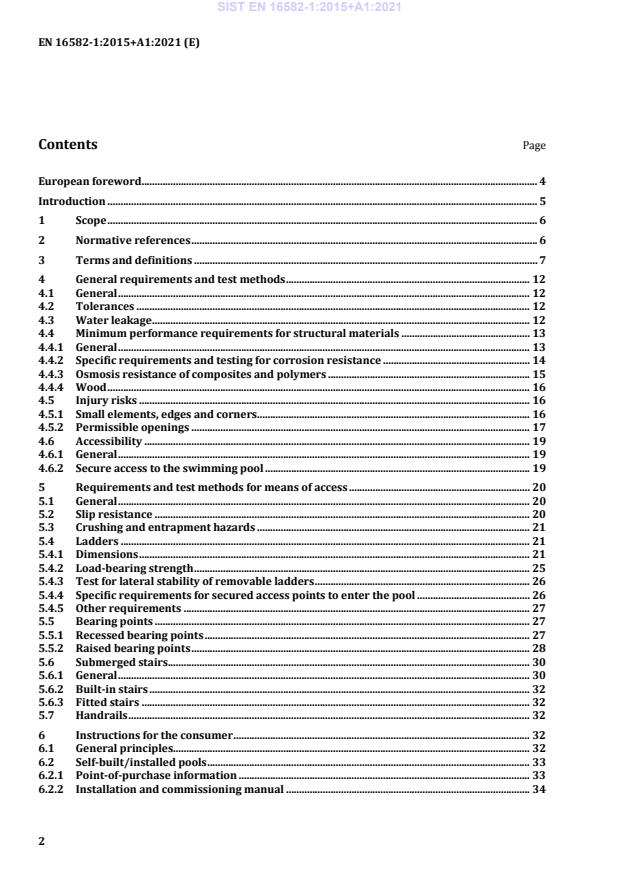
Contents Page
European foreword . 4
Introduction . 5
1 Scope . 6
2 Normative references . 6
3 Terms and definitions . 7
4 General requirements and test methods . 12
4.1 General . 12
4.2 Tolerances . 12
4.3 Water leakage . 12
4.4 Minimum performance requirements for structural materials . 13
4.4.1 General . 13
4.4.2 Specific requirements and testing for corrosion resistance . 14
4.4.3 Osmosis resistance of composites and polymers . 15
4.4.4 Wood . 16
4.5 Injury risks . 16
4.5.1 Small elements, edges and corners . 16
4.5.2 Permissible openings . 17
4.6 Accessibility . 19
4.6.1 General . 19
4.6.2 Secure access to the swimming pool . 19
5 Requirements and test methods for means of access . 20
5.1 General . 20
5.2 Slip resistance . 20
5.3 Crushing and entrapment hazards . 21
5.4 Ladders . 21
5.4.1 Dimensions . 21
5.4.2 Load-bearing strength . 25
5.4.3 Test for lateral stability of removable ladders . 26
5.4.4 Specific requirements for secured access points to enter the pool . 26
5.4.5 Other requirements . 27
5.5 Bearing points . 27
5.5.1 Recessed bearing points . 27
5.5.2 Raised bearing points . 28
5.6 Submerged stairs. 30
5.6.1 General . 30
5.6.2 Built-in stairs . 32
5.6.3 Fitted stairs . 32
5.7 Handrails . 32
6 Instructions for the consumer . 32
6.1 General principles . 32
6.2 Self-built/installed pools . 33
6.2.1 Point-of-purchase information . 33
6.2.2 Installation and commissioning manual . 34
6.2.3 Operating and maintenance manual . 34
6.3 Constructed / installed pools by professionals . 34
6.3.1 Point-of-purchase information . 34
6.3.2 Operating and maintenance manual . 35
6.4 Means of access . 35
6.4.1 Point-of-purchase information . 35
6.4.2 Operating and maintenance manual . 36
6.5 Examples illustrating pool sizes . 37
7 Safety signage . 39
Annex A (informative) Swimming pool structures . 41
Annex B (informative) Safety information in the owner’s manual and instruction sheets
accompanying the swimming pool . 43
Annex C (normative) Methods of test for entrapment . 46
C.1 Head and neck entrapment . 46
C.1.1 Apparatus . 46
C.1.2 Test method . 47
C.2 Finger and toe entrapment . 47
C.2.1 Apparatus . 47
C.2.2 Test method . 47
C.3 Foot and hand entrapment . 47
C.3.1 Apparatus . 47
C.3.2 Test method . 48
Annex D (informative) Aesthetic aspects on composite shells . 49
D.1 General . 49
D.2 Scope . 49
D.3 Operating requirements and maintenance . 49
D.3.1 General . 49
D.3.2 Operating requirements . 50
D.3.3 Maintenance . 50
D.3.4 Influence of water quality . 50
D.4 Discolourations and possible origins . 51
D.5 Stains and possible origins . 52
D.6 Repair of the aesthetic coating . 54
D.7 Mechanical disorders affecting only the aesthetic layer . 54
D.7.1 Aesthetic cracks . 54
D.7.2 Surface protuberances . 55
Bibliography . 56
European foreword
This document (EN 16582-1:2015+A1:2021) has been prepared by Technical Committee CEN/TC 402
“Domestic pools and spas”, the secretariat of which is held by AFNOR.
This European Standard shall be given the status of a national standard, either by publication of an
identical text or by endorsement, at the latest by November 2021 and conflicting national standards
shall be withdrawn at the latest by November 2021.
Attention is drawn to the possibility that some of the elements of this document may be the subject of
patent rights. CEN shall not be held responsible for identifying any or all such patent rights.
This document includes Amendment 1 approved by CEN on 11 December 2020.
This document supersedes EN 16582-1:2015.
The start and finish of text introduced or altered by amendment is indicated in the text by tags !".
This document is part of a series of standards dealing with domestic swimming pools which consists of:
— Part 1: General requirements including safety and test methods;
— Part 2: Specific requirements including safety and test methods for inground pools;
— Part 3: Specific requirements including safety and test methods for aboveground pools.
This European Standard has to be read in conjunction with local and national regulations if they exist.
According to the CEN-CENELEC Internal Regulations, the national standards organizations of the
following countries are bound to implement this European Standard: Austria, Belgium, Bulgaria,
Croatia, Cyprus, Czech Republic, Denmark, Estonia, Finland, France, Germany, Greece, Hungary, Iceland,
Ireland, Italy, Latvia, Lithuania, Luxembourg, Malta, Netherlands, Norway, Poland, Portugal, Republic of
North Macedonia, Romania, Serbia, Slovakia, Slovenia, Spain, Sweden, Switzerland, Turkey and the
United Kingdom.
Introduction
This part of EN 16582 specifies requirements including safety and test methods that are generally
applicable to domestic swimming pools. For specific types of pools these requirements are
supplemented or modified by the requirements of specific standards which have been issued as
additional parts of this European Standard.
As specific standards exist, this general standard should not be used alone.
The users of this standard could be either in a Business to consumer (B to C) relationship, such as
constructors, installers, retailers, etc. or in a Business to business (B to B) relationship, such as
manufacturers, suppliers, distributors, etc. Safe products are the basis of the consumers' safety and
therefore, this European Standard should take into account the following topics:
— product safety and performance requirements;
— safe construction and installation,
— safe use, which could include information and red flags for consumers (e.g. “Don’t leave your child
unattended in the pool”).
Special attention should also be paid to environmental aspects, according to CEN Guide 4 (e.g.
minimizing water being wasted, etc.).
1 Scope
This European Standard specifies the general safety and quality requirements and test methods for
domestic swimming pools. These requirements and test methods are applicable to inground,
aboveground or recessed swimming pool structures, including their installation and means of access.
This standard does not apply to:
— pools for public use covered by EN 15288-1;
— spas for domestic or public use;
— paddling pools according to EN 71-8.
2 Normative references
The following documents are referred to in the text in such a way that some or all of their content
constitutes requirements of this document. For dated references, only the edition cited applies. For
undated references, the latest edition of the referenced document (including any amendments) applies.
EN 350-2, Durability of wood and wood-based products - Natural durability of solid wood - Part 2: Guide
to natural durability and treatability of selected wood species of importance in Europe
EN 351-1, Durability of wood and wood-based products - Preservative-treated solid wood - Part 1:
Classification of preservative penetration and retention
EN 335, Durability of wood and wood-based products - Use classes: definitions, application to solid wood
and wood-based products
EN 460, Durability of wood and wood-based products - Natural durability of solid wood - Guide to the
durability requirements for wood to be used in hazard classes
EN 1990:2002, Eurocode - Basis of structural design
!deleted text"
EN 14843:2007, Precast concrete products - Stairs
HD 60364-7-702, Low-voltage electrical installations - Part 7-702: Requirements for special installations
or locations - Swimming pools and fountains
EN ISO 1461, Hot dip galvanized coatings on fabricated iron and steel articles - Specifications and test
methods (ISO 1461)
EN ISO 4628-2, Paints and varnishes - Evaluation of degradation of coatings - Designation of quantity and
size of defects, and of intensity of uniform changes in appearance - Part 2: Assessment of degree of
blistering (ISO 4628-2)
EN ISO 4628-3, Paints and varnishes - Evaluation of degradation of coatings - Designation of quantity and
size of defects, and of intensity of uniform changes in appearance - Part 3: Assessment of degree of rusting
(ISO 4628-3)
EN ISO 9227, Corrosion tests in artificial atmospheres - Salt spray tests (ISO 9227)
CEN/TS 16165, Determination of slip resistance of pedestrian surfaces - Methods of evaluation
ISO 20712-1, Water safety signs and beach safety flags - Part 1: Specifications for water safety signs used
in workplaces and public areas
!EN 16713-3", Domestic swimming pools - Water systems - Part 3: Treatment - Requirements
3 Terms and definitions
For the purposes of this document, the following terms and definitions apply.
ISO and IEC maintain terminological databases for use in standardization at the following addresses:
• IEC Electropedia: available at http://www.electropedia.org/
• ISO Online browsing platform: available at https://www.iso.org/obp
3.1
basin
specific water tank where water-related activities are carried out
3.2
usage class 4 wood
situation where the wood or wood-based product is in contact with the ground or fresh water and
therefore permanently exposed to wetting
3.3
point-of-purchase information
information given to consumer prior to purchase so that they can make informed choices
3.4
swimming pool kit
set of compatible and consistent elements of a swimming pool comprising of the pool or the structure,
the means of access, the filtration and skimming system with hydraulic connections necessary for its
operation, installation and commissioning manual, and the operating and maintenance manual
3.5
inground swimming pool kit
swimming pool kit, designed to be installed in the ground, with structural elements that ensure intrinsic
resistance to internal and external pressures
3.6
aboveground swimming pool kit
swimming pool kit, designed to be placed on the ground or any suitable flat horizontal surface, with
structural elements that ensures intrinsic resistance to internal pressures
3.7
recessed swimming pool kit
swimming pool kit, designed to be installed in the ground, in a masonry structure or equivalent that
ensures resistance to internal and external pressures, if required
3.8
watertightness
degree to which water is prevented from leaking from the pool shell
3.9
liner
removable independent pocket, factory-made from flexible, expandable, plasticized poly(vinyl chloride)
(PVC-P) membranes, capable of achieving a certain level of watertightness
Note 1 to entry: The liner contributes to the watertightness of a swimming pool in the same way as the parts to
be sealed and the pipework.
3.10
coping
independent add-on feature, which forms the total or partial edge of a pool, on its periphery, on the
upper part of the wall
Note 1 to entry: Add-on features with a width greater than or equal to 50 mm are considered as copings.
Note 2 to entry: On some swimming pools, the top coping also functions as the liner lock.
3.11
reinforced membrane
composite made of various thermoplastic sheets, applied on a layer comprising a reinforcement
3.12
membrane
sheet made of calendered or extruded, waterproof and gas-pervious, plasticized poly(vinyl chloride)
(PVC-P), packaged in rolls, for use in the manufacture of swimming pool liners
3.13
operating and maintenance manual
operating guide and common recommendations on use for safety and maintenance
3.14
installation and commissioning manual
document indicating the various installation and commissioning operations
3.15
frame work
all of the resistant parts that support and/or reinforce the wall in view of forming the peripheral
structure
3.16
tool
hand held device that can be used to secure, perform or facilitate mechanical operations
Note 1 to entry: A screw driver, key or coin are considered as tools.
3.17
pool wall
generally upright structure serving to enclose or divide water, or to protect an area
3.18
parts to be embedded
equipment, fixed firmly into the surrounding structure, mainly in the pool that have the specific
functions such as water circulation/filtration, lighting, counter-current swimming devices, sound
system, air injection, alarm sensors, cameras, portholes, etc.
3.19
swimming pool (pool)
artificial basin, where water is filtered being disinfected and retains continuous residual disinfection
properties, renewed and recycled, as well as all of the equipment strictly necessary for its operation
capable of achieving a certain level of watertightness
3.20
structure
part, or assembly of parts, designed to support loads and provide a sufficient degree of rigidity
[SOURCE: EN 1990:2002, modified]
Note 1 to entry: The structure guarantees the stability and cohesion of a pool.
Note 2 to entry: The "coping" is considered only if it contributes to the strength of the structure.
3.21
effective volume of water
capacity of the pool tank guaranteed by the manufacturer and determined from the water depth
recommended by the manufacturer
3.22
means of access
design feature to facilitate entry to and/or exit from the basin
3.23
tread
horizontal component or upper surface of a step
3.24
step
part of the stairs, or of a ladder, consisting of a tread and possibly a riser
[SOURCE: EN 14843:2007, modified]
3.25
platform
upper, horizontal tread, connecting the two legs of a ladder
3.26
ladder
structure used for entering and exiting the water, formed from rails connected by steps or treads,
and/or platform(s)
3.27
stair
succession of horizontal stages (steps or landings) which makes it possible to pass on foot to other
levels
[SOURCE: EN 14843:2007, modified]
3.28
pool handrail
design feature to be gripped or grasped intended to assist the user to balance, to enter, to move around
and/or to get out of the water
3.29
grip
holding of the hand around the entire circumference of a support
Note 1 to entry: See Figure 1.
Note 2 to entry: See Table 6.
[SOURCE: !EN 1176-1:2017, 3.16", modified - Note to entry has been added.]
Figure 1 — Grip
3.30
grasp
holding of the hand around part of the circumference of a support
Note 1 to entry: See Figure 2.
Note 2 to entry: See Table 6.
[SOURCE: !EN 1176-1:2017, 3.17", modified - Note to entry has been added.]
Figure 2 — Grasp
3.31
thermosetting polymer shell
main element of the prefabricated swimming pool (generally a polyester shell), that is a homogeneous
structure, which is watertight and whose function is to contain the water
3.32
entrapment
hazard presented by the situation in which a body, or part of a body, or clothing can become trapped
Note 1 to entry: Entrapment is only considered where the user is not able to free himself/herself.
3.33
laminated polyester or composite materials
polymeric materials jointly implemented to form a shell structure serving as pool, coating and
watertightness
3.34
chemical barrier layer
technical resin layer immediately under the aesthetic layer, reinforced or not
3.35
aesthetic layer (coating)
surface in contact with water, generally a resin
Note 1 to entry: Its use is limited to pools whose temperature is lower or equal to 28 °C unless otherwise
specified by the manufacturer.
3.36
aesthetic disorders
staining, stain rings, discoloration due to an aggressive chemical water treatment product or
physicochemical parameters of water
3.37
water treatment
use of chemical products and / or processes associated with filtration ensuring clean and healthy water
Note 1 to entry: The water treatment ensures water quality suitable for swimming according to the series
!EN 16713".
3.38
adult supervisor(s)
parent or responsible adult appointed by a parent
3.39
deck
fitted surface, contiguous to pool
Note 1 to entry: The loose ground (grass, sand, etc.) is not considered as part of the deck.
4 General requirements and test methods
4.1 General
In use, installed according to the installation and commissioning manual, the swimming pool shall meet
the requirements of this document.
If the pool structure includes any water system covered by the !EN 16713 series", the EN 16582
series shall be read in conjunction with the !EN 16713 series".
Assembled in accordance with the installation and commissioning manual, the electrical installation
of any material related to the pool and its surrounding shall also comply with the requirements of
HD 60364-7-702 or valid national requirements.
NOTE 1 HD 60364-7-702 applies only for fixed installations.
When a membrane is used as a watertight system, it is not mandatory to have a minimum thickness,
however any relevant standards shall apply if they exist.
NOTE 2 For PVCP membrane, EN 15836-1 or EN 15836-2 could apply.
NOTE 3 For composition requirements, the professionals’ attention is drawn to the change in the regulations in
particular concerning the possible risks inherent with the use of heavy metals.
All manufacturers are required to carry out, either internally or via a test laboratory, the tests
mentioned in Clause 4 for each new or revised material process.
4.2 Tolerances
The indicated dimensions and measurements are given with a tolerance of ± 3% (unless otherwise
indicated).
4.3 Water leakage
Wherever possible, swimming pools should be built so that they are watertight, as leakage and other
water losses may affect the building and surrounding properties.
The maximum leakage is specified in Table 1.
Once installed, the swimming pool shall be watertight according to one of the classes of Table 1 as
stated in the point of sale information.
Table 1 — Watertightness classification
Tightness Class Maximum leakage
litre per m per day or
mm per day
W 0
W 1
W2 2
W 3
The measurement of any water loss should be carried out over a period of 7 days.
The drop in water level excludes evaporation losses, bathing activity, the temperature and humidity
throughout the test period (and in the case of outdoor pools, the degree of exposure of the site to wind
and sunshine).
Once installed, the swimming pool pipework shall be watertight according to class W of Table 1.
If applicable, the balance tank shall meet the minimum watertightness classification of the swimming
pool.
4.4 Minimum performance requirements for structural materials
4.4.1 General
The structural design and materials shall be in accordance with accepted structural engineering
practices.
Any combination of different materials in direct contact with each other shall be compatible and not
negatively affect each other’s properties or structural integrity.
The requirements of this section do not apply to non-structural elements of the swimming pool,
including, but not limited to, elements with solely decorative function. When the swimming pool water
affects the resistance of the structural material, the requirements for water quality shall be stated and
accompany the affected materials.
The parameters mentioned in document !EN 16713-3" shall be met. In addition, there shall be no
influence on the water quality according to !EN 16713-3", if the material comes into contact with
the pool water.
Selection of materials for the construction of the swimming pool shall be conducted under
consideration of external influences, including but not limited to temperature, UV, chemicals (under
normal conditions of use) etc., when appropriate, that may influence their structural integrity.
EXAMPLE Materials used for the pool construction and lining are given in Table 2 and Table 3.
Table 2
Pool construction
PVC
PVC reinforced membrane (above ground
pool)
Concrete
Styrofoam Formstone
GRP one piece pool
Composite construction
Polypropylene
Steel panels
Aluminium panels
Steel & Aluminium support frames
Stainless Steel
Glass (complete or min. one side / wall)
Wood
Brick wall construction (expanded
polystyrene, …)
Table 3
Pool lining
Concrete
Liner
Tiles
Coating
GRP
PVC
Stainless steel
Glass
Natural stone
Polypropylene (PP)
Painting
Mineral coat
PVC reinforced membrane
4.4.2 Specific requirements and testing for corrosion resistance
Any material that may be affected by corrosion (including but not limited to steel, stainless steel,
aluminium and other metallic materials) and utilized for the construction of the swimming pool shall be
treated for corrosion resistance, if applicable, and shall meet any of the following minimum
requirements, as applicable.
The tested metal parts shall be assembled according to the installation instructions.
The tests are conducted according to EN ISO 9227 on all metal parts, coated (organic or inorganic
coating) or not coated, contributing to the resistance of the structure's constitutive elements.
The following are excluded:
— elements having only decorative functions;
— elements embedded and/or fixed in concrete provided that they are commercial products
commonly used in masonry constructions;
— all non-structural elements;
— hot-galvanized parts with a surface treatment thickness of ≥ 50 µm or prescriptions given in
EN ISO 1461
NOTE Hot-galvanized parts with a surface treatment thickness of ≥ 50 µm which correspond more or less to
375 g/m .
In accordance with EN ISO 9227, subject the structure samples to be tested to salt spray for:
— 192 h for aboveground and recessed swimming pool kits for the parts above the ground;
— 192 h for inground and/or recessed swimming pool kits for the parts in the ground and whose
parts to be tested are ≥ 3 mm;
— 400 h for inground and/or recessed swimming pool kits for the parts in the ground and whose
parts to be tested are < 3 mm.
On completion of these corrosion tests, all of the products shall meet the visual requirements described
below:
— red oxidation: assess the results obtained on steel parts, coated or not, referring to the
recommendations of EN ISO 4628-3. The number of red rust pits on the surface shall conform to
grade RI 3 or lower;
— white oxidation is accepted on zinc-galvanised, electrogalvanised or bichromated parts;
— green oxidation is accepted on material including copper;
— brown oxidation is accepted on stainless steel;
— the degree of blistering of organic coatings shall not exceed density 2, and the size of any blister
shall not exceed size 3 as defined in EN ISO 4628-2.
4.4.3 Osmosis resistance of composites and polymers
Dip a 150 mm x 100 mm test sample, immersed to half its height, in distilled water at a constant
temperature of 60 °C for 15 d.
Protect the sample on its edges and its rear face, to avoid contact with water.
On completion of this test, no blister (i.e. density 0), porosity, cracking or fibre prominence, shall be
detected on the surface after testing, compared to a control specimen as defined in EN ISO 4628-2.
Only the manufacturer is concerned with this test method which shall be applied for each new
manufacturing process. This test is only applicable before installation of the product for the end user.
A longer test period may validate a higher integrity of the polymer.
For polyester shells, refer to Annex D for additional requirements.
4.4.4 Wood
Structural elements made of wood or wood-based material shall meet the requirements of use class 4
according to EN 335.
Compatible woods may be chosen according to two distinct approaches:
— using naturally durable woods (excluding sapwood) as defined in EN 350-2, that meet the
requirements for use in applicable hazard classes in EN 460.
— using wood with conferred durability (preservation treatments while conserving the sapwood),
that meets the requirements for use in applicable hazard classes in EN 351-1.
To achieve the parameters stated in !EN 16713-3", the water treatment has to be adjusted in the
case of wooden material in contact with the water.
4.5 Injury risks
4.5.1 Small elements, edges and corners
When the swimming pool is being used, any protrusion on accessible parts liable to present a risk of
injury shall be protected by a method which in order to be removed, requires the use of a tool or a
minimum amount of force of 60 N, with an accuracy of 2 N.
During the installation, equipment made of wood, fibreglass, or other materials shall be free of splinters.
Small accessible and grippable elements shall not fully enter into the template shown in Figure 3
(EN 71-1) or they shall be fixed to the item to which they belong such that they cannot be detached
under a force of 60 N, with an accuracy of 2 N, applied in any direction whatsoever.
Dimensions in millimetres
Figure 3 — Template for small elements
All edges, protruding parts and corners accessible without use of tools or minimum amount of force of
60 N (±2N) shall be designed not to cause any injury. When necessary they shall be treated
appropriately to remove this risk (see Figure 4).
For example, edges can be bevelled or rounded, and surfaces shall be smooth and free from burrs.
Examples are provided in Figure 4. If they are due to a wall thickness lower than 4 mm, one of the
following requirements applies:
— they shall be folded, rolled or wound in spirals according to Figure 4 d);
— they shall be protected by a plastic coating or by any other suitable means as shown in Figure 4 e).
Dimensions in millimetres
Figure 4 — Examples of configuration of edges
4.5.2 Permissible openings
4.5.2.1 Principle
To prevent entrapment hazards inside the pool structure, accessible openings with the lowest point
located beyond 500 mm below the water surface shall be restricted to the range of opening or gap size
dimensions specified in 4.5.2.2 to 4.5.2.4, unless specifically permitted in other clauses/annexes of this
standard and/or parts of this standard series.
Test methods for entrapment are given in Annex C.
If the depth of penetration (see 'a' in Figure 5) is less than 10 mm, no requirements apply.
Figure 5 — Depth of penetration less than 10 mm
Key
a maximum depth penetration : ≤ 10 mm
4.5.2.2 Finger and toe entrapment
Where there is a risk of finger or toe entrapment, the permissible opening shall be ≤ 8 mm or ≥ 25 mm.
4.5.2.3 Head and neck entrapment
Where there is a risk of head or neck entrapment, the permissible opening shall be ≤ 110 mm or ≥ 230
mm.
Where an opening is ≥ 230 mm it should not permit passage to further entrapment hazards.
Where there is a combination of risks, the lesser of the permitted opening sizes shall be used.
4.5.2.4 Other body entrapment
Other permissible openings include the range between 25 mm and 110 mm. When such openings are
used for construction or installation reasons, the installer shall alert their customer of a potential risk of
entrapment.
4.6 Accessibility
4.6.1 General
The risk of drowning for children (especially under 5 years) is high and reasonably predictable, either
during the bathing period or at other times. Therefore it is recommended for adult supervisors to:
— secure the means of access to the swimming pool; or
— install a protection device; and
— keep the children under constant supervision.
For pools relying on a specific means of egress such means shall not be removed when the pool is in use.
4.6.2 Secure access to the swimming pool
The access to the above ground pools or partially buried pools (coming from outside to inside the pool)
can be secured by using a safe access according to the requirements stated in 5.4.4. Moreover the
swimming pool shall be designed such that, once installed, unauthorised access to the pool for children
(especially those under the age of five years) by striding over/climbing over is limited. The secure
access to the basin is met when:
— the height between the highest bearing point (according to the requirements stated in 5.5) and the
upper level of the finished pool is greater than or equal to 1 100 mm or;
— the height between the ground and the lowest bearing point (according to the requirements stated
in 5.5) is greater than or equal to 1 100 mm, or;
— the height between two consecutive bearing points (according to the requirements stated in 5.5) is
greater than 1 100 mm.
If:
— the above requirement is not satisfied and/or
— the means of access according to the requirements stated in 5.4.4 is not safe; or
— no means of access is provided with the swimming pool.
Then the manufacturer of the swimming pool shall recommend that the access to the finished
swimming pool should be secured by a protection device to prevent children drowning.
To prevent children drowning, inground pool manufacturers shall also recommend to secure the access
to the finished pool with a protection device. The following warning "In order to prevent children from
drowning, it is recommended to secure the access to the pool with a protection device" shall be present
for the consumer in the information before purchase and in the safety instructions.
EXAMPLE Protection devices to secure the access to the swimming pool can be fences, safety covers,
enclosures, etc.
NOTE Securing the boundary of the property may be an acceptable way of preventing unauthorized access to
the pool.
5 Requirements and test methods for means of access
5.1 General
All means of access shall fulfil the material requirements of 4.4, if applicable.
Swimming pools intended solely for aboveground installation with a wall height exceeding 850 mm
shall be installed with a means of access.
When such mean of access is a pool ladder, then it shall meet the ladder design requirements in 5.4 and
the safe access requirements in 4.6.
Pools intended for multiple types of installation shall include a specification or recommendation for
appropriate means of access.
5.2 Slip resistance
The risk of a slipping accident in a domestic pool is low, due to the following reasons:
— Easily accessible information for users (Annex B);
— Close and permanent adult supervision required (Annex B);
— Reduced number of simultaneous users.
The slip resistance requirements only refer to wa
...