

EN 26:2023
(Main)Gas-fired instantaneous water heaters for the production of domestic hot water
- Abstract
This European Standard defines the specifications and test methods concerning the construction, safety, rational use of energy and fitness for purpose, and also the classification and marking of gas-fired instantaneous water heaters for sanitary uses, hereafter called “water heaters”.
This European Standard applies to water heaters:
- of types AAS, B11, B11BS, B12, B12BS, B13, B13BS, B14, B22, B23, B32, B33, B44, B52, B53, C11, C12, C13, C21, C22, C23, C32, C33, C42, C43, C52, C53, C62, C63, C72, C73, C82and C83 according to CEN/TR 1749;
- fitted with atmospheric burners;
- equipped with atmospheric burners assisted by a fan for the supply of combustion air or evacuation of combustion products or fully premix burners;
- using one or more combustible gases corresponding to the three gas families and at the pressures stated in accordance to EN 437;
- of nominal heat input not exceeding 70 kW;
- with an ignition burner or with direct ignition of the main burner.
In this European Standard, the heat inputs are expressed in relation to the net calorific value (Hi).
This European Standard does not contain all the requirements necessary for:
- boiling water appliances;
- appliances intended to be connected to a mechanical means of evacuating the combustion products;
- appliances which fulfil a dual role of space heating and heating water for sanitary use;
- appliances making use of the heat of condensation of the water contained in the combustion products;
- water heaters of types B21, B31, B41, B42, B43 and B51.
This European Standard only covers water heaters where the fan, if any, is an integral part of the appliance.
This European Standard:
- does not apply to appliances not intended to be connected to a flue when they are not fitted with an atmosphere sensing device;
- takes account of the information given in Technical Report CEN/CR 1472:1994 with respect to marking.
Type B appliances should be with a combustion products discharge safety device to comply with essential requirement 3.4.3 of the Gas Appliances Directive 2009/142/EC. In this European Standard, the appliance is identified as type B11BS.
Appliances intended to be installed outdoors or in a room separate from inhabited rooms and provided with appropriate ventilation are not required to have this combustion products discharge safety device but, in this case, appropriate warnings on the packaging, and in the instructions should clearly define the limited authorized use for this type of appliance. In this European Standard, the appliance is identified as type B11.
The main symbols used in this European Standard are summarized in Annex F.
- Status
- Published
- Publication Date
- 19-Dec-2023
- Withdrawal Date
- 08-Jan-2023
- Technical Committee
- CEN/TC 48 - Domestic gas-fired water heaters
- Drafting Committee
- CEN/TC 48/WG 1 - Revision of EN 26
- Current Stage
- 6060 - Definitive text made available (DAV) - Publishing
- Start Date
- 20-Dec-2023
- Due Date
- 07-Jan-2022
- Completion Date
- 20-Dec-2023

Overview
EN 26:2023 - Gas-fired instantaneous water heaters for the production of domestic hot water is the updated European standard that specifies construction, safety, energy-use and fitness-for-purpose requirements, plus classification and marking for gas-fired instantaneous (flow) water heaters used for sanitary hot water. It applies to a wide range of appliance categories (types AAS, B11…C83 according to CEN/TR 1749) with nominal heat input up to 70 kW and heat inputs expressed relative to net calorific value (Hi). The standard covers appliances with atmospheric, fan-assisted atmospheric or fully premix burners using gases defined by EN 437.
Key topics & technical requirements
- Scope & classification
- Appliance categories and installation/venting modes (type A, B, C variants).
- Gas families and test pressures per EN 437.
- Constructional requirements
- Materials (including those in contact with potable water), durability, corrosion resistance and flue duct specifications.
- Accessibility for maintenance, disassembly, recycling and safe installation of integral fans (fan must be an integral part of the appliance).
- Control, adjustment & safety devices
- Gas shut-off and pressure regulation, ignition systems, flame supervision and atmosphere sensing.
- Combustion products discharge safety device requirements for type B (e.g., B11BS) to meet the essential requirements of the Gas Appliances Directive 2009/142/EC.
- Operational & test methods
- Soundness (gas, combustion and water circuits), heat input tests (nominal and minimum), ignition, cross-lighting, flame stability and fan-operation tests.
- Combustion performance and emissions testing (CO and NOx considerations) and limits referenced in the standard.
- Special topics
- Condensing appliances and condensate handling are addressed in supplementary clauses; however, certain condensation-based applications and other appliance types (e.g., boiling water appliances, appliances for mechanical flue evacuation, dual space/water heaters) are either excluded or require additional requirements.
- Marking & documentation
- Labelling, instructions and warnings (including guidance from CEN/CR 1472).
Practical applications & users
Who uses EN 26:2023:
- Manufacturers and product designers ensuring compliance for gas-fired instantaneous water heaters.
- Test laboratories and certification bodies conducting type and conformity testing.
- Specifiers, installers and building services engineers selecting compliant units for residential and commercial sanitary hot water systems.
- Regulators and market surveillance authorities enforcing safety, energy efficiency and emission requirements.
Practical benefits:
- Ensures safe operation, reliable ignition and flame control.
- Defines testable criteria for energy performance and emissions.
- Provides a clear classification and marking framework for market access across Europe.
Related standards & references
- EN 26:2023 (identical text)
- EN 437 (test gases and pressures)
- CEN/TR 1749 (appliance type classification)
- CEN/CR 1472 (marking guidance)
- Gas Appliances Directive 2009/142/EC (essential safety requirements)
Keywords: EN 26:2023, gas-fired instantaneous water heaters, domestic hot water, EN 437, appliance classification, safety testing, energy efficiency, combustion emissions.
Relations
- Effective Date
- 19-Jan-2023
- Effective Date
- 25-Aug-2026
- Effective Date
- 25-Aug-2026
- Refers
ISO 262:1998 - ISO general purpose metric screw threads — Selected sizes for screws, bolts and nuts - Effective Date
- 25-Aug-2026
- Effective Date
- 25-Aug-2026
- Effective Date
- 25-Aug-2026
- Effective Date
- 09-Feb-2026
- Effective Date
- 09-Feb-2026
- Effective Date
- 09-Feb-2026
- Effective Date
- 09-Feb-2026
- Effective Date
- 09-Feb-2026
- Refers
ISO 188:2011 - Rubber, vulcanized or thermoplastic — Accelerated ageing and heat resistance tests - Effective Date
- 09-Feb-2026
- Effective Date
- 09-Feb-2026
- Effective Date
- 09-Feb-2026
- Effective Date
- 28-Jan-2026
Get Certified
Connect with accredited certification bodies for this standard

DIBt (Deutsches Institut für Bautechnik)
German Institute for Building Technology.
DIN CERTCO
DIN Group product certification.

Aboma Certification B.V.
Specialized in construction, metal, and transport sectors.
Sponsored listings
Frequently Asked Questions
EN 26:2023 is a standard published by the European Committee for Standardization (CEN). Its full title is "Gas-fired instantaneous water heaters for the production of domestic hot water". This standard covers: This European Standard defines the specifications and test methods concerning the construction, safety, rational use of energy and fitness for purpose, and also the classification and marking of gas-fired instantaneous water heaters for sanitary uses, hereafter called “water heaters”. This European Standard applies to water heaters: - of types AAS, B11, B11BS, B12, B12BS, B13, B13BS, B14, B22, B23, B32, B33, B44, B52, B53, C11, C12, C13, C21, C22, C23, C32, C33, C42, C43, C52, C53, C62, C63, C72, C73, C82and C83 according to CEN/TR 1749; - fitted with atmospheric burners; - equipped with atmospheric burners assisted by a fan for the supply of combustion air or evacuation of combustion products or fully premix burners; - using one or more combustible gases corresponding to the three gas families and at the pressures stated in accordance to EN 437; - of nominal heat input not exceeding 70 kW; - with an ignition burner or with direct ignition of the main burner. In this European Standard, the heat inputs are expressed in relation to the net calorific value (Hi). This European Standard does not contain all the requirements necessary for: - boiling water appliances; - appliances intended to be connected to a mechanical means of evacuating the combustion products; - appliances which fulfil a dual role of space heating and heating water for sanitary use; - appliances making use of the heat of condensation of the water contained in the combustion products; - water heaters of types B21, B31, B41, B42, B43 and B51. This European Standard only covers water heaters where the fan, if any, is an integral part of the appliance. This European Standard: - does not apply to appliances not intended to be connected to a flue when they are not fitted with an atmosphere sensing device; - takes account of the information given in Technical Report CEN/CR 1472:1994 with respect to marking. Type B appliances should be with a combustion products discharge safety device to comply with essential requirement 3.4.3 of the Gas Appliances Directive 2009/142/EC. In this European Standard, the appliance is identified as type B11BS. Appliances intended to be installed outdoors or in a room separate from inhabited rooms and provided with appropriate ventilation are not required to have this combustion products discharge safety device but, in this case, appropriate warnings on the packaging, and in the instructions should clearly define the limited authorized use for this type of appliance. In this European Standard, the appliance is identified as type B11. The main symbols used in this European Standard are summarized in Annex F.
This European Standard defines the specifications and test methods concerning the construction, safety, rational use of energy and fitness for purpose, and also the classification and marking of gas-fired instantaneous water heaters for sanitary uses, hereafter called “water heaters”. This European Standard applies to water heaters: - of types AAS, B11, B11BS, B12, B12BS, B13, B13BS, B14, B22, B23, B32, B33, B44, B52, B53, C11, C12, C13, C21, C22, C23, C32, C33, C42, C43, C52, C53, C62, C63, C72, C73, C82and C83 according to CEN/TR 1749; - fitted with atmospheric burners; - equipped with atmospheric burners assisted by a fan for the supply of combustion air or evacuation of combustion products or fully premix burners; - using one or more combustible gases corresponding to the three gas families and at the pressures stated in accordance to EN 437; - of nominal heat input not exceeding 70 kW; - with an ignition burner or with direct ignition of the main burner. In this European Standard, the heat inputs are expressed in relation to the net calorific value (Hi). This European Standard does not contain all the requirements necessary for: - boiling water appliances; - appliances intended to be connected to a mechanical means of evacuating the combustion products; - appliances which fulfil a dual role of space heating and heating water for sanitary use; - appliances making use of the heat of condensation of the water contained in the combustion products; - water heaters of types B21, B31, B41, B42, B43 and B51. This European Standard only covers water heaters where the fan, if any, is an integral part of the appliance. This European Standard: - does not apply to appliances not intended to be connected to a flue when they are not fitted with an atmosphere sensing device; - takes account of the information given in Technical Report CEN/CR 1472:1994 with respect to marking. Type B appliances should be with a combustion products discharge safety device to comply with essential requirement 3.4.3 of the Gas Appliances Directive 2009/142/EC. In this European Standard, the appliance is identified as type B11BS. Appliances intended to be installed outdoors or in a room separate from inhabited rooms and provided with appropriate ventilation are not required to have this combustion products discharge safety device but, in this case, appropriate warnings on the packaging, and in the instructions should clearly define the limited authorized use for this type of appliance. In this European Standard, the appliance is identified as type B11. The main symbols used in this European Standard are summarized in Annex F.
EN 26:2023 is classified under the following ICS (International Classification for Standards) categories: 91.140.65 - Water heating equipment. The ICS classification helps identify the subject area and facilitates finding related standards.
EN 26:2023 has the following relationships with other standards: It is inter standard links to EN 26:2015, ISO 301:2006, ISO 6914:2013, ISO 262:1998, ISO 815-1:2019, ISO 1817:2015, ISO 2781:2018, EN 60335-2-102:2016, EN 60529:1991, EN IEC 60730-2-9:2019, EN 60335-1:2012, ISO 188:2011, ISO 7619-1:2010, ISO 37:2017, EN ISO 527-1:2019. Understanding these relationships helps ensure you are using the most current and applicable version of the standard.
EN 26:2023 is associated with the following European legislation: EU Directives/Regulations: 2016/426, 812/2013, 814/2013; Standardization Mandates: M/534, M/535, M/BC/CEN/89/6. When a standard is cited in the Official Journal of the European Union, products manufactured in conformity with it benefit from a presumption of conformity with the essential requirements of the corresponding EU directive or regulation.
EN 26:2023 is available in PDF format for immediate download after purchase. The document can be added to your cart and obtained through the secure checkout process. Digital delivery ensures instant access to the complete standard document.
Standards Content (Sample)
SLOVENSKI STANDARD
01-september-2024
Nadomešča:
SIST EN 26:2015
Pretočni plinski grelniki vode za pripravo tople sanitarne vode
Gas-fired instantaneous water heaters for the production of domestic hot water
Gasbeheizte Durchlauf-Wasserheizer für den sanitären Gebrauch
Appareils de production instantanée d'eau chaude pour usages sanitaires utilisant les
combustibles gazeux
Ta slovenski standard je istoveten z: EN 26:2023
ICS:
91.140.65 Oprema za ogrevanje vode Water heating equipment
97.100.20 Plinski grelniki Gas heaters
2003-01.Slovenski inštitut za standardizacijo. Razmnoževanje celote ali delov tega standarda ni dovoljeno.
EN 26
EUROPEAN STANDARD
NORME EUROPÉENNE
December 2023
EUROPÄISCHE NORM
ICS 91.140.65 Supersedes EN 26:2015
English Version
Gas-fired instantaneous water heaters for the production
of domestic hot water
Appareils de production instantanée d'eau chaude Gasbeheizte Durchlauf-Wasserheizer für den sanitären
pour usages sanitaires utilisant les combustibles Gebrauch
gazeux
This European Standard was approved by CEN on 8 May 2022.
CEN members are bound to comply with the CEN/CENELEC Internal Regulations which stipulate the conditions for giving this
European Standard the status of a national standard without any alteration. Up-to-date lists and bibliographical references
concerning such national standards may be obtained on application to the CEN-CENELEC Management Centre or to any CEN
member.
This European Standard exists in three official versions (English, French, German). A version in any other language made by
translation under the responsibility of a CEN member into its own language and notified to the CEN-CENELEC Management
Centre has the same status as the official versions.
CEN members are the national standards bodies of Austria, Belgium, Bulgaria, Croatia, Cyprus, Czech Republic, Denmark, Estonia,
Finland, France, Germany, Greece, Hungary, Iceland, Ireland, Italy, Latvia, Lithuania, Luxembourg, Malta, Netherlands, Norway,
Poland, Portugal, Republic of North Macedonia, Romania, Serbia, Slovakia, Slovenia, Spain, Sweden, Switzerland, Türkiye and
United Kingdom.
EUROPEAN COMMITTEE FOR STANDARDIZATION
COMITÉ EUROPÉEN DE NORMALISATION
EUROPÄISCHES KOMITEE FÜR NORMUNG
CEN-CENELEC Management Centre: Rue de la Science 23, B-1040 Brussels
© 2023 CEN All rights of exploitation in any form and by any means reserved Ref. No. EN 26:2023 E
worldwide for CEN national Members.
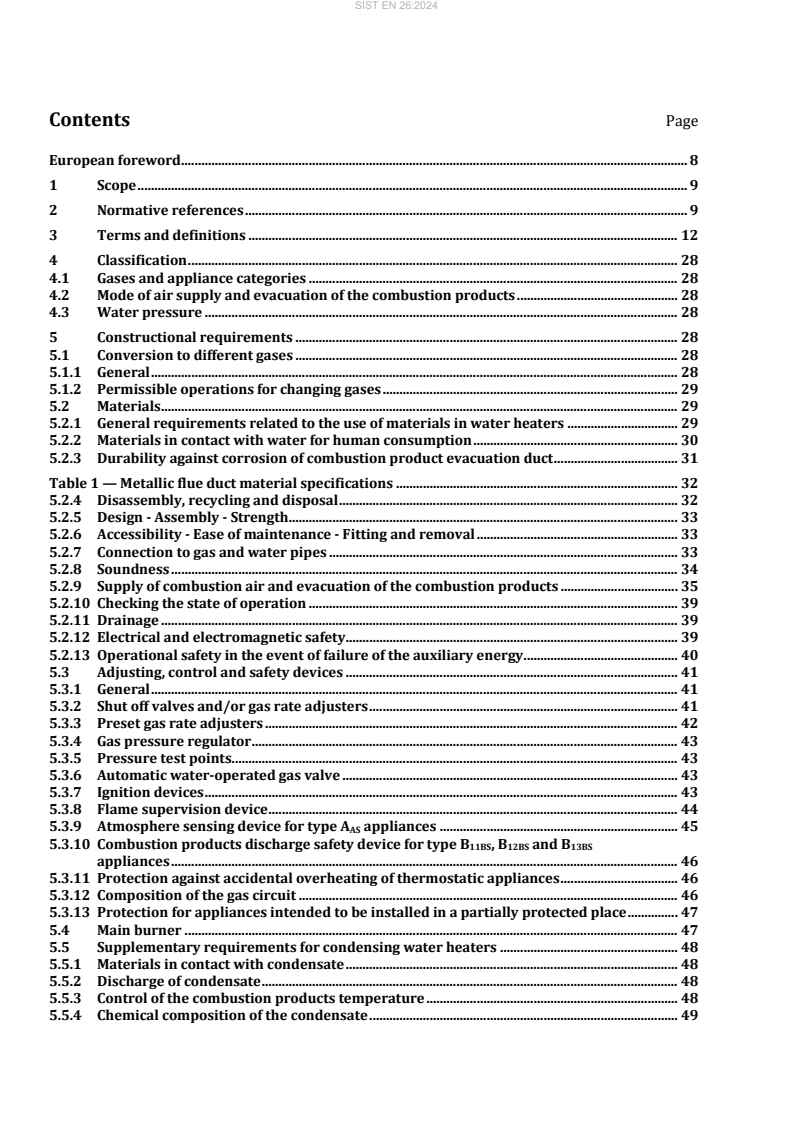
Contents Page
European foreword . 8
1 Scope . 9
2 Normative references . 9
3 Terms and definitions . 12
4 Classification . 28
4.1 Gases and appliance categories . 28
4.2 Mode of air supply and evacuation of the combustion products . 28
4.3 Water pressure . 28
5 Constructional requirements . 28
5.1 Conversion to different gases . 28
5.1.1 General . 28
5.1.2 Permissible operations for changing gases . 29
5.2 Materials . 29
5.2.1 General requirements related to the use of materials in water heaters . 29
5.2.2 Materials in contact with water for human consumption . 30
5.2.3 Durability against corrosion of combustion product evacuation duct . 31
Table 1 — Metallic flue duct material specifications . 32
5.2.4 Disassembly, recycling and disposal . 32
5.2.5 Design - Assembly - Strength . 33
5.2.6 Accessibility - Ease of maintenance - Fitting and removal . 33
5.2.7 Connection to gas and water pipes . 33
5.2.8 Soundness . 34
5.2.9 Supply of combustion air and evacuation of the combustion products . 35
5.2.10 Checking the state of operation . 39
5.2.11 Drainage . 39
5.2.12 Electrical and electromagnetic safety . 39
5.2.13 Operational safety in the event of failure of the auxiliary energy . 40
5.3 Adjusting, control and safety devices . 41
5.3.1 General . 41
5.3.2 Shut off valves and/or gas rate adjusters . 41
5.3.3 Preset gas rate adjusters . 42
5.3.4 Gas pressure regulator . 43
5.3.5 Pressure test points. 43
5.3.6 Automatic water-operated gas valve . 43
5.3.7 Ignition devices . 43
5.3.8 Flame supervision device . 44
5.3.9 Atmosphere sensing device for type A appliances . 45
AS
5.3.10 Combustion products discharge safety device for type B , B and B
11BS 12BS 13BS
appliances . 46
5.3.11 Protection against accidental overheating of thermostatic appliances . 46
5.3.12 Composition of the gas circuit . 46
5.3.13 Protection for appliances intended to be installed in a partially protected place . 47
5.4 Main burner . 47
5.5 Supplementary requirements for condensing water heaters . 48
5.5.1 Materials in contact with condensate . 48
5.5.2 Discharge of condensate . 48
5.5.3 Control of the combustion products temperature . 48
5.5.4 Chemical composition of the condensate . 49
6 Operational requirements . 49
6.1 General . 49
6.1.1 Introduction. 49
6.1.2 Characteristics of the test gases . 49
6.1.3 Requirements for preparation of the test gases . 49
6.1.4 Choice of test gases . 49
6.1.5 Test pressures . 49
6.1.6 General test conditions . 49
6.2 Soundness . 54
6.2.1 Soundness of the gas circuit . 54
6.2.2 Soundness of the combustion circuit and evacuation of the combustion products . 55
Table 2 — Maximum admissible leakage rates . 57
6.2.3 Soundness of the water circuit. 61
6.3 Heat inputs . 61
6.3.1 General . 61
6.3.2 Nominal heat input. 63
6.3.3 Minimum heat input . 64
6.4 Temperature of the control knobs . 64
6.4.1 Requirements . 64
6.4.2 Test . 64
6.5 Temperature of the adjusting, control and safety devices . 64
6.5.1 Requirement . 64
6.5.2 Test . 64
6.6 Temperature of the appliance casing, the surface on which it is installed and
adjacent surfaces and external temperature of the ducts . 64
6.6.1 Requirements . 64
6.6.2 Tests . 65
6.7 Ignition - Cross-lighting - Flame stability . 66
6.7.1 Operation in still air for all appliances . 66
6.7.2 Supplementary tests for appliances of types A and B except for B . 67
AS 1 14
6.7.3 Supplementary tests for type C appliances and outdoors and/or partially protected
appliances. 68
6.7.4 Supplementary tests for type C appliances . 70
6.7.5 Supplementary tests for appliances of types C , C , C , C , B and B . 70
12 13 32 33 4 5
6.7.6 Supplementary tests for type C and type C appliances . 71
42 43
6.7.7 Supplementary tests for type C52 and type C53 appliances . 71
appliances . 71
6.7.8 Supplementary tests for type C6
6.7.9 Supplementary tests for type C and type C appliances . 71
72 73
6.7.10 Supplementary tests for type C and type C appliances . 71
82 83
6.7.11 Functioning of a permanent ignition burner when the fan stops during the standby
time . 72
6.7.12 Air proving device for fan assisted water heaters . 72
6.7.13 Functioning of the fan of types C and C water heaters . 75
42 43
6.7.14 Protection against the accumulation of gas in the combustion circuit for water
heaters equipped with a fan . 75
6.7.15 Leakage of combustion products from type C7 water heaters . 76
6.7.16 Supplementary tests for type B , B and B water heaters . 76
14 2 3
6.8 Adjusting, control and safety devices . 77
6.8.1 General . 77
6.8.2 Control devices . 77
6.8.3 Closing mechanisms . 77
6.8.4 Ignition devices . 79
6.8.5 Safety times . 80
6.8.6 Gas pressure regulator . 82
6.8.7 Adjustment of the water rate - Maximum water temperature (all appliances) . 83
6.8.8 Overheating of the water . 83
6.8.9 Effectiveness of the protection against accidental overheating of thermostatic
appliances . 84
6.8.10 Atmosphere sensing device for type A appliances . 84
AS
6.8.11 Combustion products discharge safety device of type B appliances . 86
11BS
Table 3 — Shutdown times in relation to blockage . 87
6.9 Combustion . 88
6.9.1 Requirements . 88
6.9.2 Test . 89
Table 4 — Percentage of CO . 89
6.9.3 Nitrogen oxides emissions . 93
Table 5 — Weighting factors . 94
6.10 Soot deposition . 95
6.10.1 Requirement . 95
6.10.2 Test . 95
6.11 Frost protection system for appliances intended to be installed in a partially
protected place . 96
6.12 Protection against ingress of rain for appliances intended to be installed in a
partially protected place . 96
6.13 Condensing water heaters . 96
6.13.1 Formation of condensate . 96
6.13.2 Temperature of combustion products . 97
6.14 Electrical power measurements . 97
6.14.1 General . 97
6.14.2 Nominal and minimal conditions . 97
6.14.3 Standby . 98
6.15 Measurement of standby heat losses . 98
7 Rational use of energy . 98
7.1 General . 98
7.2 Heat input of ignition burners . 98
7.2.1 Requirement . 98
7.2.2 Test . 98
7.3 Efficiency . 98
7.3.1 Requirement . 98
7.3.2 Test . 98
8 Fitness for purpose . 100
8.1 General . 100
8.2 Constructional characteristics . 100
8.2.1 Preset water rate adjuster . 100
8.2.2 Temperature selector and summer-winter switch. 100
8.2.3 Designation and measurement of reference temperatures of flue systems . 100
8.2.4 Mechanical resistance and stability of ducts, terminal and fitting pieces . 101
8.3 Requirements for plastic in the combustion product evacuation ducts, terminals and
fitting pieces for appliances . 102
8.3.1 Thermal resistance . 102
8.3.2 Materials . 103
Table 6 — Criteria for testing long-term resistance to thermal load . 104
Table 7 — Exposure time in weeks at raised temperatures. 104
Table 8 —Criteria for testing long-term resistance to condensate exposure . 105
Table 9 — Composition of test condensate for corrosion . 106
Table 10 — Criteria for testing resistance to condensing/ non- condensing cycling. 106
8.4 Requirements for elastomeric seals and elastomeric sealants in the combustion
product evacuation ducts, terminals and fitting pieces . 108
8.4.1 Characterization . 108
8.4.2 Long-term resistance to thermal load . 109
Table 11 — Criteria for testing long-term resistance to thermal load . 109
8.4.3 Long-term resistance to condensate exposure . 109
Table 12 — Criteria for testing-long term resistance to condensate exposure . 110
Table 13 — Condensate composition, related to construction classes . 110
8.4.4 Cyclic condensate resistance test . 110
8.4.5 Relaxation behaviour . 111
8.4.6 Compression set . 111
8.4.7 Low temperature resistance . 111
8.4.8 Joints in elastomeric seals . 112
8.5 Operational characteristics . 112
8.5.1 Minimum heat input . 112
8.5.2 Nominal and minimum useful outputs . 112
8.5.3 Ignition of permanent ignition burners by a spark generator . 112
8.5.4 Ignition opening time (T ) . 113
IA
8.5.5 Automatic water-operated gas valve . 113
8.5.6 Adjustment of the water rate - Water temperature . 114
Table 14 — Maximum permitted deviation for the water rate in relation to the mean rate . 115
8.5.7 Heating-up time . 118
Table 15 — Water temperature conditions depending on the control mode of the appliance . 119
8.5.8 Specific rate . 119
9 Marking and instructions . 120
9.1 Water heater marking . 120
9.1.1 Data plate . 120
9.1.2 Markings related to the state of adjustment . 121
9.1.3 Packaging . 121
9.1.4 Warnings notices on the water heater and the packaging . 122
9.1.5 Other information . 123
9.2 Instructions . 123
9.2.1 Instructions for installation . 123
9.2.2 Instructions for use and servicing . 129
9.2.3 Conversion instructions . 131
9.3 Presentation . 131
10 Nitrogen oxides emissions . 132
11 Sound power level (L ) . 132
WA
12 Figures referenced in this standard . 133
Figure 1 — Apparatus for verifying soundness of the gas circuit (see 6.1.6.5, 6.2.1.3 and
Annex E) . 133
Figure 2 — Test of an appliance of types B and B under abnormal draught conditions
11 11BS
(see 6.7.2.2, test n° 1) . 134
Figure 3 — Probe for sampling the combustion products of appliances of types B and B
11 11BS
(see 6.9.2.1) . 135
Figure 4 — Test of a type C appliance mounted on the common duct (see 6.7.4.2) . 136
Figure 5 — Position of the sampling points in the horizontal plane of the sealed room
(see 6.8.10.1.2.1 and Annex D) . 137
Figure 6 — Device for sampling the combustion products above the deflector for type A
AS
appliances (see 6.8.10.2.1.2 and 6.9.2.1) . 138
Figure 7 — Sampling probe for test flues of diameter equal to or greater than DN 100
(see 6.9.2.1) . 139
Figure 8 — Sampling probe for test flues of diameter less than DN 100 (see 6.9.2.1) . 140
Figure 9 — Probe for sampling and measuring the temperature of the combustion products
(see 6.9.2.1) . 141
Figure 10 — Location of the probe for type C appliances (see 6.9.2.1) . 142
Figure 11 — Combustion products discharge safety device for type B appliances
11BS
(see 6.8.11.4.2.1 and 6.8.11.4.2.2) . 143
Figure 12 — Down-draught test for the type C water heaters (see 6.7.9.2 and 6.9.2.4.10) . 144
Annex A (informative) National situations . 145
A.1 General . 145
A.2 Gas connections in common use in the various countries . 145
Table A.1 — Gas connections in common use . 146
A.3 Flue pipe diameters in force in the various countries . 148
Table A.2 — Flue pipe diameters marketed . 148
Annex B (normative) Test apparatus for type C , C , B and B water heaters (see 6.7.3.2) . 149
1 3 4 5
Figure B.1 — Test apparatus for type C , B and B water heaters fitted with a horizontal
1 4 5
terminal installed on a vertical wall . 149
Figure B.2 —Test apparatus for type C , B and B water heaters fitted with a horizontal
1 4 5
terminal installed on an inclined wall . 150
Figure B.3 —Test apparatus for type C , B and B water heaters fitted with a vertical
3 4 5
terminal installed on a horizontal wall . 151
Figure B.4 — Test apparatus for type C , B and B water heaters fitted with a vertical
3 4 5
terminal installed on an inclined wall . 152
Annex C (normative) Test apparatus for type C appliances (see 6.7.4.2) . 153
Annex D (normative) Description of the sealed room for the tests of type A appliances
AS
(see 6.8.10.1.2.1) . 154
D.1 Configuration of the sealed room . 154
D.2 Soundness of the room . 154
D.3 Effectiveness of mixing . 154
D.4 Equipment of the room . 154
Annex E (informative) Soundness of the gas circuit test - Volumetric method (6.2.1) . 155
E.1 Equipment . 155
E.2 Test method . 155
Annex F (informative) Principal symbols and abbreviations used . 156
Annex G (informative) Guidelines for extension to other appliances categories . 158
Annex H (normative) Lists of materials currently used for the construction of the gas water
heaters . 159
H.1 General . 159
H.2 Special types of steel . 159
Table H.1 — Special types of steel . 159
H.3 Copper and copper alloys . 159
Table H.2 — Copper and copper alloys . 159
H.4 Plastic materials . 160
Table H.3 — Examples of plastic materials . 160
Annex I (normative) Test methods to determine the effects of to long-term thermal load,
long-term condensate exposure, condensing/ non-condensing cycling and resistance
to UV radiation . 161
Annex J (informative) NO conversion calculation . 162
x
Table J.1 — Conversion of the emission value of NOx for first family gases . 162
Table J.2 — Conversion of the NOx emission value for second family gases . 162
Table J.3 — Conversion of the NOx emission value for third family gases . 162
Table J.4 — Table of Ratio Gross/Net and Net/Gross for Gas Families 1, 2 and 3 . 163
Annex K (normative) Parts in copper or copper alloys . 164
Table K.1 – Properties of parts in copper or copper alloys . 164
Annex L (informative) Compilation of the test conditions for the various gas families . 165
Table L.1 – First family . 165
Table L.2 – Second family . 165
Table L.3 – Third family . 166
Annex M (informative) Alternative Method for the determination of the nominal heat input
or the maximum and minimum heat input (according to 6.3.1) for appliances using a
pneumatic gas/air ratio control system . 167
Bibliography . 168
European foreword
This document (EN 26:202) has been prepared by Technical Committee CEN/TC 48 “Domestic gas-fired
water heaters”, the secretariat of which is held by AFNOR.
This European Standard shall be given the status of a national standard, either by publication of an
identical text or by endorsement, at the latest by June 2024, and conflicting national standards shall be
withdrawn at the latest by June 2024.
Attention is drawn to the possibility that some of the elements of this document may be the subject of
patent rights. CEN shall not be held responsible for identifying any or all such patent rights.
This document supersedes EN 26:2015.
The main technical changes compared to EN 26:2015 are the following:
— New or generally reworded requirements:
— Separation between requirements and test methods in to different clauses;
— Moving common parts from EN 15502-1 series when relevant and applicable;
prEN 13203-2:2021 provides a means of conforming to the Commission Delegated Regulation (EU) No
812/2013 of 18 February 2013 supplementing Directive 2010/30/UE of the European Parliament and of
the Council with regard to energy labelling of water heaters, hot water storage tanks and packages of
water heaters and solar service, except on Sound power level (L ) covered by the present standard, see
WA
Clause 11.
prEN 13203-2:2021 provides a means of conforming to the Commission Regulation (EU) No 814/2013
of 2 August 2013 supplementing Directive 2009/125/EC of the European Parliament and of the Council
with regard to eco design requirements for water heaters and hot water storage tanks, except on nitrogen
oxides emissions (NO ) covered by the present standard, see Clause 10.
X
Any feedback and questions on this document should be directed to the users’ national standards body.
A complete listing of these bodies can be found on the CEN website.
According to the CEN-CENELEC Internal Regulations, the national standards organisations of the
following countries are bound to implement this European Standard: Austria, Belgium, Bulgaria, Croatia,
Cyprus, Czech Republic, Denmark, Estonia, Finland, France, Germany, Greece, Hungary, Iceland, Ireland,
Italy, Latvia, Lithuania, Luxembourg, Malta, Netherlands, Norway, Poland, Portugal, Republic of North
Macedonia, Romania, Serbia, Slovakia, Slovenia, Spain, Sweden, Switzerland, Türkiye and the United
Kingdom.
1 Scope
This document defines the specifications and test methods and also the classification, marking and energy
labelling of gas-fired instantaneous water heaters for sanitary uses, hereafter called “water heaters”.
This document applies to water heaters:
— of types A B and C as described at the appropriated clauses;
,
NOTE For more information on the configuration of the types of appliances, see EN 1749:2020.
— using one or more combustible gases corresponding to the three gas families and at the pressures
stated in accordance to EN 437:2021;
— of nominal heat input not exceeding 77 kW based on the gross calorific value (GCV);
— with an ignition burner or with direct ignition of the main burner.
In this document, the heat inputs are expressed in relation to the net calorific value (Hi).
This document does not contain all the requirements necessary for:
— boiling water appliances;
— appliances intended to be connected to a mechanical means of evacuating the combustion products;
— appliances which fulfil a dual role of space heating and heating water for sanitary use.
T
...