

EN 15050:2007
(Main)Precast concrete products - Bridge elements
- Abstract
This European Standard applies to precast concrete structural elements produced in a factory and used in bridge construction, for example deck elements, abutments, elements for piers and precast arches.
Normal weight concrete elements are considered, both reinforced and prestressed; their use can be on road bridges, railway bridges and footbridges.
Deck elements include both single elements from which the deck may be composed (beams, slabs, ribbed or cellular elements) and elements consisting of a segment of the entire deck.
The elements for abutments are precast elements able to support vertical and horizontal actions applied by the deck and the earth pressure due to the filling material.
The pier elements can consist of a segment of the pier or, for small heights, the entire pier.
Some examples of elements dealt with are shown in Annex A.
The durability aspects are also considered.
This European Standard makes reference to precast elements produced in a factory or near the construction site in a place protected from adverse weather conditions. It is assumed that if the elements are not manufactured in a factory, the production conditions assure the same level of quality control as in a factory. It is assumed that the production place is protected from rain, sunshine and wind.
Some of the elements are also treated in other European Standards (e.g. beams, slabs). This European Standard deals with the specific aspects related to the use of these elements in bridge construction.
Foundation piles, barriers, bumpers, guards and box culverts are out the scope of this European Standard.
- Status
- Withdrawn
- Publication Date
- 08-May-2007
- Withdrawal Date
- 13-Mar-2012
- Technical Committee
- CEN/TC 229 - Precast concrete products
- Current Stage
- 9960 - Withdrawal effective - Withdrawal
- Start Date
- 14-Mar-2012
- Completion Date
- 14-Mar-2012
89/106/EEC - Construction productsOJ Ref: C, C 290 OJ Date: 04-Dec-2007


Relations
- Effective Date
- 19-Jan-2023
- Effective Date
- 03-Jul-2010
Get Certified
Connect with accredited certification bodies for this standard

DIBt (Deutsches Institut für Bautechnik)
German Institute for Building Technology.
DIN CERTCO
DIN Group product certification.
Zavod za gradbeništvo Slovenije (ZAG) - Inšpekcija
ZAG inspection body for construction products, structures, and materials.
Sponsored listings
Frequently Asked Questions
EN 15050:2007 is a standard published by the European Committee for Standardization (CEN). Its full title is "Precast concrete products - Bridge elements". This standard covers: This European Standard applies to precast concrete structural elements produced in a factory and used in bridge construction, for example deck elements, abutments, elements for piers and precast arches. Normal weight concrete elements are considered, both reinforced and prestressed; their use can be on road bridges, railway bridges and footbridges. Deck elements include both single elements from which the deck may be composed (beams, slabs, ribbed or cellular elements) and elements consisting of a segment of the entire deck. The elements for abutments are precast elements able to support vertical and horizontal actions applied by the deck and the earth pressure due to the filling material. The pier elements can consist of a segment of the pier or, for small heights, the entire pier. Some examples of elements dealt with are shown in Annex A. The durability aspects are also considered. This European Standard makes reference to precast elements produced in a factory or near the construction site in a place protected from adverse weather conditions. It is assumed that if the elements are not manufactured in a factory, the production conditions assure the same level of quality control as in a factory. It is assumed that the production place is protected from rain, sunshine and wind. Some of the elements are also treated in other European Standards (e.g. beams, slabs). This European Standard deals with the specific aspects related to the use of these elements in bridge construction. Foundation piles, barriers, bumpers, guards and box culverts are out the scope of this European Standard.
This European Standard applies to precast concrete structural elements produced in a factory and used in bridge construction, for example deck elements, abutments, elements for piers and precast arches. Normal weight concrete elements are considered, both reinforced and prestressed; their use can be on road bridges, railway bridges and footbridges. Deck elements include both single elements from which the deck may be composed (beams, slabs, ribbed or cellular elements) and elements consisting of a segment of the entire deck. The elements for abutments are precast elements able to support vertical and horizontal actions applied by the deck and the earth pressure due to the filling material. The pier elements can consist of a segment of the pier or, for small heights, the entire pier. Some examples of elements dealt with are shown in Annex A. The durability aspects are also considered. This European Standard makes reference to precast elements produced in a factory or near the construction site in a place protected from adverse weather conditions. It is assumed that if the elements are not manufactured in a factory, the production conditions assure the same level of quality control as in a factory. It is assumed that the production place is protected from rain, sunshine and wind. Some of the elements are also treated in other European Standards (e.g. beams, slabs). This European Standard deals with the specific aspects related to the use of these elements in bridge construction. Foundation piles, barriers, bumpers, guards and box culverts are out the scope of this European Standard.
EN 15050:2007 is classified under the following ICS (International Classification for Standards) categories: 91.100.30 - Concrete and concrete products; 93.040 - Bridge construction. The ICS classification helps identify the subject area and facilitates finding related standards.
EN 15050:2007 has the following relationships with other standards: It is inter standard links to EN 15050:2007+A1:2012, EN 15050:2007/FprA1. Understanding these relationships helps ensure you are using the most current and applicable version of the standard.
EN 15050:2007 is associated with the following European legislation: EU Directives/Regulations: 305/2011, 89/106/EEC; Standardization Mandates: M/100. When a standard is cited in the Official Journal of the European Union, products manufactured in conformity with it benefit from a presumption of conformity with the essential requirements of the corresponding EU directive or regulation.
EN 15050:2007 is available in PDF format for immediate download after purchase. The document can be added to your cart and obtained through the secure checkout process. Digital delivery ensures instant access to the complete standard document.
Standards Content (Sample)
2003-01.Slovenski inštitut za standardizacijo. Razmnoževanje celote ali delov tega standarda ni dovoljeno.Precast concrete products - Bridge elementsMontažni betonski izdelki - Elementi za mostoveProduits préfabriqués en béton - Eléments de pontsBetonfertigteile - Fertigteile für BrückenTa slovenski standard je istoveten z:EN 15050:2007SIST EN 15050:2007en;fr;de93.040Gradnja mostovBridge construction91.100.30Beton in betonski izdelkiConcrete and concrete productsICS:SLOVENSKI
STANDARDSIST EN 15050:200701-julij-2007
EUROPEAN STANDARDNORME EUROPÉENNEEUROPÄISCHE NORMEN 15050May 2007ICS 91.100.30; 93.040 English VersionPrecast concrete products - Bridge elementsProduits préfabriqués en béton - Eléments de pontsBetonfertigteile - Fertigteile für BrückenThis European Standard was approved by CEN on 28 February 2007.CEN members are bound to comply with the CEN/CENELEC Internal Regulations which stipulate the conditions for giving this EuropeanStandard the status of a national standard without any alteration. Up-to-date lists and bibliographical references concerning such nationalstandards may be obtained on application to the CEN Management Centre or to any CEN member.This European Standard exists in three official versions (English, French, German). A version in any other language made by translationunder the responsibility of a CEN member into its own language and notified to the CEN Management Centre has the same status as theofficial versions.CEN members are the national standards bodies of Austria, Belgium, Bulgaria, Cyprus, Czech Republic, Denmark, Estonia, Finland,France, Germany, Greece, Hungary, Iceland, Ireland, Italy, Latvia, Lithuania, Luxembourg, Malta, Netherlands, Norway, Poland, Portugal,Romania, Slovakia, Slovenia, Spain, Sweden, Switzerland and United Kingdom.EUROPEAN COMMITTEE FOR STANDARDIZATIONCOMITÉ EUROPÉEN DE NORMALISATIONEUROPÄISCHES KOMITEE FÜR NORMUNGManagement Centre: rue de Stassart, 36
B-1050 Brussels© 2007 CENAll rights of exploitation in any form and by any means reservedworldwide for CEN national Members.Ref. No. EN 15050:2007: E
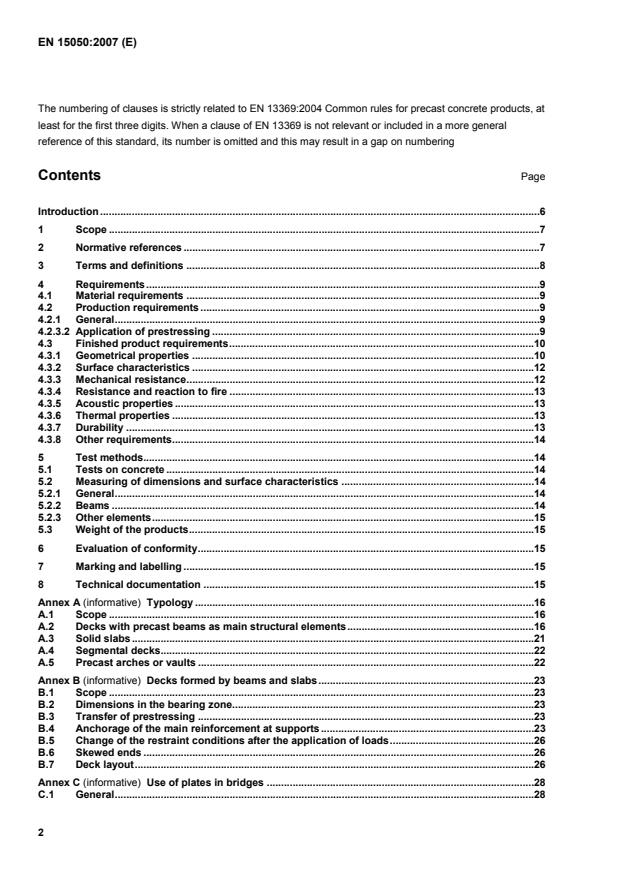
Typology.16 A.1 Scope.16 A.2 Decks with precast beams as main structural elements.16 A.3 Solid slabs.21 A.4 Segmental decks.22 A.5 Precast arches or vaults.22 Annex B (informative)
Decks formed by beams and slabs.23 B.1 Scope.23 B.2 Dimensions in the bearing zone.23 B.3 Transfer of prestressing.23 B.4 Anchorage of the main reinforcement at supports.23 B.5 Change of the restraint conditions after the application of loads.26 B.6 Skewed ends.26 B.7 Deck layout.26 Annex C (informative)
Use of plates in bridges.28 C.1 General.28
Continuity of bridge decks.31 D.1 Scope.31 D.2 Continuity of bridge decks.31 D.3 Hogging moments at supports.31 D.4 Long term sagging moments at supports.31 Annex E (informative)
Infilled beams.37 E.1 General.37 E.2 Infilled beams with a thin topping.37 E.3 Infilled beams with a thick topping.37 Annex F (informative)
Precast beams without topping.39 F.1 Scope.39 F.2 Transverse prestressing by post-tensioning.39 F.3 Reinforced joints.39 Annex G (informative)
Precast segmental decks.41 G.1 General.41 G.1.1 Description.41 G.1.2 Joints.41 G.1.3 Keys.41 G.1.4 Post-tensioning.42 G.2 Design.42 G.2.1 Assembly stage.42 G.2.2 Final situation.42 G.2.3 Checking of joints.43 G.2.4 Local transverse bending.43 G.2.5 Discontinuity regions.43 G.3 Production.44 G.4 Building assembly.44 G.4.1 Segment positioning.44 G.4.2 Segment sealing.44 G.4.3 Post-tensioning.44 G.4.4 Closing segment.44 Annex H (informative)
Ambient conditions for bridge elements.46 Annex J (normative)
Finished product inspection.47 Annex Y (informative)
Choice of CE marking method.48 Y.1 General.48 Y.2 Method 1.48 Y.3 Method 2.48 Y.4 Method 3.48 Annex ZA (informative)
Clauses of this European Standard addressing the provisions of the EU Construction Products Directive.49 ZA.1 Scope and relevant characteristics.49 ZA.2 Procedure for attestation of conformity of precast concrete bridge elements.50 ZA.2.1 System of attestation of conformity.50 ZA.2.2 EC Certificate and Declaration of conformity.52 ZA.3 CE marking and labelling.52 ZA.3.1 General.52 ZA.3.2 Declaration of geometrical data and material properties.54 ZA.3.3 Declaration of product properties.56 ZA.3.4 Declaration of compliance with a given design specification.58 Bibliography.60
The installation of some structural precast concrete products is dealt with by ENV 13670-1: Execution of concrete structures – Part 1: Common rules, which has at the moment the status of a European prestandard. In all countries it can be accompanied by alternatives for national application and it shall not be treated as a European Standard. The programme of standards for structural precast concrete products comprises the following standards, in some cases consisting of several parts: EN 1168, Precast concrete products — Hollow core slabs EN 12794, Precast concrete products — Foundation piles EN 12843, Precast concrete products — Masts and poles EN 13224, Precast concrete products — Ribbed floor elements EN 13225, Precast concrete products — Linear structural elements EN 13693, Precast concrete products — Special roof elements EN 13747, Precast concrete products — Floor plates for floor systems EN 13978, Precast concrete products — Precast concrete garages EN 14843, Precast concrete products — Stairs EN 14844, Precast concrete products — Box culverts EN 14991, Precast concrete products — Foundation elements EN 14992, Precast concrete products — Wall elements
(which is greater)
Figure 1a
Figure 1b Figure 1c
Figure 1d Figure 1 — Basic dimensions and deviations
Typology A.1 Scope Some examples of elements dealt with in this European Standard are presented in this annex, even if this annex is not exhaustive. Other types of precast elements can be used in bridge construction. A.2 Decks with precast beams as main structural elements Some types of precast beams used in bridges are sketched in Figure A.1: rectangular beams (Figure A.1a); I or double T beams (Figure A.1b); TT beams (Figure A.1c); T beams with (Figure A.1d) or without base enlargement; inverted T beams (Figure A.1e and f); U beams, V beams (Figure A.1g and h).
Figure A.1 — Some examples of precast beams and related cast in situ concrete The following sub types of decks result: a) precast beams, completed by a cast in situ slab (Figure A.2); b) one or more U beams, completed by cast in situ slab (Figure A.3); c) segmental beams, completed by cast in situ slab (Figure A.4); d) precast T beams completed by cast in situ slab (Figure A.5); e) infilled precast beams (Figure A.6); f) precast box elements without topping (Figure A.7). In types from a) to c) thin floor plates are frequently used as permanent formwork for the cast in situ concrete slab (see B.6).
Key 1 cast in situ slab 2 precast slab (or formwork) Figure A.2 — Precast beams with cast in situ slab
Figure A.3a
Figure A.3b Key 1 in situ slab 2 precast beam Figure A.3 — Single (A.3a) or multiple (A.3b) box girders
Figure A.4a
Figure A.4b Key 1 connections 2 cast in situ slab 3 precast beam
Figure A.4 — Segmental beams, cast in situ slab
Figure A.5 — Precast beams, cast in situ slab
Figure A.6a
Figure A.6b Key 1 transverse reinforcement 2 precast elements Figure A.6 — Infilled precast beams
Figure A.7 — Precast box elements without cast in situ slab A.3 Solid slabs Decks formed by precast slabs over entire span, with longitudinal shear keys, completed by cast in situ (Figure A.8) or precast slab post-tensioned transversally. Solid slabs are usually used for short spans. Side elevation
Cross section Key 1 precast slab 2 cast in situ concrete Figure A.8 — Solid slab
Figure A.9 — Precast segment A.5 Precast arches or vaults
Key 1 wing wall 2 precast collar wall 3 precast concrete arch elements 4 continuous cast in situ concrete strip footing Figure A.10 — Example of precast concrete arch structure
Decks formed by beams and slabs B.1 Scope This annex deals with decks having precast beams as the main resistant elements, i.e. types described in A.1 a), b), c) and d). B.2 Dimensions in the bearing zone The suggested minimum dimensions for the bearing zone of precast beams are shown in Figure B.1 (full depth bearings ) and in Figure B.2 (half joints). Such dimensions are to be intended as design specifications and not as acceptance tolerances. Deviations from the above values require special detailing provisions to assure safety against local spalling of concrete. Half joints (Figure B.2) can lead to durability and maintenance problems because of difficulties in inspection and in bearings replacement and should be avoided as far as possible. In case of beams to be placed with a longitudinal gradient greater than 3 %, a cavity should be provided in the underside of the beam to ensure a horizontal bearing surface at the support. In the cavity area the minimum concrete cover should still be guarantied. B.3 Transfer of prestressing 8.10.2 and 8.10.3 of EN 1992-1-1:2004 and 8.10 of EN 1992-2:2005 should apply. When the prestressing tendons are placed outside of the vertical plane of the webs, a horizontal transfer check should be made. This is particularly important for very wide elements such as box and U beams. B.4 Anchorage of the main reinforcement at supports At the end of the beams, enough support length should be provided to verify that the horizontal force, derived from the shear mechanism, is resisted by the tension chord. When the transfer of prestressing is assured by bond (pre-tensioned beams), the part of prestressing effectively anchored can be evaluated according to 8.10.2.2 and 8.10.2.3 of EN 1992-1-1:2004. The effectiveness of tendons placed at a distance from the web edge greater than the thickness of the flange should be verified case by case. If the force provided by the prestressing is insufficient, adequately anchored reinforcing steel should be added.
Figure B.1 — Dimensions in the bearing zone
Key 1 alternative shape of the beam Figure B.2 — Dimensions in the bearing zone in case of half joints
Key 1 diaphragm 2 deck slab 3 beam 4 web hole at end of the beam, for diaphragm reinforcement 5 local square end to beam Figure B.3 — Local square end of the acute corner
Use of plates in bridges C.1 General This annex deals with the use of concrete precast plates as components of decks bridges designed in accordance with EN 1992-2 whose main structure can be made with reinforced or prestre
...