

EN 12921-3:2005+A1:2008
(Main + Amendment)Machines for surface cleaning and pre-treatment of industrial items using liquids or vapours - Part 3: Safety of machines using flammable cleaning liquids
- Abstract
This European Standard deals with the significant hazards of machines for surface cleaning and pre-treatment - in the following called "cleaning machines" - of industrial items using flammable cleaning liquids or a mixture of cleaning liquids, even in emulsion form, which can potentially create, even temporarily, a condition of flammability.
This European Standard applies in combination with EN 12921-1. Both parts together cover all significant hazards relevant for cleaning machines of industrial items using liquids or vapours, when they are used as intended and under the conditions foreseen by the manufacturer (see Clause 4). The specific requirements specified in this European Standard take precedence over the respective requirements of EN 12921-1.
To the extent of this document the terms combustible materials and flammable substance and explosive are equivalently used.
NOTE 1 The condition of flammability can be generated only when molecules of the fluid are in intimate contact with oxygen from the air. Ignition is possible when: the fluid generates a concentration of vapour in air, or: the flammable fluid is present as a suspension of fine droplets in air (aerosol).
NOTE 2 In practice, fires and explosions differ by the size and intensity of the reaction, and by the instantaneous effects on the environment.
This European Standard does not apply to machinery and related equipment excluded from the scope of
EN 12921-1.
This European Standard is not applicable to cleaning machines of industrial items using flammable cleaning liquids which are manufactured before the publication of this European Standard by CEN.
- Status
- Published
- Publication Date
- 25-Nov-2008
- Withdrawal Date
- 27-Dec-2009
- Technical Committee
- CEN/TC 271 - Surface treatment equipment - Safety
- Current Stage
- 6060 - Definitive text made available (DAV) - Publishing
- Start Date
- 26-Nov-2008
- Completion Date
- 26-Nov-2008
- Directive
- 2006/42/EC - Directive 2006/42/EC of the European Parliament and of the Council of 17 May 2006 on machinery, and amending Directive 95/16/EC (recast)OJ Ref: C, C 214 OJ Date: 08-Sep-2009
98/37/EC - MachineryOJ Ref: C, C 74 OJ Date: 28-Mar-2009

Overview
EN 12921-3:2005+A1:2008 is a CEN Type C standard that specifies safety requirements for machines used in surface cleaning and pre-treatment of industrial items when flammable cleaning liquids or liquid mixtures (including emulsions) can create temporary or persistent flammable conditions. It is intended to be applied in combination with EN 12921-1 (Common safety requirements); where this Part 3 contains specific provisions they take precedence. The standard addresses risks of ignition, fire and explosion arising when liquids produce flammable vapours or aerosols in contact with air.
Key topics and technical requirements
- Scope and risk basis
- Covers significant hazards related to flammability during normal use and foreseeable misuse.
- Uses terminology and risk-analysis approach consistent with EN ISO 12100 and ATEX principles.
- Hazard identification and area classification
- Guidance on hazardous area zoning (Zone 0 / Zone 1 / Zone 2) and examples (Annex C).
- Relates flammability and flash point concepts (Annex B) to machine design.
- Electrical and non-electrical protections
- Requirements for selecting explosion-protected electrical apparatus and protection concepts (references to EN 60079 series, EN 500xx, EN 13463 series).
- Guidance on equipment categories for use in zones (Group II, Category 1/2/3).
- Mechanical, thermal, noise and material hazards
- Measures to limit heating, prevent ignition sources, and control emissions (Annex A addresses inherently limited heating).
- Control systems and energy supply
- Safety measures for control failures, failure of energy supply and safety-related control system design (references to EN 954‑1, EN 60204‑1).
- Verification and documentation
- Verification methods for safety requirements, marking and instruction handbook obligations (information for use, marking, and relationship to EU Directives in Annex ZA/ZB).
Applications and who uses it
EN 12921-3 is used by:
- Machine manufacturers and designers to ensure safe construction of cleaning machines using flammable liquids.
- Safety and compliance engineers implementing explosion protection and hazardous area zoning.
- Certification bodies, notified bodies and testing labs assessing conformity with EU machine directives.
- Plant engineers, integrators and maintenance personnel specifying safe equipment, selection of electrical apparatus, control systems and user information. Practical uses include design reviews, risk assessments, machinery procurement specs, installation zoning and operator training related to flammable cleaning processes.
Related standards
- EN 12921-1 (Common safety requirements) - mandatory companion standard.
- EN 12921-2, EN 12921-4 - other parts of the series for water-based and halogenated solvents.
- EN 1127-1, EN 60079 series, EN 13463 series, EN 60204-1, EN ISO 12100 - referenced normative documents for explosion protection, electrical safety and general machine safety.
Keywords: EN 12921-3:2005+A1:2008, flammable cleaning liquids, cleaning machines safety, hazardous area classification, ATEX, explosion protection, flash point, CEN standard.
Relations
- Effective Date
- 22-Dec-2008
- Effective Date
- 25-Aug-2026
- Refers
EN 60079-1:2014 - Explosive atmospheres - Part 1: Equipment protection by flameproof enclosures "d" - Effective Date
- 09-Feb-2026
- Refers
EN 60079-2:2014 - Explosive atmospheres - Part 2: Equipment protection by pressurized enclosure "p" - Effective Date
- 09-Feb-2026
- Effective Date
- 09-Feb-2026
- Refers
EN IEC 60079-18:2025 - Explosive atmospheres - Part 18: Equipment protection by encapsulation "m" - Effective Date
- 09-Feb-2026
- Effective Date
- 09-Feb-2026
- Refers
EN IEC 60079-11:2024 - Explosive atmospheres - Part 11: Equipment protection by intrinsic safety "i" - Effective Date
- 09-Feb-2026
- Effective Date
- 09-Feb-2026
- Effective Date
- 09-Feb-2026
- Refers
EN 60079-7:2015 - Explosive atmospheres - Part 7: Equipment protection by increased safety "e" - Effective Date
- 09-Feb-2026
- Refers
EN 50015:1998 - Electrical apparatus for potentially explosive atmospheres - Oil immersion "o" - Effective Date
- 09-Feb-2026
- Effective Date
- 09-Feb-2026
- Effective Date
- 28-Jan-2026
- Effective Date
- 28-Jan-2026
Frequently Asked Questions
EN 12921-3:2005+A1:2008 is a standard published by the European Committee for Standardization (CEN). Its full title is "Machines for surface cleaning and pre-treatment of industrial items using liquids or vapours - Part 3: Safety of machines using flammable cleaning liquids". This standard covers: This European Standard deals with the significant hazards of machines for surface cleaning and pre-treatment - in the following called "cleaning machines" - of industrial items using flammable cleaning liquids or a mixture of cleaning liquids, even in emulsion form, which can potentially create, even temporarily, a condition of flammability. This European Standard applies in combination with EN 12921-1. Both parts together cover all significant hazards relevant for cleaning machines of industrial items using liquids or vapours, when they are used as intended and under the conditions foreseen by the manufacturer (see Clause 4). The specific requirements specified in this European Standard take precedence over the respective requirements of EN 12921-1. To the extent of this document the terms combustible materials and flammable substance and explosive are equivalently used. NOTE 1 The condition of flammability can be generated only when molecules of the fluid are in intimate contact with oxygen from the air. Ignition is possible when: the fluid generates a concentration of vapour in air, or: the flammable fluid is present as a suspension of fine droplets in air (aerosol). NOTE 2 In practice, fires and explosions differ by the size and intensity of the reaction, and by the instantaneous effects on the environment. This European Standard does not apply to machinery and related equipment excluded from the scope of EN 12921-1. This European Standard is not applicable to cleaning machines of industrial items using flammable cleaning liquids which are manufactured before the publication of this European Standard by CEN.
This European Standard deals with the significant hazards of machines for surface cleaning and pre-treatment - in the following called "cleaning machines" - of industrial items using flammable cleaning liquids or a mixture of cleaning liquids, even in emulsion form, which can potentially create, even temporarily, a condition of flammability. This European Standard applies in combination with EN 12921-1. Both parts together cover all significant hazards relevant for cleaning machines of industrial items using liquids or vapours, when they are used as intended and under the conditions foreseen by the manufacturer (see Clause 4). The specific requirements specified in this European Standard take precedence over the respective requirements of EN 12921-1. To the extent of this document the terms combustible materials and flammable substance and explosive are equivalently used. NOTE 1 The condition of flammability can be generated only when molecules of the fluid are in intimate contact with oxygen from the air. Ignition is possible when: the fluid generates a concentration of vapour in air, or: the flammable fluid is present as a suspension of fine droplets in air (aerosol). NOTE 2 In practice, fires and explosions differ by the size and intensity of the reaction, and by the instantaneous effects on the environment. This European Standard does not apply to machinery and related equipment excluded from the scope of EN 12921-1. This European Standard is not applicable to cleaning machines of industrial items using flammable cleaning liquids which are manufactured before the publication of this European Standard by CEN.
EN 12921-3:2005+A1:2008 is classified under the following ICS (International Classification for Standards) categories: 97.080 - Cleaning appliances. The ICS classification helps identify the subject area and facilitates finding related standards.
EN 12921-3:2005+A1:2008 has the following relationships with other standards: It is inter standard links to EN 12921-3:2005, ISO 8598:1996, EN 60079-1:2014, EN 60079-2:2014, EN 60529:1991, EN IEC 60079-18:2025, EN 60079-5:2015, EN IEC 60079-11:2024, EN IEC 60079-25:2022, EN IEC 60079-0:2018, EN 60079-7:2015, EN 50015:1998, EN IEC 60079-15:2019, EN ISO 12100-1:2003, EN 1127-1:1997. Understanding these relationships helps ensure you are using the most current and applicable version of the standard.
EN 12921-3:2005+A1:2008 is associated with the following European legislation: EU Directives/Regulations: 2006/42/EC, 98/37/EC; Standardization Mandates: M/396, M/BC/CEN/88/13. When a standard is cited in the Official Journal of the European Union, products manufactured in conformity with it benefit from a presumption of conformity with the essential requirements of the corresponding EU directive or regulation.
EN 12921-3:2005+A1:2008 is available in PDF format for immediate download after purchase. The document can be added to your cart and obtained through the secure checkout process. Digital delivery ensures instant access to the complete standard document.
Standards Content (Sample)
2003-01.Slovenski inštitut za standardizacijo. Razmnoževanje celote ali delov tega standarda ni dovoljeno.Maschinen zur Oberflächenreinigung und -vorbehandlung von industriellen Produkten mittels Flüssigkeiten oder Dampfphasen - Teil 3: Sicherheit von Anlagen, in denen brennbare Reinigungsflüssigkeiten verwendet werdenMachines de nettoyage et de prétraitement de pièces industrielles utilisant des liquides ou des vapeurs - Partie 3: Sécurité des machines utilisant des liquides de nettoyage inflammablesMachines for surface cleaning and pre-treatment of industrial items using liquids or vapours - Part 3: Safety of machines using flammable cleaning liquids97.080Aparati za nego talFloor treatment appliancesICS:Ta slovenski standard je istoveten z:EN 12921-3:2005+A1:2008SIST EN 12921-3:2005+A1:2009en,fr01-marec-2009SIST EN 12921-3:2005+A1:2009SLOVENSKI
STANDARDSIST EN 12921-3:20051DGRPHãþD
EUROPEAN STANDARD NORME EUROPÉENNE EUROPÄISCHE NORM
EN 12921-3:2005+A1
November 2008 ICS 97.080 Supersedes EN 12921-3:2005 English Version
Machines for surface cleaning and pre-treatment of industrial items using liquids or vapours - Part 3: Safety of machines using flammable cleaning liquids
Machines de nettoyage et de prétraitement de pièces industrielles utilisant des liquides ou des vapeurs -Partie 3: Sécurité des machines utilisant des liquides de nettoyage inflammables
Maschinen zur Oberflächenreinigung und -vorbehandlung von industriellen Produkten mittels Flüssigkeiten oder Dampfphasen - Teil 3: Sicherheit von Anlagen, in denen brennbare Reinigungsflüssigkeiten verwendet werden This European Standard was approved by CEN on 21 March 2005 and includes Amendment 1 approved by CEN on 23 October 2008.
CEN members are bound to comply with the CEN/CENELEC Internal Regulations which stipulate the conditions for giving this European Standard the status of a national standard without any alteration. Up-to-date lists and bibliographical references concerning such national standards may be obtained on application to the CEN Management Centre or to any CEN member.
This European Standard exists in three official versions (English, French, German). A version in any other language made by translation under the responsibility of a CEN member into its own language and notified to the CEN Management Centre has the same status as the official versions.
CEN members are the national standards bodies of Austria, Belgium, Bulgaria, Cyprus, Czech Republic, Denmark, Estonia, Finland, France, Germany, Greece, Hungary, Iceland, Ireland, Italy, Latvia, Lithuania, Luxembourg, Malta, Netherlands, Norway, Poland, Portugal, Romania, Slovakia, Slovenia, Spain, Sweden, Switzerland and United Kingdom.
EUROPEAN COMMITTEE FOR STANDARDIZATION
COMITÉ EUROPÉEN DE NORMALISATION EUROPÄISCHES KOMITEE FÜR NORMUNG
Management Centre: rue de Stassart, 36
B-1050 Brussels © 2008 CEN All rights of exploitation in any form and by any means reserved worldwide for CEN national Members. Ref. No. EN 12921-3:2005+A1:2008: ESIST EN 12921-3:2005+A1:2009
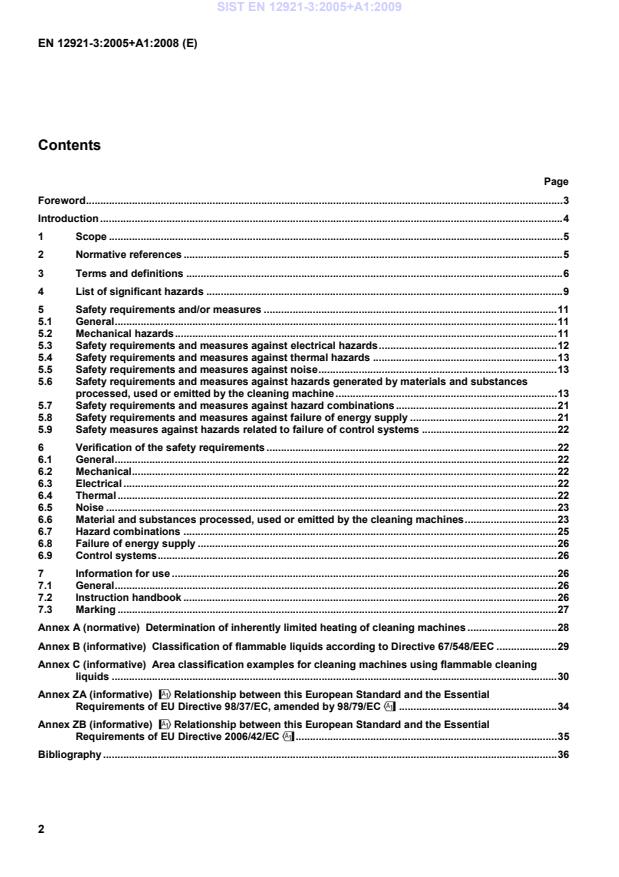
Determination of inherently limited heating of cleaning machines.28 Annex B (informative)
Classification of flammable liquids according to Directive 67/548/EEC.29 Annex C (informative)
Area classification examples for cleaning machines using flammable cleaning liquids.30 Annex ZA (informative)
!Relationship between this European Standard and the Essential Requirements of EU Directive 98/37/EC, amended by 98/79/EC".34 Annex ZB (informative)
!Relationship between this European Standard and the Essential Requirements of EU Directive 2006/42/EC".35 Bibliography.36
EN 12921-1. This European Standard is not applicable to cleaning machines of industrial items using flammable cleaning liquids which are manufactured before the publication of this European Standard by CEN. 2 Normative references The following referenced documents are indispensable for the application of this document. For dated references, only the edition cited applies. For undated references, the latest edition of the referenced document (including any amendments) applies. EN 954-1, Safety of machinery – Safety-related parts of control systems – Part 1: General principles for design EN 1127-1:1997, Explosive atmospheres - Explosion prevention and protection – Part 1: Basic concepts and methodology EN 1539, Dryers and ovens, in which flammable substances are released – Safety requirements EN 12921-1:2005, Machines for surface cleaning and pre-treatment of industrial items using liquids or vapours – Part 1: Common safety requirements EN 13463-1:2001, Non-electrical equipment for potentially explosive atmospheres – Part 1: Basic method and requirements EN 13463-5, Non-electrical equipment intended for use in potentially explosive atmospheres – Part 5: Protection by constructional safety "c" EN 50015:1998, Electrical apparatus for potentially explosive atmospheres — Oil immersion "o" EN 50017, Electrical apparatus for potentially explosive atmospheres — Powder filling "q" EN 50020, Electrical apparatus for potentially explosive atmospheres — Intrinsic safety "i" EN 60079-0, Electrical apparatus for explosive gas atmosphere – Part 0: General requirements (IEC 60079-0:2004) SIST EN 12921-3:2005+A1:2009
EN 60079-7, Electrical apparatus for explosive gas atmospheres — Part 7: Increased safety “e” (IEC 60079-7:2001) EN 60079-15, Electrical apparatus for explosive gas atmospheres – Part 15: Type of protection "n" (IEC 60079-15:2001, modified) EN 60079-18, Electrical apparatus for explosive gas atmospheres — Part 18: Construction test and marking of type of protection encapsulation "m" electrical apparatus (IEC 60079-18:2004) EN 60079-25, Electrical apparatus for explosive gas atmospheres — Part 25: Intrinsically safe systems (IEC 60079-25:2003) EN 60204-1, Safety of machinery – Electrical equipment of machines – Part 1: General requirements (IEC 60204-1:1997) EN 60529, Degrees of protection provided by enclosures (IP code) (IEC 60529:1989) EN ISO 12100-1:2003, Safety of machinery – Basic concepts, general principles for design – Part 1: Basic terminology, methodology (ISO 12100-1:2003) EN ISO 12100-2, Safety of machinery – Basic concepts, general principles for design – Part 2: Technical principles (ISO 12100-2:2003) 3 Terms and definitions For the purposes of this European Standard, the terms and definitions given in EN ISO 12100-1:2003, EN 12921-1:2005 and the following apply. 3.1 area classification assessed division of a facility into hazardous areas and non-hazardous areas, and the subdivision of the hazardous areas into zones 3.2 explosive atmosphere mixture with air, under atmospheric condition, of flammable substance(s) in the form of gas, vapour, mist or dust, in which, after ignition has occurred, combustion spreads to the entire unburned mixture (see 3.17 of EN 1127-1:1997) 3.3 explosion range range of the concentrations of a flammable substance in air, within which an explosion can occur (see 3.13 of EN 1127-1:1997) 3.4 flammable substance substance in the form of gas, vapour, liquid, solid, or mixtures of these, able to undergo an exothermic reaction with air when ignited (see 3.1 of EN 1127-1:1997) 3.5 flammable cleaning liquid liquid which can release vapours, under certain circumstances, able to undergo an exothermic reaction with air when ignited SIST EN 12921-3:2005+A1:2009
surface cleaning and pre-treatment using flammable cleaning liquids Clause/sub-clause of this European Standard Hazard Clause/sub-clause of EN 12921-1:20054.1 General This clause contains significant hazards, hazardous situations and events, as far as they are dealt with in this document, identified by risk assessment as significant for this type of machinery using flammable cleaning liquids and which requires action to eliminate or reduce the risk. NOTE Information on the method of risk analysis is given in EN 1050. 4.1 4.2 Mechanical hazards 4.2 4.2.2 Crushing, shearing, cutting, entanglement, drawing-in, impact 4.2.1 4.2.3 High pressure fluid ejection 4.2.2 4.2.4 Ejection of parts of the cleaning machine and/or items 4.2.3 4.2.5 Loss of stability (of cleaning machine and cleaning machine parts) 4.2.4 4.2.6 Personnel's slip, trip and fall hazards 4.2.5 4.3 Electrical hazards 4.3 4.4 Thermal hazards 4.4 4.5 Hazards generated by noise 4.5 4.6 Hazards generated by materials and substances processed, used or emitted by the cleaning machine 4.6 4.6.1 General 4.6.1 4.6.2 Hazards resulting from contact with/or inhalation of dangerous liquids, gases, aerosol, vapours, fumes and dusts 4.6.2 4.6.3 Fire and explosion hazard 4.6.3 SIST EN 12921-3:2005+A1:2009
4.6.3.2.2 Generation of explosive atmosphere Generation of an explosive atmosphere is related to flammable cleaning liquids under the following circumstances:
as a vapour, when the vapour concentration in air is within the explosive range between LEL and UEL; as a suspension of fine droplets. Examples of flammable substances which increase the concentration above normal are:
high cleaning liquid temperature leading to formation of flammable vapours; insufficient cleaning liquid coverage of heating elements; leaks or drips of cleaning liquid on hot surfaces; spraying of the cleaning liquid generating fine droplets and mist; change in composition of the flammable cleaning liquid.
4.6.3.2.3 Ignition of an explosive atmosphere Ignition of an explosive atmosphere is related to: hot surfaces e.g. of heating systems and electrical equipment; sparks created by mechanically induced energy e.g. fans, conveyors; electrostatic discharges; electrical sparks; ignition sources not generated by the cleaning machine, e.g. welding and other sources of thermal energy used during maintenance and cleaning of the cleaning machine.
4.6.3.2.4 Release of flammable cleaning liquid or vapour outside of the cleaning machine This is related to: loss of containment of flammable cleaning liquids; release of flammable mists; release of flammable vapours.
4.6.3.2.5 Unexpected chemical reactions Unexpected chemical reactions leading to decomposition and release of flammable vapours or explosion. NOTE Among other types of chemical substances, ethers, olefins and aldehydes are prone to formation of peroxides which can decompose spontaneously in an exothermic reaction.
4.6.3.2.6 Ejection of parts of the cleaning machines in case of explosions Ejection of parts of the cleaning machine (e.g. covers, doors) or the content of the machine (e.g. items, cleaning liquid) are related to an explosion.
4.7 Hazards combinations 4.7 4.8 Hazards caused by failure of energy supply 4.8 SIST EN 12921-3:2005+A1:2009
5 Safety requirements and/or measures 5.1 General Machinery shall comply with the safety requirements and/or protective measures of this clause. In addition, the cleaning machine shall be designed according to the principles of EN ISO 12100-2 for hazards relevant but not significant which are not dealt with by this document (e.g. sharp edges). 5.2 Mechanical hazards 5.2.1 General Shall be according to 5.1 and 5.2 of EN 12921-1:2005. 5.2.2 Safeguarding of danger points 5.2.2.1 General Shall be according to 5.2.1 of EN 12921-1:2005. 5.2.2.2 Safety measures against crushing, shearing, cutting, entanglement, drawing-in, impact Shall be according to 5.2.1.1 of EN 12921-1:2005. 5.2.2.3 Guards and interlocks Shall be according to 5.2.1.2 of EN 12921-1:2005. 5.2.2.4 Moving parts of the cleaning machine Shall be according to 5.2.1.3 of EN 12921-1:2005. 5.2.2.5 Location of controls Shall be according to 5.2.1.4 of EN 12921-1:2005. 5.2.2.6 Prevention against hazards related to close or fall of covers, lids and doors Shall be according to 5.2.1.5 of EN 12921-1:2005. 5.2.2.7 Devices for setting-up, make-ready, cleaning and trouble-shooting during the work process Shall be according to 5.2.1.6 of EN 12921-1:2005. SIST EN 12921-3:2005+A1:2009
...