


EN 13976-2:2018
(Main)Rescue systems - Transportation of incubators - Part 2: System requirements
General Information
- Abstract
This European Standard specifies the requirements for a transport incubator system needed for care and treatment of infants, used in emergency or planned transport.
It specifies the particular requirements needed to ensure the proper function of equipment during transportation (e.g. monitors, respirators, infusion pumps, extra corporeal lung support- (ECLS-) systems, gas supply) and to provide safe transportation for infants and operators.
This European Standard also specifies that the equipment or systems shall not interfere with the functions of the road and air ambulance providing transportation.
This European Standard does not give requirements for the vehicles, crafts, devices or incubators as such, these requirements are found in other standards. However, transport incubators are normally combined with other equipment to form a transport incubator system.
- Status
- Published
- Publication Date
- 26-Jun-2018
- Withdrawal Date
- 30-Dec-2019
- Technical Committee
- CEN/TC 239 - Rescue systems
- Drafting Committee
- CEN/TC 239/WG 4 - Transportation of incubators
- Current Stage
- 9093 - Decision to confirm - Review Enquiry
- Start Date
- 01-Mar-2024
- Completion Date
- 17-Sep-2026
- Directive
- Not Harmonized93/42/EEC - Medical devicesOJ Ref: LI 90, LI 90/1 OJ Date: 25-Mar-2020

Overview
EN 13976-2:2018 is a European Standard developed by CEN that specifies system requirements for transport incubator systems used in the care and treatment of infants during emergency or planned transport. This standard ensures that transport incubator systems provide safe, reliable, and effective environments during transportation by road or air ambulance. It sets forth essential functional, mechanical, and electrical criteria while emphasizing protection and comfort for infants.
Focused on the interoperability and operation of incubator systems alongside medical equipment such as monitors, respirators, infusion pumps, and extracorporeal lung support (ECLS) systems, EN 13976-2:2018 plays a crucial role in neonatal patient transport safety. The standard promotes equipment compatibility without interfering with ambulance functions and applies to the integrated system rather than individual components like vehicles or incubators, which are covered by separate standards.
Key Topics
System Integration and Compatibility
Equipment must be designed for neonatal patients and intended for use during transportation, ensuring safe function in multiple vehicle types (road and air ambulances). Transport incubator systems should minimize manual handling by operators and comply with existing vehicle-specific standards such as EN 1789 for road ambulances and EN 13718 for air ambulances.Mechanical and Electrical Safety
The system must comply with mechanical integrity standards (EN 60601-1) and be robust against mechanical stress, vibrations, and noise. Electrical compatibility requires operation on multiple power supplies (12 V DC, 24 V DC, or 230 V AC/50 Hz) with measures to prevent vehicle power drainage.Environmental and Comfort Requirements
Protection against ingress of liquids (IPX3 rating), temperature extremes, vibration, and noise is mandatory. Noise from equipment should not exceed 60 dB(A) to ensure infant comfort during transport. Transport speed must balance time efficiency with minimizing discomfort caused by vibrations or shocks.Infant Restraint and Safety
The standard mandates an infant restraint system compliant with EN 1789 and various European Aviation Safety Agency (EASA) certifications (CS-23, CS-25, CS-27, CS-29). The restraint system must limit infant movement safely during impacts and allow rapid access in emergencies.Mass and Fixation Limits
Transport incubator systems, including rails and components, must not exceed 140 kg to maintain safe handling and compatibility with vehicle loading capacities. Devices must be securely fixed according to EN 1789 and aviation-specific regulations.Electromagnetic Compatibility (EMC)
Compliance with EN 60601-1-2 and RTCA DO 160G ensures devices function without interference in diverse electromagnetic environments typical of emergency transport.Modifications
Any post-manufacturer modifications require thorough risk analysis and confirmation that additional devices are correctly secured without compromising fixation integrity or safety.
Applications
Neonatal Emergency Transport
Ensures uninterrupted care of premature or critically ill infants during ambulance or airlift transfer to specialized medical facilities.Planned Medical Transport
Facilitates safe, controlled environment transport for infants needing continuous monitoring and medical support during scheduled moves.Ambulance Equipment Specification
Sets benchmarks for ambulance procurement and retrofit projects involving neonatal transport incubators and supporting medical systems.Medical Device Development
Guides manufacturers in designing incubator systems and supporting equipment that meet stringent transportation safety, mechanical, and operational standards.
Related Standards
- EN 13976-1:2018 - Interface requirements for transport incubators, complementing Part 2 by defining connection and interoperability criteria.
- EN 60601-2-20:2009 - Basic safety and performance requirements specific to infant transport incubators.
- EN 1789:2007 + A2:2014 - Specifications for road ambulances and medical equipment fixation.
- EN 13718-1:2014 & EN 13718-2:2015 - Requirements and operational criteria for air ambulances and associated medical devices.
- EN 1865 Series - Standards for patient handling equipment and stretchers in ambulances.
- RTCA DO 160G:2010 - Environmental testing standards addressing airborne equipment's electromagnetic compatibility and physical stress.
EN 13976-2:2018 ensures that neonatal transport incubator systems provide a safe, comfortable, and effective environment across different transport modes. Adherence to its system requirements enhances infant safety, operator efficiency, and medical device reliability during critical pre-hospital and inter-facility transfers. For healthcare providers and manufacturers, integrating this standard into design and operational practices is vital for high-quality neonatal emergency care.
Relations
- Replaces
EN 13976-2:2011 - Rescue systems - Transportation of incubators - Part 2: System requirements - Effective Date
- 15-Jul-2018
- Effective Date
- 09-Feb-2026
- Effective Date
- 09-Feb-2026
- Effective Date
- 09-Feb-2026
- Effective Date
- 09-Feb-2026
- Effective Date
- 09-Feb-2026
- Effective Date
- 09-Feb-2026
- Effective Date
- 09-Feb-2026
- Effective Date
- 09-Feb-2026
- Effective Date
- 09-Feb-2026
- Effective Date
- 28-Jan-2026
- Effective Date
- 28-Jan-2026
- Refers
EN 13976-1:2018 - Rescue systems - Transportation of incubators - Part 1: Interface requirements - Effective Date
- 28-Jan-2026
- Effective Date
- 28-Jan-2026
- Effective Date
- 28-Jan-2026
Get Certified
Connect with accredited certification bodies for this standard

BSI Group
BSI (British Standards Institution) is the business standards company that helps organizations make excellence a habit.

TÜV Rheinland
TÜV Rheinland is a leading international provider of technical services.

TÜV SÜD
TÜV SÜD is a trusted partner of choice for safety, security and sustainability solutions.
Sponsored listings
Frequently Asked Questions
EN 13976-2:2018 is a standard published by the European Committee for Standardization (CEN). Its full title is "Rescue systems - Transportation of incubators - Part 2: System requirements". This standard covers: This European Standard specifies the requirements for a transport incubator system needed for care and treatment of infants, used in emergency or planned transport. It specifies the particular requirements needed to ensure the proper function of equipment during transportation (e.g. monitors, respirators, infusion pumps, extra corporeal lung support- (ECLS-) systems, gas supply) and to provide safe transportation for infants and operators. This European Standard also specifies that the equipment or systems shall not interfere with the functions of the road and air ambulance providing transportation. This European Standard does not give requirements for the vehicles, crafts, devices or incubators as such, these requirements are found in other standards. However, transport incubators are normally combined with other equipment to form a transport incubator system.
This European Standard specifies the requirements for a transport incubator system needed for care and treatment of infants, used in emergency or planned transport. It specifies the particular requirements needed to ensure the proper function of equipment during transportation (e.g. monitors, respirators, infusion pumps, extra corporeal lung support- (ECLS-) systems, gas supply) and to provide safe transportation for infants and operators. This European Standard also specifies that the equipment or systems shall not interfere with the functions of the road and air ambulance providing transportation. This European Standard does not give requirements for the vehicles, crafts, devices or incubators as such, these requirements are found in other standards. However, transport incubators are normally combined with other equipment to form a transport incubator system.
EN 13976-2:2018 is classified under the following ICS (International Classification for Standards) categories: 11.040.10 - Anaesthetic, respiratory and reanimation equipment; 11.160 - First aid. The ICS classification helps identify the subject area and facilitates finding related standards.
EN 13976-2:2018 has the following relationships with other standards: It is inter standard links to EN 13976-2:2011, EN 60529:1991/A2:2013, EN 60529:1991, EN 60601-1-12:2015, EN 60601-1:2006/A1:2013, EN 60601-1:2006/A12:2014, EN 60601-1-2:2015, EN 60601-1:2006, EN 60529:1991/A1:2000, EN 60601-2-20:2009, EN 1789:2007+A2:2014, EN 13718-1:2014, EN 13976-1:2018, EN 1865-1:2010+A1:2015, EN 1865-2:2010+A1:2015. Understanding these relationships helps ensure you are using the most current and applicable version of the standard.
EN 13976-2:2018 is associated with the following European legislation: EU Directives/Regulations: 93/42/EEC; Standardization Mandates: M/023. When a standard is cited in the Official Journal of the European Union, products manufactured in conformity with it benefit from a presumption of conformity with the essential requirements of the corresponding EU directive or regulation.
EN 13976-2:2018 is available in PDF format for immediate download after purchase. The document can be added to your cart and obtained through the secure checkout process. Digital delivery ensures instant access to the complete standard document.
Standards Content (Sample)
2003-01.Slovenski inštitut za standardizacijo. Razmnoževanje celote ali delov tega standarda ni dovoljeno.Reševalni sistemi - Prevoz inkubatorjev - 2. del: Zahteve za sistemRettungssysteme - Inkubatortransport - Teil 2: Anforderungen an TransportsystemeSystèmes de sauvetage - Transport d'incubateurs - Partie 2 : Exigences relatives au systèmeRescue systems - Transportation of incubators - Part 2: System requirements11.160First aid11.040.10Anestezijska, respiratorna in reanimacijska opremaAnaesthetic, respiratory and reanimation equipmentICS:Ta slovenski standard je istoveten z:EN 13976-2:2018SIST EN 13976-2:2018en,fr,de01-september-2018SIST EN 13976-2:2018SLOVENSKI
STANDARDSIST EN 13976-2:20111DGRPHãþD
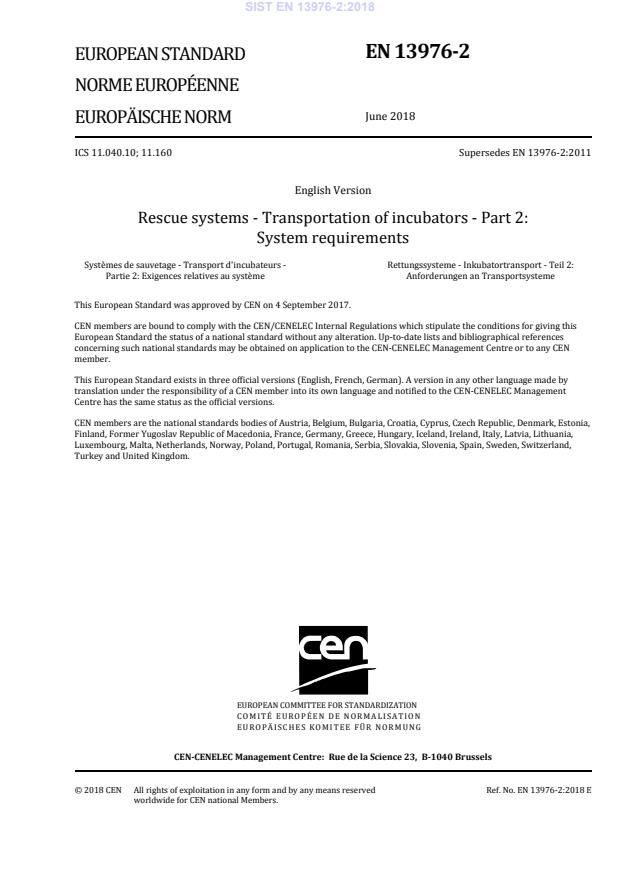
EUROPEAN STANDARD NORME EUROPÉENNE EUROPÄISCHE NORM
EN 13976-2
June
t r s z ICS
s sä r v rä s râ
s sä s x r Supersedes EN
s u { y xæ tã t r s sEnglish Version
Rescue systems æ Transportation of incubators æ Part
tã System requirements Systèmes de sauvetage æ Transport d 5incubateurs æ Partie
tã Exigences relatives au système
Rettungssysteme æ Inkubatortransport æ Teil
tã Anforderungen an Transportsysteme This European Standard was approved by CEN on
v September
t r s yä
egulations which stipulate the conditions for giving this European Standard the status of a national standard without any alterationä Upætoædate lists and bibliographical references concerning such national standards may be obtained on application to the CENæCENELEC Management Centre or to any CEN memberä
translation under the responsibility of a CEN member into its own language and notified to the CENæCENELEC Management Centre has the same status as the official versionsä
CEN members are the national standards bodies of Austriaá Belgiumá Bulgariaá Croatiaá Cyprusá Czech Republicá Denmarká Estoniaá Finlandá Former Yugoslav Republic of Macedoniaá Franceá Germanyá Greeceá Hungaryá Icelandá Irelandá Italyá Latviaá Lithuaniaá Luxembourgá Maltaá Netherlandsá Norwayá Polandá Portugalá Romaniaá Serbiaá Slovakiaá Sloveniaá Spainá Swedená Switzerlandá Turkey and United Kingdomä
EUROPEAN COMMITTEE FOR STANDARDIZATION COMITÉ EUROPÉEN DE NORMALISATION EUROPÄISCHES KOMITEE FÜR NORMUNG
CEN-CENELEC Management Centre:
Rue de la Science 23,
B-1040 Brussels
t r s z CEN All rights of exploitation in any form and by any means reserved worldwide for CEN national Membersä Refä Noä EN
s u { y xæ tã t r s z ESIST EN 13976-2:2018
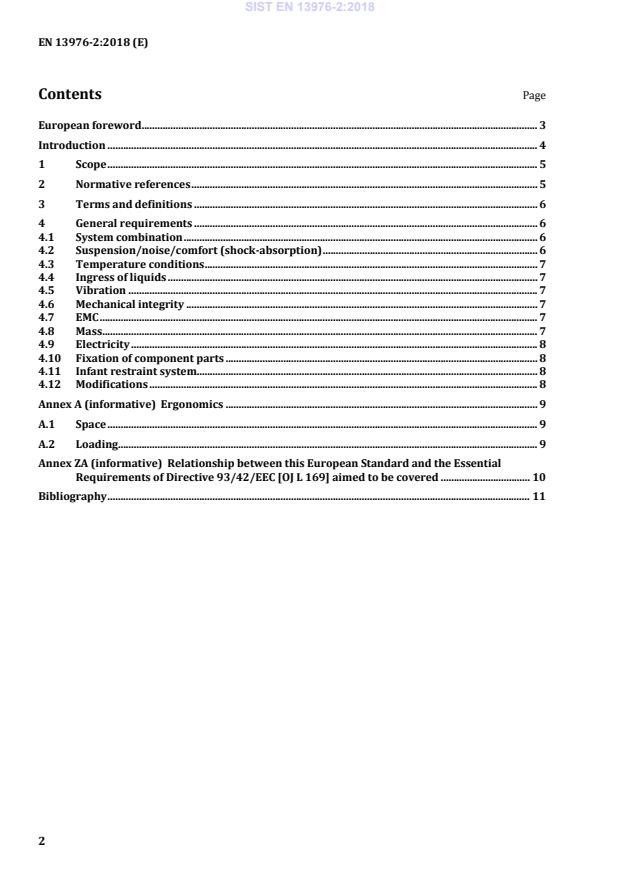
Ergonomics . 9 A.1 Space . 9 A.2 Loading. 9 Annex ZA (informative)
Relationship between this European Standard and the Essential Requirements of Directive 93/42/EEC [OJ L 169] aimed to be covered . 10 Bibliography . 11
1 As impacted by EN 60529:1991/corrigendum May 1993, EN 60529:1991/A1:2000, EN 60529:1991/A2:2013 and EN 60529:1991/AC:2016-2. 2 As impacted by EN 60601-1:2006/corrigendum Mar. 2010, EN 60601-1:2006/A1:2013, EN 60601-1:2006/A1:2013/AC:2014 and EN 60601-1:2006/A12:2014 SIST EN 13976-2:2018
3 EASA constitutes the European g
...