

EN IEC 60730-2-10:2026
(Main)Automatic electrical controls - Part 2-10: Particular requirements for motor-starting relays
- Status
- Published
- Publication Date
- 08-Oct-2026
- Technical Committee
- CLC/TC 72 - Automatic controls for household use
- Current Stage
- 6060 - Document made available - Publishing
- Start Date
- 09-Oct-2026
- Due Date
- 31-Dec-2027
- Completion Date
- 09-Oct-2026

EN IEC 60730-2-10:2026 is the CLC/CENELEC version of IEC 60730-2-10 for automatic electrical controls. It gives particular requirements for motor-starting relays used to start single-phase motors in household and similar equipment.
The standard is written for people selecting, designing, testing, or buying motor-starting relays for appliances, building automation equipment, and other public-use applications. It tells you which product types are in scope, which Part 1 requirements still apply, and where this part changes the test or safety criteria.
What does EN IEC 60730-2-10:2026 specify?
EN IEC 60730-2-10:2026 specifies construction, operation, and testing requirements for automatic electrical motor-starting relays. It is intended to be used together with IEC 60730-1, and it adapts the general Part 1 requirements to relays that switch the main winding and auxiliary starting winding of single-phase motors.
The scope covers relays for household appliances and similar use, including appliances within IEC 60335, building automation equipment within ISO 16484 and IEC 63044 series, public-use equipment such as in shops, offices, hospitals, farms, and commercial or industrial applications, and smart-enabled equipment. It also covers AC or DC powered units up to 690 V AC or 600 V DC.
It excludes some product families that are handled elsewhere, including general purpose relays and contactors covered by IEC 60947, and mechanically operated motor-starting devices.
| Annex | What it covers |
|---|---|
| Annex H | Requirements related to functional safety |
| Annex Q | Regional differences relevant for CENELEC member countries |
| Annex R | National differences relevant in the United States of America |
| Annex S | National differences relevant in Japan |
| Annex T | National differences relevant in Canada |
What are the key requirements of EN IEC 60730-2-10:2026?
EN IEC 60730-2-10:2026 keeps the Part 1 structure, but changes the clauses that matter for motor-starting relays. In practice, that means most safety topics still follow IEC 60730-1, while this part adds product-specific classification, test loading, and functional-safety details.
Clause 5 and Table 1 require technical information to be declared. The table links the relay purpose and control type to the method used to provide technical information, including motor-starting relays, voltage sensing, current sensing, PTC, and thermally operated controls. For users, this means the product data sheet and test file must identify the exact control principle before evaluation starts.
Table 1 also introduces the declared steady state motor run current. That value is used later in heating and related assessment. For manufacturers, it means the relay cannot be evaluated only by nameplate or contact rating - the declared motor run current becomes part of the safety evidence.
Clause 16 changes the heating test for the motor starter coil. The coil is loaded at 1.06 times the steady state motor run current declared in Table 1, and the contacts are not loaded. The actuator is placed in the most unfavorable position. In practice, this checks whether the coil can withstand the thermal load of real starting duty without relying on contact heating.
Clause 16 also sets special handling when the test causes the control to operate. If the control starts operating during the test, it is reset so the contacts remain closed, and if reset is not practical the test is stopped and repeated with a newly determined operating value. This matters because the test must reflect stable operation, not a one-off transient.
Clause 19 keeps the endurance requirement but removes some subclauses from application. The endurance framework of Part 1 applies, while 19.6 and 19.9 to 19.13 are marked not applicable. For readers, this means endurance still matters, but the detailed procedure is narrowed to fit motor-starting relays.
Clauses 23 and 25 apply the EMC emission and immunity requirements of Part 1. Annex H then adds functional-safety-specific EMC checks. For engineers, this is the point where electrical noise can become a safety issue, so the relay has to be assessed both as a control device and as part of the wider safety-related system.
Annex H changes the functional safety endurance and immunity checks. The thermal cycling test in H.19.1.3.3 uses 18 days instead of 14 days, and H.25.9 requires five tests for the electrical fast transient/burst immunity procedure. For testing labs, this means the functional-safety route is not just a repeat of Part 1.
Clause 26 and Annex H refine abnormal-operation assessment. The note in the burnout test says electromechanical motor-start relays, relays, and contactors meet the requirement by passing Clause 19 endurance tests, and the blocked mechanical output test is not applicable. This helps avoid applying the wrong failure scenario to the product type.
The table in Clause 5 also links material and insulation constraints to the product evaluation, including a restriction on material group IIIb with a PTI of 100 up to but excluding 175. That matters when selecting insulating materials for the relay body or internal parts.
What terms does EN IEC 60730-2-10:2026 define?
Motor-starting relay - An electrically operated control intended for integration in an appliance and used in a motor circuit to connect the main winding and the auxiliary starting winding of a single-phase motor.
Type 1 action - A form of action normally associated with electromechanical motor-starting relays, mentioned in the note to the definition of motor-starting relay.
Class A control function - The electronic counterpart noted for motor-starting relays, used when the relay is implemented electronically.
Functional safety - The safety topic covered by Annex H, where the relay is assessed as part of a safety-related system.
Electromagnetic compatibility (EMC) - The emission and immunity behavior covered in Clauses 23 and 25, showing whether the relay can operate correctly in its electromagnetic environment.
Home and Building Electronic Systems (HBES) and Building Automation and Control Systems (BACS) - The building automation context named in the scope for relays used in those systems.
Who uses EN IEC 60730-2-10:2026?
EN IEC 60730-2-10:2026 is used by appliance manufacturers, control designers, test laboratories, certification bodies, and quality teams working on motor-starting relays. It is especially relevant when a relay is built into a household appliance, a building automation product, or other similar equipment with a single-phase motor.
It is also useful for buyers and compliance engineers who need to check whether a relay is intended for the right application, whether it falls inside or outside IEC 60947-type products, and which tests apply to a smart-enabled or safety-related design.
What changed in EN IEC 60730-2-10:2026 from the previous edition?
This 3.0 edition cancels and replaces the 2.0 edition published in 2006. The main stated technical change is adoption of IEC 60730-1 Ed.6.0, together with all of its significant changes.
Which standards are used with EN IEC 60730-2-10:2026?
EN IEC 60730-2-10:2026 is intended to be used with IEC 60730-1, which provides the general requirements, common test structure, and baseline definitions for automatic electrical controls. This part modifies that base document where motor-starting relays need different treatment.
IEC 60947 (all parts) is added in Clause 2 as a normative reference. It is relevant because the scope excludes general purpose relays and contactors of the IEC 60947 family, helping users separate the product family covered here from switchgear and controlgear products.
The scope also places the standard in relation to IEC 60335, ISO 16484, IEC 63044 series, and IEC 61058-1-1. These documents mark the appliance, building automation, and mechanical-switch contexts around the relay, so users can judge whether the application belongs here or in another standard.
What does the EN IEC 60730-2-10:2026 document contain?
The document contains the Part 1 structure plus motor-starting-relay-specific replacements, additions, and modifications. It includes a technical-information table, special heating-test loading, endurance limits, EMC treatment, abnormal-operation test adjustments, and a normative functional-safety annex.
It also includes regional difference annexes for CENELEC countries, the United States, Japan, and Canada, plus a bibliography of related safety, EMC, relay, insulation, plastics, and security references. The figures of Part 1 apply, so the document is meant to be used as a practical test and compliance framework rather than as a standalone product specification.
Relations
- Effective Date
- 22-Jul-2025
- Effective Date
- 22-Sep-2026
- Effective Date
- 22-Sep-2026
- Effective Date
- 22-Sep-2026
- Effective Date
- 22-Sep-2026
- Effective Date
- 22-Sep-2026
- Effective Date
- 22-Sep-2026
- Effective Date
- 13-Oct-2026
- Effective Date
- 13-Oct-2026
- Effective Date
- 13-Oct-2026
- Effective Date
- 13-Oct-2026
- Effective Date
- 13-Oct-2026
- Effective Date
- 13-Oct-2026
- Effective Date
- 13-Oct-2026
- Effective Date
- 13-Oct-2026
Frequently Asked Questions
EN IEC 60730-2-10:2026 is a draft published by CLC. Its full title is "Automatic electrical controls - Part 2-10: Particular requirements for motor-starting relays". This standard covers: Automatic electrical controls - Part 2-10: Particular requirements for motor-starting relays
Automatic electrical controls - Part 2-10: Particular requirements for motor-starting relays
EN IEC 60730-2-10:2026 is classified under the following ICS (International Classification for Standards) categories: 97.120 - Automatic controls for household use. The ICS classification helps identify the subject area and facilitates finding related standards.
EN IEC 60730-2-10:2026 has the following relationships with other standards: It is inter standard links to EN 60730-2-10:2007, EN IEC 60947-10:2026, EN IEC 60947-1:2021, EN IEC 60947-3:2021/A1:2025, EN IEC 60947-3:2021, EN IEC 60947-8:2023, EN IEC 60947-2:2025, EN 13617-1:2012, EN 12098-2:2001, EN 60335-1:2012, EN 12098-5:2017, EN 12977-5:2012, EN 14678-1:2013, EN 15500:2008, EN 12977-5:2018. Understanding these relationships helps ensure you are using the most current and applicable version of the standard.
EN IEC 60730-2-10:2026 is associated with the following European legislation: EU Directives/Regulations: 2014/35/EU; Standardization Mandates: M/511. When a standard is cited in the Official Journal of the European Union, products manufactured in conformity with it benefit from a presumption of conformity with the essential requirements of the corresponding EU directive or regulation.
EN IEC 60730-2-10:2026 is available in PDF format for immediate download after purchase. The document can be added to your cart and obtained through the secure checkout process. Digital delivery ensures instant access to the complete standard document.
Standards Content (Sample)
SLOVENSKI STANDARD
oSIST prEN IEC 60730-2-10:2026
01-marec-2026
Avtomatske električne krmilne naprave za uporabo v gospodinjstvu in podobno
uporabo - 2-10. del: Posebne zahteve za zagonske releje
Automatic electrical controls for household and similar use - Part 2-10: Particular
requirements for motor-starting relays
Automatische elektrische Regel- und Steuergeräte für den Hausgebrauch und ähnliche
Anwendungen - Teil 2-10: Besondere Anforderungen an Motorstartrelais
Dispositifs de commande électrique automatiques à usage domestique et analogue -
Partie 2-10: Règles particulières pour les relais électriques de démarrage de moteur
Ta slovenski standard je istoveten z: prEN IEC 60730-2-10:2026
ICS:
97.120 Avtomatske krmilne naprave Automatic controls for
za dom household use
oSIST prEN IEC 60730-2-10:2026 en
2003-01.Slovenski inštitut za standardizacijo. Razmnoževanje celote ali delov tega standarda ni dovoljeno.
oSIST prEN IEC 60730-2-10:2026
oSIST prEN IEC 60730-2-10:2026
72/1522/CDV
COMMITTEE DRAFT FOR VOTE (CDV)
PROJECT NUMBER:
IEC 60730-2-10 ED3
DATE OF CIRCULATION: CLOSING DATE FOR VOTING:
2026-01-30 2026-04-24
SUPERSEDES DOCUMENTS:
72/1500/CD, 72/1519/CC
IEC TC 72: AUTOMATIC ELECTRICAL CONTROLS
SECRETARIAT: SECRETARY:
United States of America Ms Grace Roh
OF INTEREST TO THE FOLLOWING COMMITTEES: HORIZONTAL FUNCTION(S):
ASPECTS CONCERNED:
Safety
SUBMITTED FOR CENELEC PARALLEL VOTING NOT SUBMITTED FOR CENELEC PARALLEL VOTING
Attention IEC-CENELEC parallel voting
The attention of IEC National Committees, members of
CENELEC, is drawn to the fact that this Committee Draft
for Vote (CDV) is submitted for parallel voting.
The CENELEC members are invited to vote through the
CENELEC online voting system.
This document is still under study and subject to change. It should not be used for reference purposes.
Recipients of this document are invited to submit, with their comments, notification of any relevant patent rights of which
they are aware and to provide supporting documentation.
Recipients of this document are invited to submit, with their comments, notification of any relevant “In Some Countries”
clauses to be included should this proposal proceed. Recipients are reminded that the CDV stage is the final stage for
submitting ISC clauses. (SEE AC/22/2007 OR NEW GUIDANCE DOC).
TITLE:
Automatic electrical controls for household and similar use - Part 2-10: Particular requirements for
motor-starting relays
PROPOSED STABILITY DATE: 2029
NOTE FROM TC/SC OFFICERS:
electronic file, to make a copy and to print out the content for the sole purpose of preparing National Committee positions.
You may not copy or "mirror" the file or printed version of the document, or any part of it, for any other purpose without
permission in writing from IEC.
oSIST prEN IEC 60730-2-10:2026
IEC CDV 60730-2-10 © IEC 2026
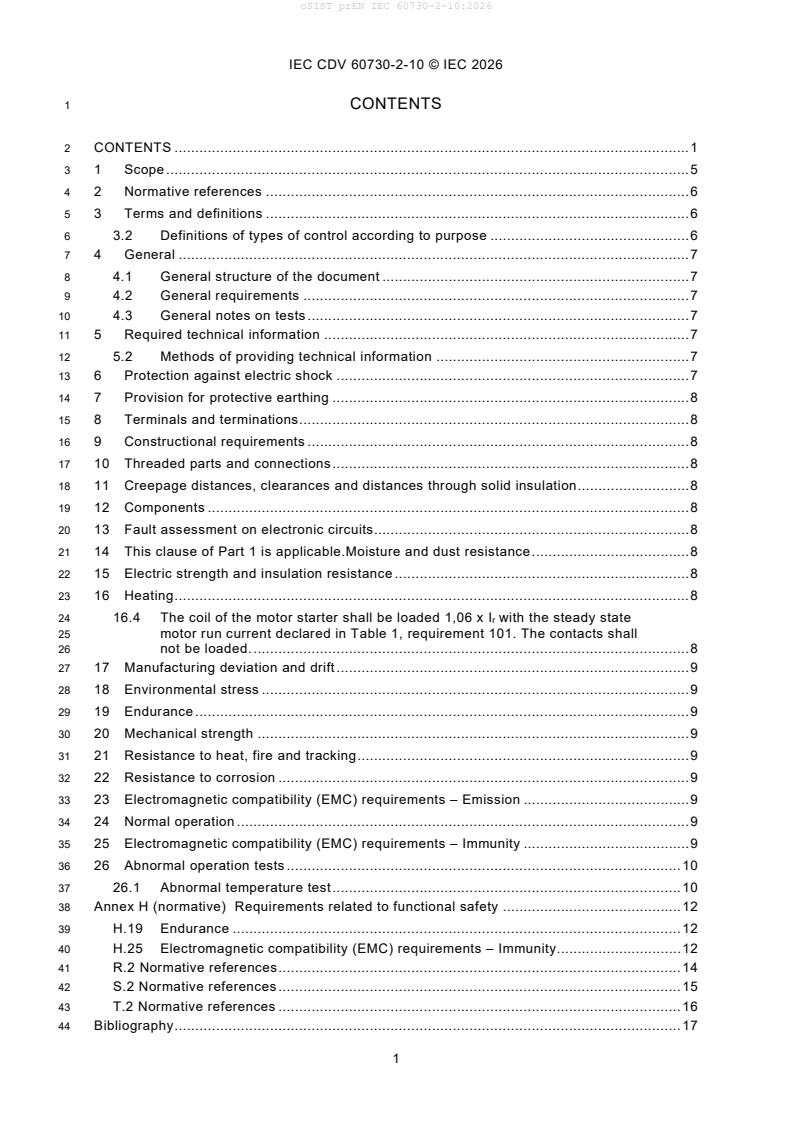
1 CONTENTS
2 CONTENTS . 1
3 1 Scope . 5
4 2 Normative references . 6
5 3 Terms and definitions . 6
6 3.2 Definitions of types of control according to purpose . 6
7 4 General . 7
8 4.1 General structure of the document . 7
9 4.2 General requirements . 7
10 4.3 General notes on tests . 7
11 5 Required technical information . 7
12 5.2 Methods of providing technical information . 7
13 6 Protection against electric shock . 7
14 7 Provision for protective earthing . 8
15 8 Terminals and terminations . 8
16 9 Constructional requirements . 8
17 10 Threaded parts and connections . 8
18 11 Creepage distances, clearances and distances through solid insulation . 8
19 12 Components . 8
20 13 Fault assessment on electronic circuits. 8
21 14 This clause of Part 1 is applicable.Moisture and dust resistance . 8
22 15 Electric strength and insulation resistance . 8
23 16 Heating . 8
24 16.4 The coil of the motor starter shall be loaded 1,06 x I with the steady state
r
25 motor run current declared in Table 1, requirement 101. The contacts shall
26 not be loaded. . 8
27 17 Manufacturing deviation and drift . 9
28 18 Environmental stress . 9
29 19 Endurance . 9
30 20 Mechanical strength . 9
31 21 Resistance to heat, fire and tracking . 9
32 22 Resistance to corrosion . 9
33 23 Electromagnetic compatibility (EMC) requirements – Emission . 9
34 24 Normal operation . 9
35 25 Electromagnetic compatibility (EMC) requirements – Immunity . 9
36 26 Abnormal operation tests . 10
37 26.1 Abnormal temperature test . 10
38 Annex H (normative) Requirements related to functional safety . 12
39 H.19 Endurance . 12
40 H.25 Electromagnetic compatibility (EMC) requirements – Immunity . 12
41 R.2 Normative references . 14
42 S.2 Normative references . 15
43 T.2 Normative references . 16
44 Bibliography . 17
oSIST prEN IEC 60730-2-10:2026
IEC CDV 60730-2-10 © IEC 2026
45 Bibliography . 18
47 Figures . 11
49 Table 1 – Required technical information and methods of providing these information . 7
oSIST prEN IEC 60730-2-10:2026
IEC CDV 60730-2-10 © IEC 2026
51 INTERNATIONAL ELECTROTECHNICAL COMMISSION
52 ____________
54 AUTOMATIC ELECTRICAL CONTROLS –
56 Part 2-10 Particular requirements for motor-starting relays
58 FOREWORD
59 1) The International Electrotechnical Commission (IEC) is a worldwide organization for standardization comprising
60 all national electrotechnical committees (IEC National Committees). The object of IEC is to promote international
61 co-operation on all questions concerning standardization in the electrical and electronic fields. To this end and
62 in addition to other activities, IEC publishes International Standards, Technical Specifications, Technical Reports,
63 Publicly Available Specifications (PAS) and Guides (hereafter referred to as “IEC Publication(s)”). Their
64 preparation is entrusted to technical committees; any IEC National Committee interested in the subject dealt with
65 may participate in this preparatory work. International, governmental and non-governmental organizations liaising
66 with the IEC also participate in this preparation. IEC collaborates closely with the International Organization for
67 Standardization (ISO) in accordance with conditions determined by agreement between the two organizations.
68 2) The formal decisions or agreements of IEC on technical matters express, as nearly as possible, an international
69 consensus of opinion on the relevant subjects since each technical committee has representation from all
70 interested IEC National Committees.
71 3) IEC Publications have the form of recommendations for international use and are accepted by IEC National
72 Committees in that sense. While all reasonable efforts are made to ensure that the technical content of IEC
73 Publications is accurate, IEC cannot be held responsible for the way in which they are used or for any
74 misinterpretation by any end user.
75 4) In order to promote international uniformity, IEC National Committees undertake to apply IEC Publications
76 transparently to the maximum extent possible in their national and regional publications. Any divergence between
77 any IEC Publication and the corresponding national or regional publication shall be clearly indicated in the latter.
78 5) IEC itself does not provide any attestation of conformity. Independent certification bodies provide conformity
79 assessment services and, in some areas, access to IEC marks of conformity. IEC is not responsible for any
80 services carried out by independent certification bodies.
81 6) All users should ensure that they have the latest edition of this publication.
82 7) No liability shall attach to IEC or its directors, employees, servants or agents including individual experts and
83 members of its technical committees and IEC National Committees for any personal injury, property damage or
84 other damage of any nature whatsoever, whether direct or indirect, or for costs (including legal fees) and
85 expenses arising out of the publication, use of, or reliance upon, this IEC Publication or any other IEC
86 Publications.
87 8) Attention is drawn to the Normative references cited in this publication. Use of the referenced publications is
88 indispensable for the correct application of this publication.
89 9) Attention is drawn to the possibility that some of the elements of this IEC Publication may be the subject of patent
90 rights. IEC shall not be held responsible for identifying any or all such patent rights.
91 IEC 60730-2-10 has been prepared by IEC technical committee 72: AUTOMATIC ELECTRICAL
92 CONTROLS. It is an International Standard.
93 This 3.0 edition cancels and replaces the 2.0 edition published in 2006. This edition constitutes
94 a technical revision.
95 This edition includes the following significant technical changes with respect to the previous
96 edition:
97 a) adoption to IEC 60730-1 Ed.6.0 with all of its significant changes.
oSIST prEN IEC 60730-2-10:2026
IEC CDV 60730-2-10 © IEC 2026
98 The text of this International Standard is based on the following documents:
Draft Report on voting
XX/XX/FDIS XX/XX/RVD
100 Full information on the voting for its approval can be found in the report on voting indicated in
101 the above table.
102 The language used for the development of this International Standard is English.
103 This document was drafted in accordance with ISO/IEC Directives, Part 2, and developed in
104 accordance with ISO/IEC Directives, Part 1 and ISO/IEC Directives, IEC Supplement, available
105 at www.iec.ch/members_experts/refdocs. The main document types developed by IEC are
106 described in greater detail at www.iec.ch/publications.
107 A list of all parts of the IEC 60730 series, under the general title: AUTOMATIC ELECTRICAL
108 CONTROLS, can be found on the IEC website.
109 This part 2-10 is intended to be used in conjunction with IEC 60730-1. It was established on the
110 basis of the sixth edition of that standard (2022. Consideration may be given to future editions
111 of, or amendments to, IEC 60730-1.
112 This part 2-10 supplements or modifies the corresponding clauses in IEC 60730-1, so as to
113 convert that publication into the IEC standard: Particular requirements for motor-starting relays.
114 Where this part 2-10 states "addition", "modification" or "replacement", the relevant require-
115 ment, test specification or explanatory matter in part 1 should be adapted accordingly.
116 Where no change is necessary part 2-10 indicates that the relevant clause or subclause applies.
117 In the development of a fully international standard it has been necessary to take into
118 consideration the differing requirements resulting from practical experience in various parts of
119 the world and to recognize the variation in national electrical systems and wiring rules.
120 The reader's attention is drawn to the fact that Annexes Q, R, S and T lists all of the national
121 and regional differences on differing practices of a less permanent nature relating to the subject
122 of this document.
123 In this publication:
124 1) The following print types are used:
125 – requirements proper: in roman type;
126 – test specifications: in italic type;
127 – explanatory matter: in smaller roman type.
128 – Defined terms: bold type.
129 2) Subclauses, notes or items which are additional to those in Part 1 are numbered starting
130 from 101, additional annexes are lettered AA, BB, etc.
131 The committee has decided that the contents of this document will remain unchanged until the
132 stability date indicated on the IEC website under webstore.iec.ch in the data related to the
133 specific document. At this date, the document will be
134 • reconfirmed,
135 • withdrawn,
oSIST prEN IEC 60730-2-10:2026
IEC CDV 60730-2-10 © IEC 2026
136 • replaced by a revised edition, or
137 • amended.
IMPORTANT – The 'colour inside' logo on the cover page of this publication indicates that it
contains colours which are considered to be useful for the correct understanding of its
contents. Users should therefore print this document using a colour printer.
140 AUTOMATIC ELECTRICAL CONTROLS –
142 Part 2-10: Particular requirements for motor-starting relays
146 1 Scope
147 Replacement:
148 This document applies to automatic electrical motor-starting relays
149 • intended to control the start windings of single phase motors
150 • for use in, on, or in association with equipment for household appliance and similar use;
151 NOTE 1 Throughout this document, the word "equipment" means "appliance and equipment" and “control” means
152 “motor-starting relays”.
153 • intended for appliances within the scope of IEC 60335.
154 • for equipment that is used in building automation within the scope of ISO 16484 series and
155 IEC 63044 series (HBES/BACS);
156 • for equipment that is used by the public, such as equipment intended to be used in shops,
157 offices, hospitals, farms and commercial and industrial applications;
158 EXAMPLE 1 Controls for commercial catering, heating and air-conditioning equipment.
159 • Used in, on, or in association with equipment that are smart enabled;
160 EXAMPLE 2 Smart grid control, remote interfaces/control of energy-consuming equipment.
161 • that are AC or DC powered with a rated voltage not exceeding 690 V AC or 600 V DC;
162 • used in, on, or in association with equipment that use electricity, gas, oil, solid fuel, solar
163 thermal energy, etc., or a combination thereof;
164 • utilized as part of a control system or controls which are mechanically integral with
165 multifunctional controls having non-electrical outputs;
166 • using NTC or PTC thermistors, requirements for which are contained in Annex J;
167 • that are mechanically or electrically operated, responsive to or controlling such
168 characteristics as current and voltage, or combinations thereof;
169 EXAMPLE 3 Centrifugal motor-starting devices
170 • as well as manual controls when such are elec
...