

IEC TR 61156-1-5:2013
(Main)Multicore and symmetrical pair/quad cables for digital communications - Part 1-5: Correction procedures for the measurement results of return loss and input impedance
General Information
- Abstract
IEC/TR 61156-1-5:2013(E), which is a Technical Report, describes correction procedures for the measurement results of return loss and input impedance.
- Status
- Published
- Publication Date
- 24-Jun-2013
- Technical Committee
- SC 46C - Wires and symmetric cables
- Current Stage
- PPUB - Publication issued
- Start Date
- 25-Jun-2013
- Completion Date
- 15-Oct-2013
Buy Documents

IEC TR 61156-1-5:2013 - Multicore and symmetrical pair/quad cables for digital communications - Part 1-5: Correction procedures for the measurement results of return loss and input impedance Released:6/25/2013
Overview
IEC TR 61156-1-5:2013 is a Technical Report published by the International Electrotechnical Commission (IEC) addressing multicore and symmetrical pair/quad cables used for digital communications. The main focus of this document is to describe established correction procedures for accurately measuring the return loss and input impedance of these communication cables. Reliable measurement data are essential for ensuring cable performance and compliance in high-speed digital communication infrastructures.
This report provides guidance on mitigating errors introduced during testing, particularly those resulting from cable-end preparation, test fixtures, and stray inductance. By applying the outlined correction methods, manufacturers and test labs can obtain more precise and meaningful data, contributing to better cable design, quality control, and system reliability.
Key Topics
Return Loss Measurement Techniques:
The standard illustrates the importance of return loss as an indicator of impedance matching and overall signal integrity in communication cables. Several ways to measure return loss, such as direct measurement (operational return loss), open/short methods, and techniques for addressing multiple reflections, are discussed.Input Impedance Measurement:
Accurate input impedance measurement is critical for characterizing cable performance, particularly at higher frequencies. The report explains how physical and test setup factors can distort results, necessitating correction.Correction Procedures:
- Parasitic Inductance Correction (PRL): This method addresses the influence of unintended inductance due to test equipment connections, significantly improving measurement accuracy.
- Gated Return Loss (GRL): By transforming frequency-domain data to the time domain, gating can filter out reflections from fixtures and sample preparations, isolating cable-specific results.
- Fitted Return Loss (FRL): This advanced approach uses mathematical fitting techniques (least squares) based on transmission line theory to systematically correct both real and imaginary impedance components.
Practical Guidance:
The report details when and how to apply each correction technique, including recommendations for test setup, frequency range, and sample lengths to ensure valid and reproducible data.
Applications
Product Development and Quality Assurance:
Cable manufacturers benefit from the guidance provided by IEC TR 61156-1-5 to verify and optimize the design of multicore and symmetrical pair/quad cables. Applying these correction procedures helps to meet industry requirements and deliver high-performance products.Testing and Certification:
Laboratories conducting return loss and input impedance measurements rely on these standardized correction methods to provide certification reports or troubleshoot cable installations in the field.Network Installation and Maintenance:
Accurate assessment of cable performance ensures reliable digital communication networks, including LAN, data centers, and telecom infrastructures. The correction procedures outlined help diagnose issues related to signal integrity and compliance.Research and Development:
R&D teams working on new cable designs or materials can use these validated methodologies to compare and innovate with greater confidence in the measurement data.
Related Standards
To ensure comprehensive testing and compatibility, users should consider the following related standards:
- IEC 61156-1: Multicore and symmetrical pair/quad cables for digital communications - Part 1: Generic specification
- IEC/TR 61156-1-2: Part 1-2: Electrical transmission characteristics and test methods of symmetrical pair/quad cables
- IEC/TR 62152: Transmission properties of cascaded two-ports or quadripols - Background of terms and definitions
- IEC 62153-1-1: Metallic communication cables test methods - Electrical - Measurement of the pulse/step return loss
- ASTM D4566: Standard Test Methods for Electrical Performance Properties of Insulations and Jackets for Telecommunications Wire and Cable
By referencing IEC TR 61156-1-5:2013 and related documents, industry professionals can enhance measurement accuracy, support international interoperability, and maintain high standards in digital communications cabling.
Buy Documents
IEC TR 61156-1-5:2013 - Multicore and symmetrical pair/quad cables for digital communications - Part 1-5: Correction procedures for the measurement results of return loss and input impedance Released:6/25/2013
Get Certified
Connect with accredited certification bodies for this standard

BSI Group
BSI (British Standards Institution) is the business standards company that helps organizations make excellence a habit.

Bureau Veritas
Bureau Veritas is a world leader in laboratory testing, inspection and certification services.

DNV
DNV is an independent assurance and risk management provider.
Sponsored listings
Frequently Asked Questions
IEC TR 61156-1-5:2013 is a technical report published by the International Electrotechnical Commission (IEC). Its full title is "Multicore and symmetrical pair/quad cables for digital communications - Part 1-5: Correction procedures for the measurement results of return loss and input impedance". This standard covers: IEC/TR 61156-1-5:2013(E), which is a Technical Report, describes correction procedures for the measurement results of return loss and input impedance.
IEC/TR 61156-1-5:2013(E), which is a Technical Report, describes correction procedures for the measurement results of return loss and input impedance.
IEC TR 61156-1-5:2013 is classified under the following ICS (International Classification for Standards) categories: 03.120.01 - Quality in general; 19.020 - Test conditions and procedures in general; 21.020 - Characteristics and design of machines, apparatus, equipment; 33.120.20 - Wires and symmetrical cables. The ICS classification helps identify the subject area and facilitates finding related standards.
IEC TR 61156-1-5:2013 is available in PDF format for immediate download after purchase. The document can be added to your cart and obtained through the secure checkout process. Digital delivery ensures instant access to the complete standard document.
Standards Content (Sample)
IEC/TR 61156-1-5 ®
Edition 1.0 2013-06
TECHNICAL
REPORT
colour
inside
Multicore and symmetrical pair/quad cables for digital communications –
Part 1-5: Correction procedures for the measurement results of return loss and
input impedance
IEC/TR 61156-1-5:2013(E)
All rights reserved. Unless otherwise specified, no part of this publication may be reproduced or utilized in any form
or by any means, electronic or mechanical, including photocopying and microfilm, without permission in writing from
either IEC or IEC's member National Committee in the country of the requester.
If you have any questions about IEC copyright or have an enquiry about obtaining additional rights to this publication,
please contact the address below or your local IEC member National Committee for further information.
IEC Central Office Tel.: +41 22 919 02 11
3, rue de Varembé Fax: +41 22 919 03 00
CH-1211 Geneva 20 info@iec.ch
Switzerland www.iec.ch
About the IEC
The International Electrotechnical Commission (IEC) is the leading global organization that prepares and publishes
International Standards for all electrical, electronic and related technologies.
About IEC publications
The technical content of IEC publications is kept under constant review by the IEC. Please make sure that you have the
latest edition, a corrigenda or an amendment might have been published.
Useful links:
IEC publications search - www.iec.ch/searchpub Electropedia - www.electropedia.org
The advanced search enables you to find IEC publications The world's leading online dictionary of electronic and
by a variety of criteria (reference number, text, technical electrical terms containing more than 30 000 terms and
committee,…). definitions in English and French, with equivalent terms in
It also gives information on projects, replaced and additional languages. Also known as the International
withdrawn publications. Electrotechnical Vocabulary (IEV) on-line.
IEC Just Published - webstore.iec.ch/justpublished Customer Service Centre - webstore.iec.ch/csc
Stay up to date on all new IEC publications. Just Published If you wish to give us your feedback on this publication
details all new publications released. Available on-line and or need further assistance, please contact the
also once a month by email. Customer Service Centre: csc@iec.ch.
IEC/TR 61156-1-5 ®
Edition 1.0 2013-06
TECHNICAL
REPORT
colour
inside
Multicore and symmetrical pair/quad cables for digital communications –
Part 1-5: Correction procedures for the measurement results of return loss and
input impedance
INTERNATIONAL
ELECTROTECHNICAL
COMMISSION
PRICE CODE
S
ICS 33.120.20 ISBN 978-2-83220-918-9
– 2 – TR 61156-1-5 IEC:2013(E)
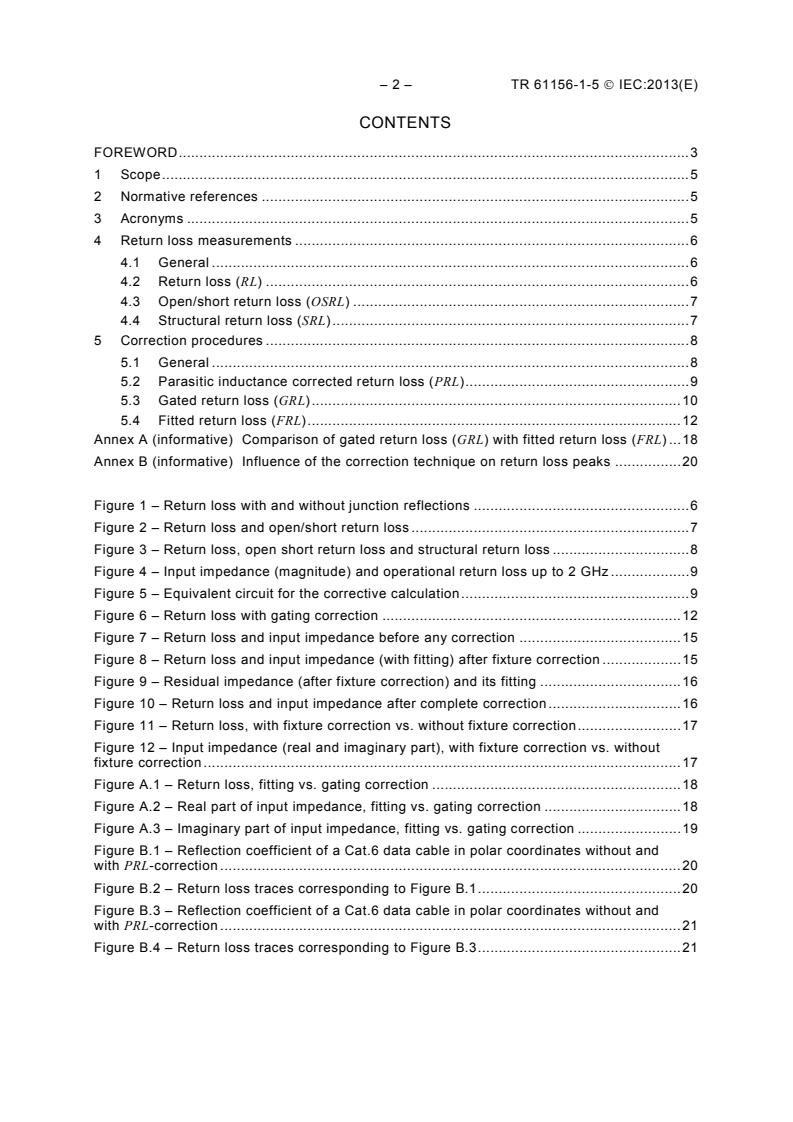
CONTENTS
FOREWORD . 3
1 Scope . 5
2 Normative references . 5
3 Acronyms . 5
4 Return loss measurements . 6
4.1 General . 6
4.2 Return loss (RL) . 6
4.3 Open/short return loss (OSRL) . 7
4.4 Structural return loss (SRL) . 7
5 Correction procedures . 8
5.1 General . 8
5.2 Parasitic inductance corrected return loss (PRL) . 9
5.3 Gated return loss (GRL) . 10
5.4 Fitted return loss (FRL) . 12
Annex A (informative) Comparison of gated return loss (GRL) with fitted return loss (FRL) . 18
Annex B (informative) Influence of the correction technique on return loss peaks . 20
Figure 1 – Return loss with and without junction reflections . 6
Figure 2 – Return loss and open/short return loss . 7
Figure 3 – Return loss, open short return loss and structural return loss . 8
Figure 4 – Input impedance (magnitude) and operational return loss up to 2 GHz . 9
Figure 5 – Equivalent circuit for the corrective calculation . 9
Figure 6 – Return loss with gating correction . 12
Figure 7 – Return loss and input impedance before any correction . 15
Figure 8 – Return loss and input impedance (with fitting) after fixture correction . 15
Figure 9 – Residual impedance (after fixture correction) and its fitting . 16
Figure 10 – Return loss and input impedance after complete correction . 16
Figure 11 – Return loss, with fixture correction vs. without fixture correction . 17
Figure 12 – Input impedance (real and imaginary part), with fixture correction vs. without
fixture correction . 17
Figure A.1 – Return loss, fitting vs. gating correction . 18
Figure A.2 – Real part of input impedance, fitting vs. gating correction . 18
Figure A.3 – Imaginary part of input impedance, fitting vs. gating correction . 19
Figure B.1 – Reflection coefficient of a Cat.6 data cable in polar coordinates without and
with PRL-correction . 20
Figure B.2 – Return loss traces corresponding to Figure B.1 . 20
Figure B.3 – Reflection coefficient of a Cat.6 data cable in polar coordinates without and
with PRL-correction . 21
Figure B.4 – Return loss traces corresponding to Figure B.3 . 21
TR 61156-1-5 IEC:2013(E) – 3 –
INTERNATIONAL ELECTROTECHNICAL COMMISSION
____________
MULTICORE AND SYMMETRICAL PAIR/QUAD
CABLES FOR DIGITAL COMMUNICATIONS –
Part 1-5: Correction procedures for the measurement
results of return loss and input impedance
FOREWORD
1) The International Electrotechnical Commission (IEC) is a worldwide organization for standardization comprising all
national electrotechnical committees (IEC National Committees). The object of IEC is to promote international co-
operation on all questions concerning standardization in the electrical and electronic fields. To this end and in
addition to other activities, IEC publishes International Standards, Technical Specifications, Technical Reports,
Publicly Available Specifications (PAS) and Guides (hereafter referred to as “IEC Publication(s)”). Their
preparation is entrusted to technical committees; any IEC National Committee interested in the subject dealt with
may participate in this preparatory work. International, governmental and non-governmental organizations liaising
with the IEC also participate in this preparation. IEC collaborates closely with the International Organization for
Standardization (ISO) in accordance with conditions determined by agreement between the two organizations.
2) The formal decisions or agreements of IEC on technical matters express, as nearly as possible, an international
consensus of opinion on the relevant subjects since each technical committee has representation from all
interested IEC National Committees.
3) IEC Publications have the form of recommendations for international use and are accepted by IEC National
Committees in that sense. While all reasonable efforts are made to ensure that the technical content of IEC
Publications is accurate, IEC cannot be held responsible for the way in which they are used or for any
misinterpretation by any end user.
4) In order to promote international uniformity, IEC National Committees undertake to apply IEC Publications
transparently to the maximum extent possible in their national and regional publications. Any divergence between
any IEC Publication and the corresponding national or regional publication shall be clearly indicated in the latter.
5) IEC itself does not provide any attestation of conformity. Independent certification bodies provide conformity
assessment services and, in some areas, access to IEC marks of conformity. IEC is not responsible for any
services carried out by independent certification bodies.
6) All users should ensure that they have the latest edition of this publication.
7) No liability shall attach to IEC or its directors, employees, servants or agents including individual experts and
members of its technical committees and IEC National Committees for any personal injury, property damage or
other damage of any nature whatsoever, whether direct or indirect, or for costs (including legal fees) and expenses
arising out of the publication, use of, or reliance upon, this IEC Publication or any other IEC Publications.
8) Attention is drawn to the Normative references cited in this publication. Use of the referenced publications is
indispensable for the correct application of this publication.
9) Attention is drawn to the possibility that some of the elements of this IEC Publication may be the subject of patent
rights. IEC shall not be held responsible for identifying any or all such patent rights.
The main task of IEC technical committees is to prepare International Standards. However, a
technical committee may propose the publication of a technical report when it has collected data
of a different kind from that which is normally published as an International Standard, for
example "state of the art".
IEC/TR 61156-1-5, which is a technical report, has been prepared by subcommittee SC46C:
Wires and symmetric cables, of IEC technical committee TC46: Cables, wires, waveguides, R.F.
connectors, R.F. and microwave passive components and accessories.
The text of this technical report is based on the following documents:
Enquiry draft Report on voting
46C/973/DTR 46C/979/RVC
Full information on the voting for the approval of this technical report can be found in the report
on voting indicated in the above table.
– 4 – TR 61156-1-5 IEC:2013(E)
This publication has been drafted in accordance with the ISO/IEC Directives, Part 2.
A list of all parts in the IEC 61156 series, published under the general title Multicore and
symmetrical pair/quad cables for digital communications, can be found on the IEC website.
The committee has decided that the contents of this publication will remain unchanged until the
stability date indicated on the IEC web site under "http://webstore.iec.ch" in the data related to
the specific publication. At this date, the publication will be
• reconfirmed,
• withdrawn,
• replaced by a revised edition, or
• amended.
A bilingual version of this publication may be issued at a later date.
IMPORTANT – Le logo "colour inside" qui se trouve sur la page de couverture de cette
publication indique qu'elle contient des couleurs qui sont considérées comme utiles à
une bonne compréhension de son contenu. Les utilisateurs devraient, par conséquent,
imprimer cette publication en utilisant une imprimante couleur.
TR 61156-1-5 IEC:2013(E) – 5 –
MULTICORE AND SYMMETRICAL PAIR/QUAD
CABLES FOR DIGITAL COMMUNICATIONS –
Part 1-5: Correction procedures for the measurement
results of return loss and input impedance
1 Scope
This part of IEC 61156 describes correction procedures for the measurement results of return
loss and input impedance.
2 Normative references
The following documents, in whole or in part, are normatively referenced in this document and
are indispensable for its application. For dated references, only the edition cited applies. For
undated references, the latest edition of the referenced document (including any amendments)
applies.
IEC 61156-1, Multicore and symmetrical pair/quad cables for digital communications – Part 1:
Generic specification
IEC/TR 61156-1-2, Multicore and symmetrical pair/quad cables for digital communications –
Part 1-2: Electrical transmission characteristics and test methods of symmetrical pair/quad
cables
IEC/TR 62152, Transmission properties of cascaded two-ports or quadripols – Background of
terms and definitions
IEC 62153-1-1, Metallic communication cables test methods – Part 1-1: Electrical –
Measurement of the pulse/step return loss in the frequency domain using the Inverse Discrete
Fourier Transformation
ASTM D4566:1998, Standard Test Methods for Electrical Performance Properties of Insulations
and Jackets for Telecommunications Wire and Cable
3 Acronyms
CUT cable under test
FRL fitted return loss
GRL gated return loss
IFDT Inverse discrete Fourier transformation
OSRL open short return loss
PRL
parasitic inductance corrected return loss
RL return loss
SRL
structural return loss
– 6 – TR 61156-1-5 IEC:2013(E)
4 Return loss measurements
4.1 General
The return loss of a transmission line (cable) can be obtained by different test methods, each
having certain advantages and/or disadvantages and therefore giving not exactly the same
results. At higher frequencies, the measured return loss is strongly influenced by the cable end
preparation (stray inductances and capacitances play an important role) leading to an
underestimated cable performance. Under laboratory conditions, one might be able to minimize
this negative effect; however under general industrial conditions using automated test systems,
one might need mathematical procedures to eliminate the effect of the cable end preparation.
The results of return loss measurements may also depend on the sample length. Therefore, for
balanced cables according to IEC 61156 series, the specified sample length is at least 100 m (if
not specified otherwise).
4.2 Return loss (RL)
The return loss is obtained by measuring the scattering parameter S11 using a test apparatus of
which the test port has the same reference impedance than the cable under test, and where the
far end of the cable is terminated with its reference impedance (See IEC/TR 62152,
IEC 61156-1). The return loss takes into account the structural variations along the cable and the
mismatch between the reference impedance and the (mean) characteristic impedance of the
pair. If the (mean) characteristic impedance of the pair is different from the reference impedance,
one gets, especially at lower frequencies (where the round trip attenuation is low), multiple
reflections that are overlaid to the structural and junction reflections. Therefore, return loss RL is
also referenced as operational return loss.
NOTE The impedance of a homogenous transmission line is a complex quantity where the real part is decreasing with
frequency and tending to an asymptotic value, the so called characteristic impedance and the imaginary part is also
decreasing from negative values to zero. This “normal” behaviour of a transmission line will also generate multiple
reflections.
As an example, Figure 1 shows the operational return loss under different conditions. The blue
line shows the return loss of a pair having a characteristic impedance equal to the reference
impedance but taking into account that the impedance is varying with frequency (see right-hand
graph). The red line shows the return loss of a pair having a characteristic impedance that is
different from the reference impedance (110 Ω vs. 100 Ω). For both lines, we observe periodic
variations that are caused by multiple reflections between the junctions at the near and far end.
The green line shows a simulation of a pair having a frequency independent characteristic
impedance which is equal to the reference impedance.
frequency dependent factor of the characteristic impedance
Return Loss
1,2 0,2
RLRL w/o mismatch
1,16 0,16
5 RLRL w mismatch
RLRL w /o mismatch; ZZcc frequency independent
1,12 0,12
1,08 0,08
1,04 0,04
1 0
25 Real
Imag
0,96 -0,04
0,92 -0,08
0,88 -0,12
0,84 -0,16
0,8 -0,2
0,1 1 10 100
0,1 1 10 100 MHz
MHz
IEC 1612/13
Figure 1 – Return loss with and without junction reflections
dB
TR 61156-1-5 IEC:2013(E) – 7 –
4.3 Open/short return loss (OSRL)
A way to avoid in the measurement of return loss multiple reflections due to a mismatch between
the characteristic impedance (asymptotic value at high frequencies) of the CUT and the
reference impedance is to use a CUT terminated in its nominal impedance and having a very
long test length such that the round trip attenuation of the CUT is at least 40 dB at the lowest
frequency to be measured. For standard LAN cables, this would result in a CUT length of roughly
1 000 m for the lowest frequency of 1 MHz.
Another way (when long CUT length is not available) is to measure the characteristic impedance
(open/short method, see IEC/TR 62152) and to calculate the return loss. As the characteristic
impedance is obtained from the measurement of the open and short circuit impedance, it is
proposed to name such obtained return loss open/short return loss.
This open/short return loss includes the effect of structural variations and the mismatch at the
near end (including the effect due to a frequency-dependent characteristic impedance), but it
does not take into account multiple reflections.
Figure 2 shows the difference between operational return loss and open/short return loss. The
left-hand graph shows the results of a pair having a characteristic impedance which is different
from the reference impedance (110 Ω vs. 100 Ω). The right-hand graph shows the results of a
pair having a characteristic impedance which is equal to the reference impedance (100 Ω). We
recognize that the open/short return loss does not take into account multiple reflections.
Return Loss Return Loss
0 0
RL RLRL w /o mismatch
RL w mismatch
5 5
OSOSRLRL w/o mismatch
OSOSRLRL w mismatch
10 10
15 15
20 20
25 25
30 30
35 35
40 40
45 45
50 50
0,1 1 10 100 0,1 1 10 100
MHz MHz
IEC 1613/13
Figure 2 – Return loss and open/short return loss
4.4 Structural return loss (SRL)
The structural return loss is the return loss where only structural variations along the cable are
taken into account. The mismatch effects at the input and output of the transmission line
(including the effect due to a frequency-dependent characteristic impedance) have been
eliminated (see IEC/TR 62152). The structural return loss cannot be measured directly but is
calculated from the measurement of the characteristic impedance (open/short method).
Z − Z
CM C
SRL= 20⋅ log (1)
Z + Z
CM C
where
Z is the (complex) mean characteristic impedance obtained from the measurement of the
CM
open and short circuit impedance;
dB
dB
– 8 – TR 61156-1-5 IEC:2013(E)
Z is the (complex) characteristic impedance obtained from a curve fitting of the real and
C
imaginary part of Z .
CM
The left-hand graph of Figure 3 shows the operational return loss, open/short return loss and
structural return loss of a CUT having a characteristic impedance of 110 Ω. We clearly see the
differences between them. The operational return loss takes into account all effects (structural
variations, mismatch effects at the input and output). The open/short return loss does not take
into account mismatch effects at the output (i.e. no multiple reflections). Whereas the structural
return loss only takes into account structural variations along the cable.
The right-hand graph shows the real and imaginary part of the mean characteristic impedance
(obtained from the measurement of the open and short circuit impedance) and it’s fitting.
Return Loss Mean Characteristic Impedance
0 140 80
RLRL
OSOSRLRL 130 70
SSRLRL
120 60
110 50
100 40
Re(Zos)
fitted Re(Zos)
40 90 30
Im(Zos)
fitted Im(Zos)
80 20
70 10
60 0
50 -10
80 40 -20
0,1 1 10 100 0,1 1 10 100
MHz MHz
IEC 1614/13
Figure 3 – Return loss, open short return loss and structural return loss
5 Correction procedures
5.1 General
From the transmission line theory we know that the characteristic impedance is decreasing with
frequency and approaching an asymptotic value (assuming dielectrics having an almost
frequency-independent dielectric constant). Therefore an asymptotic value is assumed in the
described correction procedures.
However measurements at higher frequencies often show an increase of the characteristic
impedance. This is due to the cable end preparation and related stray inductances and
capacitances. In fact we can consider the CUT as a cascade of 3 transmission lines, the two
cable ends and the cable, or even 5 lines taking into account the test fixtures.
Figure 4 shows the results of an S/FTP cable obtained with an automated test system. On the
left-hand side we see the input impedance (magnitude) and its fitting and on the right-hand side
the operational return loss. One can recognize the above-described effect of increasing
impedance and related decreasing return loss. Thus correction procedures are needed.
dB
Real Part [Ohm]
Imaginary Part [Ohm]
TR 61156-1-5 © IEC:2013(E) – 9 –
Input Impedance Operational Return Loss
180 0
100 25
20 50
0 200 400 600 800 1000 1200 1400 1600 1800 2000 0 200 400 600 800 1000 1200 1400 1600 1800 2000
MHz MHz
IEC
...