

IEC 61800-5-3:2021
(Main)Adjustable speed electrical power drive systems - Part 5-3: Safety requirements - Functional, electrical and environmental requirements for encoders
General Information
- Abstract
IEC 61800-5-3:2021, which is a product standard, specifies requirements and makes recommendations for the design and development, integration and validation of safety-related encoder (Encoder(SR)) in terms of their functional safety considerations, electrical safety and environmental conditions. It applies to Encoder(SR), being sensors as part of a PDS(SR). This document can also be referred to and used for Encoder(SR) in any other safety-related application, for example safety-related position monitoring.
This document is applicable where functional safety of an encoder is claimed and the Encoder(SR) is operating mainly in the high demand or continuous mode. The requirements of IEC 61800-5-2:2016 for PDS(SR) apply to Encoder(SR) as applicable.
This document includes additional or different requirements for Encoder(SR). It sets out safety-related considerations of Encoder(SR) in terms of the framework of IEC 61508 (all parts), and introduces requirements for Encoder(SR) as subsystems of a safety-related system. It is intended to facilitate the realisation of the electrical/electronic/programmable electronic (E/E/PE) and mechanical parts of an Encoder(SR) in relation to the safety performance of safety sub-function(s) of an Encoder(SR).
- Status
- Published
- Publication Date
- 22-Feb-2021
- Technical Committee
- SC 22G - Adjustable speed electric power drive systems (PDS)
- Drafting Committee
- PT 61800-5-3 - TC 22/SC 22G/PT 61800-5-3
- Current Stage
- PPUB - Publication issued
- Start Date
- 23-Feb-2021
- Completion Date
- 05-Mar-2021
Buy Documents
IEC 61800-5-3:2021 - Adjustable speed electrical power drive systems - Part 5-3: Safety requirements - Functional, electrical and environmental requirements for encoders Released:2/23/2021
Overview
IEC 61800-5-3:2021 is an international standard developed by the International Electrotechnical Commission (IEC) that sets safety requirements for encoders used in adjustable speed electrical power drive systems. This standard specifically addresses the functional, electrical, and environmental requirements for safety-related encoders (Encoder(SR)) that are integral components of safety-related power drive systems (PDS(SR)).
The document applies when the functional safety of encoders is claimed, especially in high demand or continuous operation modes. It aligns with the framework of IEC 61508, covering electrical/electronic/programmable electronic (E/E/PE) and mechanical design aspects to ensure the safety performance of safety sub-functions associated with encoder devices.
Key Topics
Scope and Applicability: The standard covers Encoder(SR) used predominantly in adjustable speed drives, providing guidelines for design, development, integration, and validation from a safety perspective.
Functional Safety Sub-functions:
- Safe Incremental Position (SIP)
- Safe Absolute Position (SAP)
- Safe Speed Value (SSV)
- Safe Acceleration Value (SAV)
- Safety sub-functions for evaluation and signalling
Design Requirements:
- Compliance with relevant design standards for electrical and mechanical components
- Fault detection mechanisms critical to ensuring reliable Encoder(SR) operation
- Specific design guidelines for encoders with sine, cosine, incremental, absolute output signals, and resolvers
- Mechanical design including fastenings, connecting elements, and bearings
- Signal generation and processing requirements, including for optical and magnetic encoders
- Software considerations for safe encoder operation
- Immunity to thermal and mechanical stresses
- Integration of connection cables and parameterization of encoder settings
Verification and Testing:
- Hardware fault tolerance
- Functional and EM (electromagnetic) immunity testing
- Thermal and mechanical immunity tests, including vibration and shock resistance
- Material suitability and contamination control
- Labeling accuracy and clarity along with instruction compliance
Management of Functional Safety: Emphasizes comprehensive safety management throughout encoder lifecycle stages with validation and verification processes outlined.
Applications
Adjustable Speed Drives: Ensures safe operation of encoder systems within electrical power drive mechanisms used in industrial automation, robotics, manufacturing, and process control.
Safety-Related Position Monitoring: Suitable for applications requiring high-integrity position sensing such as in automated safety systems, emergency stops, and position validation.
High Demand Functional Safety Environments: Applies in scenarios where encoders are subjected to continuous or high-frequency usage requiring reliable safety sub-function performance.
Electrical and Mechanical Safety: Relevant for any electrically driven machinery requiring robust encoders that meet strict environmental and electrical safety criteria.
Related Standards
IEC 61800-5-2:2016 – General functional safety requirements for power drive systems providing foundational safety principles applied to Encoder(SR).
IEC 61508 (all parts) – International standard for the functional safety of electrical/electronic/programmable electronic safety-related systems; the basis for Encoder(SR) safety design frameworks.
IEC 61800 Series – Covers the broader scope of adjustable speed electrical power drive systems ensuring overall system safety and performance.
Keywords: IEC 61800-5-3, adjustable speed power drive systems, safety requirements, safety-related encoders, functional safety, electrical safety, environmental requirements, encoder design, encoder validation, high demand operation, encoder fault detection, power drive safety standards.
Buy Documents
IEC 61800-5-3:2021 - Adjustable speed electrical power drive systems - Part 5-3: Safety requirements - Functional, electrical and environmental requirements for encoders Released:2/23/2021
Get Certified
Connect with accredited certification bodies for this standard

DNV
DNV is an independent assurance and risk management provider.

Lloyd's Register
Lloyd's Register is a global professional services organisation specialising in engineering and technology.

FSC International
Forest Stewardship Council certification.
Sponsored listings
Frequently Asked Questions
IEC 61800-5-3:2021 is a standard published by the International Electrotechnical Commission (IEC). Its full title is "Adjustable speed electrical power drive systems - Part 5-3: Safety requirements - Functional, electrical and environmental requirements for encoders". This standard covers: IEC 61800-5-3:2021, which is a product standard, specifies requirements and makes recommendations for the design and development, integration and validation of safety-related encoder (Encoder(SR)) in terms of their functional safety considerations, electrical safety and environmental conditions. It applies to Encoder(SR), being sensors as part of a PDS(SR). This document can also be referred to and used for Encoder(SR) in any other safety-related application, for example safety-related position monitoring. This document is applicable where functional safety of an encoder is claimed and the Encoder(SR) is operating mainly in the high demand or continuous mode. The requirements of IEC 61800-5-2:2016 for PDS(SR) apply to Encoder(SR) as applicable. This document includes additional or different requirements for Encoder(SR). It sets out safety-related considerations of Encoder(SR) in terms of the framework of IEC 61508 (all parts), and introduces requirements for Encoder(SR) as subsystems of a safety-related system. It is intended to facilitate the realisation of the electrical/electronic/programmable electronic (E/E/PE) and mechanical parts of an Encoder(SR) in relation to the safety performance of safety sub-function(s) of an Encoder(SR).
IEC 61800-5-3:2021, which is a product standard, specifies requirements and makes recommendations for the design and development, integration and validation of safety-related encoder (Encoder(SR)) in terms of their functional safety considerations, electrical safety and environmental conditions. It applies to Encoder(SR), being sensors as part of a PDS(SR). This document can also be referred to and used for Encoder(SR) in any other safety-related application, for example safety-related position monitoring. This document is applicable where functional safety of an encoder is claimed and the Encoder(SR) is operating mainly in the high demand or continuous mode. The requirements of IEC 61800-5-2:2016 for PDS(SR) apply to Encoder(SR) as applicable. This document includes additional or different requirements for Encoder(SR). It sets out safety-related considerations of Encoder(SR) in terms of the framework of IEC 61508 (all parts), and introduces requirements for Encoder(SR) as subsystems of a safety-related system. It is intended to facilitate the realisation of the electrical/electronic/programmable electronic (E/E/PE) and mechanical parts of an Encoder(SR) in relation to the safety performance of safety sub-function(s) of an Encoder(SR).
IEC 61800-5-3:2021 is classified under the following ICS (International Classification for Standards) categories: 13.110 - Safety of machinery; 29.130.99 - Other switchgear and controlgear; 29.200 - Rectifiers. Convertors. Stabilized power supply; 47.020.60 - Electrical equipment of ships and of marine structures. The ICS classification helps identify the subject area and facilitates finding related standards.
IEC 61800-5-3:2021 is available in PDF format for immediate download after purchase. The document can be added to your cart and obtained through the secure checkout process. Digital delivery ensures instant access to the complete standard document.
Standards Content (Sample)
IEC 61800-5-3 ®
Edition 1.0 2021-02
INTERNATIONAL
STANDARD
NORME
INTERNATIONALE
colour
inside
Adjustable speed electrical power drive systems –
Part 5-3: Safety requirements – Functional, electrical and environmental
requirements for encoders
Entraînements électriques de puissance à vitesse variable –
Partie 5-3: Exigences de sécurité – Exigences fonctionnelle, électrique et
environnementale pour codeurs
All rights reserved. Unless otherwise specified, no part of this publication may be reproduced or utilized in any form
or by any means, electronic or mechanical, including photocopying and microfilm, without permission in writing from
either IEC or IEC's member National Committee in the country of the requester. If you have any questions about IEC
copyright or have an enquiry about obtaining additional rights to this publication, please contact the address below or
your local IEC member National Committee for further information.
Droits de reproduction réservés. Sauf indication contraire, aucune partie de cette publication ne peut être reproduite
ni utilisée sous quelque forme que ce soit et par aucun procédé, électronique ou mécanique, y compris la photocopie
et les microfilms, sans l'accord écrit de l'IEC ou du Comité national de l'IEC du pays du demandeur. Si vous avez des
questions sur le copyright de l'IEC ou si vous désirez obtenir des droits supplémentaires sur cette publication, utilisez
les coordonnées ci-après ou contactez le Comité national de l'IEC de votre pays de résidence.
IEC Central Office Tel.: +41 22 919 02 11
3, rue de Varembé info@iec.ch
CH-1211 Geneva 20 www.iec.ch
Switzerland
About the IEC
The International Electrotechnical Commission (IEC) is the leading global organization that prepares and publishes
International Standards for all electrical, electronic and related technologies.
About IEC publications
The technical content of IEC publications is kept under constant review by the IEC. Please make sure that you have the
latest edition, a corrigendum or an amendment might have been published.
IEC publications search - webstore.iec.ch/advsearchform IEC online collection - oc.iec.ch
The advanced search enables to find IEC publications by a Discover our powerful search engine and read freely all the
variety of criteria (reference number, text, technical publications previews. With a subscription you will always
committee, …). It also gives information on projects, replaced have access to up to date content tailored to your needs.
and withdrawn publications.
Electropedia - www.electropedia.org
IEC Just Published - webstore.iec.ch/justpublished
The world's leading online dictionary on electrotechnology,
Stay up to date on all new IEC publications. Just Published
containing more than 22 000 terminological entries in English
details all new publications released. Available online and
and French, with equivalent terms in 18 additional languages.
once a month by email.
Also known as the International Electrotechnical Vocabulary
(IEV) online.
IEC Customer Service Centre - webstore.iec.ch/csc
If you wish to give us your feedback on this publication or
need further assistance, please contact the Customer Service
Centre: sales@iec.ch.
A propos de l'IEC
La Commission Electrotechnique Internationale (IEC) est la première organisation mondiale qui élabore et publie des
Normes internationales pour tout ce qui a trait à l'électricité, à l'électronique et aux technologies apparentées.
A propos des publications IEC
Le contenu technique des publications IEC est constamment revu. Veuillez vous assurer que vous possédez l’édition la
plus récente, un corrigendum ou amendement peut avoir été publié.
Recherche de publications IEC - IEC online collection - oc.iec.ch
webstore.iec.ch/advsearchform Découvrez notre puissant moteur de recherche et consultez
La recherche avancée permet de trouver des publications IEC gratuitement tous les aperçus des publications. Avec un
en utilisant différents critères (numéro de référence, texte, abonnement, vous aurez toujours accès à un contenu à jour
comité d’études, …). Elle donne aussi des informations sur adapté à vos besoins.
les projets et les publications remplacées ou retirées.
Electropedia - www.electropedia.org
IEC Just Published - webstore.iec.ch/justpublished
Le premier dictionnaire d'électrotechnologie en ligne au
Restez informé sur les nouvelles publications IEC. Just
monde, avec plus de 22 000 articles terminologiques en
Published détaille les nouvelles publications parues.
anglais et en français, ainsi que les termes équivalents dans
Disponible en ligne et une fois par mois par email.
16 langues additionnelles. Egalement appelé Vocabulaire
Electrotechnique International (IEV) en ligne.
Service Clients - webstore.iec.ch/csc
Si vous désirez nous donner des commentaires sur cette
publication ou si vous avez des questions contactez-nous:
sales@iec.ch.
IEC 61800-5-3 ®
Edition 1.0 2021-02
INTERNATIONAL
STANDARD
NORME
INTERNATIONALE
colour
inside
Adjustable speed electrical power drive systems –
Part 5-3: Safety requirements – Functional, electrical and environmental
requirements for encoders
Entraînements électriques de puissance à vitesse variable –
Partie 5-3: Exigences de sécurité – Exigences fonctionnelle, électrique et
environnementale pour codeurs
INTERNATIONAL
ELECTROTECHNICAL
COMMISSION
COMMISSION
ELECTROTECHNIQUE
INTERNATIONALE
ICS 13.110; 29.130.99; 29.200 ISBN 978-2-8322-9400-0
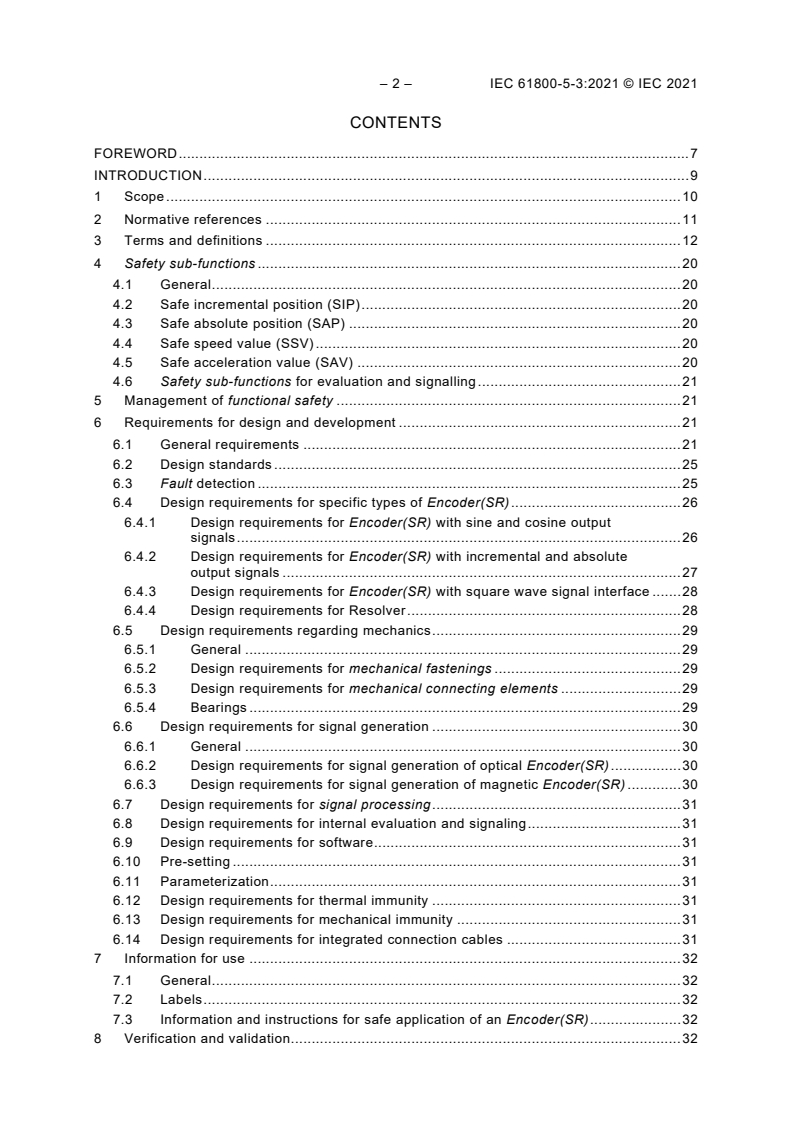
– 2 – IEC 61800-5-3:2021 © IEC 2021
CONTENTS
FOREWORD . 7
INTRODUCTION . 9
1 Scope . 10
2 Normative references . 11
3 Terms and definitions . 12
4 Safety sub-functions . 20
4.1 General . 20
4.2 Safe incremental position (SIP) . 20
4.3 Safe absolute position (SAP) . 20
4.4 Safe speed value (SSV) . 20
4.5 Safe acceleration value (SAV) . 20
4.6 Safety sub-functions for evaluation and signalling . 21
5 Management of functional safety . 21
6 Requirements for design and development . 21
6.1 General requirements . 21
6.2 Design standards . 25
6.3 Fault detection . 25
6.4 Design requirements for specific types of Encoder(SR) . 26
6.4.1 Design requirements for Encoder(SR) with sine and cosine output
signals . 26
6.4.2 Design requirements for Encoder(SR) with incremental and absolute
output signals . 27
6.4.3 Design requirements for Encoder(SR) with square wave signal interface . 28
6.4.4 Design requirements for Resolver . 28
6.5 Design requirements regarding mechanics . 29
6.5.1 General . 29
6.5.2 Design requirements for mechanical fastenings . 29
6.5.3 Design requirements for mechanical connecting elements . 29
6.5.4 Bearings . 29
6.6 Design requirements for signal generation . 30
6.6.1 General . 30
6.6.2 Design requirements for signal generation of optical Encoder(SR) . 30
6.6.3 Design requirements for signal generation of magnetic Encoder(SR) . 30
6.7 Design requirements for signal processing . 31
6.8 Design requirements for internal evaluation and signaling . 31
6.9 Design requirements for software . 31
6.10 Pre-setting . 31
6.11 Parameterization . 31
6.12 Design requirements for thermal immunity . 31
6.13 Design requirements for mechanical immunity . 31
6.14 Design requirements for integrated connection cables . 31
7 Information for use . 32
7.1 General . 32
7.2 Labels . 32
7.3 Information and instructions for safe application of an Encoder(SR) . 32
8 Verification and validation . 32
8.1 General . 32
8.2 Verification of hardware fault tolerance . 32
8.3 Additional verification for Encoder(SR) with sine and cosine output signals. 32
8.3.1 Verification of diagnostic measures for Encoder(SR) with sine and
cosine output signals with HFT = 0 . 32
8.3.2 Suitability for interpolation . 32
8.4 Qualitative FMEDA . 33
8.5 Quantification. 34
9 Test requirements . 34
9.1 General . 34
9.2 Planning of tests . 34
9.3 Functional testing . 34
9.4 Electromagnetic (EM) and electrical immunity testing . 34
9.4.1 Electrical tests . 34
9.4.2 Electromagnetic (EM) immunity testing . 35
9.5 Thermal immunity testing . 35
9.5.1 General . 35
9.5.2 Dry cold . 35
9.5.3 Dry heat . 35
9.5.4 Damp heat . 36
9.5.5 Temperature rise test . 36
9.6 Mechanical immunity testing . 36
9.6.1 Clearances and creepage distances . 36
9.6.2 Short-circuit testing of printed wiring boards . 36
9.6.3 Mechanical fastenings . 36
9.6.4 Mechanical connecting elements . 36
9.6.5 Vibration and shock test . 37
9.6.6 Mechanical properties of integrated connecting cables . 38
9.6.7 Testing the non-touchability . 38
9.6.8 Deformation testing . 38
9.7 Material tests . 38
9.8 Suitability of the components and materials used . 38
9.9 Contamination of solid measure . 39
9.10 Labels . 39
9.11 Instructions . 39
9.12 Test documentation . 39
10 Modification . 39
Annex A (informative) Types of Encoder(SR) . 40
Annex B (informative) Universal architecture of Encoder(SR) . 43
B.1 General . 43
B.2 The universal Encoder(SR) architecture . 43
Annex C (informative) Examples of suitable mechanical tests for rotary Encoder(SR) . 44
C.1 General . 44
C.2 Mechanical fastening of the Encoder(SR) . 44
C.2.1 Force-locked connection (e.g. by bolted joints) . 44
C.2.2 Form-locked connection (e.g. by feather key) . 44
C.3 Mechanical connecting elements of the Encoder(SR) – Stator coupling
(torque support) or shaft-rotor coupling . 45
C.3.1 General . 45
– 4 – IEC 61800-5-3:2021 © IEC 2021
C.3.2 Axial loads . 45
C.3.3 Radial loads . 45
Annex D (informative) Extended shock testing for rotary Encoder(SR) mounted to
motors . 47
D.1 General . 47
D.2 Pseudo-velocity shock-response spectrum (PVSRS) . 47
D.3 Verification of resilience . 47
D.4 Testing machine . 48
Annex E (informative) Dimensioning of clearances and creepage distances on printed
wiring boards – Example . 50
E.1 General . 50
E.2 Assumptions . 50
E.3 Application of IEC 61800-5-1:2007, 5.2.2.1 . 50
Annex F (normative) Information and instructions – Detailed list . 51
F.1 Overview. 51
F.2 Detailed list . 51
Annex G (informative) Encoder(SR) fault lists and fault exclusions . 54
Annex H (informative) Quantification . 58
H.1 General . 58
H.2 Safety architecture and safety-related block diagram . 58
H.3 Failure rates . 59
H.4 Failure rates at realistic working temperatures . 60
H.5 Quantitative FMEDA and assessment of diagnostic measures . 61
H.6 Estimation of the common cause factor β (only in case of redundancy) . 62
H.7 Estimation of the PFH . 62
H.8 Safe failure fraction (SFF) . 62
H.9 Determination of the quantitative SIL capability . 63
H.9.1 General . 63
H.9.2 SIL limit by architectural constraints . 63
H.9.3 SIL limit by PFH . 63
H.10 Additional considerations to comply with ISO 13849-1 . 64
H.10.1 General . 64
H.10.2 MTTF of a channel . 64
D
H.10.3 Determination of the quantitative category capability . 64
H.10.4 Determination of the quantitative PL-capability . 64
Annex I (informative) Digital processing of sine/cosine signals . 65
I.1 General . 65
I.2 Sampling of sine and cosine signals . 65
I.3 Consequences . 66
I.4 Measures to improve DC . 67
Annex J (informative) Single channel architecture with ideal fault detection . 68
J.1 General . 68
J.2 Ideal fault detection for Encoder(SR) with sine and cosine output signals . 68
Annex K (informative) Specifics for single channel incremental Encoder(SR) with sine
and cosine output signals . 70
K.1 General . 70
K.2 Single-fault tolerance . 70
K.3 Undetectable faults . 70
K.4 Fault detection (DC) . 70
Annex L (normative) Static analysis of signal evaluation and fault detection . 72
L.1 General . 72
L.2 Motivation for the analysis of signal evaluation and fault detection . 72
L.3 What does "static analysis of signal processing" mean? . 72
L.4 Standard test signals . 76
L.4.1 Make test signal available (step 1) . 76
L.4.2 Test signal 1 . 79
L.4.3 Test signal 2 . 79
L.4.4 Test signal 3 . 80
L.4.5 Test signal 4 . 80
L.4.6 Test signal 5 . 81
L.5 Simulation of signal processing to specification . 81
L.5.1 General . 81
L.5.2 Form differential signals (step 2). 83
L.5.3 Form square-wave signals to specification (Schmitt trigger, step 3) . 83
L.5.4 Perform specified diagnostics (step 4) . 83
L.6 Assessment of the signal processing specification . 84
L.6.1 General . 84
L.6.2 Assessment concept for the signal processing specification . 85
L.7 FMEDA Encoder(SR) for verification of the diagnostic coverage . 88
L.7.1 General . 88
L.7.2 Explanation of the problem . 88
L.7.3 Procedure for FMEDA . 90
L.8 List of variables used for performing static analysis . 92
L.9 MS Excel tool for performance of static analysis . 93
Annex M (informative) Aspects of diagnostic measures for obtaining incremental
position values . 94
M.1 General . 94
M.2 Obtaining position values from incremental signals . 94
M.3 Phase error of the sine and the cosine signals . 96
M.3.1 General . 96
M.3.2 Phase errors with absolute values < 90° . 96
M.3.3 Phase errors with absolute values > 90° . 99
M.4 Threshold errors of the square wave signal shapers . 100
M.4.1 General . 100
M.4.2 Asymmetric switching thresholds . 101
M.4.3 Unequal switching hysteresis at the square wave shaping for sine and
cosine . 101
Bibliography . 103
Figure 1 – Context of Encoder(SR) . 11
Figure 2 – Example of hardware architecture of Encoder(SR) with incremental and
absolute output signal . 28
Figure B.1 – Universal Encoder(SR) architecture . 43
Figure C.1 – Example of an additional ring for assembly with eccentricity x . 46
Figure D.1 – Sample shock and corresponding PVSRS on 4CP . 47
Figure D.2 – Testing machine . 48
– 6 – IEC 61800-5-3:2021 © IEC 2021
Figure I.1 – Digital sampling of sine and cosine signals – Hardware architecture,
example . 65
Figure I.2 – Lissajous figures of the sine and cosine signals A and B . 66
Figure L.1 – Static analysis concept . 73
Figure L.2 – Static analysis procedure (for one test signal) with variable
denominations . 76
Figure L.3 – Substitute circuit for Encoder(SR)’s outbound interface . 77
Figure L.4 – Example of a circuit for evaluation of the output signals and diagnostics
of Encoder(SR) faults . 82
Figure L.5 – Lissajous diagrams (representation of signal B over signal A) in two fault
cases . 90
Figure L.6 – Examples of the dual effect of a single component fault . 91
Figure M.1 – Obtaining position values from incremental signals . 95
Figure M.2 – Counting pulse generation, faultless case . 96
Figure M.3 – Counting pulse generation with a phase error of 20° . 97
Figure M.4 – Lissajous diagram with a phase error ∆ϕ = 20° . 98
Figure M.5 – Square-wave signal generation by means of a Schmitt trigger . 100
Figure M.6 – Counting pulse generation with asymmetric switching thresholds . 101
Figure M.7 – Counting pulse generation with unequal switching hysteresis . 102
Table 1 – List of terms . 13
Table 2 – Applicable subclauses of IEC 61800-5-2:2016 for Encoder(SR) and
respective modifications . 21
Table 3 – Applicable references of IEC 61800-5-1:2007 and IEC 61800-5-
1:2007/AMD1:2016 for Encoder(SR) and respective modifications . 23
Table A.1 – Types of Encoder(SR) . 40
Table B.1 – Function blocks of the universal Encoder(SR) architecture . 43
Table G.1 – Encoder(SR) – Mechanic fault list and fault exclusions . 55
Table G.2 – Faults and fault exclusions for the selection, mounting and operation of
rolling bearings . 56
Table G.3 – Factors influencing the malfunctioning of rolling bearings –
Considerations for selection, mounting and operation . 56
Table H.1 – Components for Encoder(SR) and their inclusion in quantification. 59
INTERNATIONAL ELECTROTECHNICAL COMMISSION
____________
ADJUSTABLE SPEED ELECTRICAL POWER DRIVE SYSTEMS –
Part 5-3: Safety requirements –
Functional, electrical and environmental requirements for encoders
FOREWORD
1) The International Electrotechnical Commission (IEC) is a worldwide organization for standardization comprising
all national electrotechnical committees (IEC National Committees). The object of IEC is to promote international
co-operation on all questions concerning standardization in the electrical and electronic fields. To this end and
in addition to other activities, IEC publishes International Standards, Technical Specifications, Technical Reports,
Publicly Available Specifications (PAS) and Guides (hereafter referred to as "IEC Publication(s)"). Their
preparation is entrusted to technical committees; any IEC National Committee interested in the subject dealt with
may participate in this preparatory work. International, governmental and non-governmental organizations liaising
with the IEC also participate in this preparation. IEC collaborates closely with the International Organization for
Standardization (ISO) in accordance with conditions determined by agreement between the two organizations.
2) The formal decisions or agreements of IEC on technical matters express, as nearly as possible, an international
consensus of opinion on the relevant subjects since each technical committee has representation from all
interested IEC National Committees.
3) IEC Publications have the form of recommendations for international use and are accepted by IEC National
Committees in that sense. While all reasonable efforts are made to ensure that the technical content of IEC
Publications is accurate, IEC cannot be held responsible for the way in which they are used or for any
misinterpretation by any end user.
4) In order to promote international uniformity, IEC National Committees undertake to apply IEC Publications
transparently to the maximum extent possible in their national and regional publications. Any divergence between
any IEC Publication and the corresponding national or regional publication shall be clearly indicated in the latter.
5) IEC itself does not provide any attestation of conformity. Independent certification bodies provide conformity
assessment services and, in some areas, access to IEC marks of conformity. IEC is not responsible for any
services carried out by independent certification bodies.
6) All users should ensure that they have the latest edition of this publication.
7) No liability shall attach to IEC or its directors, employees, servants or agents including individual experts and
members of its technical committees and IEC National Committees for any personal injury, property damage or
other damage of any nature whatsoever, whether direct or indirect, or for costs (including legal fees) and
expenses arising out of the publication, use of, or reliance upon, this IEC Publication or any other IEC
Publications.
8) Attention is drawn to the Normative references cited in this publication. Use of the referenced publications is
indispensable for the correct application of this publication.
9) Attention is drawn to the possibility that some of the elements of this IEC Publication may be the subject of patent
rights. IEC shall not be held responsible for identifying any or all such patent rights.
International Standard IEC 61800-5-3 has been prepared by subcommittee 22G: Adjustable
speed electric power drive systems (PDS), of IEC technical committee 22: Power electronic
systems and equipment.
The text of this International Standard is based on the following documents:
FDIS Report on voting
22G/431/FDIS 22G/434/RVD
Full information on the voting for the approval of this International Standard can be found in the
report on voting indicated in the above table.
This document has been drafted in accordance with the ISO/IEC Directives, Part 2.
Terms in italics are defined in Clause 3.
– 8 – IEC 61800-5-3:2021 © IEC 2021
A list of all parts in the IEC 61800 series, published under the general title Adjustable speed
electrical power drive systems, can be found on the IEC website.
The committee has decided that the contents of this document will remain unchanged until the
stability date indicated on the IEC website under "http://webstore.iec.ch" in the data related to
the specific document. At this date, the document will be
• reconfirmed,
• withdrawn,
• replaced by a revised edition, or
• amended.
IMPORTANT – The 'colour inside' logo on the cover page of this publication indicates that it
contains colours which are considered to be useful for the correct understanding of its
contents. Users should therefore print this document using a colour printer.
INTRODUCTION
As a result of automation, demand for increased production and reduced operator physical
effort, control systems of machinery and plant items play an increasing role in the achievement
of overall safety. These control systems increasingly employ complex
electrical/electronic/programmable electronic devices and systems.
Prominent amongst these devices and systems are encoder which are for example applied to
measure angle and position of machine parts for use in safety-related applications
(Encoder(SR)). Based on the Encoder(SR)’s output signals, PDS(SR) or other evaluation units
calculate for example speed, acceleration, absolute position, etc., to perform their safety sub-
functions SLS, SLA, SLP and others (see IEC 61800-5-2:2016, Clause 4). The signal
processing necessary to perform some of these safety sub-functions may also be included in
the Encoder(SR).
Examples of industrial applications are:
• machine tools, robots, production test equipment, test benches;
• papermaking machines, textile production machines, calendars in the rubber industry;
• plastics processing lines, chemicals or metal production lines, rolling-mills;
• cement crushing machines, cement kilns, mixers, centrifuges, extrusion machines;
• drilling machines;
• conveyors, materials handling machines, hoisting equipment (cranes, gantries, etc.);
• pumps, fans, etc.
This document can also be used as a reference for developers using Encoder(SR) for other
applications, for example in wind power plants.
Users of this document should be aware that some type C standards for machinery currently
refer to ISO 13849-1 for safety-related control systems. In this case, Encoder(SR)
manufacturers may be requested to provide further information (e.g. category and performance
level PL) to facilitate the integration of an Encoder(SR) into the safety-related control systems
of such machinery. This has been considered during development of this document and
corresponding indications are included where appropriate.
NOTE "Type C standards" are defined in ISO 12100 [1] as machine safety standards dealing with detailed safety
requirements for a particular machine or group of machines.
There are many situations where control systems that incorporate Encoder(SR) are employed,
for example as part of safety measures that have been provided to achieve risk reduction. A
typical case is reducing the speed during start-up in order to protect personnel from hazards
arising by unexpected fast movements of machine parts. This document gives a methodology
to identify the contribution made by an Encoder(SR) to identified safety sub-functions and to
enable the appropriate design of the Encoder(SR) and verification that it achieves the required
performance.
Measures are given to co-ordinate the safety performance of the Encoder(SR) with the intended
risk reduction taking into account the probabilities and consequences of its random and
systematic faults.
– 10 – IEC 61800-5-3:2021 © IEC 2021
ADJUSTABLE SPEED ELECTRICAL POWER DRIVE SYSTEMS –
Part 5-3: Safety requirements –
Functional, electrical and environmental requirements for encoders
1 Scope
This part of IEC 61800, which is a product standard, specifies requirements and makes
recommendations for the design and development, integration and validation of safety-related
encoder (Encoder(SR)) in terms of their functional safety considerations, electrical safety and
environmental conditions. It applies to Encoder(SR), being sensors as part of a PDS(SR).
NOTE 1 The term "integration" refers to the Encoder(SR) itself, not to its incorporation into the safety-related
application.
This document can also be referred to and used for Encoder(SR) in any other safety-related
application, for example safety-related position monitoring.
NOTE 2 This document specifies only complementary functional safety, electrical safety and environmental condition
requirements that are not clearly provided by other parts of the IEC 61800 series.
This document is applicable where functional safety of an encoder is claimed and the
Encoder(SR) is operating mainly in the high demand or continuous mode.
NOTE 3 While low demand mode operation is possible for an Encoder(SR), this document concentrates on high
demand and continuous mode. Safety sub-functions implemented for high demand or continuous mode can also be
used in low demand mode. Requirements for low demand mode are given in IEC 61508 (all parts) [2]. Some guidance
for the estimation of average probability of dangerous failure on demand (PFD ) value is provided in
avg
IEC 61800-5-2:2016, Annex F.
The requirements of IEC 61800-5-2:2016 for PDS(SR) apply to Encoder(SR) as applicable. This
document includes additional or different requirements for Encoder(SR). It sets out safety-
related considerations of Encoder(SR) in terms of the framework of IEC 61508 (all parts), and
introduces requirements for Encoder(SR) as subsystems of a safety-related system. It is
intended to facilitate the realisation of the electrical/electronic/programmable electronic
(E/E/PE) and mechanical parts of an Encoder(SR) in relation to the safety performance of safety
sub-function(s) of an Encoder(SR).
Manufacturers and suppliers of Encoder(SR) will, by using the normative requirements of this
document, indicate to users (system integrator, original equipment manufacturer) the safety
performance of the Encoder(SR). This will facilitate the incorporation of Encoder(SR) into
safety-related control systems using the principles of IEC 61508 (all parts), and possibly its
[3], IEC 61513 [4],
specific sector implementations (for example IEC 61511 (all parts)
IEC 62061 [5] or ISO 13849-1 and ISO 13849-2 (see Clause 2).
By applying the requirements from this document, the corresponding requirements of
IEC 61508 (all parts) that are necessary for an Encoder(SR) are fulfilled.
This document does not specify requirements for:
• the functional properties of an Encoder(SR) without any safety relevance;
• the hazard and risk analysis of a particular application;
• the identification of safety sub-functions for that application;
• the initial allocation of SILs to those safety sub-functions;
• the driven equipment except for interface arrangements;
• secondary hazards (for example from failure in a production or manufacturing process);
• the Encoder(SR) manufacturing process;
• the validity of signals and commands to the Encoder(SR); and
• security aspects (e.g. cyber security or Encoder(SR) security of access).
NOTE 4 The functional safety requirements of an Encoder(SR) are dependent on the application, and can be
considered as a part of the overall risk assessment of the installation. Where the supplier of the Encoder(SR) is not
responsible for the driven equipment, the installation designer is responsible for the risk assessment, and for
specifying the functional and safety integrity requirements of the Encoder(SR).
This document applies to Encoder(SR) implementing safety sub-functions with a SIL not greater
than SIL 3.
This document provides additional information for Encoder(SR) claiming conformity with
ISO 13849-1:2015.
Figure 1 shows the installation and the functional parts of a PDS(SR) including the Encoder(SR)
(sensor) which is considered in this document.
Figure 1 – Context of Encoder(SR)
Figure 1 shows a logical representation of a PDS(SR) rather than its physical description.
2 Normative references
The following documents are refer
...