

IEC 63589-1:2026
(Main)Linear accelerator - Electron linear accelerator for radiation processing - Part 1: General requirements and test methods
- Abstract
IEC 63589-1:2026 specifies the general requirements and test methods of radiation processing electron linear accelerator device. The rules of naming, technical requirements, test methods, inspection rules, marking, packaging, storage, and transportation requirements are also provided.
This document applies to the electron linear accelerators for radiation processing with energy 1,0 MeV to 15 MeV.
- Status
- Published
- Publication Date
- 17-Jun-2026
- Technical Committee
- TC 45 - Nuclear instrumentation
- Drafting Committee
- WG 20 - TC 45/WG 20
- Current Stage
- PPUB - Publication issued
- Start Date
- 18-Jun-2026
- Completion Date
- 03-Jul-2026
IEC 63589-1:2026 is an IEC International Standard for electron linear accelerators used in radiation processing. It specifies the general requirements and test methods for equipment in the 1.0 MeV to 15 MeV range, including naming, performance, safety, inspection, marking, packaging, storage, and transportation.
It is written for manufacturers, test labs, operators, and buyers who need a shared basis for specifying, checking, and accepting this kind of accelerator. The document focuses on what the equipment must do in practice and how to verify it.
What does IEC 63589-1:2026 specify?
IEC 63589-1:2026 sets the general requirements and test methods for radiation-processing electron linear accelerator devices. It covers the equipment from its main parts and model naming through to inspection, marking, packaging, storage, and transport.
The document applies to electron linear accelerators for radiation processing with electron energy from 1.0 MeV to 15 MeV. A note distinguishes these machines from accelerators used to produce X-ray bremsstrahlung for non-destructive testing.
| Clause | What it covers |
|---|---|
| 1 | Scope |
| 2 | Normative references |
| 3 | Terms and definitions |
| 4 | Composition, naming convention, and working conditions |
| 5 | Technical requirements |
| 6 | Test requirements and methods |
| 7 | Inspection rules |
| 8 | Marking, packaging, storage, transportation, and accompanying documents |
What are the key requirements of IEC 63589-1:2026?
IEC 63589-1:2026 ties together performance targets, safety interlocks, and acceptance tests so that the accelerator can be specified and checked in a repeatable way. The most important points are the beam performance limits, the required safety functions, and the test methods used to confirm them.
Equipment form, naming, and site conditions
IEC 63589-1:2026 lists the main subsystems of the accelerator, including the electron gun, accelerating tube, RF system, high voltage pulse modulator, cooling system, vacuum system, focusing system, scanning system, control system, safety interlock system, and auxiliary power distribution systems.
The naming convention identifies model types as GL, SL, and ML. In practice, this gives manufacturers and buyers a common way to describe the machine type in documents, labels, and certificates.
The working environment is defined with temperature, humidity, power supply, and grounding requirements. This matters because installation and site preparation must match the machine before commissioning.
Beam performance
IEC 63589-1:2026 requires the electron beam energy and electron beam intensity to be adjustable either continuously or in steps. Their measured values must stay close to the nominal values stated in the accompanying document, and their instability must remain low.
For electron beam power, the standard treats pulse electron beam power as average power. The measured power and its instability must also stay within stated limits. This gives the user a way to check whether the accelerator delivers a stable process output for radiation processing work.
Scan uniformity must be above 90%, and beam width must be adjustable. That is important for product coverage across the irradiation zone, especially when the conveyor or product geometry changes.
Control system and safety interlocks
IEC 63589-1:2026 requires a control system with intelligent control and functions for start-up, shutdown, parameter display, status indication, safety interlock protection, and emergency shutdown.
The safety interlocking system includes equipment interlocks and personal safety interlocks. Equipment interlocks cover vacuum faults, SF gas pressure faults, cooling water faults, magnetic field power supply faults, modulator faults, and scanning magnet power supply faults. Personal safety protection includes door interlocks, inspection enable buttons, emergency stop buttons, pull-wire safety interlock switches, sound and light alarms, and a key interlock.
In practice, these functions prevent high voltage from being applied unless the machine and the room are in a safe state. They also provide clear alarm indications when a fault or unsafe condition occurs.
Electrical safety, appearance, and EMC
IEC 63589-1:2026 sets electrical safety checks for protective grounding, insulation resistance, dielectric strength, and protection against electric shock. It also requires a defined appearance of the equipment surface and EMC performance for surge immunity, EFT immunity, emission, and immunity.
These requirements matter because the accelerator must be safe to touch, resistant to electrical faults, and compatible with its industrial environment. The EMC clauses link the document to IEC test standards used for verification.
Reliability, inspection, and acceptance
IEC 63589-1:2026 requires a continuous operation check under nominal energy and beam load, plus restart checks after beam stop and after shutdown. It also divides inspection into type inspection and delivery inspection.
Type inspection is tied to major design or process changes, production restart after a long stop, and periodic review during continuous production. Delivery inspection is the factory exit check against the listed inspection items. This gives both suppliers and customers a clear acceptance path.
What terms does IEC 63589-1:2026 define?
- Radiation processing - intentional irradiation of products or materials to preserve, modify, or improve their characteristics.
- Electron beam energy - the kinetic energy of the accelerated electrons in the beam, expressed in MeV.
- Nominal electron beam energy - the highest energy at which the accelerator can operate stably and reliably.
- Electron beam intensity - the time average of beam current at the reference plane.
- Scan uniformity - the degree of uniformity of dose measured along the scan direction.
- Practical electron range - the depth in material where the descending dose curve reaches the X-ray background by the defined tangent method.
- Reference plane - the selected plane in the radiation zone that is perpendicular to the electron beam axis.
- Electromagnetic compatibility (EMC) - the ability of the equipment to operate without unacceptable disturbance in its electromagnetic environment.
Who uses IEC 63589-1:2026?
IEC 63589-1:2026 is used by manufacturers, integrators, and testing organizations that build or verify electron linear accelerators for radiation processing. It is also useful for quality managers and buyers who need a procurement specification or acceptance basis.
Typical uses include:
- specifying the machine type, beam performance, and working conditions
- planning installation power, grounding, and environmental conditions
- checking safety interlocks and emergency functions
- carrying out type and delivery inspection
- preparing manuals, certificates, packaging, and transport arrangements
- supporting radiation processing work such as sterilization, modification, solidification, degradation, and agricultural breeding
Which standards are used with IEC 63589-1:2026?
| Standard | How IEC 63589-1:2026 uses it |
|---|---|
| IEC 60364-1:2025 | Defines the low-voltage installation principles used for the 3-phase 4-wire TN-C-S supply arrangement |
| IEC 61000-4-4 | Provides the EFT immunity test method |
| IEC 61000-4-5 | Provides the surge immunity test method |
| IEC 61000-6-2 | Provides the industrial immunity standard used for EMC compliance |
| IEC 61000-6-4 | Provides the industrial emission standard used for EMC compliance |
| ISO 780 | Provides graphical symbols and handling marks for packaging and warning signs |
| ISO/IEC Guide 37 | Guides the content and structure of user instructions |
| ISO/ASTM 51649:2015 | Supports the dosimetry methods used for beam energy, range, and related measurements |
| ISO/ASTM 51275 | Supports radiochromic film dosimetry in the energy test setup |
| ISO/ASTM 52628:2020 | Provides background practice for dosimetry in radiation processing |
What does the IEC 63589-1:2026 document contain?
IEC 63589-1:2026 includes a depth-dose illustration, a model naming diagram, test module and wedge device arrangements for energy measurement, and a beam measurement circuit for intensity testing. It also contains a test conditions table and an inspection items table that link each inspection item to the relevant requirement and test method.
The test methods use formulas for beam energy, intensity, power, and instability rather than only qualitative checks. That makes the document suitable for laboratory verification, factory acceptance, and documented quality control.
The later clauses also define what has to appear on the machine nameplate, what warning signs to use, how to package sensitive parts, and what to include in the instruction manual, product certificate, and other accompanying documents.
Get Certified
Connect with accredited certification bodies for this standard

BSMI (Bureau of Standards, Metrology and Inspection)
Taiwan's standards and inspection authority.
CIS Institut d.o.o.
Personal Protective Equipment (PPE) certification body. Notified Body NB-2890 for EU Regulation 2016/425 PPE.

Kiwa BDA Testing
Building and construction product certification.
Sponsored listings
Frequently Asked Questions
IEC 63589-1:2026 is a standard published by the International Electrotechnical Commission (IEC). Its full title is "Linear accelerator - Electron linear accelerator for radiation processing - Part 1: General requirements and test methods". This standard covers: IEC 63589-1:2026 specifies the general requirements and test methods of radiation processing electron linear accelerator device. The rules of naming, technical requirements, test methods, inspection rules, marking, packaging, storage, and transportation requirements are also provided. This document applies to the electron linear accelerators for radiation processing with energy 1,0 MeV to 15 MeV.
IEC 63589-1:2026 specifies the general requirements and test methods of radiation processing electron linear accelerator device. The rules of naming, technical requirements, test methods, inspection rules, marking, packaging, storage, and transportation requirements are also provided. This document applies to the electron linear accelerators for radiation processing with energy 1,0 MeV to 15 MeV.
IEC 63589-1:2026 is classified under the following ICS (International Classification for Standards) categories: 13.280 - Radiation protection; 17.240 - Radiation measurements. The ICS classification helps identify the subject area and facilitates finding related standards.
IEC 63589-1:2026 is available in PDF format for immediate download after purchase. The document can be added to your cart and obtained through the secure checkout process. Digital delivery ensures instant access to the complete standard document.
Standards Content (Sample)
IEC 63589-1 ®
Edition 1.0 2026-06
INTERNATIONAL
STANDARD
Linear accelerator - Electron linear accelerator for radiation processing -
Part 1: General requirement and test methods
ICS 13.280; 17.240 ISBN 978-2-8327-1280-1
All rights reserved. Unless otherwise specified, no part of this publication may be reproduced or utilized in any form or
by any means, electronic or mechanical, including photocopying and microfilm, without permission in writing from either
IEC or IEC's member National Committee in the country of the requester. If you have any questions about IEC copyright
or have an enquiry about obtaining additional rights to this publication, please contact the address below or your local
IEC member National Committee for further information.
IEC Secretariat Tel.: +41 22 919 02 11
3, rue de Varembé info@iec.ch
CH-1211 Geneva 20 www.iec.ch
Switzerland
About the IEC
The International Electrotechnical Commission (IEC) is the leading global organization that prepares and publishes
International Standards for all electrical, electronic and related technologies.
About IEC publications
The technical content of IEC publications is kept under constant review by the IEC. Please make sure that you have the
latest edition, a corrigendum or an amendment might have been published.
IEC publications search - IEC Products & Services Portal - products.iec.ch
webstore.iec.ch/advsearchform Discover our powerful search engine and read freely all the
The advanced search enables to find IEC publications by a
publications previews, graphical symbols and the glossary.
variety of criteria (reference number, text, technical With a subscription you will always have access to up to date
committee, …). It also gives information on projects, content tailored to your needs.
replaced and withdrawn publications.
Electropedia - www.electropedia.org
IEC Just Published - webstore.iec.ch/justpublished The world's leading online dictionary on electrotechnology,
Stay up to date on all new IEC publications. Just Published containing more than 22 500 terminological entries in English
details all new publications released. Available online and and French, with equivalent terms in 25 additional languages.
once a month by email. Also known as the International Electrotechnical Vocabulary
(IEV) online.
IEC Customer Service Centre - webstore.iec.ch/csc
If you wish to give us your feedback on this publication or
need further assistance, please contact the Customer
Service Centre: sales@iec.ch.
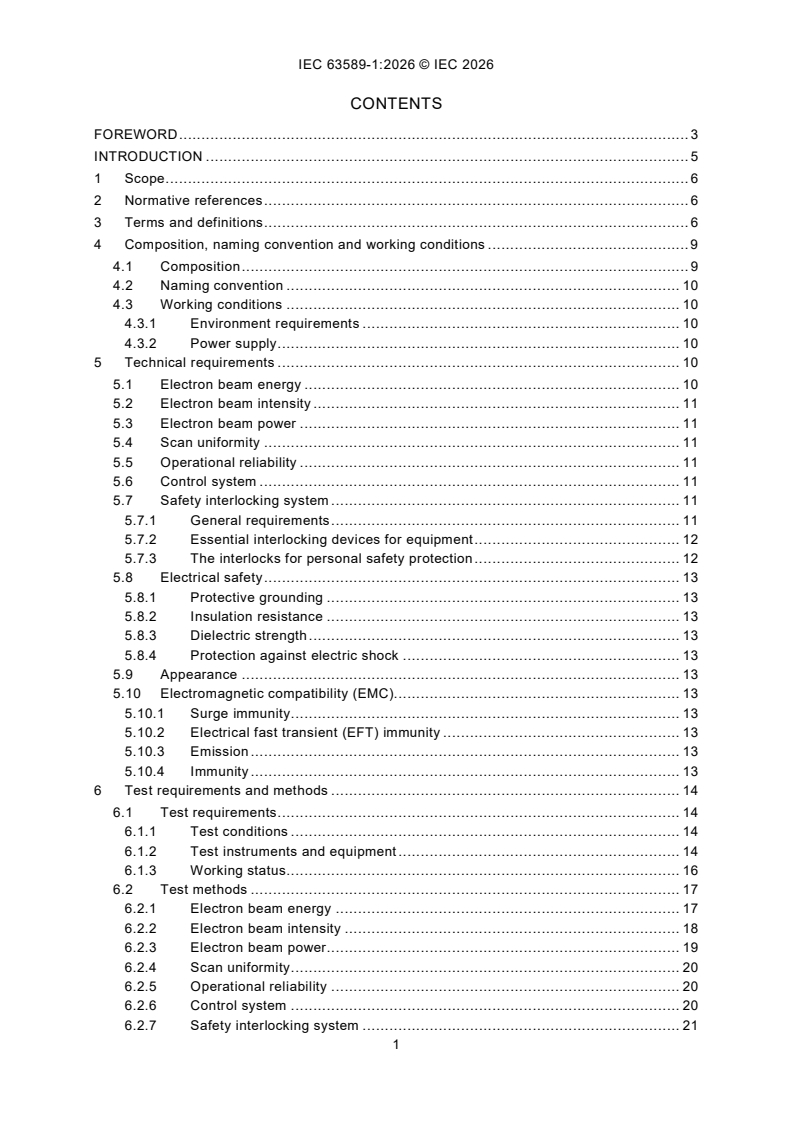
CONTENTS
FOREWORD . 3
INTRODUCTION . 5
1 Scope . 6
2 Normative references . 6
3 Terms and definitions . 6
4 Composition, naming convention and working conditions . 9
4.1 Composition . 9
4.2 Naming convention . 10
4.3 Working conditions . 10
4.3.1 Environment requirements . 10
4.3.2 Power supply . 10
5 Technical requirements . 10
5.1 Electron beam energy . 10
5.2 Electron beam intensity . 11
5.3 Electron beam power . 11
5.4 Scan uniformity . 11
5.5 Operational reliability . 11
5.6 Control system . 11
5.7 Safety interlocking system . 11
5.7.1 General requirements . 11
5.7.2 Essential interlocking devices for equipment . 12
5.7.3 The interlocks for personal safety protection . 12
5.8 Electrical safety . 13
5.8.1 Protective grounding . 13
5.8.2 Insulation resistance . 13
5.8.3 Dielectric strength . 13
5.8.4 Protection against electric shock . 13
5.9 Appearance . 13
5.10 Electromagnetic compatibility (EMC). 13
5.10.1 Surge immunity . 13
5.10.2 Electrical fast transient (EFT) immunity . 13
5.10.3 Emission . 13
5.10.4 Immunity . 13
6 Test requirements and methods . 14
6.1 Test requirements . 14
6.1.1 Test conditions . 14
6.1.2 Test instruments and equipment . 14
6.1.3 Working status . 16
6.2 Test methods . 17
6.2.1 Electron beam energy . 17
6.2.2 Electron beam intensity . 18
6.2.3 Electron beam power . 19
6.2.4 Scan uniformity . 20
6.2.5 Operational reliability . 20
6.2.6 Control system . 20
6.2.7 Safety interlocking system . 21
6.2.8 Electrical safety testing. 21
6.2.9 Appearance . 21
6.2.10 EMC . 22
7 Inspection rules . 22
7.1 Inspection classification . 22
7.1.1 General. 22
7.1.2 Type inspection . 22
7.1.3 Delivery inspection . 22
7.2 Inspection items . 22
7.3 Criterion rules . 23
8 Marking, packaging, storage, transportation and accompanying documents . 23
8.1 Marking . 23
8.1.1 Accelerator signs . 23
8.1.2 Warning signs. 23
8.2 Packaging . 24
8.3 Storage . 24
8.4 Transportation . 24
8.5 Accompanying documents . 24
8.5.1 Instruction manual. 24
8.5.2 Product certificate . 24
8.5.3 Other documents . 24
Bibliography . 25
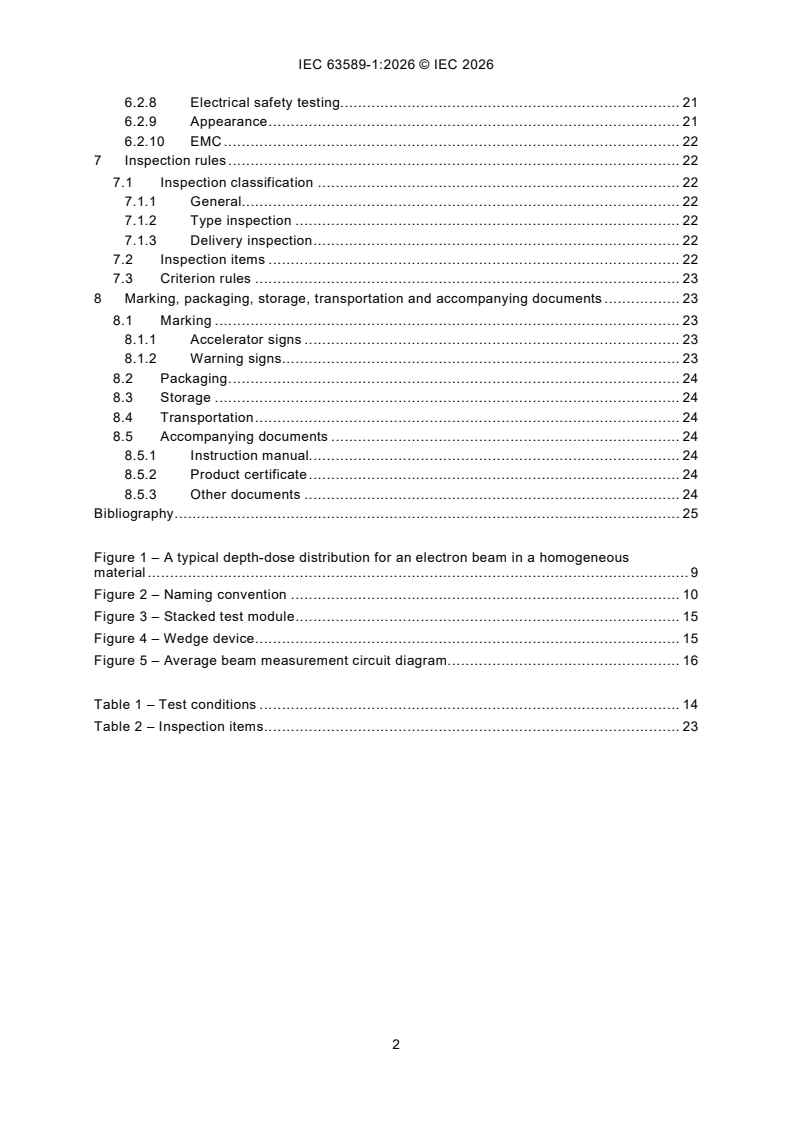
Figure 1 – A typical depth-dose distribution for an electron beam in a homogeneous
material . 9
Figure 2 – Naming convention . 10
Figure 3 – Stacked test module . 15
Figure 4 – Wedge device . 15
Figure 5 – Average beam measurement circuit diagram . 16
Table 1 – Test conditions . 14
Table 2 – Inspection items . 23
INTERNATIONAL ELECTROTECHNICAL COMMISSION
____________
Linear accelerator -
Electron linear accelerator for radiation processing -
Part 1: General requirements and test methods
FOREWORD
1) The International Electrotechnical Commission (IEC) is a worldwide organization for standardization comprising
all national electrotechnical committees (IEC National Committees). The object of IEC is to promote international
co-operation on all questions concerning standardization in the electrical and electronic fields. To this end and
in addition to other activities, IEC publishes International Standards, Technical Specifications, Technical Reports,
Publicly Available Specifications (PAS) and Guides (hereafter referred to as "IEC Publication(s)"). Their
preparation is entrusted to technical committees; any IEC National Committee interested in the subject dealt with
may participate in this preparatory work. International, governmental and non-governmental organizations liaising
with the IEC also participate in this preparation. IEC collaborates closely with the International Organization for
Standardization (ISO) in accordance with conditions determined by agreement between the two organizations.
2) The formal decisions or agreements of IEC on technical matters express, as nearly as possible, an international
consensus of opinion on the relevant subjects since each technical committee has representation from all
interested IEC National Committees.
3) IEC Publications have the form of recommendations for international use and are accepted by IEC National
Committees in that sense. While all reasonable efforts are made to ensure that the technical content of IEC
Publications is accurate, IEC cannot be held responsible for the way in which they are used or for any
misinterpretation by any end user.
4) In order to promote international uniformity, IEC National Committees undertake to apply IEC Publications
transparently to the maximum extent possible in their national and regional publications. Any divergence between
any IEC Publication and the corresponding national or regional publication shall be clearly indicated in the latter.
5) IEC itself does not provide any attestation of conformity. Independent certification bodies provide conformity
assessment services and, in some areas, access to IEC marks of conformity. IEC is not responsible for any
services carried out by independent certification bodies.
6) All users should ensure that they have the latest edition of this publication.
7) No liability shall attach to IEC or its directors, employees, servants or agents including individual experts and
members of its technical committees and IEC National Committees for any personal injury, property damage or
other damage of any nature whatsoever, whether direct or indirect, or for costs (including legal fees) and
expenses arising out of the publication, use of, or reliance upon, this IEC Publication or any other IEC
Publications.
8) Attention is drawn to the Normative references cited in this publication. Use of the referenced publications is
indispensable for the correct application of this publication.
9) IEC draws attention to the possibility that the implementation of this document may involve the use of (a)
patent(s). IEC takes no position concerning the evidence, validity or applicability of any claimed patent rights in
respect thereof. As of the date of publication of this document, IEC had not received notice of (a) patent(s), which
may be required to implement this document. However, implementers are cautioned that this may not represent
the latest information, which may be obtained from the patent database available at https://patents.iec.ch. IEC
shall not be held responsible for identifying any or all such patent rights.
IEC 63589-1 has been prepared by IEC technical committee 45: Nuclear instrumentation. It is
an International Standard.
The text of this International Standard is based on the following documents:
Draft Report on voting
45/1036XX/FDIS 45/1051XX/RVD
Full information on the voting for its approval can be found in the report on voting indicated in
the above table.
The language used for the development of this International Standard is English.
This document was drafted in accordance with ISO/IEC Directives, Part 2, and developed in
accordance with ISO/IEC Directives, Part 1 and ISO/IEC Directives, IEC Supplement, available
at www.iec.ch/members_experts/refdocs. The main document types developed by IEC are
described in greater detail at www.iec.ch/publications.
A list of all parts in the IEC 63589 series, published under the general title Linear accelerator -
Electron linear accelerator for radiation processing, can be found on the IEC website.
The committee has decided that the contents of this document will remain unchanged until the
stability date indicated on the IEC website under webstore.iec.ch in the data related to the
specific document. At this date, the document will be
– reconfirmed,
– withdrawn, or
– revised.
INTRODUCTION
An electron linear accelerator for radiation processing is a device that generates a high-energy
electron beam through a linear radio frequency resonant structure. The accelerator device has
the advantages of no toxicity or radiation residue, high radiation efficiency, and easy operation
and control. It is an important equipment for radiation sterilization, radiation modification,
radiation solidification, radiation degradation, agricultural breeding, and other radiation-
processing fields.
1 Scope
This document specifies the general requirements and test methods of radiation processing
electron linear accelerator device. The rules of naming, technical requirements, test methods,
inspection rules, marking, packaging, storage, and transportation requirements are also
provided.
This document applies to the electron linear accelerators for radiation processing with energy
1,0 MeV to 15 MeV.
NOTE Linear accelerators described in this document produce electron beams used for radiation processing. Please
see IEC 62976 for accelerators producing X-ray bremsstrahlung used for non-destructive testing.
2 Normative references
The following documents are referred to in the text in such a way that some or all of their content
constitutes requirements of this document. For dated references, only the edition cited applies.
For undated references, the latest edition of the referenced document (including any
amendments) applies.
IEC 60364-1:2025, Low-voltage electrical installations - Part 1: Fundamental principles,
assessment of general characteristics, and definitions
IEC 61000-4-4, Electromagnetic compatibility (EMC) - Part 4-4: Testing and measurement
techniques - Electrical fast transient/burst immunity test
IEC 61000-4-5, Electromagnetic compatibility (EMC) - Part 4-5: Testing and measurement
techniques - Surge immunity test
IEC 61000-6-2, Electromagnetic compatibility (EMC) - Part 6-2: Generic standards - Immunity
standard for industrial environments
IEC 61000-6-4, Electromagnetic compatibility (EMC) - Part 6-4: Generic standards - Emission
standard for industrial environments
ISO 780, Packaging - Distribution packaging - Graphical symbols for handling and storage of
packages
ISO/IEC Guide 37, Instructions for use of products by consumers
3 Terms and definitions
For the purposes of this document, the following terms and definitions apply.
ISO and IEC maintain terminology databases for use in standardization at the following
addresses:
– IEC Electropedia: available at https://www.electropedia.org/
– ISO Online browsing platform: available at https://www.iso.org/obp
3.1
radiation processing
intentional irradiation of products or materials to preserve, modify or to improve their
characteristics
[SOURCE: ISO/ASTM 52628:2020, 3.1.14]
3.2
electron beam energy
E
kinetic energy of the accelerated electrons in the beam
Note 1 to entry: E is expressed in megaelectronvolts (MeV).
[SOURCE: ISO/ASTM 51649:2015, 3.1.10]
3.3
nominal electron beam energy
nominal electron beam energy refers to the highest energy at which the accelerator can operate
stably and reliably
3.4
electron beam energy instability
rate of change in electron beam energy due to uncontrolled natural changes in accelerator
parameters over a given period
3.5
electron beam intensity
time average of the electron beam current by the reference plane, which for the pulse
accelerator means the average beam intensity
3.6
nominal electron beam intensity
maximum electron beam intensity at which the accelerator can operate stably and reliably
3.7
electron beam intensity instability
rate of change in electron beam intensity due to uncontrolled natural changes in accelerator
parameters over a given period
3.8
pulse electron beam
electron beam that recurs periodically, with a pulse duration much shorter than the interval
between consecutive pulses
3.9
pulse rate
f
pulse repetition frequency in hertz, or pulses per second
Note 1 to entry: f is expressed in hertz (Hz).
[SOURCE: ISO/ASTM 51649:2015, 3.2.12]
3.10
beam width
dimension of the irradiation zone perpendicular to the direction of product movement at a
specified distance from the accelerator window
[SOURCE: ISO/ASTM 51649:2015, 3.1.5]
3.11
beam length
dimension of the irradiation zone along the direction of product movement at a specified
distance from the accelerator window
[SOURCE: ISO/ASTM 51649:2015, 3.1.4]
3.12
scan uniformity
degree of uniformity of the dose measured along the scan direction
[SOURCE: ISO/ASTM 51649:2015, 3.2.16]
3.13
electron beam power
P
product of the average electron beam energy and the average electron beam current divided
by the elementary charge
Note 1 to entry: P is expressed in kilowatts (kW).
3.14
practical electron range
R
p
depth in homogeneous material to the point where the tangent at the steepest point (the
inflection point) on the almost straight descending portion of the depth-dose distribution curve
meets the extrapolated X-ray background
SEE: Figure 1
[SOURCE: ISO/ASTM 51649:2015, 3.2.10]
3.15
reference plane
selected plane in the radiation zone that is perpendicular to the electron beam axis
[SOURCE: ISO/ASTM 51649:2015, 3.1.19]
3.16
half value depth
R
depth in homogeneous material at which the absorbed dose has decreased to 50 % of its
maximum value
SEE: Figure 1
[SOURCE: ISO/ASTM 51649:2015, 3.2.8]
Key
D dose at entrance surface
e
R depth at which dose has decreased to 50 % of its maximum
R depth where extrapolated straight line of descending curve meets depth axis
p
Figure 1 – A typical depth-dose distribution for
an electron beam in a homogeneous material
4 Composition, naming convention and working conditions
4.1 Composition
Electron linear accelerators for radiation processing consist of the following parts:
a) electron gun;
b) accelerating tube;
c) RF system;
d) high voltage pulse modulator;
e) constant temperature water cooling system;
f) vacuum system;
g) focusing system;
h) scanning system;
i) control system;
j) safety interlock system;
k) power distribution systems and other auxiliary systems.
4.2 Naming convention
The model naming method is shown in Figure 2.
The model types are indicated by initials:
GL general linear accelerator;
SL self-shielded linear accelerator;
ML mobile linear accelerator.
Figure 2 – Naming convention
4.3 Working conditions
4.3.1 Environment requirements
The environment requirements are as follows:
a) Environmental temperature: 5 °C to 40 °C;
b) Relative humidity: ≤ 90 %.
4.3.2 Power supply
The power supply requirements are as follows:
a) Power supply: a 3-phase 4-wire (TN-C-S as specified in IEC 60364-1:2025) AC system;
b) Voltage: 400 V ± 15 %;
c) Frequency: 50 Hz ± 2 % / 60 Hz ± 2 %;
d) Supply power: it is put forward in the product manual according to the accelerator model;
e) Grounding resistance (PE): < 4 Ω.
5 Technical requirements
5.1 Electron beam energy
The electron beam energy requirements are as follows:
a) The electron beam energy shall be adjustable continuously or in steps;
b) The deviation of the measured electron beam energy measurement from the nominal
electron beam energy value of the accompanying document shall be ≤ 5 %;
c) The electron beam energy instability shall be ≤ 5 %.
5.2 Electron beam intensity
The electron beam intensity requirements are as follows:
a) The electron beam intensity shall be adjustable continuously or in steps;
b) The deviation of the electron beam intensity measurement from the nominal electron beam
intensity value of the accompanying document shall be ≤ 5 %;
c) The electron beam intensity instability shall be ≤ 5 %.
5.3 Electron beam power
The electron beam power requirements are as follows:
a) Pulse electron beam power shall refer to the average power;
b) The deviation of the electron beam power measurement from the nominal electron beam
power value of the accompanying document shall be ≤ 10 %;
c) The electron beam power instability shall be ≤ 10 %.
5.4 Scan uniformity
The scan uniformity shall be > 90 %. The beam width shall be adjustable.
5.5 Operational reliability
The operational reliability requirements are as follows:
a) Under nominal energy and beam load conditions, it shall be operated continuously for 24 h;
b) After stopping the beam, it shall be in the high vacuum holding state and when the non-fault
beam stop time shall be < 1 h, the restart into the working state shall be ≤ 10 min;
c) After shutdown, it shall be in the high vacuum holding state and when the non-fault downtime
shall be <48 h, the restart into the working state shall be ≤ 60 min.
5.6 Control system
The system shall provide intelligent control and complete functions to ensure normal operation,
stability and reliability. The system shall have the following functions:
a) normal start-up and shutdown;
b) display of the main operating parameters;
c) display of the status of normal, fault, alarm and auto-stop;
d) safety interlock protection;
e) emergency shutdown.
5.7 Safety interlocking system
5.7.1 General requirements
a) The safety of people and equipment shall be ensured.
b) The reliability of the safety interlock execution shall be ensured.
c) The state shall be centrally monitored, displayed and checked.
5.7.2 Essential interlocking devices for equipment
a) Vacuum system fault interlock:
When the vacuum level of the system exceeds the set range or the vacuum equipment fails,
the control system shall immediately cut off the high voltage and display the corresponding
fault light in the main control interface.
b) SF gas pressure system fault interlock:
When the SF gas pressure in the waveguide exceeds the set range
(0,16 MPa to 0,21 MPa), the control system shall immediately cut off the high voltage and
display the correspondin
...