


IEC 62282-3-100:2019
(Main)Fuel cell technologies - Part 3-100: Stationary fuel cell power systems - Safety
Fuel cell technologies - Part 3-100: Stationary fuel cell power systems - Safety
IEC 62282-3-100:2019 applies to stationary packaged, self-contained fuel cell power systems or fuel cell power systems comprised of factory matched packages of integrated systems which generate electricity through electrochemical reactions. This document is applicable to stationary fuel cell power systems intended for indoor and outdoor commercial, industrial and residential use in non-hazardous areas. This second edition cancels and replaces the first edition published in 2012. This edition includes the following significant technical changes with respect to the previous edition:
a) recognition that fuel carrying components qualified to leakage standards (soundness) need not be considered as potential flammable leak sources;
b) new annex for small power systems; and
c) clarifications for numerous requirements and tests
Technologies des piles à combustible - Partie 3-100: Systèmes à piles à combustible stationnaires - Sécurité
L’IEC 62282-3-100:2019 s’applique aux systèmes à piles à combustible autonomes assemblés pour être stationnaires ou aux systèmes à piles à combustible d’un ensemble assemblé en usine de systèmes intégrés qui génèrent de l’électricité par réactions électrochimiques. Le présent document s’applique aux systèmes à piles à combustibles stationnaires destinés à un usage à l'intérieur et à l'extérieur, commercial, industriel ou d'habitation, dans des zones non dangereuses. Cette deuxième édition annule et remplace la première édition parue en 2012. Cette édition inclut les modifications techniques majeures suivantes par rapport à l'édition précédente:
a) il n’est pas nécessaire de tenir compte des composants transportant le combustible qui sont qualifiés par rapport aux normes de fuite (intégrité) comme des sources potentielles de fuites inflammables;
b) nouvelle annexe relative aux petits systèmes à piles à combustible; et
c) éclaircissements relatifs à de nombreux essais et exigences.
General Information
- Status
- Published
- Publication Date
- 11-Feb-2019
- Technical Committee
- TC 105 - Fuel cell technologies
- Drafting Committee
- MT 201 - TC 105/MT 201
- Current Stage
- PPUB - Publication issued
- Start Date
- 12-Feb-2019
- Completion Date
- 09-Nov-2018
Relations
- Effective Date
- 05-Sep-2023
Overview
IEC 62282-3-100:2019 is the International Electrotechnical Commission (IEC) safety standard for stationary fuel cell power systems. It applies to packaged, self-contained systems or factory-matched integrated packages that generate electricity by electrochemical reaction, for indoor and outdoor commercial, industrial and residential use in non-hazardous areas. Edition 2.0 (2019) updates the 2012 edition with important technical changes including recognition of qualified fuel-carrying components, a new annex for small power systems, and numerous clarifications.
Key topics and technical requirements
This standard defines safety requirements, test methods and documentation expectations for stationary fuel cell power systems. Major technical topics include:
- Safety strategy and protective measures: design principles, material selection, pressure equipment and piping, and prevention of fire/explosion hazards.
- Fuel handling and gas systems: fuel input, gas‑conveying parts, shut‑off and fuel valves, venting and flue gas systems.
- Environmental and mechanical conditions: operating conditions, vibration, shock, handling, transportation and storage.
- Control, electrical and EMC requirements: control systems, protective components, electrical safety and electromagnetic compatibility testing.
- Thermal, condensate and emissions management: surface/component temperatures, condensate discharge and emissions (CO and flammable gas components).
- Type, routine and strength tests: leakage (pneumatic/hydrostatic), strength tests, burner and catalytic oxidation tests, wind and rain tests, electrical overload, dielectric strength and EMC tests.
- Marking, labelling and documentation: installation, user, operating and maintenance manuals and technical documentation.
- Small power systems: normative replacement subclauses for systems <10 kW and low-pressure passages provided in a dedicated annex.
Practical applications - who uses this standard
IEC 62282-3-100:2019 is used by:
- Manufacturers and system integrators of stationary fuel cell systems to design, validate and certify compliant products.
- Test laboratories and certifying bodies to perform type, routine and environmental tests specified by the standard.
- Specifiers, installers and maintenance personnel to ensure safe installation, operation and servicing in residential, commercial and industrial settings.
- Regulators and safety authorities for evaluation of compliance with international safety practices for fuel cell deployment.
Related standards and implementation
IEC 62282-3-100 is part of the broader IEC fuel cell standards family and should be used alongside other IEC and national standards addressing electrical safety, pressure equipment and emissions where applicable. Manufacturers should consult the full text for prescriptive test procedures, acceptance criteria and marking requirements.
By following IEC 62282-3-100:2019, stakeholders can reduce safety risks, streamline certification and support wider, safer adoption of stationary fuel cell power systems.
IEC 62282-3-100:2019 RLV - Fuel cell technologies - Part 3-100: Stationary fuel cell power systems - Safety Released:2/12/2019 Isbn:9782832265765

IEC 62282-3-100:2019 - Fuel cell technologies - Part 3-100: Stationary fuel cell power systems - Safety
Frequently Asked Questions
IEC 62282-3-100:2019 is a standard published by the International Electrotechnical Commission (IEC). Its full title is "Fuel cell technologies - Part 3-100: Stationary fuel cell power systems - Safety". This standard covers: IEC 62282-3-100:2019 applies to stationary packaged, self-contained fuel cell power systems or fuel cell power systems comprised of factory matched packages of integrated systems which generate electricity through electrochemical reactions. This document is applicable to stationary fuel cell power systems intended for indoor and outdoor commercial, industrial and residential use in non-hazardous areas. This second edition cancels and replaces the first edition published in 2012. This edition includes the following significant technical changes with respect to the previous edition: a) recognition that fuel carrying components qualified to leakage standards (soundness) need not be considered as potential flammable leak sources; b) new annex for small power systems; and c) clarifications for numerous requirements and tests
IEC 62282-3-100:2019 applies to stationary packaged, self-contained fuel cell power systems or fuel cell power systems comprised of factory matched packages of integrated systems which generate electricity through electrochemical reactions. This document is applicable to stationary fuel cell power systems intended for indoor and outdoor commercial, industrial and residential use in non-hazardous areas. This second edition cancels and replaces the first edition published in 2012. This edition includes the following significant technical changes with respect to the previous edition: a) recognition that fuel carrying components qualified to leakage standards (soundness) need not be considered as potential flammable leak sources; b) new annex for small power systems; and c) clarifications for numerous requirements and tests
IEC 62282-3-100:2019 is classified under the following ICS (International Classification for Standards) categories: 01 - GENERALITIES. TERMINOLOGY. STANDARDIZATION. DOCUMENTATION; 27.070 - Fuel cells. The ICS classification helps identify the subject area and facilitates finding related standards.
IEC 62282-3-100:2019 has the following relationships with other standards: It is inter standard links to IEC 62282-3-100:2012. Understanding these relationships helps ensure you are using the most current and applicable version of the standard.
You can purchase IEC 62282-3-100:2019 directly from iTeh Standards. The document is available in PDF format and is delivered instantly after payment. Add the standard to your cart and complete the secure checkout process. iTeh Standards is an authorized distributor of IEC standards.
Standards Content (Sample)
IEC 62282-3-100 ®
Edition 2.0 2019-02
REDLINE VERSION
INTERNATIONAL
STANDARD
colour
inside
Fuel cell technologies –
Part 3-100: Stationary fuel cell power systems – Safety
All rights reserved. Unless otherwise specified, no part of this publication may be reproduced or utilized in any form
or by any means, electronic or mechanical, including photocopying and microfilm, without permission in writing from
either IEC or IEC's member National Committee in the country of the requester. If you have any questions about IEC
copyright or have an enquiry about obtaining additional rights to this publication, please contact the address below or
your local IEC member National Committee for further information.
IEC Central Office Tel.: +41 22 919 02 11
3, rue de Varembé info@iec.ch
CH-1211 Geneva 20 www.iec.ch
Switzerland
About the IEC
The International Electrotechnical Commission (IEC) is the leading global organization that prepares and publishes
International Standards for all electrical, electronic and related technologies.
About IEC publications
The technical content of IEC publications is kept under constant review by the IEC. Please make sure that you have the
latest edition, a corrigendum or an amendment might have been published.
IEC publications search - webstore.iec.ch/advsearchform Electropedia - www.electropedia.org
The advanced search enables to find IEC publications by a The world's leading online dictionary on electrotechnology,
variety of criteria (reference number, text, technical containing more than 22 000 terminological entries in English
committee,…). It also gives information on projects, replaced and French, with equivalent terms in 16 additional languages.
and withdrawn publications. Also known as the International Electrotechnical Vocabulary
(IEV) online.
IEC Just Published - webstore.iec.ch/justpublished
Stay up to date on all new IEC publications. Just Published IEC Glossary - std.iec.ch/glossary
details all new publications released. Available online and 67 000 electrotechnical terminology entries in English and
once a month by email. French extracted from the Terms and Definitions clause of
IEC publications issued since 2002. Some entries have been
IEC Customer Service Centre - webstore.iec.ch/csc collected from earlier publications of IEC TC 37, 77, 86 and
If you wish to give us your feedback on this publication or CISPR.
need further assistance, please contact the Customer Service
Centre: sales@iec.ch.
IEC 62282-3-100 ®
Edition 2.0 2019-02
REDLINE VERSION
INTERNATIONAL
STANDARD
colour
inside
Fuel cell technologies –
Part 3-100: Stationary fuel cell power systems – Safety
INTERNATIONAL
ELECTROTECHNICAL
COMMISSION
ICS 27.070 ISBN 978-2-8322-6576-5
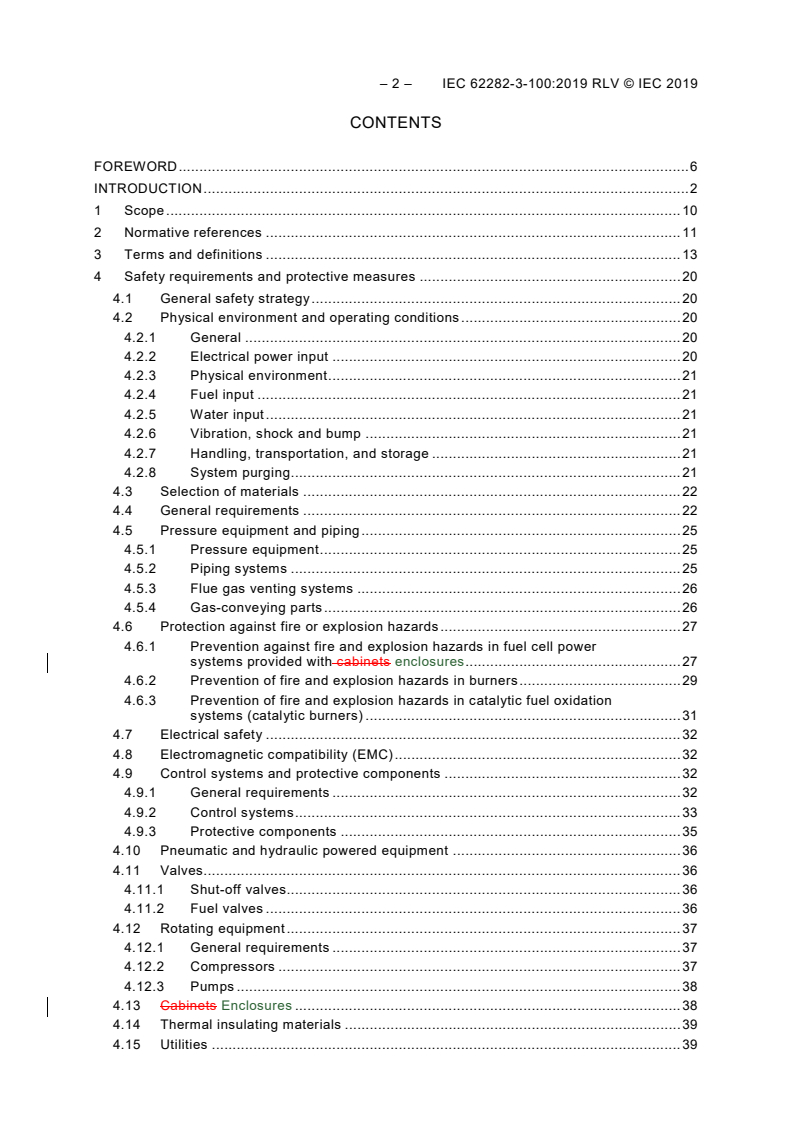
– 2 – IEC 62282-3-100:2019 RLV © IEC 2019
CONTENTS
FOREWORD . 6
INTRODUCTION . 2
1 Scope . 10
2 Normative references . 11
3 Terms and definitions . 13
4 Safety requirements and protective measures . 20
4.1 General safety strategy . 20
4.2 Physical environment and operating conditions . 20
4.2.1 General . 20
4.2.2 Electrical power input . 20
4.2.3 Physical environment . 21
4.2.4 Fuel input . 21
4.2.5 Water input . 21
4.2.6 Vibration, shock and bump . 21
4.2.7 Handling, transportation, and storage . 21
4.2.8 System purging . 21
4.3 Selection of materials . 22
4.4 General requirements . 22
4.5 Pressure equipment and piping . 25
4.5.1 Pressure equipment . 25
4.5.2 Piping systems . 25
4.5.3 Flue gas venting systems . 26
4.5.4 Gas-conveying parts . 26
4.6 Protection against fire or explosion hazards . 27
4.6.1 Prevention against fire and explosion hazards in fuel cell power
systems provided with cabinets enclosures . 27
4.6.2 Prevention of fire and explosion hazards in burners . 29
4.6.3 Prevention of fire and explosion hazards in catalytic fuel oxidation
systems (catalytic burners) . 31
4.7 Electrical safety . 32
4.8 Electromagnetic compatibility (EMC) . 32
4.9 Control systems and protective components . 32
4.9.1 General requirements . 32
4.9.2 Control systems . 33
4.9.3 Protective components . 35
4.10 Pneumatic and hydraulic powered equipment . 36
4.11 Valves. 36
4.11.1 Shut-off valves. 36
4.11.2 Fuel valves . 36
4.12 Rotating equipment . 37
4.12.1 General requirements . 37
4.12.2 Compressors . 37
4.12.3 Pumps . 38
4.13 Cabinets Enclosures . 38
4.14 Thermal insulating materials . 39
4.15 Utilities . 39
4.15.1 General requirements . 39
4.15.2 Water supply . 39
4.15.3 Fuel gas supply . 39
4.15.4 Electrical connections . 39
4.16 Installation and maintenance. 41
4.16.1 Installation . 41
4.16.2 Maintenance . 41
4.17 Equivalent safety . 41
5 Type tests . 42
5.1 General requirements . 42
5.1.1 General . 42
5.1.2 Operating parameters for tests . 42
5.2 Test fuels . 43
5.3 Basic test arrangements . 44
5.4 Leakage tests . 44
5.4.1 General . 44
5.4.2 Pneumatic leakage tests . 44
5.4.3 Hydrostatic leakage tests . 48
5.5 Strength tests . 48
5.5.1 General . 48
5.5.2 Pneumatic strength tests . 48
5.5.3 Hydrostatic strength test . 50
5.6 Normal operation type test . 51
5.7 Electrical overload test . 51
5.8 Shutdown parameters . 51
5.9 Burner operating characteristics tests . 51
5.9.1 General . 51
5.9.2 General testing . 52
5.9.3 Limit testing . 52
5.10 Automatic control of burners and catalytic oxidation reactors . 52
5.10.1 General . 52
5.10.2 Automatic ignition control burners . 52
5.10.3 Automated control of catalytic oxidation reactors . 55
5.11 Exhaust gas temperature test . 55
5.12 Surface and component temperatures . 56
5.13 Wind tests . 56
5.13.1 General . 56
5.13.2 Wind source calibration procedure for winds directed perpendicular to
the wall . 56
5.13.3 Verification of operation of outdoor fuel cell power systems under wind
conditions . 57
5.13.4 Verification of operation of indoor fuel cell power systems vented
horizontally through an outside wall . 58
5.13.5 Carbon monoxide (CO) and flammable gas components emissions
under wind – Indoor units . 61
5.13.6 Carbon monoxide (CO) and flammable gas components emissions
under wind – Outdoor units . 61
5.14 Rain test . 61
5.14.1 Outdoor units . 61
5.14.2 Indoor units supplied with horizontal venting hardware . 62
– 4 – IEC 62282-3-100:2019 RLV © IEC 2019
5.14.3 Test method . 62
5.15 Emissions . 62
5.15.1 General . 62
5.15.2 Carbon monoxide (CO) and flammable gas emissions . 62
5.15.3 Normal conditions . 63
5.16 Blocked condensate line test . 63
5.17 Condensate discharge test . 63
5.18 Electrical safety tests . 64
5.19 EMC test . 64
5.20 Venting system leakage test . 64
5.21 Leakage tests (repeat) . 65
6 Routine tests . 65
6.1 General requirements . 65
6.2 Leakage test . 65
6.3 Dielectric strength test . 66
6.4 Burner operation test . 66
7 Marking, labelling and packaging . 66
7.1 General requirements . 66
7.2 Fuel cell power system marking . 66
7.3 Marking of components . 67
7.4 Technical documentation . 67
7.4.1 General . 67
7.4.2 Installation manual . 68
7.4.3 User’s information manual . 68
7.4.4 Operating manual . 71
7.4.5 Maintenance manual . 72
Annex A (informative) Significant hazards, hazardous situations and events dealt with
in this document . 73
Annex B (informative) Carburization and material compatibility for hydrogen service . 75
B.1 Carburization . 75
B.2 Material compatibility for hydrogen service. 75
B.2.1 General . 75
B.2.2 Metals and metallic materials . 75
B.2.3 Polymers, elastomers, and other non-metallic materials. 77
B.2.4 Reference documents . 77
Annex C (normative) Normative replacement subclauses for small fuel cell power
systems with rated electrical output less than 10 kW, and maximum pressure of less
than 0,1 MPa (gauge) for fuel and oxidant passages . 81
Bibliography . 83
Figure 1 – Typical stationary fuel cell power system . 8
Figure 2 – Minimum test pressures . 50
Figure 3 – Test wall with static pressure ports and vent terminal locations . 57
Figure 4 – Vent test wall . 59
Figure 5 – Piezo ring and details of typical construction . 60
Figure 6 – Safety precautions for odorized gas-fuelled systems . 69
Figure 7 – Safety precautions for odorant-free gas fuelled systems . 70
Figure 8 – Safety precautions for liquid fuelled systems . 70
Table 1 – Allowable surface temperature rises . 24
Table 2 – Leakage test requirements . 47
Table 3 – Ultimate strength test requirements . 49
Table 4 – Wind calibration . 57
Table A.1 – Hazardous situations and events. 73
– 6 – IEC 62282-3-100:2019 RLV © IEC 2019
INTERNATIONAL ELECTROTECHNICAL COMMISSION
____________
FUEL CELL TECHNOLOGIES –
Part 3-100: Stationary fuel cell power systems – Safety
FOREWORD
1) The International Electrotechnical Commission (IEC) is a worldwide organization for standardization comprising
all national electrotechnical committees (IEC National Committees). The object of IEC is to promote
international co-operation on all questions concerning standardization in the electrical and electronic fields. To
this end and in addition to other activities, IEC publishes International Standards, Technical Specifications,
Technical Reports, Publicly Available Specifications (PAS) and Guides (hereafter referred to as “IEC
Publication(s)”). Their preparation is entrusted to technical committees; any IEC National Committee interested
in the subject dealt with may participate in this preparatory work. International, governmental and non-
governmental organizations liaising with the IEC also participate in this preparation. IEC collaborates closely
with the International Organization for Standardization (ISO) in accordance with conditions determined by
agreement between the two organizations.
2) The formal decisions or agreements of IEC on technical matters express, as nearly as possible, an international
consensus of opinion on the relevant subjects since each technical committee has representation from all
interested IEC National Committees.
3) IEC Publications have the form of recommendations for international use and are accepted by IEC National
Committees in that sense. While all reasonable efforts are made to ensure that the technical content of IEC
Publications is accurate, IEC cannot be held responsible for the way in which they are used or for any
misinterpretation by any end user.
4) In order to promote international uniformity, IEC National Committees undertake to apply IEC Publications
transparently to the maximum extent possible in their national and regional publications. Any divergence
between any IEC Publication and the corresponding national or regional publication shall be clearly indicated in
the latter.
5) IEC itself does not provide any attestation of conformity. Independent certification bodies provide conformity
assessment services and, in some areas, access to IEC marks of conformity. IEC is not responsible for any
services carried out by independent certification bodies.
6) All users should ensure that they have the latest edition of this publication.
7) No liability shall attach to IEC or its directors, employees, servants or agents including individual experts and
members of its technical committees and IEC National Committees for any personal injury, property damage or
other damage of any nature whatsoever, whether direct or indirect, or for costs (including legal fees) and
expenses arising out of the publication, use of, or reliance upon, this IEC Publication or any other IEC
Publications.
8) Attention is drawn to the Normative references cited in this publication. Use of the referenced publications is
indispensable for the correct application of this publication.
9) Attention is drawn to the possibility that some of the elements of this IEC Publication may be the subject of
patent rights. IEC shall not be held responsible for identifying any or all such patent rights.
This redline version of the official IEC Standard allows the user to identify the changes
made to the previous edition. A vertical bar appears in the margin wherever a change
has been made. Additions are in green text, deletions are in strikethrough red text.
International Standard IEC 62282-3-100 has been prepared by IEC technical committee 105:
Fuel cell technologies.
This second edition cancels and replaces the first edition published in 2012. This edition
constitutes a technical revision.
This edition includes the following significant technical changes with respect to the previous
edition:
recognition that fuel carrying components qualified to leakage standards (soundness)
need not be considered as potential flammable leak sources;
new Annex C for small power systems; and
clarifications for numerous requirements and tests.
The text of this International Standard is based on the following documents:
FDIS Report on voting
105/695/FDIS 105/705/RVD
Full information on the voting for the approval of this International Standard can be found in
the report on voting indicated in the above table.
This document has been drafted in accordance with the ISO/IEC Directives, Part 2.
A list of all parts in the IEC 62282 series, published under the general title Fuel cell
technologies, can be found on the IEC website.
The committee has decided that the contents of this document will remain unchanged until the
stability date indicated on the IEC website under "http://webstore.iec.ch" in the data related to
the specific document. At this date, the document will be
• reconfirmed,
• withdrawn,
• replaced by a revised edition, or
• amended.
IMPORTANT – The 'colour inside' logo on the cover page of this publication indicates
that it contains colours which are considered to be useful for the correct
understanding of its contents. Users should therefore print this document using a
colour printer.
– 8 – IEC 62282-3-100:2019 RLV © IEC 2019
INTRODUCTION
A typical stationary fuel cell power system is shown in Figure 1.
System boundary
Power inputs:
electrical, thermal,
mechanical
Recovered heat
Thermal
management
system
Waste heat
Fuel
Fuel
processing
Fuel
Useable power
system
cell stack
electrical
or Power
module conditioning
system
Oxidant
Oxidant
processing Water
system treatment
Internal power
Discharge
system
needs
water
Ventilation
Exhaust gases,
Ventilation
Inert gas
ventilation
system
Automatic Onboard
Water
control energy
system storage
EMI:
EMD:
noise,
vibration,
vibration
wind, rain,
temperature,
etc.
IEC
Figure 1 – Typical stationary fuel cell power systems
The overall design of the power system anticipated by this document forms an assembly of
integrated systems, as necessary, intended to perform designated functions, as follows.
• Fuel processing system – System of chemical and/or physical processing equipment plus
associated heat exchangers and controls required to prepare, and if necessary,
pressurize, the fuel for utilization within a fuel cell power system.
• Oxidant processing system – System that meters, conditions, processes and may
pressurize the incoming supply for use within the fuel cell power system.
• Thermal management system – System that provides heating or cooling and heat rejection
to maintain the fuel cell power system in the operating temperature range, and may
provide for the recovery of excess heat and assist in heating the power train during start-
up.
• Water treatment system – System that provides all the necessary purification treatment of
the recovered or added water for use within the fuel cell power system.
• Power conditioning system – Equipment that is used to adapt the electrical energy
produced by the fuel cell stack(s) to application requirements as specified by the
manufacturer.
• Automatic control system – System(s) that is composed of sensors, actuators, valves,
switches and logic components that maintain the fuel cell power system parameters within
the manufacturer’s specified limits including moving to safe states without manual
intervention.
• Ventilation system – System that provides air through forced mechanical or natural means
to the fuel cell power system’s enclosure.
• Fuel cell modules – Equipment assembly of one or more fuel cell stacks which
electrochemically converts chemical energy to electric energy and thermal energy
intended to be integrated into a power generation system.
• Fuel cell stack – Equipment assembly of cells, separators, cooling plates, manifolds and a
support structure that electrochemically converts, typically, hydrogen rich gas and air
reactants to DC power, heat and other reactant bi-products.
• Onboard energy storage – System of internal electric energy storage devices intended to
aid or complement the fuel cell module in providing power to internal or external loads.
– 10 – IEC 62282-3-100:2019 RLV © IEC 2019
FUEL CELL TECHNOLOGIES –
Part 3-100: Stationary fuel cell power systems – Safety
1 Scope
This part of IEC 62282 applies to stationary packaged, self-contained fuel cell power systems
or fuel cell power systems comprised of factory matched packages of integrated systems
which generate electricity through electrochemical reactions.
This document applies to systems
intended for electrical connection to mains direct, or with a transfer switch, or to a stand-
alone power distribution system;
intended to provide AC or DC power;
with or without the ability to recover useful heat;
intended for operation on the following input fuels:
natural gas and other methane rich gases derived from renewable (biomass) or fossil
fuel sources, for example, landfill gas, digester gas, coal mine gas;
fuels derived from oil refining, for example, diesel, gasoline, kerosene, liquefied
petroleum gases such as propane and butane;
alcohols, esters, ethers, aldehydes, ketones, Fischer-Tropsch liquids and other
suitable hydrogen-rich organic compounds derived from renewable (biomass) or fossil
fuel sources, for example, methanol, ethanol, di-methyl ether, biodiesel;
hydrogen, gaseous mixtures containing hydrogen gas, for example, synthesis gas,
town gas.
This document does not cover:
• micro fuel cell power systems;
• portable fuel cell power systems;
• propulsion fuel cell power systems.
NOTE For special applications such as “marine auxiliary power”, additional requirements may can be given by the
relevant marine ship register standard.
This document is applicable to stationary fuel cell power systems intended for indoor and
outdoor commercial, industrial and residential use in non-hazardous (unclassified) areas.
This document contemplates all significant hazards, hazardous situations and events, with the
exception of those associated with environmental compatibility (installation conditions),
relevant to fuel cell power systems, when they are used as intended and under the conditions
foreseen by the manufacturer.
This document deals with conditions that can yield hazards on the one hand to persons, and
on the other to damage outside the fuel cell power system only. Protection against damage to
the fuel cell power system internals is not addressed in this document, provided it does not
lead to hazards outside the fuel cell power system.
The requirements of this standard are not intended to constrain innovation. When considering
fuels, materials, designs or constructions not specifically dealt with in this standard, these
alternatives shall be evaluated as to their ability to yield levels of safety and performance
equivalent to those prescribed by this standard.
2 Normative references
The following documents are referred to in the text in such a way that some or all of their
content constitutes requirements of this document. For dated references, only the edition
cited applies. For undated references, the latest edition of the referenced document (including
any amendments) applies.
IEC 60079-0, Explosive atmospheres – Part 0: Equipment – General requirements
IEC 60079-2, Explosive atmospheres – Part 2: Equipment protection by pressurized
enclosure "p"
IEC 60079-10 (all parts), Explosive atmospheres − Part 10: Classification of areas
IEC 60079-10-1, Explosive atmospheres – Part 10-1: Classification of areas – Explosive gas
atmospheres
IEC 60079-29-1, Explosive atmospheres – Part 29-1: Gas detectors – Performance
requirements of detectors for flammable gases
IEC/IEEE 60079-30-1, Explosive atmospheres – Part 30-1: Electrical resistance trace heating
– General and testing requirements
IEC 60204-1, Safety of machinery – Electrical equipment of machines – Part 1: General
requirements
IEC 60335-1:2010 2016, Household and similar electrical appliances – Safety – Part 1:
General requirements
IEC 60335-2-51, Household and similar electrical appliances – Safety – Part 2-51: Particular
requirements for stationary circulation pumps for heating and service water installations
IEC 60417, Graphical symbols for use on equipment. Available from:
symbols.info/equipment>
IEC 60529:1989, Degrees of protection provided by enclosures (IP Code)
IEC 60730-1, Automatic electrical controls for household and similar use – Part 1: General
requirements
IEC 60730-2-5, Automatic electrical controls for household and similar use – Part 2-5:
Particular requirements for automatic electrical burner control systems
IEC 60730-2-6, Automatic electrical controls for household and similar use – Part 2-6:
Particular requirements for automatic electrical pressure sensing controls including
mechanical requirements
IEC 60730-2-9, Automatic electrical controls for household and similar use – Part 2-9:
Particular requirements for temperature sensing controls
IEC 60950-1, Information technology equipment – Safety – Part 1: General requirements
IEC 61000-3-2, Electromagnetic compatibility (EMC) – Part 3-2: Limits – Limits for harmonic
currents emissions (equipment input current ≤16 A per phase)
– 12 – IEC 62282-3-100:2019 RLV © IEC 2019
IEC 61000-3-3, Electromagnetic compatibility (EMC) – Part 3-3: Limits – Limitation of voltage
changes, voltage fluctuations and flicker in public low-voltage supply systems, for equipment
with rated current ≤16 A per phase and not subject to conditional connection
IEC TS 61000-3-4, Electromagnetic compatibility (EMC) – Part 3-4: Limits – Limitation of
emission of harmonic currents in low-voltage power supply systems for equipment with rated
current greater than 16 A
IEC TS 61000-3-5, Electromagnetic compatibility (EMC) – Part 3-5: Limits – Limitation of
voltage fluctuations and flicker in low-voltage power supply systems for equipment with rated
current greater than 75 A
IEC 61000-3-11, Electromagnetic compatibility (EMC) – Part 3-11: Limits – Limitation of
voltage changes, voltage fluctuations and flicker in public low-voltage supply systems –
Equipment with rated current ≤75 A and subject to conditional connection
IEC 61000-6-1, Electromagnetic compatibility (EMC) – Part 6-1: Generic standards –
Immunity standard for residential, commercial and light-industrial environments
IEC 61000-6-2, Electromagnetic compatibility (EMC) – Part 6-2: Generic standards –
Immunity standard for industrial environments
IEC 61000-6-3, Electromagnetic compatibility (EMC) – Part 6-3: Generic standards –
Emission standard for residential, commercial and light-industrial environments
IEC 61000-6-4, Electromagnetic compatibility (EMC) – Part 6-4: Generic standards –
Emission standard for industrial environments
IEC 61508 (all parts), Functional safety of electrical/electronic/programmable electronic
safety-related systems
IEC 61511-1, Functional safety – Safety instrumented systems for the process industry sector
– Part 1: Framework, definitions, system, hardware and application programming
requirements
IEC 62040-1, Uninterruptible power systems (UPS) – Part 1: General and Safety requirements
for UPS
IEC 62061, Safety of machinery – Functional safety of safety-related electrical, electronic and
programmable electronic control systems
IEC/TS 62282-1, Fuel cell technologies – Part 1: Terminology
IEC 62282-3-200, Fuel cell technologies – Part 3-200: Stationary fuel cell power systems –
Performance test methods
IEC 62368-1, Audio/video, information and communication technology equipment – Part 1:
Safety requirements
ISO 3864-2, Graphical symbols – Safety colours and safety signs – Part 2: Design principles
for product safety labels
ISO 4413, Hydraulic fluid power – General rules and safety requirements for systems and
their components
ISO 4414, Pneumatic fluid power – General rules and safety requirements for systems and
their components
ISO 5388, Stationary air compressors – Safety rules and code of practice
ISO 7000, Graphic symbols for use on equipment – Index and synopsis. Available from:
http://www.graphical-symbols.info/equipment.
ISO 10439 (all parts), Petroleum, petrochemical and natural gas service industries – Axial and
centrifugal compressors and expander-compressors
ISO 10440-1, Petroleum, petrochemical and natural gas industries – Rotary-type positive-
displacement compressors – Part 1: Process compressors
ISO 10440-2, Petroleum and natural gas industries – Rotary-type positive-displacement
compressors – Part 2: Packaged air compressors (oil-free)
ISO 10442, Petroleum, chemical and gas service industries – Packaged, integrally geared
centrifugal air compressors
ISO 12499, Industrial fans – Mechanical safety of fans – Guarding
ISO 13631, Petroleum and natural gas industries – Packaged reciprocating gas compressors
ISO 13707, Petroleum and natural gas industries – Reciprocating compressors
ISO 13709, Centrifugal pumps for petroleum, petrochemical and natural gas industries
ISO 13849-1, Safety of machinery – Safety-related parts of control systems – Part 1: General
principles for design
ISO 13850, Safety of machinery – Emergency stop function – Principles for design
ISO 14847, Rotary positive displacement pumps – Technical requirements
ISO 15649, Petroleum and natural gas industries – Piping
ISO 16111, Transportable gas storage devices – Hydrogen absorbed in reversible metal
hydride
ISO 23550, Safety and control devices for gas and/or oil burners and gas-burning appliances
– General requirements
ISO 23551-1, Safety and control devices for gas burners and gas-burning appliances –
Particular requirements – Part 1: Automatic and semi-automatic valves
ISO 23553-1, Safety and control devices for oil burners and oil-burning appliances –
Particular requirements – Part 1: Shut-off devices for oil burners Automatic and semi-
automatic valves
ISO 26142, Hydrogen detection apparatus – Stationary applications
3 Terms and definitions
For the purposes of this document, the following terms and definitions apply.
– 14 – IEC 62282-3-100:2019 RLV © IEC 2019
ISO and IEC maintain terminological databases for use in standardization at the following
addresses:
• IEC Electropedia: available at http://www.electropedia.org/
• ISO Online browsing platform: available at http://www.iso.org/obp
3.1
accessible
area to which, under normal operating conditions, one of the following applies:
a) access can be gained without the use of a tool;
b) the means of access is deliberately provided to the end user;
c) the end user is instructed to enter regardless of whether or not a tool is needed to gain
access
Note 1 to entry: The terms "access" and "accessible", unless qualified, relate to end user access area an area
deemed accessible as defined above.
Note 2 to entry: Only service technicians personnel are allowed into non-accessible areas. Service personnel that
are allowed access into non-accessible areas may need to have proper personal protective equipment as noted in
the maintenance manual.
3.2
anode exhaust catalytic reactor
catalyst reactor which oxidizes hydrogen-rich gas used for hydrogen fuel cell power systems
3.3
automatic burner control system
system which monitors the operation of fuel burners. It includes a programming unit, a
flame/oxidation detector and may include an ignition source and/or ignition device and which
monitors the operation of fuel burners
Note 1 to entry: The various functions of the system may be in one or more housings.
3.4
burner port
any opening in a burner head through which gas or gas-air mixture is discharged for ignition
3.5
combustible material
item capable of combustion being ignited and burned
Note 1 to entry: Such materials shall be are considered combustible even though flame-proofed, fire-retardant
treated, or plastered.
Note 2 to entry: When pertaining to materials adjacent to, or in contact with, heat-producing appliances, vent
connectors, flue gas vents, steam and hot water pipes, and warm air ducts, combustible materials are those
materials made of or surfaced with wood, compressed paper, plant fibres, or other materials that are capable of
being ignited and burned.
3.6
design pressure
highest pressure that may occur under any and all operating modes, including steady state
and transient
3.7
effluent
products of combustion plus the excess air being discharged from gas utilization equipment
3.8
electromagnetic disturbance
EMD
any electromagnetic phenomenon that may degrade the performance of a device, equipment
or system, or adversely affect living or inert matter
Note 1 to entry: This note applies to the French language only.
3.9
electromagnetic interference
EMI
degradation of the performance of an equipment, transmission channel or system caused by
an electromagnetic disturbance
Note 1 to entry: This note applies to the French language only.
3.10
electrical equipment
general term including material, fittings, devices, appliances, fixtures, apparatus and the like
used as part of, or in connection with, an electrical installation
3.11
emergency shutdown
safety shutdown
control system actions, based on process parameters, taken to stop the fuel cell power
system and all its reactions immediately to avoid damage to equipment and/or personnel
hazards persons
3.12
fuel cell
electrochemical device that converts the chemical energy of a fuel and an oxidant to electrical
energy (DC power), heat and other reaction products
[SOURCE: IEC TS 62282-1:2013, 3.43, modified — In the definition, "other" has been added.]
3.13
fuel cell power system
generator system that uses one or more fuel cell module(s) to generate electric power and
heat
[SOURCE: IEC TS 62282-1:2013, 3.49]
3.14
fuel compartment
cabinet compartments with internal sources of flammable gas/vapour release
3.15
flue gas vent
passageway for conveying vent gas from gas utilization equipment or their vent connectors to
the outside atmosphere
Note 1 to entry: See also 3.33.
– 16 – IEC 62282-3-100:2019 RLV © IEC 2019
3.16
heat exchanger
vessel in which heat is transferred from one medium to another
3.16
gas carrying circuit
assembly of parts of the stationary fuel cell power system that carry or contain supply gas or
process gas
3.17
igniter
device which utilizes electrical energy to ignite gas at a pilot burner or main burner
3.18
ignition device
device mounted on or adjacent to a burner for igniting fuel at the burner
EXAMPLE Pilot burners, spark electrodes and hot surface igniters.
3.19
ignition system timings
3.19.1
flame-establishing period
period of time between the signal to energize the fuel flow means and the
...
IEC 62282-3-100 ®
Edition 2.0 2019-02
INTERNATIONAL
STANDARD
NORME
INTERNATIONALE
colour
inside
Fuel cell technologies –
Part 3-100: Stationary fuel cell power systems – Safety
Technologies des piles à combustible –
Partie 3-100: Systèmes à piles à combustible stationnaires – Sécurité
All rights reserved. Unless otherwise specified, no part of this publication may be reproduced or utilized in any form
or by any means, electronic or mechanical, including photocopying and microfilm, without permission in writing from
either IEC or IEC's member National Committee in the country of the requester. If you have any questions about IEC
copyright or have an enquiry about obtaining additional rights to this publication, please contact the address below or
your local IEC member National Committee for further information.
Droits de reproduction réservés. Sauf indication contraire, aucune partie de cette publication ne peut être reproduite
ni utilisée sous quelque forme que ce soit et par aucun procédé, électronique ou mécanique, y compris la photocopie
et les microfilms, sans l'accord écrit de l'IEC ou du Comité national de l'IEC du pays du demandeur. Si vous avez des
questions sur le copyright de l'IEC ou si vous désirez obtenir des droits supplémentaires sur cette publication, utilisez
les coordonnées ci-après ou contactez le Comité national de l'IEC de votre pays de résidence.
IEC Central Office Tel.: +41 22 919 02 11
3, rue de Varembé info@iec.ch
CH-1211 Geneva 20 www.iec.ch
Switzerland
About the IEC
The International Electrotechnical Commission (IEC) is the leading global organization that prepares and publishes
International Standards for all electrical, electronic and related technologies.
About IEC publications
The technical content of IEC publications is kept under constant review by the IEC. Please make sure that you have the
latest edition, a corrigenda or an amendment might have been published.
IEC Catalogue - webstore.iec.ch/catalogue Electropedia - www.electropedia.org
The stand-alone application for consulting the entire The world's leading online dictionary of electronic and
bibliographical information on IEC International Standards, electrical terms containing 21 000 terms and definitions in
Technical Specifications, Technical Reports and other English and French, with equivalent terms in 16 additional
documents. Available for PC, Mac OS, Android Tablets and languages. Also known as the International Electrotechnical
iPad. Vocabulary (IEV) online.
IEC publications search - webstore.iec.ch/advsearchform IEC Glossary - std.iec.ch/glossary
The advanced search enables to find IEC publications by a 67 000 electrotechnical terminology entries in English and
variety of criteria (reference number, text, technical French extracted from the Terms and Definitions clause of
committee,…). It also gives information on projects, replaced IEC publications issued since 2002. Some entries have been
and withdrawn publications. collected from earlier publications of IEC TC 37, 77, 86 and
CISPR.
IEC Just Published - webstore.iec.ch/justpublished
Stay up to date on all new IEC publications. Just Published IEC Customer Service Centre - webstore.iec.ch/csc
details all new publications released. Available online and If you wish to give us your feedback on this publication or
also once a month by email. need further assistance, please contact the Customer Service
Centre: sales@iec.ch.
A propos de l'IEC
La Commission Electrotechnique Internationale (IEC) est la première organisation mondiale qui élabore et publie des
Normes internationales pour tout ce qui a trait à l'électricité, à l'électronique et aux technologies apparentées.
A propos des publications IEC
Le contenu technique des publications IEC est constamment revu. Veuillez vous assurer que vous possédez l’édition la
plus récente, un corrigendum ou amendement peut avoir été publié.
Catalogue IEC - webstore.iec.ch/catalogue Electropedia - www.electropedia.org
Application autonome pour consulter tous les renseignements
Le premier dictionnaire en ligne de termes électroniques et
bibliographiques sur les Normes internationales,
électriques. Il contient 21 000 termes et définitions en anglais
Spécifications techniques, Rapports techniques et autres
et en français, ainsi que les termes équivalents dans 16
documents de l'IEC. Disponible pour PC, Mac OS, tablettes
langues additionnelles. Egalement appelé Vocabulaire
Android et iPad.
Electrotechnique International (IEV) en ligne.
Recherche de publications IEC -
Glossaire IEC - std.iec.ch/glossary
webstore.iec.ch/advsearchform
67 000 entrées terminologiques électrotechniques, en anglais
La recherche avancée permet de trouver des publications IEC et en français, extraites des articles Termes et Définitions des
en utilisant différents critères (numéro de référence, texte, publications IEC parues depuis 2002. Plus certaines entrées
comité d’études,…). Elle donne aussi des informations sur les antérieures extraites des publications des CE 37, 77, 86 et
projets et les publications remplacées ou retirées. CISPR de l'IEC.
IEC Just Published - webstore.iec.ch/justpublished Service Clients - webstore.iec.ch/csc
Restez informé sur les nouvelles publications IEC. Just Si vous désirez nous donner des commentaires sur cette
Published détaille les nouvelles publications parues. publication ou si vous avez des questions contactez-nous:
Disponible en ligne et aussi une fois par mois par email. sales@iec.ch.
IEC 62282-3-100 ®
Edition 2.0 2019-02
INTERNATIONAL
STANDARD
NORME
INTERNATIONALE
colour
inside
Fuel cell technologies –
Part 3-100: Stationary fuel cell power systems – Safety
Technologies des piles à combustible –
Partie 3-100: Systèmes à piles à combustible stationnaires – Sécurité
INTERNATIONAL
ELECTROTECHNICAL
COMMISSION
COMMISSION
ELECTROTECHNIQUE
INTERNATIONALE
ICS 27.070 ISBN 978-2-8322-6256-6
– 2 – IEC 62282-3-100:2019 © IEC 2019
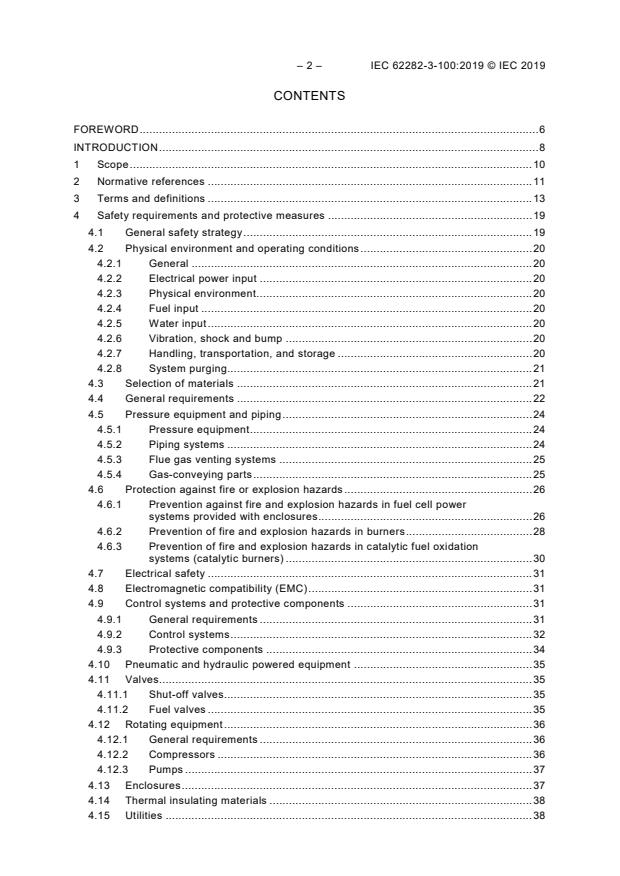
CONTENTS
FOREWORD . 6
INTRODUCTION . 8
1 Scope . 10
2 Normative references . 11
3 Terms and definitions . 13
4 Safety requirements and protective measures . 19
4.1 General safety strategy . 19
4.2 Physical environment and operating conditions . 20
4.2.1 General . 20
4.2.2 Electrical power input . 20
4.2.3 Physical environment . 20
4.2.4 Fuel input . 20
4.2.5 Water input . 20
4.2.6 Vibration, shock and bump . 20
4.2.7 Handling, transportation, and storage . 20
4.2.8 System purging . 21
4.3 Selection of materials . 21
4.4 General requirements . 22
4.5 Pressure equipment and piping . 24
4.5.1 Pressure equipment . 24
4.5.2 Piping systems . 24
4.5.3 Flue gas venting systems . 25
4.5.4 Gas-conveying parts . 25
4.6 Protection against fire or explosion hazards . 26
4.6.1 Prevention against fire and explosion hazards in fuel cell power
systems provided with enclosures . 26
4.6.2 Prevention of fire and explosion hazards in burners . 28
4.6.3 Prevention of fire and explosion hazards in catalytic fuel oxidation
systems (catalytic burners) . 30
4.7 Electrical safety . 31
4.8 Electromagnetic compatibility (EMC) . 31
4.9 Control systems and protective components . 31
4.9.1 General requirements . 31
4.9.2 Control systems . 32
4.9.3 Protective components . 34
4.10 Pneumatic and hydraulic powered equipment . 35
4.11 Valves. 35
4.11.1 Shut-off valves. 35
4.11.2 Fuel valves . 35
4.12 Rotating equipment . 36
4.12.1 General requirements . 36
4.12.2 Compressors . 36
4.12.3 Pumps . 37
4.13 Enclosures . 37
4.14 Thermal insulating materials . 38
4.15 Utilities . 38
4.15.1 General requirements . 38
4.15.2 Water supply . 38
4.15.3 Fuel gas supply . 38
4.15.4 Electrical connections . 38
4.16 Installation and maintenance. 40
4.16.1 Installation . 40
4.16.2 Maintenance . 40
4.17 Equivalent safety . 40
5 Type tests . 41
5.1 General requirements . 41
5.1.1 General . 41
5.1.2 Operating parameters for tests . 41
5.2 Test fuels . 42
5.3 Basic test arrangements . 43
5.4 Leakage tests . 43
5.4.1 General . 43
5.4.2 Pneumatic leakage tests . 43
5.4.3 Hydrostatic leakage tests . 47
5.5 Strength tests . 47
5.5.1 General . 47
5.5.2 Pneumatic strength tests . 47
5.5.3 Hydrostatic strength test . 49
5.6 Normal operation type test . 49
5.7 Electrical overload test . 50
5.8 Shutdown parameters . 50
5.9 Burner operating characteristics tests . 50
5.9.1 General . 50
5.9.2 General testing . 50
5.9.3 Limit testing . 50
5.10 Automatic control of burners and catalytic oxidation reactors . 51
5.10.1 General . 51
5.10.2 Automatic ignition control burners . 51
5.10.3 Automated control of catalytic oxidation reactors . 53
5.11 Exhaust gas temperature test . 54
5.12 Surface and component temperatures . 54
5.13 Wind tests . 55
5.13.1 General . 55
5.13.2 Wind source calibration procedure for winds directed perpendicular to
the wall . 55
5.13.3 Verification of operation of outdoor fuel cell power systems under wind
conditions . 56
5.13.4 Verification of operation of indoor fuel cell power systems vented
horizontally through an outside wall . 57
5.13.5 Carbon monoxide (CO) and flammable gas components emissions
under wind – Indoor units . 59
5.13.6 Carbon monoxide (CO) and flammable gas components emissions
under wind – Outdoor units . 59
5.14 Rain test . 60
5.14.1 Outdoor units . 60
5.14.2 Indoor units supplied with horizontal venting hardware . 60
– 4 – IEC 62282-3-100:2019 © IEC 2019
5.14.3 Test method . 60
5.15 Emissions . 60
5.15.1 General . 60
5.15.2 Carbon monoxide (CO) and flammable gas emissions . 60
5.15.3 Normal conditions . 61
5.16 Blocked condensate line test . 61
5.17 Condensate discharge test . 61
5.18 Electrical safety tests . 62
5.19 EMC test . 62
5.20 Venting system leakage test . 62
5.21 Leakage tests (repeat) . 63
6 Routine tests . 63
6.1 General requirements . 63
6.2 Leakage test . 63
6.3 Dielectric strength test . 64
6.4 Burner operation test . 64
7 Marking, labelling and packaging . 64
7.1 General requirements . 64
7.2 Fuel cell power system marking . 64
7.3 Marking of components . 65
7.4 Technical documentation . 65
7.4.1 General . 65
7.4.2 Installation manual . 66
7.4.3 User’s information manual . 66
7.4.4 Operating manual . 69
7.4.5 Maintenance manual . 70
Annex A (informative) Significant hazards, hazardous situations and events dealt with
in this document . 71
Annex B (informative) Carburization and material compatibility for hydrogen service . 73
B.1 Carburization . 73
B.2 Material compatibility for hydrogen service. 73
B.2.1 General . 73
B.2.2 Metals and metallic materials . 73
B.2.3 Polymers, elastomers, and other non-metallic materials. 75
B.2.4 Reference documents . 75
Annex C (normative) Normative replacement subclauses for small fuel cell power
systems with rated electrical output less than 10 kW, and maximum pressure of less
than 0,1 MPa (gauge) for fuel and oxidant passages . 79
Bibliography . 81
Figure 1 – Typical stationary fuel cell power system . 8
Figure 2 – Minimum test pressures . 49
Figure 3 – Test wall with static pressure ports and vent terminal locations . 56
Figure 4 – Vent test wall . 57
Figure 5 – Piezo ring and details of typical construction . 58
Figure 6 – Safety precautions for odorized gas-fuelled systems . 67
Figure 7 – Safety precautions for odorant-free gas fuelled systems . 68
Figure 8 – Safety precautions for liquid fuelled systems . 68
Table 1 – Allowable surface temperature rises . 23
Table 2 – Leakage test requirements . 46
Table 3 – Ultimate strength test requirements . 48
Table 4 – Wind calibration . 56
Table A.1 – Hazardous situations and events. 71
– 6 – IEC 62282-3-100:2019 © IEC 2019
INTERNATIONAL ELECTROTECHNICAL COMMISSION
____________
FUEL CELL TECHNOLOGIES –
Part 3-100: Stationary fuel cell power systems – Safety
FOREWORD
1) The International Electrotechnical Commission (IEC) is a worldwide organization for standardization comprising
all national electrotechnical committees (IEC National Committees). The object of IEC is to promote
international co-operation on all questions concerning standardization in the electrical and electronic fields. To
this end and in addition to other activities, IEC publishes International Standards, Technical Specifications,
Technical Reports, Publicly Available Specifications (PAS) and Guides (hereafter referred to as “IEC
Publication(s)”). Their preparation is entrusted to technical committees; any IEC National Committee interested
in the subject dealt with may participate in this preparatory work. International, governmental and non-
governmental organizations liaising with the IEC also participate in this preparation. IEC collaborates closely
with the International Organization for Standardization (ISO) in accordance with conditions determined by
agreement between the two organizations.
2) The formal decisions or agreements of IEC on technical matters express, as nearly as possible, an international
consensus of opinion on the relevant subjects since each technical committee has representation from all
interested IEC National Committees.
3) IEC Publications have the form of recommendations for international use and are accepted by IEC National
Committees in that sense. While all reasonable efforts are made to ensure that the technical content of IEC
Publications is accurate, IEC cannot be held responsible for the way in which they are used or for any
misinterpretation by any end user.
4) In order to promote international uniformity, IEC National Committees undertake to apply IEC Publications
transparently to the maximum extent possible in their national and regional publications. Any divergence
between any IEC Publication and the corresponding national or regional publication shall be clearly indicated in
the latter.
5) IEC itself does not provide any attestation of conformity. Independent certification bodies provide conformity
assessment services and, in some areas, access to IEC marks of conformity. IEC is not responsible for any
services carried out by independent certification bodies.
6) All users should ensure that they have the latest edition of this publication.
7) No liability shall attach to IEC or its directors, employees, servants or agents including individual experts and
members of its technical committees and IEC National Committees for any personal injury, property damage or
other damage of any nature whatsoever, whether direct or indirect, or for costs (including legal fees) and
expenses arising out of the publication, use of, or reliance upon, this IEC Publication or any other IEC
Publications.
8) Attention is drawn to the Normative references cited in this publication. Use of the referenced publications is
indispensable for the correct application of this publication.
9) Attention is drawn to the possibility that some of the elements of this IEC Publication may be the subject of
patent rights. IEC shall not be held responsible for identifying any or all such patent rights.
International Standard IEC 62282-3-100 has been prepared by IEC technical committee 105:
Fuel cell technologies.
This second edition cancels and replaces the first edition published in 2012. This edition
constitutes a technical revision.
This edition includes the following significant technical changes with respect to the previous
edition:
recognition that fuel carrying components qualified to leakage standards (soundness)
need not be considered as potential flammable leak sources;
new Annex C for small power systems; and
clarifications for numerous requirements and tests.
The text of this International Standard is based on the following documents:
FDIS Report on voting
105/695/FDIS 105/705/RVD
Full information on the voting for the approval of this International Standard can be found in
the report on voting indicated in the above table.
This document has been drafted in accordance with the ISO/IEC Directives, Part 2.
A list of all parts in the IEC 62282 series, published under the general title Fuel cell
technologies, can be found on the IEC website.
The committee has decided that the contents of this document will remain unchanged until the
stability date indicated on the IEC website under "http://webstore.iec.ch" in the data related to
the specific document. At this date, the document will be
• reconfirmed,
• withdrawn,
• replaced by a revised edition, or
• amended.
IMPORTANT – The 'colour inside' logo on the cover page of this publication indicates
that it contains colours which are considered to be useful for the correct
understanding of its contents. Users should therefore print this document using a
colour printer.
– 8 – IEC 62282-3-100:2019 © IEC 2019
INTRODUCTION
A typical stationary fuel cell power system is shown in Figure 1.
System boundary
Power inputs:
electrical, thermal,
mechanical
Recovered heat
Thermal
management
system
Waste heat
Fuel
Fuel
processing
Fuel
Useable power
system
cell stack
electrical
or Power
module conditioning
system
Oxidant
Oxidant
processing Water
system treatment
Internal power
Discharge
system
needs
water
Ventilation
Exhaust gases,
Ventilation
Inert gas
ventilation
system
Automatic Onboard
Water
control energy
system storage
EMI:
EMD:
noise,
vibration,
vibration
wind, rain,
temperature,
etc.
IEC
Figure 1 – Typical stationary fuel cell power system
The overall design of the power system anticipated by this document forms an assembly of
integrated systems, as necessary, intended to perform designated functions, as follows.
• Fuel processing system – System of chemical and/or physical processing equipment plus
associated heat exchangers and controls required to prepare, and if necessary,
pressurize, the fuel for utilization within a fuel cell power system.
• Oxidant processing system – System that meters, conditions, processes and may
pressurize the incoming supply for use within the fuel cell power system.
• Thermal management system – System that provides heating or cooling and heat rejection
to maintain the fuel cell power system in the operating temperature range, and may
provide for the recovery of excess heat and assist in heating the power train during start-
up.
• Water treatment system – System that provides all the necessary purification treatment of
the recovered or added water for use within the fuel cell power system.
• Power conditioning system – Equipment that is used to adapt the electrical energy
produced by the fuel cell stack(s) to application requirements as specified by the
manufacturer.
• Automatic control system – System(s) that is composed of sensors, actuators, valves,
switches and logic components that maintain the fuel cell power system parameters within
the manufacturer’s specified limits including moving to safe states without manual
intervention.
• Ventilation system – System that provides air through mechanical or natural means to the
fuel cell power system’s enclosure.
• Fuel cell modules – Equipment assembly of one or more fuel cell stacks which
electrochemically converts chemical energy to electric energy and thermal energy
intended to be integrated into a power generation system.
• Fuel cell stack – Equipment assembly of cells, separators, cooling plates, manifolds and a
support structure that electrochemically converts, typically, hydrogen rich gas and air
reactants to DC power, heat and other reactant bi-products.
• Onboard energy storage – System of internal electric energy storage devices intended to
aid or complement the fuel cell module in providing power to internal or external loads.
– 10 – IEC 62282-3-100:2019 © IEC 2019
FUEL CELL TECHNOLOGIES –
Part 3-100: Stationary fuel cell power systems – Safety
1 Scope
This part of IEC 62282 applies to stationary packaged, self-contained fuel cell power systems
or fuel cell power systems comprised of factory matched packages of integrated systems
which generate electricity through electrochemical reactions.
This document applies to systems
intended for electrical connection to mains direct, or with a transfer switch, or to a stand-
alone power distribution system;
intended to provide AC or DC power;
with or without the ability to recover useful heat;
intended for operation on the following input fuels:
natural gas and other methane rich gases derived from renewable (biomass) or fossil
fuel sources, for example, landfill gas, digester gas, coal mine gas;
fuels derived from oil refining, for example, diesel, gasoline, kerosene, liquefied
petroleum gases such as propane and butane;
alcohols, esters, ethers, aldehydes, ketones, Fischer-Tropsch liquids and other
suitable hydrogen-rich organic compounds derived from renewable (biomass) or fossil
fuel sources, for example, methanol, ethanol, di-methyl ether, biodiesel;
hydrogen, gaseous mixtures containing hydrogen gas, for example, synthesis gas,
town gas.
This document does not cover:
• micro fuel cell power systems;
• portable fuel cell power systems;
• propulsion fuel cell power systems.
NOTE For special applications such as “marine auxiliary power”, additional requirements can be given by the
relevant marine ship register standard.
This document is applicable to stationary fuel cell power systems intended for indoor and
outdoor commercial, industrial and residential use in non-hazardous areas.
This document contemplates all significant hazards, hazardous situations and events, with the
exception of those associated with environmental compatibility (installation conditions),
relevant to fuel cell power systems, when they are used as intended and under the conditions
foreseen by the manufacturer.
This document deals with conditions that can yield hazards on the one hand to persons, and
on the other to damage outside the fuel cell power system only. Protection against damage to
the fuel cell power system internals is not addressed in this document, provided it does not
lead to hazards outside the fuel cell power system.
2 Normative references
The following documents are referred to in the text in such a way that some or all of their
content constitutes requirements of this document. For dated references, only the edition
cited applies. For undated references, the latest edition of the referenced document (including
any amendments) applies.
IEC 60079-2, Explosive atmospheres – Part 2: Equipment protection by pressurized
enclosure "p"
IEC 60079-10-1, Explosive atmospheres – Part 10-1: Classification of areas – Explosive gas
atmospheres
IEC 60079-29-1, Explosive atmospheres – Part 29-1: Gas detectors – Performance
requirements of detectors for flammable gases
IEC/IEEE 60079-30-1, Explosive atmospheres – Part 30-1: Electrical resistance trace heating
– General and testing requirements
IEC 60204-1, Safety of machinery – Electrical equipment of machines – Part 1: General
requirements
IEC 60335-1:2016, Household and similar electrical appliances – Safety – Part 1: General
requirements
IEC 60335-2-51, Household and similar electrical appliances – Safety – Part 2-51: Particular
requirements for stationary circulation pumps for heating and service water installations
IEC 60529, Degrees of protection provided by enclosures (IP Code)
IEC 60730-1, Automatic electrical controls – Part 1: General requirements
IEC 60730-2-5, Automatic electrical controls – Part 2-5: Particular requirements for automatic
electrical burner control systems
IEC 60730-2-6, Automatic electrical controls – Part 2-6: Particular requirements for automatic
electrical pressure sensing controls including mechanical requirements
IEC 60730-2-9, Automatic electrical controls – Part 2-9: Particular requirements for
temperature sensing control
IEC 60950-1, Information technology equipment – Safety – Part 1: General requirements
IEC 61000-3-2, Electromagnetic compatibility (EMC) – Part 3-2: Limits – Limits for harmonic
current emissions (equipment input current ≤16 A per phase)
IEC 61000-3-3, Electromagnetic compatibility (EMC) – Part 3-3: Limits – Limitation of voltage
changes, voltage fluctuations and flicker in public low-voltage supply systems, for equipment
with rated current ≤16 A per phase and not subject to conditional connection
IEC TS 61000-3-4, Electromagnetic compatibility (EMC) – Part 3-4: Limits – Limitation of
emission of harmonic currents in low-voltage power supply systems for equipment with rated
current greater than 16 A
– 12 – IEC 62282-3-100:2019 © IEC 2019
IEC TS 61000-3-5, Electromagnetic compatibility (EMC) – Part 3-5: Limits – Limitation of
voltage fluctuations and flicker in low-voltage power supply systems for equipment with rated
current greater than 75 A
IEC 61000-3-11, Electromagnetic compatibility (EMC) – Part 3-11: Limits – Limitation of
voltage changes, voltage fluctuations and flicker in public low-voltage supply systems –
Equipment with rated current ≤75 A and subject to conditional connection
IEC 61000-6-1, Electromagnetic compatibility (EMC) – Part 6-1: Generic standards –
Immunity standard for residential, commercial and light-industrial environments
IEC 61000-6-2, Electromagnetic compatibility (EMC) – Part 6-2: Generic standards –
Immunity standard for industrial environments
IEC 61000-6-3, Electromagnetic compatibility (EMC) – Part 6-3: Generic standards –
Emission standard for residential, commercial and light-industrial environments
IEC 61000-6-4, Electromagnetic compatibility (EMC) – Part 6-4: Generic standards –
Emission standard for industrial environments
IEC 61508 (all parts), Functional safety of electrical/electronic/programmable electronic
safety-related systems
IEC 61511-1, Functional safety – Safety instrumented systems for the process industry sector
– Part 1: Framework, definitions, system, hardware and application programming
requirements
IEC 62040-1, Uninterruptible power systems (UPS) – Part 1: Safety requirements
IEC 62061, Safety of machinery – Functional safety of safety-related electrical, electronic and
programmable electronic control systems
IEC 62368-1, Audio/video, information and communication technology equipment – Part 1:
Safety requirements
ISO 3864-2, Graphical symbols – Safety colours and safety signs – Part 2: Design principles
for product safety labels
ISO 4413, Hydraulic fluid power – General rules and safety requirements for systems and
their components
ISO 4414, Pneumatic fluid power – General rules and safety requirements for systems and
their components
ISO 5388, Stationary air compressors – Safety rules and code of practice
ISO 10439 (all parts), Petroleum, petrochemical and natural gas industries – Axial and
centrifugal compressors and expander-compressors
ISO 10440-1, Petroleum, petrochemical and natural gas industries – Rotary-type positive-
displacement compressors – Part 1: Process compressors
ISO 10440-2, Petroleum and natural gas industries – Rotary-type positive-displacement
compressors – Part 2: Packaged air compressors (oil-free)
ISO 10442, Petroleum, chemical and gas service industries – Packaged, integrally geared
centrifugal air compressors
ISO 12499, Industrial fans – Mechanical safety of fans – Guarding
ISO 13631, Petroleum and natural gas industries – Packaged reciprocating gas compressors
ISO 13707, Petroleum and natural gas industries – Reciprocating compressors
ISO 13709, Centrifugal pumps for petroleum, petrochemical and natural gas industries
ISO 13849-1, Safety of machinery – Safety-related parts of control systems – Part 1: General
principles for design
ISO 13850, Safety of machinery – Emergency stop function – Principles for design
ISO 14847, Rotary positive displacement pumps – Technical requirements
ISO 15649, Petroleum and natural gas industries – Piping
ISO 16111, Transportable gas storage devices – Hydrogen absorbed in reversible metal
hydride
ISO 23550, Safety and control devices for gas and/or oil burners and appliances – General
requirements
ISO 23551-1, Safety and control devices for gas burners and gas-burning appliances –
Particular requirements – Part 1: Automatic and semi-automatic valves
ISO 23553-1, Safety and control devices for oil burners and oil-burning appliances –
Particular requirements – Part 1: Automatic and semi-automatic valves
ISO 26142, Hydrogen detection apparatus – Stationary applications
3 Terms and definitions
For the purposes of this document, the following terms and definitions apply.
ISO and IEC maintain terminological databases for use in standardization at the following
addresses:
• IEC Electropedia: available at http://www.electropedia.org/
• ISO Online browsing platform: available at http://www.iso.org/obp
3.1
accessible
area to which, under normal operating conditions, one of the following applies:
a) access can be gained without the use of a tool;
b) the means of access is deliberately provided to the user;
c) the user is instructed to enter regardless of whether or not a tool is needed to gain access
Note 1 to entry: The terms "access" and "accessible", unless qualified, relate to an area deemed accessible as
defined above.
– 14 – IEC 62282-3-100:2019 © IEC 2019
Note 2 to entry: Only service personnel are allowed into non-accessible areas. Service personnel may need to
have proper personal protective equipment as noted in the maintenance manual.
3.2
anode exhaust catalytic reactor
catalyst reactor which oxidizes hydrogen-rich gas used for hydrogen fuel cell power systems
3.3
automatic burner control system
system which includes a programming unit, a flame detector and may include an ignition
source and/or ignition device and which monitors the operation of fuel burners
Note 1 to entry: The various functions of the system may be in one or more housings.
3.4
burner port
opening in a burner head through which gas or gas-air mixture is discharged for ignition
3.5
combustible material
item capable of being ignited and burned
Note 1 to entry: Such materials are considered combustible even though flame-proofed, fire-retardant treated, or
plastered.
Note 2 to entry: When pertaining to materials adjacent to, or in contact with, heat-producing appliances, vent
connectors, flue gas vents, steam and hot water pipes, and warm air ducts, combustible materials are those
materials made of or surfaced with wood, compressed paper, plant fibres, or other materials that are capable of
being ignited and burned.
3.6
design pressure
highest pressure that may occur under any and all operating modes, including steady state
and transient
3.7
effluent
products of combustion plus the excess air being discharged from gas utilization equipment
3.8
electromagnetic disturbance
EMD
electromagnetic phenomenon that may degrade the performance of a device, equipment or
system, or adversely affect living or inert matter
Note 1 to entry: This note applies to the French language only.
3.9
electromagnetic interference
EMI
degradation of the performance of an equipment, transmission channel or system caused by
an electromagnetic disturbance
Note 1 to entry: This note applies to the French language only.
3.10
electrical equipment
material, fittings, devices, appliances, fixtures, apparatus and the like used as part of, or in
connection with, an electrical installation
IE
...
Questions, Comments and Discussion
Ask us and Technical Secretary will try to provide an answer. You can facilitate discussion about the standard in here.
Loading comments...