

IEC 62153-4-6:2017
(Main)Metallic cables and other passive components test methods - Part 4-6: Electromagnetic compatibility (EMC) - Surface transfer impedance - Line injection method
General Information
- Abstract
IEC 62153-4-6:2017 determines the screening effectiveness of a shielded metallic communication cable by applying a well-defined current and voltage to the screen of the cable and measuring the induced voltage in order to determine the surface transfer impedance.
Measurements in the frequency range from a few kHz up to and above 1 GHz can be made with the use of normal high frequency instrumentation.
- Status
- Published
- Publication Date
- 24-Aug-2017
- Technical Committee
- TC 46 - Cables, wires, waveguides, RF connectors, RF and microwave passive components and accessories
- Drafting Committee
- WG 5 - TC 46/WG 5
- Current Stage
- PPUB - Publication issued
- Start Date
- 25-Aug-2017
- Completion Date
- 23-Sep-2017
Buy Documents
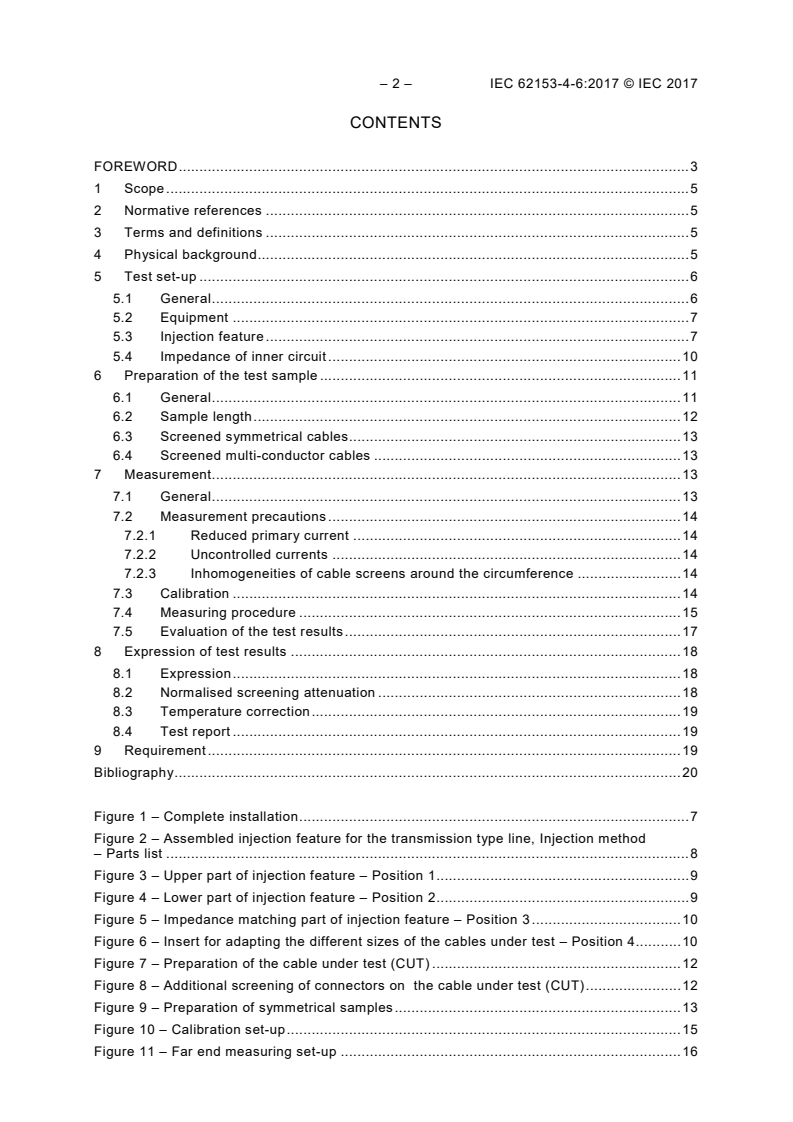
IEC 62153-4-6:2017 - Metallic cables and other passive components test methods - Part 4-6: Electromagnetic compatibility (EMC) - Surface transfer impedance - Line injection method Released:8/25/2017
IEC 62153-4-6:2017 RLV - Metallic cables and other passive components test methods - Part 4-6: Electromagnetic compatibility (EMC) - Surface transfer impedance - line injection method Released:8/25/2017
Overview - IEC 62153-4-6:2017 (Surface transfer impedance, Line injection method)
IEC 62153-4-6:2017 is an international test method for evaluating the screening effectiveness of shielded metallic communication cables by measuring surface transfer impedance using the line injection method. The standard specifies a controlled procedure for applying a defined current/voltage to the cable screen (outer circuit) and measuring the induced longitudinal voltage in the conductor(s) (inner circuit). Measurements can be made from a few kHz up to and above 1 GHz using common high‑frequency instrumentation. (Edition 2.0, 2017‑08)
Key technical topics and requirements
- Purpose: Determine the transfer impedance ZT (and equivalent ZTE when capacitive coupling is non‑negligible) per unit length to quantify shielding performance.
- Test principle: Injection circuit constructed as a transmission line (parallel wires, corrugated ribbon or flat braid) placed tightly along the cable under test (CUT); injection feature provides coaxial-to-line transition.
- Frequency range: From a few kHz to >1 GHz with standard RF instrumentation.
- Equipment:
- Vector Network Analyser (preferred) or signal generator + receiver (with amplifiers/attenuators as needed).
- Time Domain Reflectometer (TDR) with <350 ps rise time (or VNA return‑loss transformed to time domain).
- Impedance matching: Injection circuit characteristic impedance must match the generator output and load; reflection coefficient of injection feature and injection circuit shall be <0.1 (return loss >20 dB).
- Measurements & evaluation:
- Calibration procedures and measuring setups (near‑end / far‑end) are specified.
- Consideration of capacitive coupling (through capacitance C or admittance YC) and temperature correction.
- Results expressed as transfer impedance, normalized screening attenuation and reported in a standardized test report.
- Measurement precautions: Guidance on reduced primary current, uncontrolled currents, and screen inhomogeneities.
Practical applications and who uses this standard
- Cable manufacturers and designers use IEC 62153-4-6 to:
- Validate and optimize screen designs (braids, foils, drains) for EMC.
- Compare shielding performance across product variants.
- EMC test laboratories and certification bodies use it for compliance testing and performance verification.
- System integrators, telecom equipment manufacturers, procurement/specification engineers and R&D teams use transfer impedance data to assess cable suitability in EMC‑sensitive installations (industrial control, telecom, automotive wiring, data centers).
- Useful for troubleshooting EMI issues, specifying procurement limits, and documenting screening performance in technical datasheets.
Related standards
- Other parts of the IEC 62153 series (Metallic communication cable test methods), including IEC 62153‑4‑1 for background on transfer impedance concepts and related measurement techniques.
Relations
- Effective Date
- 05-Sep-2023
Buy Documents
IEC 62153-4-6:2017 - Metallic cables and other passive components test methods - Part 4-6: Electromagnetic compatibility (EMC) - Surface transfer impedance - Line injection method Released:8/25/2017
IEC 62153-4-6:2017 RLV - Metallic cables and other passive components test methods - Part 4-6: Electromagnetic compatibility (EMC) - Surface transfer impedance - line injection method Released:8/25/2017
Get Certified
Connect with accredited certification bodies for this standard

IMQ S.p.A. (Certification)
Italian electrical product certification.

SLG Prüf- und Zertifizierungs GmbH
German testing and certification body.

UL Solutions
Global safety science company with testing, inspection and certification.
Sponsored listings
Frequently Asked Questions
IEC 62153-4-6:2017 is a standard published by the International Electrotechnical Commission (IEC). Its full title is "Metallic cables and other passive components test methods - Part 4-6: Electromagnetic compatibility (EMC) - Surface transfer impedance - Line injection method". This standard covers: IEC 62153-4-6:2017 determines the screening effectiveness of a shielded metallic communication cable by applying a well-defined current and voltage to the screen of the cable and measuring the induced voltage in order to determine the surface transfer impedance. Measurements in the frequency range from a few kHz up to and above 1 GHz can be made with the use of normal high frequency instrumentation.
IEC 62153-4-6:2017 determines the screening effectiveness of a shielded metallic communication cable by applying a well-defined current and voltage to the screen of the cable and measuring the induced voltage in order to determine the surface transfer impedance. Measurements in the frequency range from a few kHz up to and above 1 GHz can be made with the use of normal high frequency instrumentation.
IEC 62153-4-6:2017 is classified under the following ICS (International Classification for Standards) categories: 29.060.10 - Wires; 33.120.10 - Coaxial cables. Waveguides. The ICS classification helps identify the subject area and facilitates finding related standards.
IEC 62153-4-6:2017 has the following relationships with other standards: It is inter standard links to IEC 62153-4-6:2006. Understanding these relationships helps ensure you are using the most current and applicable version of the standard.
IEC 62153-4-6:2017 is available in PDF format for immediate download after purchase. The document can be added to your cart and obtained through the secure checkout process. Digital delivery ensures instant access to the complete standard document.
Standards Content (Sample)
IEC 62153-4-6 ®
Edition 2.0 2017-08
INTERNATIONAL
STANDARD
Metallic cables and other passive components test methods –
Part 4-6: Electromagnetic compatibility (EMC) – Surface transfer impedance –
Line injection method
All rights reserved. Unless otherwise specified, no part of this publication may be reproduced or utilized in any form
or by any means, electronic or mechanical, including photocopying and microfilm, without permission in writing from
either IEC or IEC's member National Committee in the country of the requester. If you have any questions about IEC
copyright or have an enquiry about obtaining additional rights to this publication, please contact the address below or
your local IEC member National Committee for further information.
IEC Central Office Tel.: +41 22 919 02 11
3, rue de Varembé Fax: +41 22 919 03 00
CH-1211 Geneva 20 info@iec.ch
Switzerland www.iec.ch
About the IEC
The International Electrotechnical Commission (IEC) is the leading global organization that prepares and publishes
International Standards for all electrical, electronic and related technologies.
About IEC publications
The technical content of IEC publications is kept under constant review by the IEC. Please make sure that you have the
latest edition, a corrigenda or an amendment might have been published.
IEC Catalogue - webstore.iec.ch/catalogue Electropedia - www.electropedia.org
The stand-alone application for consulting the entire The world's leading online dictionary of electronic and
bibliographical information on IEC International Standards, electrical terms containing 20 000 terms and definitions in
Technical Specifications, Technical Reports and other English and French, with equivalent terms in 16 additional
documents. Available for PC, Mac OS, Android Tablets and languages. Also known as the International Electrotechnical
iPad. Vocabulary (IEV) online.
IEC publications search - www.iec.ch/searchpub IEC Glossary - std.iec.ch/glossary
The advanced search enables to find IEC publications by a 65 000 electrotechnical terminology entries in English and
variety of criteria (reference number, text, technical French extracted from the Terms and Definitions clause of
committee,…). It also gives information on projects, replaced IEC publications issued since 2002. Some entries have been
and withdrawn publications. collected from earlier publications of IEC TC 37, 77, 86 and
CISPR.
IEC Just Published - webstore.iec.ch/justpublished
Stay up to date on all new IEC publications. Just Published IEC Customer Service Centre - webstore.iec.ch/csc
details all new publications released. Available online and If you wish to give us your feedback on this publication or
also once a month by email. need further assistance, please contact the Customer Service
Centre: csc@iec.ch.
IEC 62153-4-6 ®
Edition 2.0 2017-08
INTERNATIONAL
STANDARD
Metallic cables and other passive components test methods –
Part 4-6: Electromagnetic compatibility (EMC) – Surface transfer impedance –
Line injection method
INTERNATIONAL
ELECTROTECHNICAL
COMMISSION
ICS 33.120.10 ISBN 978-2-8322-4748-8
– 2 – IEC 62153-4-6:2017 © IEC 2017
CONTENTS
FOREWORD . 3
1 Scope . 5
2 Normative references . 5
3 Terms and definitions . 5
4 Physical background . 5
5 Test set-up . 6
5.1 General . 6
5.2 Equipment . 7
5.3 Injection feature . 7
5.4 Impedance of inner circuit . 10
6 Preparation of the test sample . 11
6.1 General . 11
6.2 Sample length . 12
6.3 Screened symmetrical cables . 13
6.4 Screened multi-conductor cables . 13
7 Measurement . 13
7.1 General . 13
7.2 Measurement precautions . 14
7.2.1 Reduced primary current . 14
7.2.2 Uncontrolled currents . 14
7.2.3 Inhomogeneities of cable screens around the circumference . 14
7.3 Calibration . 14
7.4 Measuring procedure . 15
7.5 Evaluation of the test results . 17
8 Expression of test results . 18
8.1 Expression . 18
8.2 Normalised screening attenuation . 18
8.3 Temperature correction . 19
8.4 Test report . 19
9 Requirement . 19
Bibliography . 20
Figure 1 – Complete installation . 7
Figure 2 – Assembled injection feature for the transmission type line, Injection method
– Parts list . 8
Figure 3 – Upper part of injection feature – Position 1 . 9
Figure 4 – Lower part of injection feature – Position 2 . 9
Figure 5 – Impedance matching part of injection feature – Position 3 . 10
Figure 6 – Insert for adapting the different sizes of the cables under test – Position 4 . 10
Figure 7 – Preparation of the cable under test (CUT) . 12
Figure 8 – Additional screening of connectors on the cable under test (CUT) . 12
Figure 9 – Preparation of symmetrical samples . 13
Figure 10 – Calibration set-up . 15
Figure 11 – Far end measuring set-up . 16
INTERNATIONAL ELECTROTECHNICAL COMMISSION
____________
METALLIC CABLES AND OTHER
PASSIVE COMPONENTS TEST METHODS –
Part 4-6: Electromagnetic compatibility (EMC) –
Surface transfer impedance – Line injection method
FOREWORD
1) The International Electrotechnical Commission (IEC) is a worldwide organization for standardization comprising
all national electrotechnical committees (IEC National Committees). The object of IEC is to promote
international co-operation on all questions concerning standardization in the electrical and electronic fields. To
this end and in addition to other activities, IEC publishes International Standards, Technical Specifications,
Technical Reports, Publicly Available Specifications (PAS) and Guides (hereafter referred to as “IEC
Publication(s)”). Their preparation is entrusted to technical committees; any IEC National Committee interested
in the subject dealt with may participate in this preparatory work. International, governmental and non-
governmental organizations liaising with the IEC also participate in this preparation. IEC collaborates closely
with the International Organization for Standardization (ISO) in accordance with conditions determined by
agreement between the two organizations.
2) The formal decisions or agreements of IEC on technical matters express, as nearly as possible, an international
consensus of opinion on the relevant subjects since each technical committee has representation from all
interested IEC National Committees.
3) IEC Publications have the form of recommendations for international use and are accepted by IEC National
Committees in that sense. While all reasonable efforts are made to ensure that the technical content of IEC
Publications is accurate, IEC cannot be held responsible for the way in which they are used or for any
misinterpretation by any end user.
4) In order to promote international uniformity, IEC National Committees undertake to apply IEC Publications
transparently to the maximum extent possible in their national and regional publications. Any divergence
between any IEC Publication and the corresponding national or regional publication shall be clearly indicated in
the latter.
5) IEC itself does not provide any attestation of conformity. Independent certification bodies provide conformity
assessment services and, in some areas, access to IEC marks of conformity. IEC is not responsible for any
services carried out by independent certification bodies.
6) All users should ensure that they have the latest edition of this publication.
7) No liability shall attach to IEC or its directors, employees, servants or agents including individual experts and
members of its technical committees and IEC National Committees for any personal injury, property damage or
other damage of any nature whatsoever, whether direct or indirect, or for costs (including legal fees) and
expenses arising out of the publication, use of, or reliance upon, this IEC Publication or any other IEC
Publications.
8) Attention is drawn to the Normative references cited in this publication. Use of the referenced publications is
indispensable for the correct application of this publication.
9) Attention is drawn to the possibility that some of the elements of this IEC Publication may be the subject of
patent rights. IEC shall not be held responsible for identifying any or all such patent rights.
International Standard IEC 62153-4-6 has been prepared by subcommittee 46A: Coaxial
cables, of IEC technical committee 46: Cables, wires, waveguides, RF connectors, RF and
microwave passive components and accessories cables, wires, waveguides, r.f. connectors
and accessories for communication and signalling.
This second edition cancels and replaces the first edition, published in 2006.
– 4 – IEC 62153-4-6:2017 © IEC 2017
The text of this International Standard is based on the following documents:
FDIS Report on voting
46/650/FDIS 46/654/RVD
Full information on the voting for the approval of this International Standard can be found in
the report on voting indicated in the above table.
This document has been drafted in accordance with the ISO/IEC Directives, Part 2.
A list of all parts in the IEC 62153 series, published under the general title Metallic
communication cable test methods, can be found on the IEC website.
The committee has decided that the contents of this document will remain unchanged until the
stability date indicated on the IEC website under "http://webstore.iec.ch" in the data related to
the specific document. At this date, the document will be
• reconfirmed,
• withdrawn,
• replaced by a revised edition, or
• amended.
A bilingual version of this publication may be issued at a later date.
METALLIC CABLES AND OTHER
PASSIVE COMPONENTS TEST METHODS –
Part 4-6: Electromagnetic compatibility (EMC) –
Surface transfer impedance – Line injection method
1 Scope
This part of IEC 62153 determines the screening effectiveness of a shielded metallic
communication cable by applying a well-defined current and voltage to the screen of the cable
and measuring the induced voltage in order to determine the surface transfer impedance.
Measurements in the frequency range from a few kHz up to and above 1 GHz can be made
with the use of normal high frequency instrumentation.
2 Normative references
There are no normative references in this document.
3 Terms and definitions
For the purposes of this document, the following terms and definitions apply.
ISO and IEC maintain terminological databases for use in standardization at the following
addresses:
• IEC Electropedia: available at http://www.electropedia.org/
• ISO Online browsing platform: available at http://www.iso.org/obp
3.1
inner circuit
circuit consisting of the conductor(s) and the screen of the CUT and is denoted by the
subscript 2
3.2
outer circuit (line injection circuit)
circuit consisting of the screen surface of CUT and the injection wire and is denoted by the
subscript 1
3.3
transfer impedance
Z
T
quotient of the longitudinal voltage induced in the inner circuit of the electrically short cable
under test to the current in the outer circuit (line injection circuit) – or vice versa – related to
unit length
4 Physical background
One important element in the determination of the screening effectiveness of cables is the
transfer impedance Z of its screen.
T
– 6 – IEC 62153-4-6:2017 © IEC 2017
Most cables have a negligible capacitive coupling. But for loose single braided cables,
capacitive coupling cannot be neglected. The coupling through the holes in the screen is
described in terms of the through capacitance C or the capacitive coupling admittance Y .
T C
For an electrically short uniform cable, Y is defined as the quotient of the current induced in
C
the inner circuit to the voltage developed in the outer circuit – formed by the screen under test
and the injection wire – or vice versa related to the unit length.
In case of a non negligible capacitive coupling, the screening effectiveness is described by
the equivalent transfer impedance Z :
TE
Z = max Z ± Z (1)
TE F T
Z = jωC Z Z = Y Z Z (2)
F T 1 2 C 1 2
where
ω is the radian frequency;
± + refers to near end, – refers to far end measurement;
C is the through capacitance;
T
Y
is the capacitive coupling admittance;
C
Z is the characteristic impedance of the outer circuit (line injection circuit);
Z
is the characteristic impedance of the inner circuit (cable under test);
Z is the capacitive coupling impedance;
F
Z
is the transfer impedance;
T
Z is the equivalent transfer impedance.
TE
For more information, see the respective parts of IEC 62153-4-1.
5 Test set-up
5.1 General
As shown in Figure 1, the injection circuit is constructed as a transmission line using one or
more parallel wires, a corrugated ribbon cable or a flat copper braid with the outer conductor
of the cable under test. The injection circuit is connected to the coaxial line at each end via an
injection feature. The injection wire shall be fitted tightly to the cable sample along the
coupling length (e.g. with an adhesive tape). The characteristic impedance of the injection
circuit shall be equal to the generator output resistance and the load resistance R ; this is
achieved by choosing an appropriate conductor size and the type of insulation of the injection
wire.
The reflection coefficient of the injection feature and the injection circuit along the coupling
length shall be less than 0,1 related to the generator output resistance, i.e. the return loss
should be higher than 20 dB.
Generator
h
g g
i
b b
L
c
Receiver
z
x
k
e
b a a b d
g
f
c c
IEC
a injection feature
b ferrite
c brass/copper tube for additional screening
d screening box for the matching resistor of the cable under test
e screening box for connecting the cable under test to the receiver
f screened-room wall with screened coaxial feed-through (if needed)
g connector (SMA, N, etc.)
h feeding cable from the generator
i feeding cables for injection wire
k connecting cable to receiver
x cable under test
z injection line
L coupling length
c
Figure 1 – Complete installation
5.2 Equipment
The measuring equipment consists of
a) a vector network analyser or alternatively
• a signal generator with the same characteristic impedance as the line injection circuit
and with a power amplifier if necessary for very low transfer impedance,
• a receiver with a calibrated step attenuator and complemented with a low noise
amplifier for very low transfer impedance,
b) a time domain reflectometer (TDR) with a rise time of less than 350 ps or vector network
analyser (at least 3 GHz) performing a return loss measurement transformed into the time
domain.
5.3 Injection feature
The design of the injection features is adjusted to allow an optimum matching of the
symmetrical TEM in the coaxial feeding and terminating cables to the asymmetrical field along
the parallel line whilst maintaining good mechanical strength for repeated use. Details of a
possible injection features are given in Figure 2 to Figure 6 (the figures are related for a
coaxial cable connection of RG223). Fine tuning of the discontinuity can be made by varying
the foam insert, item 8 of Figure 2.
– 8 – IEC 62153-4-6:2017 © IEC 2017
Alternatively, a suitable injection features can be made with a small connector (solder spill
type) strapped to the CUT, or more easily by strapping the outer conductor of a small coaxial
cable of appropriate characteristic impedance to the bared sheath of the CUT. In the test
section itself, the centre conductor of the c
...
IEC 62153-4-6 ®
Edition 2.0 2017-08
REDLINE VERSION
INTERNATIONAL
STANDARD
colour
inside
Metallic communication cables and other passive components test methods –
Part 4-6: Electromagnetic compatibility (EMC) – Surface transfer impedance –
Line injection method
All rights reserved. Unless otherwise specified, no part of this publication may be reproduced or utilized in any form
or by any means, electronic or mechanical, including photocopying and microfilm, without permission in writing from
either IEC or IEC's member National Committee in the country of the requester. If you have any questions about IEC
copyright or have an enquiry about obtaining additional rights to this publication, please contact the address below or
your local IEC member National Committee for further information.
IEC Central Office Tel.: +41 22 919 02 11
3, rue de Varembé Fax: +41 22 919 03 00
CH-1211 Geneva 20 info@iec.ch
Switzerland www.iec.ch
About the IEC
The International Electrotechnical Commission (IEC) is the leading global organization that prepares and publishes
International Standards for all electrical, electronic and related technologies.
About IEC publications
The technical content of IEC publications is kept under constant review by the IEC. Please make sure that you have the
latest edition, a corrigenda or an amendment might have been published.
IEC Catalogue - webstore.iec.ch/catalogue Electropedia - www.electropedia.org
The stand-alone application for consulting the entire The world's leading online dictionary of electronic and
bibliographical information on IEC International Standards, electrical terms containing 20 000 terms and definitions in
Technical Specifications, Technical Reports and other English and French, with equivalent terms in 16 additional
documents. Available for PC, Mac OS, Android Tablets and languages. Also known as the International Electrotechnical
iPad. Vocabulary (IEV) online.
IEC publications search - www.iec.ch/searchpub IEC Glossary - std.iec.ch/glossary
The advanced search enables to find IEC publications by a 65 000 electrotechnical terminology entries in English and
variety of criteria (reference number, text, technical French extracted from the Terms and Definitions clause of
committee,…). It also gives information on projects, replaced IEC publications issued since 2002. Some entries have been
and withdrawn publications. collected from earlier publications of IEC TC 37, 77, 86 and
CISPR.
IEC Just Published - webstore.iec.ch/justpublished
Stay up to date on all new IEC publications. Just Published IEC Customer Service Centre - webstore.iec.ch/csc
details all new publications released. Available online and If you wish to give us your feedback on this publication or
also once a month by email. need further assistance, please contact the Customer Service
Centre: csc@iec.ch.
IEC 62153-4-6 ®
Edition 2.0 2017-08
REDLINE VERSION
INTERNATIONAL
STANDARD
colour
inside
Metallic communication cables and other passive components test methods –
Part 4-6: Electromagnetic compatibility (EMC) – Surface transfer impedance –
Line injection method
INTERNATIONAL
ELECTROTECHNICAL
COMMISSION
ICS 33.120.10 ISBN 978-2-8322-4788-4
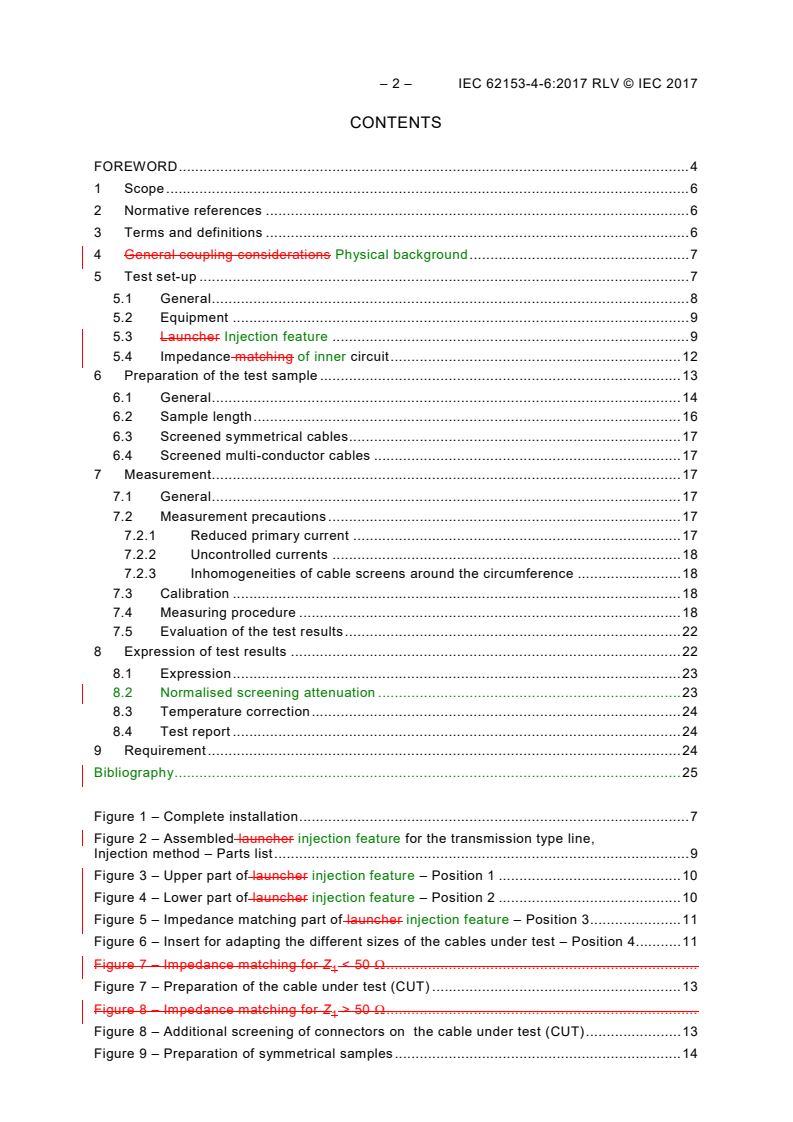
– 2 – IEC 62153-4-6:2017 RLV © IEC 2017
CONTENTS
FOREWORD . 4
1 Scope . 6
2 Normative references . 6
3 Terms and definitions . 6
4 General coupling considerations Physical background . 7
5 Test set-up . 7
5.1 General . 8
5.2 Equipment . 9
5.3 Launcher Injection feature . 9
5.4 Impedance matching of inner circuit . 12
6 Preparation of the test sample . 13
6.1 General . 14
6.2 Sample length . 16
6.3 Screened symmetrical cables . 17
6.4 Screened multi-conductor cables . 17
7 Measurement . 17
7.1 General . 17
7.2 Measurement precautions . 17
7.2.1 Reduced primary current . 17
7.2.2 Uncontrolled currents . 18
7.2.3 Inhomogeneities of cable screens around the circumference . 18
7.3 Calibration . 18
7.4 Measuring procedure . 18
7.5 Evaluation of the test results . 22
8 Expression of test results . 22
8.1 Expression . 23
8.2 Normalised screening attenuation . 23
8.3 Temperature correction . 24
8.4 Test report . 24
9 Requirement . 24
Bibliography . 25
Figure 1 – Complete installation . 7
Figure 2 – Assembled launcher injection feature for the transmission type line,
Injection method – Parts list . 9
Figure 3 – Upper part of launcher injection feature – Position 1 . 10
Figure 4 – Lower part of launcher injection feature – Position 2 . 10
Figure 5 – Impedance matching part of launcher injection feature – Position 3 . 11
Figure 6 – Insert for adapting the different sizes of the cables under test – Position 4 . 11
Figure 7 – Impedance matching for Z < 50 Ω .
Figure 7 – Preparation of the cable under test (CUT) . 13
Figure 8 – Impedance matching for Z > 50 Ω .
Figure 8 – Additional screening of connectors on the cable under test (CUT) . 13
Figure 9 – Preparation of symmetrical samples . 14
Figure 10 – Calibration set-up . 16
Figure 11 – Far end measuring set-up . 17
– 4 – IEC 62153-4-6:2017 RLV © IEC 2017
INTERNATIONAL ELECTROTECHNICAL COMMISSION
____________
METALLIC COMMUNICATION CABLES AND OTHER
PASSIVE COMPONENTS TEST METHODS –
Part 4-6: Electromagnetic compatibility (EMC) –
Surface transfer impedance – Line injection method
FOREWORD
1) The International Electrotechnical Commission (IEC) is a worldwide organization for standardization comprising
all national electrotechnical committees (IEC National Committees). The object of IEC is to promote
international co-operation on all questions concerning standardization in the electrical and electronic fields. To
this end and in addition to other activities, IEC publishes International Standards, Technical Specifications,
Technical Reports, Publicly Available Specifications (PAS) and Guides (hereafter referred to as “IEC
Publication(s)”). Their preparation is entrusted to technical committees; any IEC National Committee interested
in the subject dealt with may participate in this preparatory work. International, governmental and non-
governmental organizations liaising with the IEC also participate in this preparation. IEC collaborates closely
with the International Organization for Standardization (ISO) in accordance with conditions determined by
agreement between the two organizations.
2) The formal decisions or agreements of IEC on technical matters express, as nearly as possible, an international
consensus of opinion on the relevant subjects since each technical committee has representation from all
interested IEC National Committees.
3) IEC Publications have the form of recommendations for international use and are accepted by IEC National
Committees in that sense. While all reasonable efforts are made to ensure that the technical content of IEC
Publications is accurate, IEC cannot be held responsible for the way in which they are used or for any
misinterpretation by any end user.
4) In order to promote international uniformity, IEC National Committees undertake to apply IEC Publications
transparently to the maximum extent possible in their national and regional publications. Any divergence
between any IEC Publication and the corresponding national or regional publication shall be clearly indicated in
the latter.
5) IEC itself does not provide any attestation of conformity. Independent certification bodies provide conformity
assessment services and, in some areas, access to IEC marks of conformity. IEC is not responsible for any
services carried out by independent certification bodies.
6) All users should ensure that they have the latest edition of this publication.
7) No liability shall attach to IEC or its directors, employees, servants or agents including individual experts and
members of its technical committees and IEC National Committees for any personal injury, property damage or
other damage of any nature whatsoever, whether direct or indirect, or for costs (including legal fees) and
expenses arising out of the publication, use of, or reliance upon, this IEC Publication or any other IEC
Publications.
8) Attention is drawn to the Normative references cited in this publication. Use of the referenced publications is
indispensable for the correct application of this publication.
9) Attention is drawn to the possibility that some of the elements of this IEC Publication may be the subject of
patent rights. IEC shall not be held responsible for identifying any or all such patent rights.
This redline version of the official IEC Standard allows the user to identify the changes
made to the previous edition. A vertical bar appears in the margin wherever a change
has been made. Additions are in green text, deletions are in strikethrough red text.
International Standard IEC 62153-4-6 has been prepared by subcommittee 46A: Coaxial
cables, of IEC technical committee 46: Cables, wires, waveguides, RF connectors, RF and
microwave passive components and accessories cables, wires, waveguides, r.f. connectors
and accessories for communication and signalling.
This second edition cancels and replaces the first edition, published in 2006.
The text of this International Standard is based on the following documents:
FDIS Report on voting
46/650/FDIS 46/654/RVD
Full information on the voting for the approval of this International Standard can be found in
the report on voting indicated in the above table.
This document has been drafted in accordance with the ISO/IEC Directives, Part 2.
A list of all parts in the IEC 62153 series, published under the general title Metallic
communication cable test methods, can be found on the IEC website.
The committee has decided that the contents of this document will remain unchanged until the
stability date indicated on the IEC website under "http://webstore.iec.ch" in the data related to
the specific document. At this date, the document will be
• reconfirmed,
• withdrawn,
• replaced by a revised edition, or
• amended.
IMPORTANT – The “colour inside” logo on the cover page of this publication indicates
that it contains colours which are considered to be useful for the correct understanding
of its contents. Users should therefore print this publication using a colour printer.
– 6 – IEC 62153-4-6:2017 RLV © IEC 2017
METALLIC COMMUNICATION CABLES AND OTHER
PASSIVE COMPONENTS TEST METHODS –
Part 4-6: Electromagnetic compatibility (EMC) –
Surface transfer impedance – Line injection method
1 Scope
This part of IEC 62153 determines the screening effectiveness of a shielded metallic
communication cable by applying a well-defined current and voltage to the screen of the cable
and measuring the induced voltage in order to determine the surface transfer impedance.
Measurements in the frequency range from a few kHz up to and above 1 GHz can be made
with the use of normal high frequency instrumentation.
2 Normative references
The following referenced documents are indispensable for the application of this document.
For dated references, only the edition cited applies. For undated references, the latest edition
of the referenced document (including any amendments) applies.
IEC 61196-1:2005, Coaxial communication cables – Part 1: Generic specification – General,
definitions and requirements
IEC 62153-4-3, Metallic communication cable test methods − Electromagnetic Compatibility
(EMC) − Surface transfer impedance − Triaxial method
There are no normative references in this document.
3 Terms and definitions
For the purposes of this document, the following terms and definitions given in IEC 61196-1
apply.
ISO and IEC maintain terminological databases for use in standardization at the following
addresses:
• IEC Electropedia: available at http://www.electropedia.org/
• ISO Online browsing platform: available at http://www.iso.org/obp
3.1
inner circuit
circuit consisting of the conductor(s) and the screen of the CUT and is denoted by the
subscript 2
3.2
outer circuit (line injection circuit)
circuit consisting of the screen surface of CUT and the injection wire and is denoted by the
subscript 1
3.3
transfer impedance
Z
T
quotient of the longitudinal voltage induced in the inner circuit of the electrically short cable
under test to the current in the outer circuit (line injection circuit) – or vice versa – related to
unit length
4 General coupling considerations Physical background
4.1 Inner and outer circuit
The outer circuit (line injection circuit) is fed and indicated by the subscript 1. It consists of
the screen surface and the injection wire. The subscript 2 denotes the inner circuit (cable
under test) where the induced voltage is measured.
4.2 Transfer impedance Z
T
One important element in the determination of the screening effectiveness of cables is the
transfer impedance Z of its screen.
T
For an electrically short uniform cable, it is defined as the quotient of the longitudinal voltage
induced in the inner circuit of the cable under test to the current in the outer circuit (line
injection circuit) – or vice versa – related to unit length.
Most cables have a negligible capacitive coupling. But for loose single braided cables,
capacitive coupling cannot be neglected. The coupling through the holes in the screen is
described in terms of the through capacitance C or the capacitive coupling admittance Y .
T C
For an electrically short uniform cable, Y is defined as the quotient of the current induced in
C
the inner circuit to the voltage developed in the outer circuit – formed by the screen under test
and the injection wire – or vice versa related to the unit length.
In case of a non negligible capacitive coupling, the screening effectiveness is described by
the equivalent transfer impedance Z :
TE
Z = max Z ± Z (1)
TE F T
Z = jωC Z Z = Y Z Z (2)
F T 1 2 C 1 2
where
ω is the radian frequency;
± + refers to near end, – refers to far end measurement;
C is the through capacitance;
T
Y is the capacitive coupling admittance;
C
Z Z is the characteristic impedance of the outer circuit (line injection circuit);
2 1
Z Z is the characteristic impedance of the inner circuit (cable under test);
1 2
Z is the capacitive coupling impedance;
F
Z is the transfer impedance;
T
Z is the equivalent transfer impedance.
TE
For more information, see the respective parts of IEC 62153-4-1.
– 8 – IEC 62153-4-6:2017 RLV © IEC 2017
5 Test set-up
5.1 General
As shown in Figure 1, the injection circuit is constructed as a transmission line using one or
more parallel wires, a corrugated copper strip ribbon cable or a flat copper braid with the
outer conductor of the cable under test. The injection circuit is connected to the coaxial line at
each end via a launcher an injection feature. The injection wire shall be fitted tightly to the
cable sample along the coupling length (e.g. with an adhesive tape). The characteristic
impedance of the injection circuit shall be equal to the generator output resistance and the
load resistance R R ; this is achieved by choosing an appropriate conductor size and the
2 1
type of insulation of the injection wire.
The reflection coefficient of the launcher injection feature and the injection circuit along the
coupling length shall be less than 0,1 related to the generator output resistance, i.e. the return
loss should be higher than 20 dB.
Generator
h
g g
i
b b
L
c
Receiver
z
x
k
e
g b a a b d
f
c c
IEC
a launcher injection feature
b ferrite
c brass/copper tube for additional screening
d screening box for the matching resistor of the cable under test
e screening box for connecting the cable under test to the receiver
f screened-room wall with screened coaxial feed-through (if needed)
g connector (SMA, N, etc.)
h feeding cable from the generator
i feeding cables for injection wire
k connecting cable to receiver
x cable under test
z injection line
L coupling length
c
Figure 1 – Complete installation
5.2 Equipment
The measuring equipment consists of
a) a vector network analyser or alternatively
• a signal generator with the same characteristic impedance as the (quasi) -coaxial
system of the cable under test or with an impedance adapter and complemented the
line injection circuit and with a power amplifier if necessary for very low transfer
impedance,
• a receiver with a calibrated step attenuator and complemented with a low noise
amplifier for very low transfer impedance,
b) a time domain reflectometer (TDR) with a rise time of less than 350 ps or vector network
analyser (at least 3 GHz) performing a return loss measurement transformed into the time
domain.
c) printing facility,
d) impedance matching circuit if necessary. The nominal impedance of the primary side is
equal to the nominal impedance of the generator. The nominal impedance of the
secondary side is equal to the nominal impedance of the (quasi) –coaxial system of the
cable under test (see 5.4). The return loss measured from the primary side shall be
minimum 10 dB.
5.3 Launcher Injection feature
The design of the launchers injection features is adjusted to allow an optimum matching of the
symmetrical TEM in the coaxial feeding and terminating cables to the asymmetrical field along
the parallel line whilst maintaining good mechanical strength for repeated use. Details of a
possible launcher injection features are given in Figure 2 to Figure 6 (the figures are related
for a coaxial cable connection of RG223). Fine tuning of the discontinuity can be made by
varying the foam insert, item 8 of Figure 2.
Alternatively, a suitable launcher injection features can be made with a small connector
(solder spill type) strapped to the CUT, or more easily by strapping the outer conductor of a
small coaxial cable of appropriate characteristic impedance to the bared sheath of the CUT. In
the test section itself, the centre conductor of the coaxial cable is continued using two or four
parallel wires, corrugated copper strip ribbon cable or flat copper braid. Fine tuning of a
launcher an injection feature discontinuity can be achieved by strapping the joint and the
injection wire more closely onto the sheath of the CUT in the test section.
– 10 – IEC 62153-4-6:2017 RLV © IEC 2017
88 33
YY
JJ
11 66
YY--YY
YY
IIECEC
Quantity Part Pos. Remarks, material
4 Metric screw M3 x 10mm 11
2 Metric screw M3 x 6mm 10
1 Pin: dia. 2mm length 8mm 9
1 Foam dielectric 8
er close to 1
1 Injection wire 7
1 50 Ω coaxial cable 6 Impedance as required
1 Cable under test (CUT) 5
1 Insert for CUT 4 Brass
1 Impedance matching part 3 Brass
1 Lower part 2 Brass
1 Upper part 1 Brass
Test launcher injection feature
(two required)
Figure 2 – Assembled launcher injection feature for the transmission type line,
Injection method – Parts list
A-A
B
A
2,5
ø2
M3
0,9
1 × 45°
45°
R3
3 8°
ø3,5
56 25
B A
B-B
B 4
A A
B
IEC
Figure 3 – Upper part of launcher injection feature – Position 1
A
M3
ø2,2
A
A-A
A
A
IEC
Figure 4 – Lower part of launcher injection feature – Position 2
11,5
15 5 6,5
ø5
ø4,5
– 12 – IEC 62153-4-6:2017 RLV © IEC 2017
A
2,5
ø3,5
45°
R3
30 A
A A
IEC
Figure 5 – Impedance matching part of launcher
injection feature – Position 3
A
8°
29,8 ø2,2
A-A
A
IEC
Figure 6 – Insert for adapting the different sizes of
the cables under test – Position 4
5.4 Impedance matching of inner circuit
5.4.1 General
If the impedance of the cable under test Z is not equal to the receiver input resistance
(commonly 50 Ω) then an impedance matching circuit is needed. It shall be implemented as a
two resistor circuit with one series resistor, R and one parallel resistor R . The value of the
s p
resistors and the configurations are shown in 5.4.2 to 5.4.5.
12,5
1,8
5,5
33,5
5.4.2 Impedance of inner system
It is not necessary to match the impedance of the receiver with the impedance of the inner
circuit (cable under test). However, the load resistance R shall be equal to the characteristic
impedance of the (quasi) coaxial line of the prepared cable sample (inner circuit) (see 6.2).
If the impedance Z Z of the inner system circuit (coaxial or quasi coaxial) is not known, it
1 2
may be either determined with a time domain reflectometer or by using the following method:
One end of the prepared sample is connected to a network analyser, which is calibrated for
impedance measurements at the connector interface reference plane. The test frequency
should be at least 10 MHz and shall be the approximate frequency for which the length of the
sample is 1/8 λ, where λ is the wavelength.
c
f ≈ (3)
test
8.L . e
sample r1
where
f
is the test frequency in Hz;
test
. 8
c is the velocity of light, 3 10 m/s;
L
is the length of sample;
sample
is the resulting relative permittivity of the line injection circuit.
e
r1
The sample is short-circuited at the far end. The impedance Z is measured.
short
The sample is left open at the same point where it was shorted. The impedance Z is
open
measured.
Z Z is calculated as:
1 2
Z = Z ⋅ Z (4)
2 short open
5.4.3 Matching circuit if Z < 50 Ω
If the impedance of the inner system Z and subsequently the load resistor R is less than 50
1 1
Ω the formulas below are used:
R
R = 50 × 1 − (6)
s
R
R =
p
(7)
R
1−
The configuration is depicted in Figure 7.
– 14 – IEC 62153-4-6:2017 RLV © IEC 2017
R
s
50 Ω side R side
R 1
p
IEC 373/06
Figure 7 – Impedance matching for Z < 50 Ω
The voltage gain k of the circuit is:
m
R R
1 p
k =
(8)
m
R R + R R + R R
1 p p s 1 s
5.4.4 Matching circuit if Z > 50 Ω
If the impedance of the inner system Z and subsequently R is greater than 50 Ω, the
1 1
formulas below are used:
R = R 1−
(9)
s 2
R
R =
p
(10)
1−
R
The configuration is depicted in Figure 8.
R
s
R
50 Ω side R side
p
IEC 374/06
Figure 8 – Impedance matching for Z > 50 Ω
The voltage gain k of the circuit is:
m
R
k =
(11)
m
R + R
s 2
6 Preparation of the test sample
6.1 General
The recommended test length between the two launchers injection features is 0,5 m for
frequencies up to 1 GHz (see also 6.2). For a launcher an injection feature as described in
5.3, the CUT should be shielded with brass or copper tubes outside its test length (see items
h1 and h2 in Figure 7). The shielding tubes shall make contact with the cable screen S at E by
soldering or crimping. If soldering is used, care shall be taken not to overheat the cable
dielectric. A good practice is to choose the tube diameter such that the CUT can be inserted
with the outer sheath removed and fixed by a standard crimping tool. The advantage of this
method is that the cable braid S is prevented from unravelling near the test length of the CUT
by the close positioning of the tube. Another possibility is the use of wedges to contact non-
solder able aluminium foil/braid cables.
Suitable connectors (N, SMA) shall be mounted on both ends of the CUT. These are coupled
to the termination and to the receiver cable and are mounted in screening boxes (Figure 10).
The completed CUT shall be tested with a TDR for the electrical quality of the CUT itself.
Bending forces shall be avoided at the joints between the tubes and the test section of the
CUT to prevent mechanical damage.
One end of the CUT is prepared with a suitable RF connector (e.g. N (IEC 61169-16), SMA
(IEC 60169-15) to make the connection to the receiver. The other end is matched with a well-
screened resistor, the value of which is equal to the characteristic impedance of the CUT
(coaxial or quasi coaxial system, see 6.4). For bigger cables, it is recommended to use
several resistors in parallel. All connections shall be made so that the contact resistance can
be neglected with respect to the results. For coaxial RF cables with standard values for the
characteristic impedance (i.e. 50 Ω or 75 Ω), it is recommended to mount suitable RF
connectors (N, SMA) on both ends of the CUT and to use standard highly screened coaxial
terminations.
The load resistor and the connection to the receiver cable are mounted in screening boxes
(Figure 8). The completed CUT and the injection circuit shall be tested with a TDR for the
electrical quality of the test set-up. Bending forces shall be avoided at the joints between the
tubes and the test section of the CUT to prevent mechanical damage.
To reduce the influence of unwanted coupling of electromagnetic energy into the free ends,
the sum of both l1 and l2 shall not exceed the length of the test section of the CUT (Figure 7).
I I I
1 2
E
h S S h
1 2
IEC
Figure 7 – Preparation of the cable under test (CUT)
– 16 – IEC 62153-4-6:2017 RLV © IEC 2017
Cover
Cover
Cable under test with
additional brass tube
Cable under test with
To screened
additional brass tube
room
Box
Box
IEC
Figure 8 – Additional screening of connectors on
the cable under test (CUT)
6.2 Sample length
The length of the cable under test shall allow the coupling length necessary for the specified
frequency range and the connection to the test instrument.
The coupling length depends on the highest frequency to be measured. The minimum
coupling length shall be 0,5 m if not other specified, but not less than 0,3 m.
For matched circuits the maximum coupling length may be calculated The relation between
coupling length and highest test frequency is given by:
c
L ≤
(5)
c,max
π ⋅ f ⋅ e ± e
max r2 r1
where
is the resulting relative dielectric permittivity of the dielectric of the line
e
r1
injection circuit;
is the resulting relative dielectric permittivity of the dielectric of the cable
e
r2
under test;
± + refers to near end , – to far end measurement;
. 8
c is the velocity of light, 3 10 m/s;
f is the highest frequency to be measured in Hz;
max
L is the maximum coupling length in m.
,
c max
The ideal conditions for matched the test circuits are as follows:
a) the characteristic impedance of the line injection circuit is equal to the generator output
resistance and the load resistance R R ;
2 1
b) the characteristic impedance of the line injection circuit does not vary along the coupling
length (reflection coefficient less than 0,1) and the load resistance R ;
c) the reflection coefficient of each launcher injection feature is less than 0,1, i.e. the return
loss should be higher than 20 dB;
d) the characteristic impedance of the quasi coaxial line of the prepared cable sample is
equal to the receiver input resistance and the load resistance R ; Therefore the cable
under test may be connected to the receiver via an impedance matching circuit.
e) same propagation velocity in the inner and outer circuit.
For any mismatch in the test set-up, the highest frequency to be measured with a defined
coupling length will be less than calculated. In this case, the highest frequency may be
derived at the 6 dB deviation of the linear progress of the curve in a diagram where the x-axis
is the frequency in the logarithmic scale and the y-axis is the logarithmic voltage ratio
U /U .
generator receiver
6.3 Screened symmetrical cables
Screened symmetrical cables are treated as a quasi coaxial system, see Figure 9. Therefore
all conductors of all pairs shall be connected together at both ends. All screens, also those of
individually screened pairs or quads, shall be connected together at both ends. The screens
shall be connected over the whole circumference.
Screen
XXXXXXXXXXXXXXXX
Well screened
R
Connector load resistor R
Pairs/quads
XXXXXXXXXXXXXXXXX
IEC
Figure 9 – Preparation of symmetrical samples
6.4 Screened multi-conductor cables
Screened multi-conductor cables are prepared as screened symmetrical cables.
7 Measurement
7.1 General
The test set-up shall be assembled in accordance with Figure 1. If necessary, impedance
matching adapter shall be used to match the CUT to the receiver impedance, respectively
load.
7.2 Measurement precautions
7.2.1 Reduced primary current
When making far-end measurements with conventional coaxial instruments, the receiver is
usually earthed. At low frequencies where resistive effects may dominate over inductive ones
or due to resonance in the high kHz range, a part of the injection current may pass directly
over the ground without returning along the screen of the CUT. This leads to a reduced
sensitivity and even to measurement errors if the current in the screen is not directly
monitored over the test section. The problem may be solved by:
a) avoiding far-end measurements at the lower frequencies (mainly in the kHz range);
b) using common mode choke (absorbers, ferrites) on the coaxial feed of the injection wire
(effective in the higher kHz and beyond);
c) using an isolating transformer either for the generator or receiver mains supply (if not in
the same frame) or for the coaxial feed of the injection wire. (These measures are
– 18 – IEC 62153-4-6:2017 RLV © IEC 2017
effective from the lowest frequency ranges but care should be taken to avoid longitudinal
resonances.).
7.2.2 Uncontrolled currents
Special care is required concerning low frequency earth currents not returning through the
coaxial feeding circuit. Such currents pass through parts of the set-up that are not under test
and especially through the frame of the receiver. Therefore the required sensitivity may not be
obtained when measuring very high screening attenuation low transfer impedance. The best
method is the use of isolating transformers as discussed in 7.2.1. Another possibility is to
avoid far-end measurements at the lower frequencies (mainly in the kHz range).
7.2.3 Inhomogeneities of cable screens around the circumference
The injection wire doesn’t cover the whole circumference of the cable screen. Thus for
inhomogeneous cable screens (e.g. screens containing longitudinal tapes), the test results
may depend on the position of the injection wire. Therefore for a sufficient coverage of the
circumference, at least four measurements 90° apart shall be taken, with a coverage angle of
60° to 120°. In the case of cable diameters larger than 10 mm, more measurements may be
necessary.
7.3 Calibration
The composite loss of the connecting cables and the injection circuit (Betriebs-) attenuation of
the injection circuit including the connecting cables (see Figure 10) shall be measured
preferably in a logarithmic frequency sweep over the frequency range, which is specified for
the transfer impedance in the relevant cable specification. The calibration data has to be
saved, so that the results may be corrected.
U
gen, cal
a = 20 × log
cal 10
U
rec, cal
U
P
gen, cal
a = 10 ⋅ lg = −20 ⋅ lg S = 20 ⋅ lg (6)
cal 21
P U
2 rec, cal
where
P is the power fed to the injection circuit during the calibration procedure;
P
is the power at the receiver during the calibration procedure;
S is the scattering parameter S , forward transmission coefficient during the
21 21
calibration procedure;
U is the output voltage of generator during calibration procedure;
gen, cal
U
is the input voltage at the receiver during calibration procedure.
rec, cal
Generator
Receiver
k h
g g
i
b b
L
c
z
x
g e d
b
b a a
f
c c
IEC
Key
a injection feature
b ferrite
c brass/copper tube for additional screening
d screening box for the matching resistor of the cable under test
e screening box for connecting the cable under test to the receiver
f screened-room wall with screened coaxial feed-through (if needed)
g connector (SMA, N, etc.)
h feeding cable from the generator
i feeding cables for injection wire
k connecting cable to receiver
x cable under test
z injection line
L coupling length
c
Figure 10 – Calibration set-up
7.4 Measuring procedure
In the triaxial measuring method to determine the transfer impedance (IEC 62153-4-3) the
through capacitance is short-circuited by the short circuit at the near end of the outer circuit.
In the line injection circuit, both the transfer impedance Z and the capacitive coupling
T
impedance Z act on the cable at the same time, and result in the equivalent transfer
F
impedance Z . Thus a near and far end measurement shall be performed (see Figure 11).
TE
The attenuation shall be measured over the whole frequency range preferably in a logarithmic
frequency sweep at the same frequency points as for the calibration procedure.
Because the cable screen cannot be considered homogeneous around the circumference, at
least four measurements 90 ° apart shall be taken (see 7.2.3).
– 20 – IEC 62153-4-6:2017 RLV © IEC 2017
Generator
h
Load resistace R1
g
i g
b b
L
c
Receiver
z
x
k
g e d
b a b
a
f
c c
IEC
Key
a injection feature
b ferrite
c brass/copper tube for additional screening
d screening box for the matching resistor of the cable under test
e screening box for connecting the cable under test to the receiver
f screened-room wall with screened coaxial feed-through (if needed)
g connector (SMA, N, etc.)
h feeding cable from the generator
i feeding cables for injection wire
k connecting cable to receiver
x cable under test
z injection line
L coupling length
c
Figure 11 – Far end measuring set-up
U
gen, meas
n
f
a = 20 × log
meas 10
n
U
rec, meas
f
n
f
U
n gen, meas
P
n
f
f
n
a = 10 ⋅lg = −20 ⋅lg S = 20 ⋅lg (7)
meas 21
n
n f
P U
2 rec, meas
f
n
f
f
where
P n is the power fed to the injection circuit during the measurement procedure at
f
near end (n) respectively far end (f);
P n is the power at the receiver during the measurement procedure at near end
f
(n) respectively far end (f);
S n scattering parameter S , forward transmission coefficient during the
21 21
f
measurement procedure at near end (n) respectively far end (f);
U output voltage of generator during the measurement procedure at near end
gen, meas
n
(n) respectively far end (f);
f
U input voltage at the receiver during the measurement procedure at near end
rec, meas
n
(n) respectively far end (f).
f
– 22 – IEC 62153-4-6:2017 RLV © IEC 2017
7.5 Evaluation of the test results
Definition:
2 × U
n
f
Z × L = = (Z ± Z )× L
TE c F T c
n
k × I
m 2
f
U
2, n
I = for Z × L << R
2 T c 1
R
2, f
2 × U
n
f
Z × L = × R = (Z ± Z )× L
TE c 2 F T c
n
k × U
m 2, n
f
−A
T
n
f
2R
Z = 10
TE
n
L k
c m
f
Z = max(Z ;Z )
TE TEn TEf
(8)
− A
T
n
f
(R + Z )(R + Z )
1 G 2 R
Z = 10
TE
n
L
c 2 Z Z
f G R
with Z =Z =R =Z (9)
G R 1 0
− A
T
n
f
Z = (R + Z )⋅10
TE 2 0
n
L
c
f
A = a − a (10)
T meas cal
n
n
f
f
Where
U is the induced near end (n) or far end (f) voltage measured at the cable under
n
f
test;
± refers to near end (+) or far end (–) measurement;
I is the current in the screen caused by the injection circuit;
k is the voltage gain of the impedance matching circuit (see 5.4.3 and 5.4.4);
m
Z is the capacitance coupling impedance;
F
is the equivalent transfer impedance of near end (n) or far end (f)
Z
TE
n
measurement;
f
is the attenuation measured at near end (n) or far end (f) during the
a
meas
n
measuring procedure in dB;
f
a is the composite loss attenuation measured at calibration procedure in dB;
cal
L is the coupling length in m;
c
R R
is the load resistance of the line injection circuit in Ω (50 Ω);
2 1
R
is the load resistance of inner circuit (coaxial or quasi coaxial circuit of the
cable under test);
Z
is the equivalent transfer impedance;
TE
Z is the impedance of the generator;
G
Z
is the impedance of the receiver;
R
Z is the system impedance when using a system having the same impedance
for the generator and receiver (e.g. vector network analyser).
8 Expression of test results
8.1 Expression
The values of the equivalent transfer impedance are expressed as Z per unit length at the
TE
frequencies for which requirements are specified in the relevant cable specifications.
Mismatches and structural variations, resulting in poor return loss, in the primary and
secondary circuit may create for the measured transfer impedance at higher frequencies
deviations from or oscillations around the monotonous behaviour of the real transfer
impedance. In this case, the transfer impedance measured below 100 MHz may be
extrapolated by a straight line in a double logarithmic presentation of the transfer impedance.
The straight line shall have the same increase as the curve in the frequency range between
10 MHz to 100 MHz. The extrapolation is valid up to the cut-off frequency of the test set-up.
The cut-off frequency is obtained from:
c 1 1
f = = =
(11)
c
π ⋅ t − t
1 1
1 2
π ⋅ L ⋅ e − e
c r1 r2
π ⋅ L ⋅ −
c
v v
1 2
where
is the resulting relative permittivity of the outer (1) and inner (2) circuit
e
r1,2
respectively
. 8
c is the velocity of light, 3 10 m/s
v is the propagation velocity in the outer (1) and inner (2) circuit respectively
1,2
f is the cut off frequency
c
L is the coupling length in m
c
t is the propagation time of the signal for the length L in the outer (1) and inner
1,2
(2) circuit respectively.
NOTE The propagation time may be measured by TDR techniques. In this case – depending on the test
equipment – the measured time may correspond to the round trip propagation, i.e. twice the propagation time.
8.2 Normalised screening attenuation
For homogenous screens – i.e. screens having no variations along the length – and screens
having a transfer impedance increasing proportionally to frequency, the transfer impedance
may be converted to a normalised screening attenuation (for details, see IEC 62153-4-0). The
normalised conditions are an impedance of 150 Ω in the outer circuit and a velocity difference
between the inner and outer circuit of 10 %.
– 24 – IEC 62153-4-6:2017 RLV © IEC 2017
ω Z Z ω Z Z ⋅ e
2 s 2 s r2
a (150Ω;10%) = 20 ⋅ lg = 20 × lg (12)
sn
Z ⋅11⋅ v Z ⋅11⋅ c
TE 2 TE
where
a (150 Ω;10 %)
is the normalised screening attenuation with normalised conditions of an
sn
impedance of 150 Ω in the outer circuit and a velocity difference between
the inner and outer circuit of 10 %;
Z is the normalised impedance of the outer circuit of 150 Ω;
s
Z
is the impedance of the inner circuit, i.e. of the impedance of the coaxial
or quasi coaxial system of the cable under test;
ν
is the propagation velocity of the signal in the inner circuit, i.e. of the
coaxial or quasi coaxial system of the cable under test;
Z
is the equivalent transfer impedance;
...