

ISO/FDIS 24941
(Main)Ships and marine technology — Piping and machinery — Safety guidelines and requirements for engine rooms of ammonia fuelled vessels
- Abstract
The scope of proposed standard is to suggest safety guidelines for engine rooms of ammonia fuelled vessels, excluding the fuel containment system, and fuel consumers related to ammonia fuel systems for ships in accordance with “Guidelines for ships using ammonia as fuel” developed by the Carriage of Cargoes and Containers (CCC), which is a Sub-Committee of the International Maritime Organization (IMO). This standard focuses on application to ammonia-fuelled ships, but not ammonia carrier ships.
- Status
- Not Published
- Technical Committee
- ISO/TC 8/SC 3 - Piping and machinery
- Drafting Committee
- ISO/TC 8/SC 3/WG 19 - Alternative fuels machinery systems and components
- Current Stage
- 5020 - Proof sent to secretariat or FDIS ballot initiated: 8 weeks - 50 Approval
- Start Date
- 19-Nov-2026
- Due Date
- 19-Nov-2026
- Completion Date
- 19-Nov-2026
Buy Documents
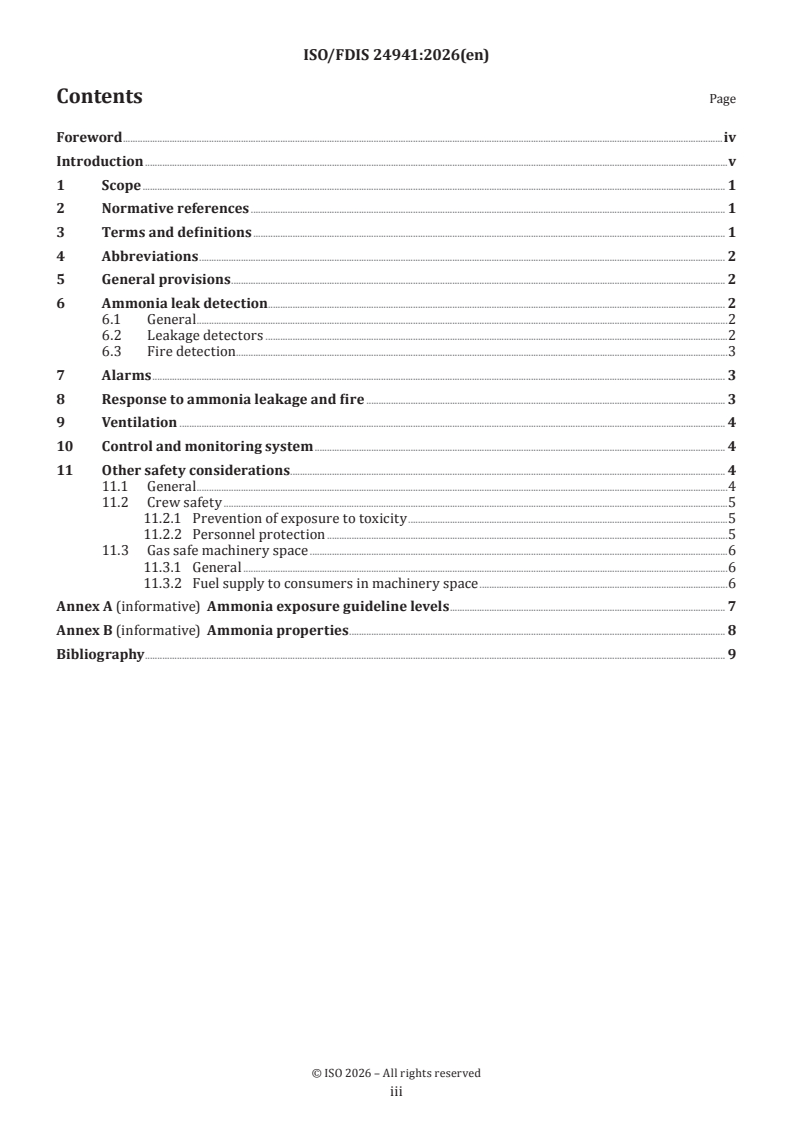
ISO/FDIS 24941 - Ships and marine technology — Piping and machinery — Safety guidelines and requirements for engine rooms of ammonia fuelled vessels
REDLINE ISO/FDIS 24941 - Ships and marine technology — Piping and machinery — Safety guidelines and requirements for engine rooms of ammonia fuelled vessels
ISO/FDIS 24941 is an ISO draft standard for safety guidelines and requirements for engine rooms of ammonia-fuelled vessels. It is aimed at ship designers, shipyards, owners, equipment manufacturers and classification societies that need a common basis for arranging, detecting, controlling and responding to ammonia hazards on board.
The document focuses on the machinery space of ammonia-fuelled vessels. It excludes the fuel containment system and ammonia as cargo, and it is written for ammonia-fuelled ships rather than ammonia carrier ships.
What does ISO/FDIS 24941 specify?
ISO/FDIS 24941 sets out safety guidelines and requirements for the machinery space of ammonia-fuelled vessels, aligned with IMO MSC.1/Circ.1687. The document is organized into clauses 1 to 11, followed by two informative annexes and a bibliography.
| Annex | What it covers |
|---|---|
| Annex A | Ammonia exposure guideline levels |
| Annex B | Ammonia properties |
Clause 1 states the scope, Clause 2 names the reference document used in the text, and Clauses 3 and 4 define the terms and abbreviations used throughout. Clauses 5 to 11 then cover the main safety topics: general provisions, leak detection, alarms, emergency response, ventilation, control and monitoring, and other safety considerations.
What are the key requirements of ISO/FDIS 24941?
Gas-safe machinery space arrangement
ISO/FDIS 24941 requires machinery spaces with ammonia fuel systems or ammonia-fuelled machinery to be arranged as gas-safe spaces under normal and abnormal conditions. In practice, a single failure should not allow fuel gas to enter the machinery space, so the layout, piping boundaries and access routes have to be designed for containment and segregation.
Clause 5 also requires risk reduction through documented methods such as FMEA, HAZID and HAZOP. That means the project team must identify credible failures, define safeguards and keep a traceable record of the decisions made.
Materials, piping and arrangement
Clause 5 requires materials exposed to ammonia to resist its corrosive action, and it excludes mercury, copper, copper alloys, tin-plated metals, zinc, zinc-plated metals and cadmium from direct-contact fuel components. It also calls for all fuel piping within machinery space boundaries to be enclosed in a gastight enclosure.
For the reader, this means the fuel system must be selected and detailed to prevent both leakage and material degradation, not just to survive normal service. The standard also expects access to the machinery space to avoid toxic areas.
Leak and fire detection
Clause 6 allows conventional detectors, LiDAR and thermal cameras for ammonia leak detection, and it expects sensor placement to reflect likely leak points, corners and ventilation outlets. Leakage detection systems are to be designed, installed and tested using the cited gas-detection standards.
Clause 6 also requires a fixed fire detection and fire alarm system. The system has to be arranged and tested with the effect of ventilation in mind, so the detection logic and response time are part of the design evidence.
Alarm and shutdown logic
Clause 7 links ammonia detection to alarm actions and automatic shutdown functions. The practical point is that the detection system is not only for warning personnel - it also has to trigger fuel isolation and emergency response functions where required.
Where shutdown or safety-system activation depends on ammonia detection, the document requires detector voting and fail-safe behavior. That means designers must prevent a single detector fault from creating an unsafe or unreliable shutdown sequence.
Emergency response and ventilation
Clause 8 points to source isolation, water spray for vapour control and careful use of extinguishing media for small fires. Clause 9 requires ventilation to support the gas-safe concept by limiting ammonia accumulation and spread.
The ventilation system must also allow opening and closure of skylights, funnel openings and dampers from two locations, one outside the machinery space. This matters because emergency access to controls must remain possible even when the space itself is hazardous.
Control systems, crew safety and documentation
Clause 10 requires control and monitoring documentation, including line diagrams, alarm lists and evidence of software development and conformity. Clause 11 then adds crew protection, training, signage, portable gas detection, emergency showers and eye-rinsing arrangements.
For operators, this means the standard is not only about hardware. It also requires operating procedures, maintenance controls and personal protection measures that keep people out of harmful ammonia exposure.
What terms does ISO/FDIS 24941 define?
- Toxic area - an area where ammonia is or can be expected to be present.
- Toxic space - an enclosed or semi-enclosed space where ammonia is or may be expected to be present.
- Source of release - a point or location where gas, mist or liquid can escape and create a toxic or flammable atmosphere.
- Machinery space - a space fitted with one or more fuel consumers.
- Consumer - any machinery, engine or boiler that burns fuel to operate.
- PPE - personal protective equipment such as gas-tight clothing, gloves, footwear and face protection.
- FMEA - failure modes and effects analysis, used to identify and control failure risks.
- HAZID / HAZOP - hazard identification and hazard and operability study, used to structure risk reviews.
Who uses ISO/FDIS 24941?
ISO/FDIS 24941 is used by shipyards, shipowners, equipment manufacturers and classification societies working on ammonia-fuelled vessels. It is also relevant to designers, surveyors and inspection teams who need to check machinery space arrangement, leak detection, ventilation, alarms, documentation and crew protection.
The document is especially useful for system design, approval reviews, risk assessment, equipment selection and onboard safety planning. It supports both new designs and the verification of installed systems.
Which standards are used with ISO/FDIS 24941?
ISO/FDIS 24941 aligns with IMO MSC.1/Circ.1687, which provides the interim safety guidelines for ships using ammonia as fuel. The document also refers to the IGF Code, SOLAS and the IMO Fire Safety Systems Code as the framework behind several safety provisions.
For detection and protection equipment, the document points to IEC 60079-29-0 for gas detection equipment, EN 45544-4 and EN 45544 (all parts) for toxic gas detection, and IEC 62990-1 for toxic gas detector performance. For PPE, it cites ISO 16602, ISO 13688, ISO 374-1, ISO 20345 and ISO 16321 (all parts) as examples of recognized standards for chemical clothing, gloves, footwear and eye and face protection.
What does the ISO/FDIS 24941 document contain?
ISO/FDIS 24941 contains the main safety clauses for ammonia-fuelled machinery spaces, plus two informative annexes. Annex A provides exposure guideline levels used for risk control, detector settings and emergency planning, while Annex B summarizes the physical properties of ammonia that drive the hazards.
The body of the document includes requirements and guidance for leak detection, alarms, fire detection, ventilation, control and monitoring, and crew protection. It also includes a table of alarm and automatic shutdown functions, which supports design, testing and safety verification.
Buy Documents
ISO/FDIS 24941 - Ships and marine technology — Piping and machinery — Safety guidelines and requirements for engine rooms of ammonia fuelled vessels
REDLINE ISO/FDIS 24941 - Ships and marine technology — Piping and machinery — Safety guidelines and requirements for engine rooms of ammonia fuelled vessels
Get Certified
Connect with accredited certification bodies for this standard

DNV
DNV is an independent assurance and risk management provider.

Lloyd's Register
Lloyd's Register is a global professional services organisation specialising in engineering and technology.

FSC International
Forest Stewardship Council certification.
Sponsored listings
Frequently Asked Questions
ISO/FDIS 24941 is a draft published by the International Organization for Standardization (ISO). Its full title is "Ships and marine technology — Piping and machinery — Safety guidelines and requirements for engine rooms of ammonia fuelled vessels". This standard covers: The scope of proposed standard is to suggest safety guidelines for engine rooms of ammonia fuelled vessels, excluding the fuel containment system, and fuel consumers related to ammonia fuel systems for ships in accordance with “Guidelines for ships using ammonia as fuel” developed by the Carriage of Cargoes and Containers (CCC), which is a Sub-Committee of the International Maritime Organization (IMO). This standard focuses on application to ammonia-fuelled ships, but not ammonia carrier ships.
The scope of proposed standard is to suggest safety guidelines for engine rooms of ammonia fuelled vessels, excluding the fuel containment system, and fuel consumers related to ammonia fuel systems for ships in accordance with “Guidelines for ships using ammonia as fuel” developed by the Carriage of Cargoes and Containers (CCC), which is a Sub-Committee of the International Maritime Organization (IMO). This standard focuses on application to ammonia-fuelled ships, but not ammonia carrier ships.
ISO/FDIS 24941 is classified under the following ICS (International Classification for Standards) categories: 47.020.20 - Marine engines and propulsion systems; 47.020.30 - Piping systems. The ICS classification helps identify the subject area and facilitates finding related standards.
ISO/FDIS 24941 is available in PDF format for immediate download after purchase. The document can be added to your cart and obtained through the secure checkout process. Digital delivery ensures instant access to the complete standard document.
Standards Content (Sample)
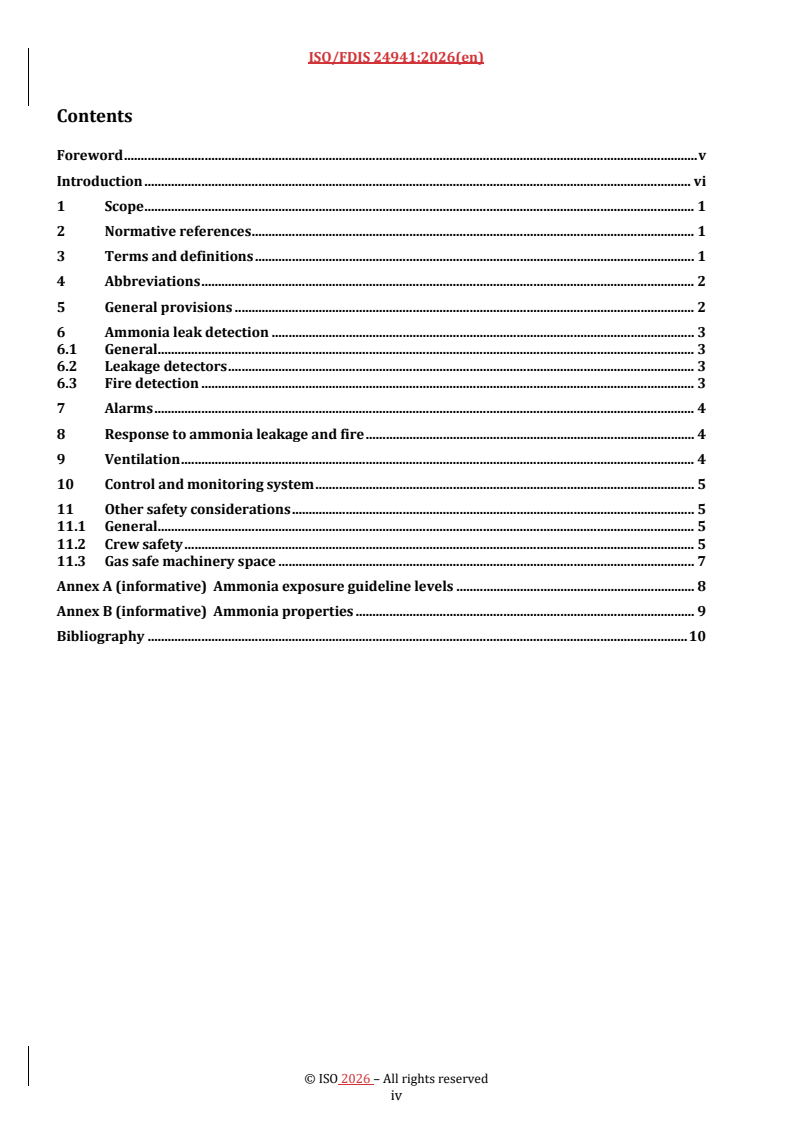
Contents
- Introduction
- 1 Scope
- 2 Normative references
- 3 Terms and definitions
- 3.1 toxic area
- 3.2 toxic space
- 3.3 source of release
- 3.4 machinery space
- 3.5 consumer
- 4 Abbreviations
- 5 General provisions
- 6 Ammonia leak detection
- 6.1 General
- 6.2 Leakage detectors
- 6.3 Fire detection
- 7 Alarms
- 8 Response to ammonia leakage and fire
- 9 Ventilation
- 10 Control and monitoring system
- 11 Other safety considerations
- 11.1 General
- 11.2 Crew safety
- 11.3 Gas safe machinery space
- Annex A
- Annex B
- Bibliography
Introduction
Ammonia is considered one of the alternative fuels with the potential to help the shipping industry meet regulations on reducing greenhouse gas (GHG) emissions.
Ammonia has a relatively high boiling point so that liquefaction is easier than other alternative fuels. But ammonia has also characteristics of toxicity and flammability. So, when handling or using ammonia, attention and caution are extremely important.
The International Maritime Organization (IMO) has published interim guidelines for the safety of ships using ammonia as fuel, as IMO document (MSC.1/Circ.1687). Furthermore, a variety of manufacturers are trying to develop equipment including ammonia-fuelled engines, pumps and valves for use in an ammonia propulsion system. For these reasons, equipment manufacturers, ship building companies and classification societies are publishing guidance and rules regarding the use of ammonia onboard ships. This document provides detailed guidelines and requirements on ammonia safety, which can be used for system designs by shipyards, ship orders from owners, inspection and survey from ship classification societies, and research and development from equipment manufacturers. This document aims to contribute to the growth of relevant industries and benefit all relevant stakeholders. The IMO interim guidelines have been formally approved by the Maritime Safety Committee at its 109th session (MSC 109). At the time of publication of this document, applicable rules and standards on ammonia fuelled ships are still in the early stages of development.
FINAL DRAFT International Standard ISO/FDIS 24941:2026(en) Ships and marine technology — Piping and machinery — Safety guidelines and requirements for engine rooms of ammonia fuelled vessels
1 Scope
This document provides safety guidelines and requirements for the machinery space of ammonia-fuelled [1] vessels, which are aligned with IMO MSC.1/Circ.1687, Interim guidelines for the safety of ships using ammonia as fuel. This document is not applicable to systems for ammonia as a cargo and does not address the design of the ammonia fuel tank.
2 Normative references
There are no normative references in this document.
3 Terms and definitions
For the purposes of this document, the following terms and definitions apply. ISO and IEC maintain terminology databases for use in standardization at the following addresses:
- ISO Online browsing platform: available at https:// www .iso .org/ obp
- IEC Electropedia: available at https:// www .electropedia .org/
3.1 toxic area
area in which ammonia is or can be expected to be present [SOURCE: MSC.1./Circ.1687, 2.2.5]
3.2 toxic space
enclosed or semi-enclosed space in which ammonia is or can be expected to be present Note 1 to entry: A gas-safe machinery space (3.4) is not considered to be a toxic space.
3.3 source of release
point or location from which a gas, mist, or liquid can be released into the atmosphere such that a toxic or flammable ammonia concentration atmosphere can be formed
3.4 machinery space
space as defined in SOLAS Chapter II-1, Part A, Reg. 3.16 that is fitted with one or more fuel consumers (3.5)
3.5 consumer
machinery, engine, or boiler that burns fuel to operate
ISO/FDIS 24941:2026(en)
4 Abbreviations
FMEA failure modes and effects analysis HAZID hazard identification HAZOP hazard and operability study LiDAR light detection and ranging PPE personal protective equipment ppm parts per million
5 General provisions
Machinery spaces containing either ammonia fuel systems or ammonia-fuelled machinery, or both, should be arranged such that the spaces can be considered gas-safe under all conditions (normal as well as abnormal conditions), meaning they are inherently gas safe. In a gas-safe machinery space, a single failure shall not lead to the release of fuel gas into the machinery space. A single failure within the fuel system should not lead to a fuel release into the machinery space. All fuel piping within machinery space boundaries [14] should be enclosed in a gastight enclosure, taking into account paragraph 9,6 of the IGF Code part A-1. Access to the machinery space should not be arranged from toxic areas or toxic zones. To further support optimal safe design, CFD analysis may be performed, taking into account the specific arrangement of each ammonia-fuelled vessel. The objective of such analysis is to evaluate ammonia dispersion and accumulation under credible leakage scenarios, verify the effectiveness of ventilation, support the arrangement of leakage detectors and ventilation openings, and assess the potential spread of ammonia gas to non-toxic areas or spaces.
Risks should be minimized through methods of a risk assessment such as FMEA, HAZID and HAZOP. Risk assessments should be documented in a consistent and traceable manner. The documentation should include the scope of the assessment, assumptions, applicable requirements, assessment method, identified hazards, credible failure scenarios, consequences, safeguards, risk control measures, verification methods, implementation status and residual risks.
Risk control measures should be described in a manner that is specific, unambiguous and verifiable, and should clearly identify the hazard or failure scenario that each measure is intended to address. Materials which can be exposed to fuel during normal operations should be resistant to the corrosive action of ammonia. Mercury, copper, copper alloys, tin-plated metals, zinc, zinc-plated metals and cadmium should not be used for the construction of pipelines, valves, fittings and other items of equipment normally in direct contact with the fuel liquid or vapour.
6 Ammonia leak detection
6.1 General
Conventional type detectors, light detection and ranging (LiDAR) and thermal cameras can be used for leak detection. Strategic placement of sensors near the expected leak points, corners, and outlet ventilation enables effective and comprehensive detection of ammonia dispersion in terms of both distribution and intensity.
6.2 Leakage detectors
A conventional type of detector (including thermal sensors and pressure gauges), LiDAR and thermal cameras can be used to detect ammonia gas or liquid leakage. Leakage detection systems should be designed, installed, and tested according to IEC 60079-29-0 and EN 45544-4. The number of detectors in each location should account for the size, layout and ventilation of the area. Gas dispersal analysis should be
ISO/FDIS 24941:2026(en) used to determine the best arrangement in the machinery space. Depending on the engine type, detectors may be installed directly with the fuel consumer. The detection equipment should be placed where leakage can accumulate and at ventilation outlets. Additionally, a leakage detector with an alarm set at 110 ppm (parts per million) and which stops the ammonia fuel supply to the engine at 220 ppm should be installed at potential source of release. See Table A.1 and Table A.2 for information on ammonia exposure guidelines and limits.
Where ammonia detection is used to initiate shutdown or safety system activation, detector voting shall be applied. Shutdown or safety system activation shall be initiated when ammonia is detected by two detectors. Where isolation of the affected ammonia fuel supply to the engine is required, the tank valves fitted at the fuel tank outlet and located as close to the tank as possible shall close automatically. Failure of one detector shall initiate an alarm, and the detection and shutdown arrangement shall be designed to operate in a failsafe manner. Permanently installed leakage detectors expected to be fitted in machinery spaces containing:
- gas/liquid piping;
- gas/liquid equipment;
- gas/liquid consumers.
6.3 Fire detection
There shall be a fixed fire detection and fire alarm system. The requirements of the IMO Fire Safety Systems [18] Code apply. The detection system should be capable of rapidly detecting a fire. The type of detectors and their spacing and location shall consider the effects of ventilation and other relevant factors. After being installed, the system shall be tested under normal ventilation conditions and the response time shall be documented.
7 Alarms
The alarm system shall be activated for the following cases shown in Table 1. Table 1 — Alarm and automatic shutdown functions Parameter Alarm Automatic shutdown Comments Local indication at all X Ammonia detection in enclosed spaces at entrances to the space,
...
Contents
- Introduction
- 1 Scope
- 2 Normative references
- 3 Terms and definitions
- 3.5 PPE
- 4 Abbreviations
- 5 General requirementsprovisions
- 6 Ammonia leak detection
- 6.1 General
- 6.2 Leakage detectors
- 7 Alarms
- 8 Response to ammonia leakage and fire
- 9 Ventilation
- 10 Control and monitoring system
- 11.1 General
- Annex A
- Annex B
- Bibliography
Introduction
Ammonia is considered one of the alternative fuels with the potential to help the shipping industry meet regulations on reducing greenhouse gas (GHG) emissions.
Ammonia has a relatively high boiling point so that liquefaction is easier than other alternative fuels. But ammonia has also characteristics of toxicity and flammability[Annex B, Table B.1].. So, when handling or using ammonia, attention and caution are extremely important.
The International Maritime Organization (IMO) has published interim guidelines for the safety of ships using ammonia as fuel, as IMO document (MSC.1/Circ.1687). Furthermore, a variety of manufacturers are trying to develop equipment including ammonia-fuelled engines, pumps and valves for use in an ammonia propulsion system. For these reasons, equipment manufacturers, ship building companies and classification societies are publishing guidance and rules regarding the use of ammonia onboard ships. This document provides detailed guidelines and requirements on ammonia safety guidelines in detail, which can be used for system designs by shipyards, ship orders from owners, inspection and survey from ship classification societies, and research and development from equipment manufacturers. This document aims to contribute to the growth of relevant industries and benefit all relevant stakeholders. The IMO interim guidelines have been formally approved by the Maritime Safety Committee at its 109th session (MSC 109). At the time of publication of this document, applicable rules and standards on ammonia fuelled ships are still in the early stages of development. If there is any inconsistency with this document and the IMO guidelines, the guidelines take first priority. The terms and definitions will be developed and harmonized to take into account future guidelines developed by the IMO.
DRAFT International Standard ISO/DIS 24941:2026(en)
Ships and marine technology — — Piping and machinery— — Safety guidelines and requirements for machinery spaceengine rooms of ammonia fuelled vessels
1 Scope
This document provides safety guidelines and requirements for the machinery space of ammonia-fuelled [1] vessels, which are aligned with the “IMO MSC.1/Circ.1687, Interim Guidelinesguidelines for Ships Using Ammoniathe safety of ships using ammonia as Fuel”, published by the International Maritime Organization (IMO). fuel. This document is not applicable to systems for ammonia as a cargo and does not address the design of the ammonia fuel tank.
2 Normative references
The following documents are referred to in the text in such a way that some or all of their content constitutes requirements of this document. For dated references, only the edition cited applies. For undated references, the latest edition of the referenced document (including any amendments) applies. IMO MSC.1/Circ.1687 Interim guidelines for the safety of ships using ammonia as fuel There are no normative references in this document.
3 Terms and definitions
For the purposes of this document, the following terms and definitions apply. ISO and IEC maintain terminology databases for use in standardization at the following addresses:
- — ISO Online browsing platform: available at https://www.iso.org/obp
- — IEC Electropedia: available at https://www.electropedia.org/ 3.1 3.1 toxic area area in which ammonia is or can be expected to be present [SOURCE: MSC.1./Circ.1687, 2.2.5] 3.2 3.2 toxic space enclosed or semi-enclosed space in which ammonia is or maycan be expected to be present Note 1 to entry: A gas-safe machinery space (3.4) is not considered to be a toxic space. 3.3 3.3 source of release point or location from which a gas, mist, or liquid can be released into the atmosphere such that a toxic or flammable ammonia concentration atmosphere couldcan be formed
ISO/FDIS 24941:2026(en) 3.4 3.4 machinery space space as defined in SOLAS regulationChapter II-1/, Part A, Reg. 3.16 that is fitted with one or more fuel consumers (3.5) [SOURCE: SOLAS regulation II-1/3.16, modified — the scope has been limited to spaces fitted with one or more fuel consumers.]
3.5 PPE
personal protective equipment (gas-tight protective clothing, aprons, gloves, footwear, chemical-resistant coveralls, face shields, etc.) 3.5 3.6 consumer any machinery, engine, or boiler that burns fuel to operate
4 Abbreviations
FMEA Failure Modes and Effects Analysis HAZID Hazard Identification HAZOP Hazard and Operability Study FMEA failure modes and effects analysis HAZID hazard identification HAZOP hazard and operability study LiDAR light detection and ranging PPE personal protective equipment ppm parts per million
5 General requirementsprovisions
Machinery spaces containing either ammonia fuel systems or ammonia-fuelled machinery, or both, should be arranged such that the spaces can be considered gas-safe under all conditions, (normal as well as abnormal conditions, i.e.), meaning they are inherently gas safe. In a gas-safe machinery space, a single failure shall not lead to the release of fuel gas into the machinery space. A single failure within the fuel system should not lead to a fuel release into the machinery space. All fuel piping within machinery space boundaries should be [14] enclosed in a gastight enclosure, taking into account paragraph 9,6 of the IGF Code part A-1[13].. Access to the machinery space should not be arranged from toxic areas or toxic zones. To further support optimal safe design, CFD analysis may be performed, taking into account the specific arrangement of each ammonia-fuelled vessel. The objective of such analysis is to evaluate ammonia dispersion and accumulation under credible leakage scenarios, verify the effectiveness of ventilation, support the arrangement of leakage detectors and ventilation openings, and assess the potential spread of ammonia gas to non-toxic areas or spaces. Risks should be minimized through methods of a risk assessment such as FMEA, HAZID and HAZOP. Risk assessments should be documented in a consistent and traceable manner. The documentation should include the scope of the assessment, assumptions, applicable requirements, assessment method, identified hazards, credible failure scenarios, consequences, safeguards, risk control measures, verification methods, implementation status and residual risks.
ISO/DISFDIS 24941:2026(en) Risk control measures should be described in a manner that is specific, unambiguous and verifiable, and should clearly identify the hazard or failure scenario that each measure is intended to address. Materials which can be exposed to fuel during normal operations should be resistant to the corrosive action of ammonia. Mercury, copper, copper alloys, tin-plated metals, zinc, zinc-plated metals and cadmium should not be used for the construction of pipelines, valves, fittings and other items of equipment normally in direct contact with the fuel liquid or vapour.
6 Ammonia leak detection
6.1 General
Conventional type detectors, Light Detectionlight detection and Rangingranging (LiDAR),) and thermal cameras can be used for leak detection. Strategic placement of sensors near the expected leak points, corners, and outlet ventilation enables effective and comprehensive detection of ammonia dispersion in terms of both distribution and intensity.
6.2 Leakage detectors
A conventional type of detector (including thermal sensors and pressure gauges), LiDAR, and thermal cameras can be used to detect ammonia gas or liquid leakage. Leakage detection systems should be designed, installed, and tested according to IEC 60079-29-0 and EN 45544-4. The number of detectors in each location should account for the size, layout, and ventilation of the area. Gas dispersal analysis should be used to determine the best arrangement in the machinery space. Depending on the engine type, detectors may be installed directly with the fuel consumer. The detection equipment should be placed where leakage can accumulate and at ventilation outlets. Additionally, a leakage detector with an alarm set at 110 ppm (parts per million) and which stops the ammonia fuel supply to the engine at 220 ppm should be installed at potential source of release. See Table A.1 and Table A.2[Annex A, Table A.1, Table A.2] for information on ammonia exposure guidelines and limits.
Where ammonia detection is used to initiate shutdown or safety system activation, detector voting shall be applied. Shutdown or safety system activation shall be initiated when ammonia is detected by two detectors. Where isolation of the affected ammonia fuel supply to the engine is required, the tank valve(s)valves fitted at the fuel tank outlet and located as close to the tank as possible shall close automatically. Failure of one detector shall initiate an alarm, and the detection and shutdown arrangement shall be designed to operate in a fail-safe manner.
Permanently installed leakage detectors expected to be fitted in :
a)machinery spacespaces containing:
- gas/liquid piping, ;
- gas/liquid equipment or ;
- gas/liquid consumers;.
...