


ISO/DTR 23583
(Main)Sulfur corrosion test method of copper winding in electric field for power equipment
Méthode d'essai de corrosion par le soufre des enroulements en cuivre dans un champ électrique pour les équipements électriques
General Information
- Status
- Not Published
- Technical Committee
- ISO/TC 156 - Corrosion of metals and alloys
- Drafting Committee
- ISO/TC 156/WG 9 - Corrosion testing of materials for power generation
- Current Stage
- 5020 - FDIS ballot initiated: 2 months. Proof sent to secretariat
- Start Date
- 12-May-2026
- Completion Date
- 12-May-2026
Buy Documents
ISO/DTR 23583 - Sulfur corrosion test method of copper winding in electric field for power equipment
REDLINE ISO/DTR 23583 - Sulfur corrosion test method of copper winding in electric field for power equipment
Overview
ISO/DTR 23583 provides a comprehensive sulfur corrosion test method for copper windings subjected to electric fields in power equipment. Developed by ISO Technical Committee 156 (Corrosion of metals and alloys), this standard addresses the limitations of existing sulfur corrosiveness testing for transformer and power industry applications. By simulating the electric field and actual operating conditions, the test method improves the accuracy of copper winding corrosion assessments, enhancing the reliability and service life of power equipment.
This international standard is applicable to both newly installed and in-service power equipment, supporting manufacturers, utilities, and testing laboratories in evaluating the sulfur corrosion resistance of copper winding materials. The document includes detailed steps for sample preparation, equipment description, test procedures, and both qualitative and quantitative corrosion evaluation.
Key Topics
- Copper Winding Sulfur Corrosion: Addresses how sulfur and corrosive sulfides present in insulating oils can degrade copper winding, leading to equipment failure.
- Influencing Factors: Considers variables such as temperature, electric field (AC/DC), moisture, concentration of corrosive sulfur compounds, insulation oil quality, and contact status between copper winding and insulating paper.
- Test Methodology:
- Pre-treatment of samples, including drying and immersion in insulation oils with known sulfur concentrations.
- Use of pig-tail models to closely replicate real-life transformer winding arrangements.
- Application of electric fields during the test to reflect operational conditions.
- Evaluation Methods:
- Qualitative assessment based on corrosion morphology in line with ASTM D 1275B criteria.
- Quantitative assessment using plasma coupled atomic emission spectrometry (ICP-AES) to measure copper ion concentration in insulating oils.
- Testing Equipment: Description of specialized thermostatic oil tanks, vacuum drying tanks, electric heating experimental tanks, and power supply equipment.
Applications
- Transformer Manufacturing and Maintenance: Enables manufacturers and service providers to assess the sulfur corrosion resistance of copper windings, helping to reduce premature failures in transformers and similar power equipment.
- Quality Assurance and Control: Assists in systematic evaluation of materials and insulating oils used in power transformers, ensuring compliance with stringent reliability requirements.
- Failure Analysis and Lifetime Extension: Helps identify corrosion-related risks in installed equipment, supporting preventive maintenance and strategies to prolong equipment lifespan.
- Testing Laboratories: Provides standardized procedures for laboratories performing corrosion resistance certifications for copper windings in high-voltage equipment.
- Power Utilities: Supports grid operators and asset managers in selecting materials and maintenance schedules by providing reliable data on equipment vulnerability to sulfur-induced corrosion.
Related Standards
- ASTM D 1275A / ASTM D 1275B - Standards for testing corrosive sulfur in electrical insulating oils.
- IEC 62535 - Test methods for detecting potentially corrosive sulfur in insulating oils.
- GB/T 25961 - Standard test method for corrosive sulfur in electrical insulating oils.
- GB/T 38265.15 - Methods for copper corrosion testing in various applications.
- ASTM D 130 - Standard for testing corrosiveness to copper from petroleum products.
- ISO 6251 - Procedures for assessing the corrosiveness of liquefied petroleum gases to copper.
- IEC 60296 - Specifications for mineral insulating oils for electrical equipment.
- GB/T 6451 - Technical requirements for oil-immersed power transformers.
By referencing ISO/DTR 23583, stakeholders in the power sector can ensure improved assessment and mitigation of sulfur corrosion risks, supporting the reliability and safety of power equipment globally. This standard fills a critical gap by introducing electric field simulation and comprehensive testing parameters, aligning with real operational conditions in the power industry.
Buy Documents
ISO/DTR 23583 - Sulfur corrosion test method of copper winding in electric field for power equipment
REDLINE ISO/DTR 23583 - Sulfur corrosion test method of copper winding in electric field for power equipment
Get Certified
Connect with accredited certification bodies for this standard

DNV
DNV is an independent assurance and risk management provider.

BSI Group
BSI (British Standards Institution) is the business standards company that helps organizations make excellence a habit.

Bureau Veritas
Bureau Veritas is a world leader in laboratory testing, inspection and certification services.
Sponsored listings
Frequently Asked Questions
ISO/DTR 23583 is a draft published by the International Organization for Standardization (ISO). Its full title is "Sulfur corrosion test method of copper winding in electric field for power equipment". This standard covers: Sulfur corrosion test method of copper winding in electric field for power equipment
Sulfur corrosion test method of copper winding in electric field for power equipment
ISO/DTR 23583 is classified under the following ICS (International Classification for Standards) categories: 27.010 - Energy and heat transfer engineering in general; 77.060 - Corrosion of metals. The ICS classification helps identify the subject area and facilitates finding related standards.
ISO/DTR 23583 is available in PDF format for immediate download after purchase. The document can be added to your cart and obtained through the secure checkout process. Digital delivery ensures instant access to the complete standard document.
Standards Content (Sample)
FINAL DRAFT
Technical
Report
ISO/TC 156
Sulfur corrosion test method of
Secretariat: SAC
copper winding in electric field for
Voting begins on:
power equipment
2026-05-12
Voting terminates on:
2026-07-07
RECIPIENTS OF THIS DRAFT ARE INVITED TO SUBMIT,
WITH THEIR COMMENTS, NOTIFICATION OF ANY
RELEVANT PATENT RIGHTS OF WHICH THEY ARE AWARE
AND TO PROVIDE SUPPOR TING DOCUMENTATION.
IN ADDITION TO THEIR EVALUATION AS
BEING ACCEPTABLE FOR INDUSTRIAL, TECHNO
LOGICAL, COMMERCIAL AND USER PURPOSES, DRAFT
INTERNATIONAL STANDARDS MAY ON OCCASION HAVE
TO BE CONSIDERED IN THE LIGHT OF THEIR POTENTIAL
TO BECOME STAN DARDS TO WHICH REFERENCE MAY BE
MADE IN NATIONAL REGULATIONS.
Reference number
FINAL DRAFT
Technical
Report
ISO/TC 156
Sulfur corrosion test method of
Secretariat: SAC
copper winding in electric field for
Voting begins on:
power equipment
Voting terminates on:
RECIPIENTS OF THIS DRAFT ARE INVITED TO SUBMIT,
WITH THEIR COMMENTS, NOTIFICATION OF ANY
RELEVANT PATENT RIGHTS OF WHICH THEY ARE AWARE
AND TO PROVIDE SUPPOR TING DOCUMENTATION.
© ISO 2026
IN ADDITION TO THEIR EVALUATION AS
All rights reserved. Unless otherwise specified, or required in the context of its implementation, no part of this publication may
BEING ACCEPTABLE FOR INDUSTRIAL, TECHNO
LOGICAL, COMMERCIAL AND USER PURPOSES, DRAFT
be reproduced or utilized otherwise in any form or by any means, electronic or mechanical, including photocopying, or posting on
INTERNATIONAL STANDARDS MAY ON OCCASION HAVE
the internet or an intranet, without prior written permission. Permission can be requested from either ISO at the address below
TO BE CONSIDERED IN THE LIGHT OF THEIR POTENTIAL
or ISO’s member body in the country of the requester.
TO BECOME STAN DARDS TO WHICH REFERENCE MAY BE
MADE IN NATIONAL REGULATIONS.
ISO copyright office
CP 401 • Ch. de Blandonnet 8
CH-1214 Vernier, Geneva
Phone: +41 22 749 01 11
Email: copyright@iso.org
Website: www.iso.org
Published in Switzerland Reference number
ii
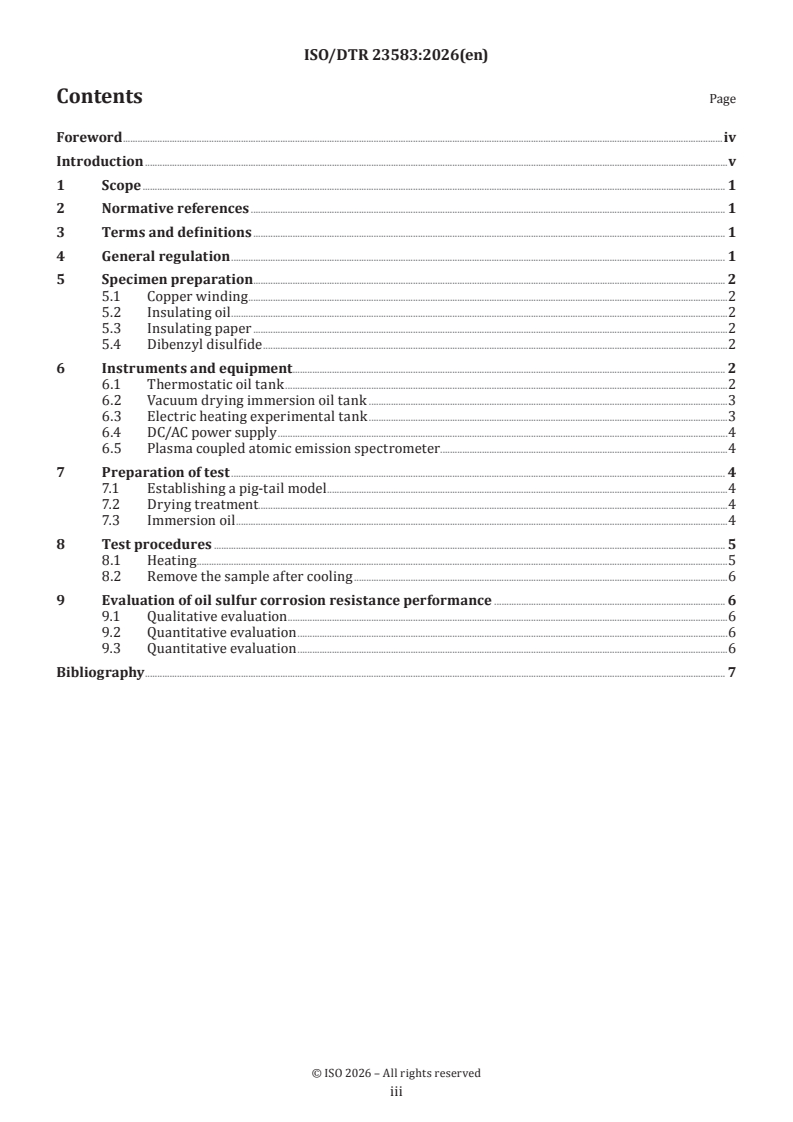
Contents Page
Foreword .iv
Introduction .v
1 Scope . 1
2 Normative references . 1
3 Terms and definitions . 1
4 General regulation . 1
5 Specimen preparation . . 2
5.1 Copper winding .2
5.2 Insulating oil .2
5.3 Insulating paper .2
5.4 Dibenzyl disulfide .2
6 Instruments and equipment . 2
6.1 Thermostatic oil tank .2
6.2 Vacuum drying immersion oil tank .3
6.3 Electric heating experimental tank .3
6.4 DC/AC power supply .4
6.5 Plasma coupled atomic emission spectrometer.4
7 Preparation of test . 4
7.1 Establishing a pig-tail model .4
7.2 Drying treatment.4
7.3 Immersion oil .4
8 Test procedures . 5
8.1 Heating.5
8.2 Remove the sample after cooling .6
9 Evaluation of oil sulfur corrosion resistance performance . 6
9.1 Qualitative evaluation .6
9.2 Quantitative evaluation .6
9.3 Quantitative evaluation .6
Bibliography . 7
iii
Foreword
ISO (the International Organization for Standardization) is a worldwide federation of national standards
bodies (ISO member bodies). The work of preparing International Standards is normally carried out through
ISO technical committees. Each member body interested in a subject for which a technical committee
has been established has the right to be represented on that committee. International organizations,
governmental and non-governmental, in liaison with ISO, also take part in the work. ISO collaborates closely
with the International Electrotechnical Commission (IEC) on all matters of electrotechnical standardization.
The procedures used to develop this document and those intended for its further maintenance are described
in the ISO/IEC Directives, Part 1. In particular, the different approval criteria needed for the different types
of ISO document should be noted. This document was drafted in accordance with the editorial rules of the
ISO/IEC Directives, Part 2 (see www.iso.org/directives).
ISO draws attention to the possibility that the implementation of this document may involve the use of (a)
patent(s). ISO takes no position concerning the evidence, validity or applicability of any claimed patent
rights in respect thereof. As of the date of publication of this document, ISO had not received notice of (a)
patent(s) which may be required to implement this document. However, implementers are cautioned that
this may not represent the latest information, which may be obtained from the patent database available at
www.iso.org/patents. ISO shall not be held responsible for identifying any or all such patent rights.
Any trade name used in this document is information given for the convenience of users and does not
constitute an endorsement.
For an explanation of the voluntary nature of standards, the meaning of ISO specific terms and expressions
related to conformity assessment, as well as information about ISO's adherence to the World Trade
Organization (WTO) principles in the Technical Barriers to Trade (TBT), see www.iso.org/iso/foreword.html.
This document was prepared by Technical Committee ISO/TC 156, Corrosion of metals and alloys.
Any feedback or questions on this document should be directed to the user’s national standards body. A
complete listing of these bodies can be found at www.iso.org/members.html.
iv
Introduction
Many factors affect the sulfur corrosion of copper windings in power equipment in the power industry.
These include:
— temperature;
— corrosive sulfide concentration in oil;
— acid products derived from oil-paper insulation aging;
— moisture;
— the type of electric field (AC or DC electric field);
— electric field strength;
— the contact state between the copper winding and the insulating paper;
— the quality of the copper winding.
These have a significant influence on the occurrence of sulfur corrosion and the generation of corrosion
products. The current assessment methods of sulfur corrosion of copper windings do not sufficiently
consider these factors. Existing standards (e.g. ASTM D 1275A, ASTM D 1275B, IEC 62535, GB/T 25961) test
specifications or methods for testing whether the quality of insulating oil meets the requirements.
As for the corrosion of copper, the existing standards are test methods for the co
...
Style Definition
...
Style Definition
...
Style Definition
...
ISO/TC 156 N7985
Style Definition
...
Style Definition
...
Style Definition
...
ISO/TC 156/WG 9
Style Definition
...
ISO/TC 156
Style Definition
...
Style Definition
Secretariat: SAC .
Style Definition
...
Date: 2026-03-2404-27
Style Definition
...
Style Definition
...
Style Definition
...
Style Definition
...
Style Definition
...
Style Definition
Sulfur corrosion test method of copper winding in electric field for .
Style Definition
...
power equipment
Style Definition
...
Style Definition
...
Style Definition
...
Style Definition
...
Style Definition
...
Style Definition
...
Style Definition
...
Style Definition
...
Style Definition
...
DTR stage
Style Definition
...
Style Definition
...
Style Definition
...
Style Definition
...
Style Definition
...
Style Definition
...
Style Definition
...
Style Definition
...
Style Definition
...
Style Definition
...
Style Definition
...
Style Definition
...
Style Definition
...
Style Definition
...
Style Definition
...
Style Definition
...
Style Definition
...
Style Definition
...
Style Definition
...
© ISO #### – All rights reserved Style Definition
...
Style Definition
...
Style Definition
...
Style Definition
...
Formatted
...
Formatted
...
Formatted
...
Formatted
...
Formatted
...
Formatted
...
Formatted
...
Formatted
...
F tt d
ISO #####-#:####(X/DTR 23583:(en) Formatted: Font: 11 pt, Bold
Formatted: Font: 11 pt, Bold
Formatted: HeaderCentered, Left, Space After: 0 pt,
Line spacing: single
Formatted: Indent: Left: 0 cm, Right: 0 cm, Space
All rights reserved. Unless otherwise specified, or required in the context of its implementation, no part of this publication
Before: 0 pt, No page break before, Adjust space
may be reproduced or utilized otherwise in any form or by any means, electronic or mechanical, including photocopying,
between Latin and Asian text, Adjust space between
or posting on the internet or an intranet, without prior written permission. Permission can be requested from either ISO
Asian text and numbers, Border: Top: (No border)
at the address below or ISO’s member body in the country of the requester.
Formatted: Left: 1.5 cm, Right: 1.5 cm, Bottom: 1 cm,
Header distance from edge: 1.27 cm, Footer distance
ISO copyright office
from edge: 0.5 cm
CP 401 • Ch. de Blandonnet 8
CH-1214 Vernier, Geneva
Phone: + 41 22 749 01 11
Formatted: French (Switzerland)
EmailE-mail: copyright@iso.org
Formatted: French (Switzerland)
Website: www.iso.orgwww.iso.org
Formatted: French (Switzerland)
Published in Switzerland
Formatted: Font: 10 pt
Formatted: Font: 10 pt
Formatted: Font: 11 pt
Formatted: FooterPageRomanNumber, Space After: 0
pt, Line spacing: single
ii © ISO #### 2026 – All rights reserved
ii
Formatted: Font: 11 pt, Bold
Formatted: Font: 11 pt, Bold, English (United Kingdom)
Formatted: Font: 11 pt, Bold
Contents
Formatted: HeaderCentered, Left, Space After: 0 pt,
Line spacing: single
Foreword . v
Introduction . vi
1 Scope . 1
2 Normative references . 1
3 Terms and definitions . 1
4 General regulation . 1
5 Specimen preparation . 2
5.1 Copper winding . 2
5.2 Insulating oil . 2
5.3 Insulating paper . 2
5.4 Dibenzyl disulfide . 2
6 Instruments and equipment . 2
6.1 Thermostatic oil tank . 2
6.2 Vacuum drying immersion oil tank . 3
6.3 Electric heating experimental tank . 3
6.4 DC/AC power supply . 4
6.5 Plasma coupled atomic emission spectrometer . 4
7 Preparation of test . 4
7.1 Establishing a pig-tail model . 4
7.2 Drying treatment . 4
7.3 Immersion oil . 5
8 Test procedures . 7
8.1 Heating . 7
8.2 Remove the sample after cooling . 7
9 Evaluation of oil sulfur corrosion resistance performance . 7
9.1 Qualitative evaluation . 7
9.2 Quantitative evaluation . 7
9.3 Quantitative evaluation . 7
Bibliography . 9
Foreword . iv
Introduction . v
1 Scope . 1
2 Normative references . 1
3 Terms and definitions . 1
4 General regulation . 1
5 Specimen preparation . 2
Formatted: Font: 10 pt
5.1 Copper winding . 2
Formatted: Font: 10 pt
5.2 Insulating oil . 2
5.3 Insulating paper . 2 Formatted: FooterCentered, Left, Line spacing: single
5.4 Dibenzyl disulfide . 2
Formatted: Font: 11 pt
6 Instruments and equipment . 2
Formatted: FooterPageRomanNumber, Left, Space
6.1 Thermostatic oil tank . 2
After: 0 pt, Line spacing: single
© ISO TR 23583 2026 – All rights reserved
iii
ISO #####-#:####(X/DTR 23583:(en) Formatted: Font: 11 pt, Bold
Formatted: Font: 11 pt, Bold
Formatted: HeaderCentered, Left, Space After: 0 pt,
6.2 Vacuum drying immersion oil tank. 2
Line spacing: single
6.3 Electric heating experimental tank . 2
6.4 DC/AC power supply. 3
6.5 Plasma coupled atomic emission spectrometer . 3
7 Preparation of test . 3
7.1 Establish a pig-tail model . 3
7.2 Drying treatment . 4
7.3 Immersion oil . 4
8 Test procedures . 5
8.1 Heating . 5
8.2 Remove the sample after cooling . 5
9 Evaluation of oil sulfur corrosion resistance performance . 5
9.1 Qualitative evaluation . 5
9.2 Quantitative evaluation . 5
9.3 Quantitative evaluation . 5
Bibliography . 错误!未定义书签。
Formatted: Font: 10 pt
Formatted: Font: 10 pt
Formatted: Font: 11 pt
Formatted: FooterPageRomanNumber, Space After: 0
pt, Line spacing: single
iv © ISO #### 2026 – All rights reserved
iv
Formatted: Font: 11 pt, Bold
Formatted: Font: 11 pt, Bold, English (United Kingdom)
Formatted: Font: 11 pt, Bold
Foreword
Formatted: HeaderCentered, Left, Space After: 0 pt,
Line spacing: single
ISO (the International Organization for Standardization) is a worldwide federation of national standards
bodies (ISO member bodies). The work of preparing International Standards is normally carried out through
ISO technical committees. Each member body interested in a subject for which a technical committee has been
established has the right to be represented on that committee. International organizations, governmental and
non-governmental, in liaison with ISO, also take part in the work. ISO collaborates closely with the
International Electrotechnical Commission (IEC) on all matters of electrotechnical standardization.
The procedures used to develop this document and those intended for its further maintenance are described
in the ISO/IEC Directives, Part 1. In particular, the different approval criteria needed for the different types of
ISO document should be noted. This document was drafted in accordance with the editorial rules of the
ISO/IEC Directives, Part 2 (see www.iso.org/directives).
Formatted: Default Paragraph Font
ISO draws attention to the possibility that the implementation of this document may involve the use of (a)
patent(s). ISO takes no position concerning the evidence, validity or applicability of any claimed patent rights
in respect thereof. As of the date of publication of this document, ISO had not received notice of (a) patent(s)
which may be required to implement this document. However, implementers are cautioned that this may not
represent the latest information, which may be obtained from the patent database available at
www.iso.org/patents.www.iso.org/patents. ISO shall not be held responsible for identifying any or all such
patent rights.
Any trade name used in this document is information given for the convenience of users and does not
constitute an endorsement.
For an explanation of the voluntary nature of standards, the meaning of ISO specific terms and expressions
related to conformity assessment, as well as information about ISO's adherence to the World Trade
Organization (WTO) principles in the Technical Barriers to Trade (TBT), see
www.iso.org/iso/foreword.htmlwww.iso.org/iso/foreword.html.
This document was prepared by Technical Committee ISO/TC 156, Corrosion of metals and alloys.
Formatted: Font: Not Italic
Any feedback or questions on this document should be directed to the user’s national standards body. A
complete listing of these bodies can be found at www.iso.org/members.htmlwww.iso.org/members.html.
Formatted: Font: 10 pt
Formatted: Font: 10 pt
Formatted: FooterCentered, Left, Line spacing: single
Formatted: Font: 11 pt
Formatted: FooterPageRomanNumber, Left, Space
After: 0 pt, Line spacing: single
© ISO TR 23583 2026 – All rights reserved
v
ISO #####-#:####(X/DTR 23583:(en) Formatted: Font: 11 pt, Bold
Formatted: Font: 11 pt, Bold
Formatted: HeaderCentered, Left, Space After: 0 pt,
Introduction
Line spacing: single
Many factors affect the sulfur corrosion of copper windings in power equipment in the power industry. These
include:
— — temperature;
Formatted: List Continue 1
— — corrosive sulfide concentration in oil;
— — acid products derived from oil-paper insulation aging;
— — moisture;
— — the type of electric field (AC or DC electric field);
— — electric field strength;
— — the contact state between the copper winding and the insulating paper;
— — the quality of the copper winding.
These have a significant influence on the occurrence of sulfur corrosion and the generation of corrosion
products. Unfortunately, theThe current assessment methods of sulfur corrosion of copper windings do not
sufficiently consider these factors. Existing standards (e.g. ASTM D 1275A/B, ASTM D 1275B, IEC 62535, GB/T
Formatted: English (United Kingdom)
25961) test specifications or methods for testing whether the quality of insulating oil meets the requirements.
As for the corrosion of copper, the existing standards are test methods for the corrosion of copper metal in the
atmospheric environment, petroleum products, etc. Standards such as GB/T 38265.15, ASTM D 130 and ISO
6251specify6251 specify special testing or assessment methods for lubricants, oil and copper parts in
atmospheric environments (e.g. pipelines, tower parts and other structures), which does not fully apply to
power equipment.
Therefore, with reference to the existing standards for corrosive sulfur detection in insulating oil, this
document proposes a sulfur corrosion test method for copper winding in electric field for power equipment.
The method includes pre-treatment, model construction, the corrosion test method and corrosion level
judgments for copper windings.
This document contributes to controlling the quality of copper windings in electric power equipment,
reducing the failure of electric power equipment due to sulfur corrosion and prolonging the service life of
power equipment, which has great significance in improving the safe operation of power grids.
This document considers the effects of actual working conditions (e.g. electric field, the contact state between
th
...