

ISO/SAE TR 8477:2026
(Main)Road vehicles — Cybersecurity verification and validation
- Abstract
This document provides considerations on the planning and execution of verification and validation (V&V) of the cybersecurity of items and components of road vehicles, in the context of ISO/SAE 21434.
- Status
- Published
- Publication Date
- 05-Nov-2026
- Technical Committee
- ISO/TC 22/SC 32 - Electrical and electronic components and general system aspects
- Drafting Committee
- ISO/TC 22/SC 32/WG 11 - Cybersecurity
- Current Stage
- 6060 - International Standard published - 60 Publication
- Start Date
- 06-Nov-2026
- Due Date
- 06-Nov-2026
- Completion Date
- 06-Nov-2026
ISO/SAE TR 8477:2026 is an ISO technical report on road vehicle cybersecurity verification and validation. It gives guidance for planning and carrying out V&V of items and components in the context of ISO/SAE 21434, with emphasis on strategy, method selection, activity sequence and reporting. It is written for engineers, suppliers and customers who need to produce or judge cybersecurity V&V evidence.
What does ISO/SAE TR 8477:2026 specify?
ISO/SAE TR 8477:2026 provides considerations for the planning and execution of cybersecurity V&V for items and components of road vehicles. The report is guidance-oriented: it helps teams decide how to organize V&V work, rather than prescribing one fixed test or review method.
The document is organized into clauses on the cybersecurity context, V&V strategy and planning, method groups, example applications of methods, and V&V reporting. It also includes one informative annex.
| Annex | What it covers |
|---|---|
| Annex A | Difference with cybersecurity assessment |
What are the key requirements of ISO/SAE TR 8477:2026?
Clause 4 explains how cybersecurity V&V fits into ISO/SAE 21434 work products and development flow. Verification checks whether the architecture and design satisfy cybersecurity requirements, while validation checks whether the item is appropriately and sufficiently cybersecure in its intended vehicle context. In practice, this distinction helps teams choose the right evidence for design conformity versus real-world cybersecurity adequacy.
Clause 4 also links V&V to the requirements hierarchy and architectural layers. Verification can apply at any level of the requirements hierarchy and against artefacts such as requirements, design or implementation. Validation focuses on the highest levels, including cybersecurity goals, conceptual cybersecurity requirements, operational-environment requirements, assumptions and cybersecurity claims. This matters because the same item may need different evidence at requirements, design and implementation level.
Clause 4.4 stresses early and iterative V&V. Validation can start from preliminary architectural results and preliminary TARA results, then be updated as development progresses, and it is concluded before release for post-development. The practical message is to “shift left” where possible, so that findings are found early enough to fix without late redesign.
Clause 4.6 connects V&V with TARA. If TARA depends on a cybersecurity control, a property of the item, or an assumption, V&V must confirm that the relied-on property really exists, that the expected effectiveness is valid, and that assumptions hold. This is important when a risk rating, attack-feasibility judgement or mitigation decision depends on a control such as secure boot, a manual procedure or an external environment condition.
Clause 4.7 and 4.8 deal with change and assumptions. When a finding, design change or refinement affects work products, the related V&V work products need updating to keep them consistent. Assumptions are to be documented and then verified or validated depending on what they influence. In practice, this supports traceable change management instead of treating test evidence as static.
Clause 5 sets out V&V strategy and planning. A strategy can identify the item or component in scope, define what V&V should establish, select methods and justify that selection, and link to the cybersecurity plan and cybersecurity interface agreements. The plan can define activities, responsibilities, timeline, entry and exit criteria, pass/fail criteria, prioritization, coordination, communication, handling of findings, distributed activities and automation. This helps teams assign work clearly between customer and supplier and decide when evidence is good enough to proceed.
Clause 6 gives method groups that can be selected in a strategy, but the report does not recommend or forbid any particular method. The groups include review, analysis, formal method, code analysis, functional testing, vulnerability scanning, fuzz testing, stress testing, fault injection, penetration testing and cryptographic testing. For a reader, this section is a menu of method families that can be matched to the property, layer and risk being checked.
Clause 8 requires structured V&V reporting that is traceable back to the cybersecurity case. Reports can identify the item or component, the strategy and plan, the test environment, the scope, the method approach, the results, deviations and conclusion. This matters because the report is meant to support a cybersecurity assessment and make the evidence judgeable, not just to record test output.
What terms does ISO/SAE TR 8477:2026 define?
- V&V - Verification and validation. Verification checks conformance to cybersecurity requirements; validation checks whether the item is sufficiently cybersecure in its intended context.
- TARA - Threat analysis and risk assessment. The report uses TARA as the risk-analysis activity whose assumptions and control dependencies may need validation.
- Conceptual cybersecurity requirement - A cybersecurity requirement directly derived from a cybersecurity goal. The report uses this term to support validation at the highest requirement level.
- Cybersecurity goal - A top-level cybersecurity intent used in the ISO/SAE 21434 hierarchy. Validation can judge whether these goals are achieved.
- Cybersecurity claim - A statement used in the highest level of the requirements hierarchy and considered in validation. It is part of the evidence chain discussed in Clause 4.
- ECU - Electronic control unit. The report uses ECU as an example of an item or component under V&V.
- CAN - Controller area network. CAN appears in examples involving interfaces, transports and test cases.
Who uses ISO/SAE TR 8477:2026?
ISO/SAE TR 8477:2026 is used by customers, suppliers and other parties involved in road vehicle cybersecurity work. Clause 4.1 explicitly says V&V activities can be performed by a customer, a supplier or other parties according to the cybersecurity interface agreement.
It is relevant to road vehicle cybersecurity engineers, integration teams, test engineers, reviewers and managers who need to plan evidence for an item or component. It is also useful for organizations that distribute cybersecurity responsibilities between parties, because the report discusses information exchange, handover, assumptions and shared evidence.
The report is aimed at road vehicle development, including automotive and commercial-vehicle contexts. Its examples cover items, components, ECUs, software, interfaces, cryptographic functions and operational-environment assumptions.
Which standards are used with ISO/SAE TR 8477:2026?
The normative reference is ISO/SAE 21434, Road vehicles - Cybersecurity engineering. ISO/SAE TR 8477:2026 is written in the context of that standard and uses its terms, work products and cybersecurity engineering structure. In practice, ISO/SAE 21434 is the companion standard that provides the main cybersecurity engineering framework, while this technical report explains how to verify and validate that framework.
What does the ISO/SAE TR 8477:2026 document contain?
Clause 4 contains the conceptual explanation of cybersecurity V&V, including its relation to requirements hierarchy levels, architectural layers, functional and non-functional properties, TARA, assumptions and different development situations such as reuse, out-of-context development and off-the-shelf components. It also includes figures that illustrate how V&V activities relate to work products and architecture.
Clause 5 gives planning content for a V&V strategy and cybersecurity plan, including scope definition, method selection, responsibilities, timing, criteria, coordination, communication and management of findings. Clause 6 describes the method groups and explains what each one contributes, from reviews and analysis to fuzz testing, stress testing, penetration testing and cryptographic testing.
Clause 7 provides tables of example applications of methods. The examples map methods to TARA, assumptions and cybersecurity claims, cybersecurity goals, cybersecurity concept and conceptual cybersecurity requirements, and cybersecurity requirements, design and specification. These tables are useful for designing a test or review campaign because they show what kind of evidence fits each type of work product.
Clause 8 describes how to report V&V results and includes example report excerpts for verification and validation. Annex A explains how V&V differs from cybersecurity assessment and how V&V evidence feeds into that assessment.
Get Certified
Connect with accredited certification bodies for this standard

BSI Group
BSI (British Standards Institution) is the business standards company that helps organizations make excellence a habit.

TÜV Rheinland
TÜV Rheinland is a leading international provider of technical services.

TÜV SÜD
TÜV SÜD is a trusted partner of choice for safety, security and sustainability solutions.
Sponsored listings
Frequently Asked Questions
ISO/SAE TR 8477:2026 is a technical report published by the International Organization for Standardization (ISO). Its full title is "Road vehicles — Cybersecurity verification and validation". This standard covers: This document provides considerations on the planning and execution of verification and validation (V&V) of the cybersecurity of items and components of road vehicles, in the context of ISO/SAE 21434.
This document provides considerations on the planning and execution of verification and validation (V&V) of the cybersecurity of items and components of road vehicles, in the context of ISO/SAE 21434.
ISO/SAE TR 8477:2026 is classified under the following ICS (International Classification for Standards) categories: 35.030 - IT Security; 43.040.15 - Car informatics. On board computer systems. The ICS classification helps identify the subject area and facilitates finding related standards.
ISO/SAE TR 8477:2026 is available in PDF format for immediate download after purchase. The document can be added to your cart and obtained through the secure checkout process. Digital delivery ensures instant access to the complete standard document.
Standards Content (Sample)
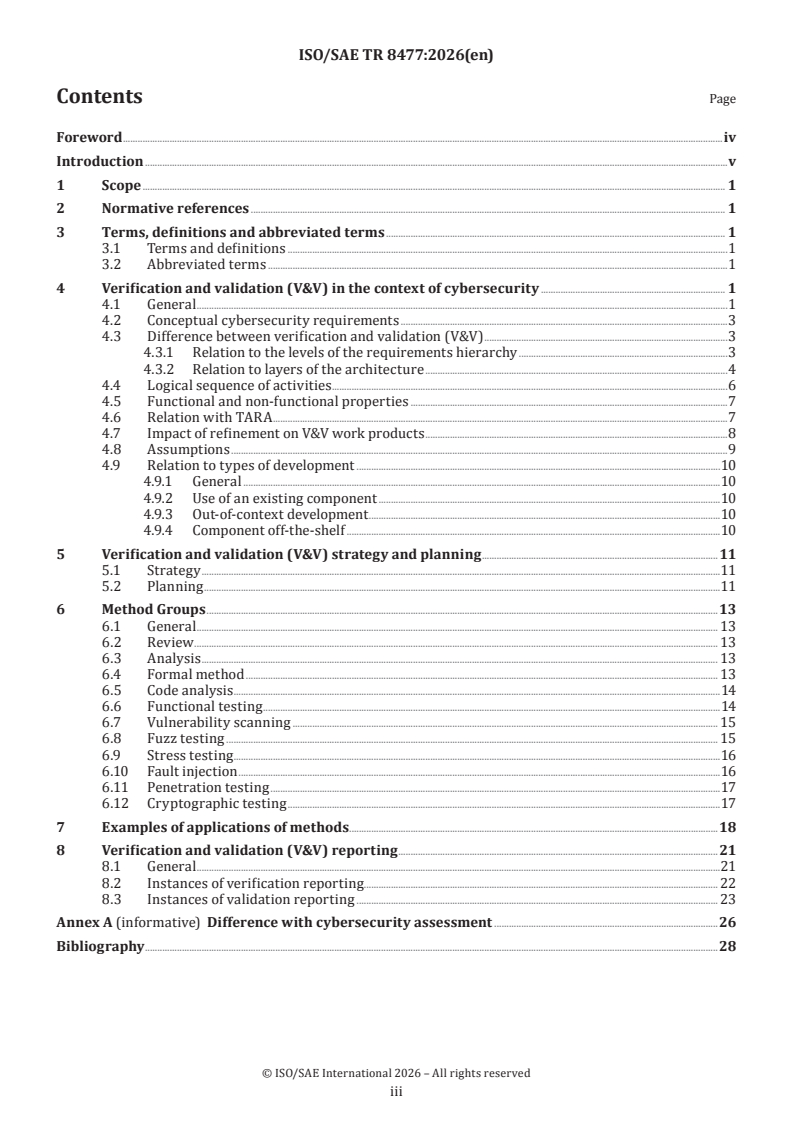
Contents
- Introduction
- 1 Scope
- 2 Normative references
- 3 Terms, definitions and abbreviated terms
- 3.1 Terms and definitions
- 3.2 Abbreviated terms
- 4 Verification and validation (V&V) in the context of cybersecurity
- 4.1 General
- 4.2 Conceptual cybersecurity requirements
- 4.3 Difference between verification and validation (V&V)
- 4.4 Logical sequence of activities
- 4.5 Functional and non-functional properties
- 4.6 Relation with TARA
- 4.7 Impact of refinement on V&V work products
- 2 Design increment Implementation of cyber- Implementation of a PIN code
- 4.8 Assumptions
- 4.9 Relation to types of development
- 5 Verification and validation (V&V) strategy and planning
- 5.1 Strategy
- 5.2 Planning
- 6 Method Groups
- 6.1 General
- 6.2 Review
- 6.3 Analysis
- 6.4 Formal method
- 6.5 Code analysis
- 6.6 Functional testing
- 6.7 Vulnerability scanning
- 6.8 Fuzz testing
- 6.9 Stress testing
- 6.10 Fault injection
- 6.11 Penetration testing
- 6.12 Cryptographic testing
- 7 Examples of applications of methods
- 8 Verification and validation (V&V) reporting
- 8.1 General
- 8.2 Instances of verification reporting
- 8.3 Instances of validation reporting
- Annex A
- Bibliography
Introduction
This document elaborates on verification and validation (V&V) of the cybersecurity of items and components [1] of road vehicles in accordance with ISO/SAE 21434 . It provides considerations on:
- V&V strategy;
- methods that can be applied;
- distribution of activities between customer and supplier;
- logical sequence of activities.
The objectives are different between V&V; however, both can use identical or similar methods. The choice of methods and the extent of the rigour with which they are applied are part of a project- and organization-specific strategy. This document focuses on strategy and does not prescribe methods. V&V are part of development of an item or component and involve multiple activities, including repeating (e.g. iteration or feedback loop) or complementing activities.
Technical Report ISO/SAE TR 8477:2026(en) Road vehicles — Cybersecurity verification and validation
1 Scope
This document provides considerations on the planning and execution of verification and validation (V&V) [1] of the cybersecurity of items and components of road vehicles, in the context of ISO/SAE 21434 .
2 Normative references
The following documents are referred to in the text in such a way that some or all of their content constitutes requirements of this document. For dated references, only the edition cited applies. For undated references, the latest edition of the referenced document (including any amendments) applies. ISO/SAE 21434, Road vehicles — Cybersecurity engineering
3 Terms, definitions and abbreviated terms
3.1 Terms and definitions
For the purposes of this document, the terms and definitions given in ISO/SAE 21434 apply. ISO and IEC maintain terminology databases for use in standardization at the following addresses:
- ISO Online browsing platform: available at https:// www .iso .org/ obp
- IEC Electropedia: available at https:// www .electropedia .org/
3.2 Abbreviated terms
CAN controller area network CS cybersecurity CVSS common vulnerability scoring system CWE common weakness enumeration E/E electric / electronic ECU electronic control unit PIN personal identification number TARA threat analysis and risk assessment V&V verification and validation
4 Verification and validation (V&V) in the context of cybersecurity
4.1 General
[1] This clause provides an overview of V&V in the context of cybersecurity, elaborating on ISO/SAE 21434 .
ISO/SAE TR 8477:2026(en) Verification in cybersecurity addresses whether the architecture and design of an item or component satisfy the cybersecurity requirements. In general, it answers the question “are we building the cybersecurity of the item or component right?” Verification results can be an input to validation. Validation in cybersecurity addresses whether an item is appropriately and sufficiently cybersecure. In general, it answers the question “are we building the right item regarding cybersecurity?” Validation applies to the item integrated in the target vehicle, considering the interfaces of the item, its operational environment and threat scenarios.
[2] See also IEC 60050-192:2015 , 192-01-17 and 192-01-18.
Figure 1 and Figure 2, respectively, provide examples of V&V activities. These figures are not intended to [3] be exhaustive – not all relevant work products of ISO/SAE 21434:2021 are included, nor are all relevant activities.
Key work product (WP) part of WP / other activity verify / validate V&V input Figure 1 — Examples of verification activities
ISO/SAE TR 8477:2026(en) Key work product part of WP / other activity verify / validate V&V input Figure 2 — Examples of validation activities V&V activities can be performed by a customer, a supplier or other parties, according to the cybersecurity interface agreement. This agreement includes information exchange, such that each party is able to fulfil corresponding responsibilities.
V&V provide evidence that can be judged in a cybersecurity assessment, see Annex A.
4.2 Conceptual cybersecurity requirements
The term “conceptual cybersecurity requirement” – meaning “cybersecurity requirement directly derived from a cybersecurity goal” – is used in this document to facilitate elaborating validation. For reference, [3] ISO/SAE 21434:2021 , 3.1.36, defines cybersecurity validation as confirmation of only the adequacy and achievement of the cybersecurity goals of the item, and effectiveness of cybersecurity controls in preventing or mitigating risk associated with threat scenarios.
[3] The work product “cybersecurity concept” (see ISO/SAE 21434:2021 , 3.1.13) includes these conceptual cybersecurity requirements, as well as their allocation.
[3] The work product “cybersecurity specification” (see ISO/SAE 21434:2021 , 3.1.21) includes the cybersecurity requirements associated with lower levels of the requirements hierarchy, as well as the corresponding architectural design.
4.3 Difference between verification and validation (V&V)
4.3.1 Relation to the levels of the requirements hierarchy
Verification relates to any level of the requirements hierarchy.
ISO/SAE TR 8477:2026(en) Validation relates to the highest level of the requirements hierarchy, i.e. validation relates to:
- cybersecurity goals; - conceptual cybersecurity requirements; - requirements allocated to the operational environment; - assumptions that influence the derivation of cybersecurity goals or conceptual cybersecurity requirements, including assumptions concerning the operational environment; NOTE A supplier developing a component can make assumptions that concern the item level and makes these available to the customer.
- cybersecurity claims.
Figure 3 illustrates the relation of V&V to the requirements hierarchy. Figure 3 — Verification, validation and relation to the requirements hierarchy
4.3.2 Relation to layers of the architecture
An item or component can include multiple layers of architectural abstraction. Figure 4 illustrates how cybersecurity requirements can be allocated to different architectural layers.
ISO/SAE TR 8477:2026(en) Figure 4 — Cybersecurity requirement allocation to architectural layers A weakness or vulnerability can exist in any layer of the architecture and thus violate cybersecurity requirements allocated to that layer (and ultimately violate the corresponding cybersecurity goals). Accordingly, both V&V can relate to any layer of the architecture:
- At any architectural layer, verification can be performed against artefacts such as cybersecurity requirements, architectural design or implementation, based on a strategy (see Clause 5);
- Validation can relate to any layer of the architecture, as any layer can ultimately bring about a violation of a cybersecurity goal or a conceptual cybersecurity requirement. At higher architectural layers, validation can be performed against cybersecurity controls that are not detailed enough to be fully implemented (i.e. not “buildable”) and cybersecurity claims.
Figure 5 further illustrates the relation between cybersecurity work products, levels of the requirements hierarchy and architectural layers considering V&V activities. All references in Figure 5 relate to [3] [3] ISO/SAE 21434:2021 , e.g. work product ISO/SAE 21434:2021 , [WP-09-01].
ISO/SAE TR 8477:2026(en) Key work product part of WP / other activity requirements, design interaction requirements hierarchy verify / validate V&V inputs Figure 5 — Relation of V&V activities to requirement hierarchy levels and architectural layers
4.4 Logical sequence of activities
V&V can range from early to late development activities. A cybersecurity activity can be performed as soon as the corresponding inputs are available. Doing so is beneficial for V&V, as it facilitates addressing findings earlier. The later a finding is uncovered, the more difficult it can be to address. For example, a finding of an opportunity for abuse – it can be difficult to address this finding if that involves modifying functionality late in development.
Accordingly, a validation activity:
- can be started based on preliminary results, e.g. threat scenarios and cybersecurity goals can be identified based on preliminary architectural design in conjunction with preliminary TARA results. This input can be sufficient to start some, but not all, validation activities;
ISO/SAE TR 8477:2026(en) - can be updated at any time during development. Early validation evidence can be re-affirmed, or enriched, later, e.g. when a prototype or final TARA results become available; - is concluded before the release for post-development.
If early validation results do not invalidate cybersecurity goals, it is an indicator of an appropriately and sufficiently cybersecure item and components.
4.5 Functional and non-functional properties
V&V considers:
- functional properties, i.e. relating to the behaviour of an item or component. For example, confirmation of wanted behaviour or the absence of unwanted behaviour;
- non-functional properties relied upon. For example, a processing load limit. Verification can uncover that a property relied upon is not (e.g. oversight), or no longer (e.g. design evolution without proper change management) implemented.
4.6 Relation with TARA
This subclause elaborates on the relation between TARA activities and V&V activities. If the TARA relies on properties associated with the item (e.g. a cybersecurity control implemented by the design) or on assumptions, it is validated that:
- those properties on which TARA relies are indeed implemented;
- the credit the TARA takes from them is valid, e.g. that a cybersecurity control relied upon is as effective as expected in the TARA;
- assumptions made are valid.
Figure 6 illustrates the TARA relying on item properties and how that relates to other cybersecurity activities.
ISO/SAE TR 8477:2026(en) Key flow of activities remark concerning interaction between work products Figure 6 — Relation between TARA and other cybersecurity activities Examples of reliance of TARA on properties associated with an item and corresponding validation:
- attack feasibility rating relying on a secure boot. If the secure boot is not implemented, or if its design is not as effective as expected by the risk assessment, the claimed attack feasibility rating is invalid;
- attack feasibility rating relying on procedures defined in a post-development manual. If that manual does not actually contain such information, or if the defined procedures are ineffective, the claimed attack feasibility rating is invalid;
- risk assessment relying on a cybersecurity control implemented external to the item (this can be specified as a requirement on the operational environment or expressed as an assumption on the operational environment).
For more examples, see Clause 7.
Such properties, and corresponding expectations, relied upon in the TARA can be shared with a supplier, such that the supplier is able to provide supporting evidence to the customer.
4.7 Impact of refinement on V&V work products
[1] Cybersecurity engineering involves maintaining the work products of ISO/SAE 21434 (see [3] ISO/SAE 21434:2021 , [RQ-06-09]), including maintaining consistency between them. This can involve an update of V&V work products. An update of a work product typically occurs within an organization. A frozen baseline of work products is expected at handover between customer and supplier. However, a supplier or customer can identify a finding after handover that affects the other party. Maintaining the consistency between work products can be supported by change management and configuration management.
ISO/SAE TR 8477:2026(en) An update of one or more work products can be triggered by:
a) a finding (e.g. uncovered by V&V activities); NOTE 1 A finding is analysed. Based on the results of this analysis, the finding is managed to closure. b) a change of the item or of one of its components (e.g. due to an update or to address a finding); NOTE 2 If a change is planned to an item or component, the impact on the other work products is analysed and those are updated, if applicable. The update of the V&V activities considers all other updated work products. c) a refinement of a work product (e.g. architectural design refined into a more detailed layer) as cybersecurity engineering can be incremental.
NOTE 3 A refinement can trigger an update of other work products, such as:
- the TARA, to identify new opportunities for attack (e.g. a threat scenario that a preliminary TARA based on a preliminary architecture was not able to identify) or to more accurately assess a risk parameter;
- verification work products, as refining the architecture enables refinement of the cybersecurity requirements;
- validation work products to confirm that the (refined) design achieves the intended effects (according to the conceptual cybersecurity requirements) and does not introduce unintended consequences, such as opportunities for abuse by attackers.
EXAMPLE Activities triggering updates Activity Relating to Detail 1 Preliminary threat Threat scenario A A design solution for meeting the cybersecurity requirements analysis (addressing threat scenario “A”) is not yet specified
2 Design increment Implementation of cyber- Implementation of a PIN code
security requirements addressing threat scenario A into design 3 Preliminary threat Update of threat analysis, Update uncovers that the PIN code implementation provides analysis considering PIN code imple- an opportunity for abuse (i.e. inducing PIN entries) as part of a mentation new attack path to provoke known threat scenario “B” 4 Preliminary risk Update of risk assessment Considering the new attack path (exploiting the opportunity assessment regarding threat scenario B, for abuse), the risk associated with threat scenario B is not considering new attack path accepted 5 Design increment Address unreasonable risk Potential for abuse is addressed by implementing a PIN rate associated with scenario B limit 6 Validation incre- Uncovered opportunity for Confirm that the identified opportunity for abuse is adequatement abuse ly addressed by the updated design
4.8 Assumptions
Any work product can rely on assumptions. These assumptions are explicitly documented in the [1] corresponding work product (see work products defined in ISO/SAE 21434 ) and subject to verification or validation.
Assumptions that influence the derivation of cybersecurity goals or conceptual cybersecurity requirements, including assumptions concerning the operational environment are validated. Other assumptions, e.g. related to development out-of-context, can be verified.
Assumptions can relate to, for example, attack feasibility rating, impact rating, the vehicle, another item, a cybersecurity control external to the vehicle, human behaviour, the operational environment, or measures not implemented by E/E. For examples of validation of such assumptions, see Clause 7. An assumption can be made explicit at any time, e.g. during testing.
ISO/SAE TR 8477:2026(en) Both the design properties and validation of assumptions relied upon during cybersecurity engineering can be in the scope of disciplines other than cybersecurity. Accordingly, cybersecurity validation can be concerned only with obtaining the results of validation by the other disciplines, and not the generation of such evidence.
4.9 Relation to types of development
4.9.1 General
Reuse and out-of-context development are not mutually exclusive, i.e. a component developed out-of-context [3] can be a new development or a reuse. See also ISO/SAE 21434:2021 , 6.4.4, 6.4.5 and 6.4.6.
4.9.2 Use of an existing component
The reuse of an existing item or component involves an analysis of their suitability. This can include identifying whether existing work products are sufficient to support reuse. This can apply to a component [1] not developed according to ISO/SAE 21434 , such as a legacy component or an off-the-shelf component not specifically developed for automotive application.
For example, a V&V strategy (see Clause 5) for a component with insufficient V&V evidence, and for which the design cannot be inspected, can address the lack of provided evidence by:
- specifying test cases and test methods with a blackbox approach to confirm that the threat scenarios are addressed;
- substituting missing evidence (e.g. identified by performing a gap analysis) with results from [3] cybersecurity monitoring of that component or of a similar component (see ISO/SAE 21434:2021 , Clause 8); and
- inspection of the specified configurations of the reused component to confirm it operates as intended for the threat scenarios.
The analysis for reuse also includes analysing the impact of any change made to the item, component or the operational environment, such as the impact on existing V&V work products. To address changes, supplemental V&V activities can be planned, e.g. regression analysis or regression test.
4.9.3 Out-of-context development
An out-of-context development can be based on assumptions, relating to:
- the expected context in which a potential customer intends to use that component, e.g. use conditions;
- expected cybersecurity goals, conceptual cybersecurity requirements or other cybersecurity requirements, i.e. those that a supplier anticipates will be specified and allocated (by a potential customer) to the component developed out-of-context.
Such assumptions are documented in the corresponding work products. Verification can be performed against assumed requirements and can be considered as equivalent to verification against agreed requirements.
If a customer plans to use a component developed out-of-context, it is integrated into context. If corresponding cybersecurity activities are distributed, these are specified in a cybersecurity interface agreement. V&V includes confirming the assumptions made by the supplier. If an assumption is not valid, customer and supplier jointly agree on how to address this.
4.9.4 Component off-the-shelf
An off-the-shelf development is a development without an interface agreement. Even if there is no interface regarding the development of a component off-the-shelf, a cybersecurity interface agreement regarding post-development can be pertinent, e.g. regarding cybersecurity monitoring. A vendor of an off-the-shelf
ISO/SAE TR 8477:2026(en) component can make relevant documentation available for verification or validation activities performed by the customer.
5 Verification and validation (V&V) strategy and planning
5.1 Strategy
A V&V strategy provides a framework for how corresponding activities can be planned and executed. A strategy can be item- or component-specific.
A strategy can rely on supplier evidence. For example, activities addressing an attack path can rely on evidence provided by a supplier, as part of a strategy addressing all attack paths. In this case, the customer provides the information that enables the supplier to generate that evidence. A strategy can include, for example:
a) identification of the item or component(s) in scope and their interfaces; b) definition of what the corresponding activities intend to establish; c) selection of methods and the rationale for their selection; EXAMPLE 1 Rationale can be based on one or more of the following:
...