

ISO 25206-1:2026
(Main)Oil and gas industries including lower carbon energy — Enhanced oil recovery terms and definitions — Part 1: General vocabulary
- Abstract
This document defines fundamental definitions for enhanced oil recovery (EOR) concepts and core methodologies, specifically addressing thermal recovery, gas flooding, chemical flooding, and microbial enhanced oil recovery technologies.
- Status
- Published
- Publication Date
- 08-Sep-2026
- Technical Committee
- SC 10 - ISO/TC 67/SC 10
- Drafting Committee
- SC 10 - ISO/TC 67/SC 10
- Current Stage
- 6060 - International Standard published
- Start Date
- 09-Sep-2026
- Due Date
- 14-Aug-2027
- Completion Date
- 09-Sep-2026
ISO 25206-1:2026 is an ISO International Standard from the oil and gas industries including lower carbon energy. It sets the general vocabulary for enhanced oil recovery (EOR), covering the core concepts used in thermal recovery, gas flooding, chemical flooding and microbial enhanced oil recovery. Engineers, project teams and standards writers use it to describe EOR methods with the same terms across reports, specifications and technical discussions.
What does ISO 25206-1:2026 specify?
ISO 25206-1:2026 defines the fundamental terms for EOR and the main method families used in the field. It is a terminology standard, so its role is to fix meaning and avoid ambiguity, not to prescribe operating procedures.
The document is organized into:
- Clause 1 - Scope
- Clause 2 - Normative references
- Clause 3 - Terms and definitions, with five subgroups:
- Basic concepts
- Terms related to thermal recovery methods
- Terms related to gas flooding methods
- Terms related to chemical flooding methods
- Terms related to microbial enhanced oil recovery methods
- Bibliography
- Index
Clause 1 limits the vocabulary to EOR concepts and core methodologies and excludes specialized terminology from reservoir engineering, production engineering and surface engineering, as well as applications outside petroleum exploration and production. In practice, that means the standard is meant for shared EOR language, not for detailed discipline-specific design terms.
What are the key requirements of ISO 25206-1:2026?
ISO 25206-1:2026 is centered on definitions, and its main value is that it organizes EOR into a clear set of named concepts and method families. The terms are grouped so users can classify a project, a process or a report using the same vocabulary.
Basic concepts in Clause 3.1
- Enhanced oil recovery (EOR) is defined as injecting materials not normally present in the reservoir to improve recovery. In practice, this gives a broad umbrella term for tertiary recovery and for comparing different recovery routes.
- Oil recovery factor, sweep efficiency and displacement efficiency are defined together. This helps users separate how much of the reservoir is contacted from how well oil is displaced from that contacted rock.
- These basic terms provide the common language used in calculations, reporting and project comparisons.
Thermal recovery terms in Clause 3.2
ISO 25206-1:2026 covers thermal recovery and its main variants: hot water flooding, steam huff and puff, steam flooding, steam assisted gravity drainage (SAGD), fire flooding, also called in-situ combustion, and multi-component thermal flooding. In practice, the standard lets users distinguish cyclic steam treatment, continuous steam injection, in-situ burning and combined thermal approaches.
Gas flooding terms in Clause 3.3
ISO 25206-1:2026 defines gas flooding as a family that includes hydrocarbon gas, carbon dioxide, nitrogen, reduced oxygen air and flue gas flooding, plus foam flooding. This matters because the injection gas or displacement medium changes the project description, operating concept and technical comparison.
Chemical flooding terms in Clause 3.4
ISO 25206-1:2026 defines chemical flooding and the main subtypes polymer flooding, alkaline flooding, surfactant flooding, binary combination flooding and alkali-surfactant-polymer (ASP) flooding. For users, this creates a consistent way to name water-based chemical displacement methods and mixed-chemical systems.
Microbial enhanced oil recovery terms in Clause 3.5
ISO 25206-1:2026 defines microbial enhanced oil recovery (MEOR) and separates it into in-situ MEOR and ex-situ MEOR. This helps users state whether microorganisms are activated in the reservoir or introduced as prepared inoculum or metabolites.
What terms does ISO 25206-1:2026 define?
- EOR - enhanced oil recovery, a reservoir process that injects materials not normally present in the reservoir to increase oil recovery.
- Oil recovery factor - the recovered oil divided by the original oil in place.
- Sweep efficiency - the share of reservoir volume contacted by the displacement medium.
- Displacement efficiency - how effectively oil is displaced from the pore space that the medium contacts.
- SAGD - steam assisted gravity drainage, a steam-based method using paired wells and gravity-assisted production.
- ASP flooding - alkali-surfactant-polymer flooding, a chemical flooding method using an aqueous solution of alkali, surfactant and polymer.
- MEOR - microbial enhanced oil recovery, a method that uses microorganisms and their metabolites to improve recovery.
Who uses ISO 25206-1:2026?
ISO 25206-1:2026 is used by reservoir and production teams, EOR project engineers, technical writers, standards developers and organizations working in the oil and gas industries including lower carbon energy. It is especially useful when people need to classify an EOR project, write a technical report, compare recovery options or align terminology across companies and countries.
What does the ISO 25206-1:2026 document contain?
ISO 25206-1:2026 is a terminology document, so its main content is a structured vocabulary rather than procedures, test methods or design calculations. Clause 3 is the core of the standard and gives grouped definitions for basic EOR concepts and the main thermal, gas, chemical and microbial recovery methods.
The document also includes an index, which makes the definitions easier to locate by full term or abbreviation. The bibliography cites ISO/TS 3250:2021 as a source linked to the EOR definition. This format is useful for drafting specifications, reports, training material and other standards where precise wording matters.
Get Certified
Connect with accredited certification bodies for this standard

Element Materials Technology
Materials testing and product certification.

ABS Group Brazil
ABS Group certification services in Brazil.

ABS Quality Evaluations Inc.
American Bureau of Shipping quality certification.
Sponsored listings
Frequently Asked Questions
ISO 25206-1:2026 is a standard published by the International Organization for Standardization (ISO). Its full title is "Oil and gas industries including lower carbon energy — Enhanced oil recovery terms and definitions — Part 1: General vocabulary". This standard covers: This document defines fundamental definitions for enhanced oil recovery (EOR) concepts and core methodologies, specifically addressing thermal recovery, gas flooding, chemical flooding, and microbial enhanced oil recovery technologies.
This document defines fundamental definitions for enhanced oil recovery (EOR) concepts and core methodologies, specifically addressing thermal recovery, gas flooding, chemical flooding, and microbial enhanced oil recovery technologies.
ISO 25206-1:2026 is classified under the following ICS (International Classification for Standards) categories: 01.040.75 - Petroleum and related technologies (Vocabularies); 75.180.20 - Processing equipment. The ICS classification helps identify the subject area and facilitates finding related standards.
ISO 25206-1:2026 is available in PDF format for immediate download after purchase. The document can be added to your cart and obtained through the secure checkout process. Digital delivery ensures instant access to the complete standard document.
Standards Content (Sample)
International
Standard
ISO 25206-1
First edition
Oil and gas industries including
2026-09
lower carbon energy —
Enhanced oil recovery terms and
definitions —
Part 1:
General vocabulary
Industries du pétrole et du gaz, y compris les énergies à
faible teneur en carbone — Termes et définitions relatifs à la
récupération améliorée des hydrocarbures —
Partie 1: Vocabulaire général
Reference number
© ISO 2026
All rights reserved. Unless otherwise specified, or required in the context of its implementation, no part of this publication may
be reproduced or utilized otherwise in any form or by any means, electronic or mechanical, including photocopying, or posting on
the internet or an intranet, without prior written permission. Permission can be requested from either ISO at the address below
or ISO’s member body in the country of the requester.
ISO copyright office
CP 401 • Ch. de Blandonnet 8
CH-1214 Vernier, Geneva
Phone: +41 22 749 01 11
Email: copyright@iso.org
Website: www.iso.org
Published in Switzerland
ii
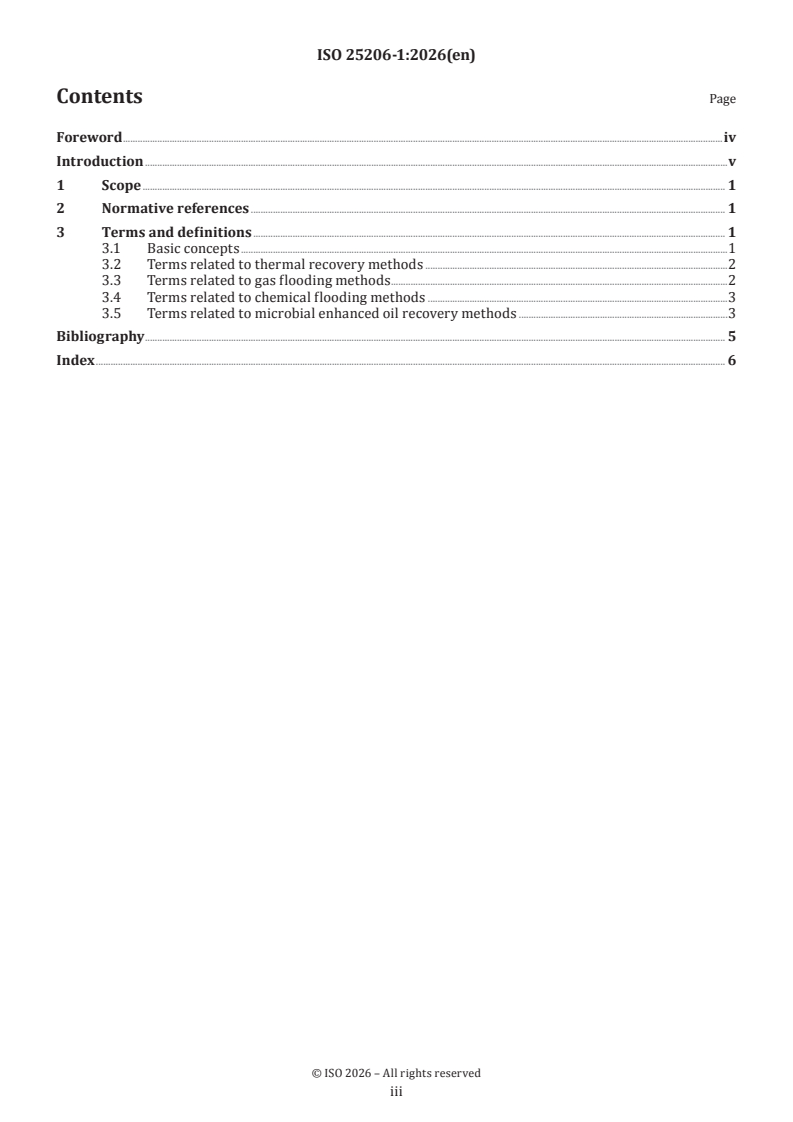
Contents Page
Foreword .iv
Introduction .v
1 Scope . 1
2 Normative references . 1
3 Terms and definitions . 1
3.1 Basic concepts .1
3.2 Terms related to thermal recovery methods .2
3.3 Terms related to gas flooding methods .2
3.4 Terms related to chemical flooding methods .3
3.5 Terms related to microbial enhanced oil recovery methods .3
Bibliography . 5
Index . 6
iii
Foreword
ISO (the International Organization for Standardization) is a worldwide federation of national standards
bodies (ISO member bodies). The work of preparing International Standards is normally carried out through
ISO technical committees. Each member body interested in a subject for which a technical committee
has been established has the right to be represented on that committee. International organizations,
governmental and non-governmental, in liaison with ISO, also take part in the work. ISO collaborates closely
with the International Electrotechnical Commission (IEC) on all matters of electrotechnical standardization.
The procedures used to develop this document and those intended for its further maintenance are described
in the ISO/IEC Directives, Part 1. In particular, the different approval criteria needed for the different types
of ISO document should be noted. This document was drafted in accordance with the editorial rules of the
ISO/IEC Directives, Part 2 (see www.iso.org/directives).
ISO draws attention to the possibility that the implementation of this document may involve the use of (a)
patent(s). ISO takes no position concerning the evidence, validity or applicability of any claimed patent
rights in respect thereof. As of the date of publication of this document, ISO had not received notice of (a)
patent(s) which may be required to implement this document. However, implementers are cautioned that
this may not represent the latest information, which may be obtained from the patent database available at
www.iso.org/patents. ISO shall not be held responsible for identifying any or all such patent rights.
Any trade name used in this document is information given for the convenience of users and does not
constitute an endorsement.
For an explanation of the voluntary nature of standards, the meaning of ISO specific terms and expressions
related to conformity assessment, as well as information about ISO's adherence to the World Trade
Organization (WTO) principles in the Technical Barriers to Trade (TBT), see www.iso.org/iso/foreword.html.
This document was prepared by Technical Committee ISO/TC 67, Oil and gas industries including lower carbon
energy, Subcommittee SC 10, Enhanced oil recovery.
A list of all parts in the ISO 25206 series can be found on the ISO website.
Any feedback or questions on this document should be directed to the user’s national standards body. A
complete listing of these bodies can be found at www.iso.org/members.html.
iv
Introduction
As enhanced oil recovery (EOR) technologies continue to advance and international collaborative projects
increase in number, there is a growing global demand for international standardization in this field. As a
universal technical language, terminology standards play a foundational role in international collaboration
by clearly defining the scope of the field and delineating boundaries with related disciplines.
To maintain terminological coherence across international EOR standards and to prevent conflicts in
application arising from ambiguous or contradictory definitions, coordinated efforts in standardization are
essential. The ISO 25206 series is being developed to establish a coherent framework of mutually reinforcing
definitions, ensuring conceptual alignment across all relevant international standards. This systematic
approach guarantees that precisely defined common terminology forms the essential basis for both the
understanding and implementation of EOR standards worldwide.
Based on the displacement medium and underlying mechanism, EOR is generally classified into the following
main types:
— thermal recovery;
— gas flooding;
— chemical flooding;
— microbial enhanced oil recovery.
This document provides general terms and definitions related to EOR, including fundamental concepts
covering the field and its subdivisions, as well as terms describing the major EOR technologies and their
associated processes. More specialized terminology for each specific category is defined in other parts of
the ISO 25206 series.
v
---------
...