

ISO 8873-1
(Main)Rigid cellular plastics — Spray-applied polyurethane foam for thermal insulation — Part 1: Material specification
- Abstract
ISO 8873-1:2006 specifies minimum requirements and test methods for spray-applied polyurethane rigid cellular plastic, used as a thermal insulation for both building, whether applied on a building site or in a prefabrication (manufacturing) facility, and non-building applications. The material is also known as in-situ thermal insulation. The spray-applied polyurethane rigid cellular plastic thermal insulation is not to be used when the continuous service temperature of the substrate is outside the range of -60 °C to +80 °C. The test methods used to determine the material properties provide a means of comparing different cellular plastic thermal insulations. They are intended for use in specifications, product evaluations and quality control. They are not intended to predict end-use product performance.
- Status
- Not Published
- Technical Committee
- ISO/TC 61/SC 10 - Cellular plastics
- Drafting Committee
- ISO/TC 61/SC 10/WG 10 - Plastic insulation
- Current Stage
- 6000 - International Standard under publication - 60 Publication
- Start Date
- 07-Nov-2026
Buy Documents
ISO/PRF 8873-1 - Rigid cellular plastics — Spray-applied polyurethane foam for thermal insulation — Part 1: Material specification

REDLINE ISO/PRF 8873-1 - Rigid cellular plastics — Spray-applied polyurethane foam for thermal insulation — Part 1: Material specification
ISO 8873-1 is an International Standard from ISO for spray-applied polyurethane rigid cellular plastic used as thermal insulation. It specifies material requirements, test methods, reporting, marking and manufacturer documentation for building and non-building applications, including in-situ thermal insulation. The standard is written for manufacturers, spray polyurethane foam contractors and installers, test laboratories, specifiers and buyers who need a common basis for product qualification and quality control.
What does ISO 8873-1 specify?
ISO 8873-1 specifies the minimum requirements and test methods for spray-applied polyurethane rigid cellular plastic used as thermal insulation on buildings, whether applied on site or in a prefabrication facility, and on non-building applications. The material is also known as in-situ thermal insulation.
The document also sets a use limitation tied to the substrate continuous service temperature, organizes the material into categories, and gives the sampling, test, reporting, marking and manufacturer-information rules needed to evaluate the product in a consistent way. Its test methods are for comparing products in specifications, product evaluations and quality control, not for predicting end-use performance.
The main structure is:
- Clause 4 - requirements and categories
- Clause 5 - sampling and specimen preparation
- Clause 6 - test methods
- Clause 7 - reporting requirements
- Clause 8 - marking, labelling and packaging
- Clause 9 - manufacturer’s documentation
What are the key requirements of ISO 8873-1?
ISO 8873-1 ties compliance to both how the insulation is made and how it is verified. In practice, that means the product must be installed correctly, tested from representative panels, and reported against the properties in Table 1.
Installation and use conditions
Clause 4 requires installation in accordance with the manufacturer’s instructions and ISO 8873-2. The product is to be applied by a spray polyurethane foam contractor using a spray polyurethane foam installer, and the cured insulation shall not present a health hazard or residual odour.
Special applications may need additional agreed properties. This matters because the standard is not only about the material formulation - it also depends on the application method, substrate condition and intended use.
Categories and performance limits
Clause 4.2 places products into Categories IA, IB, IC, IIA and IIB. These categories distinguish non-load-bearing and limited-load-bearing uses, and they link to the blowing agent and cell structure, such as predominantly closed-cell, semi-closed-cell or open-cell products.
Table 1 then sets the declared or maximum values for key properties such as air permeance, apparent core density, compressive strength, dimensional stability, open-cell content, initial thermal resistance, LTTR, tensile strength, substrate adhesion, volatile organic emissions, water absorption and water vapour permeability. Surface burning characteristics are declared and determined by the authority having jurisdiction.
Sampling and test pieces
Clause 5 requires representative sample panels, prepared from a single batch or lot and conditioned before testing. The panels are cut into specimens after conditioning in accordance with ISO 291.
This matters in practice because all physical property results in the document depend on using comparable specimens from the same batch, with controlled thickness, skins and pass lines.
Test methods and reporting
Clause 6 names the test standard for each property. Air permeance is measured at 75 Pa, density and compressive strength use ISO 845 and ISO 844, dimensional stability is checked after exposure at low temperature, high temperature and high humidity, and thermal resistance is measured with ISO 8301 or ISO 8302.
Clause 6.6 also states that LTTR is the design thermal resistance value for energy calculations. For inhabited spaces, volatile organic emissions are checked using ISO 16000-6 guidance. Clause 7 then requires a report table showing each property, the result and pass/fail status, together with the production, sampling and laboratory details.
Marking and supplier information
Clauses 8 and 9 cover packaging, labels and the technical information the manufacturer must give the contractor. The liquid components are identified as polyisocyanate component “A” and resin component “B”, and the documentation must include safety data, handling instructions, equipment parameters, substrate requirements, use limits, shelf life and the method used to identify the installed product.
What terms does ISO 8873-1 define?
- Air permeance - the air leakage rate of a material, expressed in litres per second per square metre.
- in-situ thermal insulation - a thermal insulation product produced or taking its final form at the site of application, with properties achieved after installation.
- spray-applied polyurethane foam - a rigid cellular plastic material with a substantially closed cell structure based on polyurethanes, foamed in situ by the reaction of polyisocyanates and polyhydroxyl compounds.
- spray polyurethane foam contractor - the person or organization responsible for all requirements and obligations for installing the product.
- spray polyurethane foam installer - the individual who mixes and sprays the chemical components to form the insulation.
- Long-term thermal resistance (LTTR) - the aged thermal resistance value used here as the design thermal resistance for energy calculations.
Who uses ISO 8873-1?
ISO 8873-1 is used by manufacturers who formulate and qualify spray-applied polyurethane foam, and by contractors and installers who apply it on site. It is also used by testing laboratories, inspection authorities, specifiers, designers and quality managers who need a repeatable basis for acceptance and comparison.
In practice, buyers and technical teams use it to specify product properties, check reports, and confirm that a material is suitable for a given building or non-building insulation job.
What changed in ISO 8873-1 from the previous edition?
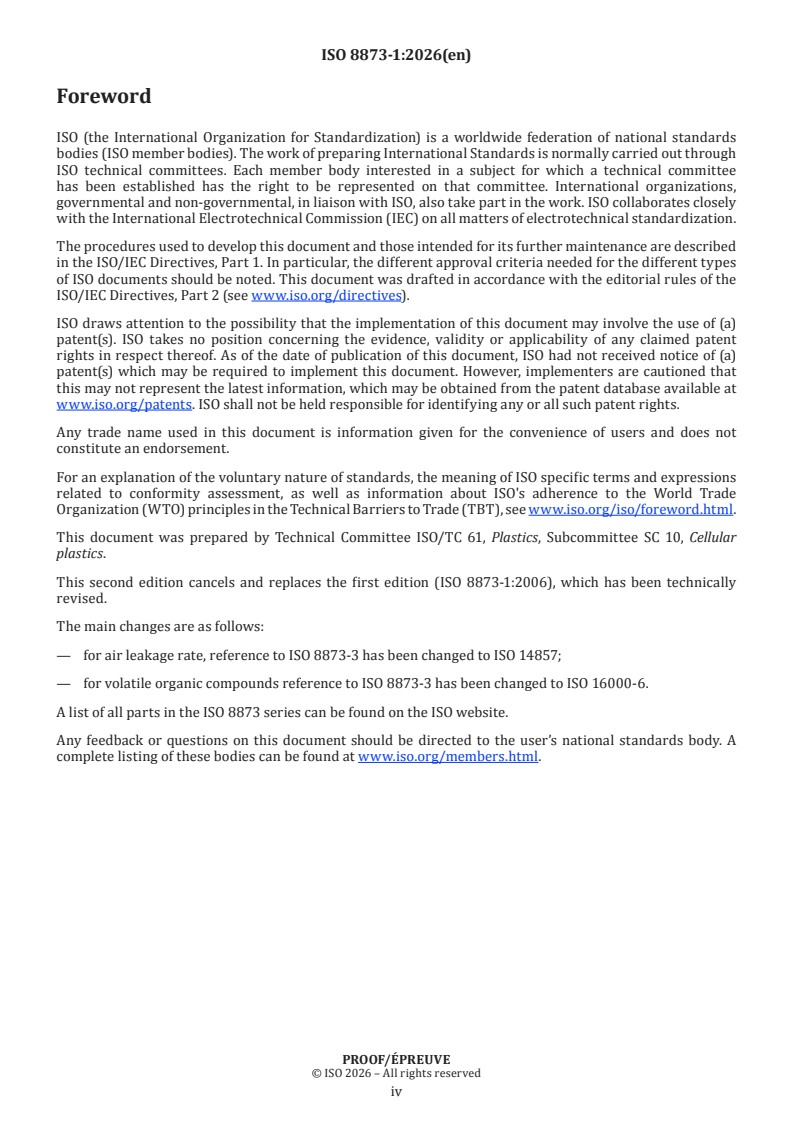
ISO 8873-1 is the second edition and it cancels and replaces ISO 8873-1:2006. The foreword states that it has been technically revised.
The stated changes are:
- the reference for air leakage rate has been changed to ISO 14857
- the reference for volatile organic compounds has been changed to ISO 16000-6
Which standards are used with ISO 8873-1?
| Reference | Contribution |
|---|---|
| ISO 291 | Conditioning and testing atmospheres for plastics |
| ISO 844 | Compressive properties of rigid cellular plastics |
| ISO 845 | Apparent density |
| ISO 1663 | Water vapour transmission properties |
| ISO 1926 | Tensile properties |
| ISO 2796 | Dimensional stability |
| ISO 2896 | Water absorption |
| ISO 4590 | Open-cell and closed-cell content |
| ISO 8301 | Steady-state thermal resistance, heat flow meter method |
| ISO 8302 | Steady-state thermal resistance, guarded hot plate method |
| ISO 8873-2 | Application requirements, limitations and job-site identification |
| ISO 10456 | Declared and design thermal values |
| ISO 11561 | Long-term change in thermal resistance |
| ISO 14857 | Air permeance of building materials |
| ISO 16000-6 | Volatile organic compounds in indoor and test chamber air |
What does the ISO 8873-1 document contain?
ISO 8873-1 contains a property table, detailed sampling instructions, specimen preparation rules, and test methods for air permeance, density, compressive strength, dimensional stability, thermal resistance, LTTR, tensile strength, substrate adhesion, volatile organic emissions, water absorption and water vapour permeability. It also includes reporting requirements, packaging and labelling instructions, and the minimum technical information the manufacturer must give to the contractor.
Relations
- Effective Date
- 04-Nov-2023
Buy Documents
ISO/PRF 8873-1 - Rigid cellular plastics — Spray-applied polyurethane foam for thermal insulation — Part 1: Material specification
REDLINE ISO/PRF 8873-1 - Rigid cellular plastics — Spray-applied polyurethane foam for thermal insulation — Part 1: Material specification
Get Certified
Connect with accredited certification bodies for this standard

DIN CERTCO
DIN Group product certification.

DIBt (Deutsches Institut für Bautechnik)
German Institute for Building Technology.

Aboma Certification B.V.
Specialized in construction, metal, and transport sectors.
Sponsored listings
Frequently Asked Questions
ISO 8873-1 is a draft published by the International Organization for Standardization (ISO). Its full title is "Rigid cellular plastics — Spray-applied polyurethane foam for thermal insulation — Part 1: Material specification". This standard covers: ISO 8873-1:2006 specifies minimum requirements and test methods for spray-applied polyurethane rigid cellular plastic, used as a thermal insulation for both building, whether applied on a building site or in a prefabrication (manufacturing) facility, and non-building applications. The material is also known as in-situ thermal insulation. The spray-applied polyurethane rigid cellular plastic thermal insulation is not to be used when the continuous service temperature of the substrate is outside the range of -60 °C to +80 °C. The test methods used to determine the material properties provide a means of comparing different cellular plastic thermal insulations. They are intended for use in specifications, product evaluations and quality control. They are not intended to predict end-use product performance.
ISO 8873-1:2006 specifies minimum requirements and test methods for spray-applied polyurethane rigid cellular plastic, used as a thermal insulation for both building, whether applied on a building site or in a prefabrication (manufacturing) facility, and non-building applications. The material is also known as in-situ thermal insulation. The spray-applied polyurethane rigid cellular plastic thermal insulation is not to be used when the continuous service temperature of the substrate is outside the range of -60 °C to +80 °C. The test methods used to determine the material properties provide a means of comparing different cellular plastic thermal insulations. They are intended for use in specifications, product evaluations and quality control. They are not intended to predict end-use product performance.
ISO 8873-1 is classified under the following ICS (International Classification for Standards) categories: 83.100 - Cellular materials; 91.100.60 - Thermal and sound insulating materials. The ICS classification helps identify the subject area and facilitates finding related standards.
ISO 8873-1 has the following relationships with other standards: It is inter standard links to ISO 8873-1:2006. Understanding these relationships helps ensure you are using the most current and applicable version of the standard.
ISO 8873-1 is available in PDF format for immediate download after purchase. The document can be added to your cart and obtained through the secure checkout process. Digital delivery ensures instant access to the complete standard document.
Standards Content (Sample)
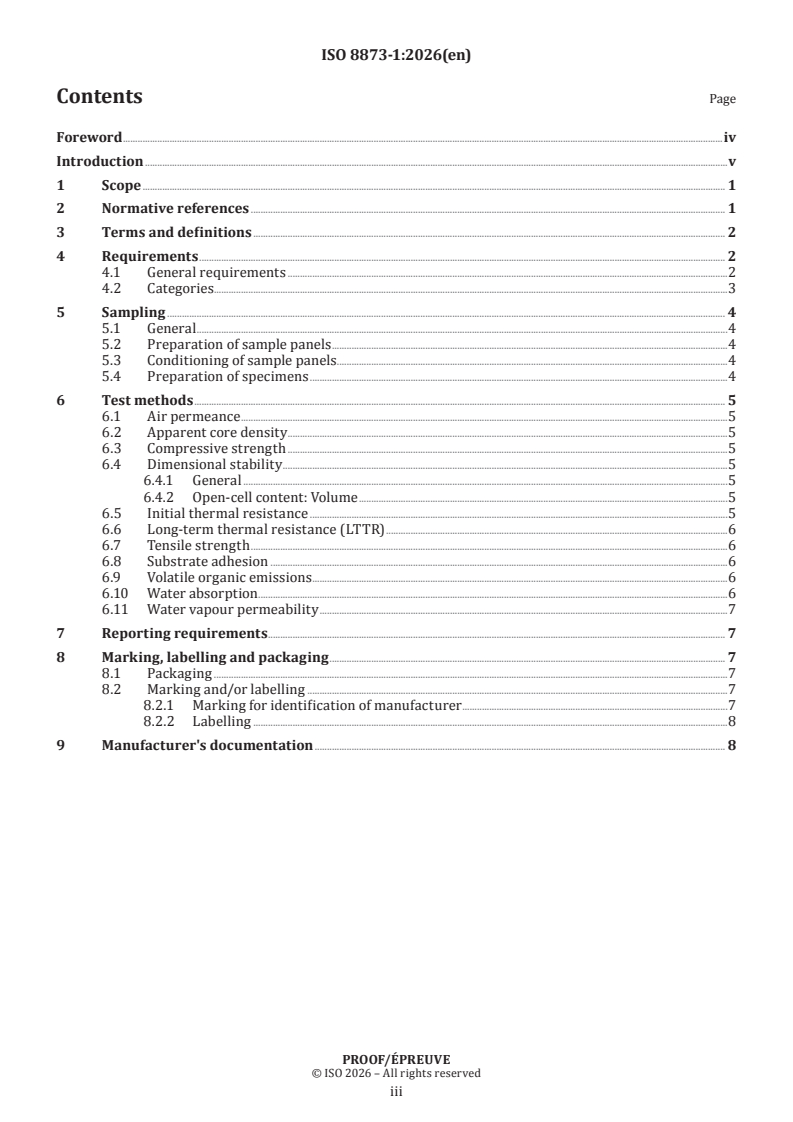
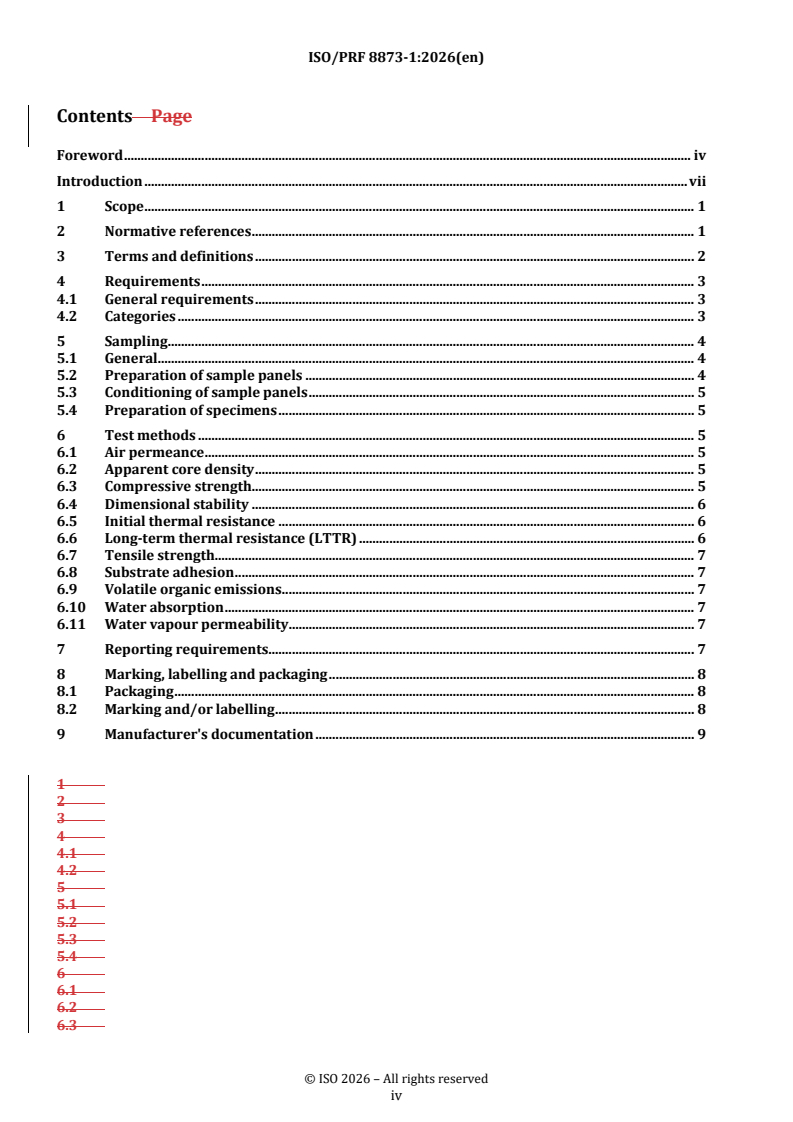
Contents
- Introduction
- 1 Scope
- 2 Normative references
- 3 Terms and definitions
- 3.1 air permeance
- 3.2 in-situ thermal insulation
- 3.3 spray-applied polyurethane foam
- 3.4 spray polyurethane foam contractor
- 3.5 spray polyurethane foam installer
- 4 Requirements
- 4.1 General requirements
- 4.2 Categories
- 5 Sampling
- 5.1 General
- 5.2 Preparation of sample panels
- 5.3 Conditioning of sample panels
- 5.4 Preparation of specimens
- 6 Test methods
- 6.1 Air permeance
- 6.2 Apparent core density
- 6.3 Compressive strength
- 6.4 Dimensional stability
- 6.5 Initial thermal resistance
- 6.6 Long-term thermal resistance (LTTR)
- 6.7 Tensile strength
- 6.8 Substrate adhesion
- 6.9 Volatile organic emissions
- 6.10 Water absorption
- 6.11 Water vapour permeability
- 7 Reporting requirements
- 8 Marking, labelling and packaging
- 8.1 Packaging
- 8.2 Marking and/or labelling
- 9 Manufacturer's documentation
Introduction
The ISO 8873 series defines the requirements for rigid cellular plastic spray polyurethane foam when used as a thermal insulation for buildings and non-buildings.
This document specifies requirements for the physical properties of rigid cellular plastic spray polyurethane foam and lists the test methods to be used. The spray-applied polyurethane rigid cellular plastic thermal insulation is not intended to be used when the continuous service temperature of the substrate is outside the range of −60 °C to +80 °C.
The designer has the responsibility for confirming that the physical properties provided by material manufactured to this document will conform to the requirements for a specific application. PROOF/ÉPREUVE
International Standard ISO 8873-1:2026(en) Rigid cellular plastics — Spray-applied polyurethane foam for thermal insulation — Part 1:
Material specification IMPORTANT — Persons using this document should be familiar with normal laboratory practice, if applicable. This document does not purport to address all the safety concerns, if any, associated with its use. It is the responsibility of the user to establish appropriate safety and health practices and to determine any regulatory requirements prior to use.
1 Scope
This document specifies the minimum requirements and test methods for spray-applied polyurethane rigid cellular plastic, used as a thermal insulation for both building, whether applied on a building site or in a prefabrication (manufacturing) facility, and non-building applications. The material is known as in-situ thermal insulation.
The test methods used to determine the material properties provide a means of comparing different cellular plastic thermal insulations. They are intended for use in specifications, product evaluations and quality control. They are not intended to predict end-use product performance.
2 Normative references
The following documents are referred to in the text in such a way that some or all of their content constitutes requirements of this document. For dated references, only the edition cited applies. For undated references, the latest edition of the referenced document (including any amendments) applies. ISO 291, Plastics — Standard atmospheres for conditioning and testing ISO 844, Rigid cellular plastics — Determination of compressive properties ISO 845, Cellular plastics and rubbers — Determination of apparent density ISO 1663, Rigid cellular plastics — Determination of water vapour transmission properties ISO 1926, Rigid cellular plastics — Determination of tensile properties ISO 2796, Cellular plastics, rigid — Test for dimensional stability ISO 2896, Rigid cellular plastics — Determination of water absorption ISO 4590, Rigid cellular plastics — Determination of the volume percentage of open cells and of closed cells ISO 8301, Thermal insulation — Determination of steady-state thermal resistance and related properties — Heat flow meter apparatus ISO 8302, Thermal insulation — Determination of steady-state thermal resistance and related properties — Guarded hot plate apparatus ISO 8873-2, Rigid cellular plastics — Spray-applied polyurethane foam for thermal insulation — Part 2:
Application PROOF/ÉPREUVE
ISO 8873-1:2026(en) ISO 10456, Building materials and products — Hygrothermal properties — Tabulated design values and procedures for determining declared and design thermal values ISO 11561, Ageing of thermal insulation materials — Determination of the long-term change in thermal resistance of closed-cell plastics (accelerated laboratory test methods) ISO 14857, Thermal performance in the built environment — Determination of air permeance of building materials ISO 16000-6, Indoor air — Part 6: Determination of organic compounds (VVOC, VOC, SVOC) in indoor and test chamber air by active sampling on sorbent tubes, thermal desorption and gas chromatography using MS or MS FID
3 Terms and definitions
For the purposes of this document, the following terms and definitions apply. ISO and IEC maintain terminology databases for use in standardization at the following addresses:
- ISO Online browsing platform: available at https:// www .iso .org/ obp
- IEC Electropedia: available at https:// www .electropedia .org/
3.1 air permeance
air leakage rate of a material, expressed in litres per second per metre squared (l/s·m )
3.2 in-situ thermal insulation
thermal insulation product produced or taking its final form at the site of application and which achieves its properties after installation
3.3 spray-applied polyurethane foam
rigid cellular plastic material with substantially closed cell structure based on polyurethanes, which is foamed in- situ by the catalysed reaction of polyisocyanates and polyhydroxyl compounds, expanded with blowing agents
3.4 spray polyurethane foam contractor
individual, organization or corporation who is responsible for all requirements and obligations for the installation of the product
3.5 spray polyurethane foam installer
individual or worker who applies the chemical components by mixing and spraying them to form the rigid cellular plastic spray polyurethane foam product Note 1 to entry: The installer is responsible for the actual installation and site requirements identified by the manufacturer and/or ISO 8873-2 for application of the product. The installer shall be have the required knowledge for proper application of the product. The installer shall follow the requirements for installation and the obligations for installers identified by the manufacturer and ISO 8873-2
4 Requirements
4.1 General requirements
Spray-applied polyurethane rigid cellular plastics shall be installed in accordance with the manufacturer's instructions and the requirements of ISO 8873-2. Applications, requirements for applications and limitations of use are included in ISO 8873-2.
PROOF/ÉPREUVE
ISO 8873-1:2026(en) Rigid cellular plastic spray-applied polyurethane foam thermal insulation shall be applied by a spray polyurethane foam contractor using a spray polyurethane foam installer in accordance with ISO 8873-2 and the instructions given by the chemical manufacturer.
When applied, the polyurethane rigid cellular plastic thermal insulation shall not present a health hazard to the potential occupants nor shall the cured insulation have any residual odour. Special applications can require properties other than, or in addition to, those specified in this document. These properties, when agreed upon by the interested parties, may be added to the requirements of this specification.
When stored in accordance with the chemical manufacturer's instructions, applied in accordance with ISO 8873-2, and within the shelf life of the chemicals as declared by the manufacturer, the chemical components shall produce an insulation that meets the requirements of this document.
...
Contents
- Introduction
- 1 Scope
- 2 Normative references
- 3 Terms and definitions
- 4 Requirements
- 4.1 General requirements
- 4.2 Categories
- 5 Sampling
- 5.1 General
- 5.2 Preparation of sample panels
- 5.3 Conditioning of sample panels
- 5.4 Preparation of specimens
- 6 Test methods
- 6.1 Air permeance
- 6.2 Apparent core density
- 6.3 Compressive strength
- 6.4 Dimensional stability
- 6.5 Initial thermal resistance
- 6.6 Long-term thermal resistance (LTTR)
- 6.7 Tensile strength
- 6.8 Substrate adhesion
- 6.9 Volatile organic emissions
- 6.10 Water absorption
- 6.11 Water vapour permeability
- 7 Reporting requirements
- 8 Marking, labelling and packaging
- 8.1 Packaging
- 8.2 Marking and/or labelling
- 9 Manufacturer's documentation
Introduction
The ISO 8873 series defines the requirements for rigid cellular plastic spray polyurethane foam when used as a thermal insulation for buildings and non-buildings.
This document specifies requirements for the physical properties of rigid cellular plastic spray polyurethane foam and lists the test methods to be used. The spray-applied polyurethane rigid cellular plastic thermal insulation is not intended to be used when the continuous service temperature of the substrate is outside the range of −60 °C to +80 °C.
The designer has the responsibility for confirming that the physical properties provided by material manufactured to this document will conform to the requirements for a specific application.
ISO/PRF 8873-1:2026(en) Rigid cellular plastics — Spray-applied polyurethane foam for thermal insulation — Part 1:
Material specification IMPORTANT — Persons using this document should be familiar with normal laboratory practice, if applicable. This document does not purport to address all the safety concerns, if any, associated with its use. It is the responsibility of the user to establish appropriate safety and health practices and to determine any regulatory requirements prior to use.
Rigid cellular plastics — Spray-applied polyurethane foam for thermal insulation — Part 1: Material specification
1 Scope
This document specifies the minimum requirements and test methods for spray-applied polyurethane rigid cellular plastic, used as a thermal insulation for both building, whether applied on a building site or in a prefabrication (manufacturing) facility, and non-building applications. The material is also known as in-situ thermal insulation.
The test methods used to determine the material properties provide a means of comparing different cellular plastic thermal insulations. They are intended for use in specifications, product evaluations and quality control. They are not intended to predict end-use product performance.
2 Normative references
The following documents are referred to in the text in such a way that some or all of their content constitutes requirements of this document. For dated references, only the edition cited applies. For undated references, the latest edition of the referenced document (including any amendments) applies. ISO 291, Plastics — Standard atmospheres for conditioning and testing ISO 844, Rigid cellular plastics — Determination of compressioncompressive properties ISO 845, Cellular plastics and rubbers — Determination of apparent density ISO 1663, Rigid cellular plastics — Determination of water vapour transmission properties ISO 1926, Rigid cellular plastics — Determination of tensile properties ISO 2796, Cellular plastics, rigid — Test for dimensional stability ISO 2896, Rigid cellular plastics — Determination of water absorption ISO 4590, Rigid cellular plastics — Determination of the volume percentage of open cells and of closed cells ISO 8301, Thermal insulation — Determination of steady-state thermal resistance and related properties — Heat flow meter apparatus
ISO/PRF 8873-1:2026(en) ISO 8302, Thermal insulation — Determination of steady-state thermal resistance and related properties — Guarded hot plate apparatus ISO 8873--2, Rigid cellular plastics — Spray-applied polyurethane foam for thermal insulation — Part 2:
Application ISO 10456, Building materials and products — Hygrothermal properties — Tabulated design values and procedures for determining declared and design thermal values ISO 11561, Ageing of thermal insulation materials — Determination of the long-term change in thermal resistance of closed-cell plastics (accelerated laboratory test methods) ISO 14857, Thermal performance in the built environment — Determination of air permeance of building materials ISO 16000--6, Indoor air — Part 6: Determination of organic compounds (VVOC, VOC, SVOC) in indoor and test chamber air by active sampling on sorbent tubes, thermal desorption and gas chromatography using MS or MS FID
3 Terms and definitions
For the purposes of this document, the following terms and definitions apply. ISO and IEC maintain terminology databases for use in standardization at the following addresses:
- — ISO Online browsing platform: available at https://www.iso.org/obp
- — IEC Electropedia: available at https://www.electropedia.org/ 3.1 3.1 air permeance
air leakage rate of a material, expressed in litres per second per metre squared (l/s·m ) 3.2
3.2inin-situ thermal insulation thermal insulation product produced or taking its final form at the site of application and which achieves its properties after installation 3.3 3.3spray spray-applied polyurethane foam rigid cellular plastic material with substantially closed cell structure based on polyurethanes, which is foamed in- situ by the catalysed reaction of polyisocyanates and polyhydroxyl compounds, expanded with blowing agents 3.4 3.3spray spray polyurethane foam contractor individual, organization or corporation who is responsible for all requirements and obligations for the installation of the product 3.5 3.4spray spray polyurethane foam installer individual or worker who applies the chemical components by mixing and spraying them to form the rigid cellular plastic spray polyurethane foam product
ISO/PRF 8873-1:2026(en) Note 1 to entry: The installer is responsible for the actual installation and site requirements identified by the manufacturer and/or ISO 8873-2 for application of the product. The installer shall be trained, and qualified as having demonstratedhave the required knowledge for proper application of the product. The installer shall follow the requirements for installation and the obligations for installers identified by the manufacturer and ISO 8873-2
4 Requirements
4.1 General requirements
Spray-applied polyurethane rigid cellular plastics shall be installed in accordance with the manufacturer's instructions and the requirements of ISO 8873-2. Applications, requirements for applications and limitations of use are included in ISO 8873-2.
Rigid cellular plastic spray-applied polyurethane foam thermal insulation shall be applied by a spray polyurethane foam contractor using a spray polyurethane foam installer in accordance with ISO 8873-2 and the instructions given by the chemical manufacturer.
When applied, the polyurethane rigid cellular plastic thermal insulation shall not present a health hazard to the potential occupants nor shall the cured insulation have any residual odour. Special applications can require properties other than, or in addition to, those specified in this document. These properties, when agreed upon by the interested parties, may be added to the requirements of this specification.
When stored in accordance with the chemical manufacturer's instructions, applied in accordance with ISO 8873-2, and within the shelf life of the chemicals as declared by the manufacturer, the chemical components shall produce an insulation that meets the requirements of this document.
...