

ISO/FDIS 24993
(Main)Plastics — Rotational moulded polyethylene water storage tanks
- Abstract
This standard covers the requirement of the mono layer or more rotational molded polyethylene water storage vertical and horizontal tanks, dimensions and construction. This standard is applicable to water storage tanks with a nominal service temperature from 1°C to 60°C. This standard is not applicable to underground or mobile water tanks.
- Status
- Not Published
- Technical Committee
- ISO/TC 61/SC 11 - Products
- Current Stage
- 5000 - Final text received or FDIS registered for formal approval - 50 Approval
- Start Date
- 13-Oct-2026
- Due Date
- 18-Mar-2027
- Completion Date
- 18-Mar-2027
Buy Documents


ISO/FDIS 24993 - Plastics — Rotational moulded polyethylene water storage tanks

REDLINE ISO/FDIS 24993 - Plastics — Rotational moulded polyethylene water storage tanks
ISO/FDIS 24993 is an ISO document for rotational moulded polyethylene water storage tanks. It specifies the design, construction, performance, sampling, test methods and marking for mono-layer or multi-layer vertical and horizontal cylindrical tanks used for water storage at nominal service temperatures from 1 °C to 60 °C.
What does ISO/FDIS 24993 specify?
ISO/FDIS 24993 covers the general principles for the design and manufacture of rotational moulded polyethylene water storage tanks. The scope includes vertical and horizontal cylindrical tanks and excludes underground and mobile water tanks.
The document is organized into clauses on scope, normative references, terms and definitions, general requirements, design requirements, fittings, performance requirements, sampling, a summary of test requirements, and marking. It also includes three normative annexes for the key test and design methods.
| Annex | What it covers |
|---|---|
| Annex A | Low-temperature impact test method |
| Annex B | Top load resistance test method and deformation measurement |
| Annex C | Wall thickness determination using finite element analysis (FEA) |
The introduction also distinguishes three tank types: tanks moulded from cross linkable polyethylene, tanks moulded from non-cross linkable polyethylene without a foam layer, and tanks moulded from non-cross linkable polyethylene with a foam layer. That helps readers see the product variants the document is written around.
What are the key requirements of ISO/FDIS 24993?
ISO/FDIS 24993 focuses on material suitability, structural design, functional performance and traceable marking. In practice, it gives manufacturers and buyers a shared basis for specifying a tank that is safe for water contact and strong enough for its intended use.
Materials and water-contact suitability
Clause 4 requires the tank, lid and any fittings in contact with water to be made from virgin polyethylene, with regrind allowed only when the resin still meets the physical property requirements in Table 1 and the rest of the document. Clause 4.2 also requires the material to be free from toxic effect and to meet national water-quality rules where they apply; conformity with NSF/ANSI/CAN 61 may be used as evidence of suitability for drinking-water contact.
Clause 4.3 points to Table 1 for the polyethylene resin properties that matter for service performance, including melt flow rate, density, tensile strength, elongation at break, flexural modulus, hardness, environmental stress-crack resistance, Vicat softening temperature and brittleness temperature. This is the basis for checking that the raw material is fit for a moulded tank, not just a generic polyethylene grade.
Outdoor use, colour and surface finish
Clause 4.4 allows ultraviolet stabilizer for outdoor application and says it must be compounded into the polyethylene. The standard also points to ISO 4892-3 as a way to evaluate the effect of UV stabilizer by accelerated weathering, which matters when the tank will sit in sunlight.
Clause 4.5 covers pigments and Clause 4.6 covers a black layer used to reduce algae growth. The practical message is that colourants and black-layer additives are controlled, compatible with polyethylene and not allowed to compromise water-contact safety or long-term durability.
Clause 4.7 requires the finished tank to be visually clean and free from defects such as pits, spots unsaturated with resin and air bubbles. The acceptable finish is agreed between manufacturer and buyer, so appearance becomes a defined quality criterion rather than an informal one.
Dimensions, fittings and entry access
Clause 4.8 gives guide dimensions for vertical and horizontal tanks and refers to figures showing typical tank details. The actual dimensions and capacity are agreed between manufacturer and buyer or set by national requirements, but the guide values help specifiers choose a practical tank size and layout.
Clause 5.2 requires the person-entry opening/handhole lid to fit securely and prevent ingress of harmful matter. Clause 6 then says fittings, gaskets and accessories must be compatible with the tank contents and resistant to corrosion, with their size and location agreed or set by national rules. In practice, this means the opening and fittings are part of the safety and hygiene design, not just accessories.
Structural design and wall thickness
Clause 5.1.1 gives the method for calculating minimum wall thickness for cylindrical vertical tanks based on hydrostatic pressure. Clause 5.1.2 explains that the hydrostatic design stress comes from hoop stress data and is reduced by a service factor, so material strength is translated into a safer working thickness.
Clause 5.1.3 and Annex C introduce finite element analysis (FEA) with a geometrically nonlinear analysis (GNA) approach for structural design, especially for horizontal tanks and complex shapes. The design has to consider occupancy loads, internal hydrostatic pressure, wind, snow, earthquake effects, openings and the service temperature limit. In plain terms, the tank must be checked as a loaded structure, not only as a container.
Performance verification, sampling and marking
Clause 7 covers the main performance tests: resistance to deformation, low-temperature impact, top load resistance, tensile strength, elongation at break, flexural modulus and opacity. These tests show whether the tank keeps its shape, survives handling and loading, and protects contents from light where outdoor use matters.
Clauses 8 to 10 connect testing and identification. Clause 8 sets sampling for representative tanks and resin batches, Clause 9 summarizes the initial and routine tests, and Clause 10 requires durable marking with manufacturer identification, product name and purpose, tank classification, resin identification code, capacity, production date, batch number and country of origin. That gives purchasers and inspectors traceability throughout supply and installation.
What terms does ISO/FDIS 24993 define?
- Rotational moulded water tank - A polyethylene tank made by rotational moulding.
- Net capacity - The water volume between the lowest inlet level and the lower specified level.
- Rotational moulding - A three-stage process of heating resin in a mould while rotating it about more than one axis, then cooling and removing the article.
- Overall height - The finished empty tank height at its highest point, including the person-entry opening/handhole rim and lid.
- Overall diameter - The maximum diameter of the finished empty tank measured at its largest side.
- Finite element analysis (FEA) - An engineering method used in Annex C to determine wall thickness and structural adequacy.
- Geometrically nonlinear analysis (GNA) - The analysis approach required for the FEA-based design checks in Annex C.
- Environmental stress-crack resistance (ESCR) - A resin property used to judge how well the polyethylene resists cracking under stress and environmental exposure.
Who uses ISO/FDIS 24993?
ISO/FDIS 24993 is used by rotational moulding manufacturers, polyethylene resin suppliers, tank designers, test laboratories, quality managers, buyers and specifiers. It is also relevant to installers and project engineers who need to match tank dimensions, support conditions, fittings and marking to a water-storage application.
For manufacturers, the document is a design-and-production reference. For buyers and quality teams, it is a way to write purchase specifications, verify conformity and compare products on the same technical basis.
Which standards are used with ISO/FDIS 24993?
- ISO 1133-1 - Used to measure melt mass-flow rate of the polyethylene resin.
- ISO 1183-1, ISO 1183-2 and ISO 1183-3 - Used to determine resin density.
- ISO 527-1 and ISO 527-2 - Used for tensile property testing.
- ISO 178 - Used for flexural properties and flexural modulus.
- ISO 868 - Used for Shore hardness.
- ISO 974 - Used for brittleness temperature by impact.
- ISO 306 - Used for Vicat softening temperature.
- ISO 7686 - Used for opacity testing.
- ISO 6964 - Used to check carbon black content in the black layer.
- ISO 22088-3 - Used for environmental stress-crack resistance.
- ISO 4892-3 - Used for accelerated weathering of UV-stabilized material.
- ASTM D2837 - Cited for hydrostatic-design-basis data used in wall-thickness design.
- ISO 8584-1, ISO 9080 and EN 1778:2000 - Used in Annex C for allowable stress and creep-related design inputs.
- NSF/ANSI/CAN 61 - Cited as evidence of suitability for drinking-water contact where applicable.
What does the ISO/FDIS 24993 document contain?
The document includes a resin property table, guide dimension tables for vertical and horizontal tanks, a summary table of test requirements, and a marking list. It also contains figures showing typical tank details and the supporting platform arrangement.
Annex A gives the low-temperature dart-drop impact test, including sample preparation, conditioning and apparatus. Annex B gives the top load resistance procedure for vertical and horizontal tanks, including the 100 kg loading step and the deformation measurements used to judge shape change. Annex C gives the FEA-based wall-thickness method and the acceptance checks for buckling, stress and long-term displacement.
Buy Documents
ISO/FDIS 24993 - Plastics — Rotational moulded polyethylene water storage tanks
REDLINE ISO/FDIS 24993 - Plastics — Rotational moulded polyethylene water storage tanks
Get Certified
Connect with accredited certification bodies for this standard

Institut za varilstvo d.o.o. (Welding Institute)
Slovenia's leading welding institute since 1952. ISO 3834, EN 1090, pressure equipment certification, NDT personnel, welder qualification. Only IIW Au
Sponsored listings
Frequently Asked Questions
ISO/FDIS 24993 is a draft published by the International Organization for Standardization (ISO). Its full title is "Plastics — Rotational moulded polyethylene water storage tanks". This standard covers: This standard covers the requirement of the mono layer or more rotational molded polyethylene water storage vertical and horizontal tanks, dimensions and construction. This standard is applicable to water storage tanks with a nominal service temperature from 1°C to 60°C. This standard is not applicable to underground or mobile water tanks.
This standard covers the requirement of the mono layer or more rotational molded polyethylene water storage vertical and horizontal tanks, dimensions and construction. This standard is applicable to water storage tanks with a nominal service temperature from 1°C to 60°C. This standard is not applicable to underground or mobile water tanks.
ISO/FDIS 24993 is classified under the following ICS (International Classification for Standards) categories: 23.020.10 - Stationary containers and tanks. The ICS classification helps identify the subject area and facilitates finding related standards.
ISO/FDIS 24993 is available in PDF format for immediate download after purchase. The document can be added to your cart and obtained through the secure checkout process. Digital delivery ensures instant access to the complete standard document.
Standards Content (Sample)
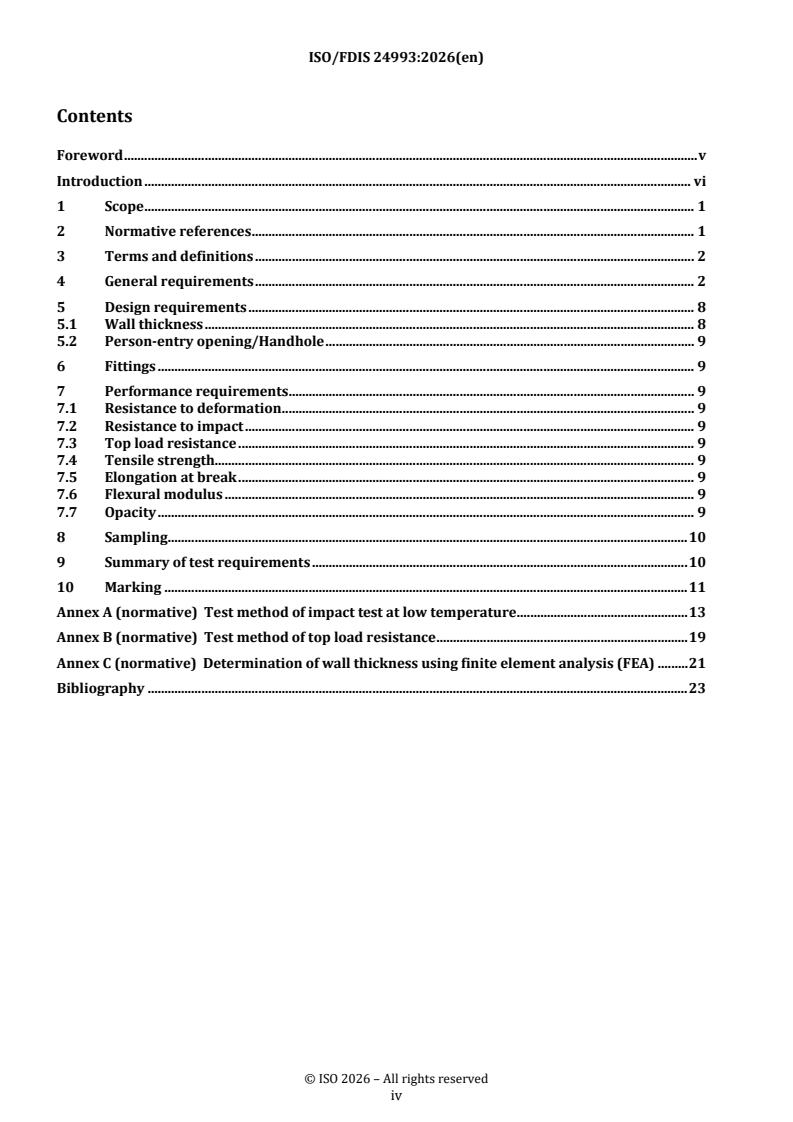
Contents
- Introduction
- 1 Scope
- 2 Normative references
- 3 Terms and definitions
- 3.1 rotational moulded water tank
- 3.2 net capacity
- 3.3 rotational moulding
- 3.4 overall height
- 3.5 overall diameter
- 4 General requirements
- 4.5 The pigments, which may be added at the purchaser’s request, shall be compatible with the
- 5 Design requirements
- 5.1 Wall thickness
- 5.2 Person-entry opening/Handhole
- 6 Fittings
- 7 Performance requirements
- 7.1 Resistance to deformation
- 7.2 Resistance to impact
- 7.3 Top load resistance
- 7.4 Tensile strength
- 7.5 Elongation at break
- 7.6 Flexural modulus
- 7.7 Opacity
- 8 Sampling
- 9 Summary of test requirements
- 1.0 resin
- 1.2 Density 4.3 1183-2 and ISO
- 2.0 General and design requirements for the water tank
- 2.3 Quality of finish 4.7 Visual Inspection
- 2.4 Dimensions, capacity and wall thickness 4.8 and 5.1 Measurement
- 3.0 Performance requirements for the water tank
- 3.1 Resistance to deformation 7.1 Annex B
- 3.2 Resistance to Impact 7.2 Annex A
- 3.3 Top load resistance 7.3 Annex B
- 4.0 Marking 10 Visual inspection
- 10 Marking
- Annex A
- Annex B
- Annex C
- Bibliography
Introduction
Nowadays, polyethylene water storage tanks are trending. The material used in construction of tank, lid and fitting which come in contact with the water is considered 100 % virgin rotational moulded polyethylene. Rotational moulding is one of the most popular plastic moulding techniques. Rotational moulding is a versatile plastic manufacturing process that allows for the manufacturing of a wide variety of products, including plastic tanks. It is a process that involves heating a plastic resin in a mould while simultaneously rotating the mould in two perpendicular axes. This causes the molten resin to evenly distribute and adhere to the walls of the mould, resulting in a seamless, hollow product. Rotomolding technology is prevalent, making it one of the rapidly growing industries in the last decade. There are numerous advantages of rotational moulding, from design versatility, reduction of environmental impact, use of lighter materials, and meeting of demand.
This document was developed to cover the requirements, dimensions and construction of vertical and horizontal of rotational moulded polyethylene water tanks. This document applies to water storage tanks with a nominal service temperature from 1 °C to 60 °C.
There are three types of rotational moulded water tank as follows:
- Type I – Tanks moulded from cross linkable polyethylene.
- Type II – Tanks moulded from non- cross linkable polyethylene without foam layer.
- Type III – Tanks moulded from non- cross linkable polyethylene with foam layer.
FINAL DRAFT International Standard ISO/FDIS 24993:2026(en) Plastics — Rotational moulded polyethylene water storage tanks
1 Scope
This document establishes the general principles for the design and manufacture of mono-layer or multilayer rotational moulded polyethylene vertical and horizontal cylindrical water storage tanks. It is applicable to water storage tanks with a nominal service temperature from 1 °C to 60 °C and does not cover any other nominal service temperature.
This document does not apply to the following:
- underground water tanks;
- mobile water tanks.
2 Normative references
The following documents are referred to in the text in such a way that some or all of their content constitutes requirements of this document. For dated references, only the edition cited applies. For undated references, the latest edition of the referenced document (including any amendments) applies. ISO 178, Plastics — Determination of flexural properties ISO 306, Plastics — Thermoplastic materials — Determination of Vicat softening temperature (VST) ISO 527-1, Plastics — Determination of tensile properties — Part 1: General principles ISO 527-2, Plastics — Determination of tensile properties — Part 2: Test conditions for moulding and extrusion plastics ISO 868, Plastics and ebonite — Determination of indentation hardness by means of a durometer (Shore hardness) ISO 974, Plastics — Determination of the brittleness temperature by impact ISO 1133-1, Plastics — Determination of the melt mass-flow rate (MFR) and melt volume-flow rate (MVR) of thermoplastics — Part 1: Standard method ISO 1183-1, Plastics — Methods for determining the density of non-cellular plastics — Part 1: Immersion method, liquid pycnometer method and titration method ISO 1183-2, Plastics — Methods for determining the density of non-cellular plastics — Part 2: Density gradient column method ISO 1183-3, Plastics — Methods for determining the density of non-cellular plastics — Part 3: Gas pyknometer method ISO 4892-3, Plastics — Methods of exposure to laboratory light sources — Part 3: Fluorescent UV lamps ISO 6964, Polyolefin pipes and fittings — Determination of carbon black content by calcination and pyrolysis — Test method ISO 7686, Plastics pipes and fittings — Determination of opacity
ISO/FDIS 24993:2026(en) ISO 22088-3, Plastics — Determination of resistance to environmental stress cracking (ESC) — Part 3: Bent strip method
3 Terms and definitions
For the purposes of this document, the following terms and definitions apply. ISO and IEC maintain terminology databases for use in standardization at the following addresses:
- ISO Online browsing platform: available at https:// www .iso .org/ obp
- IEC Electropedia: available at https:// www .electropedia .org/
3.1 rotational moulded water tank
tank moulded from polyethylene resin by the process of rotational moulding
3.2 net capacity
net volume of water contained between the lowest level of the inlet and the lower specified level
3.3 rotational moulding
three stages industrial process consisting of loading the mould with powdered resin by heating while rotating the mould about more than one axis, cooling, and removing the moulded article
3.4 overall height
height of the finished empty tank at its highest point including the top rim of the person-entry opening/ handhole and lid of the tank
3.5 overall diameter
maximum diameter of the finished empty tank measured at its largest side, including the wall thickness of the tank and avoiding the mould parting line
4 General requirements
4.1 The material used in construction of tank, lid and fitting which come in contact with water shall be 100 % virgin. Regrind material shall be allowed provided that properties shown in Table 1 are achieved and shall meet requirements in 4.2.
4.2 The material of construction of the tank shall be free of any toxic effector. National requirements or water quality regulations can apply. Where applicable, conformity with NSF/ANSI/CAN 61 may be used as evidence of suitability for contact with drinking water.
4.3 The properties of the polyethylene resin to be used for the manufacture of water tank shall meet the requirements given in Table 1.
Table 1 — Physical properties of polyethylene resin Property Range Melt flow rate, g/10 min. (190 °C, 2,16 kg) 0,5 to 20
Density, kg/m 930 to 960 Tensile strength at yield, MPa (minimum) 12 Elongation at break, % (minimum) 250 Flexural modulus, MPa (minimum) 300
ISO/FDIS 24993:2026(en) TTabablele 1 1 ((ccoonnttiinnueuedd)) Property Range Hardness shore D (minimum) 60 ESCR, hour (100 % Igepal, F ) (minimum) 100
Vicat softening temperature, °C 80 to 130 Brittleness temperature, °C (maximum) - 40 4.4 The amount of ultraviolet stabilizer which may be added at the purchaser’s request, which are, in general, applicable, shall be adequate to give protection to the tank for outdoor application. This stabilizer shall be compounded in the polyethylene. To evaluate a UV stabilizer additive in a polyethylene compound, an accelerated weathering test described in ISO 4892-3 can be performed to simulate outdoor conditions and monitor changes in the physical properties of the material.
4.5 The pigments, which may be added at the purchaser’s request, shall be compatible with the
polyethylene and shall not exceed 2 % compounded in, of the total weight, and shall be free of any toxic effect.
4.6 The tank may incorporate a black layer to prevent the potential algae growth, particularly in hot climates. The percentage of carbon black content by weight in the black layer which may be added at the purchaser’s request shall not exceed 2 % when tested according to method described in ISO 6964. 4.7 The final product shall be visually clean and free from defects such as pits, spots unsaturated with resin and air bubbles at the internal and external surfaces. Due to the differences in various resins and process conditions used, the internal and external surface finish may vary. Thus, acceptable finish shall be agreed upon between the manufacturer and the buyer.
4.8 While the dimensions and capacity of the tank shall be predetermined by the agreement between the manufacturer and the buyer, a guide for these values is given in Table 2 and Table 3. See also Figure 1 and Figure 2, respectively.
Table 2 — Dimensions of vertical – cylindrical tanks Person-entry Net capacity Overall diameter Overall height opening/Handhole Wall thickness diameter D H o litre mm mm mm (Min) mm (Min) 200 650-850 490-690 250 4,5 300 650-850 700-900 250 4,5 400 700-980 700-950 250 4,5 500 800-1 140 610-1 025 250 4,5 700 900-1 140 800-1 100 250 4,5 1 000 990-1 300 850-1 250 420 4,5 1 200 1 080-1 450 880-1 350 420 4,5 1 500 1 080-1 450 1 110-1 590 420 4,5 1 700 1 300-1 500 1 260-1 650 420 4,5 2 000 1 365-1 500 1 250-1 720 420 4,5 2 500 1 380-1 610 1 480-1 950 420 4,5 3 000 1 410-1 800 1 480-2 150 420 4,5 NOTE The net capacity, overall diameter, overall height, person-entry opening diameter and wall thickness are for guide only. In case of production other in between capacity, the wall thickness of the next capacity is used for guide. For capacities above 32 000 litres, values can be extrapolated from the table.
ISO/FDIS 24993:2026(en) TTabablele 2 2 ((ccoonnttiinnueuedd)) Person-entry Net capacity Overall diameter Overall height opening/Handhole Wall thickness diameter D H o litre mm mm mm (Min) mm (Min) 3 500 1 500-1 900 1 540-2 250 420 4,5 4 000 1 600-1 920 1 650-2 400 420 4,5 5 000 1 800-2 110 1 750-2 400 420 4,5 6 000 1 800-2 200 1 760-2 800 420 4,5 7 500 1 890-2 250 2 100-2 930 420 4,5 8 000 1 900-2 300 1 760-2 700 420 4,5 10 000 1 900-2 680 2 100-3 000 420 5,5 12 000 1 950-2 700 2 250-3 100 420 5,5 15 000 2 100-2 680 2 250-3 100 420 5,5 16 000 2 200-3 000 2 260-3 200 420 6,5 20 000 2 200-3 200 2 270-4 000 420 7,5 25 000 2 500-3 430 2 800-4 500 420 9,0 28 000 2 500-3 500 3 100-4 750 420 10,0 32 000 2 800-3 500 3 100-4 800 420 10,0 NOTE The net capacity, overall diameter, overall height, person-entry opening diameter and wall thickness are for guide only. In case of production other in between capacity, the wall thickness of the next capacity is used for guide. For capacities above 32 000 litres, values can be extrapolated from the table.
ISO/FDIS 24993:2026(en) Key 1 overflow 2 drain 3 vent 4 inlet 5 outlet 6 lid of the person-entry opening/handhole H overall height o H effective height D overall diameter a Concrete slab/Platform.
Figure 1 — Typical details of vertical – cylindrical tank
...
Contents
- Introduction
- 1 Scope
- 2 Normative references
- 3 Terms and definitions
- 4 General requirements
- 5 Design requirements
- 5.1 Wall thickness
- 5.2 ManholePerson-entry opening/Handhole
- 6 Fittings
- 7 Performance requirements
- 7.1 Resistance to deformation
- 7.2 Resistance to impact
- 7.3 Top load resistance
- 7.4 Tensile strength
- 7.5 Elongation at break
- 7.6 Flexural modulus
- 7.7 Opacity
- 8 Sampling
- 9 Summary of test requirements
- 1.0 resin
- 1.2 Density 4.34.3 1183-2 and ISO
- 2.0 General and design requirements for the water tank
- 2.3 Quality of finish 4.74.7 Visual Inspection
- 2.4 Dimensions, capacity and wall thickness 4.84.8 and 5.15.1 Measurement
- 3.0 Performance requirements for the water tank
- 3.1 Resistance to deformation 7.17.1 Annex BAnnex B
- 3.2 Resistance to Impact 7.27.2 Annex AAnnex A
- 3.3 Top load resistance 7.37.3 Annex BAnnex B
- 4.0 Marking 1010 Visual inspection
- 10 Marking
- Annex A
- Annex B
- Bibliography
Introduction
Nowadays, polyethylene water storage tanks are trending. The material used in construction of tank, lid and fitting which come in contact with the water is considered 100 % virgin rotational moulded polyethylene. Rotational moulding is one of the most popular plastic moulding techniques. Rotational moulding is a versatile plastic manufacturing process that allows for the manufacturing of a wide variety of products, including plastic tanks. It is a process that involves heating a plastic resin in a mould while simultaneously rotating the mould in two perpendicular axes. This causes the molten resin to evenly distribute and adhere to the walls of the mould, resulting in a seamless, hollow product. Rotomolding technology is prevalent, making it one of the rapidly growing industries in the last decade. There are numerous advantages of rotational moulding, from design versatility, reduction of environmental impact, use of lighter materials, and meeting of demand.
This document was developed to cover the requirements, dimensions and construction of vertical and horizontal of rotational moulded polyethylene water tanks. This document applies to water storage tanks with a nominal service temperature from 1 °C to 60 °C.
There are three types of rotational moulded water tank as follows:
- — Type I – Tanks moulded from cross linkable polyethylene.
- — Type II – Tanks moulded from non- cross linkable polyethylene without foam layer.
- — Type III – Tanks moulded from non- cross linkable polyethylene with foam layer.
ISO/FDIS 24993:2026(en) Plastics — Rotational moulded polyethylene water storage tanks
1 Scope
This document establishes the general principles for the design and manufacture of mono-layer or multi-layer rotational moulded polyethylene vertical and horizontal cylindrical water storage tanks. This documentIt is applicable to water storage tanks with a nominal service temperature from 1 °C to 60 °C and does not cover any other nominal service temperature.
This document does not apply to the following:
- — underground water tanks;
- — mobile water tanks.
2 Normative references
The following documents are referred to in the text in such a way that some or all of their content constitutes requirements of this document. For dated references, only the edition cited applies. For undated references, the latest edition of the referenced document (including any amendments) applies. ISO 178, Plastics — Determination of flexural properties ISO 306, Plastics — Thermoplastic materials — Determination of Vicat softening temperature (VST) ISO 527--1, Plastics — Determination of tensile properties — Part 1: General principles ISO 527--2, Plastics — Determination of tensile properties — Part 2: Test conditions for moulding and extrusion plastics ISO 178, Plastics — Determination of flexural properties ISO 7686, Plastics pipes and fittings — Determination of opacity ISO 6964, Polyolefin pipes and fittings — Determination of carbon black content by calcination and pyrolysis — Test method ISO 868, Plastics and ebonite — Determination of indentation hardness by means of a durometer (Shore hardness) ISO 974, Plastics — Determination of the brittleness temperature by impact ISO 1133--1, Plastics — Determination of the melt mass-flow rate (MFR) and melt volume-flow rate (MVR) of thermoplastics — Part 1: Standard method ISO 1183--1, Plastics — Methods for determining the density of non-cellular plastics — Part 1: Immersion method, liquid pycnometer method and titration method ISO 1183--2, Plastics — Methods for determining the density of non-cellular plastics — Part 2: Density gradient column method ISO 1183--3, Plastics — Methods for determining the density of non-cellular plastics — Part 3: Gas pyknometer method
ISO/FDIS 24993:2026(en) ISO 4892--3, Plastics — Methods of exposure to laboratory light sources — Part 3: Fluorescent UV lamps ISO 6964, Polyolefin pipes and fittings — Determination of carbon black content by calcination and pyrolysis — Test method ISO 7686, Plastics pipes and fittings — Determination of opacity ISO 22088-3, Plastics — Determination of resistance to environmental stress cracking (ESC) — Part 3: Bent strip method ISO 868, Plastics and ebonite — Determination of indentation hardness by means of a durometer (Shore hardness) ISO 306, Plastics — Thermoplastic materials — Determination of Vicat softening temperature (VST) ISO 974, Plastics — Determination of the brittleness temperature by impact
3 Terms and definitions
For the purposes of this document, the following terms and definitions apply. ISO and IEC maintain terminology databases for use in standardization at the following addresses:
- — ISO Online browsing platform: available at https://www.iso.org/obp
- — IEC Electropedia: available at https://www.electropedia.org/ 3.1 3.1 rotational moulded water tank tank moulded from polyethylene resin by the process of rotational moulding 3.2 3.2 net capacity net volume of water contained between the lowest level of the inlet and the lower specified level 3.3 3.3 rotational moulding three stages industrial process consisting of loading the mould with powdered resin by heating while rotating the mould about more than one axis, cooling, and removing the moulded article 3.4 3.4 overall height height of the finished empty tank at its highest point including the top rim of the manholeperson-entry opening/handhole and lid of the tank 3.5 3.5 overall diameter maximum diameter of the finished empty tank measured at its largest side, including the wall thickness of the tank and avoiding the mould parting line
4 General requirements
4.1 4.1 The material used in construction of tank, lid and fitting which come in contact with water shall be 100 % virgin. Regrind material shall be allowed provided that properties shown in Table 1Table 1 are achieved and shall meet requirements in 4.2clause 4.2..
ISO/FDIS 24993:2026(en) 4.2 4.2 The material of construction of the tank shall be free of any toxic effector shall meet as per the. National requirements or water quality regulations of each countrycan apply. Where applicable, conformity with NSF/ANSI/CAN 61 may be used as evidence of suitability for contact with drinking water. 4.3 4.3 The properties of the polyethylene resin to be used for the manufacture of water tank shall meet the requirements given in Table 1Table 1..
Table 1 — Physical properties of polyethylene resin Property Range Melt flow rate, g/10 min. (190 °C, 2,16 kg) 0,5 to 20
Density, kg/m 930 to 960 Tensile strength at yield, MPa (minimum) 12 Elongation at break, % (minimum) 250 Flexural modulus, MPa (minimum) 300 Hardness shore D (minimum) 60 ESCR, hour (100 % Igepal, F50) (minimum) 100 Vicat softening temperature, °C 80 to 130 Brittleness temperature, °C (maximum) - 40 4.4 4.4 The amount of ultraviolet stabilizer which may be added at the purchaser’s request or according to the national laws, which are, in general, applicable, shall be adequate to give protection to the tank for outdoor application. This stabilizer shall be compounded in the polyethylene. To evaluate a UV stabilizer additive in a polyethylene compound, an accelerated weathering test described in ISO 4892-3 can be performed to simulate outdoor conditions and monitor changes in the physical properties of the material. 4.5 4.5 The pigments, which may be added at the purchaser’s request or according to the national mandatory requirements, shall be compatible with the polyethylene and shall not exceed 2 % compounded in, of the total weight, and shall be free of any toxic effect. 4.6 4.6 The tank may incorporate a black layer to prevent the potential algae growth, particularly in hot climates. The percentage of carbon black content by weight in the black layer which may be added at the purchaser’s request or according to the national mandatory requirements shall not exceed 2 % when tested according to method described in ISO 6964.
4.7 4.7 The final product shall be visually clean and free from defects such as pits, spots unsaturated with resin and air bubbles at the internal and external surfaces. Due to the differences in various resins and process conditions used, the internal and external surface finish may vary. Thus, acceptable finish shall be agreed upon between the manufacturer and the buyer.
4.8 4.8 While the dimensions and capacity of the tank shall be predetermined by the agreement between the manufacturer and the buyer or according to the national mandatory requirements, a guide for these values is given in Table 2Table 2 and Table 3Table 3. Also see Figure 1. See also Figure 1 and Figure 2Figure 2,, respectively.
ISO/FDIS 24993:2026(en) Table 2 — Dimensions of vertical – cylindrical tanks Manhole/ Person- Overall entry Net capacity Overall height Wall thickness diameter opening/Handhol e diameter D H o litre mm mm mm (Min) mm (Min) 200 650-850 490-690 250 4,5 300 650-850 700-900 250 4,5 400 700-980 700-950 250 4,5 500 800-1 140 610-1 025 250 4,5 700 900-1 140 800-1 100 250 4,5 1 000 990-1 300 850-1 250 420 4,5 1 200 1 080-1 450 880-1 350 420 4,5 1 500 1 080-1 450 1 110-1 590 420 4,5 1 700 1 300-1 500 1 260-1 650 420 4,5 2 000 1 365-1 500 1 250-1 720 420 4,5 2 500 1 380-1 610 1 480-1 950 420 4,5 3 000 1 410-1 800 1 480-2 150 420 4,5 3 500 1 500-1 900 1 540-2 250 420 4,5 4 000 1 600-1 920 1 650-2 400 420 4,5 5 000 1 800-2 110 1 750-2 400 420 4,5 6 000 1 800-2 200 1 760-2 800 420 4,5 7 500 1 890-2 250 2 100-2 930 420 4,5 8 000 1 900-2 300 1 760-2 700 420 4,5 10 000 1 900-2 680 2 100-3 000 420 5,5 12 000 1 950-2 700 2 250-3 100 420 5,5 15 000 2 100-2 680 2 250-3 100 420 5,5 16 000 2 200-3 000 2 260-3 200 420 6,5 20 000 2 200-3 200 2 270-4 000 420 7,5 25 000 2 500-3 430 2 800-4 500 420 9,0 28 000 2 500-3 500 3 100-4 750 420 10,0 32 000 2 800-3 500 3 100-4 800 420 10,0 NOTE: The net capacity, overall diameter, overall height, manholeperson-entry opening diameter and wall thickness are for guide only. In case of production other in between capacity, the wall thickness of the next capacity is used for guide. For capacities above 32 000 litres, values can be extrapolated from the table.
ISO/FDIS 24993:2026(en)
Key 1 overflow 2 drain 3 vent
ISO/FDIS 24993:2026(en) 4 inlet 5 outlet 6 lid of manholethe person-entry opening/handhole H H overall height 0 o H effective height D overall diameter a Concrete slab/Platform.
...