

ISO 22230
(Main)Specification for phosphate conversion coating on magnesium and its alloys
- Abstract
This document specifies terms, definitions, requirements and test methods for phosphate conversion coatings which are usually applied to magnesium alloy components (hereinafter referred to as film).
- Status
- Not Published
- Technical Committee
- ISO/TC 79/SC 5 - Magnesium and alloys of cast or wrought magnesium
- Drafting Committee
- ISO/TC 79/SC 5 - Magnesium and alloys of cast or wrought magnesium
- Current Stage
- 6000 - International Standard under publication - 60 Publication
- Start Date
- 21-Nov-2026
Buy Documents
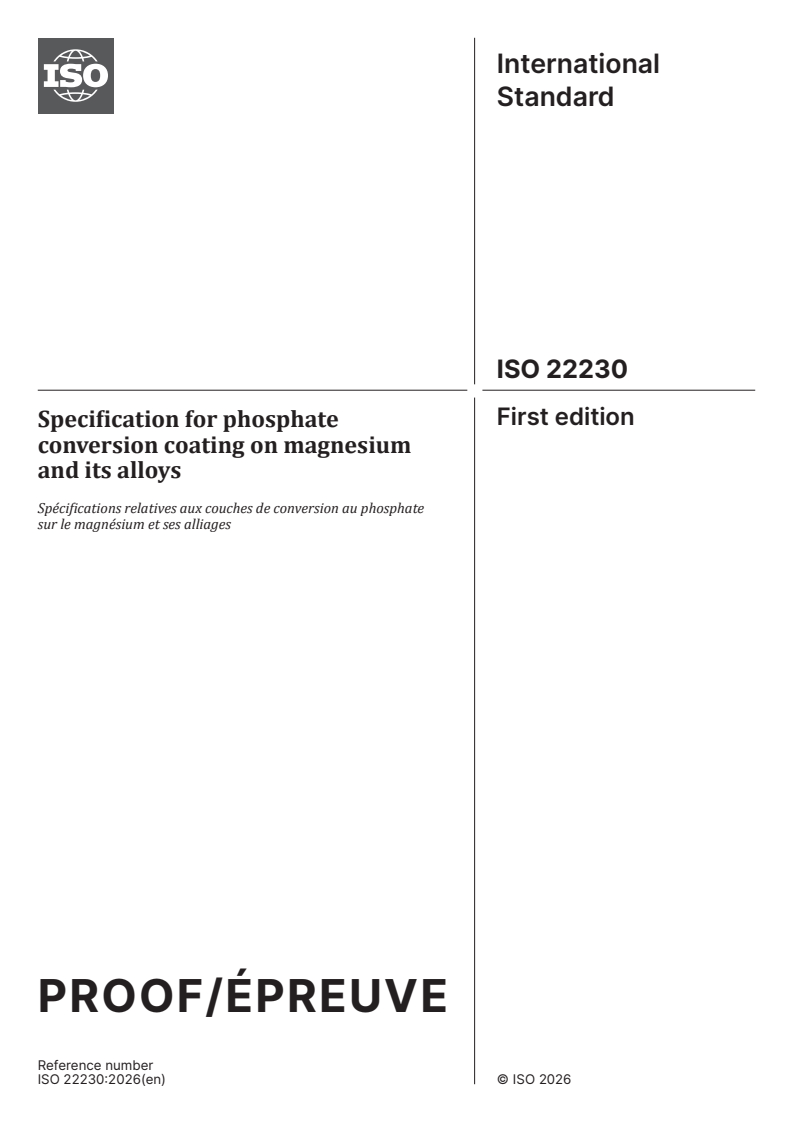

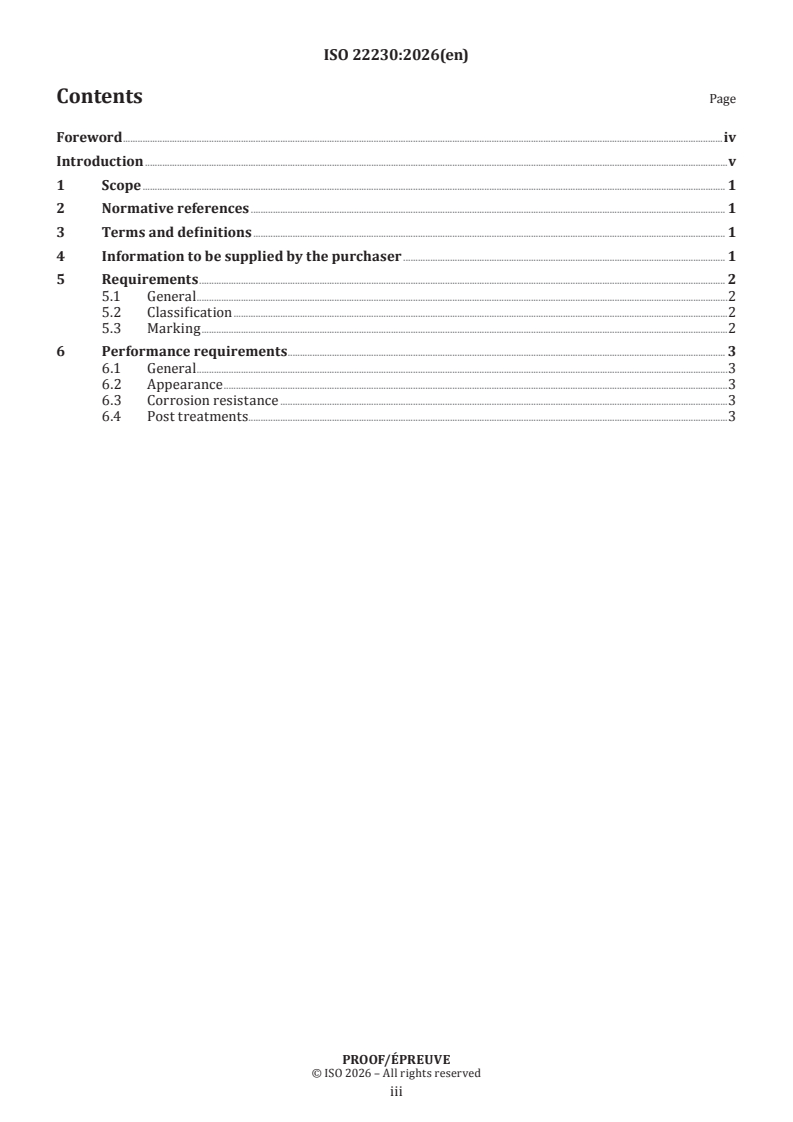

ISO/PRF 22230 - Specification for phosphate conversion coating on magnesium and its alloys

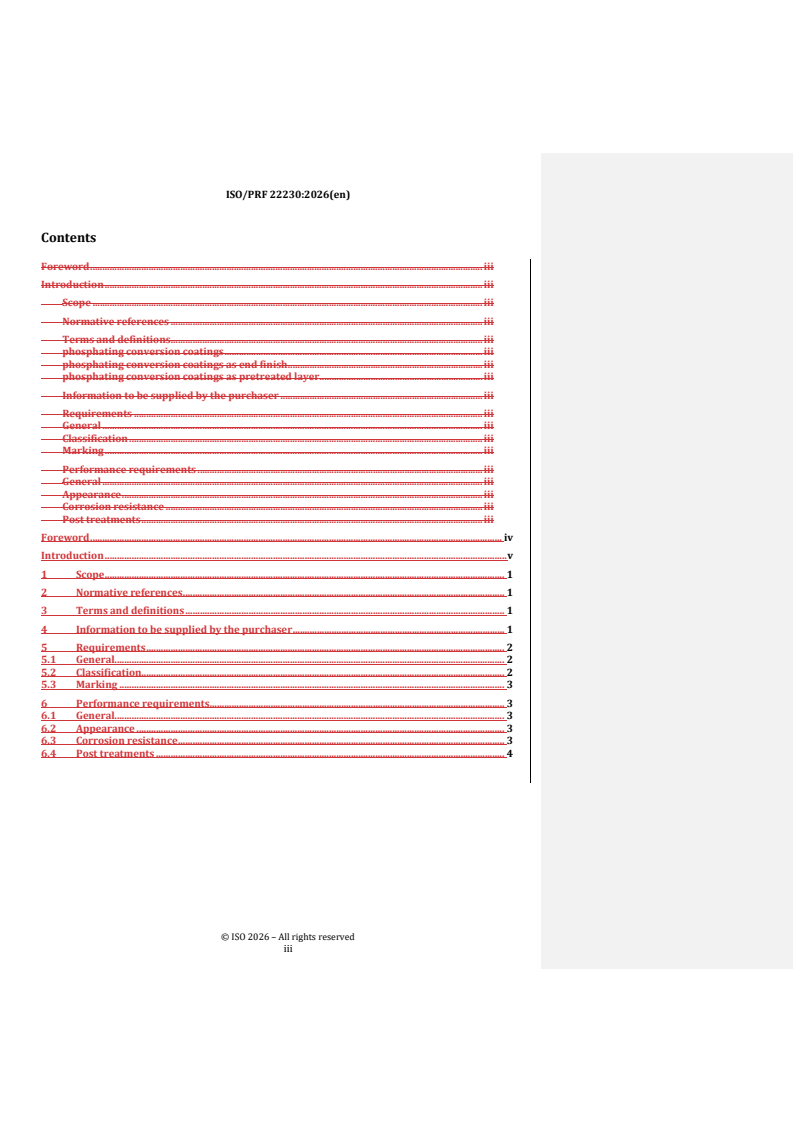
REDLINE ISO/PRF 22230 - Specification for phosphate conversion coating on magnesium and its alloys
ISO 22230 is an ISO specification for phosphate conversion coatings on magnesium and its alloys. It sets out the terms, requirements and test methods for coatings usually applied to magnesium alloy components, including when the coating is used as an end finish or as a pretreatment layer.
What does ISO 22230 specify?
ISO 22230 specifies how phosphate conversion coatings on magnesium and its alloys are described, supplied, marked and checked. The document is organized into scope, normative references, terms and definitions, purchaser information, requirements, and performance requirements.
The standard applies to the coating layer referred to as the film. It also uses the document’s own classification, marking and performance criteria so that supplier and purchaser can agree on the same coating type and expected behavior.
What are the key requirements of ISO 22230?
ISO 22230 focuses on surface condition, coating classification, marking, appearance, corrosion resistance and post-treatments. In practice, it tells the buyer and coater what must be agreed before treatment and what the finished coating should achieve.
Surface preparation and cleanliness
ISO 22230 requires the product surface to be clean before phosphating, with no oxidation, scale or contamination such as chips, grinding powder, oil, grease or sweat. Cleaning is required first, and pickling is used when oxides or scale remain.
This matters because the coating depends on the starting surface. If the surface is dirty or oxidized, the phosphate film may form poorly or perform inconsistently.
Purchaser-supplied information
ISO 22230 requires the purchaser to provide the coating description, sampling procedure, acceptable quality limit or other test deviations from ISO 4519, surface appearance, phosphating parameters, corrosion resistance requirement, and any magnesium alloy matrix condition that affects film formation or appearance.
This matters because the standard is not just a product recipe. It requires the order to define the expected coating, the checks to be used, and any special conditions that could change results.
Classification of coating types
ISO 22230 classifies the coating by composition system and typical application. The table includes Znph, Mnph, Zn and Ca, and Vph series, with example uses such as vehicle parts, railcars, 3C products and battery end plates for new energy vehicles.
This matters because the coating type should match the service need - for example temporary corrosion protection, primer use, or protection in sealed environments.
Marking
ISO 22230 requires marking to be given in the order of coating name, reference to the standard, composition system and post-treatment symbol.
This matters because the marking makes the coating specification readable on contracts, records and purchase documents, so both sides identify the same film.
Appearance requirements
ISO 22230 requires the coating to be continuous, with no white spots and no ash hanging, and with uniform appearance and colour. Supplier and purchaser may agree standard samples for appearance and colour.
This matters because appearance is part of acceptance, not only cosmetics. It also gives a practical reference when visual inspection is used.
Corrosion resistance and test method
ISO 22230 uses the neutral salt spray test (NSS) to characterize corrosion resistance. The coating must meet the minimum NSS exposure time for its intended use, and the test is carried out in accordance with ISO 9227.
This matters because corrosion performance is tied to a defined laboratory test, so results can be compared consistently. The purchaser is responsible for conducting the NSS.
Post-treatments
ISO 22230 requires post-treatments to be agreed by supplier and purchaser and stated in the contract. The listed symbols cover varnishes or organic coatings, inorganic or non-film-forming organic sealants, inorganic or organic sealing agents, and grease, oil or other lubricants.
This matters because the final performance can change after sealing or overcoating, so the contract has to state which finishing step is part of the coating system.
What terms does ISO 22230 define?
ISO 22230 defines phosphating conversion coatings as stable compound coatings formed on the surface of products in phosphoric acid solution by chemical or electrochemical methods.
A phosphating conversion coating as end finish is a coating used as the final surface of the product.
A phosphating conversion coating as pretreated layer is a coating used before a subsequent coating is applied.
The document uses film to mean the phosphate conversion coating on magnesium alloy components.
Neutral salt spray test (NSS) is the corrosion test used to assess the coating’s resistance under artificial salt spray conditions.
Who uses ISO 22230?
ISO 22230 is used by coating suppliers, purchasers, quality managers and test laboratories working with magnesium and magnesium alloy components. It is relevant to industries that use coated magnesium parts in vehicles, railcars, textile profiles and new energy vehicle battery components.
It is especially useful when a supplier and purchaser need a common way to specify the coating system, check appearance, define corrosion resistance and agree on post-treatment.
Which standards are used with ISO 22230?
ISO 22230 cites ISO 2080 for coating vocabulary, so users can apply the same terminology for metallic and other inorganic coatings.
It cites ISO 4519 for sampling procedures by attributes, which supports inspection planning and acceptable quality limits.
It cites ISO 9227 for salt spray testing, which provides the method used for the NSS corrosion requirement.
What does the ISO 22230 document contain?
ISO 22230 contains a purchaser-information clause, a general requirements clause, a classification table, a marking rule, and performance requirements for appearance, corrosion resistance and post-treatments. It also includes the terms and definitions section that establishes the meaning of the coating terms used in the standard.
The document’s tables provide the coating series and their typical applications, the NSS exposure times by intended use, and the symbols for post-treatments. These are the parts a buyer or supplier would use when writing a specification, checking acceptance, or setting up quality control for a magnesium coating process.
Buy Documents
ISO/PRF 22230 - Specification for phosphate conversion coating on magnesium and its alloys
REDLINE ISO/PRF 22230 - Specification for phosphate conversion coating on magnesium and its alloys
Get Certified
Connect with accredited certification bodies for this standard

DVS-ZERT GmbH
German welding certification society.

Element Materials Technology
Materials testing and product certification.

Inštitut za kovinske materiale in tehnologije
Institute of Metals and Technology. Materials testing, metallurgical analysis, NDT.
Sponsored listings
Frequently Asked Questions
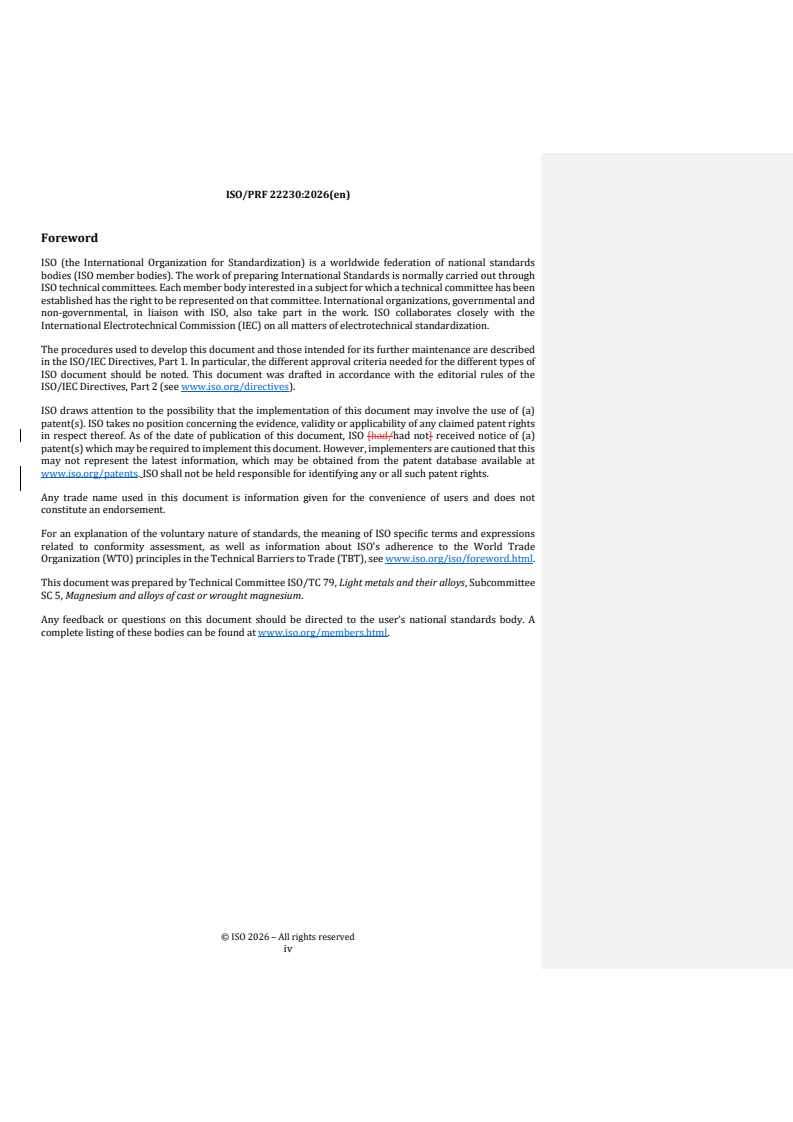
ISO 22230 is a draft published by the International Organization for Standardization (ISO). Its full title is "Specification for phosphate conversion coating on magnesium and its alloys". This standard covers: This document specifies terms, definitions, requirements and test methods for phosphate conversion coatings which are usually applied to magnesium alloy components (hereinafter referred to as film).
This document specifies terms, definitions, requirements and test methods for phosphate conversion coatings which are usually applied to magnesium alloy components (hereinafter referred to as film).
ISO 22230 is classified under the following ICS (International Classification for Standards) categories: 25.220.20 - Surface treatment; 77.120.20 - Magnesium and magnesium alloys. The ICS classification helps identify the subject area and facilitates finding related standards.
ISO 22230 is available in PDF format for immediate download after purchase. The document can be added to your cart and obtained through the secure checkout process. Digital delivery ensures instant access to the complete standard document.
Standards Content (Sample)
Contents
- Introduction
- 1 Scope
- 2 Normative references
- 3 Terms and definitions
- 3.1 phosphating conversion coatings
- 3.2 phosphating conversion coatings as end finish
- 3.3 phosphating conversion coatings as pretreated layer
- 4 Information to be supplied by the purchaser
- 5 Requirements
- 5.1 General
- 5.2 Classification
- 5.3 Marking
- 6 Performance requirements
- 6.1 General
- 6.2 Appearance
- 6.3 Corrosion resistance
- 6.4 Post treatments
Introduction
Phosphate conversion coatings are applied to magnesium and its alloy components either as an end finish or as a pretreatment layer for other coatings. They are intended to:
- improve corrosion resistance during transportation;
- improve adhesion to paints and other organic finishes;
- modify surface frictional properties to facilitate sliding.
Phosphate conversion coatings are produced by treatment with solutions, the main constituents of which are the appropriate dihydrogen orthophosphates, to enhance the corrosion resistance of the products. The following factors can affect the mass per unit area and apparent density of phosphate conversion coatings:
- the base material and surface condition of the components;
- mechanical and chemical pretreatment of the components;
- processing conditions for phosphating.
All phosphate conversion coatings of magnesium alloy components are more or less porous but can be sealed substantially by subsequent sealant processes.
PROOF/ÉPREUVE
International Standard ISO 22230:2026(en) Specification for phosphate conversion coating on magnesium and its alloys
1 Scope
This document specifies terms, definitions, requirements and test methods for phosphate conversion coatings which are usually applied to magnesium alloy components (hereinafter referred to as "film").
2 Normative references
The following documents are referred to in the text in such a way that some or all of their content constitutes requirements of this document. For dated references, only the edition cited applies. For undated references, the latest edition of the referenced document (including any amendments) applies. ISO 2080, Metallic and other inorganic coatings — Surface treatment, metallic and other inorganic coatings — Vocabulary ISO 4519, Electrodeposited metallic coatings and related finishes — Sampling procedures for inspection by attributes ISO 9227, Corrosion tests in artificial atmospheres — Salt spray tests
3 Terms and definitions
For the purposes of this document, the terms and definitions given in ISO 2080 and the following apply. ISO and IEC maintain terminology databases for use in standardization at the following addresses:
- ISO Online browsing platform: available at https:// www .iso .org/ obp
- IEC Electropedia: available at https:// www .electropedia .org/
3.1 phosphating conversion coatings
stable compound coatings formed on the surface of products in phosphoric acid solution by chemical or electrochemical methods
3.2 phosphating conversion coatings as end finish
product of phosphating pretreatment used as end finish
...
Contents
- Introduction
- 1 Scope
- 2 Normative references
- 3 Terms and definitions
- 3.1 3.1 phosphating conversion coatings Formatted: Term(s)
- 3.2 3.2 phosphating conversion coatings as end finish
- 3.3 3.3 phosphating conversion coatings as pretreated layer
- 4 Information to be supplied by the purchaser
- 5 Requirements cm + Indent at: 0 cm
- 5.1 General
- 5.2 Classification
- 5.3 Marking
- 6 Performance requirements
- 6.1 General
- 6.2 Appearance
- 6.3 Corrosion resistance
- 6.4 Post treatments
Introduction
Phosphate conversion coatings are applied to magnesium and its alloy components either as an end finish or as a pretreatment layer for other coatings. They are intended to:
- improve corrosion resistance during transportation;
- improve adhesion to paints and other organic finishes;
- modify surface frictional properties to facilitate sliding.
Phosphate conversion coatings are produced by treatment with solutions, the main constituents of which are the appropriate dihydrogen orthophosphates, to enhance the corrosion resistance of the products. The following factors can affect the mass per unit area and apparent density of phosphate conversion coatings:
- the base material and surface condition of the components;
- mechanical and chemical pretreatment of the components;
- processing conditions for phosphating.
All phosphate conversion coatings of magnesium alloy components are more or less porous but can be sealed substantially by subsequent sealant processes.
ISO/PRF 22230:2026(en) Specification for phosphate conversion coating on magnesium and its alloys
1 Scope
This document specifies terms, definitions, requirements and test methods for phosphate conversion coatings which are usually applied to magnesium alloy components (hereinafter referred to as "film").
2 Normative references
The following documents are referred to in the text in such a way that some or all of their content constitutes requirements of this document. For dated references, only the edition cited applies. For undated references, the latest edition of the referenced document (including any amendments) applies. ISO 2080, Metallic and other inorganic coatings — Surface treatment, metallic and other inorganic coatings — Vocabulary ISO 4519, Electrodeposited metallic coatings and related finishes — Sampling procedures for inspection by attributes ISO 9227, Corrosion tests in artificial atmospheres — Salt spray tests
3 Terms and definitions
For the purposes of this document, the terms and definitions given in ISO 2080 and the following apply. ISO and IEC maintain terminology databases for use in standardization at the following addresses:
- ISO Online browsing platform: available at https://www.iso.org/obp
- IEC Electropedia: available at https://www.electropedia.org/
3.1 3.1 phosphating conversion coatings Formatted: Term(s)
stable compound coatings formed on the surface of products in phosphoric acid solution by chemical or electrochemical methods
3.2 3.2 phosphating conversion coatings as end finish
Formatted: Term(s) afterproduct of phosphating pretreatment, the product shall be used as end finish
3.3 3.3 phosphating conversion coatings as pretreated layer
Formatted: Term(s) after phosphating conversion coating used as a pretreatment, the product shall be coated on the phosphate coating to form a new layer for a subsequent coating
4 Information to be supplied by the purchaser
The following information shall be provided by the purchaser:
...