

kSIST-TS FprCEN/TS 18363:2026
(Main)Road vehicles - Rechargeable batteries with internal energy storage - Digital battery passport data for EV battery
- Abstract
This document explains digital battery passport data attributes for EV battery.
- Status
- Not Published
- Public Enquiry End Date
- 09-Sep-2026
- Technical Committee
- CEV - Electric passenger and commercial vehicles
- Current Stage
- 5520 - Unique Acceptance Procedure (UAP) (Adopted Project)
- Start Date
- 30-Jun-2026
- Due Date
- 17-Nov-2026
- Completion Date
- 24-Sep-2026

kSIST-TS FprCEN/TS 18363:2026 is the Slovenian version of the CEN draft Technical Specification FprCEN/TS 18363 for road vehicles. It gives guidance on the digital battery passport data attributes for an electric vehicle battery (EV battery). The document tells economic operators what battery-model data, battery-specific data, and access levels belong in the battery passport.
What does kSIST-TS FprCEN/TS 18363:2026 specify?
kSIST-TS FprCEN/TS 18363:2026 specifies how to describe the data that belongs in a digital battery passport for an EV battery. It focuses on the meaning and structure of the data attributes, not on the digital system architecture behind the passport.
The document is organized into a short front part and the main clauses:
- Clause 1 Scope
- Clause 2 Normative references
- Clause 3 Terms and definitions
- Clause 4 Abbreviated terms
- Clause 5 Introduction to the battery passport
- Clause 6 EV battery passport content requirements
- Annex A - Normative list of data attributes
- Annex B - Informative data representation
The introduction also states that the document excludes the technical requirements for the architecture of the digital operating system of the battery passport.
| Annex | What it covers |
|---|---|
| Annex A | Structured list of the data attributes for each access level |
| Annex B | Machine-readable data representation and an example structure |
What are the key requirements of kSIST-TS FprCEN/TS 18363:2026?
kSIST-TS FprCEN/TS 18363:2026 sets out how the battery passport is accessed, what data each audience can see, and which values are tied to the battery model or to one individual battery. In practice, this lets a company publish the right information to buyers, service providers, authorities, and other legitimate users without mixing up static model data and changing battery-state data.
Access, identification, and persistence
Clause 5.1 requires the battery passport to be accessible through a QR code that links to a unique identifier assigned by the economic operator that places the battery on the market. The QR code and identifier have to follow the ISO/IEC 15459 series or equivalent, and the information has to remain available over the battery life cycle through a persistent digital reference.
For users, this means the passport should stay reachable even if IT platforms change. For operators, it means the battery needs a stable identifier that can support traceability across sale, use, repair, and end-of-life handling.
Public battery-model information
Clause 6.1 lists the battery-model data that is accessible to the general public. It includes manufacturer identification, battery category, place and date of manufacture, weight, rated capacity, chemistry, hazardous substances, critical raw materials, carbon footprint information, recycled content, share of renewable content, voltage, original power capability, expected lifetime, storage temperature range, warranty period, and waste-handling information.
In practice, this is the data most buyers, fleet operators, recyclers, and compliance teams will check first. It tells them what the battery is, how it performs, what materials it contains, and what handling or environmental information needs to follow it.
Model data for legitimate interest and authorities
Clause 6.2 adds battery-model information that is only available to persons with a legitimate interest and the European Commission. This includes detailed composition for the cathode, anode, and electrolyte, part numbers and replacement-spare contacts, dismantling information, and safety measures.
This matters for repair, reuse, repurposing, and remanufacturing work. The document links these data to disassembly and spare-part support, so a technical user can plan service work and safe teardown instead of relying only on public summary data.
Authority-only technical documentation
Clause 6.3 requires technical documentation to be available on request to notified bodies or market surveillance authorities, and it includes a list of references to that documentation in the passport. The note points to prEN 18239 for access rights management, information system security, and business confidentiality.
For manufacturers and importers, this means the passport is not only a public label. It also acts as a pointer to the deeper evidence needed for conformity assessment and market surveillance.
Individual battery data and status changes
Clause 6.4 covers information for one specific battery, accessible only to persons with a legitimate interest. It requires a new battery passport when the battery status changes, except for repair without a significant performance change. It also allows dynamic updates when the vehicle can transmit the data remotely.
The clause requires performance and durability values at original placement on the market, then updated values after status changes: capacity, power, internal resistance, round-trip energy efficiency, lifetime, fade or increase values, and the Battery Identification Number. It also requires the State of Certified Energy (SOCE) and use history such as charging and discharging cycles, negative events, operating temperature, and state of charge.
In practice, this is the part that supports second-life decisions and degradation tracking. A buyer of a used battery can compare its current condition with its original state and judge whether it still fits the intended use.
Structured attribute listing and machine-readable form
Annex A requires each data item to be expressed in a structured form with a data name, attribute, value, and where relevant a unit. It also requires standardized formats such as numeric values, Boolean values, dates, and enumerated values.
That makes the passport suitable for databases and automated exchange, not just human reading. Annex B then provides a machine-readable example, including a JSON-style structure and support for multiple data sets.
What terms does kSIST-TS FprCEN/TS 18363:2026 define?
kSIST-TS FprCEN/TS 18363:2026 defines the main battery passport terms used throughout the document.
- Battery identification number - the unique character string that identifies a battery and can also link to the battery passport.
- Battery model - the version of battery units that share the same relevant technical characteristics and the same model identifier.
- Battery producer - the economic operator that first places batteries on the market under its own name or trademark, resells them under its own name, supplies them first in a Member State, or sells them directly by distance contract.
- Battery system - the energy storage device made up of cells or packs plus the electrical circuits and electronics around them.
- Electric vehicle battery (EV battery) - a battery designed to provide traction power for hybrid or electric vehicles.
- State of the battery - the battery’s historical and current use status, such as original, re-used, repurposed, remanufactured, or waste.
- State of Certified Energy (SOCE) - the certified usable battery energy performance at a point in the battery life, expressed as a percentage.
- Energy round trip efficiency - the ratio between energy delivered on discharge and the energy needed to restore the initial state of charge.
Who uses kSIST-TS FprCEN/TS 18363:2026?
kSIST-TS FprCEN/TS 18363:2026 is used by companies and authorities that create, check, or use EV battery passport data.
Typical users include:
- battery manufacturers and other economic operators placing batteries on the market
- vehicle manufacturers that integrate EV batteries into vehicles
- importers and distributors
- repair, reuse, repurposing, and remanufacturing operators
- notified bodies and market surveillance authorities
- the European Commission
- buyers, fleet managers, and compliance teams that need battery-model data
- recyclers and waste-battery handlers that need end-of-life and safety information
In practice, these users need the standard to decide what to publish, what to keep restricted, how to update a passport after a status change, and what evidence must be ready for checks or audits.
Which standards are used with kSIST-TS FprCEN/TS 18363:2026?
kSIST-TS FprCEN/TS 18363:2026 refers to several standards that support the data definitions and passport content:
- EN 18060 - provides the performance and durability methods used for capacity, power, lifetime, internal resistance, round-trip efficiency, C-rate, and fade-related values.
- EN 18061 - provides the steps, conditions, and protocols for safe repair, re-use, preparation for repurposing, dismantling information, part numbers, and safety measures.
- ISO/IEC 15459-1 to ISO/IEC 15459-6 - support the QR code and unique identifier used to access the battery passport.
- EN 2:2004 - is used for classifying the usable extinguishing agent.
- prEN 18239 - is cited for access rights management, information system security, and business confidentiality.
What does the kSIST-TS FprCEN/TS 18363:2026 document contain?
kSIST-TS FprCEN/TS 18363:2026 contains a full list of passport data attributes grouped by access level, plus examples of how to represent them in structured form. Annex A breaks the data into public battery-model information, restricted battery-model information, authority-only technical documentation, and individual battery data.
The annex tables show which items are static and which ones change with battery status or use. Annex B gives a machine-readable model of the data, including a JSON-style example for lifetime data and support for multiple material data sets through an API-style structure.
The document also includes references to information on carbon footprint, due diligence, dismantling, safety measures, state of health, and use history. That makes it a practical data map for building and checking an EV battery passport across the battery life cycle.
Get Certified
Connect with accredited certification bodies for this standard

TÜV Rheinland
TÜV Rheinland is a leading international provider of technical services.

TÜV SÜD
TÜV SÜD is a trusted partner of choice for safety, security and sustainability solutions.

DEKRA Certification Inc.
DEKRA US certification services.
Sponsored listings
Frequently Asked Questions
kSIST-TS FprCEN/TS 18363:2026 is a draft published by the Slovenian Institute for Standardization (SIST). Its full title is "Road vehicles - Rechargeable batteries with internal energy storage - Digital battery passport data for EV battery". This standard covers: This document explains digital battery passport data attributes for EV battery.
This document explains digital battery passport data attributes for EV battery.
kSIST-TS FprCEN/TS 18363:2026 is classified under the following ICS (International Classification for Standards) categories: 29.220.20 - Acid secondary cells and batteries; 43.120 - Electric road vehicles. The ICS classification helps identify the subject area and facilitates finding related standards.
kSIST-TS FprCEN/TS 18363:2026 is available in PDF format for immediate download after purchase. The document can be added to your cart and obtained through the secure checkout process. Digital delivery ensures instant access to the complete standard document.
Standards Content (Sample)
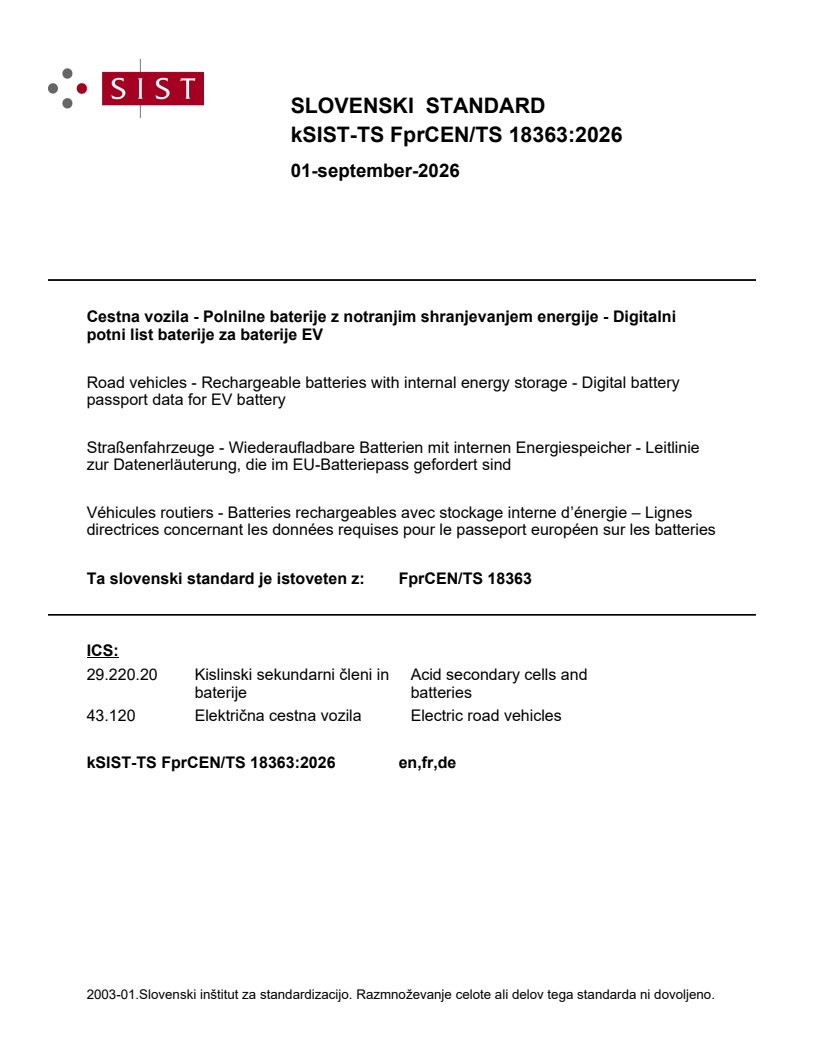
SLOVENSKI STANDARD
01-september-2026
Cestna vozila - Polnilne baterije z notranjim shranjevanjem energije - Digitalni
potni list baterije za baterije EV
Road vehicles - Rechargeable batteries with internal energy storage - Digital battery
passport data for EV battery
Straßenfahrzeuge - Wiederaufladbare Batterien mit internen Energiespeicher - Leitlinie
zur Datenerläuterung, die im EU-Batteriepass gefordert sind
Véhicules routiers - Batteries rechargeables avec stockage interne d’énergie – Lignes
directrices concernant les données requises pour le passeport européen sur les batteries
Ta slovenski standard je istoveten z: FprCEN/TS 18363
ICS:
29.220.20 Kislinski sekundarni členi in Acid secondary cells and
baterije batteries
43.120 Električna cestna vozila Electric road vehicles
2003-01.Slovenski inštitut za standardizacijo. Razmnoževanje celote ali delov tega standarda ni dovoljeno.
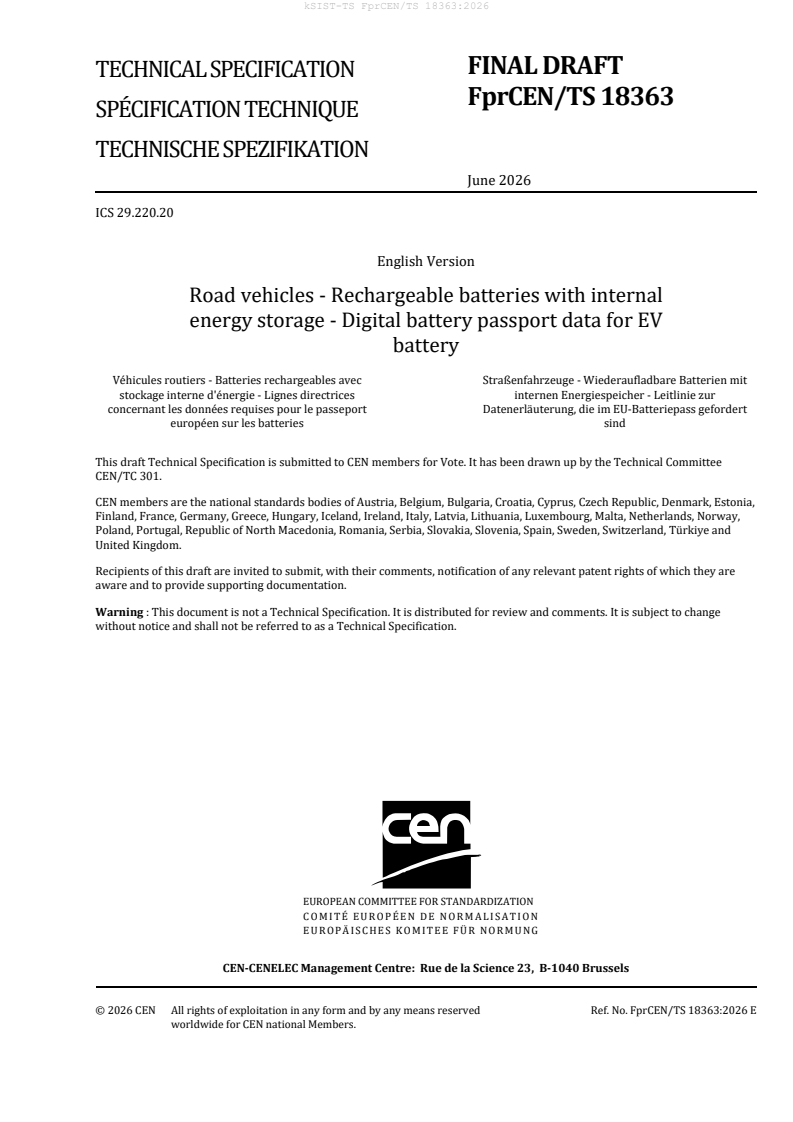
FINAL DRAFT
TECHNICAL SPECIFICATION
SPÉCIFICATION TECHNIQUE
TECHNISCHE SPEZIFIKATION
June 2026
ICS 29.220.20
English Version
Road vehicles - Rechargeable batteries with internal
energy storage - Digital battery passport data for EV
battery
Véhicules routiers - Batteries rechargeables avec Straßenfahrzeuge - Wiederaufladbare Batterien mit
stockage interne d'énergie - Lignes directrices internen Energiespeicher - Leitlinie zur
concernant les données requises pour le passeport Datenerläuterung, die im EU-Batteriepass gefordert
européen sur les batteries sind
This draft Technical Specification is submitted to CEN members for Vote. It has been drawn up by the Technical Committee
CEN/TC 301.
CEN members are the national standards bodies of Austria, Belgium, Bulgaria, Croatia, Cyprus, Czech Republic, Denmark, Estonia,
Finland, France, Germany, Greece, Hungary, Iceland, Ireland, Italy, Latvia, Lithuania, Luxembourg, Malta, Netherlands, Norway,
Poland, Portugal, Republic of North Macedonia, Romania, Serbia, Slovakia, Slovenia, Spain, Sweden, Switzerland, Türkiye and
United Kingdom.
Recipients of this draft are invited to submit, with their comments, notification of any relevant patent rights of which they are
aware and to provide supporting documentation.
Warning : This document is not a Technical Specification. It is distributed for review and comments. It is subject to change
without notice and shall not be referred to as a Technical Specification.
EUROPEAN COMMITTEE FOR STANDARDIZATION
COMITÉ EUROPÉEN DE NORMALISATION
EUROPÄISCHES KOMITEE FÜR NORMUNG
CEN-CENELEC Management Centre: Rue de la Science 23, B-1040 Brussels
© 2026 CEN All rights of exploitation in any form and by any means reserved Ref. No. FprCEN/TS 18363:2026 E
worldwide for CEN national Members.
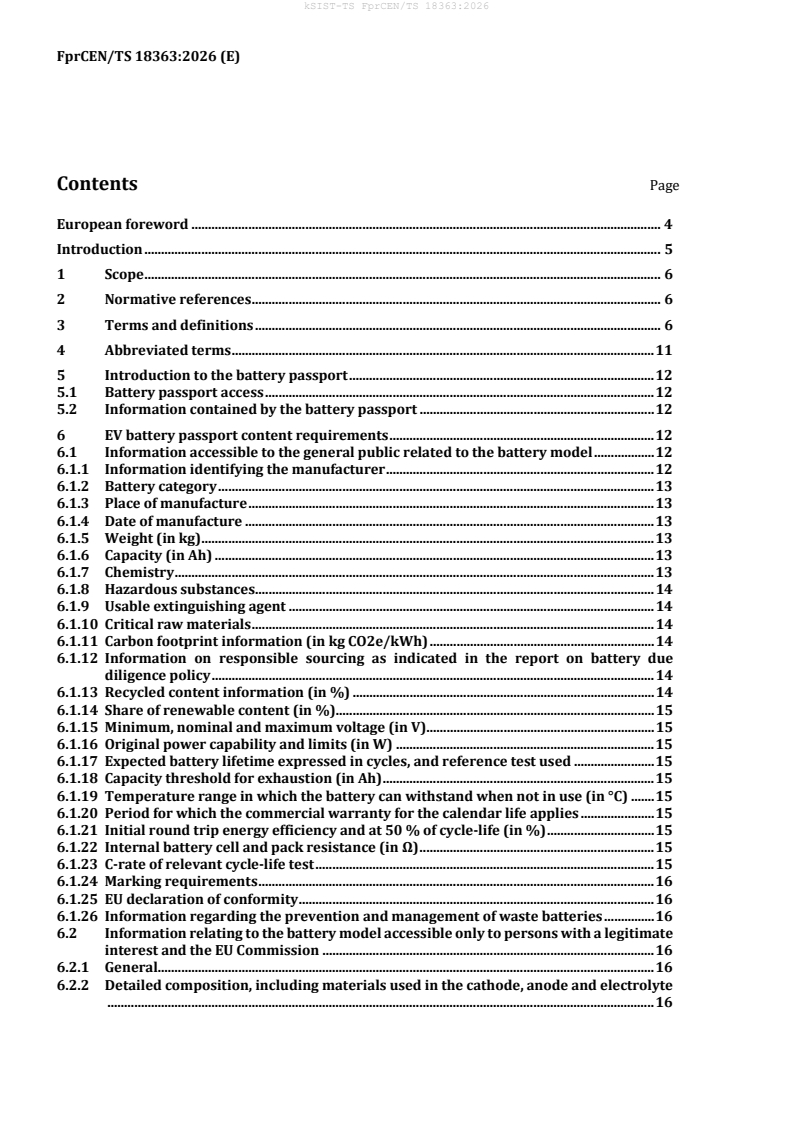
Contents Page
European foreword . 4
Introduction . 5
1 Scope . 6
2 Normative references . 6
3 Terms and definitions . 6
4 Abbreviated terms . 11
5 Introduction to the battery passport . 12
5.1 Battery passport access . 12
5.2 Information contained by the battery passport . 12
6 EV battery passport content requirements . 12
6.1 Information accessible to the general public related to the battery model . 12
6.1.1 Information identifying the manufacturer . 12
6.1.2 Battery category . 13
6.1.3 Place of manufacture . 13
6.1.4 Date of manufacture . 13
6.1.5 Weight (in kg) . 13
6.1.6 Capacity (in Ah) . 13
6.1.7 Chemistry . 13
6.1.8 Hazardous substances . 14
6.1.9 Usable extinguishing agent . 14
6.1.10 Critical raw materials . 14
6.1.11 Carbon footprint information (in kg CO2e/kWh) . 14
6.1.12 Information on responsible sourcing as indicated in the report on battery due
diligence policy . 14
6.1.13 Recycled content information (in %) . 14
6.1.14 Share of renewable content (in %) . 15
6.1.15 Minimum, nominal and maximum voltage (in V) . 15
6.1.16 Original power capability and limits (in W) . 15
6.1.17 Expected battery lifetime expressed in cycles, and reference test used . 15
6.1.18 Capacity threshold for exhaustion (in Ah) . 15
6.1.19 Temperature range in which the battery can withstand when not in use (in °C) . 15
6.1.20 Period for which the commercial warranty for the calendar life applies . 15
6.1.21 Initial round trip energy efficiency and at 50 % of cycle-life (in %) . 15
6.1.22 Internal battery cell and pack resistance (in Ω) . 15
6.1.23 C-rate of relevant cycle-life test . 15
6.1.24 Marking requirements . 16
6.1.25 EU declaration of conformity . 16
6.1.26 Information regarding the prevention and management of waste batteries . 16
6.2 Information relating to the battery model accessible only to persons with a legitimate
interest and the EU Commission . 16
6.2.1 General. 16
6.2.2 Detailed composition, including materials used in the cathode, anode and electrolyte
................................................................................................................................................................... 16
6.2.3 Part numbers for component and contact details of sources for replacement spares
................................................................................................................................................................... 17
6.2.4 Dismantling information . 17
6.2.5 Safety measures . 17
6.3 Information accessible only to notified bodies, market surveillance authorities and
the EU Commission . 17
6.4 Information and data relating to an individual battery accessible only to persons with
a legitimate interest . 18
6.4.1 General . 18
6.4.2 Values for performance and durability parameters, when the battery is placed on the
market and when it is subject to changes in its status . 18
6.4.3 Information on the state of health of the battery . 19
6.4.4 Information and data resulting from its use . 19
Annex A (normative) List of data attributes . 21
Annex B (informative) Data representation . 27
Bibliography . 28
European foreword
This document (FprCEN/TS 18363:2026) has been prepared by Technical Committee CEN/TC 301 “Road
vehicles”, the secretariat of which is held by DIN.
This document is currently submitted to the Vote on TS.
Introduction
The European regulation 2023/1542 requests each individual EV battery placed on the market or put
into service to have an electronic record (‘battery passport’). The battery passport contains information
relating to the battery model and information specific to the individual battery, including resulting from
the use of that battery.
This document transfers the actual and anticipated legal requirements into definitions of data points and
provides a guidance for application to responsible economic operators implementing the battery
passport for an EV battery.
The requirements given reflect the current best knowledge and might be subject to change due to further
delegated and implementing acts issued in due course. In addition to the requirements mandated by the
EU Battery Regulation, this document builds on the Eco-design for Sustainable Products Regulation and
further regulatory requirements to highlight the harmonization need.
This document provides a guidance to have a common understanding about the meaning of the different
data required by the battery passport for an EV battery.
Each operator can include additional parameters.
As the document focuses on the data attributes, it excludes technical requirements for the architecture of
the digital “operating system” of the battery passport, which are addressed within the working group
CEN/CLC JTC 24.
1 Scope
This document explains digital battery passport data attributes for EV battery.
2 Normative references
The following documents are referred to in the text in such a way that some or all of their content
constitutes requirements of this document. For dated references, only the edition cited applies. For
undated references, the latest edition of the referenced document (including any amendments) applies.
EN 18060, Road vehicles - Rechargeable batteries with internal energy storage - Performance and
durability of alkali-Ion (Li-Ion, Na-Ion), Pb, NiMH and combined chemistries EV modules and batteries
EN 18061, Road vehicles - Rechargeable batteries with internal energy storage - Steps, conditions and
protocols for the safe repair and re-use and preparation for repurposing of modules and batteries designed
for EV applications
3 Terms and definitions
For the purposes of this document, the following terms and definitions apply.
ISO and IEC maintain terminological databases for use in standardization at the following addresses:
- ISO Online browsing platform: available at https://www.iso.org/obp/
- IEC Electropedia: available at https://www.electropedia.org/
3.1
accident
unfortunate event, disaster, mishap
[SOURCE: ISO 15928-7:2021]
3.2
battery
device delivering electrical energy generated by direct conversion of chemical energy, having internal or
external storage, and consisting of one or more non-rechargeable or rechargeable battery cells, modules
or of packs of them, and includes a battery that has been subject to preparation for re-use, preparation
for repurposing, repurposing, or remanufacturing
[SOURCE: Regulation (EU) 2023/1542]
3.3
battery manufacturer
any natural or legal person who manufactures a battery or has a battery designed or manufactured, and
markets that battery under its own name or trademark or puts it into service for its own purposes
[SOURCE: Regulation (EU) 2023/1542]
3.4
battery identification number
unique string of characters for the identification of batteries that also enables a web link to the battery
passport
Note 1 to entry: Battery Identification Number is the unique identifier referred to in Regulation (EU) 2023/1542.
[SOURCE: Regulation (EU) 2023/1542]
3.5
battery model
version of all battery units which share the same technical characteristics relevant for the requirements
on sustainability, safety, labelling, marking and information, and the same model identifier
[SOURCE: Regulation (EU) 2023/1542]
3.6
battery pack
set of battery cells or modules that are connected together or encapsulated within an outer casing to form
a complete unit which is not meant to be split up or opened by the end-user
[SOURCE: Regulation (EU) 2023/1542]
3.7
battery producer
manufacturer, importer or distributor or other natural or legal person who, irrespective of the selling
technique used, including by means of distance contracts, either:
(i) is established in a Member State and manufactures batteries under its own name or trademark, or has
batteries designed or manufactured and supplies them for the first time under its own name or
trademark, including those incorporated in appliances, light means of transport or other vehicles, within
the territory of that Member State;
(ii) is established in a Member State and resells within the territory of that Member State, under its own
name or trademark, batteries, including those incorporated in appliances, light means of transport or
other vehicles, manufactured by others, on which the name or trademark of those other manufacturers
does not appear;
(iii) is established in a Member State and supplies for the first time in that Member State on a professional
basis, batteries, including those incorporated in appliances, light means of transport or other vehicles,
from another Member State or from a third country; or
(iv) sells batteries, including those incorporated in appliances, light means of transport or other vehicles,
by means of distance contract directly to end-users, whether or not they are private households, in a
Member State, and is established in another Member State or in a third country
Note 1 to entry: Distance contracts as defined in Article 2, point (7), of Directive 2011/83/EU (definition 46 in
Regulation (EU) 2023/1542.
[SOURCE: Regulation (EU) 2023/1542]
3.8
battery system
energy storage device that includes cells or cell assemblies or battery pack(s) (3.6) as well as electrical
circuits and electronics
Note 1 to entry: Examples of electronics are the BCU and contactors.
[SOURCE: ISO 12405-4:2018, 3.3]
3.9
capacity fade
decrease over time and upon usage in the amount of charge that a battery can deliver at the rated current,
with respect to the original rated capacity
Note 1 to entry: The Regulation (EU) 2023/1542 states in Annex IV rated voltage instead of rated current under
reference conditions.
Note 2 to entry: The test for capacity fade is defined in EN 18060.
Note 3 to entry: The capacity fade is expressed in %.
[SOURCE: Regulation (EU) 2023/1542]
3.10
carbon footprint
sum of greenhouse gas emissions and greenhouse gas removals in a product system, expressed as carbon
dioxide equivalents and based on a Product Environmental Footprint (PEF) study using the single impact
category of climate change
[SOURCE: Regulation (EU) 2023/1542]
3.11
economic operator
manufacturer, authorised representative, importer, distributor or fulfilment service provider or any
other natural or legal person who is subject to obligations in relation to the manufacture, preparation for
re-use, ration for repurposing, repurposing or remanufacturing of batteries, the making available or the
placing of batteries on the market, including online, or the putting of batteries into service
[SOURCE: Regulation (EU) 2023/1542]
3.12
electric vehicle battery
EV battery
battery that is specifically designed to provide electric power for traction in hybrid or electric vehicles
Note 1 to entry: Hybrid or electric vehicles are those of category L as provided in Regulation (EU) 168/2013, that
weighs more than 25 kg, or of categories M, N or O as provided in Regulation (EU) 2018/858
[SOURCE: Regulation (EU) 2023/1542]
3.13
energy round trip efficiency
ratio of the net energy delivered by a battery during a discharge test to the total energy required to
restore the initial state of charge by a standard charge
Note 1 to entry: Net energy is the useful electrical energy at the terminals of the EV battery.
Note 2 to entry: The energy round trip efficiency is expressed in %.
[SOURCE: Regulation (EU) 2023/1542]
3.14
functional unit
carbon footprint qualitative and quantitative aspects of the functions, services, or both, provided by the
battery
Note1 to entry: The functional unit is defined as one kWh (kilowatt-hour) of the total energy provided by the battery
system over the battery’s service life, measured in kWh.
[SOURCE: Regulation (EU) 2023/1542]
3.15
internal resistance
opposition to the flow of current within a cell or a battery under reference conditions, that is, the sum of
electronic resistance and ionic resistance to the contribution to total effective resistance including
inductive/capacitive properties
Note 1 to entry: The internal resistance is expressed in Ω .
[SOURCE: Regulation (EU) 2023/1542]
3.16
internal resistance increase
increase over time and upon usage of the internal resistance of a battery, with respect to the original
internal resistance
Note 1 to entry: The internal resistance increase is expressed in %.
[SOURCE: regulation (EU) 2023/1542]
3.17
power
amount of energy that a battery is capable to provide over a given period under reference conditions
Note 1 to entry: The power is expressed in W.
[SOURCE: Regulation (EU) 2023/1542]
3.18
power fade
decrease over time and upon usage in the amount of power that a battery can deliver at the rated current
under reference conditions
Note 1 to entry: The Regulation (EU) 2023/1542 states rated voltage instead of rated current under reference
condition
Note 2 to entry: The test for power fade is defined in EN 18060.
Note 3 to entry: The power fade is expressed in %.
[SOURCE: Regulation (EU) 2023/1542]
3.19
preparation for repurposing
operation, by which a waste battery, or parts thereof, is prepared so that it can be used for a different
purpose or application than that for which it was originally designed
[SOURCE: Regulation (EU) 2023/1542]
3.20
rated capacity
total number of ampere-hours (Ah) that can be withdrawn from a fully charged battery under reference
conditions
Note 1 to entry: The rated capacity determination is explained in EN 18060.
[SOURCE: Regulation (EU) 2023/1542]
3.21
remanufacturing
technical operation on a used battery that includes the disassembly and evaluation of all its battery cells
and modules and the use of a certain number of battery cells and modules that are new, used or recovered
from waste, or other battery components, to restore the battery capacity to at least 90% of the original
rated capacity, and where the state of health of all individual battery cells does not differ more than 3%
between cells, and results in the battery being used for the same purpose or application than the one for
which the battery was originally designed
[SOURCE: Regulation (EU) 2023/1542]
3.22
repair
one or more actions carried out to return a defective battery or waste to a condition where it fulfils its
intended purpose
[SOURCE: Regulation (EU) 2024/1781]
3.23
repurposing
operation that results in a battery, that is not a waste battery, or parts thereof being used for a purpose
or application other than that for which the battery was originally designed
[SOURCE: Regulation (EU) 2023/1542]
3.24
re-use
operation by which products or components that are not waste are used again for the same purpose for
which they were conceived
[SOURCE: Directive 2008/98/EC of the European Parliament and of the Council of 19 November 2008 on
waste and repealing certain Directives]
3.25
room temperature
RT
temperature of (23 ± 5) °C
[SOURCE: ISO 21498-2:2024, 6.1.8]
3.26
status of the battery
information on the historical and actual use of the battery
Note 1 to entry: During the battery life the status of the battery will change and can be assigned one of the following
status: 'original’, ‘repurposed’, ‘re-used’, 'remanufactured' or ‘waste’.
Note 2 to entry: A battery has the status 'original' before it is assigned another status (re-used, remanufactured
etc…) and when the battery is placed on the EU market. When exactly that happens, depends on the supply chain (a
battery in an imported vehicle is normally only placed on the EU market once the vehicle is imported, but a battery
that is sold within the EU from a battery manufacturer to a vehicle manufacturer is normally placed on the EU
market as a result of that sale).
Note 3 to entry: The note 1 is coming from Regulation (EU) 2023/1542.
Note 4 to entry: In case of any change of status, a new battery passport is created except for the waste status. In the
former battery passport, the status doesn’t change.
3.27
technical specification
document that prescribes technical requirements to be fulfilled by a product, process or service
[SOURCE: Regulation (EU) 2023/1542]
3.28
unique identifier
unique string of characters for the identification of batteries that also enables a web link to the battery
passport
[SOURCE: Regulation (EU) 2023/1542]
4 Abbreviated terms
For the purposes of this document, the following abbreviated terms apply:
BOL beginning of life
CAS chemical abstract system
EOL end of life
EV electric vehicle
ESPR ecodesign for sustainable Products Regulation (EU)2024/1781
GADSL global automotive declarable substance list
HD-OVC-HEV heavy-duty off-vehicle charging hybrid electric vehicle
HD-PEV heavy-duty pure electric vehicle
IMDS international material data system
OVC-HEV off-vehicle charging hybrid electric vehicle
PEV pure electric vehicle
PLI person with legitimate interest
REACH registration, evaluation, authorization and restriction of chemicals
SCIP substances of concern in products
SOCE state of certified energy
SVHC substances of very high concern
5 Introduction to the battery passport
5.1 Battery passport access
The battery passport shall be accessible through a QR code which links to a unique identifier that the
economic operator placing the battery on the market shall attribute to it.
The QR code and the unique identifier shall comply with ISO/IEC 15459-1:2014, ISO/IEC 15459-2:2015,
ISO/IEC 15459-3:2014, ISO/IEC 15459-4:2014, ISO/IEC 15459-5:2014 and ISO/IEC 15459-6:2014 or
their equivalent.
NOTE 1 This QR code is referred to in Article 13(6) of Regulation (EU) 2023/1542.
NOTE 2 The harmonization of battery passport access is subject of a standardization request and treated by
CEN/CLC JTC 24.
For a battery that has been subject to preparation for re-use, preparation for repurposing, re-use,
repurposing or remanufacturing, the responsibility for the new digital battery passport shall be
transferred to the new economic operator that has placed that battery on the market or has put it into
service. Such battery shall have a new battery passport linked to the battery passport or passports of the
original battery or batteries.
For the purposes of the battery passport, information shall be made available through a persistent digital
reference, ensuring durability, accessibility over the full life cycle of the battery, and independence from
changes in private IT infrastructures.
5.2 Information contained by the battery passport
The information in the battery passport shall comprise:
- information accessible to the general public relating to the battery model;
- information relating to the battery model accessible only to persons with a legitimate interest and
the European Commission;
- information accessible only to notified bodies, market surveillance authorities and the European
Commission;
- information and data relating to an individual battery accessible only to persons with a legitimate
interest.
The list of data explained in §6 is in Annex A and a data structure example is included in Annex B.
6 EV battery passport content requirements
6.1 Information accessible to the general public related to the battery model
6.1.1 Information identifying the manufacturer
The manufacturer information shall include:
- name;
- registered trade name or registered trademark;
- postal address, indicating a single contact point;
- web address, if available; and
- e-mail address, if available.
6.1.2 Battery category
A battery passport shall include the battery category (i.e. EV battery), its model identification and batch
or serial number.
6.1.3 Place of manufacture
It is the geographical location of the battery manufacturing plant. The location of the manufacturing plant
(town; country or jurisdiction) should be provided in t
...