

SIST EN 16942:2024
(Main)Fuels - Identification of vehicle compatibility - Graphical expression for consumer information
General Information
- Abstract
This document lays down harmonized identifiers for marketed liquid and gaseous fuels. The requirements in this document are to complement the informational needs of users regarding the compatibility between the fuels and the vehicles that are placed on the market. The identifier is intended to be visualized at dispensers and refuelling points, on vehicles, in motor vehicle dealerships and in consumer manuals as described in this document.
Marketed fuels include for example petroleum-derived fuels, synthetic fuels, biofuels, natural gas, LPG, hydrogen and biogas and blends of the aforementioned delivered to mobile applications.
NOTE For the purposes of this document, the terms “% (m/m)” and “% (V/V)” are used to represent respectively the mass fraction, µ, and the volume fraction, φ.
- Status
- Published
- Public Enquiry End Date
- 01-Nov-2023
- Publication Date
- 10-Sep-2024
- Technical Committee
- NAD - Petroleum products, lubricants and related products
- Current Stage
- 6060 - National Implementation/Publication (Adopted Project)
- Start Date
- 29-Aug-2024
- Due Date
- 03-Nov-2024
- Completion Date
- 11-Sep-2024

Overview
EN 16942:2024 (CEN) defines a harmonized system for graphical fuel compatibility identifiers to inform consumers about which fuels are compatible with their vehicles. The standard supports implementation of Article 7 of Directive 2014/94/EU by specifying how fuel-vehicle compatibility should be shown at refuelling points, on vehicles, in motor vehicle dealerships and in consumer manuals. Marketed fuels covered include petroleum-derived fuels, synthetic fuels, biofuels, natural gas, LPG, hydrogen, biogas and blends.
Key topics and technical requirements
- Identifier concept: A simple shape + symbol graphical expression is used to communicate compatibility. The identifier’s symbol comprises letters and numbers (Latin script) in Arial Bold, placed centrally in the shape.
- Fuel type discrimination: Shapes are used to distinguish three base fuel categories: unleaded petrol-type fuels, diesel-type fuels, and gaseous fuels.
- Colour scheme: Identifiers are executed in black with a white or silver internal background to ensure consistent visual recognition.
- Size and placement:
- Minimum sizes are specified, with a larger minimum for dispensers/fuel pumps to be visible to consumers approaching the pump.
- Placement requirements cover dispensers and nozzles, vehicle filler flaps/caps, vehicle manuals, and dealership displays.
- Compatibility categorization: Compatibility is indicated by the symbol (letters/numbers) conveying fuel designations and allowed blends/percentages where applicable.
- Scope and adaptability: The system is designed to accommodate existing and future fuels and includes annexes with examples of labels, fuel listings and labelling examples.
- Updates in 2024 edition: Includes labels for petrol fuels suitable for small two-stroke and four-stroke internal combustion engines compliant with EN 17867 (or equivalent).
Applications and who uses it
- Fuel suppliers and station operators: to label dispensers, hoses and nozzles consistently across markets.
- Vehicle manufacturers and dealerships: to mark vehicle filler flaps, produce compliant manuals and display compatibility in showrooms.
- Regulators and standards bodies: to enforce harmonized consumer information and support national implementation of Directive 2014/94/EU.
- Fleet operators and equipment manufacturers: to verify fueling compatibility and reduce misfuelling risk.
- Consumers: benefit from clearer, consistent visual guidance at pumps and on vehicles.
Related standards
- EN 16942:2024 complements fuel quality standards (e.g., EN 228, EN 590) and installation/refuelling standards (e.g., EN 17127 for hydrogen) and supersedes EN 16942:2016+A1:2021.
Keywords: EN 16942:2024, fuel compatibility label, fuel labelling, refuelling points, vehicle compatibility, graphical expression, petrol, diesel, gaseous fuels, CEN.
Relations
- Effective Date
- 01-Oct-2024
- Effective Date
- 28-Jan-2026
- Effective Date
- 28-Jan-2026
- Effective Date
- 28-Jan-2026
- Effective Date
- 28-Jan-2026
- Referred By
SIST EN 16734:2022 - Automotive fuels - Automotive B10 diesel fuel - Requirements and test methods - Effective Date
- 28-Jan-2026
- Effective Date
- 28-Jan-2026
- Effective Date
- 28-Jan-2026
- Effective Date
- 28-Jan-2026
- Effective Date
- 28-Jan-2026
- Effective Date
- 28-Jan-2026
- Effective Date
- 28-Jan-2026
- Effective Date
- 28-Jan-2026
- Effective Date
- 28-Jan-2026
- Effective Date
- 28-Jan-2026
Get Certified
Connect with accredited certification bodies for this standard

Element Materials Technology
Materials testing and product certification.

ABS Group Brazil
ABS Group certification services in Brazil.

ABS Quality Evaluations Inc.
American Bureau of Shipping quality certification.
Sponsored listings
Frequently Asked Questions
SIST EN 16942:2024 is a standard published by the Slovenian Institute for Standardization (SIST). Its full title is "Fuels - Identification of vehicle compatibility - Graphical expression for consumer information". This standard covers: This document lays down harmonized identifiers for marketed liquid and gaseous fuels. The requirements in this document are to complement the informational needs of users regarding the compatibility between the fuels and the vehicles that are placed on the market. The identifier is intended to be visualized at dispensers and refuelling points, on vehicles, in motor vehicle dealerships and in consumer manuals as described in this document. Marketed fuels include for example petroleum-derived fuels, synthetic fuels, biofuels, natural gas, LPG, hydrogen and biogas and blends of the aforementioned delivered to mobile applications. NOTE For the purposes of this document, the terms “% (m/m)” and “% (V/V)” are used to represent respectively the mass fraction, µ, and the volume fraction, φ.
This document lays down harmonized identifiers for marketed liquid and gaseous fuels. The requirements in this document are to complement the informational needs of users regarding the compatibility between the fuels and the vehicles that are placed on the market. The identifier is intended to be visualized at dispensers and refuelling points, on vehicles, in motor vehicle dealerships and in consumer manuals as described in this document. Marketed fuels include for example petroleum-derived fuels, synthetic fuels, biofuels, natural gas, LPG, hydrogen and biogas and blends of the aforementioned delivered to mobile applications. NOTE For the purposes of this document, the terms “% (m/m)” and “% (V/V)” are used to represent respectively the mass fraction, µ, and the volume fraction, φ.
SIST EN 16942:2024 is classified under the following ICS (International Classification for Standards) categories: 01.080.10 - Public information symbols. Signs. Plates. Labels; 75.160.20 - Liquid fuels. The ICS classification helps identify the subject area and facilitates finding related standards.
SIST EN 16942:2024 has the following relationships with other standards: It is inter standard links to SIST EN 16942:2016+A1:2021, SIST EN 589:2019+A1:2022, SIST EN 590:2022, SIST EN 228:2025, SIST EN 16709:2024, SIST EN 16734:2022, SIST EN 590:2025, SIST EN 17867:2023+A1:2025, SIST EN 589:2019, SIST EN ISO 12217-1:2026, SIST EN 15940:2023, SIST EN 15293:2018, SIST EN 17867:2023, SIST EN ISO 12217-3:2026, SIST EN 589:2024. Understanding these relationships helps ensure you are using the most current and applicable version of the standard.
SIST EN 16942:2024 is associated with the following European legislation: EU Directives/Regulations: 2014/94/EU. When a standard is cited in the Official Journal of the European Union, products manufactured in conformity with it benefit from a presumption of conformity with the essential requirements of the corresponding EU directive or regulation.
SIST EN 16942:2024 is available in PDF format for immediate download after purchase. The document can be added to your cart and obtained through the secure checkout process. Digital delivery ensures instant access to the complete standard document.
Standards Content (Sample)
SLOVENSKI STANDARD
01-oktober-2024
Nadomešča:
SIST EN 16942:2016+A1:2021
Goriva - Identifikacija združljivosti z vozili - Grafični prikaz informacij za potrošnika
Fuels - Identification of vehicle compatibility - Graphical expression for consumer
information
Kraftstoffe - Identifizierung der Fahrzeug-Kompatibilität - Graphische Darstellung zur
Verbraucherinformation
Carburants - Identification de la compatibilité des véhicules - Expression graphique pour
l'information des consommateurs
Ta slovenski standard je istoveten z: EN 16942:2024
ICS:
01.080.10 Simboli za javno obveščanje. Public information symbols.
Znaki. Table. Označbe Signs. Plates. Labels
75.160.20 Tekoča goriva Liquid fuels
2003-01.Slovenski inštitut za standardizacijo. Razmnoževanje celote ali delov tega standarda ni dovoljeno.
EN 16942
EUROPEAN STANDARD
NORME EUROPÉENNE
August 2024
EUROPÄISCHE NORM
ICS 75.160.20 Supersedes EN 16942:2016+A1:2021
English Version
Fuels - Identification of vehicle compatibility - Graphical
expression for consumer information
Carburants - Identification de la compatibilité des Kraftstoffe - Identifizierung der Fahrzeug-
véhicules - Expression graphique pour l'information Kompatibilität - Graphische Darstellung zur
des consommateurs Verbraucherinformation
This European Standard was approved by CEN on 26 June 2024.
CEN members are bound to comply with the CEN/CENELEC Internal Regulations which stipulate the conditions for giving this
European Standard the status of a national standard without any alteration. Up-to-date lists and bibliographical references
concerning such national standards may be obtained on application to the CEN-CENELEC Management Centre or to any CEN
member.
This European Standard exists in three official versions (English, French, German). A version in any other language made by
translation under the responsibility of a CEN member into its own language and notified to the CEN-CENELEC Management
Centre has the same status as the official versions.
CEN members are the national standards bodies of Austria, Belgium, Bulgaria, Croatia, Cyprus, Czech Republic, Denmark, Estonia,
Finland, France, Germany, Greece, Hungary, Iceland, Ireland, Italy, Latvia, Lithuania, Luxembourg, Malta, Netherlands, Norway,
Poland, Portugal, Republic of North Macedonia, Romania, Serbia, Slovakia, Slovenia, Spain, Sweden, Switzerland, Türkiye and
United Kingdom.
EUROPEAN COMMITTEE FOR STANDARDIZATION
COMITÉ EUROPÉEN DE NORMALISATION
EUROPÄISCHES KOMITEE FÜR NORMUNG
CEN-CENELEC Management Centre: Rue de la Science 23, B-1040 Brussels
© 2024 CEN All rights of exploitation in any form and by any means reserved Ref. No. EN 16942:2024 E
worldwide for CEN national Members.
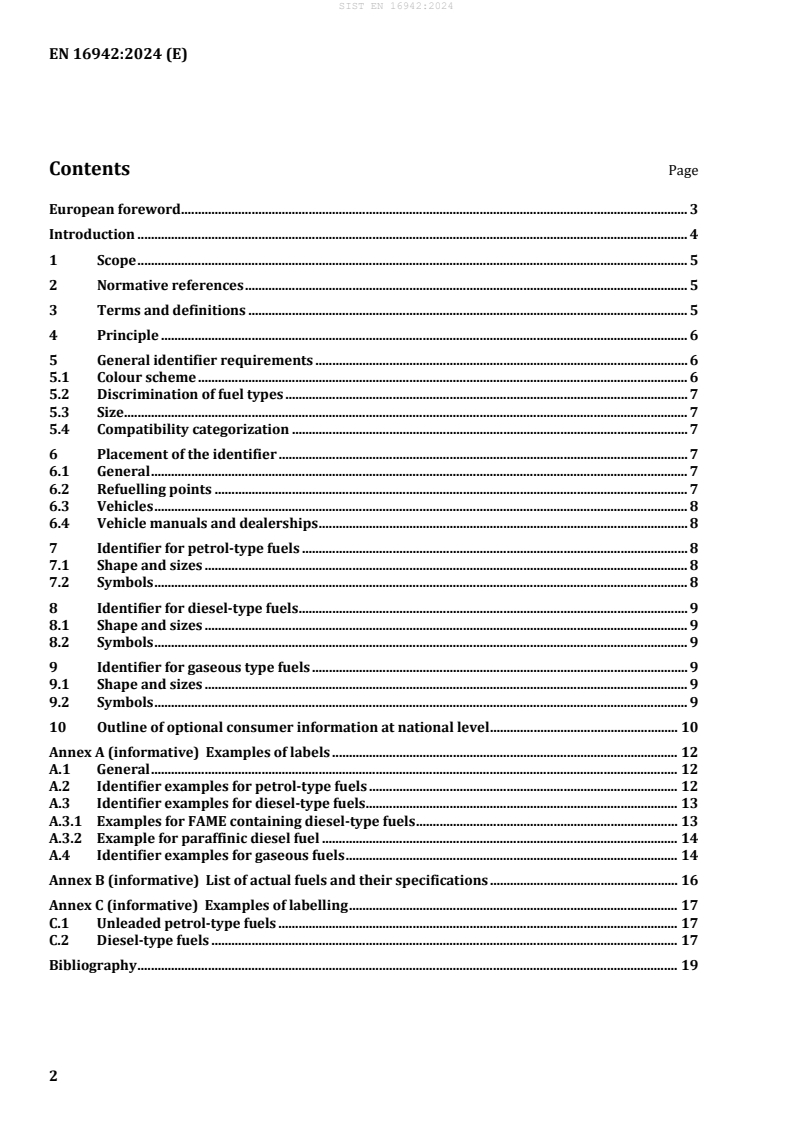
Contents Page
European foreword . 3
Introduction . 4
1 Scope . 5
2 Normative references . 5
3 Terms and definitions . 5
4 Principle . 6
5 General identifier requirements . 6
5.1 Colour scheme . 6
5.2 Discrimination of fuel types . 7
5.3 Size . 7
5.4 Compatibility categorization . 7
6 Placement of the identifier . 7
6.1 General . 7
6.2 Refuelling points . 7
6.3 Vehicles . 8
6.4 Vehicle manuals and dealerships . 8
7 Identifier for petrol-type fuels . 8
7.1 Shape and sizes . 8
7.2 Symbols . 8
8 Identifier for diesel-type fuels . 9
8.1 Shape and sizes . 9
8.2 Symbols . 9
9 Identifier for gaseous type fuels . 9
9.1 Shape and sizes . 9
9.2 Symbols . 9
10 Outline of optional consumer information at national level . 10
Annex A (informative) Examples of labels . 12
A.1 General . 12
A.2 Identifier examples for petrol-type fuels . 12
A.3 Identifier examples for diesel-type fuels . 13
A.3.1 Examples for FAME containing diesel-type fuels . 13
A.3.2 Example for paraffinic diesel fuel . 14
A.4 Identifier examples for gaseous fuels . 14
Annex B (informative) List of actual fuels and their specifications . 16
Annex C (informative) Examples of labelling . 17
C.1 Unleaded petrol-type fuels . 17
C.2 Diesel-type fuels . 17
Bibliography . 19
European foreword
This document (EN 16942:2024) has been prepared by Technical Committee CEN/TC 441 “Fuel
labelling”, the secretariat of which is held by NEN.
This European Standard shall be given the status of a national standard, either by publication of an
identical text or by endorsement, at the latest by February 2025, and conflicting national standards shall
be withdrawn at the latest by February 2025.
Attention is drawn to the possibility that some of the elements of this document may be the subject of
patent rights. CEN shall not be held responsible for identifying any or all such patent rights.
This document supersedes EN 16942:2016+A1:2021.
Further significant technical changes between this document and the previous edition are:
— Inclusion of a label for petrol fuels for small two-stroke internal combustion engines compliant to
EN 17867 [23] or equivalent national legislation.
— Inclusion of a label for petrol fuels for small four-stroke internal combustion engines compliant to
EN 17867 [23] or equivalent national legislation.
Any feedback and questions on this document should be directed to the users’ national standards body.
A complete listing of these bodies can be found on the CEN website.
According to the CEN-CENELEC Internal Regulations, the national standards organisations of the
following countries are bound to implement this European Standard: Austria, Belgium, Bulgaria, Croatia,
Cyprus, Czech Republic, Denmark, Estonia, Finland, France, Germany, Greece, Hungary, Iceland, Ireland,
Italy, Latvia, Lithuania, Luxembourg, Malta, Netherlands, Norway, Poland, Portugal, Republic of North
Macedonia, Romania, Serbia, Slovakia, Slovenia, Spain, Sweden, Switzerland, Türkiye and the United
Kingdom.
Introduction
In accordance with Article 7, of the Directive 2014/94/EU [1] the EU Member States have to bring into
force by 18 November 2016 the laws, regulations and administrative provisions necessary in order to
ensure that user information on the compatibility of their vehicles with the fuels or electricity recharging
points is provided in motor vehicle manuals, at refuelling and recharging points, as well as on motor
vehicles and in motor vehicle dealerships in their territory.
1)
As specified in the Article, this information has to be based on labelling provisions of ESO standards
setting technical specifications of fuels. However, none of the labelling provisions of the existing
European Standards for fuel quality (such as EN 228 [2] for unleaded petrol-type fuels and EN 590 [3] for
diesel fuel) includes a graphical expression that meets the requirements of the Directive.
In a letter to CEN of 26 August 2015, the European Commission requested the work of CEN/TC 441 to
aim at development and adoption of appropriate European Standard(-s) setting harmonized
compatibility labelling specifications for individual fuels placed on the market. These provisions should
include a graphical expression, including a colour coding scheme. The graphical expression should also
be in line with the following requirements of Article 7 of Directive 2014/94/EU:
a) to provide relevant, consistent and clear information as regards to those motor vehicles which can
be regularly fuelled with compatible fuels placed on the market;
b) to be simple and easy to understand;
c) to be able to be placed in a clearly visible manner:
1) on corresponding fuel pumps and their nozzles at refuelling points,
2) on or in the immediate proximity of fuel tanks’ filler caps for vehicles, recommended and
compatible with that fuel and in motor vehicle manuals.
CEN decided that it would develop a single standard laying down the systematics of the graphical
expression for the identification of fuel-vehicle compatibility that would cover a multitude of (existing
and future) market fuels. This would allow industry and governments to use this document as basis for
implementation of Directive 2014/94/EU. Furthermore, existing and future European Standards that
need to set requirements regarding labelling can refer to this Standard.
The development of this standard focused on vehicles placed on the market for the first time, which does
not preclude the application of this standard to vehicles already in circulation.
This document is not intended to replace any existing quality, safety or performance recommendations,
marketing or branding communication currently featured in similar locations at re-fuelling points,
vehicle fuel caps or vehicle manuals.
Additional requirements for labelling of refuelling points in Europe can be found in the specific standards
concerning these fuels. For instance, for hydrogen, see EN 17127 [22].
1) European Standardization Organization.
1 Scope
This document lays down harmonized identifiers for marketed liquid and gaseous fuels. The
requirements in this document are to complement the informational needs of users regarding the
compatibility between the fuels and the vehicles that are placed on the market. The identifier is intended
to be visualized at dispensers and refuelling points, on vehicles, in motor vehicle dealerships and in
consumer manuals as described in this document.
Marketed fuels include for example petroleum-derived fuels, synthetic fuels, biofuels, natural gas, LPG,
hydrogen and biogas and blends of the aforementioned delivered to mobile applications.
NOTE For the purposes of this document, the terms “% (m/m)” and “% (V/V)” are used to represent
respectively the mass fraction, µ, and the volume fraction, φ.
2 Normative references
There are no normative references in this document.
3 Terms and definitions
For the purposes of this document, the following terms and definitions apply.
ISO and IEC maintain terminology databases for use in standardization at the following addresses:
— ISO Online browsing platform: available at https://www.iso.org/obp/
— IEC Electropedia: available at https://www.electropedia.org/
3.1
compatibility
fuel/vehicle compatibility
possibility of the fuel to be regularly used in a vehicle without adverse effects on the performance
characteristics of the vehicle as declared by the vehicle manufacturer
Note 1 to entry: Usually, it is the components of the vehicle that are exposed to the fuel or the exhaust gases that
may show compatibility issues.
3.2
nozzle
mechanical system, fitted to the hose of the dispensing system, consisting of a filling nozzle body
[SOURCE: EN 14678-3:2013, 3.8, [4], modified]
3.3
filler cap
sealing mechanism of the fuel filling point on a vehicle
3.4
filler flap
area of vehicle bodywork that covers a filler cap and opens to provide access to the filler cap or provide
a fuel sealing mechanism for cap-less systems
3.5
identifier
graphical expression of compatibility consisting of shape and symbol
3.6
symbol
expression by a combination of letters, numbers or pictorials
3.7
vehicle
motor vehicle
transport modality that can be fuelled with a marketed fuel at a refuelling point
Note 1 to entry: Vessels are included herein, in line with [1].
3.8
dispenser
fuel pump
equipment through which a fuel is supplied to a transport modality
3.9
refuelling point
facility for the provision of any fuel through one or more dispensers
Note 1 to entry: In practice, terms like service station or filling station are also used.
4 Principle
The identifier laid down in this document consists of a simple shape and symbol that is used to assist
consumers in identifying the compatibility of the fuel supplied at a refuelling point. It complements
European Standards for setting technical specifications of fuels and also for installation and
commissioning of refuelling points.
This document defines for each harmonized labelling identifier the size, shape, colour and other
information of relevance for compatibility recognition, as well as the location of placement on the
refuelling points and near the vehicle fuel tank.
The labelling provisions, including those on the graphical expression are designed in such a way that they
can be adapted to fuels offered on the market for which currently no European Standard for setting
technical specifications of fuels exists.
This document provides harmonized compatibility labelling across Europe and thus effectively supports
the implementation of Article 7 of Directive 2014/94/EU [1] by the EU Member States. The European
Standard complements the informational needs of a vehicle user arriving at a refuelling point as regards
to the compatibility between a fuel and motor vehicle engine so that consumer can easily distinguish
amongst fuel types and grades (e.g. unleaded petrol, diesel, LPG, natural gas, etc.) and the compatibility
of those fuels with their vehicle's engine.
Annex A provides examples of each of the identifiers defined in this document.
5 General identifier requirements
5.1 Colour scheme
The identifier shall be executed in black with a white or silver internal background.
NOTE Silver labels or plates are common identification spots, for instance in cars and on motor cycles.
5.2 Discrimination of fuel types
In the identifier a shape is used to discriminate three different base fuel types:
a) unleaded petrol-type fuels,
b) diesel-type fuels, and
c) gaseous type fuels.
5.3 Size
The minimum size of the identifier is defined for a potential need of more than one identifier to be put on
a vehicle which can regularly use more than one fuel type offered on the market, in combination with the
available space on the filler flap and on the dispenser.
In order for the consumer to recognize the fuel when approaching the dispenser, a larger minimum size
is set for the fuel pump.
It is recommended to scale the size upward for the benefit of recognition of the consumer.
5.4 Compatibility categorization
The fuel/vehicle compatibility is categorized by a symbol.
The symbol consists of combination of letters and numbers in normal, Latin script. The symbol shall be
based on an Arial Bold font. The symbol shall be placed in the middle of the shape.
NOTE 1 The symbol is based on an industry-wide accepted fuel designation, such as described in Annex B. The
symbol does not imply to give any further technical information or certify for any product quality.
NOTE 2 The symbol is not meant to indicate the actual content of biofuel (or the absence thereof).
6 Placement of the identifier
6.1 General
The use of the identifier is intended to meet the informational needs of a vehicle user arriving at a
refuelling point regarding the fuel/vehicle compatibility so that a c
...