

oSIST prEN 18287:2026
(Main)Artificial Intelligence - Requirements and guidance for the environmental impact evaluation of artificial intelligence systems and services
- Abstract
This document specifies requirements, guidance and metrics for environmental impact evaluation of artificial intelligence systems and services and gives guidance on impact reduction throughout its Life cycle. This document establishes requirements and guidance on reporting and communicating about the environmental impact of AI. This document also provides techniques to evaluate potential indirect negative or positive consequences of AI systems and services, for stakeholders to anticipate or mitigate them.
This document is applicable to the entire Life cycle of AI systems and services, from inception to end-of-life.
This document is applicable to LCA practitioners conducting life-cycle analyses for AI systems or AI services, organizations developing and using AI systems or AI services (AI providers and deployers), and all actors in the value chain.
- Status
- Not Published
- Public Enquiry End Date
- 23-Dec-2026
- Technical Committee
- UMI - Artificial intelligence
- Current Stage
- 4020 - Public enquire (PE) (Adopted Project)
- Start Date
- 28-Oct-2026
- Due Date
- 17-Mar-2027

Get Certified
Connect with accredited certification bodies for this standard

BSI Group
BSI (British Standards Institution) is the business standards company that helps organizations make excellence a habit.

Bureau Veritas
Bureau Veritas is a world leader in laboratory testing, inspection and certification services.

DNV
DNV is an independent assurance and risk management provider.
Sponsored listings
Frequently Asked Questions
oSIST prEN 18287:2026 is a draft published by the Slovenian Institute for Standardization (SIST). Its full title is "Artificial Intelligence - Requirements and guidance for the environmental impact evaluation of artificial intelligence systems and services". This standard covers: This document specifies requirements, guidance and metrics for environmental impact evaluation of artificial intelligence systems and services and gives guidance on impact reduction throughout its Life cycle. This document establishes requirements and guidance on reporting and communicating about the environmental impact of AI. This document also provides techniques to evaluate potential indirect negative or positive consequences of AI systems and services, for stakeholders to anticipate or mitigate them. This document is applicable to the entire Life cycle of AI systems and services, from inception to end-of-life. This document is applicable to LCA practitioners conducting life-cycle analyses for AI systems or AI services, organizations developing and using AI systems or AI services (AI providers and deployers), and all actors in the value chain.
This document specifies requirements, guidance and metrics for environmental impact evaluation of artificial intelligence systems and services and gives guidance on impact reduction throughout its Life cycle. This document establishes requirements and guidance on reporting and communicating about the environmental impact of AI. This document also provides techniques to evaluate potential indirect negative or positive consequences of AI systems and services, for stakeholders to anticipate or mitigate them. This document is applicable to the entire Life cycle of AI systems and services, from inception to end-of-life. This document is applicable to LCA practitioners conducting life-cycle analyses for AI systems or AI services, organizations developing and using AI systems or AI services (AI providers and deployers), and all actors in the value chain.
oSIST prEN 18287:2026 is classified under the following ICS (International Classification for Standards) categories: 13.020.60 - Product life-cycles; 35.240.01 - Application of information technology in general. The ICS classification helps identify the subject area and facilitates finding related standards.
oSIST prEN 18287:2026 is available in PDF format for immediate download after purchase. The document can be added to your cart and obtained through the secure checkout process. Digital delivery ensures instant access to the complete standard document.
Standards Content (Sample)
SLOVENSKI STANDARD
01-december-2026
Umetna inteligenca - Zahteve in navodila za ocenjevanje vpliva na okolje sistemov
in storitev umetne inteligence
Artificial Intelligence - Requirements and guidance for the environmental impact
evaluation of artificial intelligence systems and services
Künstliche Intelligenz - Anforderungen und Leitlinien für die Bewertung der
Umweltauswirkungen von Systemen und Diensten der künstlichen Intelligenz
Intelligence artificielle - Exigences et recommandations pour l'évaluation de l'impact
environnemental des systèmes et services d'intelligence artificielle
Ta slovenski standard je istoveten z: prEN 18287
ICS:
13.020.60 Življenjski ciklusi izdelkov Product life-cycles
35.240.01 Uporabniške rešitve Application of information
informacijske tehnike in technology in general
tehnologije na splošno
2003-01.Slovenski inštitut za standardizacijo. Razmnoževanje celote ali delov tega standarda ni dovoljeno.
EUROPEAN STANDARD DRAFT
NORME EUROPÉENNE
EUROPÄISCHE NORM
October 2026
ICS 13.020.60
English version
Artificial Intelligence - Requirements and guidance for the
environmental impact evaluation of artificial intelligence
systems and services
Künstliche Intelligenz - Anforderungen und Leitlinien
für die Bewertung der Umweltauswirkungen von
Systemen und Diensten der künstlichen Intelligenz
This draft European Standard is submitted to CEN members for enquiry. It has been drawn up by the Technical Committee
CEN/CLC/JTC 21.
If this draft becomes a European Standard, CEN and CENELEC members are bound to comply with the CEN/CENELEC Internal
Regulations which stipulate the conditions for giving this European Standard the status of a national standard without any
alteration.
This draft European Standard was established by CEN and CENELEC in three official versions (English, French, German). A
version in any other language made by translation under the responsibility of a CEN and CENELEC member into its own
language and notified to the CEN-CENELEC Management Centre has the same status as the official versions.
CEN and CENELEC members are the national standards bodies and national electrotechnical committees of Austria, Belgium,
Bulgaria, Croatia, Cyprus, Czech Republic, Denmark, Estonia, Finland, France, Germany, Greece, Hungary, Iceland, Ireland, Italy,
Latvia, Lithuania, Luxembourg, Malta, Netherlands, Norway, Poland, Portugal, Republic of North Macedonia, Romania, Serbia,
Slovakia, Slovenia, Spain, Sweden, Switzerland, Türkiye and United Kingdom.
Recipients of this draft are invited to submit, with their comments, notification of any relevant patent rights of which they are
aware and to provide supporting documentation.Recipients of this draft are invited to submit, with their comments, notification
of any relevant patent rights of which they are aware and to provide supporting documentation.
Warning : This document is not a European Standard. It is distributed for review and comments. It is subject to change without
notice and shall not be referred to as a European Standard.
CEN-CENELEC Management Centre:
Rue de la Science 23, B-1040 Brussels
© 2026 CEN/CENELEC All rights of exploitation in any form and by any means Ref. No. prEN 18287:2026 E
reserved worldwide for CEN national Members and for
CENELEC Members.
Page
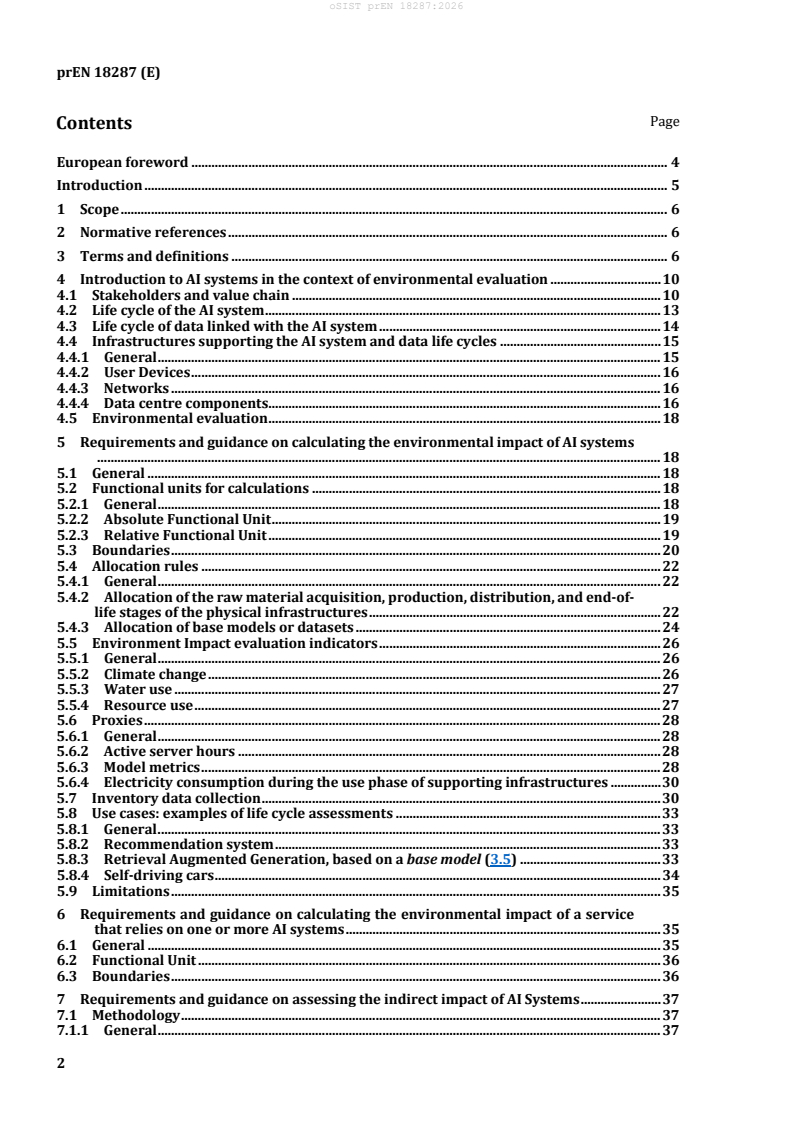
Contents
European foreword . 4
Introduction . 5
1 Scope . 6
2 Normative references . 6
3 Terms and definitions . 6
4 Introduction to AI systems in the context of environmental evaluation . 10
4.1 Stakeholders and value chain . 10
4.2 Life cycle of the AI system . 13
4.3 Life cycle of data linked with the AI system . 14
4.4 Infrastructures supporting the AI system and data life cycles . 15
4.4.1 General . 15
4.4.2 User Devices . 16
4.4.3 Networks . 16
4.4.4 Data centre components . 16
4.5 Environmental evaluation . 18
5 Requirements and guidance on calculating the environmental impact of AI systems
........................................................................................................................................................................ 18
5.1 General . 18
5.2 Functional units for calculations . 18
5.2.1 General . 18
5.2.2 Absolute Functional Unit . 19
5.2.3 Relative Functional Unit . 19
5.3 Boundaries . 20
5.4 Allocation rules . 22
5.4.1 General . 22
5.4.2 Allocation of the raw material acquisition, production, distribution, and end-of-
life stages of the physical infrastructures . 22
5.4.3 Allocation of base models or datasets . 24
5.5 Environment Impact evaluation indicators . 26
5.5.1 General . 26
5.5.2 Climate change . 26
5.5.3 Water use . 27
5.5.4 Resource use . 27
5.6 Proxies . 28
5.6.1 General . 28
5.6.2 Active server hours . 28
5.6.3 Model metrics . 28
5.6.4 Electricity consumption during the use phase of supporting infrastructures . 30
5.7 Inventory data collection . 30
5.8 Use cases: examples of life cycle assessments . 33
5.8.1 General . 33
5.8.2 Recommendation system . 33
5.8.3 Retrieval Augmented Generation, based on a base model (3.5) . 33
5.8.4 Self-driving cars . 34
5.9 Limitations . 35
6 Requirements and guidance on calculating the environmental impact of a service
that relies on one or more AI systems . 35
6.1 General . 35
6.2 Functional Unit . 36
6.3 Boundaries . 36
7 Requirements and guidance on assessing the indirect impact of AI Systems . 37
7.1 Methodology . 37
7.1.1 General . 37
7.1.2 Reference scenario . 37
7.1.3 Qualitative list of effects . 37
7.2 Use case: an AI-powered recommendation system . 39
7.2.1 General . 39
7.2.2 Reference scenario . 39
7.2.3 Consequential tree . 40
7.2.4 First order effects . 41
7.2.5 Second and higher order effects . 41
7.3 Limitations . 41
8 Requirements and guidance on reducing the environmental impact of AI . 41
8.1 General . 41
8.2 Question the need to use AI . 42
8.3 AI project management and governance systems . 42
8.4 Environmental impact analysis . 43
8.5 Environmental impact optimization . 44
8.5.1 General . 44
8.5.2 Model selection . 44
8.5.3 Optimize data management . 47
8.5.4 Optimize infrastructure management . 47
8.5.5 Development and coding . 48
8.6 Enhance skills and awareness . 49
9 Requirements and guidance on reporting and communicating about the
environmental impact of AI . 49
9.1 Recommended data to publish . 49
9.2 Format and conditions of the reporting . 50
9.3 Format and conditions of the reporting of compliance with ecodesign principles. 50
Bibliography . 52
European foreword
This document (prEN 18287:2026) has been prepared by the Joint Technical Committee CEN-
CENELEC/JTC 21 "Artificial Intelligence", the secretariat of which is held by DS.
This document is currently submitted to the CEN Enquiry.
Introduction
The increasing deployment of AI systems and services, including generative AI applications, is expected
to result in a significant growth of the environmental impacts attributable to the AI sector. However, as
with other sectors and following the Intergovernmental Panel on Climate Change (IPCC)
recommendations, we collectively need to reduce our impact on the planet and to remain within
planetary limits to avoid environmental crises with impact on society at large. The rapid adoption of AI
systems necessitates a transparent and comprehensive understanding of their environmental footprint.
Targets in line with the IPCC P2 scenario were defined in 2020 in the ITU-T L.1470:2020 [1], stating that
a reduction of -50% by 2030 of the GHG emissions for the ICT sector relative to 2015 should be required,
stating also in the longer term a reduction of the a GHG emissions of about 88% in 2050. Therefore, this
document aims at giving the tools and guidance for AI stakeholders to align their development with our
global environmental goals, through evaluation and best practices. It builds upon the literature review
done in CEN/CLC/TR 18145:2025 [2].
This document focuses on the environmental cost of AI and does not specifically touch upon the
environmental benefits associated with its uses. People interested in AI benefits for the environment
and climate can consult “Beneficial AI” (ISO/IEC TR 21221:2025 [3]). Environmental costs include direct
effects from the consumption of resources due to the Life cycle of the AI system, and the physical
materials on which it is based.
In addition, a more sustainable Artificial Intelligence represents a necessity for the deployment at scale
of AI, in a context of limited supply of energy and other material resources. Through this harmonized
methodology, companies will be able to reach cost reduction and economies of scale, by integrating
better risk management in a context of resource scarcity and climate emergency.
Different types of organizations can be interested in having access to the environmental assessment of
artificial intelligence, including business and civil society organisations, academia, research
organisations, public entities, trade unions and consumer protection organisations.
Moreover, small and medium-sized companies will be able to benefit from relevant market positioning
through the promotion of AI models that are more respectful of the environment and less resource-
consuming, encouraging a sustainable innovation ecosystem. In a broader perspective, Corporate Social
Responsibility teams can be especially interested in this standard, has it will enable AI systems to be
included as a quantifiable component of companies' extra-financial reporting obligations as well as
being accounted as components of products affected by the European Product Environmental Footprint
(PEF) method.
Other standardization bodies are currently working on this growing topic. It is important to note that
the goal was to align this document with the work of those other organizations, to make sure that the
sector benefits from methods that are comparable. As such, we acknowledge IEEE P7100 (Standard for
Measurement of Environmental Impacts of Artificial Intelligence Systems) and ITU-T L.1801 (Guidelines
for assessing the environmental impact of artificial intelligence systems).
https://www.ipcc.ch/
1 Scope
This document specifies requirements, guidance and metrics for environmental impact evaluation of
artificial intelligence systems and services and gives guidance on impact reduction throughout its Life
cycle. This document establishes requirements and guidance on reporting and communicating about
the environmental impact of AI. This document also provides techniques to evaluate potential indirect
negative or positive consequences of AI systems and services, for stakeholders to anticipate or mitigate
them.
This document is applicable to the entire Life cycle of AI systems and services, from inception to end-of-
life.
This document is applicable to LCA practitioners conducting life-cycle analyses for AI systems or AI
services, organizations developing and using AI systems or AI services (AI providers and deployers),
and all actors in the value chain.
2 Normative references
The following documents are referred to in the text in such a way that some or all of their content
constitutes requirements of this document. For dated references, only the edition cited applies. For
undated references, the latest edition of the referenced document (including any amendments) applies.
EN ISO 14040, Environmental management - Life cycle assessment - Principles and framework (ISO
14040:2006)
EN ISO 14044, Environmental management - Life cycle assessment - Requirements and guidelines (ISO
14044:2006)
EN ISO 14067, Greenhouse gases - Carbon footprint of products - Requirements and guidelines for
quantification (ISO 14067:2018)
3 Terms and definitions
For the purposes of this document, the following terms and definitions apply.
3.1
artificial intelligence system
AI system
machine-based system that is designed to operate with varying levels of autonomy and that may exhibit
adaptiveness after deployment, and that, for explicit or implicit objectives, infers, from the input it
receives, how to generate outputs such as predictions, content, recommendations, or decisions that can
influence physical or virtual environments
[SOURCE: [4]]
3.2
artificial intelligence model
AI model
construct containing logical operations, arithmetical operations or a combination of both to generate an
inference (3.29) or prediction based on input data or information without being completely defined by
human knowledge
[SOURCE: ISO/PAS 8800:2024 [5]]
3.3
data centre
structure, or group of structures, dedicated to the centralized accommodation, interconnection and
operation of information technology and network telecommunications equipment providing data
storage, processing and transport services together with all the facilities and infrastructures for power
distribution and environmental control together with the necessary levels of resilience and security
required to provide the desired service (3.20) availability
[SOURCE: ISO/IEC 30134-1:2016 [6]]
3.4
first order effect
direct environmental effect associated with the physical existence of an Information and
Communication Technology (ICT) solution, i.e. the raw materials acquisition, production, use and end-
of-life treatment stages, and generic processes supporting those including the use of energy and
transportation
[SOURCE: ITU-T L.1480:2022 [7]]
3.5
base model
AI model (3.2) that is trained on a massive amount of data and that can be integrated into a variety of
downstream AI systems
Note 1 to entry: A significant part of "base models" is called General Purpose AI model (3.9) or "foundational
models" or "foundation models". However, those last terms include only very large models that can have multiple
purposes, while "base models" can include smaller models achieving only a specific task (3.22) that are then fine-
tuned.
3.6
ecodesign
systematic approach that considers environmental aspects in design and development with the aim to
reduce adverse environmental impacts throughout the life cycle (3.14) of a product
[SOURCE: ISO/IEC TS 20125-1 [8]]
3.7
ecopractice
set of requirements and recommendations referring to a specific topic within a life cycle (3.14) stage to
achieve the ecodesign (3.6) of a digital service (3.21)
[SOURCE: ISO/IEC TS 20125-1 [8]]
3.8
functional unit
FU
quantified performance of a product system for use as a reference unit in a life cycle assessment (3.15)
[SOURCE: EN ISO 14040 [9]]
3.9
general purpose AI model
GPAI
AI model (3.2), including where such an AI model (3.2) is trained with a large amount of data using self-
supervision at scale, that displays significant generality and is capable of competently performing a wide
range of distinct tasks regardless of the way the model is made available to third parties and that can be
integrated into a variety of downstream systems or application
Note 1 to entry: base model (3.5) has a wider meaning that GPAI (3.9) models. GPAI (3.9) models are sometimes
referred as "foundational models" or "foundation models".
[SOURCE: [4]]
3.10
higher order effect
indirect effect (including but not limited to rebound effects) other than first and second order effects
occurring through changes in consumption patterns, lifestyles and value systems
[SOURCE: ITU-T L.1480:2022 [7]]
3.11
intended purpose
use for which an AI system (3.1) is intended by the provider, including the specific context and conditions
of use, as specified in the information supplied by the provider in the instructions, as well as in the
technical documentation
[SOURCE: [4]]
3.12
impact category
class representing environmental issues of concern to which life cycle (3.14) inventory analysis results
may be assigned
[SOURCE: EN ISO 14040 [9]]
3.13
impact category indicator
quantifiable representation of an impact category (3.12)
[SOURCE: EN ISO 14040 [9]]
3.14
life cycle
consecutive and interlinked stages of a product system, from raw material acquisition or generation
from natural resources to final disposal
[SOURCE: EN ISO 14040 [9]]
3.15
life cycle assessment
LCA
compilation and evaluation of the inputs, outputs and the potential environmental impacts of a product
system throughout its life cycle (3.14)
[SOURCE: EN ISO 14040 [9]]
3.16
market-based electricity GHG quantification
method to quantify the greenhouse gas (GHG) emissions from electricity / energy inputs into a product
system based on GHG emissions emitted by the generators from which the reporting entity contractually
purchases electricity bundled with contractual instruments, or contractual instruments on their own
[SOURCE: EN ISO 14064-1:2019 [10]]
3.17
location-based electricity GHG quantification
location-based approach is a method to quantify the GHG emissions from electricity / energy inputs into
a product system based on average energy generation emission factors for defined geographic locations,
including local, subnational or national boundaries
[SOURCE: EN ISO 14064-1:2019 [10]]
3.18
power usage effectiveness
PUE
ratio of the data centre (3.3) total energy consumption to information technology equipment energy
consumption, calculated, measured or assessed across the same period
[SOURCE: ISO/IEC 30134-2:2016 [11]EN 50600-4-2:2016 [12]]
3.19
second order effect
indirect impact created by the use and application of Information and Communication technologies
(ICT) which includes changes of environmental load due to the use of ICT that could be positive or
negative
[SOURCE: ITU-T L.1480:2022 [7]]
3.20
service
means of delivering value for the customer by facilitating outcomes the customer wants to achieve
Note 1 to entry: A service (3.20) can be not entirely digital.
Note 2 to entry: A service (3.20) may or may not include one or more AI systems but is not limited to them. As such,
it would be an oversimplification to use the term "AI service (3.20) ". As a consequence it is not recommended to
talk about AI services, but instead use more generic terms such as "service (3.20) " or "digital service (3.21) " that
relies on/embeds one or more AI systems.
Note 3 to entry: A service (3.20) is characterized by defined interfaces, conditions of use and operational
responsibility. As a consequence, parts of the customer-side impacts shall be attributed to the service (3.20) 's
impacts.
[SOURCE: ISO/IEC 20000-1:2018 [13]]
3.21
digital service
service (3.20) that provides one or several functions to users through a combination of electronic
devices, software and telecommunication networks, with clearly defined functional boundaries,
interacting with each other
Note 1 to entry: A digital service (3.21) may use other digital services. In this case, requirements and guidance
apply to all services under control of the organization performing the environmental impact evaluation.
Note 2 to entry: A digital service (3.21) may or may not use an AI system (3.1) but every service (3.20) using one or
more AI systems is a digital service (3.21) .
[SOURCE: ISO/IEC TS 20125-1:2026 [14]]
3.22
task
action required to achieve a specific goal
EXAMPLE Generation, classification, regression, ranking, clustering, dimensionality reduction.
Note 1 to entry: Actions can be physical or cognitive. For instance, computing or creation of predictions,
translations, synthetic data or artefacts or navigating through a physical space.
[SOURCE: ISO/IEC 22989:2022 [15]]
3.23
thermal design power
TDP
maximum amount of heat a CPU or GPU (3.27) generates
[SOURCE: ISO/IEC TS 8236-1:2025 [16]]
3.24
utilization rate
percentage of utilization relative to the maximum of an IT equipment capacity over a given period
3.25
water usage effectiveness
WUE
ratio of the Data centre (3.3) water consumption divided by the energy consumed by IT equipment
[SOURCE: ISO/IEC 30134-9:2022 [17]]
3.26
random access memory
RAM
memory that can be accessed in any order and which has no endurance limitations
[SOURCE: ISO/IEC 11889-1:2015 [18]]
3.27
graphical processing unit
GPU
application-specific integrated circuit (ASIC) specialized for display functions such as rendering images
Note 1 to entry: GPUs are designed for parallel data processing of images with a single function, but this parallel
processing is also useful for executing AI-based software, such as neural networks.
[SOURCE: ISO/IEC TR 29119-11:2020 [19]]
3.28
training
process to determine or to improve the parameters of an AI model (3.2)
[SOURCE: ISO/IEC 22989:2022 [15]]
3.29
inference
reasoning by which conclusions are derived from known premises
Note 1 to entry: In AI, a premise is either a fact, a rule, a model, a feature or raw data.
Note 2 to entry: The term "inference (3.29) " refers both to the process and its result.
[SOURCE: EN ISO/IEC 22989:2023 [20]]
4 Introduction to AI systems in the context of environmental evaluation
4.1 Stakeholders and value chain
Stakeholders mainly involved in AI sustainability best practices and environmental evaluation are:
— AI Provider: a company or organization that develops an AI system (3.1) or that has an AI system
(3.1) developed and places it on the market or puts the AI system (3.1) into Service (3.20) ([4]),
— AI Deployer: a company or organization using an AI system (3.1) under its authority except where
the AI system (3.1) is used in the course of a personal non-professional activity ([4]).
Other stakeholders that can contribute to the best practices and the evaluation evaluation are:
— IT hardware manufacturer: a company or organization that fabricates, constructs, assembles or
delivers physical components of an information processing system (adapted from ISO/IEC
2382:2015 [21]),
— Non-IT hardware manufacturer: a company or organization that fabricates, constructs,
assembles or delivers Data centre (3.3) building construction and Data centre (3.3) non-IT
equipment (e.g. power backup, distribution and cooling, environmental control equipment),
— IT hardware raw material provider: a company or organization that provides any substance
going into or involved in the manufacturing of hardware, includes upstream extractive and
primary processing actors (e.g. mining/refining),
— Network provider: a company or organization that provides a collection of interconnected
elements that provides connection services to users (adapted from ISO/IEC 16500-1:1999 [22]),
including terrestrial and subsea cables and satellite networks,
— Data infrastructure provider: a company or organization that provides hardware and software
elements for creating, capturing, collecting and curating data from various sources,
— Cloud service (3.20) provider: a company or organization which makes cloud services available
(adapted from ISO/IEC 22123-1:2023 [23]),
— Computing service (3.20) provider: a company or organization which makes computing
services available, including edge and HPC infrastructures,
— data centre (3.3) operator: a company or organization which operates a Data centre (3.3),
— Electricity supplier: an entity that delivers electricity to end use customers (ISO 17800:2017
[24]),
— Water supplier: an entity that delivers water to end use customers.
This list of stakeholders is not exhaustive. Other parties may be affected by environmental impacts
occurring along the AI system (3.1) life cycle (3.14) and its supporting infrastructure, and relevant end-
of-life operators; but economic and social aspects are outside the scope of LCA (3.15) and of this
standard.
To ensure the highest-quality environmental reporting, these stakeholders supply the data necessary
for the LCA (3.15) practitioner to compute the environmental impact of AI systems and to put best
practices in place. This document will suggest a repartition of roles for the provision of environmental
data, so that a downstream evaluation can be realized at the end of the value chain.
The most common value chain of AI systems is represented in Figure 1 a). Figure 1 b) shows how
stakeholder software and models interact to build an AI system (3.1) .
a) Simplified value chain of AI Systems
b) Value chain of Generative AI Systems
Figure 1 — Value chains for AI Systems
4.2 Life cycle of the AI system
The system can include several AI models (3.2) serving the system, including supporting models for
example for scoring, ranking and classification.
The AI system (3.1) is being developed, put on the market and used through this life cycle (3.14) (ISO/IEC
22989:2022 [15]):
— Inception: One or more stakeholders decide to transform an idea into a concrete system, with the
decision to move to the design and development stage.
— Design & Development: AI system (3.1) creation stage, resulting in an AI system (3.1) ready for
the verification and validation stage.
— Verification & validation: Verification that the AI system (3.1) resulting from the design and
development stage operates in accordance with the requirements and achieves the objectives
defined at previous stages of the life cycle (3.14) , including safety and trustworthiness.
— Deployment: The AI system (3.1) is installed, deployed or configured to operate in a target
environment.
— Operation & Monitoring: The AI system (3.1) is operating and is generally available for use.
— Continuous validation: If the AI system (3.1) uses continuous learning, the operation and
monitoring stage is extended by an additional continuous validation stage, including the
assessment of safety and trustworthiness. Incremental training (3.28) takes place continuously
while the system is running in production.
— Re-evaluation: After the operation and monitoring stage, according to the AI system (3.1) work
results, it may be deemed necessary to carry out a re-evaluation.
— Retirement: The AI system (3.1) may become obsolete insofar as repairs and updates are not
sufficient to meet new requirements, in which case it may be retired.
At each step of this life cycle (3.14), physical flows are being mobilized which lead to environmental
impacts.
The stages from inception to verification & validation can be identified as the “design” phase. They also
correspond to the commonly called “cradle to gate” phase of life cycle assessment (3.15), meaning the
evaluation is made to the point where the product “leaves the factory gate” (in this case, is made
available online or on premise).
The initial design phase of the AI system (3.1) is realized by the AI provider. At the end of the initial
design phase, the AI system (3.1) is at the stage of a finished product, ready to be delivered to provide a
service (3.20). It encompasses the life cycle (3.14) stages of inception, design and development, and
verification and validation. The next stages of deployment, operation & monitoring, continuous
validation and re-evaluation are part of the “operation” phase, which is realized by the AI provider, the
AI deployer or both. The combined 3 phases combined give the full life cycle (3.14) , or “cradle to grave”
(see Figure 2).
Figure 2 — Decomposition of life cycle of AI systems (source: ISO/IEC 22989:2022 [15])
4.3 Life cycle of data linked with the AI system
The data can be any data used during the life cycle (3.14) of the AI system (3.1): for training (3.28),
validation and testing, but also the input and output data during the operation of the AI system (3.1). To
represent the environmental impact of the life cycle (3.14) of data, the following stages can be taken into
account (from ISO/IEC 5259-1:2024 [25]):
— Specification of data requirements: Definition of the required data to meet the defined need, as
well as the quality criteria required for the use in question, verification of data availability.
— Data planning: Design of data architecture, estimation of required effort to collect and prepare
data for the project.
— Collection or acquisition: Production of data, accounting for defined quality and risk assessment
criteria, with the addition of metadata. This stage includes testing and potential improvement of
collection methods, and measurements of data quality (including safety: security, accuracy,
fairness, explainability and privacy aspects), and potential data quality improvements.
— Data preparation: Data adaptation processes (data cleaning according to collection methods,
change of format, labelling for supervised learning, data aggregation, data sampling, etc.) before
being taken into account in the AI system (3.1) (e.g. augmentation).
— Data provision: Providing the prepared data to the AI system (3.1).
— Data decommissioning: Intermediate, easily accessible archiving or long-term, permanent
archiving (data logging) or retirement, deletion of all copies, archives of data. Destruction of
stored or archived data generally follows service (3.20) discontinuation. It can be frequent for
intermediate, temporary or generated data.
The order of these stages represents the main way of advancement of stages, but each life cycle (3.14)
stage can feed back to previous life cycle (3.14) stages. During all the life cycle (3.14) stages, data quality,
security and protection are ensured. The data can be stored and transferred between multiple
hardware.
4.4 Infrastructures supporting the AI system and data life cycles
4.4.1 General
Infrastructures for developing and deploying AI systems are in general similar to those necessary for
digital services (see ISO/IEC TS 20125-1 [8]). Those physical infrastructures include therefore (see
Table 1):
— end-user devices (e.g. laptops, smartphones, smart cars);
— networking infrastructures;
— infrastructures dedicated to computing and data storage (e.g. cloud data centres, edge servers, on-
premise data centres, and other infrastructures).
Those physical infrastructures have their own life cycle (3.14), with embodied environmental impacts
through manufacturing and end-of-life processes, such as decommissioning or recycling, and
operational impacts throughout the life cycle (3.14) of the AI system (3.1). The life cycle (3.14) of each
physical infrastructure shall be taken into account in the LCA (3.15) of AI systems through a physical
allocation method as described in EN ISO 14040 and EN ISO 14044. Boundaries of the environmental
evaluation of those physical infrastructures are discussed in 5.3.
Table 1 — Physical infrastructures for the life cycle of AI systems and their key characteristics for
environmental evaluation
Infrastructures
Key characteristics
End-user devices
Networks
Data centres Compute servers Processing units (e.g.GPU (3.27) , CPU, and
other processing units.)
Installed IT capacity
Type and Memory capacity
PUE (3.18)
Thermal design power (3.23)
WUE (3.25)
Idle power
Memory modules (RAM (3.26) , and other
memory modules.)
Capacity
Speed
Other relevant supporting items
Supporting infrastructure (storage systems, networking equipment,
cooling and environmental controls, backup equipment, and other
supporting infrastructure)
4.4.2 User Devices
End-user devices enable content to be used, received and consulted (e.g. robots, vehicles, smart devices,
smartphones, drones, and other devices). They are increasingly used for computing as well, for inference
(3.29), continuous training (3.28), or federated learning, which is a field called edge AI. It raises concerns
about obsolescence, as it drives demand for increasingly powerful computing devices.
4.4.3 Networks
Networks enable data to be transmitted over network infrastructures to end-user devices, including,
but not limited to, terrestrial cables, mobile networks and satellite networks.
4.4.4 Data centre components
4.4.4.1 General
Data centres (3.3) are facilities comprising IT equipment, and a range of auxiliary equipment required
to keep it in working order. More specifically, it includes:
— compute servers (see 4.4.4.2);
— storage systems: devices used for centralised data storage and backup;
— networking equipment includes switches to connect devices within the data centre (3.3) , routers
to direct traffic and load balancers to optimize performance;
— cooling and environmental controls consist of equipment that regulates temperature and
humidity to keep IT equipment operating at optimal conditions;
— uninterruptible power supply batteries and backup power generators keep the data centre (3.3)
powered during outages;
— other infrastructure includes lighting and office equipment for on-site staff, and other
infrastructure.
Technical characteristics of interest for a data centre (3.3) include:
— installed IT capacity refers to the operating servers, storage and networking devices and is
measured in megawatts (MW). Total installed capacity includes both IT capacity and auxiliary
facility infrastructure nameplate power capacity (MW). Maximum designed capacity refers to the
data centre (3.3) fully populated with IT equipment (compute, storage, and network), not compute
servers only;
— efficiency metrics as described in Table 2.
Table 2 — Efficiency metrics for data centres
Ratio of the total
energy
power usage
𝑃𝑃𝑃𝑃𝑃𝑃
consumption to
effectiveness ISO/IEC 30134-
𝑃𝑃
𝐷𝐷𝐷𝐷
information Dimensionless (1)
(3.18) (PUE (3.18) = 2:2016 [11]
technology
𝑃𝑃
) 𝐼𝐼𝐼𝐼
equipment energy
consumption.
Amount of water
consumed by
𝑀𝑀𝑃𝑃𝑃𝑃
Water Use
cooling systems ISO/IEC 30134-
3 𝑀𝑀
Effectiveness 𝑚𝑚 /𝑀𝑀𝑀𝑀ℎ 𝐼𝐼𝐼𝐼
(2)
during the lifespan = 9:2022 [17]
(WUE (3.25) )
𝑃𝑃
𝐼𝐼𝐼𝐼
of the data centre
(3.3) .
Where:
𝑃𝑃 is the total energy consumed (in MWh) by the data centre (3.3) infrastructure. This value includes all energy entering
𝐷𝐷𝐷𝐷
in the physical boundaries of the data centre (3.3) and used to support its operation, including power delivery, cooling
systems, lighting, security systems, and other auxiliary services not directly related to computation.
𝑃𝑃 is the total energy consumption of information technology equipment, in MWh. This value represents exclusively the
𝐼𝐼𝐼𝐼
energy consumed by IT equipment (servers, storage systems, network systems, etc.) connected through uninterrupted
power systems (UPS)
...