

oSIST prEN 4731:2026
(Main)Aerospace series - Spectral quality of LED luminaires used with photoluminescent marking systems
- Abstract
This document defines a measure for the spectral quality of LED luminaires in terms of the ratio of the amount of visual light emitted by the luminaire versus the amount effective for charging photoluminescent products contained in that spectrum.
Fulfilment of this document by a LED luminaire will ensure general compatibility of the luminaire with photoluminescent marking systems.
This document alone does not provide any means of compliance to fulfil any airworthiness requirements.
For a specific aircraft installation, the spectral power distribution and illuminance at the photoluminescent marking systems are relevant.
- Status
- Not Published
- Public Enquiry End Date
- 09-Jul-2026
- Technical Committee
- I13 - Imaginarni 13
- Current Stage
- 4020 - Public enquire (PE) (Adopted Project)
- Start Date
- 21-May-2026
- Due Date
- 08-Oct-2026
- Completion Date
- 10-Jul-2026

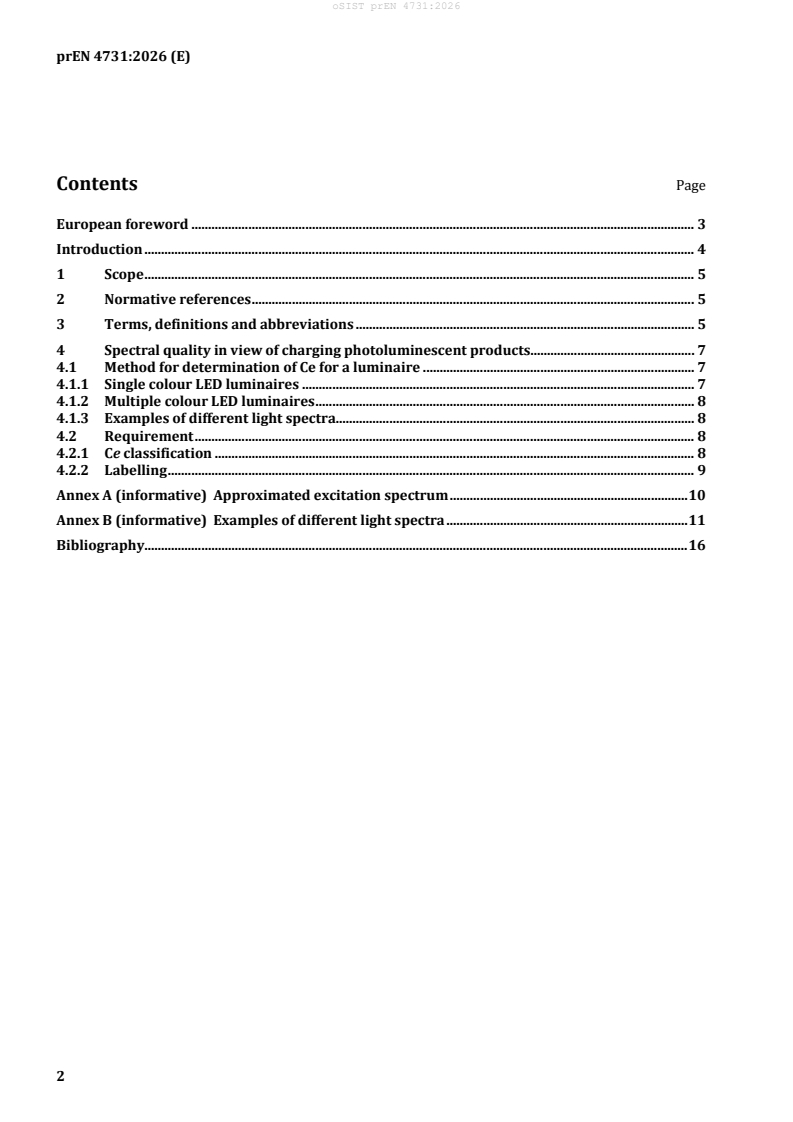
oSIST prEN 4731:2026 is the Slovenian publication of draft European Standard prEN 4731 from CEN, prepared by ASD-STAN for aerospace LED luminaires used with photoluminescent marking systems. It specifies the excitation coefficient Ce, a spectral-quality measure that compares the visually useful light from a luminaire with the part of its spectrum that charges photoluminescent products. The document is intended for comparing luminaires and colour settings, not for proving airworthiness compliance.
What does oSIST prEN 4731:2026 specify?
oSIST prEN 4731:2026 defines a way to judge whether an LED luminaire is spectrally suitable for charging photoluminescent marking systems. It focuses on spectral quality only; for a real aircraft installation, spectral power distribution and illuminance at the marking system are still relevant.
The document is organized into:
- Clause 1, Scope
- Clause 2, Normative references
- Clause 3, Terms, definitions and abbreviations
- Clause 4, Spectral quality in view of charging photoluminescent products
- Annex A and Annex B, both informative
| Annex | What it covers |
|---|---|
| Annex A | Approximated excitation spectrum for typical photoluminescent pigments based on strontium aluminate |
| Annex B | Examples of different light spectra and the corresponding Ce values |
What are the key requirements of oSIST prEN 4731:2026?
oSIST prEN 4731:2026 bases its main requirement on the excitation coefficient Ce and on how it is measured and declared. In practice, manufacturers and test labs must measure the luminaire spectrum, calculate Ce, classify it, and publish the result clearly.
- Clause 4.1.1 sets the method for single colour LED luminaires. The spectral irradiance is measured in steady state, at 1 nm steps, with a spectrometer across the visible range and with a narrow optical bandwidth. This matters because Ce is based on the spectrum itself, not just on total light output.
- Clause 4.1.2 uses the same calculation route for multiple colour LED luminaires, but first the colour setting dedicated to charging photoluminescent products must be defined. This matters because the declared Ce depends on the selected colour scenario.
- Clause 4.1 compares the part of the spectrum that contributes to human-perceived brightness with the part that contributes to charging. In practice, Ce expresses how much of the emitted light is useful for photoluminescent material relative to visible brightness.
- Clause 4.2.1 classifies Ce into four grades, from Excellent to Poor. This gives buyers, specifiers and cabin integrators a quick way to compare luminaires for the intended marking system.
- Clause 4.2.2 requires Ce to be stated in the product data sheet with three decimal figures. For multiple colour luminaires, the claim must identify the colour scenario to which it applies, and multiple claims are allowed.
- Clause 4.2.2 also requires a Ce claim for the EN 4706 S4000 setting for comparison purposes. This helps users compare products on a common reference setting.
- Annex A provides the standardized approximated excitation spectrum used in the charging calculation. Annex B shows example spectra for single colour, multi-colour and bi-colour luminaires so users can see how different LED mixes affect Ce.
What terms does oSIST prEN 4731:2026 define?
- LED - a solid state device with a p-n junction that emits optical radiation when current passes through it.
- single colour LED luminaire - a luminaire designed to operate in one colour setting only.
- multiple colour LED luminaire - a luminaire with two or more primary wavelengths designed to operate in two or more colour settings.
- colour setting - the set of parameters that defines the power of each primary and produces a specific colour output.
- photopic luminosity function V(λ) - the wavelength weighting that represents human brightness perception in photopic vision.
- approximated excitation spectrum Aλ(λ) - a linear approximation of the charging sensitivity of typical strontium aluminate-based photoluminescent pigments.
- excitation coefficient Ce - the indicator used here for spectral quality; a higher Ce means more of the light is effective for charging photoluminescent material.
Who uses oSIST prEN 4731:2026?
oSIST prEN 4731:2026 is used by aerospace lighting engineers, cabin interior designers, luminaire manufacturers, test laboratories, quality managers and buyers working on passenger aircraft cabins. They use it to design or select LED luminaires, measure spectral output, compare colour settings, and declare Ce for photoluminescent marking system compatibility.
What changed in oSIST prEN 4731:2026 from the previous edition?
Compared with EN 4731:2018, oSIST prEN 4731:2026 introduces the term colour setting and uses it instead of colour mode. It also corrects the definition of photopic luminosity function and changes the heading of Clause 4 to “Spectral quality in view of charging photoluminescent products.” The document states that it will supersede EN 4731:2018.
Which standards are used with oSIST prEN 4731:2026?
- EN 4706, Aerospace series - LED colour and brightness ranking - provides the S4000 setting used as the comparison point for multiple colour luminaires.
- CIE 018.2:1983, The basis of physical photometry - is cited as the basis for the photopic luminosity function V(λ).
What does the oSIST prEN 4731:2026 document contain?
The document contains a calculation method for Ce, with separate procedures for single colour and multiple colour LED luminaires. It also includes the Ce classification table and the labelling rule that requires the value to appear in the product data sheet.
Annex A gives the approximated excitation spectrum used in the charging calculation, while Annex B gives examples of real light spectra and their Ce values for different luminaire types. These figures and examples support design review, testing, product comparison and data-sheet declaration.
Relations
- Effective Date
- 11-Mar-2026
Get Certified
Connect with accredited certification bodies for this standard

BUREAU VERITAS Certification Germany
Bureau Veritas certification in Germany.

Element Materials Technology
Materials testing and product certification.

IMQ S.p.A. (Certification)
Italian electrical product certification.
Sponsored listings
Frequently Asked Questions
oSIST prEN 4731:2026 is a draft published by the Slovenian Institute for Standardization (SIST). Its full title is "Aerospace series - Spectral quality of LED luminaires used with photoluminescent marking systems". This standard covers: This document defines a measure for the spectral quality of LED luminaires in terms of the ratio of the amount of visual light emitted by the luminaire versus the amount effective for charging photoluminescent products contained in that spectrum. Fulfilment of this document by a LED luminaire will ensure general compatibility of the luminaire with photoluminescent marking systems. This document alone does not provide any means of compliance to fulfil any airworthiness requirements. For a specific aircraft installation, the spectral power distribution and illuminance at the photoluminescent marking systems are relevant.
This document defines a measure for the spectral quality of LED luminaires in terms of the ratio of the amount of visual light emitted by the luminaire versus the amount effective for charging photoluminescent products contained in that spectrum. Fulfilment of this document by a LED luminaire will ensure general compatibility of the luminaire with photoluminescent marking systems. This document alone does not provide any means of compliance to fulfil any airworthiness requirements. For a specific aircraft installation, the spectral power distribution and illuminance at the photoluminescent marking systems are relevant.
oSIST prEN 4731:2026 is classified under the following ICS (International Classification for Standards) categories: 29.140.99 - Other standards related to lamps; 49.095 - Passenger and cabin equipment. The ICS classification helps identify the subject area and facilitates finding related standards.
oSIST prEN 4731:2026 has the following relationships with other standards: It is inter standard links to SIST EN 4731:2018. Understanding these relationships helps ensure you are using the most current and applicable version of the standard.
oSIST prEN 4731:2026 is available in PDF format for immediate download after purchase. The document can be added to your cart and obtained through the secure checkout process. Digital delivery ensures instant access to the complete standard document.
Standards Content (Sample)
SLOVENSKI STANDARD
01-julij-2026
Aeronavtika - Spektralna kakovost LED-svetilk, ki se uporabljajo s
fotoluminiscenčnimi sistemi označevanja
Aerospace series - Spectral quality of LED luminaires used with photoluminescent
marking systems
Luft- und Raumfahrt - Spektrale Qualität von LED-Leuchten zur Verwendung mit
langnachleuchtenden Markierungssystemen
Ta slovenski standard je istoveten z: prEN 4731
ICS:
29.140.99 Drugi standardi v zvezi z Other standards related to
žarnicami lamps
49.095 Oprema za potnike in Passenger and cabin
oprema kabin equipment
2003-01.Slovenski inštitut za standardizacijo. Razmnoževanje celote ali delov tega standarda ni dovoljeno.
DRAFT
EUROPEAN STANDARD
NORME EUROPÉENNE
EUROPÄISCHE NORM
April 2026
ICS 49.095; 29.140.99 Will supersede EN 4731:2018
English Version
Aerospace series - Spectral quality of LED luminaires used
with photoluminescent marking systems
Luft- und Raumfahrt - Spektrale Qualität von LED-
Leuchten zur Verwendung mit langnachleuchtenden
Markierungssystemen
This draft European Standard is submitted to CEN members for enquiry. It has been drawn up by the Technical Committee ASD-
STAN.
If this draft becomes a European Standard, CEN members are bound to comply with the CEN/CENELEC Internal Regulations
which stipulate the conditions for giving this European Standard the status of a national standard without any alteration.
This draft European Standard was established by CEN in three official versions (English, French, German). A version in any other
language made by translation under the responsibility of a CEN member into its own language and notified to the CEN-CENELEC
Management Centre has the same status as the official versions.
CEN members are the national standards bodies of Austria, Belgium, Bulgaria, Croatia, Cyprus, Czech Republic, Denmark, Estonia,
Finland, France, Germany, Greece, Hungary, Iceland, Ireland, Italy, Latvia, Lithuania, Luxembourg, Malta, Netherlands, Norway,
Poland, Portugal, Republic of North Macedonia, Romania, Serbia, Slovakia, Slovenia, Spain, Sweden, Switzerland, Türkiye and
United Kingdom.
Recipients of this draft are invited to submit, with their comments, notification of any relevant patent rights of which they are
aware and to provide supporting documentation.
Warning : This document is not a European Standard. It is distributed for review and comments. It is subject to change without
notice and shall not be referred to as a European Standard.
EUROPEAN COMMITTEE FOR STANDARDIZATION
COMITÉ EUROPÉEN DE NORMALISATION
EUROPÄISCHES KOMITEE FÜR NORMUNG
CEN-CENELEC Management Centre: Rue de la Science 23, B-1040 Brussels
© 2026 CEN All rights of exploitation in any form and by any means reserved Ref. No. prEN 4731:2026 E
worldwide for CEN national Members.
Contents Page
European foreword . 3
Introduction . 4
1 Scope . 5
2 Normative references . 5
3 Terms, definitions and abbreviations . 5
4 Spectral quality in view of charging photoluminescent products. 7
4.1 Method for determination of Ce for a luminaire . 7
4.1.1 Single colour LED luminaires . 7
4.1.2 Multiple colour LED luminaires . 8
4.1.3 Examples of different light spectra. 8
4.2 Requirement . 8
4.2.1 Ce classification . 8
4.2.2 Labelling . 9
Annex A (informative) Approximated excitation spectrum . 10
Annex B (informative) Examples of different light spectra . 11
Bibliography. 16
European foreword
This document (prEN 4731:2026) has been prepared by ASD-STAN.
After enquiries and votes carried out in accordance with the rules of this Association, this document has
received the approval of the National Associations and the Official Services of the member countries of
ASD-STAN, prior to its presentation to CEN.
This document is currently submitted to the CEN Enquiry.
This document will supersede EN 4731:2018.
— new term “colour setting” and using it instead of “colour mode”;
— correct the definition of term “photopic luminosity function”;
— change heading of Clause 4 into “Spectral quality in view of charging photoluminescent products”.
Introduction
Photoluminescent marking systems are commonly used in passenger airplanes to provide visual
guidance in emergency events. Those marking systems need to be charged by ambient light during
cabin preparation and/ or aircraft operation as to be operational if, at any phase of a flight, an
emergency occurs.
While the certification regulations require photoluminescent marking system to be sufficiently charged
solely by cabin interior lighting, i.e. without accounting for daylight entering the cabin through
windows, only certain portions of the visual light spectrum emitted by a cabin interior luminaire are
stored by the photoluminescent pigment and thus contribute to charging.
1 Scope
This document defines a measure for the spectral quality of LED luminaires in terms of the ratio of the
amount of visual light emitted by the luminaire versus the amount effective for charging
photoluminescent products contained in that spectrum.
Fulfilment of this document by a LED luminaire will ensure general compatibility of the luminaire with
photoluminescent marking systems.
This document alone does not provide any means of compliance to fulfil any airworthiness
requirements.
For a specific aircraft installation, the spectral power distribution and illuminance at the
photoluminescent marking systems are relevant.
2 Normative references
The following documents are referred to in the text in such a way that some or all of their content
constitutes requirements of this document. For dated references, only the edition cited applies. For
undated references, the latest edition of the referenced document (including any amendments) applies.
EN 4706, Aerospace series — LED colour and brightness ranking
3 Terms, definitions and abbreviations
For the purposes of this document, the following terms, definitions and abbreviations apply.
ISO and IEC maintain terminological databases for use in standardization at the following addresses:
— ISO Online browsing platform: available at https://www.iso.org/obp
— IEC Electropedia: available at https://www.electropedia.org/
3.1
Light Emitting Diode
LED
solid state device embodying a p-n junction, emitting optical radiation when excited by an electric
current
3.2
single colour LED luminaire
luminaire using one or more LEDs as source of light whereas the luminaire is designed to operate in a
single colour setting only
3.3
multiple colour LED luminaire
luminaire using two or more LEDs as source of light whereas the LEDs are of at least two different
primary wavelengths and the luminaire is designed to operate in two or more colour settings
3.4
colour setting
set of parameters that define the power setting of every primary of a multiple colour LED Luminaire
thus achieving a specific colour output
3.5
spectral irradiance
Eλ(λ)
function that relates the spectral irradiance E𝜆𝜆 of a light source to the wavelength λ
Note 1 to entry: The function’s unit is W/m /nm.
3.6
photopic luminosity function
V(λ)
function that relates the average spectral sensitivity of human visual perception of brightness for
photopic vision to the wavelength 𝜆𝜆
Note 1 to entry: Published by the Commission Internationale de L’Éclairage (CIE) in steps of one nanometer with
document CIE 018.2:1983.
3.7
photom
...