

SIST EN 61960-3:2018/FprA1:2026
(Amendment)Amendment 1 - Secondary cells and batteries containing alkaline or other non-acid electrolytes - Secondary lithium cells and batteries for portable applications - Part 3: Prismatic and cylindrical lithium secondary cells and batteries made from them
- Status
- Not Published
- Public Enquiry End Date
- 31-Oct-2025
- Technical Committee
- ISCB - Secondary cells and batteries
- Current Stage
- 5020 - Formal vote (FV) (Adopted Project)
- Start Date
- 09-Jun-2026
- Due Date
- 28-Jul-2026
- Completion Date
- 24-Jun-2026


SIST EN 61960-3:2018/FprA1:2026 is a CLC draft amendment to EN 61960-3 for secondary lithium cells and batteries for portable applications. It updates the marking rules for prismatic and cylindrical lithium secondary cells and batteries made from them, including what must appear on the product, what may be placed in documents or a QR code, and when extra caution information is needed. It is mainly relevant to cell and battery manufacturers, suppliers, and end-product makers who decide how batteries are identified and labeled.
What does SIST EN 61960-3:2018/FprA1:2026 specify?
SIST EN 61960-3:2018/FprA1:2026 specifies amendments to the marking requirements in EN 61960-3 for secondary lithium cells and batteries for portable applications. The draft text shown here focuses on Section 5.2, Marking, and adds Clause 30.8 on QR code use for certain batteries.
The amendment is organized around practical labeling choices:
- what must be marked directly on the cell or battery,
- what may be supplied in documents such as a specification sheet or instruction manual,
- what may be carried in a QR code,
- and what extra symbols or cautions are needed in special cases.
What are the key requirements of SIST EN 61960-3:2018/FprA1:2026?
SIST EN 61960-3:2018/FprA1:2026 tightens and expands how marking information can be presented. The main change is that the standard now gives a structured option for QR code-based information, while keeping core identification information on the battery itself in some cases.
Clear and durable markings - Each cell or battery shall carry clear, durable markings with the listed information. In practice, manufacturers need a marking method that stays readable through normal handling and use.
Documented information versus product marking - The manufacturer may provide the required information in a specification sheet, instruction manual, or similar document. When the battery is handled by end-users, the listed information shall be marked on the battery. This matters because information for end-users cannot rely only on separate paperwork.
Core identification items - The marking list includes secondary (rechargeable) Li or Li-ion, the battery or cell designation as specified in 5.1, polarity, date of manufacture, manufacturer or supplier identity, rated capacity, and nominal voltage. These are the basic identity and electrical data that let users and downstream manufacturers recognize the product.
QR code option for certain batteries - For batteries that are not coin cells and are designed for use in a particular end product, all or part of the marking information may be provided in a QR code. However, secondary (rechargeable) Li or Li-ion and, when applicable, polarity shall still be marked on the battery. This means a QR code can reduce label clutter, but it does not replace the most important battery-identifying markings.
QR code and website conditions - The QR code shall meet ISO/IEC 18004. The information may be stored directly in the QR code or provided through a website address encoded in the QR code. The website shall be publicly available, permanently online, and easy for end-users to understand. In practice, this sets a reliability requirement for digital marking.
Symbols next to the QR code - The CAUTION symbol ISO 7000:0434 and the INFORMATION SOURCE symbol IEC 60417:6222 shall be printed or engraved alongside the QR code. This helps users recognize that the code carries product information and a cautionary message.
Special marking cases - If a cell or battery is considered swallowable, extra caution marking shall be added on the product or immediate package. If the battery surface is too small for all markings, some information may move to the specification sheet, instruction manual, or immediate package. Polarity does not need to be marked when the battery is designed not to be connected wrongly. A product code or battery name may be used instead of the designation specified in 5.1 for a battery intended for a particular end product.
What terms does SIST EN 61960-3:2018/FprA1:2026 define?
SIST EN 61960-3:2018/FprA1:2026 uses a small set of practical marking terms that drive the labeling rules.
- secondary (rechargeable) Li or Li-ion - The required chemistry marking for a rechargeable lithium cell or battery.
- designation as specified in 5.1 - The formal product designation used by the standard for identification on the marking.
- polarity - The indication of correct electrical connection orientation.
- rated capacity - The declared capacity value used to identify the battery’s performance.
- nominal voltage - The declared voltage level used to identify the battery’s electrical characteristics.
- QR code - A machine-readable code that may carry marking data or a link to it.
- swallowable - A condition used to trigger extra caution marking when a battery may be swallowed.
- end user - The final user of the battery or the end product, who may need information directly on the battery.
Who uses SIST EN 61960-3:2018/FprA1:2026?
SIST EN 61960-3:2018/FprA1:2026 is used by battery cell makers, battery pack assemblers, and end-product manufacturers that need to decide what goes on the battery, what goes in the package, and what can be moved into digital or paper documentation. It is also relevant to quality, compliance, and product labeling teams.
In practice, these users apply the amendment when they:
- design product markings,
- prepare specification sheets and instruction manuals,
- build QR-code labeling systems,
- check whether a battery needs extra caution marking,
- and decide whether marking exemptions apply for a specific design.
What changed in SIST EN 61960-3:2018/FprA1:2026 from the previous edition?
SIST EN 61960-3:2018/FprA1:2026 adds new wording to Section 5.2 and Clause 30.8. The amendment introduces QR code-based marking for certain batteries, sets conditions for the linked website, adds the CAUTION and INFORMATION SOURCE symbols next to the QR code, and gives extra marking rules for swallowable batteries and small battery surfaces.
It also clarifies when polarity marking is not needed, when a product code or battery name may replace the formal designation, and when cells or batteries used in an assembly do not need separate marking.
Which standards are used with SIST EN 61960-3:2018/FprA1:2026?
SIST EN 61960-3:2018/FprA1:2026 points to several other standards for the marking system it introduces.
- ISO/IEC 18004 - the QR code standard that the code itself shall meet.
- ISO/IEC/IEEE 23026 - a recommended standard for informational websites.
- ISO/IEC 40500 - a recommended standard for making those websites accessible.
- IEC 60086-4 - the reference used for caution marking when a battery is considered swallowable.
- ISO 7000:0434 - the CAUTION symbol to print or engrave beside the QR code.
- IEC 60417:6222 - the INFORMATION SOURCE symbol to print or engrave beside the QR code.
What does the SIST EN 61960-3:2018/FprA1:2026 document contain?
SIST EN 61960-3:2018/FprA1:2026 contains proposed changes shown with deletions and additions in Section 5.2, plus the new text of Clause 30.8. The visible material focuses on marking content, placement, QR code use, website conditions, and symbol requirements.
It also includes the practical exceptions and alternatives that matter in manufacturing and labeling decisions, such as moving some information to documents or packaging when the battery surface is too small. The document is therefore a drafting text for updating battery identification and user-information practices, not a general technical overview of battery performance.
Relations
- Effective Date
- 08-Apr-2025
Get Certified
Connect with accredited certification bodies for this standard

IMQ S.p.A. (Certification)
Italian electrical product certification.

SLG Prüf- und Zertifizierungs GmbH
German testing and certification body.

UL Solutions
Global safety science company with testing, inspection and certification.
Sponsored listings
Frequently Asked Questions
SIST EN 61960-3:2018/FprA1:2026 is a draft published by the Slovenian Institute for Standardization (SIST). Its full title is "Amendment 1 - Secondary cells and batteries containing alkaline or other non-acid electrolytes - Secondary lithium cells and batteries for portable applications - Part 3: Prismatic and cylindrical lithium secondary cells and batteries made from them". This standard covers: Amendment 1 - Secondary cells and batteries containing alkaline or other non-acid electrolytes - Secondary lithium cells and batteries for portable applications - Part 3: Prismatic and cylindrical lithium secondary cells and batteries made from them
Amendment 1 - Secondary cells and batteries containing alkaline or other non-acid electrolytes - Secondary lithium cells and batteries for portable applications - Part 3: Prismatic and cylindrical lithium secondary cells and batteries made from them
SIST EN 61960-3:2018/FprA1:2026 is classified under the following ICS (International Classification for Standards) categories: 29.220.30 - Alkaline secondary cells and batteries; 29.220.99 - Other cells and batteries. The ICS classification helps identify the subject area and facilitates finding related standards.
SIST EN 61960-3:2018/FprA1:2026 has the following relationships with other standards: It is inter standard links to SIST EN 61960-3:2018. Understanding these relationships helps ensure you are using the most current and applicable version of the standard.
SIST EN 61960-3:2018/FprA1:2026 is available in PDF format for immediate download after purchase. The document can be added to your cart and obtained through the secure checkout process. Digital delivery ensures instant access to the complete standard document.
Standards Content (Sample)
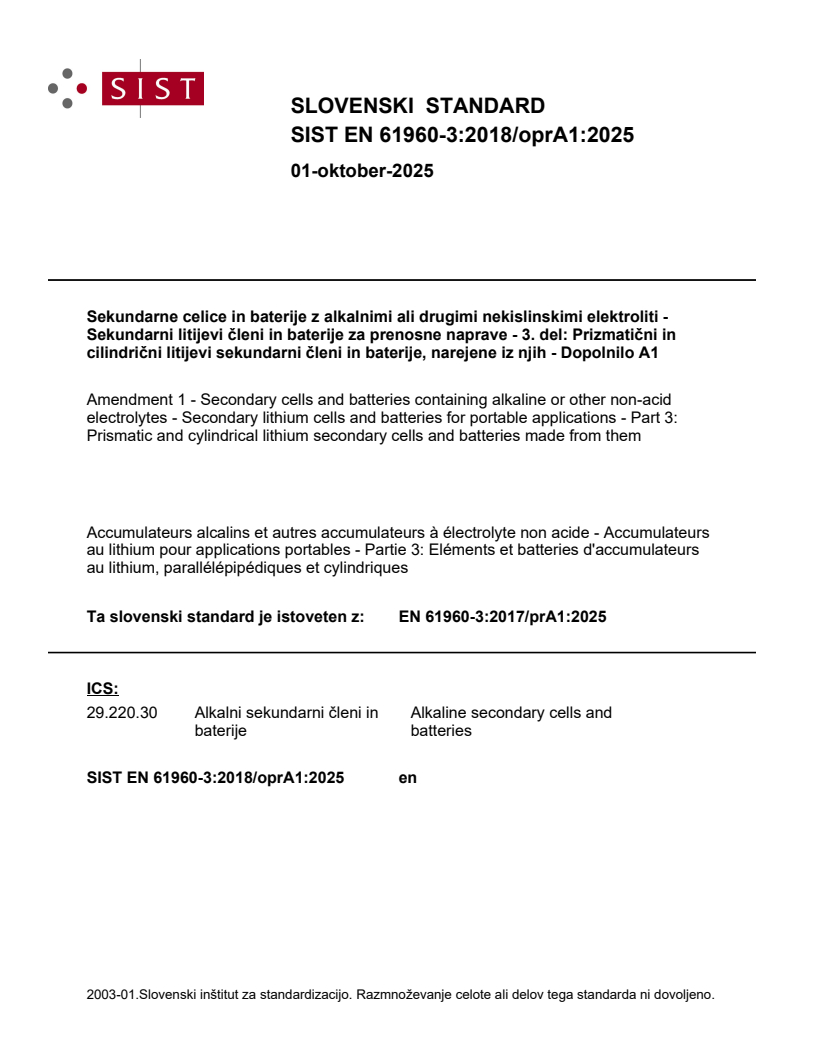
SLOVENSKI STANDARD
SIST EN 61960-3:2018/oprA1:2025
01-oktober-2025
Sekundarne celice in baterije z alkalnimi ali drugimi nekislinskimi elektroliti -
Sekundarni litijevi členi in baterije za prenosne naprave - 3. del: Prizmatični in
cilindrični litijevi sekundarni členi in baterije, narejene iz njih - Dopolnilo A1
Amendment 1 - Secondary cells and batteries containing alkaline or other non-acid
electrolytes - Secondary lithium cells and batteries for portable applications - Part 3:
Prismatic and cylindrical lithium secondary cells and batteries made from them
Accumulateurs alcalins et autres accumulateurs à électrolyte non acide - Accumulateurs
au lithium pour applications portables - Partie 3: Eléments et batteries d'accumulateurs
au lithium, parallélépipédiques et cylindriques
Ta slovenski standard je istoveten z: EN 61960-3:2017/prA1:2025
ICS:
29.220.30 Alkalni sekundarni členi in Alkaline secondary cells and
baterije batteries
SIST EN 61960-3:2018/oprA1:2025 en
2003-01.Slovenski inštitut za standardizacijo. Razmnoževanje celote ali delov tega standarda ni dovoljeno.
SIST EN 61960-3:2018/oprA1:2025
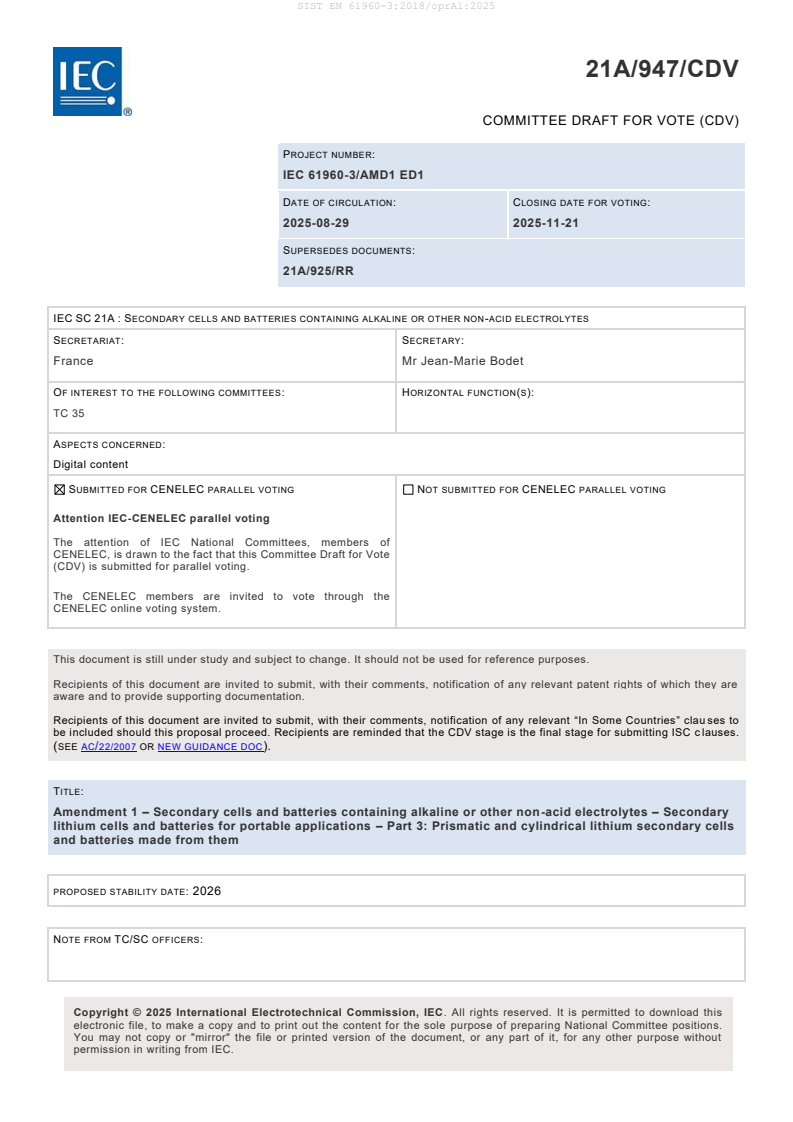
SIST EN 61960-3:2018/oprA1:2025
21A/947/CDV
COMMITTEE DRAFT FOR VOTE (CDV)
PROJECT NUMBER:
IEC 61960-3/AMD1 ED1
DATE OF CIRCULATION: CLOSING DATE FOR VOTING:
2025-08-29 2025-11-21
SUPERSEDES DOCUMENTS:
21A/925/RR
IEC SC 21A : SECONDARY CELLS AND BATTERIES CONTAINING ALKALINE OR OTHER NON-ACID ELECTROLYTES
SECRETARIAT: SECRETARY:
France Mr Jean-Marie Bodet
OF INTEREST TO THE FOLLOWING COMMITTEES: HORIZONTAL FUNCTION(S):
TC 35
ASPECTS CONCERNED:
Digital content
SUBMITTED FOR CENELEC PARALLEL VOTING NOT SUBMITTED FOR CENELEC PARALLEL VOTING
Attention IEC-CENELEC parallel voting
The attention of IEC National Committees, members of
CENELEC, is drawn to the fact that this Committee Draft for Vote
(CDV) is submitted for parallel voting.
The CENELEC members are invited to vote through the
CENELEC online voting system.
This document is still under study and subject to change. It should not be used for reference purposes.
Recipients of this document are invited to submit, with their comments, notification of any relevant patent rights of which they are
aware and to provide supporting documentation.
Recipients of this document are invited to submit, with their comments, notification of any relevant “In Some Countries” clau ses to
be included should this proposal proceed. Recipients are reminded that the CDV stage is the final stage for submitting ISC c lauses.
(SEE AC/22/2007 OR NEW GUIDANCE DOC).
TITLE:
Amendment 1 – Secondary cells and batteries containing alkaline or other non-acid electrolytes – Secondary
lithium cells and batteries for portable applications – Part 3: Prismatic and cylindrical lithium secondary cells
and batteries made from them
PROPOSED STABILITY DATE: 2026
NOTE FROM TC/SC OFFICERS:
...