

SIST EN 12225:2021
(Main)Geosynthetics - Method for determining the microbiological resistance by a soil burial test
General Information
- Abstract
This document specifies a method for the determination of the microbiological resistance of geosynthetics including those of natural fibres and biodegradable polymers by a soil burial test.
NOTE Experience and exhumation of geosynthetics which had performed successfully, in some cases for more than two decades, indicate that geosynthetics made out of synthetic materials are generally resistant against microbial initiated decay. It can therefore be expected that most of these products commercially available at the present time will pass the soil burial test successfully and it is probably not necessary to submit them all to this test independent of their function. However, if the requirements for appropriate functioning of the geosynthetics demand proof of microbiological resistance or if they are manufactured from newly developed polymers whose resistance is in any doubt, the soil burial test can provide additional information.
- Status
- Published
- Public Enquiry End Date
- 03-Nov-2019
- Publication Date
- 30-Nov-2020
- Technical Committee
- ITEK - Textile and textile products
- Current Stage
- 6060 - National Implementation/Publication (Adopted Project)
- Start Date
- 25-Nov-2020
- Due Date
- 30-Jan-2021
- Completion Date
- 01-Dec-2020



Overview
EN 12225:2020 (CEN) - "Geosynthetics - Method for determining the microbiological resistance by a soil burial test" - specifies a laboratory soil burial method to assess the microbiological resistance of geosynthetics, including products made from natural fibres and biodegradable polymers. The standard defines test soil preparation, incubation climate, specimen handling, cleaning, and tensile evaluation to determine whether a geosynthetic shows microbiologically induced degradation under controlled, biologically active soil conditions.
Key topics and technical requirements
- Scope: Evaluates microbiological attack by bacteria and fungi on geosynthetics; intended for cases where proof of resistance is required or for new polymers.
- Test specimen and sampling:
- Five tensile specimens per direction (machine and cross-machine) and per condition.
- Control specimens stored in standard atmosphere (EN ISO 291: 23 ±1 °C, 50 ±5 % RH).
- Test soil and biological activity:
- Natural soil, sieved to remove particles >4 mm; moisture set to (60 ± 5) % of the soil’s SMC (saturation moisture content).
- Soil acclimatisation: at least 28 days at ≥90 % RH and ≈28 °C (or 56 days at ≈26 °C) to establish microbial activity.
- Biological activity check: buried cotton strips (100 × 25 mm, ~230 g/m²) must lose tensile strength to ≤25 % of original after 7 days.
- Incubation conditions:
- Specimens buried 100–150 mm deep; container allows air exchange.
- Ambient test climate: ~26 ±1 °C with gaseous-phase RH ≥90 % for the container above the soil.
- Standard test duration: 16 weeks (index); extended tests up to 32 weeks may be used during product development.
- Cleaning and evaluation:
- After exposure, clean specimens in ethanol-water (70:30) for 300 s, rinse, and dry 72 h in standard atmosphere (unless a product is sensitive to washing-then wipe and dry).
- Tensile tests performed per EN 12226 and EN ISO 13934-1 (modified clamp distance 50 mm) and compared to controls.
- Reporting: Include reference to EN 12225, test date, sample ID, soil type, soil preparation, test conditions, and results.
Applications and users
EN 12225:2020 is used by:
- Geosynthetic manufacturers validating microbiological durability of new polymers or natural-fibre products
- Independent testing laboratories performing standardized soil-burial assessments
- Geotechnical and civil engineers specifying materials for long-term soil-contact applications (landfills, erosion control, drainage, reinforcement)
- Procurement and conformity bodies requiring documented resistance to microbial degradation
Use this method when biological decay could affect material function or when regulatory/contractual proof of microbiological resistance is required.
Related standards
- EN 12226 - General tests for evaluation following durability testing
- EN ISO 11721-1 - Soil burial test for cellulose-containing textiles
- EN ISO 13934-1 - Tensile properties of fabrics (strip method)
- EN ISO 291 - Standard atmospheres for conditioning and testing
Keywords: EN 12225:2020, geosynthetics, microbiological resistance, soil burial test, geotextiles, biodegradable polymers, CEN.
Relations
- Effective Date
- 01-Jan-2021
- Effective Date
- 28-Jan-2026
- Refers
SIST EN 12226:2012 - Geosynthetics - General tests for evaluation following durability testing - Effective Date
- 28-Jan-2026
- Refers
SIST EN ISO 291:2009 - Plastics - Standard atmospheres for conditioning and testing (ISO 291:2008) - Effective Date
- 28-Jan-2026
- Effective Date
- 28-Jan-2026
- Effective Date
- 28-Jan-2026
- Effective Date
- 28-Jan-2026
- Effective Date
- 28-Jan-2026
- Effective Date
- 28-Jan-2026
- Effective Date
- 28-Jan-2026
- Effective Date
- 28-Jan-2026
- Effective Date
- 28-Jan-2026
- Effective Date
- 28-Jan-2026
- Effective Date
- 28-Jan-2026
- Effective Date
- 28-Jan-2026
Get Certified
Connect with accredited certification bodies for this standard

Control Union Certifications
Global certification for agriculture and sustainability.

Hohenstein Institut
Textile testing and certification.

Bureau Veritas Bangladesh
Bureau Veritas certification services in Bangladesh.
Sponsored listings
Frequently Asked Questions
SIST EN 12225:2021 is a standard published by the Slovenian Institute for Standardization (SIST). Its full title is "Geosynthetics - Method for determining the microbiological resistance by a soil burial test". This standard covers: This document specifies a method for the determination of the microbiological resistance of geosynthetics including those of natural fibres and biodegradable polymers by a soil burial test. NOTE Experience and exhumation of geosynthetics which had performed successfully, in some cases for more than two decades, indicate that geosynthetics made out of synthetic materials are generally resistant against microbial initiated decay. It can therefore be expected that most of these products commercially available at the present time will pass the soil burial test successfully and it is probably not necessary to submit them all to this test independent of their function. However, if the requirements for appropriate functioning of the geosynthetics demand proof of microbiological resistance or if they are manufactured from newly developed polymers whose resistance is in any doubt, the soil burial test can provide additional information.
This document specifies a method for the determination of the microbiological resistance of geosynthetics including those of natural fibres and biodegradable polymers by a soil burial test. NOTE Experience and exhumation of geosynthetics which had performed successfully, in some cases for more than two decades, indicate that geosynthetics made out of synthetic materials are generally resistant against microbial initiated decay. It can therefore be expected that most of these products commercially available at the present time will pass the soil burial test successfully and it is probably not necessary to submit them all to this test independent of their function. However, if the requirements for appropriate functioning of the geosynthetics demand proof of microbiological resistance or if they are manufactured from newly developed polymers whose resistance is in any doubt, the soil burial test can provide additional information.
SIST EN 12225:2021 is classified under the following ICS (International Classification for Standards) categories: 07.100.99 - Other standards related to microbiology; 59.080.70 - Geotextiles. The ICS classification helps identify the subject area and facilitates finding related standards.
SIST EN 12225:2021 has the following relationships with other standards: It is inter standard links to SIST EN 12225:2001, SIST EN ISO 11721-1:2001, SIST EN 12226:2012, SIST EN ISO 291:2009, SIST EN ISO 13934-1:2013, SIST EN 13265:2001, SIST EN 15382:2009, SIST EN 13493:2005, SIST EN 13253:2001, SIST EN 13493:2013, SIST EN 13361:2004, SIST EN 13249:2001, SIST EN 13250:2001, SIST EN 13491:2013, SIST EN 14475:2006. Understanding these relationships helps ensure you are using the most current and applicable version of the standard.
SIST EN 12225:2021 is associated with the following European legislation: EU Directives/Regulations: 305/2011. When a standard is cited in the Official Journal of the European Union, products manufactured in conformity with it benefit from a presumption of conformity with the essential requirements of the corresponding EU directive or regulation.
SIST EN 12225:2021 is available in PDF format for immediate download after purchase. The document can be added to your cart and obtained through the secure checkout process. Digital delivery ensures instant access to the complete standard document.
Standards Content (Sample)
SLOVENSKI STANDARD
01-januar-2021
Nadomešča:
SIST EN 12225:2001
Geosintetika - Metoda ugotavljanja mikrobiološke odpornosti s preskusom
zakopavanja v zemljo
Geosynthetics - Method for determining the microbiological resistance by a soil burial
test
Geokunststoffe - Prüfverfahren zur Bestimmung der mikrobiologischen Beständigkeit
durch einen Erdeingrabungsversuch
Géosynthetics - Méthode pour la détermination de la résistance microbiologique par un
essai d'enfouissement
Ta slovenski standard je istoveten z: EN 12225:2020
ICS:
07.100.99 Drugi standardi v zvezi z Other standards related to
mikrobiologijo microbiology
59.080.70 Geotekstilije Geotextiles
2003-01.Slovenski inštitut za standardizacijo. Razmnoževanje celote ali delov tega standarda ni dovoljeno.
EN 12225
EUROPEAN STANDARD
NORME EUROPÉENNE
November 2020
EUROPÄISCHE NORM
ICS 59.080.70; 07.100.99 Supersedes EN 12225:2000
English Version
Geosynthetics - Method for determining the
microbiological resistance by a soil burial test
Géosynthétiques - Méthode de détermination de la Geokunststoffe - Prüfverfahren zur Bestimmung der
résistance microbiologique par un test mikrobiologischen Beständigkeit durch einen
d'enfouissement dans le sol Erdeingrabungsversuch
This European Standard was approved by CEN on 11 October 2020.
CEN members are bound to comply with the CEN/CENELEC Internal Regulations which stipulate the conditions for giving this
European Standard the status of a national standard without any alteration. Up-to-date lists and bibliographical references
concerning such national standards may be obtained on application to the CEN-CENELEC Management Centre or to any CEN
member.
This European Standard exists in three official versions (English, French, German). A version in any other language made by
translation under the responsibility of a CEN member into its own language and notified to the CEN-CENELEC Management
Centre has the same status as the official versions.
CEN members are the national standards bodies of Austria, Belgium, Bulgaria, Croatia, Cyprus, Czech Republic, Denmark, Estonia,
Finland, France, Germany, Greece, Hungary, Iceland, Ireland, Italy, Latvia, Lithuania, Luxembourg, Malta, Netherlands, Norway,
Poland, Portugal, Republic of North Macedonia, Romania, Serbia, Slovakia, Slovenia, Spain, Sweden, Switzerland, Turkey and
United Kingdom.
EUROPEAN COMMITTEE FOR STANDARDIZATION
COMITÉ EUROPÉEN DE NORMALISATION
EUROPÄISCHES KOMITEE FÜR NORMUNG
CEN-CENELEC Management Centre: Rue de la Science 23, B-1040 Brussels
© 2020 CEN All rights of exploitation in any form and by any means reserved Ref. No. EN 12225:2020 E
worldwide for CEN national Members.
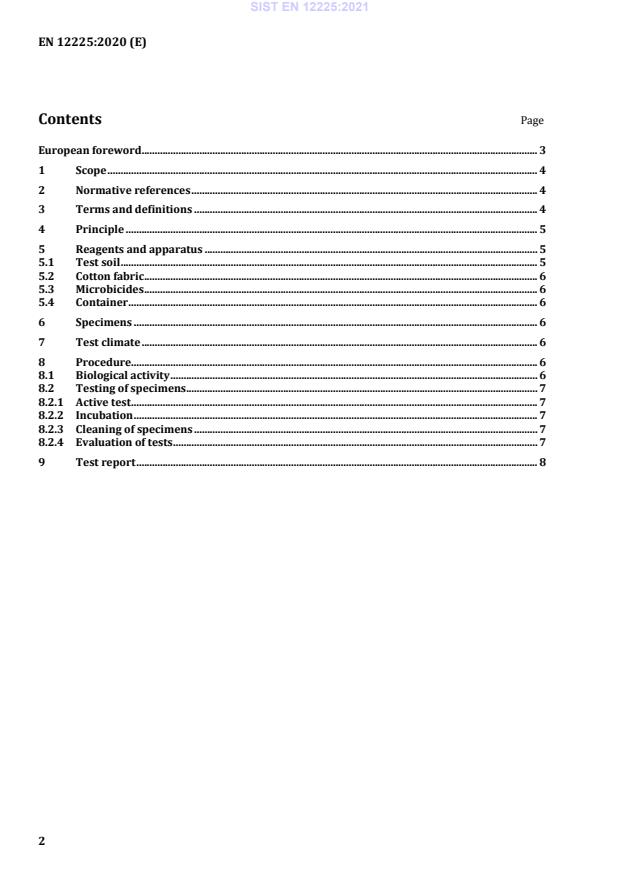
Contents Page
European foreword . 3
1 Scope . 4
2 Normative references . 4
3 Terms and definitions . 4
4 Principle . 5
5 Reagents and apparatus . 5
5.1 Test soil . 5
5.2 Cotton fabric . 6
5.3 Microbicides . 6
5.4 Container . 6
6 Specimens . 6
7 Test climate . 6
8 Procedure. 6
8.1 Biological activity . 6
8.2 Testing of specimens . 7
8.2.1 Active test . 7
8.2.2 Incubation . 7
8.2.3 Cleaning of specimens . 7
8.2.4 Evaluation of tests . 7
9 Test report . 8
European foreword
This document (EN 12225:2020) has been prepared by Technical Committee CEN/TC 189
“Geosynthetics”, the secretariat of which is held by NBN.
This European Standard shall be given the status of a national standard, either by publication of an
identical text or by endorsement, at the latest by May 2021, and conflicting national standards shall be
withdrawn at the latest by May 2021.
Attention is drawn to the possibility that some of the elements of this document may be the subject of
patent rights. CEN shall not be held responsible for identifying any or all such patent rights.
This document supersedes EN 12225:2000.
Compared with EN 12225:2000 the following modifications have been made:
— revision of the entire document and adaptation to the current rules of structuring and drafting;
— revision of the normative references in the entire document and Clause 2;
— references to the terminological databases of ISO and IEC included in Clause 3;
— the bibliography has been deleted.
According to the CEN-CENELEC Internal Regulations, the national standards organisations of the
following countries are bound to implement this European Standard: Austria, Belgium, Bulgaria,
Croatia, Cyprus, Czech Republic, Denmark, Estonia, Finland, France, Germany, Greece, Hungary, Iceland,
Ireland, Italy, Latvia, Lithuania, Luxembourg, Malta, Netherlands, Norway, Poland, Portugal, Republic of
North Macedonia, Romania, Serbia, Slovakia, Slovenia, Spain, Sweden, Switzerland, Turkey and the
United Kingdom.
1 Scope
This document specifies a method for the determination of the microbiological resistance of
geosynthetics including those of natural fibres and biodegradable polymers by a soil burial test.
NOTE Experience and exhumation of geosynthetics which had performed successfully, in some cases for
more than two decades, indicate that geosynthetics made out of synthetic materials are generally resistant against
microbial initiated decay. It can therefore be expected that most of these products commercially available at the
present time will pass the soil burial test successfully and it is probably not necessary to submit them all to this
test independent of their function. However, if the requirements for appropriate functioning of the geosynthetics
demand proof of microbiological resistance or if they are manufactured from newly developed polymers whose
resistance is in any doubt, the soil burial test can provide additional information.
2 Normative references
The following documents are referred to in the text in such a way that some or all of their content
constitutes requirements of this document. For dated references, only the edition cited applies. For
undated references, the latest edition of the referenced document (including any amendments) applies.
EN 12226, Geosynthetics — General tests for evaluation following durability testing
EN ISO 291, Plastics — Standard atmospheres for conditioning and testing (ISO 291)
EN ISO 11721-1:2001, Textiles — Determination of the resistance of cellulose-containing textiles to micro-
organisms — Soil burial test — Part 1: Assessment of rot-retardant finishing (ISO 11721-1:2001)
EN ISO 13934-1, Textiles — Tensile properties of fabrics — Part 1: Determination of maximum force and
elongation at maximum force using the strip method (ISO 13934-1)
3 Terms and definitions
For the purposes of this document, the following terms and definitions apply.
ISO and IEC maintain terminological databases for use in standardization at the following addresses:
— IEC Elec
...