


SIST-TS CEN/TS 17977:2024
(Main)Gas infrastructure - Quality of gas - Hydrogen used in rededicated gas systems
Gas infrastructure - Quality of gas - Hydrogen used in rededicated gas systems
This document defines the quality of gaseous hydrogen, i.e. its parameters and limiting values, to be transmitted, injected into and extracted from storages, distributed and utilized in fully and/or partially rededicated gas infrastructure and connected applications in a safe way.
This document gives evidence to the end-user which minimum exit hydrogen quality can be expected and ensured from natural gas infrastructure as minimum requirement and without further purification.
NOTE 1 The rededicated gas infrastructure can include new parts of this infrastructure constructed/added after the conversion of the natural gas grid.
NOTE 2 It is expected that over time the hydrogen delivered through such pipework will improve in quality, e.g. due to the increase in share of high purity hydrogen produced by electrolysis This will be taken into account in further development of this document.
Gasinfrastruktur - Beschaffenheit von Gas - Wasserstoff zur Nutzung in umgestellten Gassystemen
Dieses Dokument definiert die Qualität von gasförmigem Wasserstoff, d. h. dessen Parameter und Grenzwerte, der auf sichere Weise zu transportieren ist, in Speicher einzuspeisen und aus Speichern zu entnehmen ist, und in vollständig und/oder teilweise umgestellten Gasinfrastrukturen und damit zusammenhängenden Anwendungen zu verteilen und zu nutzen ist.
Dieses Dokument liefert dem Endverbraucher Aufschluss darüber, welche Mindestqualität des austretenden Wasserstoffs erwartet werden kann und von der Erdgasinfrastruktur als Mindestanforderung, ohne zusätzliche Reinigung, sichergestellt werden kann.
ANMERKUNG 1 Die umgestellte Gasinfrastruktur kann neue Teile dieser Infrastruktur umfassen, die nach der Umstellung des Erdgasnetzes erbaut/hinzugefügt wurden.
ANMERKUNG 2 Es wird erwartet, dass sich die Qualität des durch diese Rohrleitungen gelieferten Wasserstoffs im Laufe der Zeit verbessert, z. B. infolge eines steigenden Anteils an hochreinem, durch Elektrolyse hergestelltem Wasserstoff. Dies wird bei der Weiterentwicklung dieses Dokuments beachtet.
Infrastructures gazières - Qualité du gaz - Hydrogène utilisé dans des réseaux de gaz convertis
Le présent document définit la qualité de l’hydrogène gazeux (c’est-à-dire ses paramètres et ses valeurs limites) qui est destiné à être transporté, injecté dans les stockages, extrait des stockages, et distribué et utilisé dans les infrastructures gazières entièrement et/ou partiellement converties ainsi que dans les applications connectées, tout cela en toute sécurité.
Ce document apporte la preuve à l’utilisateur final de la qualité minimale d’hydrogène de sortie qui peut être attendue et assurée par l’infrastructure de gaz naturel comme exigence minimale et sans purification supplémentaire.
NOTE 1 L’infrastructure gazière convertie peut inclure toutes nouvelles parties de cette infrastructure construites/ajoutées après la conversion du réseau de gaz naturel.
NOTE 2 Il est prévu qu’au fil du temps, la qualité de l’hydrogène livré par ces canalisations s’améliore, par exemple en raison de l’augmentation de la part d’hydrogène de haute pureté produit par électrolyse. Il en sera tenu compte dans la suite de l’élaboration du présent document.
Infrastruktura za plin - Kakovost plina - Uporaba vodika v prilagojenih plinskih sistemih
Ta dokument določa kakovost uplinjenega vodika, tj. njegove parametre in mejne vrednosti, za varen prenos, vnos v vsebnike in odstranitev iz njih, distribucijo in uporabo v povsem in/ali delno prenovljeni infrastrukturi za plin in povezane načine uporabe.
Ta dokument vsebuje dokaze za končnega uporabnika o tem, katero najmanjšo izhodno kakovost vodika je mogoče pričakovati in jo zagotavlja infrastruktura za zemeljski plin kot minimalno zahtevo in brez dodatnega prečiščevanja.
OPOMBA 1: Prenovljena infrastruktura za plin lahko vključuje nove dele, ki so bili izdelani/dodani po pretvorbi omrežja za zemeljski plin.
OPOMBA 2: Sčasoma gre pričakovati, da bo vodik, ki se ga dovaja po tovrstnem cevovodu, boljše kakovosti, npr. zaradi večjega deleža vodika visoke čistosti zaradi postopka elektrolize. To bo upoštevano v nadaljnjem razvoju tega dokumenta.
General Information
- Status
- Published
- Public Enquiry End Date
- 02-Jul-2023
- Publication Date
- 19-Dec-2023
- Technical Committee
- DPL - Gas supply
- Current Stage
- 6060 - National Implementation/Publication (Adopted Project)
- Start Date
- 16-Nov-2023
- Due Date
- 21-Jan-2024
- Completion Date
- 20-Dec-2023
Overview
The SIST-TS CEN/TS 17977:2024 standard, titled Gas infrastructure - Quality of gas - Hydrogen used in rededicated gas systems, is a key technical specification developed by the European Committee for Standardization (CEN). It defines the quality parameters and limiting values for gaseous hydrogen specifically used in gas infrastructure systems that have been fully or partially rededicated from natural gas to hydrogen. This includes hydrogen that is transmitted, stored, injected, distributed, and extracted through rededicated or adapted pipelines and connected applications, ensuring safety and reliability across the entire value chain.
This document establishes minimum hydrogen quality requirements that end-users can expect from natural gas infrastructure without requiring further purification. It also supports the safe and effective integration of hydrogen into existing gas networks, facilitating the European hydrogen strategy and enabling cross-border hydrogen trade.
Key Topics
- Hydrogen Quality Parameters:
The standard specifies critical gas quality characteristics, including a minimum hydrogen content of 98 mol-% and strict limits on contaminants such as oxygen, carbon monoxide, carbon dioxide, sulfur compounds, ammonia, halogenated compounds, particulate matter, and hydrocarbons. - Wobbe Index and Calorific Value:
It defines acceptable ranges for the Wobbe Index (42.0 – 46.0 MJ/m³ at 15 °C/15 °C) to ensure consistent energy content and combustion properties suitable for downstream applications. - Contaminants and Impurities:
Limits on contaminants reflect the influence of the infrastructure’s previous use for natural gas, addressing legacy residues such as odorants, sulfur compounds, and other inert gases. - Reference Conditions:
Measurements and calculations adhere to ISO standard reference conditions (15 °C, 1013.25 mbar) to maintain consistency across testing and reporting. - Infrastructure Adaptation:
The standard covers both existing and newly added infrastructure components post-rededication, emphasizing safety assessments and suitability for hydrogen conveyance. - Quality Evolution Over Time:
Annexes highlight that hydrogen purity is expected to improve with ongoing use of rededicated pipelines as contaminants from previous natural gas use diminish, and the share of high-purity hydrogen increases due to advances in production technologies like electrolysis.
Applications
- Hydrogen Transmission and Distribution:
Ensures the clean and safe transportation of hydrogen gas through converted natural gas grids, supporting decarbonization strategies in energy systems and industrial sectors. - Industrial End-Use:
Provides quality assurances for hydrogen supply used in industrial processes, gas turbines, gas engines, and chemical synthesis, reducing the risk of infrastructure damage or process inefficiencies. - Storage and Injection:
Facilitates safe injection and extraction of hydrogen into gas storage facilities integrated within the rededicated network. - Energy Sector Transition:
Supports the gradual shift from fossil-based natural gas systems to hydrogen-based energy infrastructure, aligning with national and European climate targets. - Safety and Reliability Assessment:
Encourages operators to perform thorough risk assessments when adapting infrastructures for hydrogen use, helping to prevent material degradation and operational hazards.
Related Standards
- EN 16726: Provides foundational parameters influencing the hydrogen quality criteria adopted in this document.
- EN ISO 13443: Standardizes reference conditions for natural gas measurement, used here for hydrogen volume and energy calculations.
- EN ISO 6976: Defines methods for calculating gross calorific value and Wobbe Index relevant to hydrogen gas composition.
- ISO 21087: Specifies test methods for assessing hydrogen purity and contaminants.
- EN 17124:2022: Addresses hydrogen quality specifically for fuel cell applications, complementing CEN/TS 17977 for different end-use scenarios.
- Upcoming standards such as ISO 19880-9 (under preparation) provide sampling principles for hydrogen quality control within gas networks.
SIST-TS CEN/TS 17977:2024 serves as a cornerstone for integrating hydrogen into existing European gas infrastructure by defining coherent quality standards, ensuring operational safety, and enabling the efficient deployment of hydrogen as a key energy carrier in transitioning to a sustainable energy future. It facilitates collaboration among producers, system operators, end-users, and policymakers to harmonize hydrogen quality requirements compatible with rededicated gas systems.

Frequently Asked Questions
SIST-TS CEN/TS 17977:2024 is a technical specification published by the Slovenian Institute for Standardization (SIST). Its full title is "Gas infrastructure - Quality of gas - Hydrogen used in rededicated gas systems". This standard covers: This document defines the quality of gaseous hydrogen, i.e. its parameters and limiting values, to be transmitted, injected into and extracted from storages, distributed and utilized in fully and/or partially rededicated gas infrastructure and connected applications in a safe way. This document gives evidence to the end-user which minimum exit hydrogen quality can be expected and ensured from natural gas infrastructure as minimum requirement and without further purification. NOTE 1 The rededicated gas infrastructure can include new parts of this infrastructure constructed/added after the conversion of the natural gas grid. NOTE 2 It is expected that over time the hydrogen delivered through such pipework will improve in quality, e.g. due to the increase in share of high purity hydrogen produced by electrolysis This will be taken into account in further development of this document.
This document defines the quality of gaseous hydrogen, i.e. its parameters and limiting values, to be transmitted, injected into and extracted from storages, distributed and utilized in fully and/or partially rededicated gas infrastructure and connected applications in a safe way. This document gives evidence to the end-user which minimum exit hydrogen quality can be expected and ensured from natural gas infrastructure as minimum requirement and without further purification. NOTE 1 The rededicated gas infrastructure can include new parts of this infrastructure constructed/added after the conversion of the natural gas grid. NOTE 2 It is expected that over time the hydrogen delivered through such pipework will improve in quality, e.g. due to the increase in share of high purity hydrogen produced by electrolysis This will be taken into account in further development of this document.
SIST-TS CEN/TS 17977:2024 is classified under the following ICS (International Classification for Standards) categories: 27.075 - Hydrogen technologies; 75.180.01 - Equipment for petroleum and natural gas industries in general. The ICS classification helps identify the subject area and facilitates finding related standards.
SIST-TS CEN/TS 17977:2024 is available in PDF format for immediate download after purchase. The document can be added to your cart and obtained through the secure checkout process. Digital delivery ensures instant access to the complete standard document.
Standards Content (Sample)
SLOVENSKI STANDARD
01-februar-2024
Infrastruktura za plin - Kakovost plina - Uporaba vodika v prilagojenih plinskih
sistemih
Gas infrastructure - Quality of gas - Hydrogen used in rededicated gas systems
Gasinfrastruktur - Beschaffenheit von Gas - Wasserstoff zur Nutzung in umgestellten
Gassystemen
Infrastructures gazières - Qualité du gaz - Hydrogène utilisé dans des réseaux de gaz
convertis
Ta slovenski standard je istoveten z: CEN/TS 17977:2023
ICS:
27.075 Tehnologija vodika Hydrogen technologies
75.180.01 Oprema za industrijo nafte in Equipment for petroleum and
zemeljskega plina na splošno natural gas industries in
general
2003-01.Slovenski inštitut za standardizacijo. Razmnoževanje celote ali delov tega standarda ni dovoljeno.
CEN/TS 17977
TECHNICAL SPECIFICATION
SPÉCIFICATION TECHNIQUE
November 2023
TECHNISCHE SPEZIFIKATION
ICS 75.180.01; 27.075
English Version
Gas infrastructure - Quality of gas - Hydrogen used in
rededicated gas systems
Infrastructures gazières - Qualité du gaz - Hydrogène Gasinfrastruktur - Beschaffenheit von Gas -
utilisé dans des réseaux de gaz convertis Wasserstoff zur Nutzung in umgestellten Gassystemen
This Technical Specification (CEN/TS) was approved by CEN on 28 August 2023 for provisional application.
The period of validity of this CEN/TS is limited initially to three years. After two years the members of CEN will be requested to
submit their comments, particularly on the question whether the CEN/TS can be converted into a European Standard.
CEN members are required to announce the existence of this CEN/TS in the same way as for an EN and to make the CEN/TS
available promptly at national level in an appropriate form. It is permissible to keep conflicting national standards in force (in
parallel to the CEN/TS) until the final decision about the possible conversion of the CEN/TS into an EN is reached.
CEN members are the national standards bodies of Austria, Belgium, Bulgaria, Croatia, Cyprus, Czech Republic, Denmark, Estonia,
Finland, France, Germany, Greece, Hungary, Iceland, Ireland, Italy, Latvia, Lithuania, Luxembourg, Malta, Netherlands, Norway,
Poland, Portugal, Republic of North Macedonia, Romania, Serbia, Slovakia, Slovenia, Spain, Sweden, Switzerland, Türkiye and
United Kingdom.
EUROPEAN COMMITTEE FOR STANDARDIZATION
COMITÉ EUROPÉEN DE NORMALISATION
EUROPÄISCHES KOMITEE FÜR NORMUNG
CEN-CENELEC Management Centre: Rue de la Science 23, B-1040 Brussels
© 2023 CEN All rights of exploitation in any form and by any means reserved Ref. No. CEN/TS 17977:2023 E
worldwide for CEN national Members.
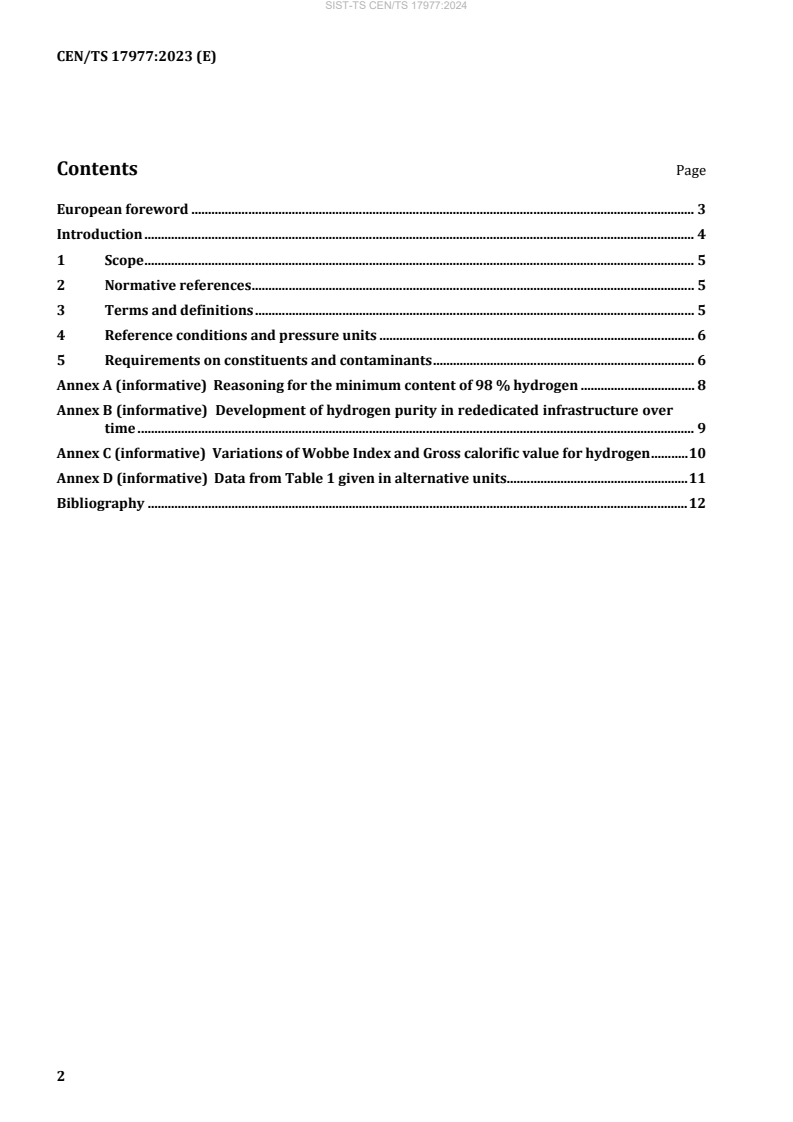
Contents Page
European foreword . 3
Introduction . 4
1 Scope . 5
2 Normative references . 5
3 Terms and definitions . 5
4 Reference conditions and pressure units . 6
5 Requirements on constituents and contaminants . 6
Annex A (informative) Reasoning for the minimum content of 98 % hydrogen . 8
Annex B (informative) Development of hydrogen purity in rededicated infrastructure over
time . 9
Annex C (informative) Variations of Wobbe Index and Gross calorific value for hydrogen . 10
Annex D (informative) Data from Table 1 given in alternative units. 11
Bibliography . 12
European foreword
This document (CEN/TS 17977:2023) has been prepared by Technical Committee CEN/TC 234 “Gas
infrastructure”, the secretariat of which is held by DIN.
Attention is drawn to the possibility that some of the elements of this document may be the subject of
patent rights. CEN shall not be held responsible for identifying any or all such patent rights.
Any feedback and questions on this document should be directed to the users’ national standards body.
A complete listing of these bodies can be found on the CEN website.
According to the CEN-CENELEC Internal Regulations, the national standards organizations of the
following countries are bound to announce this Technical Specification: Austria, Belgium, Bulgaria,
Croatia, Cyprus, Czech Republic, Denmark, Estonia, Finland, France, Germany, Greece, Hungary, Iceland,
Ireland, Italy, Latvia, Lithuania, Luxembourg, Malta, Netherlands, Norway, Poland, Portugal, Republic of
North Macedonia, Romania, Serbia, Slovakia, Slovenia, Spain, Sweden, Switzerland, Türkiye and the
United Kingdom.
Introduction
This document for hydrogen in rededicated gas systems takes into account the condition of existing
piping with possible presence of liquid and solid deposits influencing the hydrogen quality.
Many parameters given in this document are deduced from EN 16726.
This document is the first edition and reflects the current situation, taking into account the existing grid,
see Annex B. It is expected that over time the hydrogen delivered through such pipework will improve
in quality. This will be taken into account in further development of the document.
This document is supposed to balance the requirements of gaseous hydrogen for the producer, the
different grid operators and the end-users, respectively in order to set- up a reliable backbone of future
energy supply which is (partly) based on using rededicated gas infrastructure. As a consequence, on-
site pre-treatment cannot be excluded for applications and/or processes with specific stringent
requirements.
The proposed parameters are verified by German project results (HyQual) which have been consulted
in combination with end-users' specifications. In the project, different sources of hydrogen have been
evaluated, including pyrolysis, steam reforming, electrolysis (Chlorine-Alkaline process and water
electrolysis). Furthermore, the proposal takes biological hydrogen production process into account.
Also, the results of the Work Package 9 of the EC-CEN/GERG PNR project ‘Removing the technical
barriers to use of hydrogen in natural gas networks and for (natural) gas end users’ have been taken
into account.
This document supports the whole value chain (producers, system operators, other related services,
end-users) to produce, transport, store, deliver and/or use hydrogen in a possibly rededicated (or
adapted) natural gas infrastructure and connected applications in a safe way in the CEN member
countries and where applicable, without the risk to harm or damage the infrastructure or connected
user applications.
However, it is recognized that some end-users are sensitive to some gas quality parameters and
impurities. In these cases, purification measures can be needed, for upgrading the hydrogen quality.
This document supports the implementation of the hydrogen strategy on European and national level
and will accordingly facilitate the trade of hydrogen across entire Europe.
In the context of this document, the following aspects require close co-operation respectively co-
ordination with other TCs (CEN-CLC/JTC 6, CEN/TC 268, ISO/TC 197, TCs for equipment and
application):
— taking into account both natural gas systems and new built hydrogen systems;
— hydrogen qualities for fuel cell applications EN 17124:2022 (CEN/TC 268 WG 5, legally binding in
some countries, e.g. DE).
1 Scope
This document defines the quality of gaseous hydrogen, i.e. its parameters and limiting values, to be
transmitted, injected into and extracted from storages, distributed and utilized in fully and/or partially
rededicated gas infrastructure and connected applications in a safe way.
This document gives evidence to the end-user which minimum exit hydrogen quality can be expected
and ensured from natural gas infrastructure as minimum requirement and without further purification.
NOTE 1 The rededicated gas infrastructure can include new parts of this infrastructure constructed/added
after the conversion of the natural gas grid.
NOTE 2 It is expected that over time the hydrogen delivered through such pipework will improve in quality,
e.g. due to the increase in share of high purity hydrogen produced by electrolysis. This will be taken into account
in further development of this document.
2 Normative references
The following documents are referred to in the text in such a way that some or all of their content
constitutes requirements of this document. For dated references, only the edition cited applies. For
undated references, the latest edition of the referenced document (including any amendments) applies.
EN ISO 13443, Natural gas - Standard reference conditions (ISO 13443)
3 Terms and definitions
For the purposes of this document, the following terms and definitions apply.
ISO and IEC maintain terminology databases for use in standardization at the following addresses:
— ISO Online browsing platform: available at https://www.iso.org/obp/
— IEC Electropedia: available at https://www.electropedia.org/
3.1
rededicated gas system
repurposed gas system
gas infrastructure originally used to convey or store gases of the first and second family which will be
used from the time of rededication for other fluids as e. g. hydrogen. It can include new parts of
infrastructure constructed/added after the conversion of the natural gas grid
Note 1 to entry: After a safety and reliability assessment the components of the infrastructure should be found
suited for conveying hydrogen.
3.2
hydrogen
gaseous hydrogen with a certain purity as described in Clause 5
Note 1 to entry: The definition is focussing the purpose of this document.
3.3
exit point
point at which gas leaves the gas transmission or distribution system for end-use
SIST
...
Questions, Comments and Discussion
Ask us and Technical Secretary will try to provide an answer. You can facilitate discussion about the standard in here.
Loading comments...