

oSIST prEN 16852:2026
(Main)Foodstuffs - Determination of ethyl carbamate in stone fruit spirits, fruit marc spirits and other spirit drinks - GC-MS method
- Abstract
This European Standard specifies a gas chromatographic method using mass spectrometric detection for the determination of ethyl carbamate (EC) in stone fruit spirits, fruit marc spirits and other spirit drinks.
The method has been validated in an interlaboratory study for stone fruit spirits and fruit liqueurs, at levels ranging from 0,253 mg/l to 1,11 mg/l. However, linearity of the instrument response was proven for the concentration ranges 0,10 mg/l to 4,0 mg/l (simplified method) and 0,025 mg/l to 3,0 mg/l (procedure including sample clean-up), respectively.
- Status
- Not Published
- Public Enquiry End Date
- 30-Dec-2026
- Technical Committee
- KŽP - Agricultural food products
- Current Stage
- 4020 - Public enquire (PE) (Adopted Project)
- Start Date
- 02-Nov-2026
- Due Date
- 22-Mar-2027

Relations
- Effective Date
- 09-Feb-2026
Get Certified
Connect with accredited certification bodies for this standard

BSI Group
BSI (British Standards Institution) is the business standards company that helps organizations make excellence a habit.

Bureau Veritas
Bureau Veritas is a world leader in laboratory testing, inspection and certification services.

DNV
DNV is an independent assurance and risk management provider.
Sponsored listings
Frequently Asked Questions
oSIST prEN 16852:2026 is a draft published by the Slovenian Institute for Standardization (SIST). Its full title is "Foodstuffs - Determination of ethyl carbamate in stone fruit spirits, fruit marc spirits and other spirit drinks - GC-MS method". This standard covers: This European Standard specifies a gas chromatographic method using mass spectrometric detection for the determination of ethyl carbamate (EC) in stone fruit spirits, fruit marc spirits and other spirit drinks. The method has been validated in an interlaboratory study for stone fruit spirits and fruit liqueurs, at levels ranging from 0,253 mg/l to 1,11 mg/l. However, linearity of the instrument response was proven for the concentration ranges 0,10 mg/l to 4,0 mg/l (simplified method) and 0,025 mg/l to 3,0 mg/l (procedure including sample clean-up), respectively.
This European Standard specifies a gas chromatographic method using mass spectrometric detection for the determination of ethyl carbamate (EC) in stone fruit spirits, fruit marc spirits and other spirit drinks. The method has been validated in an interlaboratory study for stone fruit spirits and fruit liqueurs, at levels ranging from 0,253 mg/l to 1,11 mg/l. However, linearity of the instrument response was proven for the concentration ranges 0,10 mg/l to 4,0 mg/l (simplified method) and 0,025 mg/l to 3,0 mg/l (procedure including sample clean-up), respectively.
oSIST prEN 16852:2026 is classified under the following ICS (International Classification for Standards) categories: 67.160.10 - Alcoholic beverages. The ICS classification helps identify the subject area and facilitates finding related standards.
oSIST prEN 16852:2026 has the following relationships with other standards: It is inter standard links to SIST EN 16852:2017. Understanding these relationships helps ensure you are using the most current and applicable version of the standard.
oSIST prEN 16852:2026 is associated with the following European legislation: EU Directives/Regulations: 882/2004; Standardization Mandates: M/463. When a standard is cited in the Official Journal of the European Union, products manufactured in conformity with it benefit from a presumption of conformity with the essential requirements of the corresponding EU directive or regulation.
oSIST prEN 16852:2026 is available in PDF format for immediate download after purchase. The document can be added to your cart and obtained through the secure checkout process. Digital delivery ensures instant access to the complete standard document.
Standards Content (Sample)
SLOVENSKI STANDARD
01-december-2026
Živila - Ugotavljanje etil karbamata v žganju iz koščičastega sadja, sadnih tropin in
v drugih žganih pijačah - Metoda GC-MS
Foodstuffs - Determination of ethyl carbamate in stone fruit spirits, fruit marc spirits and
other spirit drinks - GC-MS method
Lebensmittel - Bestimmung von Ethylcarbamat in Steinobstbränden, Bränden aus
Obsttrester und anderen Spirituosen - GC-MS-Verfahren
Produits alimentaires - Détermination de la teneur en carbamate d'éthyle dans les eaux-
de-vie de fruits à noyaux, les eaux-de-vie de marc de fruits et les autres boissons
alcoolisées - Méthode par CG-SM
Ta slovenski standard je istoveten z: prEN 16852
ICS:
67.160.10 Alkoholne pijače Alcoholic beverages
2003-01.Slovenski inštitut za standardizacijo. Razmnoževanje celote ali delov tega standarda ni dovoljeno.
DRAFT
EUROPEAN STANDARD
NORME EUROPÉENNE
EUROPÄISCHE NORM
October 2026
ICS 67.160.10 Will supersede EN 16852:2017
English Version
Foodstuffs - Determination of ethyl carbamate in stone
fruit spirits, fruit marc spirits and other spirit drinks - GC-
MS method
Produits alimentaires - Détermination de la teneur en Lebensmittel - Bestimmung von Ethylcarbamat in
carbamate d'éthyle dans les eaux-de-vie de fruits à Steinobstbränden, Bränden aus Obsttrester und
noyaux, les eaux-de-vie de marc de fruits et les autres anderen Spirituosen - GC-MS-Verfahren
boissons alcoolisées - Méthode par CG-SM
This draft European Standard is submitted to CEN members for enquiry. It has been drawn up by the Technical Committee
CEN/TC 275.
If this draft becomes a European Standard, CEN members are bound to comply with the CEN/CENELEC Internal Regulations
which stipulate the conditions for giving this European Standard the status of a national standard without any alteration.
This draft European Standard was established by CEN in three official versions (English, French, German). A version in any other
language made by translation under the responsibility of a CEN member into its own language and notified to the CEN-CENELEC
Management Centre has the same status as the official versions.
CEN members are the national standards bodies of Austria, Belgium, Bulgaria, Croatia, Cyprus, Czech Republic, Denmark, Estonia,
Finland, France, Germany, Greece, Hungary, Iceland, Ireland, Italy, Latvia, Lithuania, Luxembourg, Malta, Netherlands, Norway,
Poland, Portugal, Republic of North Macedonia, Romania, Serbia, Slovakia, Slovenia, Spain, Sweden, Switzerland, Türkiye and
United Kingdom.
Recipients of this draft are invited to submit, with their comments, notification of any relevant patent rights of which they are
aware and to provide supporting documentation.
Warning : This document is not a European Standard. It is distributed for review and comments. It is subject to change without
notice and shall not be referred to as a European Standard.
EUROPEAN COMMITTEE FOR STANDARDIZATION
COMITÉ EUROPÉEN DE NORMALISATION
EUROPÄISCHES KOMITEE FÜR NORMUNG
CEN-CENELEC Management Centre: Rue de la Science 23, B-1040 Brussels
© 2026 CEN All rights of exploitation in any form and by any means reserved Ref. No. prEN 16852:2026 E
worldwide for CEN national Members.
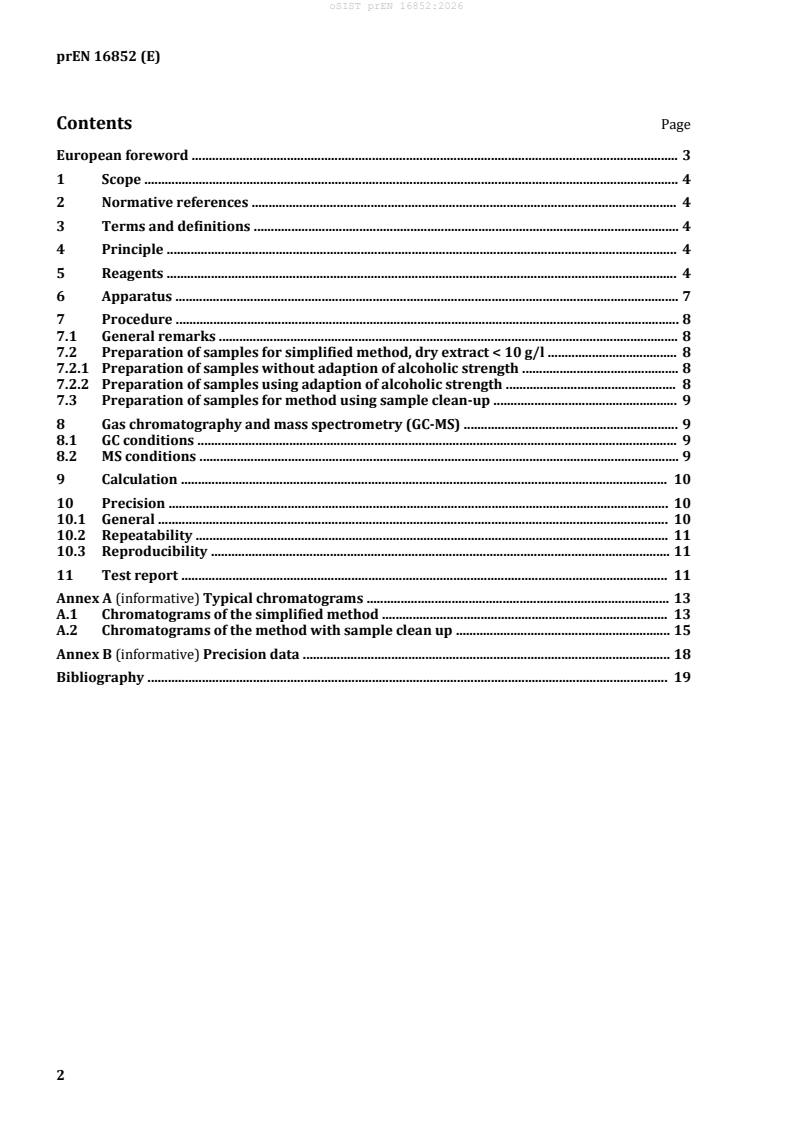
Contents Page
European foreword . 3
1 Scope . 4
2 Normative references . 4
3 Terms and definitions . 4
4 Principle . 4
5 Reagents . 4
6 Apparatus . 7
7 Procedure . 8
7.1 General remarks . 8
7.2 Preparation of samples for simplified method, dry extract < 10 g/l . 8
7.2.1 Preparation of samples without adaption of alcoholic strength . 8
7.2.2 Preparation of samples using adaption of alcoholic strength . 8
7.3 Preparation of samples for method using sample clean-up . 9
8 Gas chromatography and mass spectrometry (GC-MS) . 9
8.1 GC conditions . 9
8.2 MS conditions . 9
9 Calculation . 10
10 Precision . 10
10.1 General . 10
10.2 Repeatability . 11
10.3 Reproducibility . 11
11 Test report . 11
Annex A (informative) Typical chromatograms . 13
A.1 Chromatograms of the simplified method . 13
A.2 Chromatograms of the method with sample clean up . 15
Annex B (informative) Precision data . 18
Bibliography . 19
European foreword
This document (prEN 16852:2026) has been prepared by Technical Committee CEN/TC 275 "Food
analysis - Horizontal methods", the secretariat of which is held by DIN.
This document is currently submitted to the CEN Enquiry.
This document will supersede EN 16852:2017.
— Removed normative references from the document;
— added purity and CAS numbers for several substances in the reagents clause;
— included option to use different weights for standard substances or commercially available
standard solutions;
— added new clause 5.22 with information on quality control;
— removed recommendation about PTV injector for the GC device;
— included an optional sample preparation without the adjustment of the alcoholic strength;
— amended ethyl carbamate concentrations of the calibration solutions in Table 2;
— added an option for an additional qualifiér ion;
— added a calculation formula for the method with SPE clean-up;
— removed reference to ISO 17025 regarding test report requirements;
— added the alcoholic strength for matrices used in the method validation study;
— full editorial revision.
1 Scope
This European Standard spécifiés a gas chromatographic method using mass spectrometric detection
for the determination of ethyl carbamate (EC) in stone fruit spirits, fruit marc spirits and other spirit
drinks.
The method has been validated in an interlaboratory study for stone fruit spirits and fruit liqueurs, at
levels ranging from 0,253 mg/l to 1,11 mg/l. However, linearity of the instrument response was proven
for the concentration ranges 0,10 mg/l to 4,0 mg/l (simplifiéd method) and 0,025 mg/l to 3,0 mg/l
(procedure including sample clean-up), respectively.
2 Normative references
There are no normative references in this document.
3 Terms and definitions
No terms and définitions are listed in this document.
• ISO Online browsing platform: available at http://www.iso.org/obp
• IEC Electropedia: available at http://www.electropedia.org/
4 Principle
Samples with a content of total dry extract of less than 10 g/l are injected directly into the gas
chromatography mass spectrometry (GC-MS) system after the addition of internal standard (ISTD), and
optionally after the adjustment of the alcoholic strength of the beverage. Samples with a higher total
dry extract are first transferred onto a solid phase extraction (SPE) cartridge and the ethyl carbamate
is eluted with a mixture of cyclohexane and ethyl acetate.
Stone fruit spirits can contain precursors of ethyl carbamate which get transformed into EC under the
influéncé of sunlight, e.g. during the shelf life of a spirit. To obtain the actual content of EC in the sample,
light-protected glass ware (e.g. brown glass) shall be used during the analysis.
5 Reagents
Use only reagents of recognized analytical grade, including deionized water, unless otherwise spécifiéd.
Solvents shall be of quality for HPLC (High Performance Liquid Chromatography) analysis.
In the preparation of solutions, other amounts can also be used respecting the given accuracy.
Commercially available solutions may also be used.
Ethyl carbamate has been classifiéd by IARC as probably carcinogenic to humans (see [1]).
5.1 Ethanol absolute, ≥ 99 %.
5.2 Ethanol solution, volume fraction φ = 65 %.
Pipet 65 ml of ethanol (5.1) into a 100 ml volumetric flask and fill to the mark with water.
5.3 Ethanol solution, φ = 35 %.
Pipet 35 ml of ethanol (5.1) into a 100 ml volumetric flask and fill to the mark with water.
5.4 Cyclohexane.
5.5 Ethyl acetate.
5.6 Eluant, cyclohexane + ethylacetate, V + V , 1+1.
1 2
5.7 n-Pentane.
5.8 Solid phase material.
Approximately 20 g of a chemically inert, wide-pore and highly pure diatomaceous earth based solid
® 1
phase, e.g. Extrelut NT
5.9 Sodium chloride.
5.10 Ethyl carbamate, ≥ 99 %, CAS 51-79-6.
5.11 Butyl carbamate, ≥ 98 %, CAS 592-35-8.
5.12 d -Ethyl carbamate, ≥ 98% chemical purity, ≥ 99% isotopic purity, CAS 73962-07-9.
5.13 Ethyl carbamate stock solution, mass concentration ρ(EC) = 1 000 mg/l.
Weigh to the nearest 0,01 mg, 50 mg of ethyl carbamate (5.10) into a 50 ml volumetric flask and fill to
the mark with ethanol (5.1).
5.14 Ethyl carbamate working solution 1, ρ(EC) = 100 mg/l.
Pipet 5 ml of ethyl carbamate stock solution (5.13) into a 50 ml volumetric flask and dilute to the mark
with ethanol (5.1).
5.15 Ethyl carbamate working solution 2, ρ(EC) = 10 mg/l.
Pipet 5 ml of ethyl carbamate working solution 1 (5.14) into a 50 ml volumetric flask and dilute to the
mark with ethanol (5.1).
5.16 Butyl carbamate stock solution, ρ(BC) = 1 000 mg/l.
Weigh to the nearest 0,01 mg, 50 mg of butyl carbamate (5.11) into a 50 ml volumetric flask and fill to
the mark with ethanol (5.1).
5.17 Butyl carbamate working solution, ρ(BC) = 40 mg/l.
Pipet 2 ml of butyl carbamate stock solution (5.16) into a 50 ml volumetric flask. Add 33 ml of ethanol
(5.1) and dilute to the mark with water.
5.18 d -Ethyl carbamate stock solution, ρ(d5-EC) = 1 000 mg/l.
Weigh to the nearest 0,01 mg, 50 mg of d -ethyl carbamate (5.12) into a 50 ml volumetric flask and fill
to the mark with ethanol (5.1).
5.19 d -Ethyl carbamate working solution, ρ(d5-EC) = 40 mg/l.
Pipet 2 ml of d -ethyl carbamate stock solution (5.18) into a 50 ml volumetric flask. Add 33 ml of ethanol
(5.1) and dilute to the mark with water.
5.20 Ethyl carbamate standard solutions for simplified method, dry extract < 10 g/l.
The ethyl carbamate standard solutions for the simplifiéd method can be prepared according to Table
1. A minimum of 6 standard solutions shall be prepared.
This information is given for the convenience of users of this European Standard and does not constitute an
endorsement by CEN of these products. Equivalent products may be used if they can be shown to lead to the same
results.
In principle it is possible to prepare the ethyl carbamate standard solutions to an alcoholic strength
with a volume fraction of 40 % or 70 % depending on the GC system.
For example, for an ethyl carbamate standard solution with a volume fraction of 70 %, pipet the amount
of ethyl carbamate working solution (5.14 or 5.15) stated in Table 1 into a 10 ml volumetric flask and
add the corresponding amount of ethanol (5.1). Fill the volumetric flask to the mark with an ethanol
solution with a volume fraction of 65 % (5.2).
For an ethyl carbamate standard solution with a volume fraction of 40 %, use an ethanol solution with
a volume fraction of 35 % (5.3) to fill up the volumetric flasks.
Table 1 — Exemplary preparation of the ethyl carbamate standard solutions for simplified
method
Standard solution EC working solution EC working solution Ethanol (5.1) ρ(EC)
2 (5.15 ) 1 (5.14 )
μl μl μl mg/l
C0 0 - 500 0,00
C1 100 - 400 0,10
C2 200 - 300 0,20
C3 500 - 0 0,50
C4 - 80 420 0,80
C5 - 100 400 1,00
C6 - 200 300 2,00
C7 - 300 200 3,00
C8 - 400 100 4,00
Fill the 10 ml volumetric flasks to the mark and add 0,25 ml of butyl carbamate working solution (5.17)
into each of them with a pipette (to give a total volume of 10,25 ml).
It is very important that the volumes of standard solutions and sample solutions (before an optional
adjustment of the alcoholic strength, see 7.2) are equal. Usually, 10 ml are used.
Mix the solution thoroughly and transfer an aliquot into a GC vial and seal the vial with a septum cap.
5.21 Ethyl carbamate standard solutions for method using sample clean up
The ethyl carbamate standard solutions for the method using sample clean up can be prepared
according to Table 2. A minimum of 6 standard solutions shall be prepared. Seal the GC vial with a septum
cap and mix the content thoroughly.
Table 2 — Exemplary preparation of ethyl carbamate standard solutions for method using
sample clean up
Standard EC working EC working d -EC Ethanol (5.1) ρ(EC) ρ(EC)
solution solution 2 solution 1
working
(in standard (in relation to
(5.15) (5.14)
solution
solution) 20 ml
(5.19)
sample)
μl μl μl μl mg/l mg/l
C0 0 - 100 900 0,00 0,00
C1 50 - 100 850 0,50 0,025
C2 200 - 100 700 2,00 0,10
C3 500 - 100 400 5,00 0,25
---------------------- P
...