

SIST EN 13277-4:2002
(Main)Protective equipment for martial arts - Part 4: Additional requirements and test methods for head protectors
General Information
- Abstract
This European Standard specifies additional requirements and test methods for head protectors without face protection used in unarmed martial arts, such as Taekwondo, Karate, Kick-Boxing and similar disciplines.
It also applies to head protectors used in boxing.
.
- Status
- Published
- Publication Date
- 31-May-2002
- Technical Committee
- OVP - Personal protecting equipment
- Current Stage
- 6060 - National Implementation/Publication (Adopted Project)
- Start Date
- 01-Jun-2002
- Due Date
- 01-Jun-2002
- Completion Date
- 01-Jun-2002
- Directive
- 2016/425 - Regulation (EU) 2016/425 of the European Parliament and of the Council of 9 March 2016 on personal protective equipment and repealing Council Directive 89/686/EECOJ Ref: C 113 OJ Date: 27-Mar-2018
89/686/EEC - Personal protective equipment (PPE)OJ Ref: C 190 OJ Date: 10-Aug-2002


Overview
SIST EN 13277-4:2002 is a European Standard developed by CEN that specifies additional requirements and test methods for head protectors used in unarmed martial arts such as Taekwondo, Karate, Kick-Boxing, and similar disciplines. This standard also applies to head protectors used in boxing. It supplements the general safety requirements and provides detailed guidelines to ensure the effectiveness, comfort, and safety of head protective equipment designed to minimize injury risks during martial arts practice and competition.
This standard is part of a series established to regulate protective equipment for martial arts practitioners, focusing on different body parts to promote harmonized safety measures across Europe.
Key Topics
Scope and Applicability
Head protectors covered by this standard do not include face protection but provide shielding for the front, sides, and rear of the head. It applies principally to equipment used in unarmed combat sports and boxing.Safety and Performance Requirements
- Ergonomics: Head protectors must be easy to put on/take off and fit securely on different head circumferences.
- Openings and Ventilation: Designs must allow environmental connection to the ears for hearing and prevent damage from air pressure caused by blows. Ventilation openings may be included.
- Weight Limits: Maximum mass varies by head size to ensure comfort and practicality without compromising protection (e.g., 360g max for heads <540 mm circumference).
- Field of Vision: The field of vision must be maintained with minimum angles specified vertically and horizontally, ensuring no visual obstruction.
- Restraint Systems: Must securely attach the equipment, allow adjustment, and limit displacement during impacts to less than 5% of head circumference.
- Zone of Protection: The protector must fully cover the head circumference in designated zones to maximize safety.
- Impact Performance: The maximum peak force transmitted during impact testing must not exceed 2 kN, demonstrating the protector’s effectiveness in absorbing shocks.
Test Methods
Detailed testing procedures include sampling, conditioning, field of vision measurement, restraint testing with defined forces and directions, zone of protection assessment, and impact performance testing using calibrated apparatus. Tests involve placing the head protector on standardized headforms and applying controlled forces to simulate combat conditions.Marking and Manufacturer Information
Marking must comply with EN 13277-1:2000, including size indication and safety information. Manufacturers must provide clear instructions on sizing, positioning, and correct use to ensure optimal protection.
Applications
Martial Arts Training and Competition
This standard ensures that head protectors used by martial arts athletes provide reliable protection, crucial for reducing the risk of injury during practice or fights.Boxing Protective Equipment
Headgear designed for boxing, which demands similar levels of protection from impacts without providing face protection, also falls under this standard’s scope.Sports Equipment Certification
Manufacturers and testing laboratories use SIST EN 13277-4:2002 as a benchmark to certify head protectors that meet recognized safety criteria, enhancing consumer trust and compliance with European safety directives.Regulatory Compliance
Sports clubs, associations, and retailers rely on this standard to fulfill legal requirements under European safety regulations (e.g., EU Directive 89/686/EEC), ensuring safe martial arts environments.
Related Standards
EN 13277-1:2000: General requirements and test methods for protective equipment for martial arts - foundational document referenced for terms, definitions, and overarching safety criteria.
EN 13277-2:200x: Additional requirements for instep, shin, and forearm protectors.
EN 13277-3:200x: Additional requirements for trunk protectors.
EN 13277-5:200x: Additional requirements for genital and abdominal protectors.
EN 13277-6:200x: Additional requirements for female breast protectors.
EN 960: Specifies headforms used for testing protective helmets, referenced for impact and fit testing of headgear.
Conclusion
SIST EN 13277-4:2002 is a critical standard for ensuring safety, functionality, and performance of head protectors used in martial arts and boxing. By defining rigorous requirements and standardized test methods regarding ergonomics, impact resistance, vision, and fit, it provides manufacturers, users, and regulators with a clear framework to minimize head injury risks during combat sports activities.
Adherence to this standard enhances athlete protection and supports compliance with European safety directives, promoting safer martial arts practice across Europe and beyond.
Keywords: SIST EN 13277-4:2002, martial arts protective equipment, head protectors standard, Taekwondo safety gear, Karate headgear safety, boxing head protectors, impact test methods, European head protector standards, martial arts injury prevention, protective headgear testing.
Relations
- Effective Date
- 22-Jul-2026
- Effective Date
- 28-Jan-2026
- Effective Date
- 28-Jan-2026
- Effective Date
- 01-Sep-2007
Get Certified
Connect with accredited certification bodies for this standard

CIS Institut d.o.o.
Personal Protective Equipment (PPE) certification body. Notified Body NB-2890 for EU Regulation 2016/425 PPE.

Kiwa BDA Testing
Building and construction product certification.
Kmetijski inštitut Slovenije
Agricultural Institute of Slovenia. Soil testing, plant health, agricultural product analysis.
Sponsored listings
Frequently Asked Questions
SIST EN 13277-4:2002 is a standard published by the Slovenian Institute for Standardization (SIST). Its full title is "Protective equipment for martial arts - Part 4: Additional requirements and test methods for head protectors". This standard covers: This European Standard specifies additional requirements and test methods for head protectors without face protection used in unarmed martial arts, such as Taekwondo, Karate, Kick-Boxing and similar disciplines. It also applies to head protectors used in boxing. .
This European Standard specifies additional requirements and test methods for head protectors without face protection used in unarmed martial arts, such as Taekwondo, Karate, Kick-Boxing and similar disciplines. It also applies to head protectors used in boxing. .
SIST EN 13277-4:2002 is classified under the following ICS (International Classification for Standards) categories: 13.340.20 - Head protective equipment; 97.220.30 - Indoor sports equipment. The ICS classification helps identify the subject area and facilitates finding related standards.
SIST EN 13277-4:2002 has the following relationships with other standards: It is inter standard links to SIST EN 960:2006, SIST EN 13277-1:2001, SIST EN 1422:2000+A1:2009, SIST EN 13277-4:2002/A1:2007. Understanding these relationships helps ensure you are using the most current and applicable version of the standard.
SIST EN 13277-4:2002 is associated with the following European legislation: EU Directives/Regulations: 2016/425, 89/686/EEC; Standardization Mandates: M/031. When a standard is cited in the Official Journal of the European Union, products manufactured in conformity with it benefit from a presumption of conformity with the essential requirements of the corresponding EU directive or regulation.
SIST EN 13277-4:2002 is available in PDF format for immediate download after purchase. The document can be added to your cart and obtained through the secure checkout process. Digital delivery ensures instant access to the complete standard document.
Standards Content (Sample)
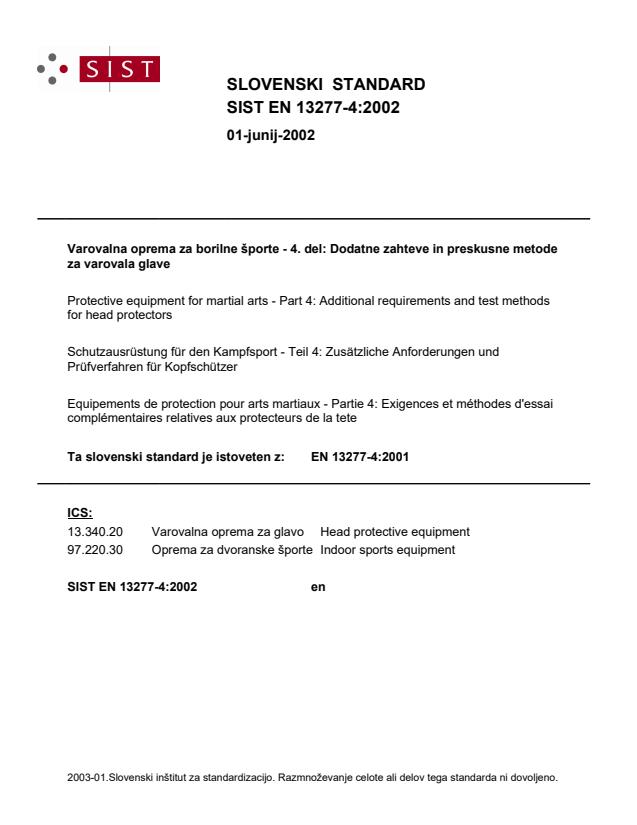
2003-01.Slovenski inštitut za standardizacijo. Razmnoževanje celote ali delov tega standarda ni dovoljeno.Varovalna oprema za borilne športe - 4. del: Dodatne zahteve in preskusne metode za varovala glaveSchutzausrüstung für den Kampfsport - Teil 4: Zusätzliche Anforderungen und Prüfverfahren für KopfschützerEquipements de protection pour arts martiaux - Partie 4: Exigences et méthodes d'essai complémentaires relatives aux protecteurs de la teteProtective equipment for martial arts - Part 4: Additional requirements and test methods for head protectors97.220.30Oprema za dvoranske športeIndoor sports equipment13.340.20Varovalna oprema za glavoHead protective equipmentICS:Ta slovenski standard je istoveten z:EN 13277-4:2001SIST EN 13277-4:2002en01-junij-2002SIST EN 13277-4:2002SLOVENSKI
STANDARD
EUROPEAN STANDARDNORME EUROPÉENNEEUROPÄISCHE NORMEN 13277-4October 2001ICS 13.040.20English versionProtective equipment for martial arts - Part 4: Additionalrequirements and test methods for head protectorsEquipements de protection pour arts martiaux - Partie 4:Exigences et méthodes d'essai complémentaires relativesaux protecteurs de la têteSchutzausrüstung für den Kampfsport - Teil 4: ZusätzlicheAnforderungen und Prüfverfahren für KopfschützerThis European Standard was approved by CEN on 29 September 2001.CEN members are bound to comply with the CEN/CENELEC Internal Regulations which stipulate the conditions for giving this EuropeanStandard the status of a national standard without any alteration. Up-to-date lists and bibliographical references concerning such nationalstandards may be obtained on application to the Management Centre or to any CEN member.This European Standard exists in three official versions (English, French, German). A version in any other language made by translationunder the responsibility of a CEN member into its own language and notified to the Management Centre has the same status as the officialversions.CEN members are the national standards bodies of Austria, Belgium, Czech Republic, Denmark, Finland, France, Germany, Greece,Iceland, Ireland, Italy, Luxembourg, Netherlands, Norway, Portugal, Spain, Sweden, Switzerland and United Kingdom.EUROPEAN COMMITTEE FOR STANDARDIZATIONCOMITÉ EUROPÉEN DE NORMALISATIONEUROPÄISCHES KOMITEE FÜR NORMUNGManagement Centre: rue de Stassart, 36
B-1050 Brussels© 2001 CENAll rights of exploitation in any form and by any means reservedworldwide for CEN national Members.Ref. No. EN 13277-4:2001 ESIST EN 13277-4:2002
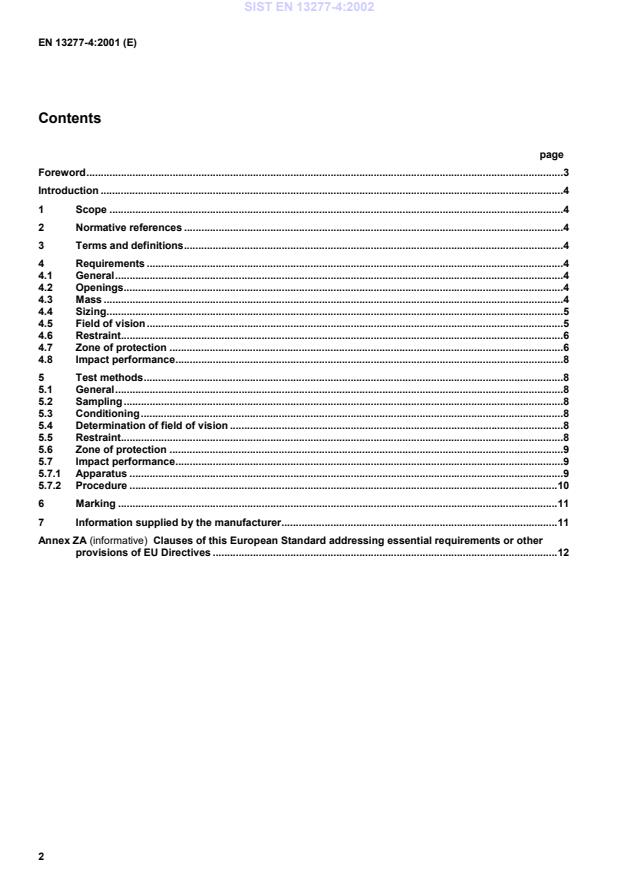
Clauses of this European Standard addressing essential requirements or otherprovisions of EU Directives.12SIST EN 13277-4:2002
General requirements and test methods.Part 2:
Additional requirements and test methods for instep protectors, shin protectors and forearm protectors.Part 3:
Additional requirements and test methods for trunk protectors.Part 4:
Additional requirements and test methods for head protectors.Part 5:
Additional requirements and test methods for genital protectors and abdominal protectors.Part 6:
Additional requirements and test methods for breast protectors for females.This European Standard has been prepared under a mandate given to CEN by the European Commission and theEuropean Free Trade Association, and supports essential requirements of EU Directive(s).For relationship with EU Directive(s), see informative Annex ZA, which is an integral part of this standard.According to the CEN/CENELEC Internal Regulations, the national standards organizations of the followingcountries are bound to implement this European Standard: Austria, Belgium, Czech Republic, Denmark, Finland,France, Germany, Greece, Iceland, Ireland, Italy, Luxembourg, Netherlands, Norway, Portugal, Spain, Sweden,Switzerland and the United Kingdom.SIST EN 13277-4:2002
...