

SIST-TP CEN/TR 18326:2026
(Main)Report on installation scenarios, available test methods and national legislation to be considered for the fire performance classification of roof systems with above roof mounted PV modules
- Abstract
This document describes installation scenarios and available test methods and national legislations to be considered when determining the external fire performance of roof systems, when combined with BAPV.
- Status
- Published
- Public Enquiry End Date
- 30-Mar-2026
- Publication Date
- 15-Jun-2026
- Technical Committee
- POZ - Požarna varnost
- Current Stage
- 6060 - National Implementation/Publication (Adopted Project)
- Start Date
- 11-Jun-2026
- Due Date
- 16-Aug-2026
- Completion Date
- 16-Jun-2026

SIST-TP CEN/TR 18326:2026 is the Slovenian adoption of CEN/TR 18326:2026, a CEN Technical Report on roof systems combined with above roof mounted PV modules, also referred to as BAPV. It describes the installation scenarios, available test methods and national legislation to consider when judging the external fire performance of roofs with BAPV, for building fire-safety specialists, test laboratories, manufacturers, regulators and roof system specifiers.
What does SIST-TP CEN/TR 18326:2026 specify?
SIST-TP CEN/TR 18326:2026 gives a structured overview of how roofs with BAPV are assessed for external fire performance. It focuses on roof systems, the PV modules mounted above them, and the interaction between the two in fire exposure.
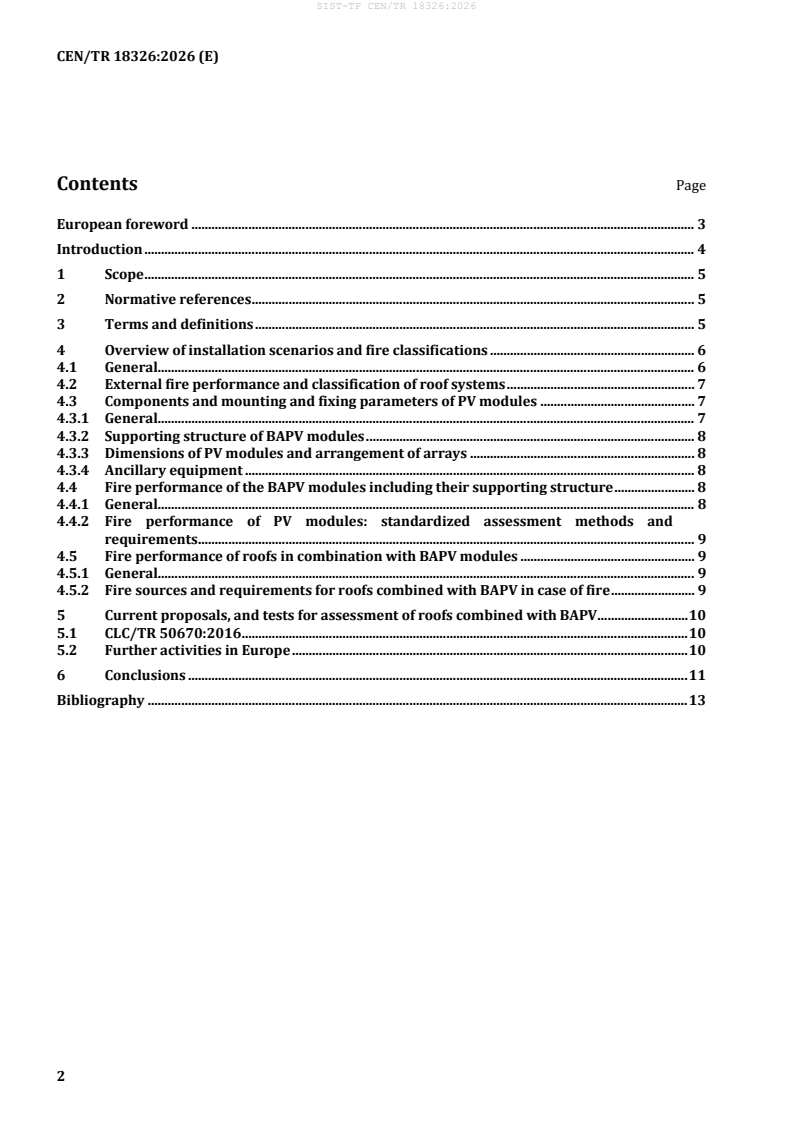
The report is organized into six clauses plus a bibliography:
- Clause 1 Scope
- Clause 2 Normative references
- Clause 3 Terms and definitions
- Clause 4 Overview of installation scenarios and fire classifications
- Clause 5 Current proposals, and tests for assessment of roofs combined with BAPV
- Clause 6 Conclusions
Clause 4 is the core of the document. It explains the installation parameters that affect fire behaviour, while Clause 5 reviews current test ideas and national approaches already in use in Europe.
What are the key requirements of SIST-TP CEN/TR 18326:2026?
Roof fire classification context
Clause 4.2 places roof classification in the framework of EN 13501-5 and the four external fire test methods in CEN/TS 1187. SIST-TP CEN/TR 18326:2026 explains that member states choose which tests, requirements and building types apply. In practice, the same roof may be treated differently from one country to another, so the exact national rule set matters.
BAPV configuration parameters
Clauses 4.3 and 4.4 show that fire behaviour depends on the PV module build-up and the mounting geometry. The report highlights module materials, supporting structure, slope, distance from the roof, spacing between modules and arrays, orientation, shields, cables, connectors and inverter placement. In practice, a fire assessment has to use the actual installation geometry, not just the module type.
Roof-plus-PV fire performance
Clause 4.5 states that the combined roof and BAPV system can behave differently from the roof alone or the PV modules alone. The report points to the need to limit fire spread beyond PV arrays and, in some scenarios, to prevent roof penetration. For readers, that means the key question is not only ignition but also whether fire can travel across the roof or burn through into the building.
Module and electrical safety measures
Clause 4.4.2 and Clause 4.5.2 link PV assessment with IEC 61730-1, IEC 61730-2, IEC 63027, IEC 62109 Series and IEC 62446-2. These standards address module qualification, fire testing, arc detection, power converter safety and maintenance. In practice, electrical design and maintenance are part of fire risk reduction because arcing and other electrical faults can start fires.
Existing test approaches and national rules
Clause 5 reviews CLC/TR 50670:2016 and ongoing European work. It notes that some national rules and test protocols address distances to fire walls, roof edges, penetrations, rooflights and smoke exhaust systems, and that large-scale test methods are being developed in several countries. For users, this means the report is a guide to the current landscape rather than a single harmonized test method.
What terms does SIST-TP CEN/TR 18326:2026 define?
- PV modules - a mechanically integrated assembly of modules or panels and its support structure.
- external fire performance - fire performance in case of external fire exposure.
- fire performance - the response of a material, product or assembly in a fire.
- pitched roof - a roof with an inclination angle of at least 10°.
- flat roof - a roof with an inclination of less than 10°.
- roof covering - the uppermost waterproofing part of a roof.
- roof system/assembly - the roof layers, supporting elements and attachment up to and including the roof covering.
- roof system plus PV modules - the combination of roof systems and PV modules plus installation systems (BAPV).
Who uses SIST-TP CEN/TR 18326:2026?
National standards bodies, building authorities, fire-safety regulators, test laboratories, roofing manufacturers, PV manufacturers, designers, installers and insurers use this report. They use it to compare installation scenarios, choose test methods, interpret national legislation and judge the fire risk of roof systems with above roof mounted PV modules.
Which standards are used with SIST-TP CEN/TR 18326:2026?
The normative reference is EN ISO 13943:2017, which supplies the fire safety vocabulary used in the report.
Other standards named in the report contribute the following:
- EN 13501-5 - roof fire classification using external fire exposure data
- CEN/TS 1187 - test methods for external roof fire exposure
- IEC 61730-1 and IEC 61730-2 - PV module safety qualification and testing
- IEC 63027 - DC arc detection and interruption
- IEC 62109 Series - safety of power converters in PV systems
- IEC 62446-2 - testing, documentation and maintenance for grid-connected PV systems
- CLC/TR 50670:2016 - test method concept for external fire exposure to roofs with PV arrays
What does the SIST-TP CEN/TR 18326:2026 document contain?
The document contains a technical overview of installation scenarios for BAPV on roofs, with attention to module geometry, support structures, spacing, orientation, ancillary equipment and roof type. It also discusses the fire performance of the PV modules themselves, the roof system below them and the combined roof-plus-PV arrangement.
It reviews current test concepts and national practices in Europe, including large-scale and small-scale approaches, and it explains why roof fire tests for ordinary construction products do not fully cover BAPV scenarios. The bibliography brings together related standards, national rules and research used in this field.
Get Certified
Connect with accredited certification bodies for this standard

DNV
DNV is an independent assurance and risk management provider.

Lloyd's Register
Lloyd's Register is a global professional services organisation specialising in engineering and technology.
DNV Energy Systems
Energy and renewable energy certification.
Sponsored listings
Frequently Asked Questions
SIST-TP CEN/TR 18326:2026 is a technical report published by the Slovenian Institute for Standardization (SIST). Its full title is "Report on installation scenarios, available test methods and national legislation to be considered for the fire performance classification of roof systems with above roof mounted PV modules". This standard covers: This document describes installation scenarios and available test methods and national legislations to be considered when determining the external fire performance of roof systems, when combined with BAPV.
This document describes installation scenarios and available test methods and national legislations to be considered when determining the external fire performance of roof systems, when combined with BAPV.
SIST-TP CEN/TR 18326:2026 is classified under the following ICS (International Classification for Standards) categories: 13.220 - Protection against fire; 13.220.50 - Fire-resistance of building materials and elements; 27.160 - Solar energy engineering. The ICS classification helps identify the subject area and facilitates finding related standards.
SIST-TP CEN/TR 18326:2026 is associated with the following European legislation: EU Directives/Regulations: 305/2011. When a standard is cited in the Official Journal of the European Union, products manufactured in conformity with it benefit from a presumption of conformity with the essential requirements of the corresponding EU directive or regulation.
SIST-TP CEN/TR 18326:2026 is available in PDF format for immediate download after purchase. The document can be added to your cart and obtained through the secure checkout process. Digital delivery ensures instant access to the complete standard document.
Standards Content (Sample)
SLOVENSKI STANDARD
01-julij-2026
Poročilo o namestitvenih scenarijih, razpoložljivih preskusnih metodah in
nacionalni zakonodaji, ki jih je treba upoštevati pri razvrščanju požarne odpornosti
strešnih sistemov s fotonapetostnimi moduli, nameščenimi nad streho
Report on installation scenarios, available test methods and national legislation to be
considered for the fire performance classification of roof systems with above roof
mounted PV modules
Rapport sur les scénarios d'installation, les méthodes d'essai disponibles et la législation
nationale à prendre en compte dans la classification des performances au feu des
systèmes de toiture équipés de modules photovoltaïques montés en surimposition
Ta slovenski standard je istoveten z: CEN/TR 18326:2026
ICS:
13.220.50 Požarna odpornost Fire-resistance of building
gradbenih materialov in materials and elements
elementov
27.160 Sončna energija Solar energy engineering
2003-01.Slovenski inštitut za standardizacijo. Razmnoževanje celote ali delov tega standarda ni dovoljeno.
CEN/TR 18326
TECHNICAL REPORT
RAPPORT TECHNIQUE
June 2026
TECHNISCHER REPORT
ICS 13.220
English Version
Report on installation scenarios, available test methods
and national legislation to be considered for the fire
performance classification of roof systems with above roof
mounted PV modules
Rapport sur les scénarios d'installation, les méthodes
d'essai disponibles et la législation nationale à prendre
en compte dans la classification des performances au
feu des systèmes de toiture équipés de modules
photovoltaïques montés en surimposition
This Technical Report was approved by CEN on 17 May 2026. It has been drawn up by the Technical Committee CEN/TC 127.
CEN members are the national standards bodies of Austria, Belgium, Bulgaria, Croatia, Cyprus, Czech Republic, Denmark, Estonia,
Finland, France, Germany, Greece, Hungary, Iceland, Ireland, Italy, Latvia, Lithuania, Luxembourg, Malta, Netherlands, Norway,
Poland, Portugal, Republic of North Macedonia, Romania, Serbia, Slovakia, Slovenia, Spain, Sweden, Switzerland, Türkiye and
United Kingdom.
EUROPEAN COMMITTEE FOR STANDARDIZATION
COMITÉ EUROPÉEN DE NORMALISATION
EUROPÄISCHES KOMITEE FÜR NORMUNG
CEN-CENELEC Management Centre: Rue de la Science 23, B-1040 Brussels
© 2026 CEN All rights of exploitation in any form and by any means reserved Ref. No. CEN/TR 18326:2026 E
worldwide for CEN national Members.
Contents Page
European foreword . 3
Introduction . 4
1 Scope . 5
2 Normative references . 5
3 Terms and definitions . 5
4 Overview of installation scenarios and fire classifications . 6
4.1 General. 6
4.2 External fire performance and classification of roof systems . 7
4.3 Components and mounting and fixing parameters of PV modules . 7
4.3.1 General. 7
4.3.2 Supporting structure of BAPV modules . 8
4.3.3 Dimensions of PV modules and arrangement of arrays . 8
4.3.4 Ancillary equipment . 8
4.4 Fire performance of the BAPV modules including their supporting structure . 8
4.4.1 General. 8
4.4.2 Fire performance of PV modules: standardized assessment methods and
requirements . 9
4.5 Fire performance of roofs in combination with BAPV modules . 9
4.5.1 General. 9
4.5.2 Fire sources and requirements for roofs combined with BAPV in case of fire . 9
5 Current proposals, and tests for assessment of roofs combined with BAPV . 10
5.1 CLC/TR 50670:2016 . 10
5.2 Further activities in Europe . 10
6 Conclusions . 11
Bibliography . 13
European foreword
This document (CEN/TR 18326:2026) has been prepared by Technical Committee CEN/TC 127 “Fire
safety in buildings”, the secretariat of which is held by BSI.
Attention is drawn to the possibility that some of the elements of this document may be the subject of
patent rights. CEN shall not be held responsible for identifying any or all such patent rights.
Any feedback and questions on this document should be directed to the users’ national standards body.
A complete listing of these bodies can be found on the CEN website.
Introduction
Photovoltaic systems (PV) on roofs can be part of the roofing system (Building Integrated PV systems,
BIPV) or mounted on top of a roof (Building Attached PV, BAPV). Above roof mounted PV systems are
increasingly used. In most European countries the fire performance of roof integrated PV systems
(BIPV) is tested in the same way as for roof systems. Whilst additional guidance is required in CEN/TS
1187 to ensure a unified approach to testing BIPV systems, this is not the subject of this TR, which
addresses only BAPV systems.
Above roof PV modules (BAPV) are usually not considered as construction products. Therefore no
harmonized standards until now have been developed by CEN for assessing the fire performance of
these installations alone or in combination with the roofing system below.
PV modules in general are regulated under the low voltage directive (LVD 2014/35/EU)014/35/EU). It
covers health and safety risks for electrical equipment, in order to make sure that the requirements are
the same across Europe for products placed on the market. The European Committee for
Electrotechnical Standardization (CENELEC) is responsible for standardization in electro-technical
engineering field.
Statistics show an increased risk of fire on roofs with BAPV or BIPV. A major cause is with the electrical
connections and these have been mitigated by adhering to CENELEC standards. Nevertheless, risks
remain and PV installations can lead to the outbreak of fire and can contribute to the spread of fire on
and within the roof.
A general assessment of all scenarios for BAPV mounting and fixing above roof systems procedures is
needed.
This document addresses the fire performance of roofs fitted with BAPV modules. It considers the
performance of the PV panels themselves, their method of mounting and the roof system they are
mounted above. There are many variables and for the mounting system these include material, design,
inclination and spacing between the PV modules and the roof covering.
Consideration is needed with regards with creation of Exap Rules due to the complex nature and
number of variations within the construction.
1 Scope
This document describes installation scenarios and available test methods and national legislations to
be considered when determining the external fire performance of roof systems, when combined with
BAPV.
2 Normative references
The following documents are referred to in the text in such a way that some or all of their content
constitutes requirements of this document. For dated references, only the edition cited applies. For
undated references, the latest edition of the referenced document (including any amendments) applies.
EN ISO 13943:2017, Fire safety - Vocabulary (ISO 13943:2017)
3 Terms and definitions
For the purposes of this document, the terms and definitions given in EN ISO 13943:2017 and the
following apply.
ISO and IEC maintain terminology databases for use in standardization at the following addresses:
— ISO Online browsing platform: available at https://www.iso.org/obp/
— IEC Electropedia: available at https://www.electropedia.org/
3.1
PV modules
PV Array
mechanically integrated assembly of modules or panels and its support structure
3.2
external fire performance
fire performance in case of external fire exposure
3.3
fire performance
response of a material, product or assembly in a fire
Note 1 to entry: It is often important to understand how materials, products or assemblies behave in real fires as
opposed to in fire tests under controlled conditions. Improved fire performance can be exhibited in a variety of
ways. For example, longer times to ignition, lower heat release, lower flame spread or lower smoke release could
all be evidence of improvements in fire performance.
[SOURCE: Fire Vocabulary]
3.4
pitched roof
roof with an inclination angle of at least 10°
3.5
flat roof
roof with an inclination less than 10°
3.6
roof covering
uppermost waterproofing part of a roof
Note 1 to entry: This layer can comprise single layer or multiple layer coverings.
[SOURCE: CEN/TS 1187]
3.7
roof pitch
inclination of the rafters to the horizontal (pitched roofs) or the inclination of the roof surface to the
horizontal (flat roofs)
3.8
fire penetration
appearance on the underside of the specimen of any sustained flaming or glowing due to combustion,
including the occurrence of any flaming droplets falling from the underside
3.9
roof
roof covering and sealing system including any insulating layers or vapour barriers normally provided
together with their supporting elements including attachment (glued, mechanically fastened, etc.), that
are intended to provide a weatherproof surface
3.10
continuous deck
element with a continuous supporting function in which the gap between adjacent elements is not
greater than 0,5 mm ((5,0 ± 0,5) mm in the case of wooden planks with plain edges)
[SOURCE: CEN/TS 1187]
3.11
roof system/assembly
continuous deck, if present, (and any supporting structure as/if needed), insulation and intermediary
layers, through to and including the roof covering
Note 1 to entry: The roof system/assembly includes all layers e.g.: insulation and the Air Vapour Control Layer
(AVCL) etc.
3.12
roof system plus PV modules
combination of roof systems and PV modules plus installation systems (BAPV)
4 Overview of installation scenarios and fire classifications
4.1 General
Solar modules systems convert solar energy into electrical energy. They can be located on the ground,
or attached to the exterior of building structures such as facades or roofs.
On buildings they are either integrated into the outer face of the building (Building Integrated, BIPV) for
example roofs or facades or attached to the existing building envelope (Building Applied BAPV) for
example on roofs. This document only covers above roof mounted PV systems (BAPV).
Since harmonized methodologies to assess the fire performance of roof systems in combination with
above roof PV modules for the external fire scenario(s) do not exist, their approval follows a variety of
non-harmonized assessments and test methods. In most cases, approval is supported by guidance or
legislation. In addition, a number of insurance methods, guidelines and recommendations are in place.
There is a need to understand the rationale behind these rules, including fire statistics and evidence
from testing.
To evaluate fire performance of the combination of PV modules interacting with roof systems, a general
assessment of PV design, of performance of PV in fire and a general assessment of all scenarios for PV
mounting and fixing above roof systems procedures is needed. The following parameters are relevant
for fire performance:
— Fire performance (and classification) of roof systems;
— Fire performance of the solar modules;
— Fire performance of the electrical infrastructure and accessories (cables, connector boxes etc.);
— Fire performance and geometry of mounting and fixing systems.
For defining a test scenario and a basis for the assessment criteria, information from real fires should be
studied to determine:
— The cause of the fire (external and or autoignition of the PV installation);
— Remedial actions.
4.2 External fire performance and classification of roof systems
Within CEN/TC 127, standards have been developed to assess the external fire performance of roofs.
The scenario of burning brands (for example from a neighbouring building, a wildfire or a chimney),
wind and radiation, are well defined for roofing assemblies through the classification standard of
EN 13501-5 and the associated 4 test methods in CEN/TS 1187. Member states choose which of these
four tests, plus the associated requirements and classifications, they wish to adopt. They also choose the
building types to which these apply. The ignition sources and other test parameters as well as sample
sizes and assessment criteria are different for each test.
4.3 Components and mounting and fixing parameters of PV modules
4.3.1 General
PV modules contain combustible and non-combustible materials.
BAPV modules may be composed of the following layers:
— Mainly Glass on top of the module;
— Crystalline semiconductor cells embedded in a flexible polymeric layer;
— A rear side which can be glass or a polymeric layer (glass backed modules or foil backed modules);
— The outer edges are sealed with a polymer, and often an aluminium frame is used around the
module.
4.3.2 Supporting structure of BAPV modules
The supporting structure may be made of metal (for example aluminium) or from plastics (fibre
reinforced plastics). In addition, a number of different mounting or ballasting fixing are used.
The supporting system can also include shields to prevent dirt and leaves building up or to shield the
underside from the wind.
The supporting structure of the BAPV can also influence the fire behaviour of the combined system, key
parameters being:
• Slope: PV modules can be parallel to the roof or inclined to it. Inclinations vary from 0° to 45;
• Distance of the PV modules from the roof: parallel PV modules are usually close to roof surface (few
centimetres, between 5 to 10); inclined PV modules structures have bottom of PV modules 10 to
20 cm from roof surface;
• The distance between PV modules;
• Orientation of differen
...