

SIST EN 50160:2023
(Main)Voltage characteristics of electricity supplied by public distribution networks
- Abstract
1.1 Application
This document specifies the main characteristics of the voltage at a network user's supply terminals in public low voltage, medium, high, and extra-high voltage AC electricity networks under normal operating conditions. This document specifies the limits or values within which the voltage characteristics can be expected to remain at any supply terminal in public European electricity networks, only. Industrial networks are excluded from the scope of EN 50160.
NOTE 1 If non-public networks (e.g. residential quarters, energy communities, office centres, shopping centres) have similar end-users as public networks, it is strongly advised to apply the same requirements as for public networks.
This document does not apply under abnormal operating conditions, including the following:
a) a temporary supply arrangement to keep network users supplied during conditions arising as a result of a fault, maintenance and construction work, or to minimize the extent and duration of a loss of supply;
b) in the case of non-compliance of a network user's installation or equipment with the relevant standards or with the technical requirements for connection, established either by the public authorities or the network operator, including the limits for the emission of conducted disturbances;
NOTE 2 A network user’s installation can include load and generation.
c) in exceptional situations, in particular:
1) exceptional weather conditions and other natural disasters;
2) third party interference;
3) acts by public authorities,
4) industrial actions (subject to legal requirements);
5) force majeure;
6) power shortages resulting from external events.
The voltage characteristics given in this document refer to conducted disturbances in public electric power networks. They are not intended to be used as electromagnetic compatibility (EMC) levels or product emission limits.
Power quality is related to EMC in several ways – especially because compliance with power quality requirements depends on the control of cumulative effect of electromagnetic emissions from all/multiple equipment and/or installations. Therefore, the voltage characteristics given in this document gives guidance for specifying requirements in equipment product standards and in installation standards.
NOTE 3 The performance of equipment might be impaired if it is subjected to supply conditions which are not specified in the equipment product standard.
NOTE 4 This document can be superseded in total or in part by the terms of a contract between the individual network user and the network operator.
The sharing of complaint management and problem mitigation costs between the involved parties is outside the scope of EN 50160.
Measurement methods to be applied in this document are described in EN 61000-4-30.
[...]
- Status
- Published
- Publication Date
- 02-Feb-2023
- Technical Committee
- NTF - Electricity energy supply systems
- Current Stage
- 6100 - Translation of adopted SIST standards (Adopted Project)
- Start Date
- 06-Mar-2024
- Due Date
- 05-Mar-2025
- Completion Date
- 08-Jun-2026
Buy Documents



SIST EN 50160:2023 is the Slovenian adoption of EN 50160:2022 from CENELEC. It specifies the voltage characteristics that network users can expect at the supply terminals of public AC electricity networks, for low, medium, high and extra-high voltage systems under normal operating conditions. The document is used to describe supply quality for public networks, not to set product emission limits or EMC levels.
What does SIST EN 50160:2023 specify?
SIST EN 50160:2023 specifies the main characteristics of the supply voltage at a network user’s supply terminals in public European electricity networks. It focuses on public networks only, and it frames what can normally be expected at the point of supply under normal operating conditions.
The scope excludes industrial networks and abnormal operating conditions such as temporary supply arrangements, non-compliant installations, and exceptional events like major weather damage, third-party interference, public authority actions, industrial action, force majeure, and external power shortages. The document also states that its voltage characteristics are not intended as EMC levels or product emission limits.
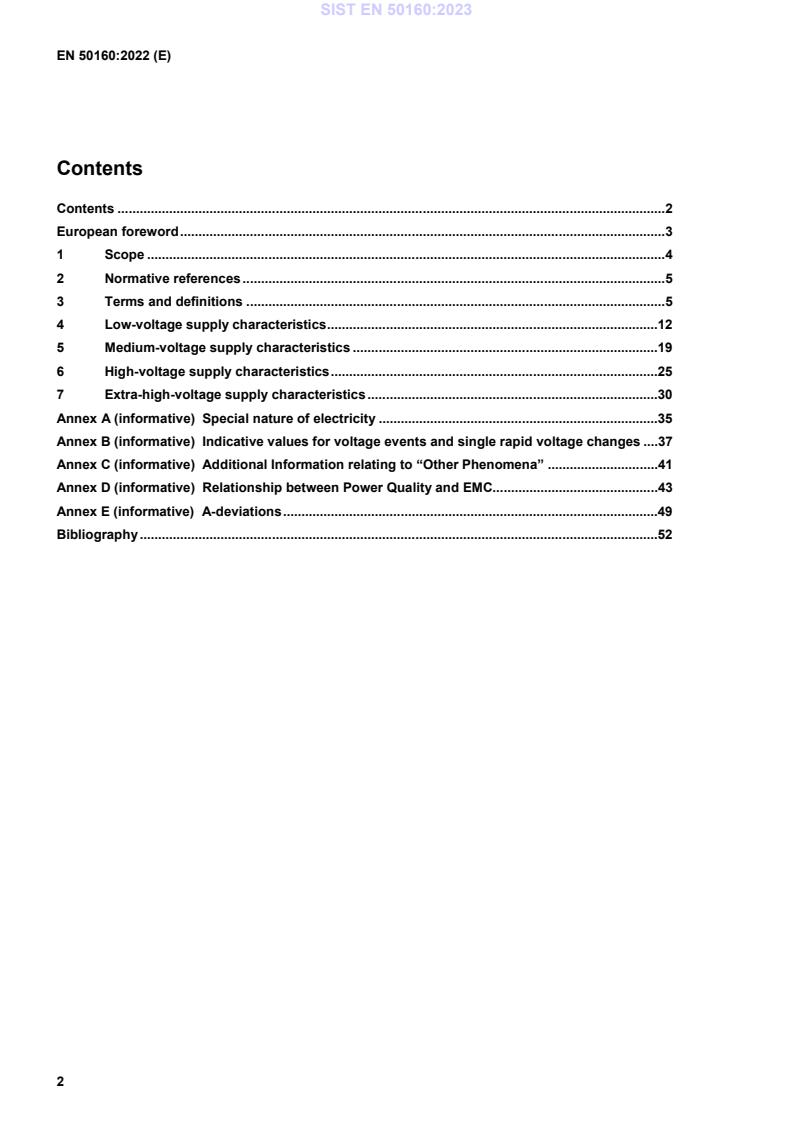
The standard is organized into one scope clause, one clause on normative references, one clause on terms and definitions, and separate clauses for low-, medium-, high- and extra-high-voltage supply characteristics. It also includes five informative annexes.
| Annex | What it covers |
|---|---|
| Annex A | Special nature of electricity |
| Annex B | Indicative values for voltage events and single rapid voltage changes |
| Annex C | Additional information relating to other phenomena |
| Annex D | Relationship between Power Quality and EMC |
| Annex E | A-deviations |
What are the key requirements of SIST EN 50160:2023?
SIST EN 50160:2023 sets expectations for supply voltage quality by network level, by phenomenon, and by how the values are to be interpreted in practice. The document separates continuous phenomena, voltage events, and other phenomena, and it uses EN 61000-4-30 for the measurement methods.
Network level and voltage reference
For public low-voltage networks, SIST EN 50160:2023 uses a nominal voltage of 230 V, either between phase and neutral or between phases depending on the system. For medium voltage, high voltage and extra-high voltage, the clauses define the upper voltage ranges covered by the standard, up to 36 kV, 150 kV and 800 kV respectively.
This matters because the same power quality rules are not applied to every voltage level in the same way. A buyer, operator or tester needs to start with the correct network class and reference voltage before judging compliance or expected performance.
Power frequency
SIST EN 50160:2023 gives power frequency limits for normal operation across LV, MV, HV and EHV systems. The standard uses a 99.5% annual band around 50 Hz, a wider 100% band, and separate ranges for systems without synchronous connection to an interconnected system.
In practice, this is the basic frequency quality benchmark for public supply. It tells operators and users how often the frequency may move away from nominal values and still remain within the standard’s expectations.
Continuous voltage quality
SIST EN 50160:2023 addresses supply voltage variations, rapid voltage changes, flicker severity, voltage unbalance, harmonic voltage and interharmonic voltage in the continuous-phenomena clauses. For some of these, the document gives fixed limits; for single rapid voltage changes and some voltage events, it gives indicative values rather than hard limits.
That distinction matters because not every disturbance is treated the same way. Engineers have to know whether they are checking a firm requirement or using indicative values for comparison and investigation.
Voltage events
SIST EN 50160:2023 treats interruptions, dips, swells and transient overvoltages as voltage events. It defines a supply interruption as a condition where voltage at the supply terminals falls below 5% of the reference voltage, and it classifies accidental interruptions as short or long depending on whether they last up to 3 minutes or longer.
The document also defines a voltage dip as a temporary reduction below a 90% start threshold, and a voltage swell as a temporary increase above a 110% start threshold. Both are treated as time-dependent events, with durations from 10 ms up to 1 minute.
Other phenomena and mains communication
SIST EN 50160:2023 includes a separate treatment of other phenomena connected with mains communicating systems (MCS) and equipment using switch-mode technology. Annex C extends this to the frequency range 2 kHz to 150 kHz and points readers to time-domain and frequency-domain measurement approaches.
This is important where modern loads and signal injection can affect power quality in ways that are not captured by the classic 50 Hz view alone. The standard also links this area to EMC and immunity test standards.
Clause structure by voltage level
SIST EN 50160:2023 repeats the same structure for LV, MV, HV and EHV supply characteristics. Each level has general text, continuous phenomena, voltage events, and other phenomena, so the reader can go directly to the relevant network class.
What terms does SIST EN 50160:2023 define?
SIST EN 50160:2023 defines the terms that anchor its scope and measurements.
- Public electric power network - a network that any network user can access and that is operated by a regulated or licensed operator.
- Point of supply (POS) - the contractually fixed supply terminal where energy is exchanged between contractual partners; this is the point where the standard applies in practice.
- Network operator - the party responsible for operating, maintaining and developing the supply network in an area.
- Network user - a party supplied by, or supplying to, an electricity supply network.
- Power quality (PQ) - the characteristics of electricity at a point on the system, assessed against reference technical parameters.
- Conducted disturbance - an electromagnetic phenomenon propagated along the line conductors of a supply network.
- Voltage dip - a temporary reduction of rms voltage below the dip start threshold.
- Mains communicating system (MCS) - an electrical system that uses signals to transmit information on electricity supply systems.
Who uses SIST EN 50160:2023?
SIST EN 50160:2023 is used by network operators, network users, equipment manufacturers, and the authors of product and installation standards. It is also relevant to measurement specialists who need to check supply quality using EN 61000-4-30 methods.
In practice, it supports supply contracts, network quality monitoring, investigation of complaints, and the definition of voltage-related requirements for connected equipment. It is also useful in public low-, medium-, high- and extra-high-voltage networks where supply characteristics need to be described in a common technical language.
What changed in SIST EN 50160:2023 from the previous edition?
SIST EN 50160:2023 replaces SIST EN 50160:2011 and its amendments and corrigendum, and it is identical to EN 50160:2022. The foreword lists these significant technical changes compared with EN 50160:2010:
- implementation of amendments A2 and A3, including the new 2 kHz to 150 kHz range and the change to the 15th and 21st harmonic in LV
- slight modification of the Norway A-deviation
- clarifications in the scope
- a new clause for extra high voltage
- clarification of dips and swells
- a new Annex D on the relationship between Power Quality and EMC
Which standards are used with SIST EN 50160:2023?
SIST EN 50160:2023 relies on EN 61000-4-30 for the measurement methods used throughout the document. It also points to related standards and reports that support specific phenomena and test conditions.
- EN 61000-4-30 - power quality measurement methods
- EN 61000-4-15 - flickermeter functional and design specifications
- EN 61000-4-16 and EN 61000-4-19 - immunity tests for conducted disturbances and signalling in the 2 kHz to 150 kHz range
- EN 61000-4-34 - immunity tests for voltage dips, short interruptions and voltage variations for equipment above 16 A per phase
- EN IEC 61000-6-1 and EN IEC 61000-6-2 - generic immunity standards for residential/commercial/light-industrial and industrial environments
- IEC 60038 - standard voltages
- IEC 60364-4-44 and IEC 60364-5-53 - protection against voltage disturbances and selection of protective and switching equipment
- IEC/TR 61000-2-8, IEC/TR 61000-2-14 and IEC/TR 61000-3-7 - statistical data, overvoltages and fluctuating-load assessment
- IEC/TS 62578 - design recommendations for active infeed converter emissions below 150 kHz
What does the SIST EN 50160:2023 document contain?
SIST EN 50160:2023 contains the clause-by-clause description of supply characteristics for LV, MV, HV and EHV networks, plus informative annexes that help interpret events and compare them with EMC concepts. Annex B gives guidance on using indicative values for interruptions, dips, swells and rapid voltage changes, while Annex C explains the 2 kHz to 150 kHz phenomenon range and recommends combining time-domain and frequency-domain measurements.
Annex D provides a structured comparison between Power Quality and EMC, including a table and a schematic figure that explain why the two subjects are related but not identical. Annex E records national A-deviations, with Norway listed in the document.
Relations
- Effective Date
- 20-Dec-2022
- Replaces
SIST EN 50160:2011 - Voltage characteristics of electricity supplied by public distribution networks - Effective Date
- 20-Dec-2022
- Effective Date
- 20-Dec-2022
- Effective Date
- 20-Dec-2022
- Effective Date
- 20-Dec-2022
- Effective Date
- 03-Feb-2026
- Effective Date
- 09-Feb-2026
- Effective Date
- 09-Feb-2026
- Effective Date
- 09-Feb-2026
- Effective Date
- 03-Feb-2026
- Effective Date
- 03-Feb-2026
- Effective Date
- 03-Feb-2026
- Effective Date
- 03-Feb-2026
- Effective Date
- 03-Feb-2026
- Effective Date
- 03-Feb-2026
Buy Documents
Get Certified
Connect with accredited certification bodies for this standard

IMQ S.p.A. (Certification)
Italian electrical product certification.

SLG Prüf- und Zertifizierungs GmbH
German testing and certification body.

UL Solutions
Global safety science company with testing, inspection and certification.
Sponsored listings
Frequently Asked Questions
SIST EN 50160:2023 is a standard published by the Slovenian Institute for Standardization (SIST). Its full title is "Voltage characteristics of electricity supplied by public distribution networks". This standard covers: 1.1 Application This document specifies the main characteristics of the voltage at a network user's supply terminals in public low voltage, medium, high, and extra-high voltage AC electricity networks under normal operating conditions. This document specifies the limits or values within which the voltage characteristics can be expected to remain at any supply terminal in public European electricity networks, only. Industrial networks are excluded from the scope of EN 50160. NOTE 1 If non-public networks (e.g. residential quarters, energy communities, office centres, shopping centres) have similar end-users as public networks, it is strongly advised to apply the same requirements as for public networks. This document does not apply under abnormal operating conditions, including the following: a) a temporary supply arrangement to keep network users supplied during conditions arising as a result of a fault, maintenance and construction work, or to minimize the extent and duration of a loss of supply; b) in the case of non-compliance of a network user's installation or equipment with the relevant standards or with the technical requirements for connection, established either by the public authorities or the network operator, including the limits for the emission of conducted disturbances; NOTE 2 A network user’s installation can include load and generation. c) in exceptional situations, in particular: 1) exceptional weather conditions and other natural disasters; 2) third party interference; 3) acts by public authorities, 4) industrial actions (subject to legal requirements); 5) force majeure; 6) power shortages resulting from external events. The voltage characteristics given in this document refer to conducted disturbances in public electric power networks. They are not intended to be used as electromagnetic compatibility (EMC) levels or product emission limits. Power quality is related to EMC in several ways – especially because compliance with power quality requirements depends on the control of cumulative effect of electromagnetic emissions from all/multiple equipment and/or installations. Therefore, the voltage characteristics given in this document gives guidance for specifying requirements in equipment product standards and in installation standards. NOTE 3 The performance of equipment might be impaired if it is subjected to supply conditions which are not specified in the equipment product standard. NOTE 4 This document can be superseded in total or in part by the terms of a contract between the individual network user and the network operator. The sharing of complaint management and problem mitigation costs between the involved parties is outside the scope of EN 50160. Measurement methods to be applied in this document are described in EN 61000-4-30. [...]
1.1 Application This document specifies the main characteristics of the voltage at a network user's supply terminals in public low voltage, medium, high, and extra-high voltage AC electricity networks under normal operating conditions. This document specifies the limits or values within which the voltage characteristics can be expected to remain at any supply terminal in public European electricity networks, only. Industrial networks are excluded from the scope of EN 50160. NOTE 1 If non-public networks (e.g. residential quarters, energy communities, office centres, shopping centres) have similar end-users as public networks, it is strongly advised to apply the same requirements as for public networks. This document does not apply under abnormal operating conditions, including the following: a) a temporary supply arrangement to keep network users supplied during conditions arising as a result of a fault, maintenance and construction work, or to minimize the extent and duration of a loss of supply; b) in the case of non-compliance of a network user's installation or equipment with the relevant standards or with the technical requirements for connection, established either by the public authorities or the network operator, including the limits for the emission of conducted disturbances; NOTE 2 A network user’s installation can include load and generation. c) in exceptional situations, in particular: 1) exceptional weather conditions and other natural disasters; 2) third party interference; 3) acts by public authorities, 4) industrial actions (subject to legal requirements); 5) force majeure; 6) power shortages resulting from external events. The voltage characteristics given in this document refer to conducted disturbances in public electric power networks. They are not intended to be used as electromagnetic compatibility (EMC) levels or product emission limits. Power quality is related to EMC in several ways – especially because compliance with power quality requirements depends on the control of cumulative effect of electromagnetic emissions from all/multiple equipment and/or installations. Therefore, the voltage characteristics given in this document gives guidance for specifying requirements in equipment product standards and in installation standards. NOTE 3 The performance of equipment might be impaired if it is subjected to supply conditions which are not specified in the equipment product standard. NOTE 4 This document can be superseded in total or in part by the terms of a contract between the individual network user and the network operator. The sharing of complaint management and problem mitigation costs between the involved parties is outside the scope of EN 50160. Measurement methods to be applied in this document are described in EN 61000-4-30. [...]
SIST EN 50160:2023 is classified under the following ICS (International Classification for Standards) categories: 29.020 - Electrical engineering in general; 29.240.01 - Power transmission and distribution networks in general. The ICS classification helps identify the subject area and facilitates finding related standards.
SIST EN 50160:2023 has the following relationships with other standards: It is inter standard links to SIST EN 50160:2011/A3:2019, SIST EN 50160:2011, SIST EN 50160:2011/A2:2019, SIST EN 50160:2011/AC:2013, SIST EN 50160:2011/A1:2015, SIST EN 61000-4-30:2015, SIST EN 15267-3:2024, SIST EN 15267-4:2024, SIST EN 16644:2015, SIST-TS CLC/TS 50457-1:2008, SIST EN 50546:2020, SIST EN 50438:2008, SIST EN 50090-5-1:2020, SIST-TP CLC/TR 50646:2018, SIST-TS CLC/TS 50740:2025. Understanding these relationships helps ensure you are using the most current and applicable version of the standard.
SIST EN 50160:2023 is associated with the following European legislation: EU Directives/Regulations: TP117, TP253. When a standard is cited in the Official Journal of the European Union, products manufactured in conformity with it benefit from a presumption of conformity with the essential requirements of the corresponding EU directive or regulation.
SIST EN 50160:2023 is available in PDF format for immediate download after purchase. The document can be added to your cart and obtained through the secure checkout process. Digital delivery ensures instant access to the complete standard document.
Standards Content (Sample)
Contents
- 1 Scope
- 1.1 Application
- 1.2 Objective
- 2 Normative references
- 3 Terms and definitions
- 3.1 Electric power network
- 3.1.1 public electric power network
- 3.1.2 closed distribution network
- 3.1.3 point of supply POS
- 3.1.4 point of connection POC
- 3.1.5 network operator
- 3.1.6 (power) network user
- 3.1.7 power quality PQ
- 3.1.8 conducted disturbance
- 3.1.9 normal operating condition
- 3.1.10 supply interruption
- 3.2 Reference voltages and frequency
- 3.2.1 extra high voltage
- 3.2.2 high voltage
- 3.2.3 medium voltage
- 3.2.4 low voltage
- 3.2.5 nominal voltage
- 3.2.6 supply voltage
- 3.2.7 declared supply voltage
- 3.2.8 reference voltage
- 3.2.9 frequency of the supply voltage
- 3.2.10 nominal frequency
- 3.3 Phenomena
- 3.3.1 voltage variation
- 3.3.2 voltage fluctuation
- 3.3.3 rapid voltage change
- 3.3.4 flicker
- 3.3.5 flicker severity
- 3.3.6 harmonic voltage U
- 3.3.7 interharmonic voltage
- 3.3.8 voltage unbalance
- 3.3.9 voltage dip
- 3.3.10 voltage dip duration
- 3.3.11 voltage dip start threshold
- 3.3.12 voltage dip end threshold
- 3.3.13 voltage dip residual voltage
- 3.3.14 transient overvoltage
- 3.3.15 voltage swell
- 3.3.16 voltage swell duration
- 3.3.17 voltage swell end threshold
- 3.3.18 voltage swell start threshold
- 3.3.19 mains communicating system
- 3.3.20 mains signalling voltage
- 4 Low-voltage supply characteristics
- 4.1 General
- 4.2 Continuous phenomena
- 4.3 Voltage events
- 4.4 Other phenomena (see also Annex C)
- 5 Medium-voltage supply characteristics
- 5.1 General
- 5.2 Continuous phenomena
- 50 Hz ± 1 % (i.e. 49,5 Hz... 50,5 Hz) during 99,5 % of a year
- 50 Hz + 4 % / - 6 % (i.e. 47 Hz... 52 Hz) during 100 % of the time
- 50 Hz ± 2 % (i.e. 49 Hz... 51 Hz) during 95 % of a week
- 50 Hz ± 15 % (i.e. 42,5 Hz... 57,5 Hz) during 100 % of the time
- 5.3 Voltage events
- 5.4 Other phenomena (see also Annex C)
- 6 High-voltage supply characteristics
- 6.1 General
- 6.2 Continuous phenomena
- 6.3 Voltage events
- 6.4 Other phenomena (see also Annex C)
- 7 Extra-high-voltage supply characteristics
- 7.1 General
- 7.2 Continuous phenomena
- 7.3 Voltage events
- 7.4 Other phenomena (see also Annex C)
- Annex A
- Annex B
- Annex C
- Annex D
- Annex E
- 6.2.3.1 RVCs Maximum frequency per 24 h period
- 7.2.3.1 0,23 ≤ U ≤ 35 35 < U
- 6.2.4 7.2.4
1 Scope
1.1 Application
This document specifies the main characteristics of the voltage at a network user's supply terminals in public low voltage, medium, high, and extra-high voltage AC electricity networks under normal operating conditions. This document specifies the limits or values within which the voltage characteristics can be expected to remain at any supply terminal in public European electricity networks, only. Industrial networks are excluded from the scope of EN 50160.
NOTE 1 If non-public networks (e.g. residential quarters, energy communities, office centres, shopping centres) have similar end-users as public networks, it is strongly advised to apply the same requirements as for public networks. This document does not apply under abnormal operating conditions, including the following:
a) a temporary supply arrangement to keep network users supplied during conditions arising as a result of a fault, maintenance and construction work, or to minimize the extent and duration of a loss of supply; b) in the case of non-compliance of a network user's installation or equipment with the relevant standards or with the technical requirements for connection, established either by the public authorities or the network operator, including the limits for the emission of conducted disturbances; NOTE 2 A network user’s installation can include load and generation. c) in exceptional situations, in particular:
1) exceptional weather conditions and other natural disasters; 2) third party interference; 3) acts by public authorities, 4) industrial actions (subject to legal requirements); 5) force majeure; 6) power shortages resulting from external events.
The voltage characteristics given in this document refer to conducted disturbances in public electric power networks. They are not intended to be used as electromagnetic compatibility (EMC) levels or product emission limits.
Power quality is related to EMC in several ways – especially because compliance with power quality requirements depends on the control of cumulative effect of electromagnetic emissions from all/multiple equipment and/or installations. Therefore, the voltage characteristics given in this document gives guidance for specifying requirements in equipment product standards and in installation standards. NOTE 3 The performance of equipment might be impaired if it is subjected to supply conditions which are not specified in the equipment product standard.
NOTE 4 This document can be superseded in total or in part by the terms of a contract between the individual network user and the network operator.
The sharing of complaint management and problem mitigation costs between the involved parties is outside the scope of EN 50160.
Measurement methods to be applied in this document are described in EN 61000-4-30.
SIST EN 50160:2023 EN 50160:2022 (E)
1.2 Objective
The objective of this document is to define, describe and specify the characteristics of the supply voltage concerning:
a) Frequency; b) Magnitude; c) Waveform; d) Symmetry of the line voltages.
This document also covers the continuous characteristics of the supply voltage and other foreseeable phenomena which may influence the voltage characteristics, such as e.g. operational communication, monitoring or measurement signals which are transmitted via power lines. These characteristics are subject to variations during the normal operation of a supply system due to changes of load, disturbances generated by certain equipment and the occurrence of faults which are mainly caused by external events.
The characteristics vary in a manner which is random in time, with reference to any specific supply terminal, and random in location, with reference to any given instant of time. Because of these variations, the values given in this document for the characteristics can be expected to be exceeded on a small number of occasions. Some of the phenomena affecting the voltage are particularly unpredictable, which make it very difficult to give useful definite values for the corresponding characteristics. The values given in this document for the voltage characteristics associated with such phenomena, e.g. voltage dips and voltage interruptions, are interpreted accordingly.
2 Normative references
The following documents are referred to in the text in such a way that some or all of their content constitutes requirements of this document. For dated references, only the edition cited applies. For undated references, the latest edition of the referenced document (including any amendments) applies. EN 61000-4-30:2015, Electromagnetic compatibility (EMC) — Part 4-30: Testing and measurement techniques - Power quality measurement methods (IEC 61000-4-30:2015)
3 Terms and definitions
For the purposes of this document, the following terms and definitions apply. ISO and IEC maintain terminological databases for use in standardization at the following addresses:
- ISO Online browsing platform: available at https://www.iso.org/obp
- IEC Electropedia: available at https://www.electropedia.org/
3.1 Electric power network
3.1.1 public electric power network
electric power network to which any network user has access, and which is operated by a regulated (licenced) network operator
3.1.2 closed distribution network
system which distributes electricity within an industrial, commercial, or shared service or residential sites, that is geographically confined
SIST EN 50160:2023 EN 50160:2022 (E) Note 1 to entry: Closed distribution networks may be private networks. [SOURCE: Directive 2009/72/EC, Article 28, modified].
3.1.3 point of supply POS
supply terminal point in an electric power network designated as such and contractually fixed, at which electric energy is exchanged between contractual partners [SOURCE: IEV 614-01-02] Note 1 to entry: In practice it is the location of the interface between the public supply network and a closed distribution network or a network user. The characteristics of the voltage that a network user can expect according to EN 50160 apply at the Point of Supply (supply terminals).
3.1.4 point of connection POC
reference point on the electric power system where the user’s electrical facility is connected [SOURCE: IEV 617-04-01] Note 1 to entry: In some regions the point of supply (supply terminals) is labelled as the point of connection (POC). In practice, the connection to a power system can be one to the public supply network or in some cases to a closed distribution network one. It is worth noting that many standards use the term “point of connection” generally for an interface which is dealt with in the relevant context of the standard.
3.1.5 network operator
party responsible for operating, ensuring the maintenance of, and if necessary, developing, the supply network in a given area and responsible for ensuring the long term ability of the network to meet reasonable demands for electricity supply
3.1.6 (power) network user
party being supplied by or supplying to an electricity supply network Note 1 to entry: In several countries, the term network user includes network operators connected to a supply network with the same or higher voltage level.
3.1.7 power quality PQ
characteristics of the electricity at a given point on an electrical system, evaluated against a set of reference technical parameters Note 1 to entry: These parameters might, in some cases, relate to the compatibility between electricity supplied on a network and the loads connected to that network.
Note 2 to entry: In the context of this document, power quality refers to the supply terminals and focusses on defining the characteristics of the voltage and frequency.
3.1.8 conducted disturbance
electromagnetic phenomenon propagated along the line conductors of a supply network Note 1 to entry: In some cases, an electromagnetic phenomenon is propagated across transformer windings and hence between networks of different voltage levels. These disturbances may degrade the performance of a device, equipment or system or they may cause damage.
SIST EN 50160:2023 EN 50160:2022 (E)
3.1.9 normal operating condition
operating condition for an electricity network, where load and generation demands are met, system switching operations are made and faults are cleared by automatic protection systems, in the absence of exceptional circumstances Note 1 to entry: Frequent examples of exceptional circumstances are:
▪ temporary supply arrangement; ▪ in the case of non-compliance of a network user’s installation or equipment with the relevant standards or with the technical requirements for connection; ▪ exceptional situations, such as:
o exceptional weather conditions and other natural disasters; o third party interference; o acts by public authorities; o industrial actions (subject to legal requirements); o force majeure; o power shortages resulting from external events.
3.1.10 supply interruption
condition in which the voltage at the supply terminals is lower than 5 % of the reference voltage Note 1 to entry: Classification: a supply interruption can be classified as prearranged, when network users are informed in advance, or accidental, caused by permanent or transient faults, mostly related to external events, equipment failures or interference. An accidental interruption is classified as:
- a long interruption (longer than 3 min).
- a short interruption (up to and including 3 min).
Note 2 to entry: Normally, interruptions are caused by the operation of switches or protective devices. Note 3 to entry: The effect of a prearranged interruption can be minimized by network users by taking appropriate measures.
Note 4 to entry: Prearranged interruptions are typically due to the execution of scheduled works on the electricity network. Note 5 to entry: Accidental supply interruptions are unpredictable, largely random events. Note 6 to entry: For polyphase systems, an interruption occurs when the voltage falls below 5 % of the reference voltage on all phases (otherwise, it is considered to be a dip).
Note 7 to entry: In some countries, the term Very Short Interruptions (VSI) or transitory interruptions are used to classify interruptions with duration shorter than 1 s to 5 s. Such interruptions are related to automatic reclosing device operation. Note 8 to entry: This point can differ from, for example, the electricity metering point or the point of common coupling.
SIST EN 50160:2023 EN 50160:2022 (E)
3.2 Reference voltages and frequency
3.2.1 extra high voltage
EHV voltage with a nominal rms-value 150 kV < U ≤ 800 kV n
3.2.2 high voltage
HV voltage with a nominal rms-value 36 kV < U ≤ 150 kV n
3.2.3 medium voltage
MV voltage with a nominal rms-value is 1 kV < U ≤ 36 kV n
3.2.4 low voltage
LV voltage with a nominal rms-value is U ≤ 1 kV n
3.2.5 nominal voltage
U n voltage by which a supply network is designated or identified and to which certain operating characteristics are referred
3.2.6 supply voltage
rms-value of the voltage at a given time at the supply terminal, measured over a given interval
3.2.7 declared supply voltage
U C supply voltage agreed by the network operator and the network user Note 1 to entry: Generally declared supply voltage U is the nominal voltage U but it may be different according to the c n agreement between the network operator and the network user.
3.2.8 reference voltage
value specified as the base on which residual voltage, thresholds and other values are expressed in per unit or percentage terms Note 1 to entry: For the purpose of this document, the reference voltage is the nominal or declared voltage of the supply system.
Note 2 to entry: This term is used in relation to interruptions, voltage dips and voltage swell evaluation.
3.2.9 frequency of the supply voltage
repetition rate of the fundamental wave of the supply voltage measured over a given interval of time
SIST EN 50160:2023 EN 50160:2022 (E)
3.2.10 nominal frequency
nominal value of the frequency of the supply voltage
3.3 Phenomena
3.3.1 voltage variation
increase or decrease of rms-voltage normally due to load variations
3.3.2 voltage fluctuation
series of voltage changes or a cyclic variation of the voltage envelope [SOURCE: IEV 161-08-05, modified]
3.3.3 rapid voltage change
single rapid variation of the rms-value of a voltage between two consecutive levels which are sustained for definite but unspecified durations Note 1 to entry: For more information see EN 61000-3-3 and EN 61000-4-30.
3.3.4 flicker
impression of unsteadiness of visual sensation induced by a light stimulus whose luminance or spectral distribution fluctuates with time [SOURCE: IEV 161-08-13]
3.3.5 flicker severity
intensity of flicker annoyance evaluated by the following quantities:
- short term severity (P ) measured over a period of ten minutes st
- long term severity (P ) calculated from a sequence of twelve P -values over a two-hour interval, according lt st to the following expression
PP= / 12 lt ∑ sti i=1
3.3.6 harmonic voltage U
h sinusoidal voltage with a frequency equal to an integer multiple of the fundamental frequency of the supply voltage Note 1 to entry: Application: Harmonic voltages can be evaluated individually, by their relative amplitude (u ) which is the h harmonic voltage related to the fundamental voltage U1, where h is the order of the harmonic, or globally, for example by the total harmonic distortion factor THD, calculated using the following expression:
THD= U/U
∑ hn n=2
SIST EN 50160:2023 EN 50160:2022 (E)
3.3.7 interharmonic voltage
sinusoidal voltage with a frequency not equal to an integer multiple of the fundamental Note 1 to entry: Interharmonic voltages at closely adjacent frequencies can appear at the same time forming a wide band spectrum.
3.3.8 voltage unbalance
condition in a polyphase system in which the rms-values of the line-to-line voltages (fundamental component), or the phase angles between consecutive line voltages, are not all equal Note 1 to entry: The degree of the inequality is usually expressed as the ratios of the negative and zero sequence components to the positive sequence component.
Note 2 to entry: In this document, voltage unbalance is considered in relation to three-phase systems and negative phase sequence only.
[SOURCE: IEV 161-08-09, modified]
3.3.9 voltage dip
temporary reduction of the rms-voltage at a point in the electrical supply system below a specified start threshold Note 1 to entry: Application: for the purpose of this document, the dip start threshold is equal to 90 % of the reference voltage.
Note 2 to entry: Typically, a dip is associated with the occurrence and termination of a short circuit or other extreme current increase on the system or installations connected to it.
Note 3 to entry: For the purpose of this document, a voltage dip is a two-dimensional electromagnetic disturbance, the level of which is determined by both voltage and time (duration).
3.3.10 voltage dip duration
time between the instant at which the rms-voltage at a particular point of an electricity supply system falls below the start threshold and the instant at which it rises to the end threshold Note 1 to entry: Application: for the purpose of the standard, the duration of a voltage dip is from 10 ms up to and including 1 min.
Note 2 to entry: For polyphase events, a dip begins when one voltage falls below the dip start threshold and ends when all voltages are equal to or above the dip end threshold.
3.3.11 voltage dip start threshold
rms-value of the voltage on an electricity supply system specified for the purpose of defining the start of a voltage dip
3.3.12 voltage dip end threshold
rms-value of the voltage on an electricity supply system specified for the purpose of defining the end of a voltage dip
3.3.13 voltage dip residual voltage
minimum value of rms- voltage recorded during a voltage dip
SIST EN 50160:2023 EN 50160:2022 (E) Note 1 to entry: For the purpose of this document, the residual voltage is expressed as a percentage of the reference voltage.
3.3.14 transient overvoltage
short duration oscillatory or non-oscillatory overvoltage usually highly damped and with a duration of a few milliseconds or less Note 1 to entry: Transient overvoltages are usually caused by lightning, switching or operation of fuses. The rise time of a transient overvoltage can vary from less than a microsecond up to a few milliseconds. [SOURCE: IEV 604-03-14, modified]
3.3.15 voltage swell
temporary power frequency overvoltage temporary increase of the rms-voltage at a point in the electrical supply system above a specified start threshold Note 1 to entry: Application: for the purpose of this document, the swell start threshold is equal to the 110 % of the reference voltage (see CLC/TR 50542-1:2018, Clause 3, for more information). Note 2 to entry: For the purpose of this document, a voltage swell is a two-dimensional electromagnetic disturbance, the level of which is determined by both voltage and time (duration). Note 3 to entry: Voltage swells may appear between live conductors or between live conductors and earth. Depending on the neutral arrangement, faults to ground may also give rise to overvoltages between healthy phases and neutral.
3.3.16 voltage swell duration
time between the instant at which the rms-voltage at a particular point of an electricity supply system exceeds the start threshold and the instant at which it falls below the end threshold Note 1 to entry: Application: for the purpose of this document, the duration of a voltage swell is from 10 ms up to and including 1 min.
3.3.17 voltage swell end threshold
rms-value of the voltage on an electricity supply system specified for the purpose of defining the end of a voltage swell
3.3.18 voltage swell start threshold
rms-value of the voltage on an electricity supply system specified for the purpose of defining the start of a voltage swell
3.3.19 mains communicating system
MCS electrical system using signals to transmit information on electricity supply systems, either on the public electric power network or within installations of network users
3.3.20 mains signalling voltage
signal superimposed on the supply voltage for the purpose of transmission of information in the public supply network and to network users' premises Note 1 to entry: Classification: three types of signals in the public supply network can be classified:
- ripple control signals: superimposed sinusoidal voltage signals in the frequency range 110 Hz to 3 000 Hz;
SIST EN 50160:2023 EN 50160:2022 (E) - power-line-carrier signals: superimposed sinusoidal voltage signals in the frequency range 3 kHz to 148,5 kHz; - mains marking signals: superimposed short time alterations (transients) at selected points of the voltage waveform.
...
Contents
- 1 Področje uporabe
- 1.1 Uporaba
- 1 Scope
- 1.1 Application
- 1.2 Namen
- 2 Zveze s standardi
- 3 Izrazi in definicije
- 3.1 Elektroenergetsko omrežje
- 3.1.1 javno elektroenergetsko omrežje
- 1.2 Objective
- 2 Normative references
- 3 Terms and definitions
- 3.1 Electric power network
- 3.1.1 public electric power network
- 3.1.2 zaprto razdelilno omrežje
- 3.1.3 priključna točka (POS)
- 3.1.4 stično mesto (POC)
- 3.1.5 operater omrežja
- 3.1.6 uporabnik (elektroenergetskega) omrežja
- 3.1.7 kakovost električne energije, PQ
- 3.1.8 prevajana motnja
- 3.1.2 closed distribution network
- 3.1.3 point of supply, POS
- 3.1.4 point of connection, POC
- 3.1.5 network operator
- 3.1.6 (power) network user
- 3.1.7 power quality, PQ
- 3.1.8 conducted disturbance
- 3.1.9 normalni obratovalni pogoji
- 3.1.10 prekinitev napajanja
- 3.2 Referenčna napetost in frekvenca
- 3.2.1 zelo visoka napetost
- 3.1.9 normal operating condition
- 3.1.10 supply interruption
- 3.2 Reference voltages and frequency
- 3.2.1 extra high voltage
- 3.2.2 visoka napetost
- 3.2.3 srednja napetost
- 3.2.4 nizka napetost
- 3.2.5 nazivna napetost
- 3.2.6 napajalna napetost
- 3.2.7 dogovorjena napajalna napetost
- 3.2.8 referenčna napetost
- 3.2.9 frekvenca napajalne napetosti
- 3.2.10 nazivna frekvenca
- 3.3 Pojavi
- 3.3.1 odklon napetosti
- 3.2.2 high voltage
- 3.2.3 medium voltage
- 3.2.4 low voltage
- 3.2.5 nominal voltage
- 3.2.6 supply voltage
- 3.2.7 declared supply voltage
- 3.2.8 reference voltage
- 3.2.9 frequency of the supply voltage
- 3.2.10 nominal frequency
- 3.3 Phenomena
- 3.3.1 voltage variation
- 3.3.2 kolebanje napetosti
- 3.3.3 hitra napetostna sprememba
- 3.3.4 fliker
- 3.2.2 jakost flikerja
- 3.3.6 harmonska napetost, U
- 3.3.7 medharmonska napetost
- 3.3.2 voltage fluctuation
- 3.3.3 rapid voltage change
- 3.3.4 flicker
- 3.3.5 flicker severity
- 3.3.6 harmonic voltage, U
- 3.3.7 interharmonic voltage
- 3.3.8 napetostno neravnotežje
- 3.3.9 napetostni upad
- 3.3.10 trajanje napetostnega upada
- 3.3.11 začetni prag napetostnega upada
- 3.3.12 končni prag napetostnega upada
- 3.3.13 preostala napetost napetostnega upada
- 3.3.14 prehodna prenapetost
- 3.3.8 voltage unbalance
- 3.3.9 voltage dip
- 3.3.10 voltage dip duration
1 Področje uporabe
1.1 Uporaba
Ta dokument določa glavne značilnosti napetosti na uporabnikovih priključnih sponkah v javnem izmeničnem omrežju nizke napetosti, srednje napetosti, visoke napetosti in zelo visoke napetosti pri normalnih obratovalnih pogojih. Ta dokument določa mejne vrednosti ali vrednosti, znotraj katerih je mogoče pričakovati, da bodo napetostne značilnosti ostale nespremenjene na vseh priključnih točkah v javnih evropskih električnih omrežjih. Industrijska omrežja so izključena iz področja uporabe SIST EN 50160.
OPOMBA 1: Če imajo nejavna omrežja (npr. stanovanjske četrti, energetske skupnosti, pisarniški centri, nakupovalna središča) podobne končne uporabnike kot javna omrežja, je zelo priporočljivo uporabiti enake zahteve kot za javna omrežja.
Ta dokument se ne uporablja pri nenormalnih obratovalnih pogojih, vključno:
a) z ureditvijo začasnega napajanja uporabnika omrežja pri pogojih, ki nastanejo zaradi okvare, vzdrževanja in gradbenih del, ali da se zmanjšata obseg in trajanje odsotnosti napajanja,
b) v primeru, ko inštalacija ali naprave pri uporabniku omrežja ne ustrezajo zadevnim standardom ali tehničnim zahtevam za priključitev naprav, ki jih postavljajo državni organi oziroma operater omrežja, vključno z mejnimi vrednostmi oddajanja prevajanih motenj,
OPOMBA 2: Inštalacija uporabnika omrežja lahko vsebuje porabo in proizvodnjo.
c) v izjemnih primerih, kot so:
1) izredne vremenske razmere in druge naravne katastrofe,
2) motnje, ki jih povzroči tretja oseba,
3) ukrepi državnih organov,
4) delavski protesti (ob upoštevanju zakonskih pogojev),
5) višja sila,
6) zmanjšanje električnega napajanja zaradi zunanjih dogodkov.
Značilnosti napetosti, navedene v tem dokumentu, se nanašajo na prevajane motnje v javnih elektroenergetskih omrežjih. Niso namenjene za uporabo kot ravni elektromagnetne združljivosti (EMC) ali mejne vrednosti motenj, ki jih oddaja izdelek.
Kakovost električne napetosti je povezana z EMC na več načinov – zlasti zato, ker je skladnost z zahtevami za kakovost električne energije odvisna od nadzora skupnega učinka elektromagnetnih oddajanj iz posameznega dela/celotne opreme in/ali naprav. Zato značilnosti napetosti, podane v tem dokumentu, dajejo napotke za določanje zahtev v standardih za proizvod in v standardih za inštalacije.
OPOMBA 3: Delovanje opreme se lahko poslabša, če je njeno napajanje izvedeno po pogojih, ki niso določeni v standardu za proizvod.
OPOMBA 4: Ta standard lahko v celoti ali delno nadomestijo določila pogodbe med posameznim uporabnikom omrežja in operaterjem omrežja.
Obvladovanja pritožb in stroškov za odpravo težav med vključenimi strankami standard EN 50160 ne obravnava.
Merilne metode, ki se uporabijo po tem standardu, so opisane v EN 61000-4-30.
SIST EN 50160 : 2023
1 Scope
1.1 Application
This document specifies the main characteristics of the voltage at a network user's supply terminals in public low voltage, medium, high, and extra-high voltage AC electricity networks under normal operating conditions. This document specifies the limits or values within which the voltage characteristics can be expected to remain at any supply terminal in public European electricity networks, only. Industrial networks are excluded from the scope of EN 50160.
NOTE 1 If non-public networks (e.g. residential quarters, energy communities, office centres, shopping centres) have similar end-users as public networks, it is strongly advised to apply the same requirements as for public networks.
This document does not apply under abnormal operating conditions, including the following:
a) a temporary supply arrangement to keep network users supplied during conditions arising as a result of a fault, maintenance and construction work, or to minimize the extent and duration of a loss of supply;
b) in the case of non-compliance of a network user's installation or equipment with the relevant standards or with the technical requirements for connection, established either by the public authorities or the network operator, including the limits for the emission of conducted disturbances;
NOTE 2 A network user’s installation can include load and generation.
c) in exceptional situations, in particular:
1) exceptional weather conditions and other natural disasters;
2) third party interference;
3) acts by public authorities,
4) industrial actions (subject to legal requirements);
5) force majeure;
6) power shortages resulting from external events.
The voltage characteristics given in this document refer to conducted disturbances in public electric power networks. They are not intended to be used as electromagnetic compatibility (EMC) levels or product emission limits.
Power quality is related to EMC in several ways – especially because compliance with power quality requirements depends on the control of cumulative effect of electromagnetic emissions from all/multiple equipment and/or installations. Therefore, the voltage characteristics given in this document gives guidance for specifying requirements in equipment product standards and in installation standards.
NOTE 3 The performance of equipment might be impaired if it is subjected to supply conditions which are not specified in the equipment product standard.
NOTE 4 This document can be superseded in total or in part by the terms of a contract between the individual network user and the network operator.
The sharing of complaint management and problem mitigation costs between the involved parties is outside the scope of EN 50160.
Measurement methods to be applied in this document are described in EN 61000-4-30.
SIST EN 50160 : 2023
1.2 Namen
Namen tega dokumenta je opredeliti, opisati in določiti značilnosti napajalne napetosti, ki se navezujejo na:
a) frekvenco,
b) velikost,
c) valovno obliko,
d) simetrijo linijskih napetosti.
Ta dokument zajema tudi stalne značilnosti napajalne napetosti in druge predvidljive pojave, ki lahko vplivajo na značilnosti napetosti, kot so npr. operativna komunikacija, nadzorni ali merilni signali, ki se prenašajo po električnih vodih.
Te značilnosti so izpostavljene odstopanjem med normalnim obratovanjem napajalnega sistema zaradi sprememb obremenitve, motenj, ki jih povzroča določena oprema, in pojava okvar, ki so večinoma posledica zunanjih dogodkov.
Značilnosti napetosti se spreminjajo naključno časovno (glede na katerokoli priključno mesto) in prostorsko (glede na katerikoli trenutek). Zaradi teh odstopanj je mogoče pričakovati, da bodo ravni značilnosti presežene v majhnem številu primerov.
Nekateri pojavi, ki vplivajo na napetost, so še posebej nepredvidljivi, tako da je za nekatere značilnosti nemogoče podati uporabne končne vrednosti. Vrednosti, ki so v tem dokumentu podane za značilnosti napetosti, povezane s takšnimi pojavi, kot so na primer upadi napetosti in prekinitve napetosti, je zato treba ustrezno obravnavati.
2 Zveze s standardi
Naslednji dokumenti so v besedilu navedeni tako, da del ali celotna njihova vsebina predstavlja zahteve tega dokumenta. Pri datiranih sklicevanjih se uporablja zgolj navedena izdaja. Pri nedatiranih sklicevanjih se uporablja zadnja izdaja navedenega dokumenta (vključno z vsemi dopolnili).
EN 61000-4-30:2015 Elektromagnetna združljivost (EMC) – 4-30. del: Preskusne in merilne tehnike - Metode merjenja kakovosti električne napetosti (IEC 61000-4-30:2015)
3 Izrazi in definicije
V tem standardu veljajo naslednji pojmi:
ISO in IEC vzdržujeta terminološke podatkovne zbirke za uporabo pri standardizaciji na naslednjih naslovih:
- platforma ISO za spletno brskanje: dostopno na naslovu https://www.iso.org/obp
- IEC Electropedia: dostopno na spletni strani https://www.electropedia.org/
3.1 Elektroenergetsko omrežje
3.1.1 javno elektroenergetsko omrežje
elektroenergetsko omrežje, do katerega ima dostop vsak uporabnik omrežja in ga upravlja regulirani (s koncesijo) operater omrežja
SIST EN 50160 : 2023
1.2 Objective
The objective of this document is to define, describe and specify the characteristics of the supply voltage concerning:
a) Frequency;
b) Magnitude;
c) Waveform;
d) Symmetry of the line voltages.
This document also covers the continuous characteristics of the supply voltage and other foreseeable phenomena which may influence the voltage characteristics, such as e.g. operational communication, monitoring or measurement signals which are transmitted via power lines.
These characteristics are subject to variations during the normal operation of a supply system due to changes of load, disturbances generated by certain equipment and the occurrence of faults which are mainly caused by external events.
The characteristics vary in a manner which is random in time, with reference to any specific supply terminal, and random in location, with reference to any given instant of time. Because of these variations, the values given in this document for the characteristics can be expected to be exceeded on a small number of occasions.
Some of the phenomena affecting the voltage are particularly unpredictable, which make it very difficult to give useful definite values for the corresponding characteristics. The values given in this document for the voltage characteristics associated with such phenomena, e.g. voltage dips and voltage interruptions, are interpreted accordingly.
2 Normative references
The following documents are referred to in the text in such a way that some or all of their content constitutes requirements of this document. For dated references, only the edition cited applies. For undated references, the latest edition of the referenced document (including any amendments) applies.
EN 61000-4-30:2015, Electromagnetic compatibility (EMC) — Part 4-30: Testing and measurement techniques — Power quality measurement methods (IEC 61000-4-30:2015)
3 Terms and definitions
For the purposes of this document, the following terms and definitions apply.
ISO and IEC maintain terminological databases for use in standardization at the following addresses:
- ISO Online browsing platform: available at https://www.iso.org/obp
- IEC Electropedia: available at https://www.electropedia.org/
3.1 Electric power network
3.1.1 public electric power network
electric power network to which any network user has access, and which is operated by a regulated (licenced) network operator
SIST EN 50160 : 2023
3.1.2 zaprto razdelilno omrežje
prostorsko omejen sistem, ki razdeljuje električno energijo znotraj industrijskih, trgovskih ali skupnih storitev ali stanovanjskih območij
Opomba: Zaprta razdelilna omrežja so lahko zasebna omrežja.
[VIR: Direktiva 2009/72/ES, člen 28, spremenjen]
3.1.3 priključna točka (POS)
prevzemno-predajno mesto točka v elektroenergetskem omrežju, zasnovana in pogodbeno določena tako, da se v njej izmenjuje električna energija med pogodbenima partnerjema
[VIR: IEV 614-01-02]
Opomba 1: V praksi je to lokacija vmesnika med javnim napajalnim omrežjem in zaprtim razdelilnim omrežjem oziroma uporabnikom omrežja. Značilnosti napetosti, ki jih uporabnik omrežja lahko pričakuje skladno z EN 50160, veljajo na priključni točki (prevzemno-predajnem mestu).
3.1.4 stično mesto (POC)
referenčna točka v elektroenergetskem sistemu, kjer je uporabnik električno priključen
[VIR: IEV 617-04-01]
Opomba 1: V nekaterih regijah je priključna točka (prevzemno-predajno mesto) označena kot stično mesto (POC). V praksi je lahko priključek na elektroenergetski sistem priključek na javno napajalno omrežje ali v nekaterih primerih na zaprto razdelilno omrežje. Omeniti je treba, da mnogi standardi uporabljajo izraz "stično mesto" na splošno za priključek, ki je obravnavan v ustreznem kontekstu standarda.
3.1.5 operater omrežja
udeleženec, odgovoren za obratovanje, zagotavljanje vzdrževanja in po potrebi za razvoj napajalnega omrežja na danem območju ter odgovoren za zagotavljanje dolgoročne sposobnosti omrežja, da izpolnjuje razumne potrebe za napajanje z električno energijo
3.1.6 uporabnik (elektroenergetskega) omrežja
udeleženec, ki odjema elektriko iz elektroenergetskega omrežja ali jo vanj dobavlja
Opomba 1: V več državah izraz uporabnik omrežja vključuje tudi operaterje, ki so priključeni v napajalno omrežje z istim ali višjim nivojem napetosti.
3.1.7 kakovost električne energije, PQ
značilnosti električne energije na dani točki električnega sistema, ovrednotene glede na niz referenčnih tehničnih parametrov
Opomba 1: Ti parametri se lahko v nekaterih primerih nanašajo na združljivost med električno energijo, dobavljeno v omrežju, in bremeni, priključenimi v to omrežje.
Opomba 2: V okviru tega dokumenta se kakovost električne energije nanaša na priključne sponke (prevzemno-predajna mesta) in se osredotoča na opredelitev značilnosti napetosti in frekvence.
3.1.8 prevajana motnja
elektromagnetni pojav, ki se širi po linijskih vodnikih napajalnega omrežja
SIST EN 50160 : 2023
3.1.2 closed distribution network
system which distributes electricity within an industrial, commercial, or shared service or residential sites, that is geographically confined
Note 1 to entry: Closed distribution networks may be private networks.
[SOURCE: Directive 2009/72/EC, Article 28, modified].
3.1.3 point of supply, POS
supply terminal point in an electric power network designated as such and contractually fixed, at which electric energy is exchanged between contractual partners
[SOURCE: IEV 614-01-02]
Note 1 to entry: In practice it is the location of the interface between the public supply network and a closed distribution network or a network user. The characteristics of the voltage that a network user can expect according to EN 50160 apply at the Point of Supply (supply terminals).
3.1.4 point of connection, POC
reference point on the electric power system where the user’s electrical facility is connected
[SOURCE: IEV 617-04-01]
Note 1 to entry: In some regions the point of supply (supply terminals) is labelled as the point of connection (POC). In practice, the connection to a power system can be one to the public supply network or in some cases to a closed distribution network one. It is worth noting that many standards use the term "point of connection" generally for an interface which is dealt with in the relevant context of the standard.
3.1.5 network operator
party responsible for operating, ensuring the maintenance of, and if necessary, developing, the supply network in a given area and responsible for ensuring the long term ability of the network to meet reasonable demands for electricity supply
3.1.6 (power) network user
party being supplied by or supplying to an electricity supply network
Note 1 to entry: In several countries, the term network user includes network operators connected to a supply network with the same or higher voltage level.
3.1.7 power quality, PQ
characteristics of the electricity at a given point on an electrical system, evaluated against a set of reference technical parameters
Note 1 to entry: These parameters might, in some cases, relate to the compatibility between electricity supplied on a network and the loads connected to that network.
Note 2 to entry: In the context of this document, power quality refers to the supply terminals and focusses on defining the characteristics of the voltage and frequency.
3.1.8 conducted disturbance
electromagnetic phenomenon propagated along the line conductors of a supply network
SIST EN 50160 : 2023
OPOMBA: V nekaterih primerih se elektromagnetni pojav širi po navitjih transformatorjev in s tem med sosednjimi omrežji, ki imajo različne nivoje napetosti. Te motnje lahko poslabšajo tehnične lastnosti naprave, opreme ali sistema ali pa povzročijo škodo.
3.1.9 normalni obratovalni pogoji
obratovalno stanje električnega omrežja, v katerem sta proizvodnja in poraba električne energije v ravnotežju, se izvajajo sistemski preklopi in samodejni zaščitni sistemi izvajajo stikalne manevre in odpravo okvar v sistemu, razen v izjemnih okoliščinah
Opomba 1: Pogosti primeri izjemnih okoliščin so:
- ureditev začasnega napajanja,
- primeri neskladnosti inštalacije ali opreme uporabnika omrežja glede na veljavne standarde ali tehnične pogoje za priključitev,
- izjemni primeri, npr.:
- izredne vremenske razmere in druge naravne nesreče,
- motnje, ki jih povzroči tretja oseba,
- ukrepi državnih organov,
- delavski protesti (ob upoštevanju zakonskih pogojev),
- višja sila,
- omejitev napajanja z električno energijo zaradi zunanjih dogodkov.
3.1.10 prekinitev napajanja
stanje, ko je napetost na priključnih sponkah (prevzemno-predajnih mestih) nižja od 5 % referenčne napetosti
Opomba 1: Razvrstitev: prekinitev napajanja je mogoče razvrstiti kot načrtovano, kadar so uporabniki omrežja vnaprej obveščeni, ali nenapovedano, ki jo povzročijo trajne ali prehodne napake, večinoma povezane z zunanjimi dogodki, odpovedmi opreme ali motnjami. Nenapovedana prekinitev se deli v:
- dolgotrajno prekinitev (daljšo od treh minut)
- kratkotrajno prekinitev (do vključno treh minut).
Opomba 2: Prekinitve po navadi povzroči delovanje stikal ali zaščitnih naprav.
Opomba 3: Posledice načrtovanih prekinitev je mogoče pri uporabniku omrežja zmanjšati z ustreznimi ukrepi.
Opomba 4: Načrtovane prekinitve so navadno posledica izvajanja načrtovanih del v električnem omrežju.
Opomba 5: Nenapovedane prekinitve napajanja so nepredvidljivi, večinoma naključni dogodki.
Opomba 6: V večfaznih sistemih se za prekinitev napajanja šteje, kadar napetost upade pod 5 % referenčne napetosti na vseh fazah (drugače se to šteje za upad napetosti).
Opomba 7: V nekaterih državah se uporablja izraz zelo kratka prekinitev (Very Short Interruptions – VSI) ali tranzientna prekinitev za razvrstitev prekinitev, ki trajajo manj kot 1 s do 5 s. Take prekinitve so povezane z delovanjem avtomatskega ponovnega vklopa.
Opomba 8: Ta točka je lahko drugačna kot na primer merilno mesto ali skupna priključna točka.
3.2 Referenčna napetost in frekvenca
3.2.1 zelo visoka napetost
ZVN napetost z nazivno efektivno vrednostjo 150 kV < U ≤ 800 kV n
SIST EN 50160 : 2023
Note 1 to entry: In some cases, an electromagnetic phenomenon is propagated across transformer windings and hence between networks of different voltage levels. These disturbances may degrade the performance of a device, equipment or system or they may cause damage.
3.1.9 normal operating condition
operating condition for an electricity network, where load and generation demands are met, system switching operations are made and faults are cleared by automatic protection systems, in the absence of exceptional circumstances
Note 1 to entry: Frequent examples of exceptional circumstances are:
- temporary supply arrangement;
- in the case of non-compliance of a network user’s installation or equipment with the relevant standards or with the technical requirements for connection;
- exceptional situations, such as:
- exceptional weather conditions and other natural disasters;
- third party interference;
- acts by public authorities;
- industrial actions (subject to legal requirements);
- force majeure;
- power shortages resulting from external events.
3.1.10 supply interruption
condition in which the voltage at the supply terminals is lower than 5 % of the reference voltage
Note 1 to entry: Classification: a supply interruption can be classified as prearranged, when network users are informed in advance, or accidental, caused by permanent or transient faults, mostly related to external events, equipment failures or interference. An accidental interruption is classified as:
- a long interruption (longer than 3 min).
- a short interruption (up to and including 3 min).
Note 2 to entry: Normally, interruptions are caused by the operation of switches or protective devices.
...