

oSIST prEN 4877-001:2022
(Main)Aerospace series - Filler metals for welding - Part 001: Technical specification
General Information
- Abstract
- Status
- Not Published
- Public Enquiry End Date
- 31-Jan-2022
- Technical Committee
- I13 - Imaginarni 13
- Current Stage
- 98 - Abandoned project (Adopted Project)
- Start Date
- 21-May-2024
- Due Date
- 26-May-2024
- Completion Date
- 21-May-2024



Overview
The oSIST prEN 4877-001:2022 standard, titled "Aerospace series - Filler metals for welding - Part 001: Technical specification," is a draft European Standard developed by the Aerospace and Defence Industries Association of Europe (ASD-STAN) and submitted to CEN members for enquiry. This standard establishes comprehensive technical specifications, requirements, and guidelines for the production, testing, inspection, and delivery of filler metals used in welding processes within the aerospace industry.
Filler metals covered by this standard include various forms such as wire and rods essential for high-quality welding applications on ferrous alloys and other metallic materials. It ensures consistency, traceability, and conformance with health and safety regulations across the entire supply chain.
Key Topics
Scope and Definitions
Defines the requirements for ordering, manufacturing, testing, inspection, and delivery of all filler metal forms relevant to aerospace welding applications. Key terms such as producer, supplier, batch, and product are clearly described to unify understanding.Ordering Requirements
Specifies critical order details including quantities, delivery dates, material designations, marking methods, dimensions, packaging, and special testing criteria to ensure clarity and alignment between suppliers and purchasers.Health and Safety Compliance
Mandates that filler metals conform to applicable health and safety laws at the place of delivery, including the submission of safety data sheets. Emphasizes risk mitigation by preferring chemicals with lower hazards during manufacturing processes.Authorized Filler Metals
Refers users to EN 4877-002 for a list of filler metals authorized for aerospace welding applications, ensuring that only certified materials are used in critical aerospace manufacturing.Technical Requirements and Manufacturing Control
Focuses on quality assurance through strict manufacturing processes, including production scheduling (per EN 2078), batch uniformity, surface condition (chemical pickling, finishing), heat treatments, and dimensional tolerance control.
The standard requires traceability, packaging standards, and batch consistency to prevent defects and guarantee product reliability. It also details extensive inspection and testing protocols such as chemical composition verification, bend radius tests, unwinding evaluations, and suitability for intergranular corrosion resistance (for coated electrodes).Inspection and Testing Procedures
Specifies various critical tests and statistical process controls to monitor product uniformity and quality. These include visual appearance, dimensional inspections, particle sizing for powders, melting capacity, and retest/rejection criteria to uphold performance standards for aerospace manufacturing.
Applications
oSIST prEN 4877-001:2022 is instrumental in industries where high-performance welding consumables are required, primarily:
- Aerospace Manufacturing: Welding of ferrous alloys and other metallic parts in aircraft and spacecraft production requiring extreme precision and reliability.
- Defense Technologies: Supporting welding materials for critical defense equipment ensuring safety and durability.
- Aerospace Supply Chain: Guiding producers, transformers, and resellers to maintain consistent quality and compliance within procurement and manufacturing processes.
- Quality Assurance Programs: Implementation in quality management systems to certify filler metals meet stringent aerospace industry standards.
This technical specification standard ensures enhanced product traceability, safety, and performance consistency, reducing risk and supporting innovation in aerospace welding technologies.
Related Standards
- EN 4877-002 - Aerospace series: List of authorized filler metals for welding.
- EN 2078 - Aerospace series: Manufacturing schedule, inspection schedule, inspection and test report.
- EN 4258 - Aerospace series: General organization and instruction for use of metallic material standards.
- EN ISO 544 - Welding consumables: Technical delivery conditions for filler materials and fluxes.
- ISO 3954 - Powders for powder metallurgical purposes: Sampling procedures.
- ISO 4063 - Welding and allied processes: Nomenclature and reference numbers.
- EN 2032 (Parts 001 and 2) - Aerospace metallic materials: Conventional designation and coding of metallurgical conditions.
By referring to these interlinked standards, aerospace manufacturers can ensure harmonized material specifications, testing, and quality assurance protocols for welding consumables, fostering consistency across different countries and suppliers.
Keywords: aerospace filler metals, welding consumables, aerospace welding standards, filler metal technical specification, welding wire and rod, aerospace manufacturing, welding product testing, EN 4877-001, filler metal supply chain, welding safety standards, aerospace quality assurance.
Get Certified
Connect with accredited certification bodies for this standard

BUREAU VERITAS Certification Germany
Bureau Veritas certification in Germany.

DVS-ZERT GmbH
German welding certification society.

Element Materials Technology
Materials testing and product certification.
Sponsored listings
Frequently Asked Questions
oSIST prEN 4877-001:2022 is a draft published by the Slovenian Institute for Standardization (SIST). Its full title is "Aerospace series - Filler metals for welding - Part 001: Technical specification". This standard covers: Le présent document définit les exigences relatives aux commandes, à la fabrication, aux essais, aux contrôles et à la livraison de toutes les formes de métal d’apport. Il doit être appliqué lorsqu'il est cité en référence et conjointement avec la spécification d’approvisionnement du produit, sauf instruction contraire figurant sur le dessin, la commande ou la fiche d'essais.
Le présent document définit les exigences relatives aux commandes, à la fabrication, aux essais, aux contrôles et à la livraison de toutes les formes de métal d’apport. Il doit être appliqué lorsqu'il est cité en référence et conjointement avec la spécification d’approvisionnement du produit, sauf instruction contraire figurant sur le dessin, la commande ou la fiche d'essais.
oSIST prEN 4877-001:2022 is classified under the following ICS (International Classification for Standards) categories: 25.160.20 - Welding consumables; 49.025.05 - Ferrous alloys in general. The ICS classification helps identify the subject area and facilitates finding related standards.
oSIST prEN 4877-001:2022 is available in PDF format for immediate download after purchase. The document can be added to your cart and obtained through the secure checkout process. Digital delivery ensures instant access to the complete standard document.
Standards Content (Sample)
SLOVENSKI STANDARD
01-januar-2022
Aeronavtika - Dodajni materiali za varilne kable - 001. del: Tehnična specifikacija
Aerospace series - Filler metals for welding - Part 001: Technical specification
Luft- und Raumfahrt - Schweißzusätze - Teil 001: Technische Lieferbedingungen
Série aérospatiale - Métaux d’apport de soudage - Partie 001: Spécification technique
Ta slovenski standard je istoveten z: prEN 4877-001
ICS:
25.160.20 Potrošni material pri varjenju Welding consumables
49.025.05 Železove zlitine na splošno Ferrous alloys in general
2003-01.Slovenski inštitut za standardizacijo. Razmnoževanje celote ali delov tega standarda ni dovoljeno.
DRAFT
EUROPEAN STANDARD
NORME EUROPÉENNE
EUROPÄISCHE NORM
November 2021
ICS
English Version
Aerospace series - Filler metals for welding - Part 001:
Technical specification
Série aérospatiale - Métaux d'apport de soudage - Luft- und Raumfahrt - Schweißzusätze - Teil 001:
Partie 001: Spécification technique Technische Lieferbedingungen
This draft European Standard is submitted to CEN members for enquiry. It has been drawn up by the Technical Committee ASD-
STAN.
If this draft becomes a European Standard, CEN members are bound to comply with the CEN/CENELEC Internal Regulations
which stipulate the conditions for giving this European Standard the status of a national standard without any alteration.
This draft European Standard was established by CEN in three official versions (English, French, German). A version in any other
language made by translation under the responsibility of a CEN member into its own language and notified to the CEN-CENELEC
Management Centre has the same status as the official versions.
CEN members are the national standards bodies of Austria, Belgium, Bulgaria, Croatia, Cyprus, Czech Republic, Denmark, Estonia,
Finland, France, Germany, Greece, Hungary, Iceland, Ireland, Italy, Latvia, Lithuania, Luxembourg, Malta, Netherlands, Norway,
Poland, Portugal, Republic of North Macedonia, Romania, Serbia, Slovakia, Slovenia, Spain, Sweden, Switzerland, Turkey and
United Kingdom.
Recipients of this draft are invited to submit, with their comments, notification of any relevant patent rights of which they are
aware and to provide supporting documentation.
Warning : This document is not a European Standard. It is distributed for review and comments. It is subject to change without
notice and shall not be referred to as a European Standard.
EUROPEAN COMMITTEE FOR STANDARDIZATION
COMITÉ EUROPÉEN DE NORMALISATION
EUROPÄISCHES KOMITEE FÜR NORMUNG
CEN-CENELEC Management Centre: Rue de la Science 23, B-1040 Brussels
© 2021 CEN All rights of exploitation in any form and by any means reserved Ref. No. prEN 4877-001:2021 E
worldwide for CEN national Members.
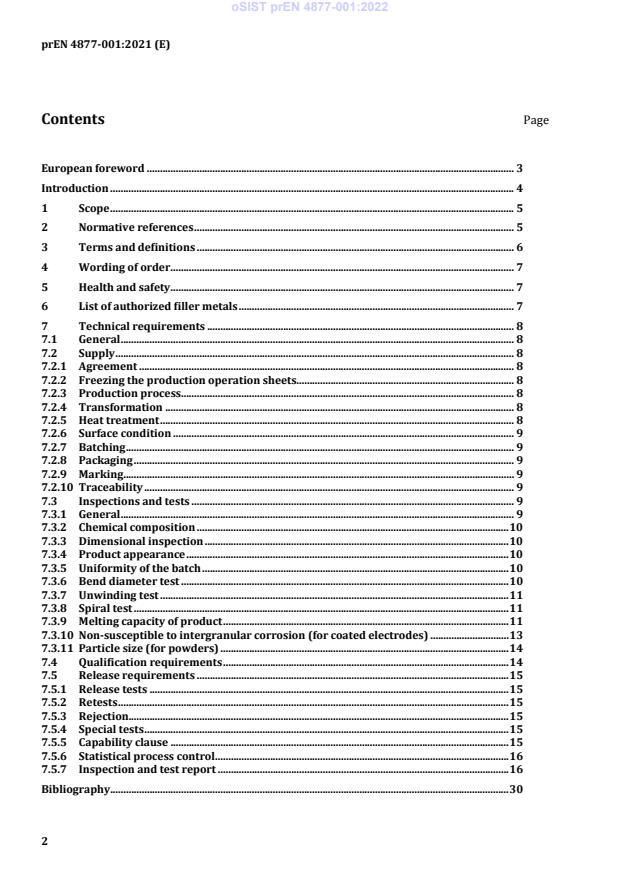
Contents Page
European foreword . 3
Introduction . 4
1 Scope . 5
2 Normative references . 5
3 Terms and definitions . 6
4 Wording of order . 7
5 Health and safety . 7
6 List of authorized filler metals . 7
7 Technical requirements . 8
7.1 General . 8
7.2 Supply . 8
7.2.1 Agreement . 8
7.2.2 Freezing the production operation sheets. 8
7.2.3 Production process. 8
7.2.4 Transformation . 8
7.2.5 Heat treatment . 8
7.2.6 Surface condition . 9
7.2.7 Batching . 9
7.2.8 Packaging . 9
7.2.9 Marking . 9
7.2.10 Traceability . 9
7.3 Inspections and tests . 9
7.3.1 General . 9
7.3.2 Chemical composition . 10
7.3.3 Dimensional inspection . 10
7.3.4 Product appearance . 10
7.3.5 Uniformity of the batch . 10
7.3.6 Bend diameter test . 10
7.3.7 Unwinding test . 11
7.3.8 Spiral test . 11
7.3.9 Melting capacity of product . 11
7.3.10 Non-susceptible to intergranular corrosion (for coated electrodes) . 13
7.3.11 Particle size (for powders) . 14
7.4 Qualification requirements . 14
7.5 Release requirements . 15
7.5.1 Release tests . 15
7.5.2 Retests . 15
7.5.3 Rejection. 15
7.5.4 Special tests . 15
7.5.5 Capability clause . 15
7.5.6 Statistical process control . 16
7.5.7 Inspection and test report . 16
Bibliography . 30
European foreword
This document (prEN 4877-001:2021) has been prepared by the Aerospace and Defence Industries
Association of Europe — Standardization (ASD-STAN).
After enquiries and votes carried out in accordance with the rules of this Association, this document has
received the approval of the National Associations and the Official Services of the member countries of
ASD-STAN, prior to its presentation to CEN.
This document is currently submitted to the CEN Enquiry.
Introduction
This document is part of the series of EN metallic material standards for aerospace applications. The
general organization of this series is described in EN 4258.
From the date of publication of this document, specifications for different welding products can be
written in only one standard instead of separated material standards.
Already existing material standards of filler metals for welding can continue to follow the organization
described in EN 4258.
1 Scope
This document defines the requirements for the ordering, manufacture, testing, inspection and delivery
of all forms of filler metal. It is applied when referred to and in conjunction with the product procurement
specification unless otherwise specified on the drawing, order or inspection schedule.
2 Normative references
The following documents are referred to in the text in such a way that some or all of their content
constitutes requirements of this document. For dated references, only the edition cited applies. For
undated references, the latest edition of the referenced document (including any amendments) applies.
EN 2032-001, Aerospace series - Metallic materials - Part 001: Conventional designation
EN 2032-2, Aerospace series - Metallic materials - Part 2: Coding of metallurgical condition in delivery
condition
EN 2078, Aerospace series - Metallic materials - Manufacturing schedule, inspection schedule, inspection
and test report - Definition, general principles, preparation and approval
FprEN 4259:2019, Aerospace series — Metallic materials — Definition of general terms
EN 4268, Aerospace series - Metallic materials - Heat treatment facilities - General requirements
EN 4877-002, Aerospace series — Filler metals for welding — Part 002: Authorized filler metals
EN ISO 544, Welding consumables - Technical delivery conditions for filler materials and fluxes - Type of
product, dimensions, tolerances and markings (ISO 544:2017)
ISO 3954, Powders for powder metallurgical purposes — Sampling
ISO 4063, Welding and allied processes — Nomenclature of processes and reference numbers
ISO 4497, Metallic powders — Determination of particle size by dry sieving
TR 4607, Aerospace series — Weldability test for weld filler metal wire
At draft stage.
Published as ASD-STAN Technical Report at the date of publication of this document by AeroSpace and Defence
industries Association of Europe — Standardization (ASD-STAN), http://www.asd-stan.org/.
3 Terms and definitions
For the purposes of this document, the terms and definitions given in FprEN 4259:2019 and the following
apply.
ISO and IEC maintain terminological databases for use in standardization at the following addresses:
• ISO Online browsing platform: available at http://www.iso.org/obp
• IEC Electropedia: available at http://www.electropedia.org/
3.1
filler metal for welding
is supplied in the form of:
• wire;
wrought product of uniform solid section supplied in coil or on spools;
• rod;
wire supplied in straight cut lengths
3.2
heat
metal from a same last melting operation
3.3
producer
producer of the alloy
3.4
supplier
producer, transformer or reseller
3.5
batch
quantity of product from one manufacturing campaign, and characterised by a homogeneous chemical
composition and grain size/diameter
3.6
product
generic term used to indicate the material as it shall be manufactured and delivered by the supply source
3.7
reseller
company that performs product storage and reselling operations
3.8
transformer
producer of product in the form requested by the customer (rod or wire)
4 Wording of order
The order shall clearly indicate:
• quantities to be supplied;
• dates of delivery;
• material designation;
• material standard number, or EN 4877-002 (when the product procurement specification is
described in EN 4877-002);
• marking method;
• delivery condition;
• dimensions and tolerances or reference to an appropriate dimensional standard;
• forwarding address;
• nature and type of packing, if required;
• definition and frequency of any special tests and their retest procedures, if required.
5 Health and safety
The product in the delivery condition should fulfil the health and safety laws of the area of the country
when and where it is to be delivered.
A product safety data sheet shall be available.
The implementation of certain special processes implies using substances or chemical preparations that
may present risks for health, safety, or the environment. In addition to the regulations in effect in the
country where the process is performed, the purchaser can prohibit and/or restrict the use of certain
substances by its subcontractors. These prohibitions and/or restrictions can be described in the
applicable procedures of the purchaser.
Furthermore, in strict compliance with the applicable regulations, subcontractor should use the
chemicals presenting a lower risk for a given set of processes, when several choices of chemicals exist.
Pursuant to the applicable regulations, the subcontractors should
• be informed of and comply with the recommendations and the uses identified provided in the
material safety data sheets for the chemical substances used in processes, and
• apply the prevention and protection measures specified in the safety data sheets and/or resulting
from the workstation chemical risk assessment, in accordance with the applicable health and safety
regulations.
6 List of authorized filler metals
Filler metals authorized with associated material standard are listed in EN 4877-002.
7 Technical requirements
7.1 General
The product shall be manufactured in accordance with the requirements of the relevant product’s
procurement specification and the applicable requirements of this specification. A manufacturing
schedule shall be established and applied in accordance with EN 2078.
Product shall satisfy the requirements of the product’s procurement specification and/or order and shall
be free from irregularities and defects prejudicial to the subsequent manufacture or use of this product.
Notwithstanding previous acceptance complying with this product’s procurement specification, any
product that is found, at a later stage, to contain such defects shall be rejected. Instructions for the use of
the material standard are contained in EN 4258.
Unless otherwise specified, the requirements in Table 3 and Table 4 shall apply in conjunction with those
of the relevant product’s procurement specification. Table 3 relates to lines 1 to 29 (inclusive) of the
material standard and Table 4 relates to line 30 onwards in which the sub-line format is also used.
Lines 2 to 98 may also be opened in line 100 if the product’s procurement specification details specific
qualification requirements. If a specific line number is not shown in Table 3 and Table 4, the requirement
is stated in the product’s procurement specification and/or order.
7.2 Supply
7.2.1 Agreement
All products covered by the present document shall be produced by supply sources approved by the
purchaser, according to the procedures in force.
7.2.2 Freezing the production operation sheets
The producer shall ensure consistent quality.
The manufacturing and inspection operation sheet can be modified by the producer provided that the
proposed modifications have no influence on part quality. It shall inform the purchaser’s Quality
Departments and demonstrate that the level of the product has not been affected by this change.
Otherwise, the request for change shall be submitted to the notice of the purchaser’s Quality Department
for a decision.
The purchaser reserves the right to check the relevance of the changes made by the supply source.
7.2.3 Production process
See Table 3, line 4.2 “Method of production”.
7.2.4 Transformation
The transformation shall make it possible to obtain the dimensional, metallurgical, surface roughness and
quality requirements stipulated in the present document and in the product procurement specification
of the product.
7.2.5 Heat treatment
See Table 3, line 6.1 “Delivery conditions — Heat treatment”.
7.2.6 Surface condition
Unless indicated otherwise in the product’s procurement document or the order, the required surface
condition is chemical pickling, with prior machine finishing in certain cases. In cases of a product
delivered in annealed condition in a controlled atmosphere, the pickling may be removed if the surface
condition following annealing has no negative effect on the welding.
7.2.7 Batching
Unless otherwise specified in the order or with the agreement of the purchaser, the delivered welding
rods and wires shall come from the same batch.
7.2.8 Packaging
See Table 3, line 6.1 “Delivery conditions”.
7.2.9 Marking
See Table 3, line 6.1 “Delivery conditions”.
7.2.10 Traceability
Each product shall be traceable to the cast production batch and/or heat treatment batch at all stages of
manufacture and delivery.
Traceability shall be established in order to be able to trace, for each product, the concerned heat, the
manufacturing and heat treatment steps, the inspections and the batches delivered.
The supply source shall keep the documents relative to the manufacture and inspections of the product
at the disposal of the purchaser.
7.3 Inspections and tests
7.3.1 General
7.3.1.1 Qualification of test laboratories
Laboratories performing the inspections and tests described in this document and in the procurement
documents specific to the products shall meet the purchaser requirements applicable to said inspections
and tests.
7.3.1.2 Test frequency
The supply source shall perform all the inspections and tests required in the product’s specific
procurement document and in the present document.
When an inspection frequency is set in this document, it may be alleviated in light of experience, at the
discretion of the Quality Department concerned.
When the present document specifies a test frequency of 10 % of the products, this means that, if the
number of products per batch is N, the tests shall be conducted on a minimum amount of products as
determined by the chart of Table 1.
Table 1
Product amount N Minimum amount of products to test
< 5 N
5 ≤ N < 50 5
50 ≤ N < 200 N/10
N > 200 20
7.3.1.3 Sampling of test pieces
The sample is to be taken from the outer end of the spool.
7.3.1.4 Miscellaneous testing
Additional testing, not specified in the present document, may be required in the product’s specific
procurement documentation.
7.3.2 Chemical composition
See Table 3, line 2 “Chemical composition”.
7.3.3 Dimensional inspection
See Table 4, line 96 “Dimensional inspection”.
7.3.4 Product appearance
7.3.4.1 Wires and rods
See Table 4, line 44 “External defects”, sub-line 3 “Wire or rod” and sub-line 7 “Acceptance criteria”.
7.3.4.2 Coated electrodes
The coatings checked on the electrodes in the packet shall neither be humid or greasy. The surface shall
be uniform. Cracks in the coating are not acceptable, according to EN ISO 544.
Frequency: 10 % of products (see 7.3.1.2).
7.3.4.3 Powders
Powders shall be free from oxidation and contamination, and approximately spherical.
Frequency: One per batch. Sampling according to ISO 3954.
7.3.5 Uniformity of the batch
See Table 4, line 82 “Batch uniformity”.
7.3.6 Bend diameter test
This test is only performed for wires with a diameter 2 mm.
Four coils on the spool are taken as a sample and left to unwind freely on a flat surface. The coils will
unwind on the flat surface and form a circle, which shall have a diameter between:
• wire diameter 1,2 mm: 200 mm and 900 mm;
• wire diameter > 1,2 mm: 380 mm and 900 mm.
Frequency: One per spool.
7.3.7 Unwinding test
Fluttering movements on the wire shall not exceed an amplitude of 1 mm measured at 15 mm from the
wire guide outlet.
Frequency: One per spool.
7.3.8 Spiral test
This test is only performed for wires with a diameter 2 mm.
A spiral is measured on the sample that was used for the bend diameter test. The largest spiral formed
by the coil when placed unattached on a horizontal surface shall not exceed 100 mm (shall not create a
plastic deformation during handling).
Frequency: One per batch.
7.3.9 Melting capacity of product
7.3.9.1 General
The supply source is bound to guarantee the welding capability of the delivered product by checking the
results to be obtained according to the clauses below.
Frequency: Under supply source guarantee. This test is required by the purchaser as part of the approval
in case of customer disputes or difficulties encountered during manufacturing.
7.3.9.2 Wires and rods
7.3.9.2.1 Type of test
For this test, a molten metal deposit is created with the product to be delivered, preferably using the TIG
welding process (according to ISO 4063) or, subject to approval by Safran, the oxy-acetylene (oxy-fuel)
welding process (according to ISO 4063).
A sample approximately 2 mm
...