

SIST EN 4500-006:2026
(Main)Aerospace series - Metallic materials - Rules for drafting and presentation of material standards - Part 006: Specific rules for filler metals and brazing
- Abstract
The EN 4500 series specifies the rules for the drafting and presentation of metallic material standards for aerospace applications.
This Part 006 specifies the "Specific rules for filler metals for brazing".
- Status
- Published
- Public Enquiry End Date
- 30-Oct-2025
- Publication Date
- 20-Oct-2026
- Technical Committee
- I13 - Imaginarni 13
- Current Stage
- 6060 - National Implementation/Publication (Adopted Project)
- Start Date
- 19-Oct-2026
- Due Date
- 24-Dec-2026
- Completion Date
- 21-Oct-2026

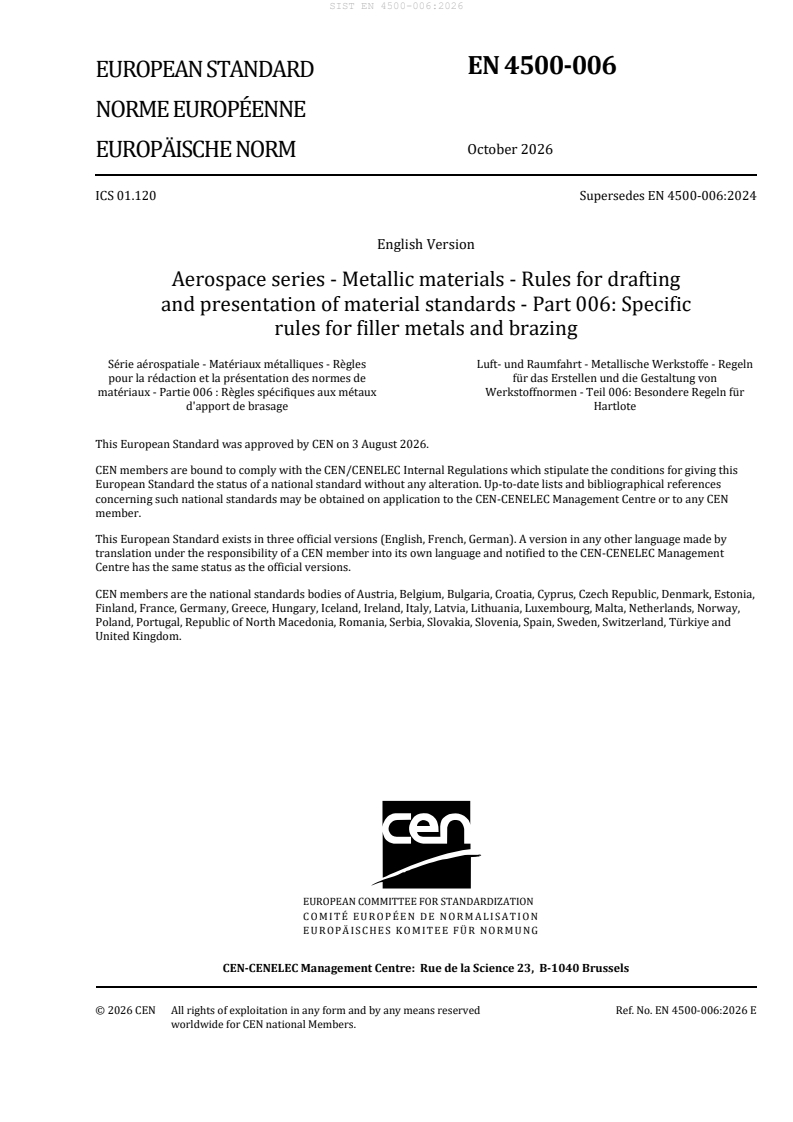
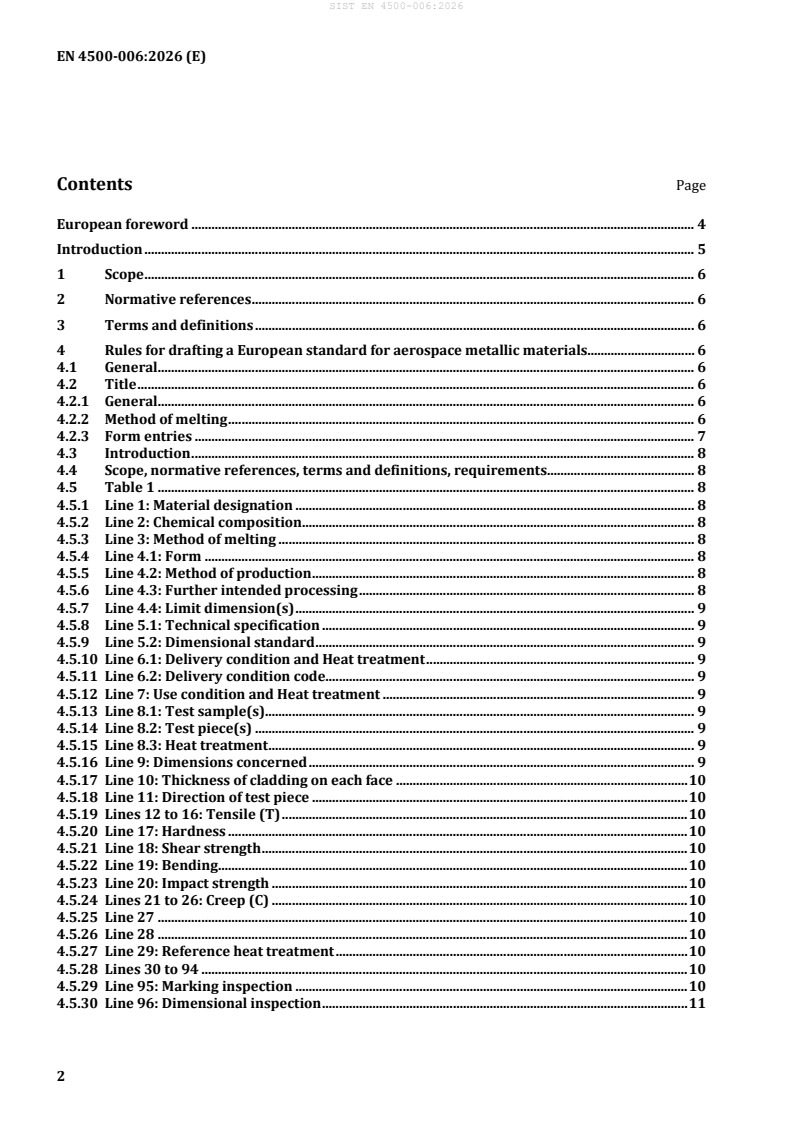
SIST EN 4500-006:2026 is the Slovenian standard corresponding to prEN 4500-006:2025, a draft European Standard prepared by CEN for aerospace metallic materials. It sets specific rules for drafting and presenting material standards for filler metals for brazing, so it is used by people who create, review, or apply aerospace material specifications.
What does SIST EN 4500-006:2026 specify?
SIST EN 4500-006:2026 belongs to the EN 4500 series, which gives rules for the drafting and presentation of metallic material standards for aerospace applications. This Part 006 covers the specific rules for filler metals for brazing and shows how a European material standard for that family should be structured.
The document is organized into four main clauses plus a bibliography, with informative annexes that provide completion examples:
- Clause 1 Scope
- Clause 2 Normative references
- Clause 3 Terms and definitions
- Clause 4 Rules for drafting a European standard for aerospace metallic materials
- Bibliography
- Annexes A to E
| Annex | What it covers |
|---|---|
| Annex A | Completion of the title page |
| Annex B | Completion of the introduction |
| Annex C | Completion of the scope, normative references, terms and definitions, and requirements |
| Annex D | Completion of Table 1 |
| Annex E | Completion of the bibliography |
In practice, the standard is a drafting rulebook rather than a product specification for one alloy. That means it tells authors what information belongs in a filler metal standard and how to present it in a consistent aerospace format.
What are the key requirements of SIST EN 4500-006:2026?
SIST EN 4500-006:2026 sets the wording and structure to use when writing a filler-metal standard, especially in the title and in Table 1. The most important point for users is that the standard controls how the information is presented, so the resulting material standard can be read and applied consistently across aerospace projects.
Title and identification rules
Clause 4.2 gives the title rules. The material designation is shown in the title, and when an ECISS designation exists it is added in brackets for information. Annex A illustrates how the title page is completed for materials with and without an ECISS designation, which helps drafters present the alloy name in the expected form.
Melting method and product form
Clause 4.2.2 lists the allowed melting descriptors, such as air melted, inert gas melted, vacuum melted, and vacuum arc variants. Clause 4.2.3 lists the form entries and the qualifiers that may be added for forms such as amorphous foil, borided foil, rolled foil, powder, paste, tape, and wire.
This matters because the title and Table 1 must identify how the filler metal was made and what physical form it has. For a buyer or engineer, that is the first cue that the document applies to the right product type.
Chemical composition and Table 1 structure
Clause 4.5.2 requires chemical composition to be written in the EN 4500-001 format and in a defined order of presentation. Clause 4.5 lays out the full structure of Table 1, including material designation, chemical composition, method of melting, form, method of production, further intended processing, limit dimensions, technical specification, dimensional standard, delivery condition, use condition, test samples, test pieces, heat treatment, dimensions concerned, and the inspection and qualification lines.
In practice, this means the standard forces a complete and predictable data set. Anyone drafting or checking a material standard can see where each piece of information belongs.
Delivery condition, use condition, and heat treatment
Clause 4.5.10 gives the delivery condition and heat-treatment entries, using terms such as as manufactured and annealed. Clause 4.5.12 covers the use condition and heat treatment, and Annex D shows how those entries are completed in a worked example.
This matters when the same filler metal may be supplied, stored, or used in different states. Clear condition wording avoids confusion between what is supplied and what is intended for application.
Test and inspection entries
Clause 4.5.19 to 4.5.26 cover the main mechanical and thermal property lines, including tensile, hardness, shear strength, bending, impact strength, and creep. Clause 4.5.28 to 4.5.33 cover marking inspection, dimensional inspection, notes, typical use, and product qualification.
For practice, this section tells the standard writer which performance topics can be built into the material standard and where the corresponding inspection or qualification information belongs.
Normative application of the table
Annex C states that the requirements of Table 1 shall be applied and that the documents listed in Table 1 shall be applied. Annex D then shows how the table is completed in an example for a nickel base braze alloy, including entries for thermal analysis, wettability, porosity, formability of joining metals, and product qualification.
That means Table 1 is not just an illustration. It is the core structure that the resulting material standard has to follow.
What terms does SIST EN 4500-006:2026 define?
For the purposes of SIST EN 4500-006:2026, the terms and definitions from EN 4259 and EN 4500-001 apply. The document also uses several key drafting terms that matter when completing the title and Table 1.
- ECISS designation - A conventional designation that may be shown in brackets after the material designation in the title.
- Material designation - The identifying name or code for the alloy or filler metal being standardized.
- Delivery condition - The state in which the material is supplied, such as as manufactured or annealed.
- Use condition - The state intended for application or service, which may match the delivery condition.
- Reference heat treatment - The heat treatment state used as the reference point for the standard’s requirements.
- Product qualification - The qualification entry that links the product to an agreed qualification programme or referenced qualification standard.
- Marking inspection - The inspection item used to check product marking before acceptance.
- Dimensional inspection - The inspection item used to check that dimensions meet the specified limits.
Who uses SIST EN 4500-006:2026?
SIST EN 4500-006:2026 is used by standards writers, technical committees, and aerospace material specialists who prepare European or national material standards. It is also used by manufacturers of filler metals for brazing, by aerospace suppliers, and by quality and procurement teams that need to read or apply those standards.
In practice, users rely on it when they:
- draft or review a filler-metal standard for aerospace use
- complete a title page, scope, or Table 1
- define composition, form, condition, testing, and qualification entries
- align a product specification with the EN 4500 drafting system
- check marking, dimensional inspection, and product qualification wording
What changed in SIST EN 4500-006:2026 from the previous edition?
SIST EN 4500-006:2026 supersedes EN 4500-006:2024. The foreword states these significant technical changes:
- addition of the missing text in the scope
- addition of line 4.3, Further intended processing, and line 5.2, Dimensional standard, in the body of the document and in Annex D
- addition of introductory sentences to Table 1 in Annex C to make clear that the table is a normative element and that all listed documents shall be applied
- editorial revisions to clarify whether references to other documents or annexes are normative or informative
- restructuring and simplification of the template to achieve a single continuous table
Which standards are used with SIST EN 4500-006:2026?
| Standard | Role in SIST EN 4500-006:2026 |
|---|---|
| EN 4259 | Gives the general terms and definitions used for aerospace metallic materials |
| EN 4500-001 | Provides the general drafting rules and is used for title wording, composition order, and some Table 1 entries |
| EN 4258 | Describes the general organization of aerospace metallic materials standardization |
| EN 3875 | Appears in Annex C and Annex D as the example technical specification for filler metal for brazing |
| EN 2043 | Appears in Annex D as the qualification standard used in some product-qualification cases |
| EN 2032-001 | Cited in the bibliography for conventional designation practice |
| EN 4500-002, EN 4500-003, EN 4500-004, EN 4500-005 | Other parts of the EN 4500 series cited in the bibliography as related drafting rules for other material families |
What does the SIST EN 4500-006:2026 document contain?
The document contains the drafting rules for the title, introduction, scope, references, terms, and the main Table 1 structure used in aerospace material standards. Clause 4 gives the detailed line-by-line template, including composition, melting method, form, production method, dimensions, tests, inspections, notes, typical use, and product qualification.
Annex A gives title-page completion examples, Annex B gives an introduction example, and Annex C shows how the scope and Table 1 are completed in a normative context. Annex D gives a worked Table 1 example for a nickel base braze alloy, including how property checks and qualification entries are presented. Annex E completes the bibliography and shows the related documents that support the drafting system.
Relations
- Effective Date
- 21-Oct-2026
- Effective Date
- 21-Oct-2026
- Effective Date
- 14-Oct-2026
- Effective Date
- 14-Oct-2026
- Effective Date
- 11-Jun-2025
Get Certified
Connect with accredited certification bodies for this standard

BUREAU VERITAS Certification Germany
Bureau Veritas certification in Germany.

DVS-ZERT GmbH
German welding certification society.

Element Materials Technology
Materials testing and product certification.
Sponsored listings
Frequently Asked Questions
SIST EN 4500-006:2026 is a standard published by the Slovenian Institute for Standardization (SIST). Its full title is "Aerospace series - Metallic materials - Rules for drafting and presentation of material standards - Part 006: Specific rules for filler metals and brazing". This standard covers: The EN 4500 series specifies the rules for the drafting and presentation of metallic material standards for aerospace applications. This Part 006 specifies the "Specific rules for filler metals for brazing".
The EN 4500 series specifies the rules for the drafting and presentation of metallic material standards for aerospace applications. This Part 006 specifies the "Specific rules for filler metals for brazing".
SIST EN 4500-006:2026 is classified under the following ICS (International Classification for Standards) categories: 01.120 - Standardization. General rules; 25.160.20 - Welding consumables; 49.025.05 - Ferrous alloys in general. The ICS classification helps identify the subject area and facilitates finding related standards.
SIST EN 4500-006:2026 has the following relationships with other standards: It is inter standard links to SIST EN 4259:2022, SIST EN 4500-001:2026, SIST EN 4258:2024, SIST EN 4500-001:2024, SIST EN 4500-006:2024. Understanding these relationships helps ensure you are using the most current and applicable version of the standard.
SIST EN 4500-006:2026 is available in PDF format for immediate download after purchase. The document can be added to your cart and obtained through the secure checkout process. Digital delivery ensures instant access to the complete standard document.
Standards Content (Sample)
Contents
- Introduction
- 1 Scope
- 2 Normative references
- 3 Terms and definitions
- 4 Rules for drafting a European standard for aerospace metallic materials
- 4.1 General
- 4.2 Title
- 4.3 Introduction
- 4.4 Scope, normative references, terms and definitions, requirements
- 4.6 Bibliography
- Annex A
- Annex B
- Introduction
- Annex C
- 1 Scope
- 2 Normative references
- 3 Terms and definitions
- 4 Requirements
- Annex D
- 1 Material designation Nickel base braze alloy NI-B40002 (NiSi4B2)
- 2 Chemical Element C Si P S Al B Co Fe Se Ti Zr Ni
- 3 Method of melting Air or inert gas or vacuum melted or the alloy without boron
- 4.1 Form Borided foil
- 4.3 Further intended processing —
- 4.4 Limit dimension(s) mm —
- 5.2 Dimensional standard —
- 6.1 Delivery condition As manufactured
- 6.2 Delivery condition code U
- 7 Use condition Delivery condition
- 8.1 Test sample(s) —
- 8.2 Test piece(s) —
- 8.3 Heat treatment —
- 9 Dimensions concerned mm —
- 10 Thickness of cladding on % —
- 11 Direction of test piece —
- 12 Temperature θ °C —
- 13 Proof stress Rp0,2 MPa —
- 14 T Strength R MPa —
- 15 Elongation A % —
- 16 Reduction of Z % —
- 17 Hardness HV —
- 18 Shear strength R MPa —
- 19 Bending k — —
- 20 Impact strength —
- 21 Temperature θ °C —
- 22 Time h —
- 23 C Stress σa MPa —
- 24 Elongation a % —
- 25 Rupture stress σ MPa —
- 26 Elongation at A % —
- 98 Notes — ppm
- Annex E
- Bibliography
- Bibliography
Introduction
This document is part of the series of EN metallic material standards for aerospace applications. The general organization of this series is described in EN 4258.
The EN 4500 series (Aerospace series — Metallic materials — Rules for drafting and presentation of material standards) is composed by the following documents:
- General rules EN 4500-001;
- Specific rules for aluminium, aluminium alloys and EN 4500-002; magnesium alloys
- Specific rules for heat-resisting alloys EN 4500-003;
- Specific rules for titanium and titanium alloys EN 4500-004;
- Specific rules for steels EN 4500-005;
- Specific rules for filler metals for welding EN 4500-002 to EN 4500-005;
- Specific rules for filler metals for brazing EN 4500-006.
Basis for the drafting of all European standards is CEN/CENELEC Internal Regulations — Part 3:
Principles and rules for the structure and drafting of CEN and CENELEC documents.
SIST EN 4500-006:2026 EN 4500-006:2026 (E)
1 Scope
The EN 4500 series specifies the rules for the drafting and presentation of metallic material standards for aerospace applications.
This Part 006 specifies the “Specific rules for filler metals for brazing”.
2 Normative references
The following documents are referred to in the text in such a way that some or all of their content constitutes requirements of this document. For dated references, only the edition cited applies. For undated references, the latest edition of the referenced document (including any amendments) applies. EN 4259, Aerospace series — Metallic materials — Definition of general terms EN 4500-001, Aerospace series — Metallic materials — Rules for drafting and presentation of material standards — Part 001: General rules
3 Terms and definitions
For the purposes of this document, the terms and definitions given in EN 4259 and EN 4500-001 apply. ISO and IEC maintain terminological databases for use in standardization at the following addresses:
- ISO Online browsing platform: available at https://www.iso.org/obp
- IEC Electropedia: available at https://www.electropedia.org/
4 Rules for drafting a European standard for aerospace metallic materials
4.1 General
Examples given in annexes are only intended to illustrate the rules for drafting and presentation and might not correspond to real standardized EN semi-finished products. Technological development can require the use of terms additional to those listed.
4.2 Title
4.2.1 General
Shall be according to EN 4500-001.
See also Annex A, subclause A.1 of this document.
When the material has an ECISS designation, this shall be shown, for information, in brackets after the designation. See Annex A, subclause A.2 of this document.
The following are examples of descriptions which shall be used.
4.2.2 Method of melting
Complete in accordance with EN 4500-001 using one or more of the following terms:
- air melted;
- inert gas melted;
- vacuum melted;
SIST EN 4500-006:2026 EN 4500-006:2026 (E) - non-consumable electrode vacuum melted; - consumable electrode vacuum arc melted; - consumable electrode vacuum arc remelted.
4.2.3 Form entries
a) Amorphous foil:
The term may be qualified with the following term:
1) melt spun.
b) Borided foil:
The term may be qualified with one or more of the following terms:
1) cold rolled; 2) hot rolled; 3) boron diffused into the surface.
c) Rolled foil:
The term may be qualified with one of the following terms:
1) cold rolled; 2) hot rolled.
d) Powder:
The term may be qualified with one or more of the following terms:
1) water atomized; 2) gas atomized; 3) sieved.
e) Paste.
f) Tape.
g) Wire:
The term may be qualified with one of the following terms:
1) cold drawn; 2) cold rolled; 3) cold extruded.
SIST EN 4500-006:2026 EN 4500-006:2026 (E)
4.3 Introduction
Shall be according to EN 4500-001.
See also Annex B of this document.
4.4 Scope, normative references, terms and definitions, requirements
Shall be according to EN 4500-001.
See also Annex C of this document.
4.5 Table 1
4.5.1 Line 1: Material designation
Shall be according to EN 4500-001.
See also Annex D of this document.
4.5.2 Line 2: Chemical composition
The chemical composition shall be written in accordance with EN 4500-001 and the order of presentation of elements shall conform to the following rules:
- C, Si, Mn, P, S;
- alloying elements in alphabetical order using their chemical symbol;
- trace elements in alphabetical order;
- ratio and/or total elements.
4.5.3 Line 3: Method of melting
Shall be according to EN 4500-001.
See also Annex D of this document.
The terms listed in 4.2.2 shall be used.
4.5.4 Line 4.1: Form
Shall be according to EN 4500-001.
See also Annex D of this document.
4.5.5 Line 4.2: Method of production
Shall be according to EN 4500-001.
See also Annex D of this document.
The applicable terms given in 4.2 shall be used.
4.5.6 Line 4.3: Further intended processing
Shall be according to EN 4500-001.
See also Annex D of this document.
SIST EN 4500-006:2026 EN 4500-006:2026 (E)
4.5.7 Line 4.4: Limit dimension(s)
Shall be according to EN 4500-001.
See also Annex D of this document.
4.5.8 Line 5.1: Technical specification
Shall be according to EN 4500-001.
See also Annex D of this document.
4.5.9 Line 5.2: Dimensional standard
This line shall indicate the applicable dimensional standard.
4.5.10 Line 6.1: Delivery condition and Heat treatment
Shall be according to EN 4500-001.
...