

SIST EN 12504-2:2021
(Main)Testing concrete in structures - Part 2: Non-destructive testing - Determination of rebound number
General Information
- Abstract
This document specifies a method for determining the rebound number of an area of hardened concrete using a spring-driven hammer.
NOTE 1 The rebound number determined by this method can be used to assess the uniformity of concrete in situ, to delineate zones or areas of poor quality or deteriorated concrete in structures.
NOTE 2 The test method is not intended as an alternative for the compressive strength determination of concrete (EN 12390-3), but with suitable correlation, it can provide an estimate of in situ compressive strength. For the assessment of in situ compressive strength, see EN 13791.
NOTE 3 The hammer can be used for comparative testing, referenced against a concrete with known strength or against a concrete which has been shown that it has come from a defined volume of concrete with a population verified as conforming to a particular strength class.
- Status
- Published
- Public Enquiry End Date
- 14-Nov-2019
- Publication Date
- 16-Aug-2021
- Technical Committee
- BBB - Concrete, reinforced concrete and prestressed concrete
- Current Stage
- 6060 - National Implementation/Publication (Adopted Project)
- Start Date
- 28-Jul-2021
- Due Date
- 02-Oct-2021
- Completion Date
- 17-Aug-2021

Overview
EN 12504-2:2021 - Testing concrete in structures - Part 2: Non‑destructive testing - Determination of rebound number - specifies a standardized method to determine the rebound number of hardened concrete using a spring‑driven hammer (Type N, Schmidt‑style). The method is intended for in‑situ assessment of concrete uniformity and for delineating zones of poor quality or deterioration. It is not a direct substitute for laboratory compressive strength tests (EN 12390‑3) but can provide an estimate of in‑situ compressive strength when suitably correlated (see EN 13791).
Key topics
- Principle: A spring‑loaded mass strikes a plunger on the concrete surface and the rebound distance (or related energy/velocity measure) is recorded as the rebound number.
- Apparatus:
- Spring‑driven rebound hammer (Type N, Schmidt‑style).
- Steel reference anvil: hardness ≥ 52 HRC (EN ISO 6508‑1), mass (16 ± 1) kg, diameter ≈150 mm for hammer verification.
- Abrasive stone (medium‑grain silicon carbide) for surface preparation.
- Test location & preparation:
- Concrete elements ≥ 100 mm thick or rigidly supported specimens.
- Avoid honeycombing, scaling, very porous surfaces; grind heavily textured areas.
- Remove surface water; consider surface type, moisture, carbonation, direction of test.
- Procedure & acceptance criteria:
- Verify hammer on reference anvil before and after tests (five impacts; readings within ±3 of manufacturer value).
- Operate hammer between 0 °C and 50 °C, follow manufacturer’s instructions for orientation/perpendicularity.
- Minimum of nine valid readings per test location; ensure impacts are ≥25 mm apart and ≥25 mm from edges (grid spacing 25–50 mm recommended).
- Report the median rebound number (whole number) adjusted for hammer orientation. Discard set if >20% of readings deviate >25% from the median.
- Reporting: Include reference to EN 12504‑2:2021, structure ID, test locations, hammer type/ID, surface prep, conditions, date/time, rebound number and any deviations.
Applications
- Quick, portable non‑destructive testing (NDT) for condition surveys and quality control.
- Locating deteriorated or low‑quality zones in concrete structures.
- Comparative testing when referenced to concrete of known strength or a verified population from the same pour.
- Preliminary estimate of in‑situ compressive strength when combined with appropriate correlations (use EN 13791 for formal assessment).
Who uses this standard
- Structural and materials engineers
- Site inspectors, forensic engineers, asset managers
- Contractors and quality control personnel performing concrete condition surveys
- Laboratories and testing bodies carrying out NDT on concrete
Related standards
- EN 12390‑3 - Compressive strength of test specimens
- EN 13791 - Assessment of in‑situ compressive strength
- ISO 1920‑7 - Non‑destructive tests on hardened concrete (basis for this document)
- ASTM C805 - Rebound number test method
- Other parts of EN 12504 series (e.g., parts on coring, pull‑out, ultrasonic pulse velocity)
Keywords: EN 12504‑2:2021, rebound number, rebound hammer, Schmidt hammer, non‑destructive testing, concrete testing, in‑situ compressive strength, concrete condition survey.
Relations
- Effective Date
- 01-Sep-2021
- Effective Date
- 28-Jan-2026
- Effective Date
- 28-Jan-2026
- Referred By
SIST EN 14487-1:2006 - Sprayed concrete - Part 1: Definitions, specifications and conformity - Effective Date
- 28-Jan-2026
- Effective Date
- 28-Jan-2026
- Effective Date
- 28-Jan-2026
- Referred By
SIST EN ISO 20485:2018 - Non-destructive testing - Leak testing - Tracer gas method (ISO 20485:2017) - Effective Date
- 28-Jan-2026
- Effective Date
- 28-Jan-2026
- Effective Date
- 28-Jan-2026
- Effective Date
- 28-Jan-2026
- Effective Date
- 28-Jan-2026
- Referred By
SIST EN 14487-1:2023 - Sprayed concrete - Part 1: Definitions, specifications and conformity - Effective Date
- 28-Jan-2026
Get Certified
Connect with accredited certification bodies for this standard

DIBt (Deutsches Institut für Bautechnik)
German Institute for Building Technology.
DIN CERTCO
DIN Group product certification.

Aboma Certification B.V.
Specialized in construction, metal, and transport sectors.
Sponsored listings
Frequently Asked Questions
SIST EN 12504-2:2021 is a standard published by the Slovenian Institute for Standardization (SIST). Its full title is "Testing concrete in structures - Part 2: Non-destructive testing - Determination of rebound number". This standard covers: This document specifies a method for determining the rebound number of an area of hardened concrete using a spring-driven hammer. NOTE 1 The rebound number determined by this method can be used to assess the uniformity of concrete in situ, to delineate zones or areas of poor quality or deteriorated concrete in structures. NOTE 2 The test method is not intended as an alternative for the compressive strength determination of concrete (EN 12390-3), but with suitable correlation, it can provide an estimate of in situ compressive strength. For the assessment of in situ compressive strength, see EN 13791. NOTE 3 The hammer can be used for comparative testing, referenced against a concrete with known strength or against a concrete which has been shown that it has come from a defined volume of concrete with a population verified as conforming to a particular strength class.
This document specifies a method for determining the rebound number of an area of hardened concrete using a spring-driven hammer. NOTE 1 The rebound number determined by this method can be used to assess the uniformity of concrete in situ, to delineate zones or areas of poor quality or deteriorated concrete in structures. NOTE 2 The test method is not intended as an alternative for the compressive strength determination of concrete (EN 12390-3), but with suitable correlation, it can provide an estimate of in situ compressive strength. For the assessment of in situ compressive strength, see EN 13791. NOTE 3 The hammer can be used for comparative testing, referenced against a concrete with known strength or against a concrete which has been shown that it has come from a defined volume of concrete with a population verified as conforming to a particular strength class.
SIST EN 12504-2:2021 is classified under the following ICS (International Classification for Standards) categories: 19.100 - Non-destructive testing; 91.100.30 - Concrete and concrete products. The ICS classification helps identify the subject area and facilitates finding related standards.
SIST EN 12504-2:2021 has the following relationships with other standards: It is inter standard links to SIST EN 12504-2:2013, SIST EN ISO 6508-1:2024, SIST EN ISO 20486:2018, SIST EN 14487-1:2006, SIST EN 1504-10:2017, SIST EN 1504-10:2004, SIST EN ISO 20485:2018, SIST EN 13791:2019, SIST EN 17435:2022, SIST EN 13791:2007, SIST-TS CEN/TS 16717:2015, SIST EN 14487-1:2023. Understanding these relationships helps ensure you are using the most current and applicable version of the standard.
SIST EN 12504-2:2021 is available in PDF format for immediate download after purchase. The document can be added to your cart and obtained through the secure checkout process. Digital delivery ensures instant access to the complete standard document.
Standards Content (Sample)
SLOVENSKI STANDARD
01-september-2021
Nadomešča:
SIST EN 12504-2:2013
Preskušanje betona v konstrukcijah - 2. del: Neporušitveno preskušanje -
Ugotavljanje sklerometričnega indeksa
Testing concrete in structures - Part 2: Non-destructive testing - Determination of
rebound number
Prüfung von Beton in Bauwerken - Teil 2: Zerstörungsfreie Prüfung - Bestimmung der
Rückprallzahl
Essais pour béton dans les structures - Partie 2 : Essais non destructifs - Détermination
de l’indice de rebondissement
Ta slovenski standard je istoveten z: EN 12504-2:2021
ICS:
19.100 Neporušitveno preskušanje Non-destructive testing
91.100.30 Beton in betonski izdelki Concrete and concrete
products
2003-01.Slovenski inštitut za standardizacijo. Razmnoževanje celote ali delov tega standarda ni dovoljeno.
EN 12504-2
EUROPEAN STANDARD
NORME EUROPÉENNE
July 2021
EUROPÄISCHE NORM
ICS 91.100.30 Supersedes EN 12504-2:2012
English Version
Testing concrete in structures - Part 2: Non-destructive
testing - Determination of rebound number
Essais pour béton dans les structures - Partie 2 : Essais Prüfung von Beton in Bauwerken - Teil 2:
non destructifs - Détermination de l'indice de Zerstörungsfreie Prüfung - Bestimmung der
rebondissement Rückprallzahl
This European Standard was approved by CEN on 14 June 2021.
CEN members are bound to comply with the CEN/CENELEC Internal Regulations which stipulate the conditions for giving this
European Standard the status of a national standard without any alteration. Up-to-date lists and bibliographical references
concerning such national standards may be obtained on application to the CEN-CENELEC Management Centre or to any CEN
member.
This European Standard exists in three official versions (English, French, German). A version in any other language made by
translation under the responsibility of a CEN member into its own language and notified to the CEN-CENELEC Management
Centre has the same status as the official versions.
CEN members are the national standards bodies of Austria, Belgium, Bulgaria, Croatia, Cyprus, Czech Republic, Denmark, Estonia,
Finland, France, Germany, Greece, Hungary, Iceland, Ireland, Italy, Latvia, Lithuania, Luxembourg, Malta, Netherlands, Norway,
Poland, Portugal, Republic of North Macedonia, Romania, Serbia, Slovakia, Slovenia, Spain, Sweden, Switzerland, Turkey and
United Kingdom.
EUROPEAN COMMITTEE FOR STANDARDIZATION
COMITÉ EUROPÉEN DE NORMALISATION
EUROPÄISCHES KOMITEE FÜR NORMUNG
CEN-CENELEC Management Centre: Rue de la Science 23, B-1040 Brussels
© 2021 CEN All rights of exploitation in any form and by any means reserved Ref. No. EN 12504-2:2021 E
worldwide for CEN national Members.
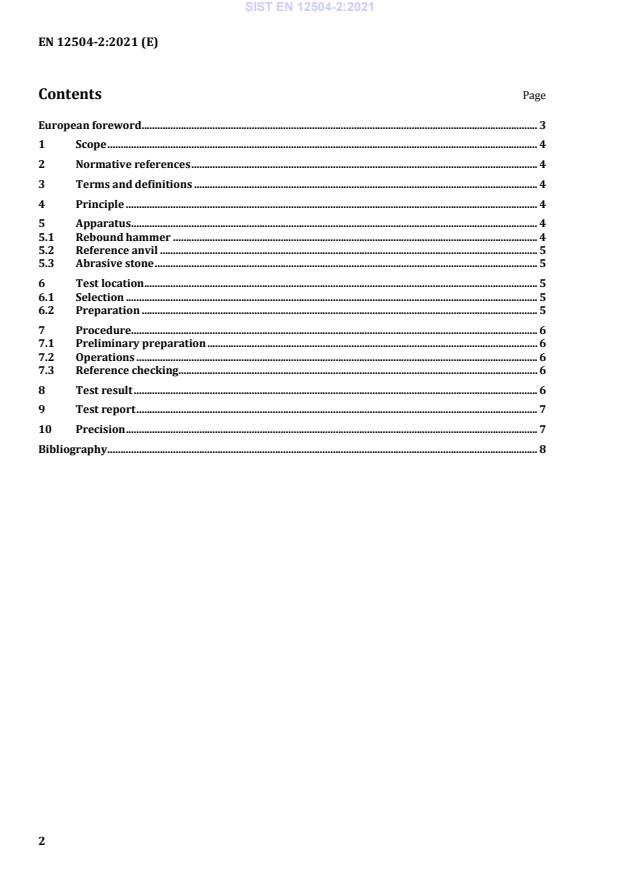
Contents Page
European foreword . 3
1 Scope . 4
2 Normative references . 4
3 Terms and definitions . 4
4 Principle . 4
5 Apparatus . 4
5.1 Rebound hammer . 4
5.2 Reference anvil . 5
5.3 Abrasive stone . 5
6 Test location . 5
6.1 Selection . 5
6.2 Preparation . 5
7 Procedure. 6
7.1 Preliminary preparation . 6
7.2 Operations . 6
7.3 Reference checking. 6
8 Test result . 6
9 Test report . 7
10 Precision . 7
Bibliography . 8
European foreword
This document (EN 12504-2:2021) has been prepared by Technical Committee CEN/TC 104 “Concrete
and related products”, the secretariat of which is held by SN.
This European Standard shall be given the status of a national standard, either by publication of an
identical text or by endorsement, at the latest by January 2022, and conflicting national standards shall
be withdrawn at the latest by January 2022.
Attention is drawn to the possibility that some of the elements of this document may be the subject of
patent rights. CEN shall not be held responsible for identifying any or all such patent rights.
This document supersedes EN 12504-2:2012.
The following amendments have been made in comparison to the former edition:
— a recommendation that two different reference anvils are used for calibrating the equipment.
— the allowable range of results has been tightened.
This document is based on the International Standard ISO 1920-7, Testing of concrete – Part 7: Non-
destructive tests on hardened concrete, and reference has been made to ASTM C805, Standard Test Method
for Rebound number of hardened concrete.
This document has been framed around the use of a Type N, spring driven steel hammer, originally
designed by Schmidt.
This document is one of a series on testing concrete.
EN 12504, Testing concrete in structures, consists of the following parts:
— Part 1: Cored specimens – Taking, examining and testing in compression;
— Part 2: Non-destructive testing – Determination of rebound number;
— Part 3: Determination of pull-out force;
— Part 4: Determination of ultrasonic pulse velocity.
Any feedback and questions on this document should be directed to the users’ national standards body.
A complete listing of these bodies can be found on the CEN website.
According to the CEN-CENELEC Internal Regulations, the national standards organisations of the
following countries are bound to implement this European Standard: Austria, Belgium, Bulgaria, Croatia,
Cyprus, Czech Republic, Denmark, Estonia, Finland, France, Germany, Greece, Hungary, Iceland, Ireland,
Italy, Latvia, Lithuania, Luxembourg, Malta, Netherlands, Norway, Poland, Portugal, Republic of North
Macedonia, Romania, Serbia, Slovakia, Slovenia, Spain, Sweden, Switzerland, Turkey and the United
Kingdom.
1 Scope
This document specifies a method for determining the rebound number of an area of hardened concrete
using a spring-driven hammer
...