

oSIST prEN IEC 62660-2:2026
(Main)Secondary lithium-ion cells for the propulsion of electric road vehicles - Part 2: Reliability and abuse testing
- Status
- Not Published
- Public Enquiry End Date
- 30-Nov-2026
- Technical Committee
- ISCB - Secondary cells and batteries
- Current Stage
- 4020 - Public enquire (PE) (Adopted Project)
- Start Date
- 30-Sep-2026
- Due Date
- 17-Feb-2027

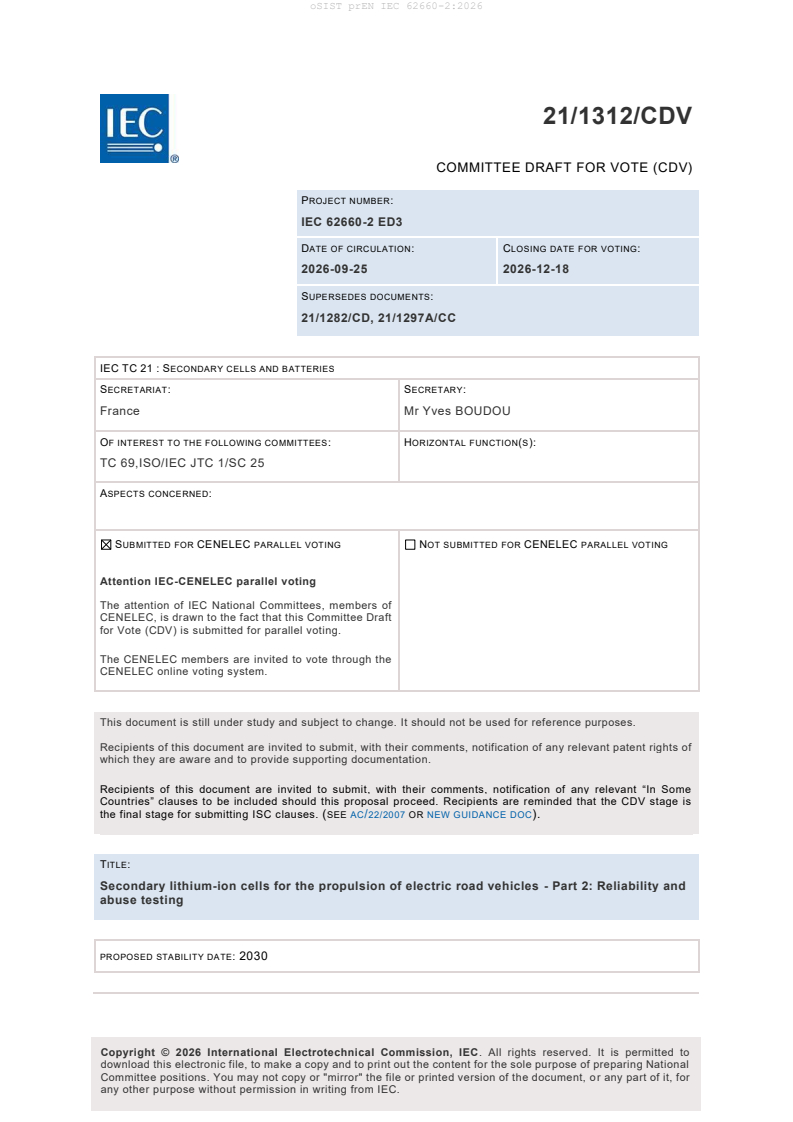
oSIST prEN IEC 62660-2:2026 is the Slovenian standard identical to prEN IEC 62660-2:2026, published by SIST and prepared by IEC. It specifies test procedures for the reliability and abuse behaviour of secondary lithium-ion cells and cell blocks used for propulsion of electric road vehicles, and it gives a standard way to describe test results for battery system and battery pack design.
What does oSIST prEN IEC 62660-2:2026 specify?
oSIST prEN IEC 62660-2:2026 covers reliability and abuse testing for secondary lithium-ion cells and cell blocks used in battery electric vehicles (BEV) and hybrid electric vehicles (HEV). In practice, it gives common test methods and recording rules so that manufacturers and customers can compare cell behaviour in a consistent way.
The document is organized into clauses on scope, normative references, terms and definitions, test conditions, electrical measurement, reliability and abuse tests, and description of test results. Annex A gives selective test conditions for the capacity test.
| Annex | What it covers |
|---|---|
| Annex A | Selective test conditions for the capacity test in Clause 5 |
What are the key requirements of oSIST prEN IEC 62660-2:2026?
oSIST prEN IEC 62660-2:2026 starts with common test conditions in Clause 4, then defines electrical preparation in Clause 5, the test methods themselves in Clause 6, and the result description system in Clause 7. The practical effect is that a test report should show not only the outcome, but also how the cell was prepared, mounted, measured and observed.
Test conditions and measurement control
Clause 4 sets the default test environment at room temperature, defined as 25 °C ± 2 K, unless another condition is stated. The cell shall be thermally stabilized before testing, normally by soaking for at least 12 h, and stabilization is reached when the temperature change over 1 h is below 1 K.
Clause 4 also sets measurement quality requirements. Voltage, current, temperature, time, mass and dimensions all have stated tolerances, and the report shall identify the instrumentation used. This matters because reliability and abuse results are only comparable when the measuring set-up is known and sufficiently accurate.
Electrical preparation before testing
Clause 5 requires the cell to be discharged at room temperature before charging, using the discharge current from Table 1, and then charged by the method declared by the cell manufacturer. Capacity measurement is done after charging and stabilization by discharging at the specified current until the manufacturer’s end-of-discharge voltage is reached.
Clause 5 also defines state of charge (SOC) adjustment for the later tests. The test cell is charged, rested, and then discharged for a calculated time so that it reaches the target SOC. This is the preparation step that puts the cell into the right condition for abuse or reliability testing.
Mechanical and thermal tests
Clause 6 includes vibration, mechanical shock, crush, high temperature endurance and temperature cycling. Vibration uses the random vibration method of IEC 60068-2-64 and applies 8 h per test plane, with the specified acceleration profile. Mechanical shock follows ISO 16750-3 and uses a half-sinusoidal pulse.
The crush test uses a round bar, hemisphere, sphere or similar tool, with the force released when one of the stop conditions is reached. High temperature endurance raises the cell to 130 °C and holds it there for 30 min. Temperature cycling follows ISO 16750-4 and runs for 30 cycles between the specified low and high temperature limits.
These tests matter because they show how the cell reacts to vehicle vibration, impact, crushing and thermal cycling, which are all relevant to installation inside a vehicle battery system.
Electrical abuse tests
Clause 6 also covers external short circuit, overcharge and forced discharge. The external short circuit test keeps the short for 10 min with a total external resistance of 5 mΩ or less by agreement, and voltage, current and temperature are recorded with a sampling rate of 10 ms or better.
The overcharge test continues charging beyond 100 % SOC until the agreed cutoff voltage is reached, charging is disabled by any protective device, or the cell fails. The forced discharge test starts from 0 % SOC and continues discharge at 1 I for 90 min at room temperature. These tests show how the cell behaves when protection is challenged or operating limits are exceeded.
Test result classification
Clause 7 requires results to be described using the standard effect categories in Table 5. The categories include no effect, deformation, venting, leakage, smoke, rupture, fire and explosion. This is useful in practice because the document gives a common language for reporting what happened, even though it does not provide pass-fail criteria.
What terms does oSIST prEN IEC 62660-2:2026 define?
- Battery electric vehicle (BEV) - an electric vehicle powered only by a traction battery.
- Hybrid electric vehicle (HEV) - a vehicle with both a rechargeable energy storage system and a fuelled power source for propulsion.
- Cell block - a group of cells connected in parallel, with or without protective devices, before final housing and control devices are fitted.
- Rated capacity - the cell capacity in ampere hours declared by the manufacturer under specified conditions.
- Reference test current - the current based on rated capacity and the time base n, used as a reference in the document’s testing.
- State of charge (SOC) - the quantity of electricity stored in a cell, expressed as a percentage of rated capacity.
- Secondary lithium-ion cell - a rechargeable cell whose energy comes from lithium-ion insertion and extraction between negative and positive electrodes.
Who uses oSIST prEN IEC 62660-2:2026?
oSIST prEN IEC 62660-2:2026 is used by cell manufacturers, their customers, and designers of battery systems and battery packs for electric road vehicles. Test laboratories use it to run the listed reliability and abuse tests and to report the results in the standard format.
It is relevant to BEV and HEV development, especially where a project needs comparable data on vibration, shock, crush, thermal behaviour, short circuit response, overcharge response and over-discharge response. It also helps when a customer and manufacturer need to agree on test conditions such as SOC, sample numbers or selective capacity conditions.
What changed in oSIST prEN IEC 62660-2:2026 from the previous edition?
oSIST prEN IEC 62660-2:2026 is the third edition and it cancels and replaces the second edition published in 2018. The document states these technical changes:
- The forced discharge procedure was clarified.
- Cell block was added to the scope.
- The temperature cycling option with electrical operation was deleted.
- The overcharge test conditions were revised.
Which standards are used with oSIST prEN IEC 62660-2:2026?
- IEC 60068-2-64:2008 - provides the broadband random vibration method used for the vibration test.
- ISO/TR 8713:2019 - provides the vehicle vocabulary used for terms and definitions.
- ISO 16750-3:2023 - provides the mechanical load test basis used for mechanical shock.
- ISO 16750-4:2023 - provides the climatic load test basis used for temperature cycling.
- ISO 12405-4:2018 - is named as an associated document for traction battery pack and system performance testing.
- IEC 62660-1:2018 - gives performance testing for lithium-ion cells for electric vehicle application.
- IEC 62660-3:2022 - gives safety requirements for lithium-ion cells for electric vehicle application.
What does the oSIST prEN IEC 62660-2:2026 document contain?
The document contains step-by-step procedures for preparing cells, adjusting SOC, measuring capacity and running each reliability or abuse test. It also includes reporting expectations for installation, fixing, wiring, instrumentation and post-test observations.
It provides Figure 1 for temperature measurement, Figure 2 for the vibration PSD profile, and Figure 3 with crush test examples. The main tables cover discharge conditions, PSD and frequency values, mechanical shock parameters, temperature cycling timing, and the test result description categories.
Annex A adds selective capacity test conditions, including optional temperatures and current levels agreed between the cell manufacturer and the customer. These details are used for testing and design evaluation rather than for a pass-fail decision.
Relations
- Effective Date
- 27-Jan-2026
Get Certified
Connect with accredited certification bodies for this standard

TÜV Rheinland
TÜV Rheinland is a leading international provider of technical services.

TÜV SÜD
TÜV SÜD is a trusted partner of choice for safety, security and sustainability solutions.

DEKRA Certification Inc.
DEKRA US certification services.
Sponsored listings
Frequently Asked Questions
oSIST prEN IEC 62660-2:2026 is a draft published by the Slovenian Institute for Standardization (SIST). Its full title is "Secondary lithium-ion cells for the propulsion of electric road vehicles - Part 2: Reliability and abuse testing". This standard covers: Secondary lithium-ion cells for the propulsion of electric road vehicles - Part 2: Reliability and abuse testing
Secondary lithium-ion cells for the propulsion of electric road vehicles - Part 2: Reliability and abuse testing
oSIST prEN IEC 62660-2:2026 is classified under the following ICS (International Classification for Standards) categories: 29.220.20 - Acid secondary cells and batteries; 43.120 - Electric road vehicles. The ICS classification helps identify the subject area and facilitates finding related standards.
oSIST prEN IEC 62660-2:2026 has the following relationships with other standards: It is inter standard links to SIST EN IEC 62660-2:2019. Understanding these relationships helps ensure you are using the most current and applicable version of the standard.
oSIST prEN IEC 62660-2:2026 is available in PDF format for immediate download after purchase. The document can be added to your cart and obtained through the secure checkout process. Digital delivery ensures instant access to the complete standard document.
Standards Content (Sample)
SLOVENSKI STANDARD
01-november-2026
Sekundarni litij-ionski členi za pogon električnih cestnih vozil - 2. del: Preskušanje
zanesljivosti in izrabljivosti
Secondary lithium-ion cells for the propulsion of electric road vehicles - Part 2: Reliability
and abuse testing
Lithium-Ionen-Sekundärzellen für den Antrieb von Elektrostraßenfahrzeugen - Teil 2:
Zuverlässigkeits- und Missbrauchsprüfung
Eléments d'accumulateurs lithium-ion pour la propulsion des véhicules routiers
électriques - Partie 2: Essais de fiabilité et de traitement abusif
Ta slovenski standard je istoveten z: prEN IEC 62660-2:2026
ICS:
29.220.20 Kislinski sekundarni členi in Acid secondary cells and
baterije batteries
43.120 Električna cestna vozila Electric road vehicles
2003-01.Slovenski inštitut za standardizacijo. Razmnoževanje celote ali delov tega standarda ni dovoljeno.
21/1312/CDV
COMMITTEE DRAFT FOR VOTE (CDV)
PROJECT NUMBER:
IEC 62660-2 ED3
DATE OF CIRCULATION: CLOSING DATE FOR VOTING:
2026-09-25 2026-12-18
SUPERSEDES DOCUMENTS:
21/1282/CD, 21/1297A/CC
IEC TC 21 : SECONDARY CELLS AND BATTERIES
SECRETARIAT: SECRETARY:
France Mr Yves BOUDOU
OF INTEREST TO THE FOLLOWING COMMITTEES: HORIZONTAL FUNCTION(S):
TC 69,ISO/IEC JTC 1/SC 25
ASPECTS CONCERNED:
SUBMITTED FOR CENELEC PARALLEL VOTING NOT SUBMITTED FOR CENELEC PARALLEL VOTING
Attention IEC-CENELEC parallel voting
The attention of IEC National Committees, members of
CENELEC, is drawn to the fact that this Committee Draft
for Vote (CDV) is submitted for parallel voting.
The CENELEC members are invited to vote through the
CENELEC online voting system.
This document is still under study and subject to change. It should not be used for reference purposes.
Recipients of this document are invited to submit, with their comments, notification of any relevant patent rights of
which they are aware and to provide supporting documentation.
Recipients of this document are invited to submit, with their comments, notification of any relevant “In Some
Countries” clauses to be included should this proposal proceed. Recipients are reminded that the CDV stage is
the final stage for submitting ISC clauses. (SEE AC/22/2007 OR NEW GUIDANCE DOC).
TITLE:
Secondary lithium-ion cells for the propulsion of electric road vehicles - Part 2: Reliability and
abuse testing
PROPOSED STABILITY DATE: 2030
download this electronic file, to make a copy and to print out the content for the sole purpose of preparing National
Committee positions. You may not copy or "mirror" the file or printed version of the document, or any part of it, for
any other purpose without permission in writing from IEC.
NOTE FROM TC/SC OFFICERS:
Link to Committee Draft for Vote (CDV) online document:
Click here
How to access
This link leads you to the Online Standards Development (OSD) platform for National Mirror
Committee’s (NMC) comments. The project draft may be found further down this document.
Resource materials
We recommend NCs to review the available materials to better understand the member commenting
on the OSD platform. This includes the:
• OSD NC roles overview
• How to add and submit comments to the IEC
Contact
Should you require any assistance, please contact the IEC IT Helpdesk.
IEC CDV 62660-2 © IEC 2026
CONTENTS
CONTENTS . 4
FOREWORD . 6
INTRODUCTION . 8
1 Scope . 9
2 Normative references . 9
3 Terms and definitions . 9
4 Test conditions . 11
4.1 General . 11
4.2 Measuring instruments . 11
4.2.1 Range of measuring devices . 11
4.2.2 Voltage measurement . 11
4.2.3 Current measurement . 11
4.2.4 Temperature measurements . 11
4.2.5 Other measurements . 12
4.3 Tolerance . 12
4.4 Thermal stabilization . 12
5 Electrical measurement . 12
5.1 General charge conditions . 12
5.2 Capacity . 13
5.3 SOC adjustment . 13
6 Reliability and abuse tests . 13
6.1 General . 13
6.2 Mechanical test . 14
6.2.1 Vibration . 14
6.2.2 Mechanical shock . 15
6.2.3 Crush . 16
6.3 Thermal test. 17
6.3.1 High temperature endurance . 17
6.3.2 Temperature cycling . 18
6.4 Electrical test . 18
6.4.1 External short circuit . 18
6.4.2 Overcharge . 19
6.4.3 Forced discharge . 19
7 Description of test results . 20
Annex A (informative) Selective test conditions . 21
Bibliography . 22
Figure 1 – Example of temperature measurement of cell . 12
Figure 2 – PSD of acceleration plotted against frequency . 15
Figure 3 – Examples of crush test . 17
Table 1 – Discharge conditions . 13
Table 2 – Values for PSD and frequency . 15
Table 3 – Mechanical shock test - parameters . 16
Table 4 – Temperatures and time duration for temperature cycling . 18
IEC CDV 62660-2 © IEC 2026
Table 5 – Test result description . 20
Table A.1 – Capacity test conditions . 21
IEC CDV 62660-2 © IEC 2026
INTERNATIONAL ELECTROTECHNICAL COMMISSION
____________
Secondary lithium-ion cells for the propulsion of electric road vehicles -
Part 2: Reliability and abuse testing
FOREWORD
1) The International Electrotechnical Commission (IEC) is a worldwide organization for
standardization comprising all national electrotechnical committees (IEC National Committees).
The object of IEC is to promote international co-operation on all questions concerning
standardization in the electrical and electronic fields. To this end and in addition to other
activities, IEC publishes International Standards, Technical Specifications, Technical Reports,
Publicly Available Specifications (PAS) and Guides (hereafter referred to as "IEC
Publication(s)"). Their preparation is entrusted to technical committees; any IEC National
Committee interested in the subject dealt with may participate in this preparatory work.
International, governmental and non-governmental organizations liaising with the IEC also
participate in this preparation. IEC collaborates closely with the International Organization for
Standardization (ISO) in accordance with conditions determined by agreement between the two
organizations.
2) The formal decisions or agreements of IEC on technical matters express, as nearly as
possible, an international consensus of opinion on the relevant subjects since each technical
committee has representation from all interested IEC National Committees.
3) IEC Publications have the form of recommendations for international use and are accepted
by IEC National Committees in that sense. While all reasonable efforts are made to ensure that
the technical content of IEC Publications is accurate, IEC cannot be held responsible for the
way in which they are used or for any misinterpretation by any end user.
4) In order to promote international uniformity, IEC National Committees undertake to apply IEC
Publications transparently to the maximum extent possible in their national and regional
publications. Any divergence between any IEC Publication and the corres ponding national or
regional publication shall be clearly indicated in the latter.
5) IEC itself does not provide any attestation of conformity. Independent certification bodies
provide conformity assessment services and, in some areas, access to IEC marks of conformity.
IEC is not responsible for any services carried out by independent certification bodies.
6) All users should ensure that they have the latest edition of this publication.
7) No liability shall attach to IEC or its directors, employees, servants or agents including
individual experts and members of its technical committees and IEC National Committees for
any personal injury, property damage or other damage of any nature whatsoever, whether direct
or indirect, or for costs (including legal fees) and expenses arising out of the publication, use
of, or reliance upon, this IEC Publication or any other IEC Publications.
8) Attention is drawn to the Normative references cited in this publication. Use of the referenced
publications is indispensable for the correct application of this publication.
9) IEC draws attention to the possibility that the implementation of this document may involve
the use of (a) patent(s). IEC takes no position concerning the evidence, validity or applicability
of any claimed patent rights in respect thereof. As of the date of publication of this document,
IEC [had/had not] received notice of (a) patent(s), which may be required to implement this
document. However, implementers are cautioned that this may not represent the latest
IEC CDV 62660-2 © IEC 2026
information, which may be obtained from the patent database available at https://patents.iec.ch.
IEC shall not be held responsible for identifying any or all such patent rights.
IEC 62660-2 has been prepared by IEC technical committee 21: Secondary cells and batteries.
It is an International Standard.
This third edition cancels and replaces the second edition published in 2018. This edition
constitutes a technical revision.
This edition includes the following significant technical changes with respect to the previous
edition:
a) The procedure of forced discharge test has been clarified (6.4.3.2).
b) "Cell block" has been added to the scope (Clause 1).
c) Option of temperature cycling test with electrical operation has been deleted ( 6.3.2).
d) The test conditions for overcharge test have been revised (6.4.2.2).
The text of this International Standard is based on the following documents:
Draft Report on voting
21/XX/FDIS 21/XX/RVD
Full information on the voting for its approval can be found in the report on voting indicated in
the above table.
The language used for the development of this International Standard is English.
This document was drafted in accordance with ISO/IEC Directives, Part 2, and developed in
accordance with ISO/IEC Directives, Part 1 and ISO/IEC Directives, IEC Supplement, available
at www.iec.ch/members_experts/refdocs. The main document types developed by IEC are
described in greater detail at www.iec.ch/publications.
A list of all the parts in the IEC 62660 series, published under the general title Secondary
lithium-ion cells for the propulsion of electric road vehicles, can be found on the IEC website.
The committee has decided that the contents of this document will remain unchanged until the
stability date indicated on the IEC website under webstore.iec.ch in the data related to the
specific document. At this date, the document will be
– reconfirmed,
– withdrawn, or
– revised.
IEC CDV 62660-2 © IEC 2026
INTRODUCTION
The commercialization of electric road vehicles including battery, hybrid and plug -in hybrid
electric vehicles has been accelerated in the global market, responding to the global concerns
on CO reduction and energy security. This, in turn, has led to rapidly increasing demand for
high-power and high-energy-density traction batteries. Lithium-ion batteries are estimated to be
one of the most promising secondary batteries for the propulsion of electric vehicles. In the light
of the rapid spread of hybrid electric vehicles and the emergence of battery and plug -in hybrid
electric vehicles, a standard method for testing reliability and abuse requirements of lithium -ion
batteries is indispensable for securing a basic level of safety and obtaining essential data for
the design of vehicle systems and battery packs.
This document specifies reliability and abuse testing for automobile traction lithium -ion cells
that basically differ from the other cells including those for portable and stationary applications
specified by other IEC standards. For automobile application, it is important to note the usage
specificity; i.e. the design diversity of automobile battery packs and systems, and specific
requirements for cells and batteries corresponding to each of such designs. Based on these
facts, the purpose of this document is to provide a basic test methodology with general
versatility, which serves a function in common primary testing of lithium-ion cells to be used in
a variety of battery systems. This document does not provide any pass-fail criteria for the tests,
but specifies a standard classification of descriptions for test results.
This document is associated with ISO 12405-4:2018 [1].
IEC 62660-1:2018 [2] specifies the performance testing of lithium-ion cells for electric vehicle
application.
IEC 62660-3:2022 [3] specifies the safety requirements of lithium-ion cells for electric vehicle
application.
IEC CDV 62660-2 © IEC 2026
1 Scope
This part of IEC 62660 specifies test procedures to observe the reliability and abuse behaviour
of secondary lithium-ion cells and cell blocks used for propulsion of electric vehicles including
battery electric vehicles (BEV) and hybrid electric vehicles (HEV).
This document specifies the standard test procedures and conditions for basic characteristics
of lithium-ion cells for use in propulsion of battery and hybrid electric vehicles. The tests are
indispensable for obtaining essential data on reliability and abuse behaviour of lithium-ion cells
for use in various designs of battery systems and battery packs.
This document provides standard classification of description of test results to be used for the
design of battery systems or battery packs.
NOTE The safety requirements of lithium-ion cells for electric vehicle application are defined in IEC 62660-3:2022
[3].
2 Normative references
The following documents are referred to in the text in such a way that some or all of their content
constitutes requirements of this document. For dated references, only the edition cited applies.
For undated references, the latest edition of the referenced document (including any
amendments) applies.
IEC 60068-2-64:2008, Environmental testing - Part 2-64: Tests - Test Fh: Vibration, broadband
random and guidance
ISO/TR 8713:2019, Electrically propelled road vehicles — Vocabulary
ISO 16750-3:2023, Road vehicles — Environmental conditions and testing for electrical and
electronic equipment — Part 3: Mechanical loads
ISO 16750-4:2023, Road vehicles — Environmental conditions and testing for electrical and
electronic equipment — Part 4: Climatic loads
3 Terms and definitions
For the purposes of this document, the terms and definitions given in ISO/TR 8713:2019 and
the following apply.
ISO and IEC maintain terminological databases for use in standardization at the following
addresses:
– IEC Electropedia: available at http://www.electropedia.org/
– ISO Online browsing platform: available at http://www.iso.org/obp
3.1
battery electric vehicle
BEV
electric vehicle with only a traction battery as power source for vehicle propulsion
3.2
cell block
group of cells connected together in parallel configuration with or without protective devices,
e.g. fuse or positive temperature coefficient resistor (PTC), not yet fitted with its final housing,
terminal arrangement and electronic control device
IEC CDV 62660-2 © IEC 2026
3.3
hybrid electric vehicle
HEV
vehicle with both a rechargeable energy storage system and a fuelled power source for
propulsion
3.4
rated capacity
C
n
capacity value of a cell in ampere hours (Ah) determined under specified conditions and
declared by the cell manufacturer
Note 1 to entry: n in C is the time base in hours (h). In this document, n = 3 for BEV application and n = 1 for HEV
n
application unless otherwise specified.
3.5
I
t
reference test current in amperes (A) which is expressed as 𝐼 =𝐶 /1
t 𝑛
Note 1 to entry: 1 has a dimension of time in hours (h).
Note 2 to entry: See IEC 61434:1996 [4], Clause 2.
3.6
room temperature
temperature o
...