

oSIST prEN IEC 61285:2024
(Main)Industrial-process control - Safety of analyser houses
General Information
- Abstract
- Status
- Not Published
- Public Enquiry End Date
- 29-Nov-2024
- Technical Committee
- MOV - Measuring equipment for electromagnetic quantities
- Current Stage
- 4020 - Public enquire (PE) (Adopted Project)
- Start Date
- 03-Oct-2024
- Due Date
- 20-Feb-2025
- Completion Date
- 19-Dec-2024

Overview
oSIST prEN IEC 61285:2024 - Industrial-process control - Safety of analyser houses specifies the minimum physical and operational requirements to ensure the safe use of analyser houses (AHs) in industrial process control environments. Issued by CLC and based on the latest international standards, this document addresses the design, construction, location, and safety features necessary to protect personnel, equipment, and facilities against fire, explosion, and health hazards.
The standard is particularly focused on environments where process analysers are used within enclosed structures to monitor and manage chemical or material processes. It applies to analyser houses with potential for explosive atmospheres and hazards arising from toxic or asphyxiant gases but excludes facilities where the main risk involves dust or solid particulates.
Key Topics
- Location and Integration: Guidance for siting analyser houses to minimize exposure to hazardous releases, with consideration of escape routes, connection to utilities, and access for maintenance.
- Design and Construction: Recommendations for structural integrity, material choice, layout, equipment, and space requirements to promote safe operation and efficient maintenance.
- Explosion Protection: Requirements for both artificial and natural ventilation, classification of hazardous areas, and specific measures for managing internal or external explosion risks.
- Health and Safety Measures: Identification and mitigation of hazards posed by toxic substances, procedures for safe storage and handling, and the use of detection, signaling, and emergency systems.
- Labeling and Documentation: Clear marking of piping, utilities, and safety systems, alongside accessible operating instructions and safety data.
Applications
oSIST prEN IEC 61285:2024 is essential for industries using process analysers in petrochemical plants, chemical processing, refineries, pharmaceutical manufacturing, and similar sectors where accurate monitoring and control of process streams are critical. Typical applications include:
- On-site Process Analysis: Ensuring reliable operation of analytical instruments in controlled environments.
- Safe Maintenance Access: Providing safe entry conditions for authorized personnel performing inspection, repair, or calibration.
- Explosion and Toxic Hazard Mitigation: Implementing adequate design and operational controls to reduce the risk of fire, explosion, and exposure to hazardous gases.
- Regulatory Compliance: Meeting safety requirements for hazardous area classification and health hazards as set by local or international regulations.
Organizations implementing this standard benefit from reduced operational risks, enhanced personnel safety, improved equipment reliability, and easier adherence to regulatory or corporate safety policies.
Related Standards
The development of oSIST prEN IEC 61285:2024 aligns closely with other international standards, providing a framework that harmonizes process safety practices globally. Relevant referenced standards include:
- IEC 60079-0:2017 - Explosive atmospheres – General requirements
- IEC 60079-10-1:2020 - Explosive atmospheres – Classification of areas – Explosive gas atmospheres
- ISO/IEC 80079-20-1:2017 - Explosive atmospheres – Material characteristics for gas and vapour classification
By aligning with these and related process safety standards, oSIST prEN IEC 61285:2024 ensures consistent, robust safety management across diverse industrial sectors involving analyser houses.
Keywords: analyser house safety, industrial process control, explosion protection standard, toxic gas safety, IEC 61285:2024, analyser shelter requirements, process analyser hazard mitigation, hazardous area classification, analyser building compliance, process plant safety standards.
Relations
- Effective Date
- 31-Jan-2023
Get Certified
Connect with accredited certification bodies for this standard

DVS-ZERT GmbH
German welding certification society.
CARES (UK Certification Authority for Reinforcing Steels)
UK certification for reinforcing steels and construction.
CIS Institut d.o.o.
Personal Protective Equipment (PPE) certification body. Notified Body NB-2890 for EU Regulation 2016/425 PPE.
Sponsored listings
Frequently Asked Questions
oSIST prEN IEC 61285:2024 is a draft published by the Slovenian Institute for Standardization (SIST). Its full title is "Industrial-process control - Safety of analyser houses". This standard covers: Industrial-process control - Safety of analyser houses
Industrial-process control - Safety of analyser houses
oSIST prEN IEC 61285:2024 is classified under the following ICS (International Classification for Standards) categories: 13.110 - Safety of machinery; 25.040.40 - Industrial process measurement and control. The ICS classification helps identify the subject area and facilitates finding related standards.
oSIST prEN IEC 61285:2024 has the following relationships with other standards: It is inter standard links to SIST EN 61285:2015. Understanding these relationships helps ensure you are using the most current and applicable version of the standard.
oSIST prEN IEC 61285:2024 is available in PDF format for immediate download after purchase. The document can be added to your cart and obtained through the secure checkout process. Digital delivery ensures instant access to the complete standard document.
Standards Content (Sample)
SLOVENSKI STANDARD
01-november-2024
Nadzor industrijskih procesov - Varnost prostorov z napravami za analiziranje
Industrial-process control - Safety of analyser houses
Commande des processus industriels - Sécurité des bâtiments pour analyseurs
Ta slovenski standard je istoveten z: prEN IEC 61285:2024
ICS:
13.110 Varnost strojev Safety of machinery
25.040.40 Merjenje in krmiljenje Industrial process
industrijskih postopkov measurement and control
2003-01.Slovenski inštitut za standardizacijo. Razmnoževanje celote ali delov tega standarda ni dovoljeno.
65B/1272/CDV
COMMITTEE DRAFT FOR VOTE (CDV)
PROJECT NUMBER:
IEC 61285 ED4
DATE OF CIRCULATION: CLOSING DATE FOR VOTING:
2024-09-27 2024-12-20
SUPERSEDES DOCUMENTS:
65B/1225/RR
SC 65B : MEASUREMENT AND CONTROL DEVICES
IEC
SECRETARIAT: SECRETARY:
United States of America Mr Wallie Zoller
OF INTEREST TO THE FOLLOWING COMMITTEES: HORIZONTAL FUNCTION(S):
ASPECTS CONCERNED:
SUBMITTED FOR CENELEC PARALLEL VOTING NOT SUBMITTED FOR CENELEC PARALLEL VOTING
Attention IEC-CENELEC parallel voting
The attention of IEC National Committees, members of
CENELEC, is drawn to the fact that this Committee Draft
for Vote (CDV) is submitted for parallel voting.
The CENELEC members are invited to vote through the
CENELEC online voting system.
This document is still under study and subject to change. It should not be used for reference purposes.
Recipients of this document are invited to submit, with their comments, notification of any relevant patent rights of
which they are aware and to provide supporting documentation.
Recipients of this document are invited to submit, with their comments, notification of any relevant “In Some
Countries” clauses to be included should this proposal proceed. Recipients are reminded that the CDV stage is
the final stage for submitting ISC clauses. (SEE AC/22/2007 OR NEW GUIDANCE DOC).
TITLE:
Industrial-process control - Safety of analyser houses
PROPOSED STABILITY DATE: 2030
NOTE FROM TC/SC OFFICERS:
electronic file, to make a copy and to print out the content for the sole purpose of preparing National Committee positions.
You may not copy or "mirror" the file or printed version of the document, or any part of it, for any other purpose without
permission in writing from IEC.
65B/1272/CDV – 2 – IEC CDV 61285 © IEC 2023
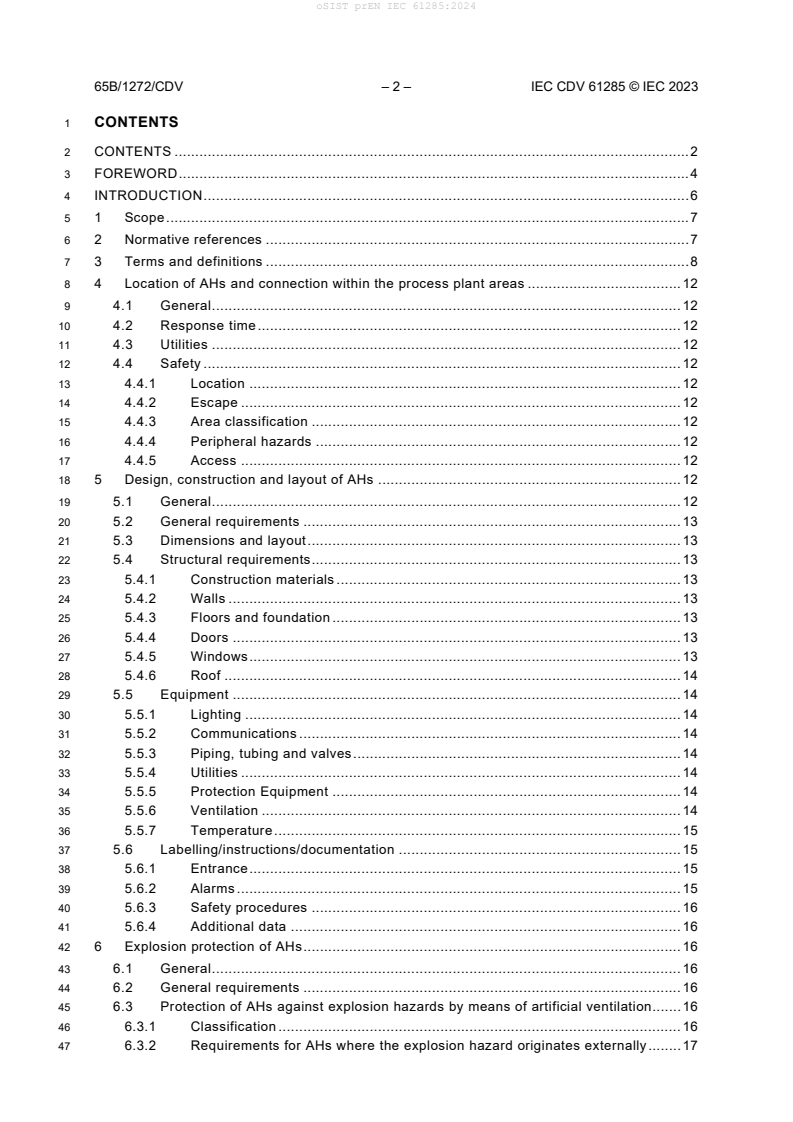
1 CONTENTS
2 CONTENTS . 2
3 FOREWORD . 4
4 INTRODUCTION . 6
5 1 Scope . 7
6 2 Normative references . 7
7 3 Terms and definitions . 8
8 4 Location of AHs and connection within the process plant areas . 12
9 4.1 General . 12
10 4.2 Response time . 12
11 4.3 Utilities . 12
12 4.4 Safety . 12
13 4.4.1 Location . 12
14 4.4.2 Escape . 12
15 4.4.3 Area classification . 12
16 4.4.4 Peripheral hazards . 12
17 4.4.5 Access . 12
18 5 Design, construction and layout of AHs . 12
19 5.1 General . 12
20 5.2 General requirements . 13
21 5.3 Dimensions and layout . 13
22 5.4 Structural requirements . 13
23 5.4.1 Construction materials . 13
24 5.4.2 Walls . 13
25 5.4.3 Floors and foundation . 13
26 5.4.4 Doors . 13
27 5.4.5 Windows . 13
28 5.4.6 Roof . 14
29 5.5 Equipment . 14
30 5.5.1 Lighting . 14
31 5.5.2 Communications . 14
32 5.5.3 Piping, tubing and valves . 14
33 5.5.4 Utilities . 14
34 5.5.5 Protection Equipment . 14
35 5.5.6 Ventilation . 14
36 5.5.7 Temperature . 15
37 5.6 Labelling/instructions/documentation . 15
38 5.6.1 Entrance . 15
39 5.6.2 Alarms . 15
40 5.6.3 Safety procedures . 16
41 5.6.4 Additional data . 16
42 6 Explosion protection of AHs . 16
43 6.1 General . 16
44 6.2 General requirements . 16
45 6.3 Protection of AHs against explosion hazards by means of artificial ventilation . 16
46 6.3.1 Classification . 16
47 6.3.2 Requirements for AHs where the explosion hazard originates externally . 17
IEC CDV 61285 © IEC 2023 – 3 – 65B/1272/CDV
48 6.3.3 Requirements for AHs where the explosion hazard originates from
49 internal gases or vapours . 17
50 6.3.4 Requirements for AHs where the explosion hazard originates from
51 internal liquids . 18
52 6.3.5 Requirements for AHs where the explosion hazard originates from any
53 combination of the above . 19
54 6.4 Protection of AHs against explosion hazards by means of natural ventilation . 19
55 6.4.1 General . 19
56 6.4.2 Ventilation requirements . 19
57 6.4.3 Heating requirements . 20
58 6.4.4 Gas detectors . 20
59 7 Measures to prevent health hazards to personnel in AHs . 20
60 7.1 General . 20
61 7.2 Guidelines . 20
62 7.3 General requirements . 20
63 7.4 Safety measures . 21
64 7.4.1 Storage of toxic materials . 21
65 7.4.2 Design of lines carrying toxic material. 21
66 7.4.3 Flushing . 21
67 7.4.4 Observation windows . 21
68 7.4.5 Design of components carrying toxic material . 21
69 7.4.6 Additional measures . 21
70 7.4.7 Gas detection . 21
71 7.4.8 Emergency measures . 21
72 7.4.9 Toxicity consideration . 22
73 7.4.10 Warning signs . 22
74 7.4.11 Vacuum exhaust system . 22
75 7.5 External hazards . 22
76 7.5.1 Fresh air supply . 22
77 7.5.2 Alarm signalisation . 22
78 7.6 Additional measures for abnormal working conditions . 22
79 7.7 Labelling/instructions/documentation . 22
80 Annex A (informative) Examples of hazardous area classification inside of AHs . 24
81 A.1 General . 24
82 A.2 Examples . 24
83 Example 1 . 24
84 Example 2 . 26
85 Annex B (informative) Checklist for analyser houses . 28
86 B.1 General . 28
87 B.2 Example for checklist . 29
88 Bibliography . 43
65B/1272/CDV – 4 – IEC CDV 61285 © IEC 2023
91 INTERNATIONAL ELECTROTECHNICAL COMMISSION
92 ____________
94 INDUSTRIAL-PROCESS CONTROL – SAFETY OF ANALYSER HOUSES
96 FOREWORD
97 1) The International Electrotechnical Commission (IEC) is a worldwide organization for standardization comprising
98 all national electrotechnical committees (IEC National Committees). The object of IEC is to promote international
99 co-operation on all questions concerning standardization in the electrical and electronic fields. To this end and
100 in addition to other activities, IEC publishes International Standards, Technical Specifications, Technical Reports,
101 Publicly Available Specifications (PAS) and Guides (hereafter referred to as “IEC Publication(s)”). Their
102 preparation is entrusted to technical committees; any IEC National Committee interested in the subject dealt with
103 may participate in this preparatory work. International, governmental and non-governmental organizations liaising
104 with the IEC also participate in this preparation. IEC collaborates closely with the International Organization for
105 Standardization (ISO) in accordance with conditions determined by agreement between the two organizations.
106 2) The formal decisions or agreements of IEC on technical matters express, as nearly as possible, an international
107 consensus of opinion on the relevant subjects since each technical committee has representation from all
108 interested IEC National Committees.
109 3) IEC Publications have the form of recommendations for international use and are accepted by IEC National
110 Committees in that sense. While all reasonable efforts are made to ensure that the technical content of IEC
111 Publications is accurate, IEC cannot be held responsible for the way in which they are used or for any
112 misinterpretation by any end user.
113 4) In order to promote international uniformity, IEC National Committees undertake to apply IEC Publications
114 transparently to the maximum extent possible in their national and regional publications. Any divergence between
115 any IEC Publication and the corresponding national or regional publication shall be clearly indicated in the latter.
116 5) IEC itself does not provide any attestation of conformity. Independent certification bodies provide conformity
117 assessment services and, in some areas, access to IEC marks of conformity. IEC is not responsible for any
118 services carried out by independent certification bodies.
119 6) All users should ensure that they have the latest edition of this publication.
120 7) No liability shall attach to IEC or its directors, employees, servants or agents including individual experts and
121 members of its technical committees and IEC National Committees for any personal injury, property damage or
122 other damage of any nature whatsoever, whether direct or indirect, or for costs (including legal fees) and
123 expenses arising out of the publication, use of, or reliance upon, this IEC Publication or any other IEC
124 Publications.
125 8) Attention is drawn to the Normative references cited in this publication. Use of the referenced publications is
126 indispensable for the correct application of this publication.
127 9) Attention is drawn to the possibility that some of the elements of this IEC Publication may be the subject of patent
128 rights. IEC shall not be held responsible for identifying any or all such patent rights.
129 IEC 61285 has been prepared by subcommittee 65B: Measurement and control devices, of IEC
130 technical committee 65: Industrial-process measurement, control and automation. It is an
131 International Standard.
132 This 4th edition cancels and replaces the 3rd edition published in 2015. This edition constitutes
133 a technical revision.
134 This edition includes the following significant technical changes with respect to the previous
135 edition:
136 a) incorporation of previously issued corrigendum;
137 b) adaption to latest version of standard IEC 60079-1-10:2020 for the classification of areas;
138 c) minor updates to several sections and references.
IEC CDV 61285 © IEC 2023 – 5 – 65B/1272/CDV
139 The text of this International Standard is based on the following documents:
Draft Report on voting
XX/XX/FDIS XX/XX/RVD
141 Full information on the voting for its approval can be found in the report on voting indicated in
142 the above table.
143 The language used for the development of this International Standard is English.
144 This document was drafted in accordance with ISO/IEC Directives, Part 2, and developed in
145 accordance with ISO/IEC Directives, Part 1 and ISO/IEC Directives, IEC Supplement, available
146 at www.iec.ch/members_experts/refdocs. The main document types developed by IEC are
147 described in greater detail at www.iec.ch/standardsdev/publications.
148 The committee has decided that the contents of this document will remain unchanged until the
149 stability date indicated on the IEC website under webstore.iec.ch in the data related to the
150 specific document. At this date, the document will be
151 • reconfirmed,
152 • withdrawn,
153 • replaced by a revised edition, or
154 • amended.
65B/1272/CDV – 6 – IEC CDV 61285 © IEC 2023
155 INTRODUCTION
156 Process analysers measure the characteristics of a process stream continuously and
157 automatically. The process sample is introduced automatically and the system is designed for
158 unattended operation and minimal maintenance.
159 The placement of devices for process analysis in analyser houses is beneficial for technical and
160 economic reasons:
161 – in order to facilitate appropriate environmental conditions;
162 – to simplify servicing and maintenance issues;
163 – to enable the use of a common infrastructure (see 3.6).
164 This document is designed to set forth minimum safety requirements for typical analyser houses
165 (AHs). It is superseded in all cases by national, local, or corporate requirements, if additional
166 or more stringent requirements will apply.
IEC CDV 61285 © IEC 2023 – 7 – 65B/1272/CDV
167 INDUSTRIAL-PROCESS CONTROL – SAFETY OF ANALYSER HOUSES
169 1 Scope
170 This International Standard describes the physical requirements for the safe operation of the
171 process analyser measuring system installed in an analyser house (AH) in order to ensure its
172 protection against fire, explosion and health hazards. This standard applies for analyser houses
173 with inner and/or external potential explosive atmospheres and it applies to hazards caused by
174 toxic substances or asphyxiant gases. (Refer to national guidelines on toxic hazards.)
175 This standard does not address facilities where solids (dust, powder, fibres) are the hazard.
176 This standard does not seek to address all functional safety issues related to analyser houses.
177 Clause 4 addresses the location of the AH and connection within the process plant areas.
178 Clause 5 addresses the design, construction and layout of the AH.
179 Clause 6 addresses measures for reducing the danger of explosion for AHs while permitting
180 maintenance of equipment with the power on and the case open.
181 For most fluids, the major constraint is that the concentration of vapours, which are toxic for
182 personnel, is lower than the lower explosive (flammable) limit (LFL) (see Clause 7).
–6
183 Using n-Pentane as an example, the LFL is 1,5 % or 15 000 × 10 [Source OSHA], the level
184 immediately dangerous to life or health (which is the maximum level from which a worker could
185 escape within 30 min without any escape-impairing symptoms or any irreversible health effects)
–
186 is only 0,1 % or 1 000 × 10 .
187 Clause 7 addresses those measures for protecting personnel from materials in the atmosphere
188 of AHs that are hazardous to health.
190 2 Normative references
191 The following documents, in whole or in part, are normatively referenced in this document and are
192 indispensable for its application. For dated references, only the edition cited applies. For undated
193 references, the latest edition of the referenced document (including any amendments) applies.
194 IEC 60079-0:2017, Explosive atmospheres – Part 0: General requirements
195 IEC 60079-10-1:2020, Explosive atmospheres – Part 10-1: Classification of areas – Explosive gas
196 atmospheres
ISO/IEC80079-20-1:2017, Explosive atmospheres — Part 20-1: Material characteristics for gas and
vapour classification — Test methods and data
65B/1272/CDV – 8 – IEC CDV 61285 © IEC 2023
199 3 Terms and definitions
200 For the purposes of this document, the following terms and definitions apply.
201 ISO and IEC maintain terminological databases for use in standardization at the following
202 addresses:
203 • IEC Electropedia: available at https://www.electropedia.org/
204 • ISO Online browsing platform: available at https://www.iso.org/obp
206 3.1
207 analyser cabinet
208 housing in which analysers are installed individually or grouped together
209 Note 1 to entry: Maintenance is performed from outside the cabinet with the door(s) open.
210 3.2
211 analyser shelter
212 structure with one or more sides open and free from obstruction to the natural passage of air,
213 in which one or more analysers are installed
214 Note 1 to entry: The maintenance of the analysers is normally performed in the protection of the shelter.
215 3.3
216 analyser house (AH)
217 enclosed building or part of a building containing process analysers and associated equipment
218 where streams for analysis are brought in and which is regularly entered by authorized
219 personnel
220 Note 1 to entry: An AH is not a permanent workplace. Within the scope of this standard, the term AH is used
221 regardless of the structure configuration as either a room, a walk-in cabinet, an analyser container or an analyser
222 building and whether or not it is an integral part of, or attached to, another structure.
223 3.4
224 sample conditioning cabinet (SCC)
225 Cabinet in which sample conditioning systems are installed individually or grouped together.
226 Note 1 to entry: Maintenance is performed from outside the cabinet with the door(s) open.
227 3.5
228 sample conditioning room (SCR)
229 room that is separated from the AH and has modules for sample conditioning, auxiliary material,
230 or sample disposal equipment.
231 Note 1 to entry: A SCR is not a permanent workplace.
233 3.6
234 infrastructure
235 required means and supply with auxiliaries to operate an AH with all equipment therein, for
236 example, instrument air, nitrogen, water, power supply, incidental disposal of waste and
237 disposal of substances introduced to be analysed
238 Note 1 to entry: The infrastructure occasionally comprises the fundament of an AH, the positioning of gas bottles
239 and containers for gas supply and test gases. The infrastructure comprises in addition the ventilation and
240 climatisation of the AH and the needed alarm devices within and outside of the AH.
241 3.7
242 maintenance
243 servicing, inspection, repair, improvement and weakness analysis of process analyser devices
244 and infrastructure
IEC CDV 61285 © IEC 2023 – 9 – 65B/1272/CDV
245 3.8
246 toxic substances
247 gaseous or liquid substances that, if released in a room, will cause a health hazard by contact
248 with the skin or by inhalation from the surrounding atmosphere
249 3.9
250 safety back-up
251 additional personnel, in constant contact with a person or persons in hazardous working
252 condition, who could assist or call for additional help
253 3.10
254 external explosion hazard
255 hazard existing when the AH is erected at a location where flammable substances may ingress
256 from the outside resulting in dangerous concentrations of flammable gases and vapours inside
257 the AH
258 3.11
259 internal explosion hazard
260 hazard existing when a flammable mixture can result from release of samples or auxiliary
261 supplies inside the AH
262 3.12
263 lower flammable limit (LFL)
264 concentration of flammable gas or vapour in air below which an explosive gas atmosphere does
265 not form
266 Note 1 to entry: The term “lower explosive limit” is used especially in European standardization and regulations
267 interchangeably to describe this limit.
268 [SOURCE: ISO/IEC 80079-20-1:2017, 3.6.1]
269 3.13
270 explosive gas atmosphere
271 mixture with air, under atmospheric conditions, of flammable substances in the form of gas or
272 vapour, which, after ignition, permits self-sustaining flame propagation
273 [SOURCE: IEC 60079-10-1:2020, 3.40]
274 3.14
275 hazardous area
276 area in which an explosive gas atmosphere is present or can be expected to be present, in
277 quantities such that special precautions for the construction, installation and use of equipment
278 are required
279 [SOURCE: IEC 60079-10-1:2020, 3.3.1]
280 3.15
281 non-hazardous area
282 area in which an explosive gas atmosphere is not expected to be present in quantities such that
283 special precautions for the construction, installation and use of equipment are required
284 [SOURCE: IEC 60079-10-1:2020, 3.3.2]
285 3.16
286 zone 0
287 area in which an explosive gas atmosphere is present continuously or for long periods or
288 frequently
289 [SOURCE: IEC 60079-10-1:2020, 3.3.4]
290 3.17
291 zone 1
292 area in which an explosive gas atmosphere is likely to occur in normal operation occasionally
293 [SOURCE: IEC 60079-10-1:2020, 3.3.5]]
65B/1272/CDV – 10 – IEC CDV 61285 © IEC 2023
294 3.18
295 zone 2
296 area in which an explosive gas atmosphere is not likely to occur in normal operation but, if it
297 does occur, will persist for a short period only
298 [SOURCE: IEC 60050-426:2020, 426-03-05]
299 3.19
300 source of release
301 a point or location from which a gas, vapour, mist or liquid may be released into the atmosphere
302 so that an explosive gas atmosphere could be formed
303 [SOURCE: IEC 60050-426:2020, 426-03-06, modified (addition of "mist")]
304 3.20
305 continuous grade of release
306 release which is continuous or is expected to occur frequently or for long periods
307 Note 1 to entry: Both “frequently” and “long” are the terms which are intended to describe a very high likelihood of
308 a potential release. In that respect, those terms do not necessarily need to be quantified.
309 [SOURCE: IEC 60079-10-1:2020, 3.4.2]
310 3.21
311 primary grade of release
312 release which can be expected to occur periodically or occasionally during normal operation
313 [SOURCE: IEC 60079-10-1:2020, 3.4.3]
314 3.22
315 secondary grade of release
316 release which is not expected to occur in normal operation and, if it does occur, is likely to do
317 so only infrequently and for short periods
318 [SOURCE: IEC 60079-10-1:2020, 3.4.4]
319 3.23
320 release rate
321 quantity of flammable gas, vapour or mist emitted per unit time from the source of release
322 [SOURCE: IEC 60079-10-1:2020, 3.4.5]
323 3.24
324 flashpoint
325 lowest liquid temperature at which, under certain standardized conditions, a liquid gives off
326 vapours in a quantity such as to be capable of forming an ignitable vapour/air mixture
327 [SOURCE: IEC 60079-10-1:2020, 3.6.8]
328 3.25
329 auto-ignition temperature (AIT)
330 lowest temperature (of a surface) at which under specified test conditions an ignition of a
331 flammable gas or vapour in mixture with air or air-inert gas occurs
332 [SOURCE: ISO/IEC 80079-20-1:2017, 3.3]
333 3.26
334 equipment protection level (EPL)
335 level of protection assigned to equipment based on its likelihood of becoming a source of
336 ignition and distinguishing the differences between explosive gas atmospheres, explosive dust
337 atmospheres, and the explosive atmospheres in mines susceptible to firedamp
338 [SOURCE: IEC 60079-0:2017, 3.26]
IEC CDV 61285 © IEC 2023 – 11 – 65B/1272/CDV
339 3.27
340 containment system
341 parts within the room or building containing the hazardous substance that may constitute an
342 internal source of release
65B/1272/CDV – 12 – IEC CDV 61285 © IEC 2023
343 4 Location of AHs and connection within the process plant areas
344 4.1 General
345 When determining the location of the AH, the following factors should be considered.
346 4.2 Response time
347 Line lengths from sample points to the analysers shall be estimated and the necessary flow
348 rates calculated to determine whether resultant dead times, sample deterioration and flow rates
349 are acceptable.
350 4.3 Utilities
351 Connection lengths to all utilities such as air, steam, electricity, sample return, gas cylinders,
352 signals, etc. shall be estimated.
353 4.4 Safety
354 4.4.1 Location
355 The AH should preferably be located away from external sources of toxic or flammable release,
356 and in a place where accumulation of these substances is not likely to occur.
357 4.4.2 Escape
358 Escape routes shall be determined and remain unobstructed and where possible be oriented
359 away from hazardous areas.
360 4.4.3 Area classification
361 Area classification for the AH location and for the ventilation air source shall be determined by
362 the owner or process plant safety authority.
363 4.4.4 Peripheral hazards
364 Consideration shall be given to the possibility of analysers or their sample lines creating a
365 hazard in the AH or any adjacent room.
366 4.4.5 Access
367 Access is needed both for maintenance personnel and for supplies. AH's should preferably be
368 located at ground level. In case an AH cannot be installed at ground level, consideration shall
369 be given to suitable means allowing safe transport of materials and/or gas cylinders to and from
370 the AH.
371 Maintenance access to process equipment such as a heat exchanger shall also be considered.
372 In addition, access is needed to isolation valves for auxiliary supplies, sampling points and
373 sampling streams outside the AH, in order to render the AH safe as fast as possible. Access is
374 also needed to an external isolation switch for electrical power to shut the entire AH down.
375 5 Design, construction and layout of AHs
376 5.1 General
377 Analysers and analyser sampling systems require varying degrees of protection depending on
378 the sample and the type of analyser, the importance of the application and the environment in
379 which it has to operate. Where the construction and maintenance requirements are not suitable
380 for the working environment, additional protection such as AHs should be provided. This
381 additional protection is to ensure satisfactory performance of the instrument and to facilitate
382 maintenance.
383 The selection of the housing depends on a number of factors such as
384 – classification of the area in which the analyser and/or sample system is to be located;
385 – range of ambient conditions at the site, including temperature, rain, humidity, snow, wind,
386 dust, sand, direct sunlight, seismic area and corrosive atmosphere;
387 – environment specified by the analyser vendor for reliable, accurate, and safe operation;
IEC CDV 61285 © IEC 2023 – 13 – 65B/1272/CDV
388 – protection required for equipment and personnel during maintenance;
389 – maintenance and accessibility requirements of the system components;
390 – process conditions/environment of the area in which the AH is to be located (for example,
391 loading, unloading or transferring of chemicals or equipment, noise, vibration, chemical
392 releases, etc.).
393 Clause 5 primarily describes AHs located in hazardous areas (classified environments) and/or
394 into which flammable or toxic samples are introduced. Those AHs located in an unclassified
395 area and into which no flammable or toxic samples, services, calibration mixtures or air from a
396 hazardous location are introduced, only need to provide the environment necessary for accurate
397 and reliable operation.
398 5.2 General requirements
399 This clause addresses the general requirements for safe operation of an AH regardless of
400 leakage or flammable material (see Clause 6) or material hazardous to health (see Clause 7).
401 5.3 Dimensions and layout
402 The size of the AH depends on the number, size and access requirements of the analysers and
403 auxiliary equipment. Allowance shall be considered for any ventilation, drainage, spare parts
404 storage, electrical distribution, local recording, etc. Recommended minimum dimensions are
405 2,4 m length and width and 2,3 m headroom. The absolute minimum unobstructed headroom
406 should be 2,0 m. Sufficient space for escape routes shall be considered. Spare space of 30 %
407 is recommended to facilitate later equipment addition. Suspended ceilings, cable trenches and
408 other dead air spaces should be avoided.
409 5.4 Structural requirements
410 5.4.1 Construction materials
411 Local requirements such as for anti-static properties, corrosion, fire and weather resistance
412 shall be determined and appropriate material selected.
413 5.4.2 Walls
414 Where equipment is supported from the walls, appropriate reinforcement may be required. Wall
415 penetrations should be minimized and sealed where appropriate with materials meeting the
416 relevant structural and safety requirements (for example, watertight, fire-retardant, flame-
417 resistant, mechanical strength, etc.).
418 5.4.3 Floors and foundation
419 Floors should be non-porous, non-slip and resistant to materials likely to be spilled on them.
420 Requirements for floor cleaning, such as a slight slope and drain, should be considered. If a
421 floor drain is installed, it should be free draining to the outside of the AH, where the liquid can
422 be properly disposed of. Measures should be taken to prevent the entry of extraneous liquids.
423 Such measures can include raising the floor above the exterior grade level or providing a step
424 or ramp at the entrance or by appropriately sealing the house at the base.
425 5.4.4 Doors
426 Doors shall open outwards and be self-closing or controlled with an alarm device. Doors shall be fitted
427 with a "panic bar" so that they may be opened from the inside even if locked for use as emergency
428 escape. An additional emergency exit, remote from the first, shall be considered depending on the
429 floor area of the AH, if access to the main door can be impeded either internally or externally. Doors
430 used to separate Ex zones are subject to specific requirements as given in IEC 60079-10-1:2020,
431 Clause A.2. Where the AH is part of a building, other safety considerations may override this.
432 5.4.5 Windows
433 The AH shall have observation windows that assure an unobstructed view into the room.
434 Windows shall be made of shatter-resistant safety glass and shall be fixed closed. Where Ex
435 hazards may arise, windows shall be gas-tight. Observation windows in the door(s) are
436 preferable.
65B/1272/CDV – 14 – IEC CDV 61285 © IEC 2023
437 5.4.6 Roof
438 The roof shall be designed for appropriate loads (for example, snow, wind, equipment, people, etc.).
439 5.5 Equipment
440 5.5.1 Lighting
441 Lighting or emergency lights shall be operational at all times. Light level shall be that required
442 for all works or the level specified by authorities having jurisdiction.
443 5.5.2 Communications
444 Where safety alarm(s) from the surrounding plant cannot be detected inside the AH, they shall
445 be repeated inside the AH. An appropriate device for communication to a permanently manned
446 location shall be available.
447 5.5.3 Piping, tubing and valves
448 Containment systems inside the AH shall be designed such that no hazardous material can
449 escape into the AH under normal operation. The functions and content of piping, tubing and
450 valves shall be clearly marked. Isolation valves shall be external to the AH. Streams for disposal
451 shall be treated according to their hazard, for example, collected in closed systems or
452 transported to facilities outside the AH. Any lines capable of delivering unacceptable high
453 quantities of hazardous material under fault conditions into the AH shall have flow restrictors or
454 excess flow preventers outside and before the point of entry into the AH. In addition, it shall be
455 taken into account if the installation of automatic shut-off valves is appropriate.
456 5.5.4 Utilities
457 5.5.4.1 Hazardous quantities
458 The quantity of hazardous auxiliary substances should be restricted to the minimum necessary
459 to operate the analyser systems.
460 5.5.4.2 Hazard identification
461 Any fire, explosion or health hazard should be clearly identified.
462 5.5.4.3 Asphyxiants (for example nitrogen, carbon dioxide)
463 Any asphyxiant line connected into the AH shall have a flow restrictor or excess flow preventer
464 in the line outside the AH, to limit the flow to assist in meeting the requirements of the ventilation
465 system.
466 When a potential low oxygen hazard exists (for example, instrument air backed up with nitrogen)
467 or if significant quantities of asphyxiant substances enter the AH under normal operation, the
468 air inside the AH has to be monitored by low oxygen detectors. They shall be installed with fail-
469 safe alarms, both locally and in a remote permanently manned location.
470 5.5.4.4 Storage
471 Hazardous auxiliary supplies shall be stored outside the AH if possible.
472 If the storage of auxiliary gases or calibration gases in pressurized cylinders inside the AH is
473 unavoidable, they shall be protected against rise in pressure when heated by fire. This can be
474 accomplished by storage in insulated and continuously ventilated cabinets or through rupture
475 disks and relief valves, which are installed at the cylinders immediately ahead of the pressure-
476 reducing stations. Gases escaping from the rupture discs shall be safely carried to the outside
477 of the AH. Exceptions to these measures may be made in agreement with local authorities.
478 5.5.5 Protection Equipment
479 An appropriate fire extinguisher shall be located near the door(s). Additional protection
480 equipment, like safety showers, eye showers and gas masks shall be considered.
481 5.5.6 Ventilation
482 Ventilation may be installed for climate control, corrosion protection, protection from
483 asphyxiation, explosion protection (see Clause 6) and/or personnel safety (see Clause 7).
IEC CDV 61285 © IEC 2023 – 15 – 65B/1272/CDV
484 The ventilation air source shall be preferably in a non-hazardous area. If this is not available,
485 zone 2 air may be used if the equipment installed in the AH is suitable for a zone 2 or worse
486 location, or if the ventilation air is monitored at the intake point by means of one or more gas
487 detectors, which discontinue ventilation airflow when a value of 25 % or less of LFL is exceeded.
488 Dust filtration should be installed in the ventilation inlet.
489 If ventilation is applied to prevent the formation of an explosive atmosphere, a minimum of five
490 air changes per hour shall be provided unless a larger flow is required based on calculations
491 as given in IEC 60079-10-1:2020 Annex C. For flammable liquids, special requirements apply,
492 as given in 6.3.4.
493 The prevention of the formation of a toxic or asphyxiate gas atmosphere requires a risk
494 assessment to define the rate of ventilation and additional measures where required.
495 5.5.7 Temperature
496 For safe performance of the monitoring instruments and alarm systems, temperature shall be
497 kept in their recommended operating range.
498 5.6 Labelling/instructions/documentation
499 5.6.1 Entrance
500 An indelible marked sign indicating the type of hazard may be required according to local
501 regulations on the entrance to the AH stating that entering the AH is allowed only for authorized
502 personnel. Information such as the organization responsible for the AH can be included on the
503 sign (e.g. name, department, telephone number, etc.)
504 5.6.2 Alarms
505 An appropriate risk assessment shall be used to determine which of the following AH safety
506 related local alarms/indicators shall be generated and visibly displayed:
507 a) ventilation failure;
508 b) shelter pressure failure;
509 c) flammable gas: concentration exceeds 25 % LFL;
510 d) toxic gas: concentration exceeds allowable levels;
511 e) oxygen deficiency: oxygen concentration needs to be above statutory requirements;
512 f) fire- or smoke-detection;
513 g) automatic extinguisher released;
514 h) gas / fire detection instrument fault.
516 The relative densities of the hazardous substances, size of the AH and the air flow dictate the
517 number and placement of flammable or toxic gas detectors. It may be necessary to detect light
518 gases near the roof level and heavy gases and vapours near the floor level.
519 Alarms shall be reported at the following locations:
520 1) inside the AH a common audible alarm or a highly noticeable visual light (for example,
521 strobe lamp);
522 2) at a continuously manned process location, if possible;
523 3) discrete alarm lamps shall be provided outside near the entrance of the AH for toxic,
524 asphyxiant, and LFL and should be considered for other alarms.
525 A positive indication of a non-hazardous condition is recommended.
526 All alarms shall be fail-safe and shall be connected to Uninterruptable Power Supply (UPS).
65B/1272/CDV – 16 – IEC CDV 61285 © IEC 2023
527 5.6.3 Safety procedures
528 The AH safety procedures shall be documented and be kept in a readily accessible location at
529 the AH. Any person working in the AH shall have adequate training for this location.
...