

EN 17893:2024
(Main)Thermal road vehicles - Temperature-controlled systems using flammable refrigerants for transport of goods - Requirements and risk analysis process
General Information
- Abstract
This document specifies requirements for the use of flammable refrigerants class A2L, A2 and A3 as defined in ISO 817 with regard to:
- design and construction of the refrigerating system (as far as not specified in EN 378-2);
- operation;
- in all anticipated operational modes and locations;
- including continuous idling during standstill;
- service, maintenance and decommissioning;
- for the investigation and mitigation of risk for thermally insulated means of transport, including: trucks, trailers, tanks, vans (light commercial vehicles), wagons, containers for land transport, small containers, packaging.
This document describes an Operational Mode Risk Assessment (OMRA), which uses methods such as Hazard and Operability Analysis (HAZOP), Failure Mode and Effects and Criticality Analysis (FMECA), or Fault Tree Analysis (FTA) or a combination of these methods.
The document specifies requirements:
- for the validation of possible safety concepts and protective devices within the OMRA process, including charge release tests, simulation, and function tests of the associated protective equipment;
- for tests related to the application;
- using methodologies to achieve tolerable risk values.
Mobile air conditioning systems in cars are covered in ISO 13043 and refrigerated containers conforming to ISO 20854 are excluded.
This document could be used for class "B" refrigerants providing the OMRA is adjusted to account for their specific properties.
- Status
- Published
- Publication Date
- 11-Jun-2024
- Current Stage
- 6060 - Definitive text made available (DAV) - Publishing
- Start Date
- 12-Jun-2024
- Due Date
- 13-Jun-2023
- Completion Date
- 12-Jun-2024

Overview
EN 17893:2024 - "Thermal road vehicles - Safety standard for temperature-controlled systems using flammable refrigerants for the transport of goods" - defines safety requirements and a structured risk-analysis process for transport refrigeration units (TRUs) and temperature-controlled vehicles using flammable refrigerants (classes A2L, A2, A3 as per ISO 817). The standard covers design, construction, operation (including continuous idling), service, maintenance and decommissioning for trucks, trailers, vans, tanks, wagons, containers, small containers and packaging used in land transport.
Key topics and technical requirements
- Operational Mode Risk Assessment (OMRA): A formal process to identify and mitigate hazards across all anticipated operational modes and locations. OMRA may use methods such as HAZOP, FMECA, FTA, or combinations.
- Safety concept validation: Requirements for validating protective devices and safety concepts using charge release tests, simulation, and function tests of protective equipment.
- Design and construction: Additional requirements for refrigerating system components and piping where EN 378-2 does not apply, including external fire relief, refrigeration charge management, and evaluation of surface temperatures.
- Testing regime: Specifies tests including air-tightness (to determine dilution of releases), vibration, shock/impact, corrosion, and final system tests prior to operation.
- Electrical and alarm systems: Requirements for electrical components, outside cabinets, alarm power and operator alarm handling.
- Operational sites & ventilation: Guidance for operation in open air, well-ventilated, non-well-ventilated and non-ventilated areas, and for safe loading/unloading procedures.
- Service, maintenance & decommissioning: Manufacturer responsibilities for training, manuals, self-check mechanisms, safe repair practices, refrigerant handling, recovery and disposal.
- Risk criteria: Methods to achieve tolerable risk values and auditing/effectiveness checks of safety concepts.
Practical applications and users
Who benefits from EN 17893:2024:
- TRU and vehicle manufacturers designing systems that use flammable refrigerants
- System integrators and bodybuilders mounting refrigeration units on trucks, trailers and vans
- Fleet operators and logistics companies implementing safe operating procedures and maintenance regimes
- Service and repair workshops following safe repair, testing and refrigerant handling practices
- Safety assessors, certification bodies and regulators evaluating compliance and risk mitigation
- Design engineers performing OMRA, HAZOP/FMECA/FTA studies and validating protection strategies
Use cases include selecting safe refrigerant charge sizes, validating leak detection and ventilation strategies, proving protective devices through testing/simulation, and documenting safe operation and maintenance procedures.
Related standards
- ISO 817 (refrigerant classification)
- EN 378‑2 (refrigeration system design - where applicable)
- ISO 13043 (mobile air conditioning - cars) - excluded
- ISO 20854 (refrigerated containers) - excluded
Keywords: EN 17893:2024, thermal road vehicles, flammable refrigerants, A2L A2 A3, OMRA, HAZOP, FMECA, FTA, TRU safety, transport refrigeration.
Relations
- Refers
IEC 60079-15:2017 - Explosive atmospheres - Part 15: Equipment protection by type of protection "n" - Effective Date
- 25-Aug-2026
- Effective Date
- 09-Feb-2026
- Effective Date
- 09-Feb-2026
- Effective Date
- 09-Feb-2026
- Effective Date
- 09-Feb-2026
- Effective Date
- 09-Feb-2026
- Effective Date
- 09-Feb-2026
- Effective Date
- 28-Jan-2026
- Effective Date
- 28-Jan-2026
- Effective Date
- 28-Jan-2026
- Effective Date
- 28-Jan-2026
- Effective Date
- 28-Jan-2026
- Effective Date
- 28-Jan-2026
- Effective Date
- 28-Jan-2026
- Effective Date
- 28-Jan-2026
Get Certified
Connect with accredited certification bodies for this standard

DNV
DNV is an independent assurance and risk management provider.

TÜV Rheinland
TÜV Rheinland is a leading international provider of technical services.

TÜV SÜD
TÜV SÜD is a trusted partner of choice for safety, security and sustainability solutions.
Sponsored listings
Frequently Asked Questions
EN 17893:2024 is a standard published by the European Committee for Standardization (CEN). Its full title is "Thermal road vehicles - Temperature-controlled systems using flammable refrigerants for transport of goods - Requirements and risk analysis process". This standard covers: This document specifies requirements for the use of flammable refrigerants class A2L, A2 and A3 as defined in ISO 817 with regard to: - design and construction of the refrigerating system (as far as not specified in EN 378-2); - operation; - in all anticipated operational modes and locations; - including continuous idling during standstill; - service, maintenance and decommissioning; - for the investigation and mitigation of risk for thermally insulated means of transport, including: trucks, trailers, tanks, vans (light commercial vehicles), wagons, containers for land transport, small containers, packaging. This document describes an Operational Mode Risk Assessment (OMRA), which uses methods such as Hazard and Operability Analysis (HAZOP), Failure Mode and Effects and Criticality Analysis (FMECA), or Fault Tree Analysis (FTA) or a combination of these methods. The document specifies requirements: - for the validation of possible safety concepts and protective devices within the OMRA process, including charge release tests, simulation, and function tests of the associated protective equipment; - for tests related to the application; - using methodologies to achieve tolerable risk values. Mobile air conditioning systems in cars are covered in ISO 13043 and refrigerated containers conforming to ISO 20854 are excluded. This document could be used for class "B" refrigerants providing the OMRA is adjusted to account for their specific properties.
This document specifies requirements for the use of flammable refrigerants class A2L, A2 and A3 as defined in ISO 817 with regard to: - design and construction of the refrigerating system (as far as not specified in EN 378-2); - operation; - in all anticipated operational modes and locations; - including continuous idling during standstill; - service, maintenance and decommissioning; - for the investigation and mitigation of risk for thermally insulated means of transport, including: trucks, trailers, tanks, vans (light commercial vehicles), wagons, containers for land transport, small containers, packaging. This document describes an Operational Mode Risk Assessment (OMRA), which uses methods such as Hazard and Operability Analysis (HAZOP), Failure Mode and Effects and Criticality Analysis (FMECA), or Fault Tree Analysis (FTA) or a combination of these methods. The document specifies requirements: - for the validation of possible safety concepts and protective devices within the OMRA process, including charge release tests, simulation, and function tests of the associated protective equipment; - for tests related to the application; - using methodologies to achieve tolerable risk values. Mobile air conditioning systems in cars are covered in ISO 13043 and refrigerated containers conforming to ISO 20854 are excluded. This document could be used for class "B" refrigerants providing the OMRA is adjusted to account for their specific properties.
EN 17893:2024 is classified under the following ICS (International Classification for Standards) categories: 27.200 - Refrigerating technology; 43.080.10 - Trucks and trailers; 71.100.45 - Refrigerants and antifreezes. The ICS classification helps identify the subject area and facilitates finding related standards.
EN 17893:2024 has the following relationships with other standards: It is inter standard links to IEC 60079-15:2017, IEC 60079-10-1:2020, EN IEC 60079-14:2024, EN 60068-2-75:2014, IEC 60079-29-1:2016, ISO 817:2014, EN 60068-2-6:2008, EN ISO 20884:2011, EN ISO 12100:2010, EN ISO 7010:2020, EN 14804:2005, EN 1736:2008, EN 14624:2020, EN 378-2:2016, EN 378-1:2016+A1:2020. Understanding these relationships helps ensure you are using the most current and applicable version of the standard.
EN 17893:2024 is associated with the following European legislation: EU Directives/Regulations: 517/2014; Standardization Mandates: M/555. When a standard is cited in the Official Journal of the European Union, products manufactured in conformity with it benefit from a presumption of conformity with the essential requirements of the corresponding EU directive or regulation.
EN 17893:2024 is available in PDF format for immediate download after purchase. The document can be added to your cart and obtained through the secure checkout process. Digital delivery ensures instant access to the complete standard document.
Standards Content (Sample)
SLOVENSKI STANDARD
01-september-2024
Toplotna cestna vozila - Varnostni standard za toplotno upravljane sisteme, ki pri
prevozu blaga uporabljajo vnetljiva hladilna sredstva - Zahteve in proces analize
tveganja
Thermal road vehicles - Safety standard for temperature-controlled systems using
flammable refrigerants for the transport of goods - Requirements and risk analysis
process
Anforderungen und Risikoanalyseverfahren für Kühlanlagen für den Straßentransport
von temperaturempfindlichen Gütern, die mit brennbaren Kältemitteln betrieben werden
Véhicules routiers réfrigérés - Norme de sécurité applicable aux systèmes sous contrôle
de température utilisant des fluides frigorigènes inflammables pour le transport de
marchandises - Exigences et processus d’analyse des risques
Ta slovenski standard je istoveten z: EN 17893:2024
ICS:
27.200 Hladilna tehnologija Refrigerating technology
43.080.10 Tovornjaki in priklopniki Trucks and trailers
71.100.45 Hladiva in antifrizi Refrigerants and antifreezes
2003-01.Slovenski inštitut za standardizacijo. Razmnoževanje celote ali delov tega standarda ni dovoljeno.
EN 17893
EUROPEAN STANDARD
NORME EUROPÉENNE
June 2024
EUROPÄISCHE NORM
ICS 27.200; 43.080.10; 71.100.45
English Version
Thermal road vehicles - Temperature-controlled systems
using flammable refrigerants for transport of goods -
Requirements and risk analysis process
Véhicules routiers réfrigérés - Systèmes sous contrôle Anforderungen und Risikoanalyseverfahren für
de température utilisant des fluides frigorigènes Kühlanlagen für den Straßentransport von
inflammables pour le transport de marchandises - temperaturempfindlichen Gütern, die mit brennbaren
Exigences et processus d'analyse des risques Kältemitteln betrieben werden
This European Standard was approved by CEN on 8 April 2024.
CEN members are bound to comply with the CEN/CENELEC Internal Regulations which stipulate the conditions for giving this
European Standard the status of a national standard without any alteration. Up-to-date lists and bibliographical references
concerning such national standards may be obtained on application to the CEN-CENELEC Management Centre or to any CEN
member.
This European Standard exists in three official versions (English, French, German). A version in any other language made by
translation under the responsibility of a CEN member into its own language and notified to the CEN-CENELEC Management
Centre has the same status as the official versions.
CEN members are the national standards bodies of Austria, Belgium, Bulgaria, Croatia, Cyprus, Czech Republic, Denmark, Estonia,
Finland, France, Germany, Greece, Hungary, Iceland, Ireland, Italy, Latvia, Lithuania, Luxembourg, Malta, Netherlands, Norway,
Poland, Portugal, Republic of North Macedonia, Romania, Serbia, Slovakia, Slovenia, Spain, Sweden, Switzerland, Türkiye and
United Kingdom.
EUROPEAN COMMITTEE FOR STANDARDIZATION
COMITÉ EUROPÉEN DE NORMALISATION
EUROPÄISCHES KOMITEE FÜR NORMUNG
CEN-CENELEC Management Centre: Rue de la Science 23, B-1040 Brussels
© 2024 CEN All rights of exploitation in any form and by any means reserved Ref. No. EN 17893:2024 E
worldwide for CEN national Members.
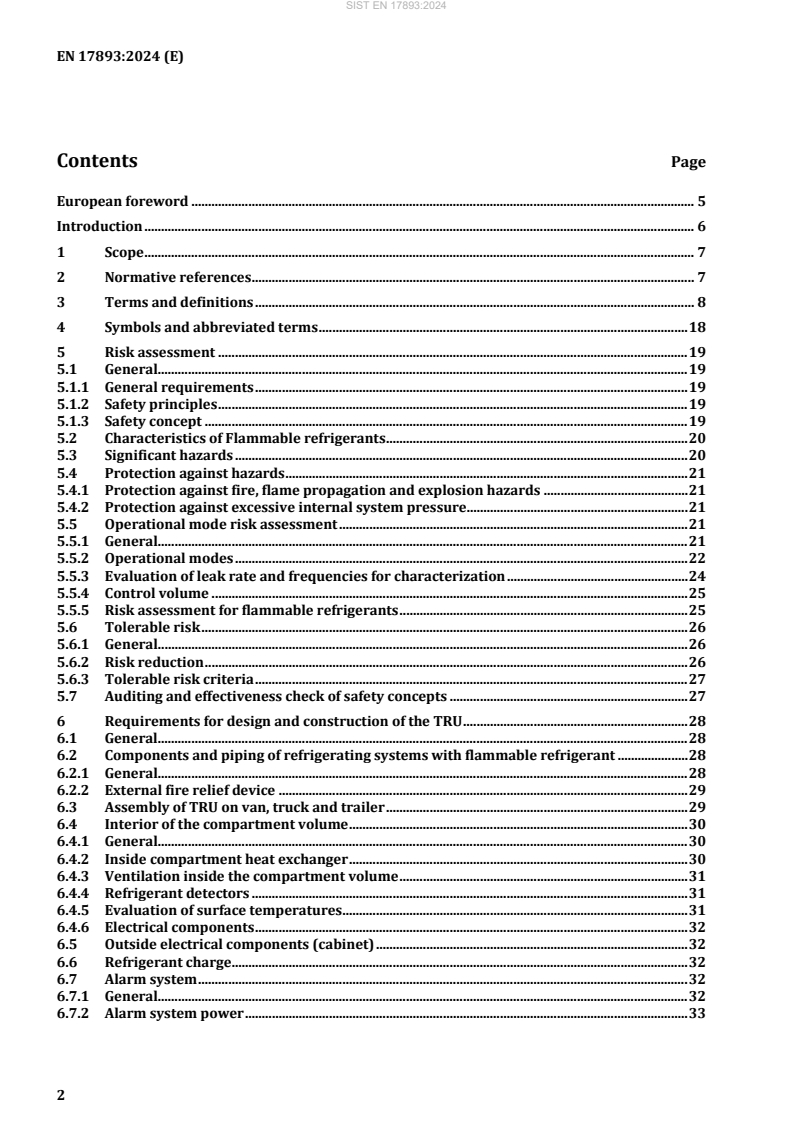
Contents Page
European foreword . 5
Introduction . 6
1 Scope . 7
2 Normative references . 7
3 Terms and definitions . 8
4 Symbols and abbreviated terms . 18
5 Risk assessment . 19
5.1 General. 19
5.1.1 General requirements . 19
5.1.2 Safety principles . 19
5.1.3 Safety concept . 19
5.2 Characteristics of Flammable refrigerants . 20
5.3 Significant hazards . 20
5.4 Protection against hazards . 21
5.4.1 Protection against fire, flame propagation and explosion hazards . 21
5.4.2 Protection against excessive internal system pressure. 21
5.5 Operational mode risk assessment . 21
5.5.1 General. 21
5.5.2 Operational modes . 22
5.5.3 Evaluation of leak rate and frequencies for characterization . 24
5.5.4 Control volume . 25
5.5.5 Risk assessment for flammable refrigerants . 25
5.6 Tolerable risk . 26
5.6.1 General. 26
5.6.2 Risk reduction . 26
5.6.3 Tolerable risk criteria . 27
5.7 Auditing and effectiveness check of safety concepts . 27
6 Requirements for design and construction of the TRU . 28
6.1 General. 28
6.2 Components and piping of refrigerating systems with flammable refrigerant . 28
6.2.1 General. 28
6.2.2 External fire relief device . 29
6.3 Assembly of TRU on van, truck and trailer . 29
6.4 Interior of the compartment volume . 30
6.4.1 General. 30
6.4.2 Inside compartment heat exchanger . 30
6.4.3 Ventilation inside the compartment volume . 31
6.4.4 Refrigerant detectors . 31
6.4.5 Evaluation of surface temperatures . 31
6.4.6 Electrical components . 32
6.5 Outside electrical components (cabinet) . 32
6.6 Refrigerant charge . 32
6.7 Alarm system . 32
6.7.1 General. 32
6.7.2 Alarm system power . 33
6.8 Testing . 33
6.8.1 General . 33
6.8.2 Testing of safety concept and protective devices . 33
6.8.3 Testing the air tightness of the compartment volume to determine the dilution of release
............................................................................................................................................................................. 34
6.8.4 Corrosion testing . 34
6.8.5 Vibration type-test . 34
6.8.6 Shock and impact type test. 35
6.8.7 Final system test before putting into operation . 35
6.9 Marking and documentation . 36
6.9.1 General . 36
6.9.2 Marking . 36
6.9.3 Manuals and documentation . 37
7 Requirements for the TRU manufacturer ensuring safe service, maintenance, repair . 38
7.1 General . 38
7.2 Providing education and training . 39
7.3 Instruction for maintenance and repair . 39
7.4 Providing safety instructions . 39
7.5 Providing a self-check mechanism . 40
8 Safe operation at different operating sites. 40
8.1 General . 40
8.2 Operating sites . 42
8.3 Significant hazards at operating sites . 44
8.4 Ventilating condition at operating sites . 44
8.4.1 General . 44
8.4.2 Requirements for operation in open air . 45
8.4.3 Requirements for operation in well-ventilated areas . 45
8.4.4 Requirements for operation in non-well-ventilated areas . 45
8.4.5 Operation in non-ventilated areas . 46
8.5 Requirements for opening of door(s) and for loading and unloading of goods. 46
8.6 Electrical installations at operating sites . 47
8.7 Operator instruction for handling of alarms . 47
8.8 Accidents . 48
8.8.1 General . 48
8.8.2 Measures for accidents prevention . 48
8.8.3 Measures after accidents . 49
8.9 Operating instructions, manuals, guidelines at operating sites . 50
9 Servicing recommendations and requirements at operating sites . 50
9.1 General . 50
9.2 Operating sites with service activities . 50
9.2.1 General . 50
9.2.2 General requirements . 51
9.2.3 Instruction of personnel . 51
9.2.4 General failure prevention . 51
9.3 Assembly of TRU at the vehicle and inside the compartment volume . 52
9.4 Repair and maintenance on the vehicle or the body structure . 52
9.5 Repair and maintenance on the TRU including refrigerating system repair . 52
9.5.1 General . 52
9.5.2 Instruction of personnel . 53
9.5.3 Work area requirements . 54
9.5.4 Inspection . 54
9.5.5 System failure indication . 55
9.5.6 Actions and procedure for refrigerating system repair . 55
9.5.7 Tools and equipment . 58
9.5.8 Testing after repair . 58
9.5.9 Failure prevention for maintenance and refrigerating system repair . 58
9.5.10 Documentation . 59
9.6 Handling, recovery, reuse and disposal of refrigerant . 59
10 Decommissioning of the TRU . 60
Annex A (informative) Specifications of control volumes for TRV. 61
Annex B (informative) Description of mechanisms to reduce risk . 64
B.1 General. 64
B.2 Heat exchanger zoning concept . 64
B.3 Indirect heat exchanger . 64
B.4 Heat exchanger separation mechanism, shut-off devices . 65
B.5 Ventilation mechanism . 66
B.5.1 General. 66
B.5.2 Outside ventilation mechanism . 66
B.5.3 Inside ventilation mechanism . 67
B.6 Refrigerant detection . 67
B.7 Alarm system . 68
B.7.1 General. 68
B.7.2 Types of alarm . 68
B.7.3 Visible and audible refrigerant leak alarm . 69
B.7.4 Actions by the alarm system . 69
Annex C (normative) Information on leak types and leak mass flow . 70
Annex D (normative) Useful equations for the calculation of environment ventilation . 72
D.1 General. 72
D.2 Dilution of a flammable substance release with air . 72
D.3 Additional examples . 74
D.3.1 Small volume in open air situation . 74
D.3.2 A Non-ventilated enclosure . 75
Annex E (normative) Tracer gas measurement for determination of air exchange rate . 76
E.1 General. 76
E.2 Tracer gas measurement with CO . 77
E.3 Required air exchange rate for dilution of refrigerant releases inside the compartment
volume . 78
Annex F (informative) Typical ignition sources for risk assessment of TRU . 79
Annex G (informative) Example process for risk evaluation . 80
Bibliography . 81
European foreword
This document (EN 17893:2024) has been prepared by Technical Committee CEN/TC 413 “Insulated
means of transport for temperature sensitive goods with or without cooling and/or heating device”, the
secretariat of which is held by DIN.
This European Standard shall be given the status of a national standard, either by publication of an
identical text or by endorsement, at the latest by December 2024, and conflicting national standards shall
be withdrawn at the latest by December 2024.
Attention is drawn to the possibility that some of the elements of this document may be the subject of
patent rights. CEN shall not be held responsible for identifying any or all such patent rights.
This document has been prepared under a standardization request addressed to CEN by the European
Commission. The Standing Committee of the EFTA States subsequently approves these requests for its
Member States.
Any feedback and questions on this document should be directed to the users’ national standards body.
A complete listing of these bodies can be found on the CEN website.
According to the CEN-CENELEC Internal Regulations, the national standards organisations of the
following countries are bound to implement this European Standard: Austria, Belgium, Bulgaria, Croatia,
Cyprus, Czech Republic, Denmark, Estonia, Finland, France, Germany, Greece, Hungary, Iceland, Ireland,
Italy, Latvia, Lithuania, Luxembourg, Malta, Netherlands, Norway, Poland, Portugal, Republic of North
Macedonia, Romania, Serbia, Slovakia, Slovenia, Spain, Sweden, Switzerland, Türkiye and the United
Kingdom.
Introduction
For many years, hydrofluorocarbons (HFCs) have been the preferred refrigerants used in refrigerating
systems of truck and trailer road vehicles and vans (TRV). However, the use of these refrigerants is being
now considered as unacceptable due to their contribution to global warming. Regulation (EU) No
517/2014 of the European Parliament and of the Council imposes provisions for the reduction of the use
of HFCs, in order to reduce the emissions of these fluorinated gases and lower the impact of their use on
climate change. The use of HFCs is regulated in all EU Member States, the United Kingdom and EFTA
countries and these fluorinated gases are to be phased down.
The continuous improvement of refrigerating systems in terms of reduction of greenhouse gas (GHG)
emissions and energy efficiency results in the deployment of technologies which has entailed the use of
flammable refrigerants. The use of these flammable refrigerants in transport refrigeration units (TRU’s)
may raise specific safety concerns or pose additional hazards which should be considered in the design
phase and during operation, correspondingly in all phases of the product life cycle. Leakage of flammable
refrigerants may lead to fire, explosion, or toxicity when decomposed.
This document has been developed to enable the safe use of flammable refrigerants in TRU’s. This
document enables system manufacturers, owners, and operators to understand and validate the risks
associated with operation, especially for maintenance and repair. This document provides requirements
and methodology to an acceptable level of safety.
For TRV’s this document supplements EN 378 (all parts) with specific additional requirements. It
provides minimum requirements for a risk-based approach to reduce the threat to persons, assets, and
the environment.
The working group which developed this document consisted of representatives from refrigerating
system manufacturers, refrigerated vehicle body builder, notified body, equipment owners and other
interested industry experts.
1 Scope
This document specifies requirements for the use of flammable refrigerants class A2L, A2 and A3 as
defined in ISO 817 with regard to:
— design and construction of the refrigerating system (as far as not specified in EN 378-2);
— operation;
— in all anticipated operational modes and locations;
— including continuous idling during standstill;
— service, maintenance and decommissioning;
— for the investigation and mitigation of risk for thermally insulated means of transport, including:
trucks, trailers, tanks, vans (light commercial vehicles), wagons, containers for land transport, small
containers, packaging.
This document describes an Operational Mode Risk Assessment (OMRA), which uses methods such as
Hazard and Operability Analysis (HAZOP), Failure Mode and Effects and Criticality Analysis (FMECA), or
Fault Tree Analysis (FTA) or a combination of these methods.
The document specifies requirements:
— for the validation of possible safety concepts and protective devices within the OMRA process,
including charge release tests, simulation, and function tests of the associated protective equipment;
— for tests related to the application;
— using methodologies to achieve tolerable risk values.
Mobile air conditioning systems in cars are covered in ISO 13043 and refrigerated containers conforming
to ISO 20854 are excluded.
This document could be used for class “B” refrigerants providing the OMRA is adjusted to account for
their specific properties.
2 Normative references
The following documents are referred to in the text in such a way that some or all of their content
constitutes requirements of this document. For dated references, only the edition cited applies. For
undated references, the latest edition of the referenced document (including any amendments) applies.
EN 378-1:2016+A1:2020, Refrigerating systems and heat pumps — Safety and environmental
requirements — Part 1: Basic requirements, definitions, classification and selection criteria
EN 378-2:2016, Refrigerating systems and heat pumps — Safety and environmental requirements — Part
2: Design, construction, testing, marking and documentation
EN 378-4:2016+A1:2019, Refrigerating systems and heat pumps — Safety and environmental
requirements — Part 4: Operation, maintenance, repair and recovery
EN 1127-1:2019, Explosive atmospheres — Explosion prevention and protection — Part 1: Basic concepts
and methodology
EN 1736:2008, Refrigeration systems and heat pumps — Flexible pipe elements, vibration isolators,
expansion joints and non-metallic tubes — Requirements, design and installation
EN 14624, Performance of portable locating leak detectors and of fixed gas detectors for all refrigerants
EN ISO 7010:2020, Graphical symbols — Safety colours and safety signs — Registered safety signs (ISO
7010:2019, Corrected version 2020-06)
EN ISO 12100:2010, Safety of machinery — General principles for design — Risk assessment and risk
reduction (ISO 12100:2010)
EN 60068-2-6, Environmental testing — Part 2-6: Tests — Test Fc: Vibration (sinusoidal) (IEC60068-2-6)
EN 60068-2-75, Environmental testing — Part 2-75: Tests — Test Eh: Hammer tests (IEC 60068-2-75)
IEC 60079-10-1:2020, Explosive atmospheres — Part 10-1: Classification of areas — Explosive gas
atmospheres
EN 60079-14, Explosive atmospheres — Part 14: Electrical installations, design, selection and erection (IEC
60079-14)
IEC 60079-15:2020, Explosive atmospheres — Part 15: Equipment protection by type of equipment “n”
IEC 60079-29-1, Explosive atmospheres — Part 29-1: Gas detectors — Performance requirements of
detectors for flammable gases
IEC 60335-2-40:2018, Household and similar electrical appliances — Safety — Part 2-40: Particular
requirements for electrical heat pump, air-conditioners and dehumidifiers
ISO 817:2014, Refrigerants — Designation and safety classification
3 Terms and definitions
For the purposes of this document, the following terms and definitions apply.
ISO and IEC maintain terminological databases for use in standardization at the following addresses:
— IEC Electropedia: available at https://www.electropedia.org/
— ISO Online browsing platform: available at https://www.iso.org/obp
3.1
air ventilation duct
connection between an inside compartment volume and an outside and/or other compartment volume
as part of a protective device that can be used for ventilation of the compartment volume to dilute
unexpected refrigerant release
3.2
alarm system
system constituting all electrical and electronic parts of the refrigerating system which monitor the
correct function of the refrigerating system and the protective device(s) and may give a warning in case
of malfunctioning or refrigerant leakage
3.3
authorized service facility
service facility that is authorized by the manufacturer to repair and to maintain the TRU
3.4
compartment volume
insulated closed space (cargo compartment) which is cooled by the refrigerating system or heated and
not intended to be occupied, except periodically for loading and unloading
Note 1 to entry: The compartment volume can have several separate sections.
Note 2 to entry: The compartment volume can include the evaporator space.
Note 3 to entry: The compartment volume can also be built in a vehicle using an heat insulation kit, refer to
EN 17066-1:2019, 3.1.8.
Note 4 to entry: For the definition of a compartment refer to EN 17066-1:2019, 3.1.1.6.
3.5
condenser space
space in the outside of the TRU where condenser, condenser fan and associated pipes are located
Note 1 to entry: The air-cooled condenser section is not a confined space.
Note 2 to entry: The condenser section corresponds to control volume II described in Annex A.
3.6
control volume
CV
theoretical volume representing a space in which a flammable atmosphere can occur as a consequence of
a refrigerant leak and the ventilating condition
Note 1 to entry: It can be delimited by the internal or external space of the vehicle dimensions , and/or by specific
component compartments.
Note 2 to entry: A description of CVs is included in Annex A.
3.7
enhanced tightness
absence of refrigerant leakage in the circuit when due to the design and measures of maintenance any of
the tightness tests or tightness monitoring appropriate for the application does not reveal any hazardous
leaks during normal operations and expected malfunctions
[SOURCE: EN 1127-1:2019, 3.2, modified — The words “refrigerant” and “in the circuit” and the Note 1, 2, 3 to entry
have been added.]
Note 1 to entry: Fugitive emissions (see 3.31.1) are regarded in this application as leaks which will not result to
significant hazards according to EN ISO 12100:2010, 3.8.
Note 2 to entry: Additional information can be found in EN 1127-1:2019, Annex B.
Note 3 to entry: Clause 6, Clause 8 and especially Clause 9 provide information on design and operational aspects
to maintain tightness, permanently ensured by means of enhanced maintenance and supervision.
3.8
environment ventilation
environmental condition related to the footprint of the vehicle, on which the TRU is mounted, capable of
diluting releases of hazardous substances
Note 1 to entry: Defined ventilation conditions are sufficient to dilute fugitive emissions to non-hazardous
concentration.
3.8.1
open air
any unenclosed space, possibly but not necessarily roofed, with, as a minimum, natural ventilation
Note 1 to entry: The environment ventilation “open air” refers to or represents areas or operating sites such as
loading/unloading areas, inspection, (roofed) repair areas.
[SOURCE: EN 378-1:2016+A1:2020, 3.2.8, modified — The words “with, as a minimum, natural
ventilation” and Note 1 to entry have been added.]
3.8.2
well-ventilated
area which is naturally or mechanically ventilated
Note 1 to entry: The environment ventilation “well-ventilated” refers or represent areas or operating sites such as
workshops, system repair areas where ventilation requirements are established according to workplace
requirements.
3.8.3
non-well-ventilated
area other than open air or well-ventilated
Note 1 to entry: The environment ventilation “non-well-ventilated” should be considered if an artificial or forced
ventilation system is not in operation (due to power failures or other type of malfunction).
Note 2 to entry: For release rate and accumulation time of hazardous substances in non-well-ventilated areas or
operating sites see Annex D.
3.9
evaporator space
space containing the evaporator, associated piping, connections, housing and air ducts inside the cold
compartment volume
Note 1 to entry: The evaporator space corresponds to CV III (see Annex A).
3.10
external power supply
connected to grid or independent generator
3.11
type of failure
3.11.1
rare malfunction
type of malfunction which may happen only in rare instances
Note 1 to entry: Rare malfunctions could include unanticipated conditions that are not covered by the TRU design
such as unexpected loose connection, or unexpected corrosion that results in a release. Where releases due to
corrosion or similar conditions may or could reasonably be expected as part of the plant operations then this is not
considered as a rare malfunction.
[SOURCE: IEC 60079-10-1:2020, 3.7.3 modified — NOTE 1 has been omitted and NOTE 2 has been
modified]
3.11.2
catastrophic failure
reasonably unexpected occurrence which exceeds the design parameters of the TRU and control system
resulting in an accidental type release of flammable refrigerant
Note 1 to entry: Catastrophic failures in the context of this standard include, for example, major accidents, crash
such as the rupture of a component, equipment or piping such as total breakdown of a flange or seal.
[SOURCE: IEC 60079-10-1:2020, 3.7.4, modified — In the definition, the word “process plant” has been
replaced with “TRU” and the words “an accidental type” have been added. In addition, NOTE 1 is
modified.]
3.12
flammable atmosphere
mixture with air, under atmospheric conditions, of flammable refrigerant in the form of gas or vapour,
which after ignition, permits self-sustained flame propagation
Note 1 to entry: For example, a mixture of flammable refrigerant fluid with air under atmospheric conditions.
[SOURCE: IEC 60079-10-1:2020, 3.2]
3.13
flammability limit
Note 1 to entry: The flammability limits are function of temperature and humidity. For refrigerants
flammability, ISO 817:2014 defines test conditions of 50 % relative humidity at 23,0 °C and 101,3 kPa for
burning velocity and LFL/UFL measurements. The effect of a reduced lower flammability limit and an
increased upper flammability limit at higher operational humidity and temperature levels can be taken
into account in the operational mode risk assessment.
3.13.1
lower flammability limit
LFL
minimum concentration of the refrigerant that is capable of propagating a flame through a homogeneous
mixture of the refrigerant and air under the specified test conditions at 23,0 °C and 101,3 kPa
[SOURCE: ISO 817:2014, 3.1.24, modified — NOTE 1 and NOTE 2 have been omitted.]
3.13.2
upper flammability limit
UFL
concentration of flammable gas or vapour in air, above which the gas atmosphere is not flammable
[SOURCE: IEC 60079-10-1:2020, 3.6.13, modified — In the definition, the words “or mist” have been
removed after “vapour”. Also, at the end, after “above which”, “an explosive gas atmosphere will not be
formed” has been changed to “the gas atmosphere is not flammable”.]
3.14
flammable refrigerant
refrigerant with a classification of class 2L, 2 or 3 in compliance with ISO 817:2014 classification
3.14.1
auto-ignition temperature
AIT
lowest temperature of a hot surface at which, under specified conditions, an ignition of a flammable gas
or vapour in mixture with air occurs
[SOURCE: IEC 60079-10-1:2020, 3.6.11, modified — In the definition, the words “/inert gas” have been
removed after “air”]
3.14.2
reaction threshold temperature
RTT
lowest temperature of a substance at which a chemical can be decomposed spontaneously in a normal
atmosphere, in the presence of an external source of ignition, such as an open flame, hot surface or spark
Note 1 to entry: As an estimation, the following values may be used: RTT = AIT − 100 °C.
est
3.14.3
hot surface ignition temperature
HSIT
highest temperature at which a refrigerant does not ignite when tested in accordance with Annex KK in
IEC 60335-2-40:2018
[SOURCE: IEC 60335-2-40:2018]
3.15
flammable substance
substance in the form of gas, vapour, liquid, or mixtures of these, able to propagate a flame from an
ignition source
3.16
hazardous area
area in which a flammable or toxic atmosphere is present, or may be expected to be present, in quantities
such as to require special precautions for construction, installation or use of apparatus
[SOURCE: IEC 60079-10-1:2020, 3.3.1, modified — In the definition, the word “explosive” has been
replaced with “flammable and toxic”.]
3.16.1
non-hazardous area
area in which a flammable or toxic atmosphere is not expected to be present in quantities such as to
require special precautions for construction, installation and use of equipment
[SOURCE: IEC 60079-10-1:2020, 3.3.2, modified — In the definition, the word “explosive” has been
replaced with “flammable and toxic”.]
3.16.2
temporary hazardous area
hazardous area for a short period of time as a consequence of an abnormal or accidental type leak
3.17
inside component
component of the refrigerating system, which is located inside the insulated compartment volume (3.4)
3.18
intended use
use of the transport refrigeration unit (TRU) in accordance with the information for use provided in the
instructions
Note 1 to entry: The intended use includes all operational modes described in 5.5.2.
[SOURCE: EN ISO 12100:2010, 3.23, modified — The words “a machine” have been replaced with “the
TRU” and Note 1 to entry has been added.]
3.18.1
normal operation
situation when the equipment is operating within its designed parameters
Note 1 to entry: Failures (such as the breakdown of components or ruptures) which involve shut-down and urgent
repair are not considered to be part of normal operation.
Note 2 to entry: Normal operation includes start-up and shut-down conditions, and “off”, “on”, cooling, defrost and
heating, if appropriate.
Note 3 to entry: Normal operation can include occurrence of fugitive emissions. Normal operation does not include
larger leaks. Normal operation of the TRU requires a certain minimum refrigerant charge.
[SOURCE: IEC 60079-10-1:2020, 3.7.1, modified — NOTE 1 and NOTE 2 have been modified and NOTE 3
to entry has been added]
3.18.2
stationary operation
use of a TRV for cooling and storage of goods whilst not in motion
3.18.3
reasonably foreseeable misuse
use of the TRU in a way not intended by the designer, but which can result from readily predictable human
behaviour, or, in the absence of such information, by generally understood patterns of usage
[SOURCE: EN ISO 12100:2010, 3.24, modified — The words “a machine” have been replaced with “the
TRU”.]
3.19
loading/unloading
action of filling/removing cargo/goods into/from the thermal insulated compartment volume, cargo
space
3.20
multi-temperature compartment volume
cargo space divided by insulated partition walls in two or more insulated compartment volumes and
equipped with a cooling and/or heating device for maintaining different temperatures
3.21
non-occupied space
compartment volume which is not occupied for a significant period of time by person(s)”
Note 1 to entry: For loading and unloading of goods, the doors to the insulated compartment volume(s) are open,
see 8.5.
3.22
on the road operation
operation of the cooling and/or heating device using an independent power source or the mechanical or
electrical power supplied by the vehicle
3.23
ope
...