

prEN 16175-2
(Main)Soil, treated biowaste and sludge - Determination of mercury - Part 2: Cold-vapour atomic fluorescence spectrometry (CV-AFS)
- Abstract
This European Standard specifies a method for the determination of mercury in aqua regia or nitric acid
digests of sludge, treated biowaste and soil, obtained according to EN ISO 54321 or EN 13173 using cold-
vapour atomic absorption spectrometry (CV-AAS). The lower working range limit is at least 0,003 mg/kg (dry
matter basis) depending on digestion parameters.
- Status
- Not Published
- Publication Date
- 16-May-2028
- Technical Committee
- CEN/TC 444 - Environmental characterization
- Drafting Committee
- CEN/TC 444/WG 3 - Inorganic analysis
- Current Stage
- 4020 - Submission to enquiry - Enquiry
- Start Date
- 03-Sep-2026
- Due Date
- 03-Feb-2027
- Completion Date
- 03-Sep-2026

prEN 16175-2 is a CEN draft European Standard for determining mercury in acid digests of soil, treated biowaste and sludge by cold-vapour atomic fluorescence spectrometry (CV-AFS). It is written for laboratory users and sets a lower working range limit of at least 0.003 mg/kg on a dry-matter basis, depending on digestion conditions.
What does prEN 16175-2 specify?
prEN 16175-2 specifies a measurement method for mercury in digests prepared from soil, treated biowaste and sludge, using CV-AFS. The standard focuses on the analytical step after digestion, so the result depends on how the sample was digested and diluted before measurement.
The document is organized into Clauses 1 to 11, followed by one informative annex and a bibliography. The main clauses cover the principle of the method, interferences, reagents, apparatus, procedure, calculation, performance data and the test report.
| Annex | What it covers |
|---|---|
| Annex A (informative) | Repeatability and reproducibility data from the validation study |
What are the key requirements of prEN 16175-2?
prEN 16175-2 requires the analyst to control the digestion matrix, the reduction chemistry and the measurement sequence so the mercury signal can be linked to a calibration curve. In practice, this means the method is not just about the instrument - the blank, calibration solutions, gas handling and sample preparation all matter.
Principle and measurement step
Clause 4 states that mono- and divalent mercury are reduced to elemental mercury in acid medium, then stripped into a closed system and measured by atomic fluorescence, usually at about 254 nm. Tin(II) chloride is recommended as the reducing agent, while sodium borohydride may also be used. For the reader, this means the method is built around vapor generation and optical detection, not direct liquid aspiration.
Interferences and matrix control
Clause 5 highlights suppression from water vapour, aerosols, noble metals and strongly complexing anions such as sulfide, iodide and bromide. The carrier gas stream should be dried before it reaches the detector. In practice, this is the part that tells a lab how to avoid low or unstable mercury signals from a difficult matrix.
Reagents and solution handling
Clause 6 specifies the water quality, carrier gas purity, acids, reducing solutions and mercury standards used in the method. It also states that the same batch of hydrochloric acid and nitric acid should be used throughout the procedure, and that mercury standard solutions must be stabilized appropriately. For users, that means consistency of reagents is part of method control, not just a housekeeping detail.
Apparatus and instrument setup
Clause 7 covers usual laboratory glassware and the AFS system, including automated flow systems, flow injection analysis (FIA), sample introduction and the cold-vapour generator. It also gives practical setup points such as the mercury lamp, filter, gas supply and drying arrangement. This matters because the method can be run manually, semi-automatically or in an automated flow system, but the configuration must support stable sensitivity and peak shape.
Procedure, calibration and blank correction
Clause 8 requires a test solution, a test blank solution, a calibration blank and at least five calibration solutions. The calibration solutions must contain the same reagent proportions as the test solutions, and the sample signal is measured only after the blank. This tells the user to match the matrix as closely as possible and to check the result against the calibration range.
Calculation, reporting and validation
Clause 9 requires blank correction and correction to dry matter, and results are reported with no more than three significant figures. Clause 10 points to an international validation study, and Clause 11 sets the minimum content of the test report. In practice, the report has to identify the sample, the digestion used, the result and any deviations or optional details that could affect the outcome.
What terms does prEN 16175-2 define?
- CV-AFS - Cold-vapour atomic fluorescence spectrometry, the detection technique used to measure mercury vapour.
- Test solution - The aliquot of the particle-free digest or extraction solution that is analysed.
- Test blank solution - A blank prepared with the same reagents and steps as the sample, but without the test solution.
- Calibration blank solution - The zero-level calibration solution used to start the calibration sequence.
- Calibration solution - A mercury standard solution used to build the calibration curve.
- Dry matter fraction - The sample dry-solids fraction used to correct the result to a dry-matter basis.
- Standard addition method - A check for matrix effects by adding known mercury to the sample and comparing the response.
Who uses prEN 16175-2?
prEN 16175-2 is used by environmental and analytical laboratories that test sludge, treated biowaste and soil for mercury. It is relevant to analysts setting up CV-AFS measurements, quality managers reviewing validation and reporting, and buyers or technical staff selecting a mercury method for routine monitoring or compliance work.
The validation information also makes it useful for laboratories comparing performance across different matrices, such as municipal sludge, compost and soil. It supports method implementation, instrument configuration, and result reporting in routine environmental testing.
What changed in prEN 16175-2 from the previous edition?
prEN 16175-2 will supersede EN 16175-2:2016. The foreword states these significant technical changes:
- EN 16174 for aqua regia digestion is replaced by EN ISO 54321.
- The calibration range and stabilization reagents have been opened up.
- Clause 6 on apparatus has been revised.
Which standards are used with prEN 16175-2?
The document names no normative references. In the method and bibliography, prEN 16175-2 uses EN 16173 for nitric acid digestion, EN ISO 54321 for aqua regia digestion, and EN ISO 11465 for determining the dry matter fraction. EN 16175-1 is the companion part of the series and covers mercury by cold-vapour atomic absorption spectrometry (CV-AAS).
What does the prEN 16175-2 document contain?
prEN 16175-2 contains the method principle, interferences, reagent preparation, apparatus requirements and a detailed step-by-step procedure for blanks, calibration and measurement. It also includes the calculation approach for blank-corrected, dry-matter-corrected mercury results.
The document provides a calibration example, instrument setup guidance for automated and manual systems, and handling notes for sample dilution and matrix effects. Table 1 identifies the matrices covered by the validation work, and Table 2 gives tolerable concentrations for some matrix elements.
Annex A gives repeatability and reproducibility data from the validation study, which helps laboratories judge expected method performance. The test report clause lists the minimum information that should accompany the result.
Relations
- Effective Date
- 18-Mar-2026
Get Certified
Connect with accredited certification bodies for this standard

CIS Institut d.o.o.
Personal Protective Equipment (PPE) certification body. Notified Body NB-2890 for EU Regulation 2016/425 PPE.

Kiwa BDA Testing
Building and construction product certification.
Kmetijski inštitut Slovenije
Agricultural Institute of Slovenia. Soil testing, plant health, agricultural product analysis.
Sponsored listings
Frequently Asked Questions
prEN 16175-2 is a draft published by the European Committee for Standardization (CEN). Its full title is "Soil, treated biowaste and sludge - Determination of mercury - Part 2: Cold-vapour atomic fluorescence spectrometry (CV-AFS)". This standard covers: This European Standard specifies a method for the determination of mercury in aqua regia or nitric acid digests of sludge, treated biowaste and soil, obtained according to EN ISO 54321 or EN 13173 using cold- vapour atomic absorption spectrometry (CV-AAS). The lower working range limit is at least 0,003 mg/kg (dry matter basis) depending on digestion parameters.
This European Standard specifies a method for the determination of mercury in aqua regia or nitric acid digests of sludge, treated biowaste and soil, obtained according to EN ISO 54321 or EN 13173 using cold- vapour atomic absorption spectrometry (CV-AAS). The lower working range limit is at least 0,003 mg/kg (dry matter basis) depending on digestion parameters.
prEN 16175-2 is classified under the following ICS (International Classification for Standards) categories: 13.030.01 - Wastes in general; 13.080.01 - Soil quality and pedology in general; 13.080.10 - Chemical characteristics of soils. The ICS classification helps identify the subject area and facilitates finding related standards.
prEN 16175-2 has the following relationships with other standards: It is inter standard links to EN 16175-2:2016. Understanding these relationships helps ensure you are using the most current and applicable version of the standard.
prEN 16175-2 is available in PDF format for immediate download after purchase. The document can be added to your cart and obtained through the secure checkout process. Digital delivery ensures instant access to the complete standard document.
Standards Content (Sample)
SLOVENSKI STANDARD
01-oktober-2026
Tla, obdelani biološki odpadki in blato - Določanje živega srebra - 2. del: Metoda
atomske fluorescenčne spektrometrije s tehniko hladnih par (CV-AFS)
Soil, treated biowaste and sludge - Determination of mercury - Part 2: Cold-vapour
atomic fluorescence spectrometry (CV-AFS)
Schlamm, behandelter Bioabfall und Boden - Bestimmung von Quecksilber - Teil 2:
Kaltdampf-Atomfluoreszenzspektrometrie (CV-AFS)
Boues, biodéchets traités et sols - Détermination du mercure - Partie 2: Spectrométrie de
fluorescence atomique de vapeur froide (SFA-VP)
Ta slovenski standard je istoveten z: prEN 16175-2
ICS:
13.030.20 Tekoči odpadki. Blato Liquid wastes. Sludge
13.080.10 Kemijske značilnosti tal Chemical characteristics of
soils
71.040.50 Fizikalnokemijske analitske Physicochemical methods of
metode analysis
2003-01.Slovenski inštitut za standardizacijo. Razmnoževanje celote ali delov tega standarda ni dovoljeno.
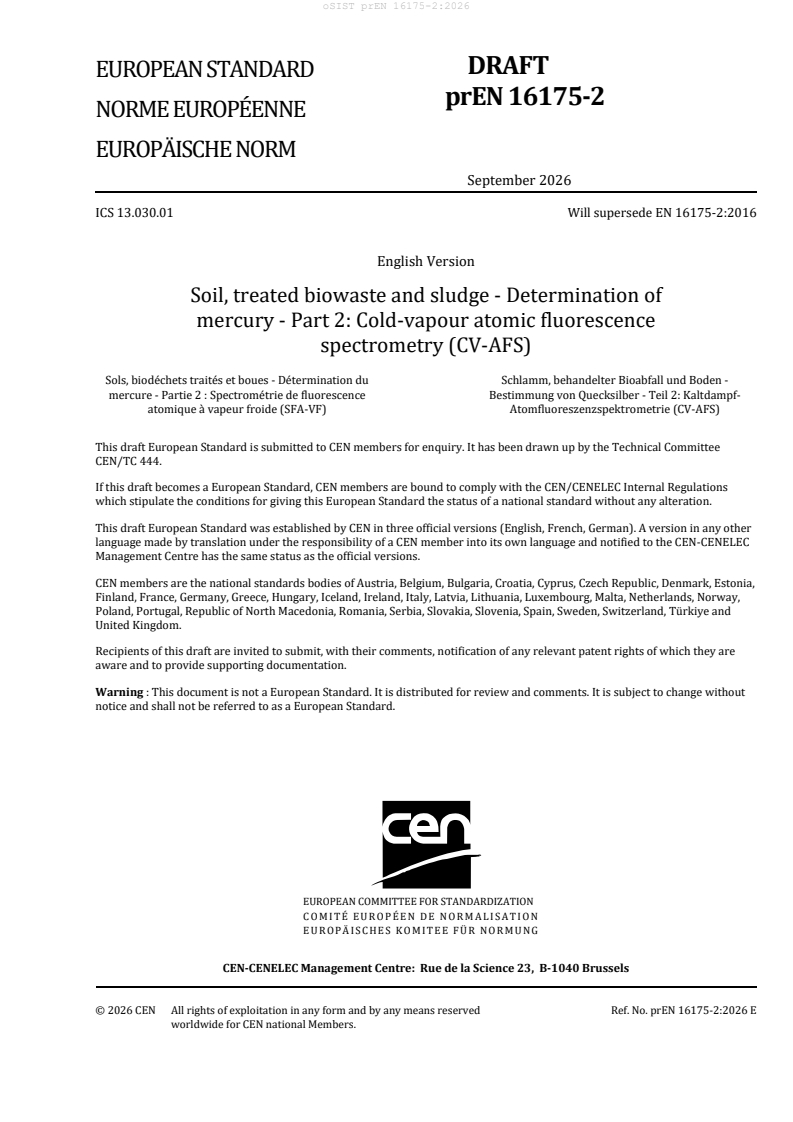
DRAFT
EUROPEAN STANDARD
NORME EUROPÉENNE
EUROPÄISCHE NORM
September 2026
ICS 13.030.01 Will supersede EN 16175-2:2016
English Version
Soil, treated biowaste and sludge - Determination of
mercury - Part 2: Cold-vapour atomic fluorescence
spectrometry (CV-AFS)
Sols, biodéchets traités et boues - Détermination du Schlamm, behandelter Bioabfall und Boden -
mercure - Partie 2 : Spectrométrie de fluorescence Bestimmung von Quecksilber - Teil 2: Kaltdampf-
atomique à vapeur froide (SFA-VF) Atomfluoreszenzspektrometrie (CV-AFS)
This draft European Standard is submitted to CEN members for enquiry. It has been drawn up by the Technical Committee
CEN/TC 444.
If this draft becomes a European Standard, CEN members are bound to comply with the CEN/CENELEC Internal Regulations
which stipulate the conditions for giving this European Standard the status of a national standard without any alteration.
This draft European Standard was established by CEN in three official versions (English, French, German). A version in any other
language made by translation under the responsibility of a CEN member into its own language and notified to the CEN-CENELEC
Management Centre has the same status as the official versions.
CEN members are the national standards bodies of Austria, Belgium, Bulgaria, Croatia, Cyprus, Czech Republic, Denmark, Estonia,
Finland, France, Germany, Greece, Hungary, Iceland, Ireland, Italy, Latvia, Lithuania, Luxembourg, Malta, Netherlands, Norway,
Poland, Portugal, Republic of North Macedonia, Romania, Serbia, Slovakia, Slovenia, Spain, Sweden, Switzerland, Türkiye and
United Kingdom.
Recipients of this draft are invited to submit, with their comments, notification of any relevant patent rights of which they are
aware and to provide supporting documentation.
Warning : This document is not a European Standard. It is distributed for review and comments. It is subject to change without
notice and shall not be referred to as a European Standard.
EUROPEAN COMMITTEE FOR STANDARDIZATION
COMITÉ EUROPÉEN DE NORMALISATION
EUROPÄISCHES KOMITEE FÜR NORMUNG
CEN-CENELEC Management Centre: Rue de la Science 23, B-1040 Brussels
© 2026 CEN All rights of exploitation in any form and by any means reserved Ref. No. prEN 16175-2:2026 E
worldwide for CEN national Members.
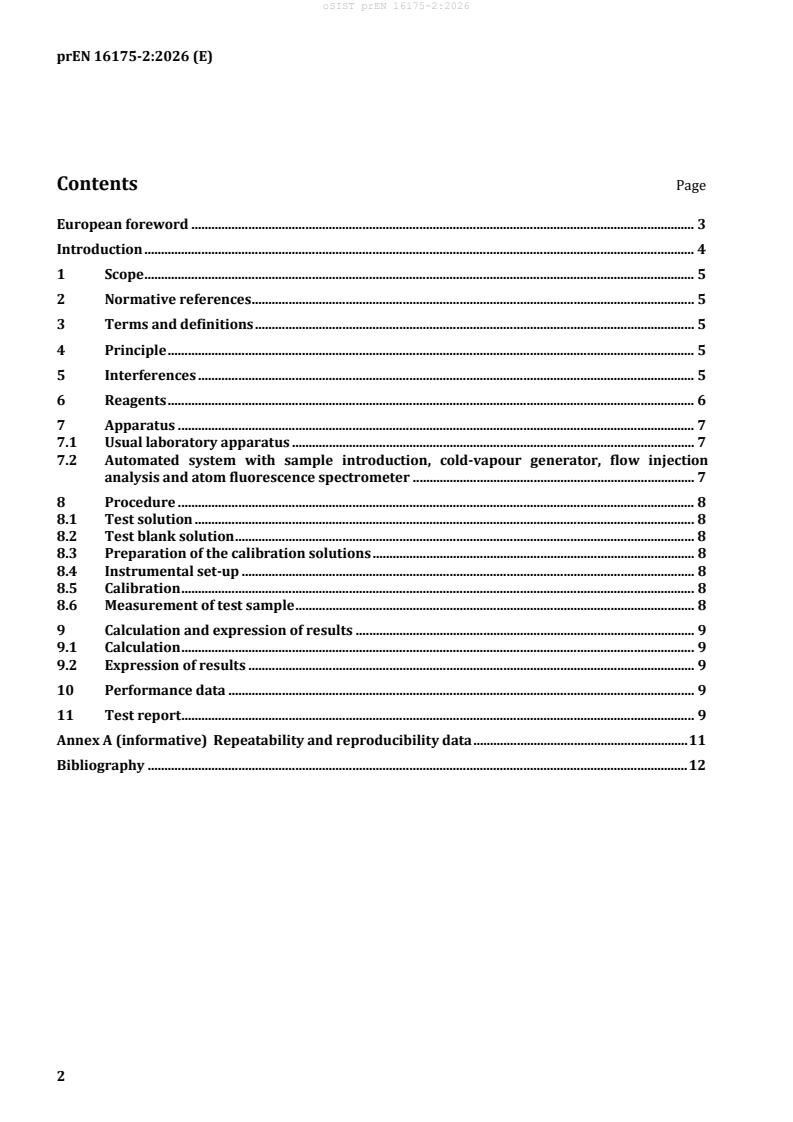
Contents Page
European foreword . 3
Introduction . 4
1 Scope . 5
2 Normative references . 5
3 Terms and definitions . 5
4 Principle . 5
5 Interferences . 5
6 Reagents . 6
7 Apparatus . 7
7.1 Usual laboratory apparatus . 7
7.2 Automated system with sample introduction, cold-vapour generator, flow injection
analysis and atom fluorescence spectrometer . 7
8 Procedure . 8
8.1 Test solution . 8
8.2 Test blank solution . 8
8.3 Preparation of the calibration solutions . 8
8.4 Instrumental set-up . 8
8.5 Calibration . 8
8.6 Measurement of test sample . 8
9 Calculation and expression of results . 9
9.1 Calculation . 9
9.2 Expression of results . 9
10 Performance data . 9
11 Test report . 9
Annex A (informative) Repeatability and reproducibility data . 11
Bibliography . 12
European foreword
This document (prEN 16175-2:2026) has been prepared by Technical Committee CEN/TC 444 “Test
methods for environmental characterization of solid matrices”, the secretariat of which is held by NEN.
This document is currently submitted to the-CEN Enquiry.
This document will supersede EN 16175-2:2016.
2:2016:
— EN 16174 (digestion with aqua regia) is replaced by EN ISO 54321.
— Calibration range and stabilization reagents are opened to customer belongings.
— Clause 6 Apparatus has been revised.
EN 16175, Sludge, treated biowaste and soil — Determination of mercury comprises the following parts:
— Part 1: Cold-vapour atomic absorption spectrometry (CV-AAS);
— Part 2: Cold-vapour atomic fluorescence spectrometry (CV-AFS).
Introduction
This document is applicable and validated for several types of matrices as indicated in Table 1 (see
Annex A for the results of validation).
Table 1 — Matrices for which this document is applicable and validated
Matrix Materials used for validation
Sludge Municipal sludge
Biowaste Compost
Soil Soil
WARNING — Persons using this document should be familiar with usual laboratory practice. This
document does not purport to address all of the safety problems, if any, associated with its use. It
is the responsibility of the user to establish appropriate safety and health practices and to ensure
compliance with any national regulatory conditions.
IMPORTANT — It is absolutely essential that tests conducted according to this document be
carried out by suitably trained staff.
1 Scope
This document specifies a method for the determination of mercury in digests of soil, treated biowaste,
sudge and waste, obtained according to EN 16173 (nitric acid digestion) or EN ISO 54321 (aqua regia
digestion) with using cold-vapour atomic fluorescence spectrometry (CV-AFS). The lower working range
limit is at least 0,003 mg/kg (dry matter basis) depending on digestion parameters.
2 Normative references
There are no normative references in this document.
3 Terms and definitions
No terms and definitions are listed in this document.
ISO and IEC maintain terminology databases for use in standardization at the following addresses:
— ISO Online browsing platform: available at https://www.iso.org/obp/
— IEC Electropedia: available at https://www.electropedia.org/
4 Principle
Mono- and divalent mercury is reduced to the elemental form by tin(II) chloride solution or sodium
borohydride in acid medium. Elemental mercury is stripped off from the solution in a closed system. The
mercury vapour, in the form of an atomic gas, passes through a cell positioned in the light path of an
atomic fluorescence spectrometer where the mercury atoms are excited by radiation of a specific
wavelength, usually about 254 nm. The intensity of the fluorescence radiation is a function of mercury
concentration. The concentrations are calculated using a calibration curve.
The matrix of the solution analysed is dominated by the acids used in the digestion step. Tin(II) chloride
as a reduction substance is recommended in this document, because sodium borohydride reduces many
elements commonly found in soil, sludge and waste extract solutions, to the elemental state, which might
cause matrix problems under particular circumstances. However, it is still possible to use sodium
borohydride as reduction agent.
5 Interferences
The presence of water vapour or aerosol in the fluorescence cell may cause suppression due to quenching.
Water vapour should be removed from the carrier gas stream using a hygroscopic membrane before
entering the detector. The noble metals, such as gold and silver, amalgamate with mercury and, therefore,
may cause suppression. Also anions, for instance sulfide, iodide and bromide, which complex strongly
with mercury, can cause suppression.
Fewer interferences arise from heavy metals when tin(II) chloride is used rather than sodium
borohydride. When flow systems are used, interference effects due to heavy metals may be less than
indicated in Table 2.
Table 2 — Tolerable concentrations of some matrix elements
Element Acceptable
concentration in the test
solution
mg/l
Cu(II) 500
Ni(II) 500
Ag(I) 1
6 Reagents
−1
6.1 Water, with an electrical conductivity less than 0,1 mS m (equivalent to resistivity greate
...