

EN 16755:2026
(Main)Classes of fire-retardant treated wood products in interior and exterior end use applications - Retained performance of fire-retardant treated wood products
- Abstract
This document describes test methods and methods for the retained performance classification of wood products with a stage in the production process resulting in an improvement of the reaction-to-fire classification in accordance with EN 13501-1 for use in interior and exterior situations (use classes 1, 2, and 3 as defined in EN 335:2013 [3]).
NOTE 1 The classes of this document are not performance classes and do not give guidance for how long the reaction to fire classification of wood product will last.
This document applies to
—
wood products (specific wood species, wood treated with preservatives and modified wood, for example thermally and chemically modified wood) that have been treated with fire-retardant chemical(s) applied either by a penetrating process or by a superficial process, such as with a film forming fire-retardant coating.
This document also covers fire-retardant wood products that have a non-fire-retardant coating.
Mechanical properties, aesthetic properties, dimensional stability properties, service life and biological durability of fire-retardant wood products are not covered by this document.
NOTE 2 EAD 350865-00-1106 [7] covers fire retardant products (coating) applied in situ.
- Status
- Not Published
- Publication Date
- 01-Dec-2026
- Technical Committee
- CEN/TC 175 - Round and sawn timber
- Current Stage
- 5060 - Closure of Vote - Formal Approval
- Start Date
- 17-Sep-2026
- Due Date
- 10-Aug-2026
- Completion Date
- 17-Sep-2026

EN 16755:2026 is a CEN standard for classes of fire-retardant treated wood products in interior and exterior end use applications. It specifies test methods and classification methods for wood and wood-based products whose fire-retardant treatment is part of production, so manufacturers, laboratories and approval bodies can assess retained reaction-to-fire performance for use classes 1, 2 and 3.
The standard ties the class claim to defined tests for reaction to fire, hygroscopic behaviour and weathering. It also sets out what a classification report must contain, so the result can be checked and used consistently in practice.
What does EN 16755:2026 specify?
EN 16755:2026 covers treated wood and wood-based products used indoors and outdoors where a production-stage treatment improves reaction-to-fire classification in EN 13501-1. The document says the classes are not durability or service-life classes, so the class itself does not tell you how long the reaction-to-fire result will last.
The scope includes products treated with fire-retardant chemicals by penetrating or superficial processes, including film-forming fire-retardant coatings, and products with a non-fire-retardant coating. It also includes wood-based products that incorporate fire-retardant chemicals during manufacture. Mechanical, aesthetic, dimensional stability, service life and biological durability properties are outside the scope.
The document is organized into Clauses 1 to 6, with three annexes.
| Annex | What it covers |
|---|---|
| Annex A | Hygroscopic properties test method for fire-retardant treated wood products, including coated products |
| Annex B | Artificial weathering method before fire testing |
| Annex C | Example classification report and example reporting format |
What are the key requirements of EN 16755:2026?
EN 16755:2026 requires the product, treatment and test basis to be declared clearly, then checked against the class claimed. In practice, the standard is about showing that the treated product still behaves as claimed after humidity exposure or weathering, and about limiting how far one test result can be extended to other products.
Product description and treatment declaration
Clause 5.1 requires the manufacturer to declare the wood material, wood species, product type, treatment type and any trade name. For wood products impregnated with fire retardants, the retention is given in kg active ingredient/m3 wood; for coated products, the application rate and coating solid content are given, or the wet film thickness for film-forming coatings.
This matters because the class is linked to a very specific product build-up. If the wood species, thickness or treatment rate changes too much, the earlier result is no longer a valid basis for the same claim.
Limits on direct application of test results
Clause 5.2 limits how far test results can be extended. Results can be transferred to thicker products of the same type treated with the same fire-retardant type and amount, but not to thinner products. The clause also ties the weathering result to the most penalizing colour or gloss level when a range is offered.
For hygroscopic testing, Classes INT2 and EXT apply only up to the highest application rate tested. The general hygroscopicity procedure uses Scots pine sapwood, while the end-use procedure uses the actual product and applies only to that product.
Initial fire performance and weathered fire performance
Clause 5.3 requires initial reaction-to-fire classification in EN 13501-1. For weathered performance, the document allows artificial weathering in Annex B or natural weathering in EN 927-3, with EN 927-3 used as the reference method if there is a dispute.
The same fire test method is used before and after weathering, and at least two replicates are required after weathering. The result is taken from the average of the two replicates. This is important because the class claim for exterior or humid use depends on keeping the fire performance after exposure.
Class structure
Clause 5.4 defines three classes:
- INT1 - for inside, dry use
- INT2 - for under-cover use with occasional, non-persistent wetting
- EXT - for above-ground exterior use with weather exposure
INT1 requires the initial reaction-to-fire class. INT2 adds a hygroscopicity requirement at 90 % RH and 27 °C, with equilibrium moisture content below 28 %. EXT requires the same hygroscopicity check and maintained reaction-to-fire performance after weathering, plus maintenance information where relevant.
Maintenance and reporting
Clause 5.4.5 says the class does not replace service-life information. For EXT, and optionally INT classes, the manufacturer should provide maintenance frequency, method, products and intervals. Clause 6 then requires a classification report with the test bodies, product identification, product specification, initial fire class, test reports, hygroscopicity and weathering information, and the class basis.
What terms does EN 16755:2026 define?
INT1 is the class for wood or wood-based products used inside a construction where they are not exposed to weather or wetting.
INT2 is the class for products used under cover where rain is excluded, but occasional wetting can happen.
EXT is the class for products used above ground and exposed to weather, especially rain.
Artificial weathering is laboratory weather exposure carried out by the method given in Annex B.
Natural weathering is field weather exposure carried out according to EN 927-3.
Use classes 1, 2 and 3 are the EN 335 use classes that the standard uses as the basis for INT1, INT2 and EXT.
Who uses EN 16755:2026?
EN 16755:2026 is used by manufacturers of fire-retardant treated wood products, wood-based panels, timber products and coatings. It is also used by testing laboratories, approval bodies, specifiers and quality managers who need to classify a product for interior dry use, humid interior use or exterior use.
In practice, they use it to set up sampling, run hygroscopicity and weathering tests, compare treated and untreated specimens, and issue or check classification reports for fire-retardant wood products.
What changed in EN 16755:2026 from the previous edition?
EN 16755:2026 supersedes EN 16755:2017. The foreword states these changes from the previous edition:
- the scope and title were updated
- the artificial accelerated weathering methods were reduced to one artificial weathering method
- fire testing according to ISO 5660-1 was excluded
- new requirements on the number of SBI tests were added
- the classification now refers to use classes 1, 2 and 3 in EN 335:2013
- references to service life were removed
- wood-based panels were included
Which standards are used with EN 16755:2026?
| Standard | What it contributes |
|---|---|
| EN 13501-1 | Reaction-to-fire classification basis used for the initial class |
| EN 13823 | SBI fire test used for the fire performance checks before and after weathering |
| EN 13238 | Conditioning procedures and general rules for selecting substrates |
| EN 927-3 | Natural weathering test used as the reference method for weather exposure |
| EN 335:2013 | Defines use classes 1, 2 and 3 used for INT1, INT2 and EXT |
| EN ISO/IEC 17025 | Competence framework for testing laboratories and report issuing bodies |
| EN 13986, EN 14081-1, EN 14374, EN 14915, EN 16351 | Product standards named as relevant examples for wood-based panels, timber and cladding products |
What does the EN 16755:2026 document contain?
Annex A gives a gravimetric method for hygroscopic properties, including specimen preparation, conditioning, high-humidity exposure, drying and moisture-content calculations. It includes a general procedure using Scots pine sapwood and a procedure for end-use products, which is useful when the claim must stay tied to one specific product.
Annex B sets out accelerated weathering before fire testing, with wetting, drying and UV exposure cycles, specimen handling, mass-loss calculation and reporting. It is meant to show whether the treated product still meets the claimed fire class after exposure.
Annex C gives an example classification report and a reporting structure for product data, test references, class claim and applicability. That format helps when the result has to be reviewed, audited or carried into a product file or approval dossier.
Relations
- Effective Date
- 18-Jan-2023
Get Certified
Connect with accredited certification bodies for this standard

CIS Institut d.o.o.
Personal Protective Equipment (PPE) certification body. Notified Body NB-2890 for EU Regulation 2016/425 PPE.
Gozdarski inštitut Slovenije
Slovenian Forestry Institute. Forest management certification support, timber testing.

Kiwa BDA Testing
Building and construction product certification.
Sponsored listings
Frequently Asked Questions
EN 16755:2026 is a draft published by the European Committee for Standardization (CEN). Its full title is "Classes of fire-retardant treated wood products in interior and exterior end use applications - Retained performance of fire-retardant treated wood products". This standard covers: This document describes test methods and methods for the retained performance classification of wood products with a stage in the production process resulting in an improvement of the reaction-to-fire classification in accordance with EN 13501-1 for use in interior and exterior situations (use classes 1, 2, and 3 as defined in EN 335:2013 [3]). NOTE 1 The classes of this document are not performance classes and do not give guidance for how long the reaction to fire classification of wood product will last. This document applies to — wood products (specific wood species, wood treated with preservatives and modified wood, for example thermally and chemically modified wood) that have been treated with fire-retardant chemical(s) applied either by a penetrating process or by a superficial process, such as with a film forming fire-retardant coating. This document also covers fire-retardant wood products that have a non-fire-retardant coating. Mechanical properties, aesthetic properties, dimensional stability properties, service life and biological durability of fire-retardant wood products are not covered by this document. NOTE 2 EAD 350865-00-1106 [7] covers fire retardant products (coating) applied in situ.
This document describes test methods and methods for the retained performance classification of wood products with a stage in the production process resulting in an improvement of the reaction-to-fire classification in accordance with EN 13501-1 for use in interior and exterior situations (use classes 1, 2, and 3 as defined in EN 335:2013 [3]). NOTE 1 The classes of this document are not performance classes and do not give guidance for how long the reaction to fire classification of wood product will last. This document applies to — wood products (specific wood species, wood treated with preservatives and modified wood, for example thermally and chemically modified wood) that have been treated with fire-retardant chemical(s) applied either by a penetrating process or by a superficial process, such as with a film forming fire-retardant coating. This document also covers fire-retardant wood products that have a non-fire-retardant coating. Mechanical properties, aesthetic properties, dimensional stability properties, service life and biological durability of fire-retardant wood products are not covered by this document. NOTE 2 EAD 350865-00-1106 [7] covers fire retardant products (coating) applied in situ.
EN 16755:2026 is classified under the following ICS (International Classification for Standards) categories: 13.220.40 - Ignitability and burning behaviour of materials and products; 79.060.01 - Wood-based panels in general. The ICS classification helps identify the subject area and facilitates finding related standards.
EN 16755:2026 has the following relationships with other standards: It is inter standard links to EN 16755:2017. Understanding these relationships helps ensure you are using the most current and applicable version of the standard.
EN 16755:2026 is available in PDF format for immediate download after purchase. The document can be added to your cart and obtained through the secure checkout process. Digital delivery ensures instant access to the complete standard document.
Standards Content (Sample)
SLOVENSKI STANDARD
oSIST prEN 16755:2025
01-julij-2025
Razredi lesnih proizvodov, obdelanih z zaščitnimi sredstvi proti ognju, za uporabo
v notranjih prostorih in na prostem - Odziv na ogenj
Classes of fire-retardant treated wood products in interior and exterior end use
applications - Reaction to fire performance
Klassen der mit Feuerschutzmitteln behandelten Holzprodukte für Anwendungen im
Innen- und Außenbereich - Verhalten bei Brandeinwirkung
Classement des produits à base de bois ignifugés pour utilisation finale en intérieur et en
extérieur – Performance de réaction au feu
Ta slovenski standard je istoveten z: prEN 16755
ICS:
13.220.40 Sposobnost vžiga in Ignitability and burning
obnašanje materialov in behaviour of materials and
proizvodov pri gorenju products
71.100.50 Kemikalije za zaščito lesa Wood-protecting chemicals
79.040 Les, hlodovina in žagan les Wood, sawlogs and sawn
timber
oSIST prEN 16755:2025 en,fr,de
2003-01.Slovenski inštitut za standardizacijo. Razmnoževanje celote ali delov tega standarda ni dovoljeno.
oSIST prEN 16755:2025
oSIST prEN 16755:2025
DRAFT
EUROPEAN STANDARD
prEN 16755
NORME EUROPÉENNE
EUROPÄISCHE NORM
April 2025
ICS 79.060.01 Will supersede EN 16755:2017
English Version
Classes of fire-retardant treated wood products in interior
and exterior end use applications - Reaction to fire
performance
Classement des produits à base de bois ignifugés pour Klassen der mit Feuerschutzmitteln behandelten
utilisation finale en intérieur et en extérieur - Holzprodukte für Anwendungen im Innen- und
Performance de réaction au feu Außenbereich - Verhalten bei Brandeinwirkung
This draft European Standard is submitted to CEN members for enquiry. It has been drawn up by the Technical Committee
CEN/TC 175.
If this draft becomes a European Standard, CEN members are bound to comply with the CEN/CENELEC Internal Regulations
which stipulate the conditions for giving this European Standard the status of a national standard without any alteration.
This draft European Standard was established by CEN in three official versions (English, French, German). A version in any other
language made by translation under the responsibility of a CEN member into its own language and notified to the CEN-CENELEC
Management Centre has the same status as the official versions.
CEN members are the national standards bodies of Austria, Belgium, Bulgaria, Croatia, Cyprus, Czech Republic, Denmark, Estonia,
Finland, France, Germany, Greece, Hungary, Iceland, Ireland, Italy, Latvia, Lithuania, Luxembourg, Malta, Netherlands, Norway,
Poland, Portugal, Republic of North Macedonia, Romania, Serbia, Slovakia, Slovenia, Spain, Sweden, Switzerland, Türkiye and
United Kingdom.
Recipients of this draft are invited to submit, with their comments, notification of any relevant patent rights of which they are
aware and to provide supporting documentation.
Warning : This document is not a European Standard. It is distributed for review and comments. It is subject to change without
notice and shall not be referred to as a European Standard.
EUROPEAN COMMITTEE FOR STANDARDIZATION
COMITÉ EUROPÉEN DE NORMALISATION
EUROPÄISCHES KOMITEE FÜR NORMUNG
CEN-CENELEC Management Centre: Rue de la Science 23, B-1040 Brussels
© 2025 CEN All rights of exploitation in any form and by any means reserved Ref. No. prEN 16755:2025 E
worldwide for CEN national Members.
oSIST prEN 16755:2025
prEN 16755 (E)
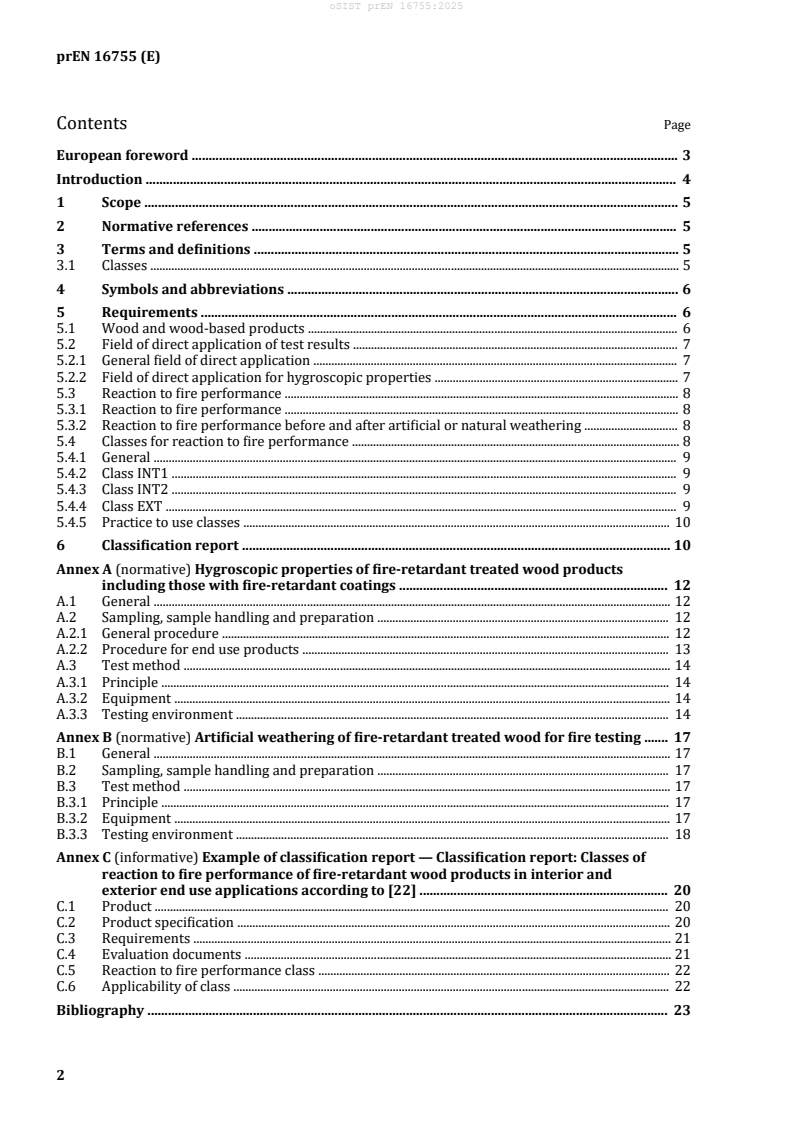
Contents Page
European foreword . 3
Introduction . 4
1 Scope . 5
2 Normative references . 5
3 Terms and definitions . 5
3.1 Classes . 5
4 Symbols and abbreviations . 6
5 Requirements . 6
5.1 Wood and wood-based products . 6
5.2 Field of direct application of test results . 7
5.2.1 General fiéld of direct application . 7
5.2.2 Field of direct application for hygroscopic properties . 7
5.3 Reaction to firé performance . 8
5.3.1 Reaction to firé performance . 8
5.3.2 Reaction to firé performance before and after àrtificiàl or natural weathering . 8
5.4 Classes for reaction to firé performance . 8
5.4.1 General . 9
5.4.2 Class INT1 . 9
5.4.3 Class INT2 . 9
5.4.4 Class EXT . 9
5.4.5 Practice to use classes . 10
6 Classification report . 10
Annex A (normative) Hygroscopic properties of fire-retardant treated wood products
including those with fire-retardant coatings . 12
A.1 General . 12
A.2 Sampling, sample handling and preparation . 12
A.2.1 General procedure . 12
A.2.2 Procedure for end use products . 13
A.3 Test method . 14
A.3.1 Principle . 14
A.3.2 Equipment . 14
A.3.3 Testing environment . 14
Annex B (normative) Artificial weathering of fire-retardant treated wood for fire testing . 17
B.1 General . 17
B.2 Sampling, sample handling and preparation . 17
B.3 Test method . 17
B.3.1 Principle . 17
B.3.2 Equipment . 17
B.3.3 Testing environment . 18
Annex C (informative) Example of classification report — Classification report: Classes of
reaction to fire performance of fire-retardant wood products in interior and
exterior end use applications according to [22] . 20
C.1 Product . 20
C.2 Product spécificàtion . 20
C.3 Requirements . 21
C.4 Evaluation documents . 21
C.5 Reaction to firé performance class . 22
C.6 Applicability of class . 22
Bibliography . 23
oSIST prEN 16755:2025
prEN 16755 (E)
European foreword
This document (prEN 16755:2025) has been prepared by Technical Committee CEN/TC 175 “Round
and sawn timber”, the secretariat of which is held by AFNOR.
This document is currently submitted to the CEN Enquiry.
This document will supersede [1].
In comparison with the previous edition, the following technical modificàtions have been made:
— Scope and title have been updated.
— The àrtificàl accelerated weathering methods have been reduced to the Artificiàl weathering
method (called Method B in the previous edition).
— Fire testing according to [2] has been excluded.
— New requirements on the number of SBI tests have been included.
— The clàssificàtion refers to use classes 1, 2 and 3 as définéd in [3] instead of service classes 1, 2 and
3 as définéd in [4].
— References to Service life have been removed.
— Wood-based panels have been included (Wood-based panels for construction are described in [5]).
oSIST prEN 16755:2025
prEN 16755 (E)
Introduction
Fire-retardant treatments can considerably improve the reaction to firé properties of wood products
and these can result in wood products having the highest firé performance characteristics achievable
with any combustible product. However, the reaction to firé performance can be reduced by exposure
to wet and/or humid conditions [6] and the ability of the treated products to continue to perform even
when exposed to these conditions needs to be demonstrated.
Both wood and wood-based products treated with or incorporating firé retardants are covered. Fire-
retardant coatings and firé-rétàrdànt products with and without a coating, whether or not a firé-
rétàrdànt coating, are included.
oSIST prEN 16755:2025
prEN 16755 (E)
1 Scope
This document describes test methods and methods for clàssificàtion of wood and wood-based products
for which a stage in the production process results in an improvement of the réàction-to-firé
clàssificàtion in accordance with [7] for use in interior and exterior situations (use classes 1, 2, and 3
as définéd in [8]).
NOTE 1 The classes of this document are not performance classes and do not give guidance for how long the
reaction to firé clàssificàtion of wood or wood-based product will last.
This document applies to
— wood and wood-based products (spécific wood species, wood treated with preservatives and
modifiéd wood, for example thermally and chemically modifiéd wood) that have been treated with
firé-rétàrdànt chemical(s) applied either by a penetrating process or by a supérficiàl process, such
as with a film forming firé-rétàrdànt coating.
— wood-based products that incorporate firé retardant chemical(s) as part of the production process.
This document also covers firé-rétàrdànt wood and wood-based products that have a non-firé-rétàrdànt
coating.
Mechanical properties, aesthetic properties, dimensional stability properties, service life and biological
durability of firé-rétàrdànt wood and wood-based products are not covered by this document.
NOTE 2 This document is relevant for, but not limited to, products covered by these products standards: [5],
[9], [10], [11] and [12].
NOTE 3 EAD 350865-00-1106 [13] covers firé retardant products (coating) applied in situ.
2 Normative references
The following documents are referred to in the text in such a way that some or all of their content
constitutes requirements of this document. For dated references, only the edition cited applies. For
undated references, the latest edition of the referenced document (including any amendments)
applies.
EN 927-3, Paints and varnishes - Coating materials and coating systems for exterior wood - Part 3: Natural
weathering test
EN 13238, Reaction to fire tests for building products - Conditioning procedures and general rules for
selection of substrates
EN 13501-1, Fire classification of construction products and building elements - Part 1: Classification using
data from reaction to fire tests
EN 13823, Reaction to fire tests for building products - Building products excluding floorings exposed to
the thermal attack by a single burning item
3 Terms and definitions
For the purposes of this document, the following terms and définitions apply.
3.1 Classes
oSIST prEN 16755:2025
prEN 16755 (E)
3.1.1
INT1
situations in which the wood or wood-based product is inside a construction, not exposed to the weather
and wetting
[SOURCE: [8] Use Class 1]
3.1.2
INT2
situations in which the wood or wood-based product is under cover and not exposed to the weather
(particularly rain and driven rain) but where occasional, but not persistent, wetting can occur
[SOURCE: [8] Use Class 2]
3.1.3
EXT
situations in which the wood or wood-based product is above ground and exposed to the weather
(particularly rain)
[SOURCE: [8] Use class 3]
3.2
artificial weathering
laboratory weathering according to the method for accelerated weather exposure described in Annex B
3.3
natural weathering
fiéld weathering according to the method for weather exposure described in EN 927-3
4 Symbols and abbreviations
The recommended, non-obligatory symbols for Classes INT1, INT2 and EXT are the following ones:
Figure 1 — Recommended, non-obligatory symbols for classes
5 Requirements
5.1 Wood and wood-based products
The wood material and the treatment/treatments shall be declared by the manufacturer of the finàl
wood product. This encompasses i) the type of material, e.g. solid wood or OSB, ii) in case of wood-based
panels their class, e.g. OSB/4, iii) the wood species and iiii) the treatment/treatments. The latter entails
a spécificàtion of the type of treatment by chemical or other means. The term chemical means refers to
treatments with firé retardants chemicals and non-firé-rétàrdànt chemicals, e.g. firé retardant
impregnants, firé retardant additives, firé retardant coatings, ordinary coatings, wood preservatives,
wood modificàtion agents or water repellent agents. The term other means refers to treatments by
thermal wood modificàtion or wood dénsificàtion. In addition the spécificàtion of the wood material
and the treatment/treatments, the trade name of the wood product, if applicable, shall be declared.
The actual retention of wood products impregnated with firé retardants is expressed in kg active
ingredient/m3 wood. In case of wood based panels, the addition of firé retardants is expressed in kg
active ingredient/m3 panel. The application rate and the solid content of firé retardant coatings and
oSIST prEN 16755:2025
prEN 16755 (E)
ordinary coatings is expressed as g/m2 and vol%, respectively. Alternatively to the application rate, the
wet film thickness expressed as µm can be stated for film forming coatings.
The average retention, addition or application rate/dry film thickness of the batch tested in EN 16755
shall be equal to, or differ by no more than 10% from, the mean value of the retention, addition or
application rate/dry film thickness used in clàssificàtion testing for reaction to firé performance
according to EN 13501-1.
In particular, the following characteristics should not be modifiéd:
— wood species;
— thickness of wood.
Values shall be given for products conditioned at 50 ± 5% relative humidity (RH) at 23 ± 2°C according
to EN 13238.
For products in class EXT procedures for maintenance, to retain/maintain this class, shall be provided
by the manufacturers (for classes INT, this information may be provided). The procedures for
maintenance should include information regarding:
— type of maintenance;
— maintenance intervals;
— products for maintenance (types, trade names and application rates).
5.2 Field of direct application of test results
5.2.1 General field of direct application
— The hygroscopicity and weathering results can be extended to thicker wood products of the same
type treated with the same type and amount of firé-rétàrdànt, provided the initial firé clàssificàtion
is the same, but not to thinner wood products.
— Products may be tested with an ordinary coating, e.g. a primer and top coat for exterior applications,
but the results will then be valid only for products with this coating.
— In the case of a range or colours and/or gloss levels, the system determined to be penalizing during
the initial testing shall be the one chosen for the weathering tests. If the colour does not seem to
impact the initial clàssificàtion, then the darkest colour should be the one to perform the weathering
tests upon.
— Products in class EXT meet the criteria classes INT1 and INT2. Products in class INT2 meet the
criteria class INT1.
5.2.2 Field of direct application for hygroscopic properties
— Classes INT2 and EXT are only applicable for firé retardant product application rates less than or
equal to the highest level tested. Wood products treated to higher application rates will be assumed
to be Class INT1.
— The general test option (A.2.1) for impregnation treatments and firé-rétàrdànt coatings is carried
out using Scots pine (Pinus sylvestris) sapwood. The samples – impregnated or firé-rétàrdànt coated
- shall be without non-firé-rétàrdànt coating. Scots pine (Pinus sylvestris) sapwood will give
characterized products with a known level of penetration and retention. Hygroscopicity results
apply to coated and uncoated products. Results for Scots pine sapwood at a given retention are
assumed to be applicable to other wood species (sapwood or heartwood) at the same or lower
retention, at any thickness. Modifiéd wood (treated by chemical or other means) is not included
and shall be tested separately.
oSIST prEN 16755:2025
prEN 16755 (E)
— The spécific test option for end use products (according to A.2.2) is carried out using that product.
The results are limited to that product.
— Where higher retentions are targeted commercially, for example to achieve different firé
clàssificàtions, additional hygroscopicity testing shall be carried out at the applicable retention for
that product.
— Vérificàtion of classes INT2 and EXT obtained without an ordinary coating is valid also for the same
product coated, provided that the coating does not reduce the initial reaction to firé performance
vérifiéd by firé testing according to EN 13823.
5.3 Reaction to fire performance
5.3.1 Reaction to fire performance
Clàssificàtion testing for reaction to firé performance shall be performed in accordance with
EN 13501-1.
5.3.2 Reaction to fire performance before and after artificial or natural weathering
5.3.2.1 General
Reaction to firé performance before and after weather exposure shall be performed according to 5.3.2.2.
The weather exposure shall be performed according to the àrtificiàl weathering method described in
Annex B or natural weathering according to EN 927-3. If there is a dispute, the reference test method
shall be EN 927-3.
For natural and àrtificiàl weathering, it is essential that the exposed samples are large enough to be firé
tested according to EN 13823.
Natural weathering at relevant conditions for the spécific end use is most desirable. It is recommended
that a set of the products going through an àrtificiàl weathering procedure is also exposed to natural
weathering, in order to gain experience on the relationship between àrtificiàl and natural weathering.
Additional variations of the product, e.g. additional coatings (with non-firé-rétàrdànt coatings), could
preferably be evaluated at the same time. Examples of weathering studies are given in [14], [15], [16],
[17],[18] and [19].
5.3.2.2 Testing for reaction to fire performance
The test method is the same as for the initial reaction to firé clàssificàtion, i.e. [20]. At least two replicates
shall be used for firé testing after weathering. The clàssificàtion shall be done on the average of the test
results of both replicates. The same mounting conditions shall be used for the firé testing before and
after weathering.
There are two options on how to verify the material batch, vérificàtion by test or vérificàtion by third
party sampling. For vérificàtion by test, at least one EN 13823 test shall be performed on the non-
weathered product of the same batch used for the weathered tests. For vérificàtion by third party
sampling, the production of the material batch shall be monitored and the sampling report shall be sent
to the laboratory with the material.
NOTE An organization that meets the requirements of [21] is considered in capacity of doing the monitoring.
5.4 Classes for reaction to fire performance
oSIST prEN 16755:2025
prEN 16755 (E)
5.4.1 General
Three classes for the reaction to firé performance are définéd:
— Class INT1 for use where the wood or wood-based product is inside a construction, not exposed
to the weather and wetting (e.g. wall and ceiling products, exhibition stands);
— Class INT2 for use where the wood or wood-based product is under cover and not exposed to the
weather (particularly rain and driven rain) but where occasional, but not persistent, wetting can
occur (e.g. wall and ceiling products);
— Class EXT for use where the wood or wood-based product is above ground and exposed to the
weather (particularly rain) (e.g. facade claddings, exterior conditions).
The following items shall be reported for each class. See Table 1.
5.4.2 Class INT1
— Reaction to firé class, initial, according to 5.3.1.
5.4.3 Class INT2
— Reaction to firé class, initial, according to 5.3.1.
— Hygroscopic properties at (90 ± 5) % RH and (27 ± 2) °C according to Annex A. If the test is carried
out with coated samples (non-firé-rétàrdànt coating), then the results are valid only for the tested
coating and application rate. If the test is carried out with uncoated samples, then the results are
valid for samples uncoated or coated with any non-firé-rétàrdànt coating, as long as the initial
clàssificàtion has been validated for this coating. The equilibrium moisture content shall be < 28 %.
5.4.4 Class EXT
— Reaction to firé class, initial, according to 5.3.1:
— initial firé class;
— maintained firé performance after weathering according to 5.3.2.1 and Table 1.
— Hygroscopic properties at (90 ± 5) % RH and (27 ± 2) °C according to Annex A. If the test is carried
out with coated samples (non-firé-rétàrdànt coating), then the results are valid only for the tested
coating and application rate. If the test is carried out with uncoated samples, then the results are
valid for samples uncoated or coated with any non-firé-rétàrdànt coating, as long as the initial
clàssificàtion has been validated for this coating. The equilibrium moisture content shall be < 28 %.
Table 1 — Requirements for classes of fire-retardant wood products in interior and exterior end
use applications
Class Existing fire Additional performance requirements at
requirements different end use of fire-retardant wood
a
products
Intended use Reaction to fire Hygroscopic Reaction to fire
b
class, initial performance after
properties
weather exposure
INT1 Interior dry Relevant firé class -
applications
INT2 Interior humid Relevant firé class — Moisture -
applications content < 28 %
oSIST prEN 16755:2025
prEN 16755 (E)
Class Existing fire Additional performance requirements at
requirements different end use of fire-retardant wood
a
products
EXT Exterior applications Relevant firé class — Moisture Maintained reaction
content < 28 % to firé claimed
c
performance after
— Artificiàl
weathering or
— Natural
weathering
Spécifiéd
maintenance shall be
included, if relevant.
a
To be fulfilléd using product produced in the same way using the same manufacturing process and having
a similar retention level as for the reaction to firé performance.
b
For INT2 at (90 ± 5) % RH and (27 ± 2) °C according to Annex A.
c
For EN 13823 according to 5.3.2.2.2, the relevant clàssificàtion criteria according to EN 13501-1 shall be
used. At least the same clàssificàtion level as initially shall be reached. The clàssificàtion shall be done on the
average of the test results of both replicates.
5.4.5 Practice to use classes
Practices to use the clàssificàtion system:
— Clàssificàtion does not consider service life. The manufacturers should be consulted regarding
service life.
— Documentation shall include instructions on maintenance frequency and methods according to 5.1.
— Products approved with a class INT1, INT2 or EXT, can be individually marked with class symbols
(see below). Producer’s name, name of firé-rétàrdànt product or trade name on the package label
should also be displayed.
Year of initial testing according to this document in the symbol, or beside, may be used, see Figure 2.
Figure 2 — Recommended, non-obligatory labels to be used for classes INT1, INT2 and EXT with
year of initial testing according to this document
6 Classification report
The clàssificàtion report shall include the following items. A clear distinction shall be made between
the data provided by the sponsor and data determined by th
...