

FprEN ISO 21809-3
(Main)Oil and gas industries including lower carbon energy - External coatings for buried or submerged pipelines used in pipeline transportation systems - Part 3: Field joint coatings (ISO/FDIS 21809-3:2026)
- Abstract
ISO 21809-3:2016 specifies requirements for field joint coating of seamless or welded steel pipes for buried and submerged sections of pipeline transportation systems used in the petroleum, petrochemical and natural gas industries as defined in ISO 13623. This part of ISO 21809 specifies the qualification, application and testing of the corrosion protection coatings applied to steel surfaces left bare after the joining of pipes and fittings (components) by welding.
ISO 21809-3:2016 defines and codifies in Table 1 the different types of field joint coatings for pipelines.
ISO 21809-3:2016 does not address requirements for additional mechanical protection, for thermal insulation or for joint infills of concrete weight-coated pipes.
NOTE Field joints of pipes and fittings coated in accordance with this part of ISO 21809 are considered suitable for further protection by means of cathodic protection.
- Status
- Not Published
- Publication Date
- 15-Feb-2027
- Current Stage
- 5020 - Submission to Vote - Formal Approval
- Start Date
- 24-Sep-2026
- Completion Date
- 24-Sep-2026


FprEN ISO 21809-3 is the draft CEN/ISO standard for external field joint coatings on buried or submerged steel pipelines used in pipeline transportation systems. It specifies how those corrosion protection coatings are qualified, applied and tested on welded joints for the petroleum, petrochemical and natural gas industries, including the lower carbon energy context named in the title. The document is written for purchasers, applicators, manufacturers, inspectors and laboratories that need a common basis for specifying and verifying field joint coating work.
What does FprEN ISO 21809-3 specify?
FprEN ISO 21809-3 specifies field joint coatings for seamless or welded steel pipes in buried and submerged pipeline sections. It focuses on the corrosion protection coating applied to steel surfaces left bare after welding pipes or fittings together.
FprEN ISO 21809-3 also defines how the different field joint coating types are classified in Table 1 of Clause 7. The scope is limited to coating qualification, application and testing for corrosion protection, while additional mechanical protection, thermal insulation and joint infills of concrete weight-coated pipes are outside the document. Field joints coated to this standard are considered suitable for further protection by cathodic protection.
The document is organised into:
- Clauses 1 to 4 for scope, references, terms and symbols
- Clauses 5 to 9 for general requirements, information exchange, classification, qualification and surface preparation
- Clauses 10 to 20 for the coating-family-specific requirements
- Annexes A to R for reporting and test methods
| Annex | What it covers |
|---|---|
| A | Reporting of results |
| B | Thickness measurement |
| C | Holiday detection |
| D | Impact testing |
| E | Indentation testing |
| F | Specific electrical insulation resistance |
| G | Cathodic disbondment testing |
| H | Adhesion, peel, lift and pull-off testing |
| I | Adhesion after immersion exposure |
| J | Lap shear strength |
| K | Drip resistance |
| L | Peel strength between layers |
| M | Thermal ageing tests |
| N | Porosity rating |
| O | Bursting strength |
| P | Differential scanning calorimetry (DSC) for epoxy powder |
| Q | Adhesion rating by knife method |
| R | Flexibility testing |
What are the key requirements of FprEN ISO 21809-3?
FprEN ISO 21809-3 is built around a qualification and verification process. The most important practical point is that a field joint coating system is not just chosen by name - it has to be specified, qualified, applied and checked against the right clause and the right stage of work.
Project information and qualification
Clauses 5 and 6 set up the responsibilities of the end user, purchaser, applicator and manufacturer. FprEN ISO 21809-3 expects the parties to exchange the information needed to define the coating system, the service conditions and the job controls.
This matters because coating performance depends on the project data being correct before work starts. In practice, the purchaser and applicator need to agree what the field joint coating must withstand, what documents will control the work, and what evidence will be kept.
Clause 8 lays out the qualification path:
- Coating Qualification (CQ) originated by the manufacturer
- Procedure Qualification Trial (PQT) originated by the applicator
- Coating System Qualification (CSQ) originated by the applicator
- Pre-Production Trial (PPT) originated by the applicator
- Inspection and testing during production
The standard also requires an Application Procedure Specification (APS), an Inspection and Test Plan (ITP), traceability, inspection documents, and qualification of coating operatives and inspection personnel. In practice, that means a site cannot rely on informal know-how alone - the method, the people and the records all have to be controlled.
Surface preparation and application control
Clause 9 ties surface preparation to the coating type. FprEN ISO 21809-3 uses cleaning grades, surface profile, dust control, soluble salt checks and environmental checks such as substrate temperature and dew point. Different coating families need different cleaning methods and different substrate conditions.
That matters because poor surface preparation is one of the main reasons field joint coatings fail early. The standard makes the applicator verify that the steel and any adjacent plant-applied coating are ready before coating is applied.
Common verification tests
Across Clauses 10 to 20, FprEN ISO 21809-3 repeatedly uses the same core checks:
- Appearance
- Thickness
- Holiday detection
- Impact resistance
- Adhesion or peel strength
- Cathodic disbondment resistance
- Indentation resistance
- Specific electrical insulation resistance where relevant
These checks are used at qualification stages and during production, with the exact frequency set by the coating type. The practical meaning is simple: the joint has to be continuous, bonded, thick enough and resistant to damage before it can be accepted.
Coating-family-specific checks
FprEN ISO 21809-3 adds tests that match the coating family:
- Bituminous tape and wax-based systems include drip resistance, hot-water immersion and peel strength checks
- Cold-applied polymeric tapes include layer-to-layer peel, lap shear and thermal ageing checks
- Non-crystalline low-viscosity polyolefin-based coatings include compound checks, reinforcement checks and thermal performance checks
- Heat-shrinkable systems include primer thickness, backing strength, thermal ageing and cathodic disbondment limits by temperature class
- Hot-applied microcrystalline wax coatings add melting, flash point and drip-related checks
- Elastomeric coatings add tear strength, ozone resistance and rheometer-related checks
- FBE powder coatings add degree of cure, porosity, thermal characteristics and repair-related checks
- Liquid-applied coatings add hardness, adhesion to steel and plant coatings, flexibility and elongation
- TSA coatings add porosity, sealer penetration and bend testing
This matters because each coating family protects the joint in a different way. The standard does not treat all coatings as interchangeable, and the user must follow the clause for the selected system.
What terms does FprEN ISO 21809-3 define?
FprEN ISO 21809-3 defines the vocabulary used to manage field joint coating work.
- Application procedure specification (APS) - the document that describes the procedures, methods, equipment and tools used for field joint coating application.
- Inspection and test plan (ITP) - the document that sets out the sequence of inspections and tests, together with the referenced resources and procedures.
- Coating Qualification (CQ) - manufacturer-originated qualification of a coating system before field use.
- Procedure Qualification Trial (PQT) - an application trial used to confirm that the APS and ITP produce acceptable field joint coatings.
- Pre-Production Trial (PPT) - a final check run just before routine production starts.
- Holiday - a coating discontinuity that becomes electrically conductive when tested at a specified voltage.
- Cutback - the length of pipe left uncoated at each end for welding.
- Field joint area - the uncoated area created when coated pipe sections or fittings are welded together in the field.
Who uses FprEN ISO 21809-3?
FprEN ISO 21809-3 is used in oil and gas pipeline projects, including buried and submerged pipeline transportation systems, and in the lower carbon energy context named in the title. The main users are the parties that have to define, apply and verify the coating system.
In practice, the standard is used by:
- End users to define the service conditions and approve the coating system
- Purchasers to state the product order requirements
- Applicators to prepare the APS, qualify the process and coat the joints
- Manufacturers to qualify coating materials and supply batch evidence
- Inspectors to check surface preparation, application and acceptance tests
- Testing laboratories to carry out the specified test methods and report results
Which standards are used with FprEN ISO 21809-3?
FprEN ISO 21809-3 relies on several normative references and companion standards.
- ISO 13623 - defines pipeline transportation systems, which is the pipeline context used throughout the document
- ISO 3183 - covers steel pipe for pipeline transportation systems
- ISO 8501-1, ISO 8501-3, ISO 8502-3, ISO 8502-6, ISO 8502-9, ISO 8503-1, ISO 8503-2, ISO 8503-4, ISO 8503-5, ISO 8504-2 and ISO 8504-3 - support steel surface cleaning, cleanliness checks and surface profile control
- ISO 10474 and EN 10204 - support inspection documents and conformity records
- ISO 17020, ISO 17025 and ISO 17065 - support competence for inspection bodies, laboratories and product certification bodies
- ISO 21809-2 - the related part for single-layer fusion-bonded epoxy coatings
- ISO 11357-1, ISO 11357-2, ISO 11357-3 and ISO 11357-6 - support DSC and thermal analysis used in some coating checks
- ISO 527-1, ISO 527-2 and ISO 527-3 - support tensile testing of backing and coating materials
- ASTM and SSPC methods named in Clause 2 - supply material, adhesion, flash point, density, cleaning and thermal spray methods used for specific coating families
What does the FprEN ISO 21809-3 document contain?
FprEN ISO 21809-3 contains requirement tables for each coating family, along with the test methods and test frequencies linked to CQ, PQT, PPT and production. It also contains the procedures that tell the user how to measure thickness, detect holidays, run impact and indentation tests, assess adhesion, measure cathodic disbondment and evaluate thermal ageing.
The annexes provide practical test set-ups, not just pass/fail criteria. They include apparatus and procedures for immersion cells, peel rigs, lap shear fixtures, impact equipment, DSC runs, porosity rating and flexibility bend tests.
For a buyer or engineer, the most useful part of the document is the way it links each field joint coating type to its own application steps and acceptance tests. For a quality manager or inspector, the annexes are the working instructions for how to sample, test, record and report the coating work.
Relations
- Effective Date
- 12-Feb-2026
- Effective Date
- 30-Apr-2025
- Effective Date
- 30-Apr-2025
Get Certified
Connect with accredited certification bodies for this standard

Element Materials Technology
Materials testing and product certification.

ABS Group Brazil
ABS Group certification services in Brazil.

ABS Quality Evaluations Inc.
American Bureau of Shipping quality certification.
Sponsored listings
Frequently Asked Questions
FprEN ISO 21809-3 is a draft published by the European Committee for Standardization (CEN). Its full title is "Oil and gas industries including lower carbon energy - External coatings for buried or submerged pipelines used in pipeline transportation systems - Part 3: Field joint coatings (ISO/FDIS 21809-3:2026)". This standard covers: ISO 21809-3:2016 specifies requirements for field joint coating of seamless or welded steel pipes for buried and submerged sections of pipeline transportation systems used in the petroleum, petrochemical and natural gas industries as defined in ISO 13623. This part of ISO 21809 specifies the qualification, application and testing of the corrosion protection coatings applied to steel surfaces left bare after the joining of pipes and fittings (components) by welding. ISO 21809-3:2016 defines and codifies in Table 1 the different types of field joint coatings for pipelines. ISO 21809-3:2016 does not address requirements for additional mechanical protection, for thermal insulation or for joint infills of concrete weight-coated pipes. NOTE Field joints of pipes and fittings coated in accordance with this part of ISO 21809 are considered suitable for further protection by means of cathodic protection.
ISO 21809-3:2016 specifies requirements for field joint coating of seamless or welded steel pipes for buried and submerged sections of pipeline transportation systems used in the petroleum, petrochemical and natural gas industries as defined in ISO 13623. This part of ISO 21809 specifies the qualification, application and testing of the corrosion protection coatings applied to steel surfaces left bare after the joining of pipes and fittings (components) by welding. ISO 21809-3:2016 defines and codifies in Table 1 the different types of field joint coatings for pipelines. ISO 21809-3:2016 does not address requirements for additional mechanical protection, for thermal insulation or for joint infills of concrete weight-coated pipes. NOTE Field joints of pipes and fittings coated in accordance with this part of ISO 21809 are considered suitable for further protection by means of cathodic protection.
FprEN ISO 21809-3 is classified under the following ICS (International Classification for Standards) categories: 23.040.10 - Iron and steel pipes; 75.200 - Petroleum products and natural gas handling equipment; 87.040 - Paints and varnishes. The ICS classification helps identify the subject area and facilitates finding related standards.
FprEN ISO 21809-3 has the following relationships with other standards: It is inter standard links to ISO/FDIS 21809-3, EN ISO 21809-3:2016/A1:2020, EN ISO 21809-3:2016. Understanding these relationships helps ensure you are using the most current and applicable version of the standard.
FprEN ISO 21809-3 is available in PDF format for immediate download after purchase. The document can be added to your cart and obtained through the secure checkout process. Digital delivery ensures instant access to the complete standard document.
Standards Content (Sample)
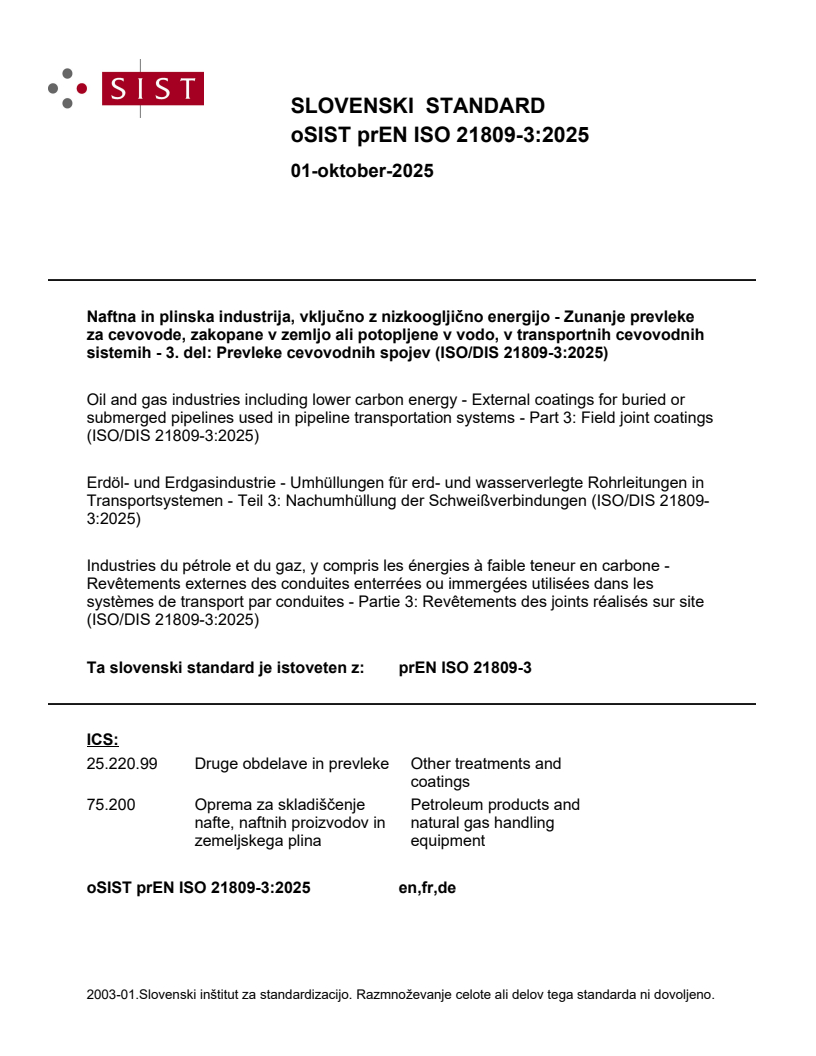
SLOVENSKI STANDARD
oSIST prEN ISO 21809-3:2025
01-oktober-2025
Naftna in plinska industrija, vključno z nizkoogljično energijo - Zunanje prevleke
za cevovode, zakopane v zemljo ali potopljene v vodo, v transportnih cevovodnih
sistemih - 3. del: Prevleke cevovodnih spojev (ISO/DIS 21809-3:2025)
Oil and gas industries including lower carbon energy - External coatings for buried or
submerged pipelines used in pipeline transportation systems - Part 3: Field joint coatings
(ISO/DIS 21809-3:2025)
Erdöl- und Erdgasindustrie - Umhüllungen für erd- und wasserverlegte Rohrleitungen in
Transportsystemen - Teil 3: Nachumhüllung der Schweißverbindungen (ISO/DIS 21809-
3:2025)
Industries du pétrole et du gaz, y compris les énergies à faible teneur en carbone -
Revêtements externes des conduites enterrées ou immergées utilisées dans les
systèmes de transport par conduites - Partie 3: Revêtements des joints réalisés sur site
(ISO/DIS 21809-3:2025)
Ta slovenski standard je istoveten z: prEN ISO 21809-3
ICS:
25.220.99 Druge obdelave in prevleke Other treatments and
coatings
75.200 Oprema za skladiščenje Petroleum products and
nafte, naftnih proizvodov in natural gas handling
zemeljskega plina equipment
oSIST prEN ISO 21809-3:2025 en,fr,de
2003-01.Slovenski inštitut za standardizacijo. Razmnoževanje celote ali delov tega standarda ni dovoljeno.
oSIST prEN ISO 21809-3:2025
oSIST prEN ISO 21809-3:2025
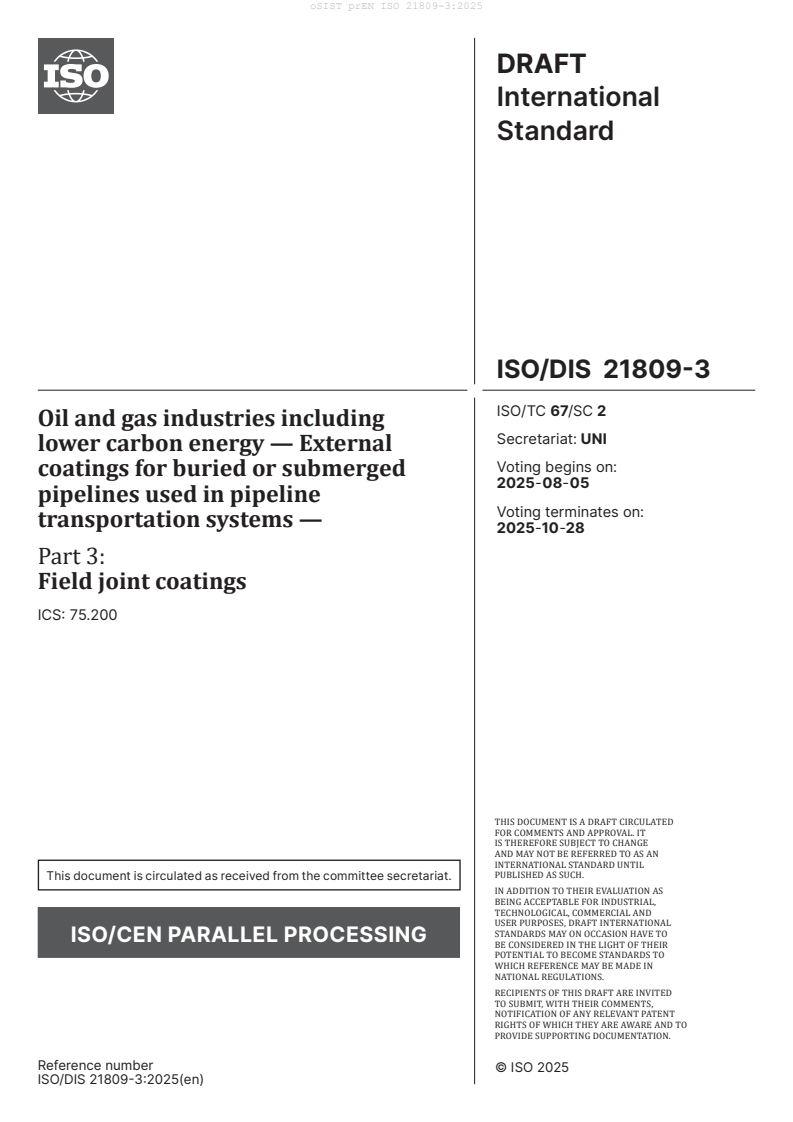
DRAFT
International
Standard
ISO/DIS 21809-3
ISO/TC 67/SC 2
Oil and gas industries including
Secretariat: UNI
lower carbon energy — External
Voting begins on:
coatings for buried or submerged
2025-08-05
pipelines used in pipeline
Voting terminates on:
transportation systems —
2025-10-28
Part 3:
Field joint coatings
ICS: 75.200
THIS DOCUMENT IS A DRAFT CIRCULATED
FOR COMMENTS AND APPROVAL. IT
IS THEREFORE SUBJECT TO CHANGE
AND MAY NOT BE REFERRED TO AS AN
INTERNATIONAL STANDARD UNTIL
PUBLISHED AS SUCH.
This document is circulated as received from the committee secretariat.
IN ADDITION TO THEIR EVALUATION AS
BEING ACCEPTABLE FOR INDUSTRIAL,
TECHNOLOGICAL, COMMERCIAL AND
USER PURPOSES, DRAFT INTERNATIONAL
STANDARDS MAY ON OCCASION HAVE TO
ISO/CEN PARALLEL PROCESSING
BE CONSIDERED IN THE LIGHT OF THEIR
POTENTIAL TO BECOME STANDARDS TO
WHICH REFERENCE MAY BE MADE IN
NATIONAL REGULATIONS.
RECIPIENTS OF THIS DRAFT ARE INVITED
TO SUBMIT, WITH THEIR COMMENTS,
NOTIFICATION OF ANY RELEVANT PATENT
RIGHTS OF WHICH THEY ARE AWARE AND TO
PROVIDE SUPPORTING DOCUMENTATION.
Reference number
ISO/DIS 21809-3:2025(en)
oSIST prEN ISO 21809-3:2025
DRAFT
ISO/DIS 21809-3:2025(en)
International
Standard
ISO/DIS 21809-3
ISO/TC 67/SC 2
Oil and gas industries including
Secretariat: UNI
lower carbon energy — External
Voting begins on:
coatings for buried or submerged
pipelines used in pipeline
Voting terminates on:
transportation systems —
Part 3:
Field joint coatings
ICS: 75.200
THIS DOCUMENT IS A DRAFT CIRCULATED
FOR COMMENTS AND APPROVAL. IT
IS THEREFORE SUBJECT TO CHANGE
AND MAY NOT BE REFERRED TO AS AN
INTERNATIONAL STANDARD UNTIL
PUBLISHED AS SUCH.
This document is circulated as received from the committee secretariat.
IN ADDITION TO THEIR EVALUATION AS
BEING ACCEPTABLE FOR INDUSTRIAL,
© ISO 2025
TECHNOLOGICAL, COMMERCIAL AND
USER PURPOSES, DRAFT INTERNATIONAL
All rights reserved. Unless otherwise specified, or required in the context of its implementation, no part of this publication may
STANDARDS MAY ON OCCASION HAVE TO
ISO/CEN PARALLEL PROCESSING
be reproduced or utilized otherwise in any form or by any means, electronic or mechanical, including photocopying, or posting on
BE CONSIDERED IN THE LIGHT OF THEIR
the internet or an intranet, without prior written permission. Permission can be requested from either ISO at the address below
POTENTIAL TO BECOME STANDARDS TO
WHICH REFERENCE MAY BE MADE IN
or ISO’s member body in the country of the requester.
NATIONAL REGULATIONS.
ISO copyright office
RECIPIENTS OF THIS DRAFT ARE INVITED
CP 401 • Ch. de Blandonnet 8
TO SUBMIT, WITH THEIR COMMENTS,
CH-1214 Vernier, Geneva
NOTIFICATION OF ANY RELEVANT PATENT
Phone: +41 22 749 01 11
RIGHTS OF WHICH THEY ARE AWARE AND TO
PROVIDE SUPPORTING DOCUMENTATION.
Email: copyright@iso.org
Website: www.iso.org
Published in Switzerland Reference number
ISO/DIS 21809-3:2025(en)
ii
oSIST prEN ISO 21809-3:2025
ISO/DIS 21809-3:2025(en)
Contents Page
Foreword .vii
Introduction .viii
1 Scope . 1
2 Normative references . 1
3 Terms and definitions . 4
4 Symbols and Abbreviated terms . 7
4.1 Symbols .7
4.2 Abbreviated terms .8
5 General requirements . 9
5.1 Responsibility of the end user .9
5.2 Rounding .9
5.3 Compliance, testing and quality .9
6 Information to be supplied . 9
6.1 General .9
6.2 Information to be supplied by the purchaser to the applicator .9
6.3 Information to be supplied by the applicator to the purchaser .10
7 Classification of field joint coatings.11
8 Qualification processes .12
8.1 Qualification of a coating system . 12
8.1.1 Coating Qualification (CQ), originated by the manufacturer . 13
8.1.2 Procedure Qualification Trial (PQT), originated by the applicator .14
8.1.3 Coating System Qualification (CSQ), originated by the applicator . 15
8.1.4 Pre-Production Trial (PPT), originated by the applicator . 15
8.1.5 Inspection and testing during production .16
8.2 Coating application documents .16
8.2.1 Application procedure specification (APS) .16
8.2.2 Inspection and Test Plan (ITP) .19
8.2.3 Inspection and Test Plan (ITP) . 20
8.2.4 Inspection documents, traceability and verification . 20
8.3 Qualification of coating operatives and inspection personnel .21
8.3.1 General .21
8.3.2 Qualification of coating operatives .21
8.3.3 Documentary evidence of applicator’s coating operatives’ qualification . 22
8.3.4 Requalification . 23
9 Surface preparation.23
9.1 General . 23
9.2 Preparation of the steel substrate . 23
9.2.1 General . 23
9.2.2 Abrasive blast-cleaning .24
9.2.3 Wire-brush cleaning.24
9.2.4 Other cleaning methods . 25
9.3 Preparation of the adjacent plant-applied coating. 25
10 Hot-applied bituminous tape coatings .27
10.1 Coating identification .27
10.2 Description of the coatings .27
10.3 Surface preparation .27
10.4 Coating application . 28
10.5 Testing of the applied coatings . 28
10.5.1 General . 28
11 Petrolatum and wax-based tape coatings .30
iii
oSIST prEN ISO 21809-3:2025
ISO/DIS 21809-3:2025(en)
11.1 Coating identification . 30
11.2 Description of the coatings . 30
11.2.1 Petrolatum tapes (Type 11A) . 30
11.2.2 Wax-based tapes (Type 11B) . 30
11.3 Surface preparation . 30
11.4 Coating application .31
11.4.1 Application of the primer .31
11.4.2 Application of petrolatum or wax-based tapes .31
11.5 Testing of the applied coatings . .31
11.5.1 General .31
12 Cold-applied polymeric tape coatings .35
12.1 Coating identification . 35
12.2 Description of the coatings . 35
12.2.1 Cold-applied tape coatings with a polymeric continuous backing (Type 12A) . 35
12.2.2 Cold-applied tape coatings with a polymeric mesh backing (Type 12B) . 35
12.3 Surface preparation . 35
12.4 Coating application . 35
12.5 Testing of the applied coatings . 36
12.5.1 General . 36
13 Non-crystalline low-viscosity polyolefin-based coatings .40
13.1 Coating identification . 40
13.2 Description of the coatings . 40
13.3 Surface preparation . 40
13.4 Coating application . 40
13.5 Testing of the applied coatings . .41
13.5.1 General .41
13.5.2 Pre-application check of compound containing reinforcement .41
14 Coatings based on heat-shrinkable materials . 47
14.1 Coating identification .47
14.2 Description of the coatings .47
14.2.1 General .47
14.2.2 Type 14A .47
14.3 Surface preparation . 48
14.4 Coating application . 48
14.5 Testing of the applied coatings . 48
14.5.1 General . 48
15 Hot-applied microcrystalline wax coatings .56
15.1 Coating identification . 56
15.2 Description of the coatings . 56
15.3 Surface preparation . 56
15.4 Coating application . 56
15.5 Testing of the applied coatings . 56
15.5.1 General . 56
16 Elastomeric coatings .58
16.1 Coating identification . 58
16.2 Description of the coatings . 58
16.3 Surface preparation . 58
16.4 Coating application . 58
16.4.1 General . 58
16.4.2 In situ vulcanization method . 58
16.5 Testing of the applied coatings .59
16.5.1 General .59
16.5.2 Rheometer curve — Oscillating disc . 63
16.5.3 Electrical volume resistivity. 63
17 Fusion-bonded epoxy (FBE) powder coatings .63
17.1 Coating identification . 63
iv
oSIST prEN ISO 21809-3:2025
ISO/DIS 21809-3:2025(en)
17.2 Description of the coatings . 63
17.3 Surface preparation . 63
17.4 Coating application . 63
17.4.1 General . 63
17.4.2 Transport and storage of epoxy powder . 64
17.4.3 Heating . 64
17.4.4 Application of epoxy powder . 64
17.5 Testing of the applied coatings . 64
17.5.1 General . 64
17.5.2 Thickness .67
18 Liquid-applied coatings . 67
18.1 Coating identification .67
18.2 Description of the coatings .67
18.2.1 Liquid epoxy — 18A .67
18.2.2 Liquid polyurethane — 18B .67
18.2.3 Fibre reinforced epoxy — 18C .67
18.2.4 Fibre reinforced vinylester — 18D .67
18.2.5 Fibre reinforced polyurethane — 18E .67
18.2.6 Polyolefin enclosure with polyurethane filling — 18F . 68
18.3 Surface preparation . 68
18.4 Coating application . 68
18.4.1 General . 68
18.4.2 Heating . 68
18.4.3 Liquide coating application . 68
18.4.4 General guideline . 68
18.5 Testing of the applied coatings . . 69
18.5.1 General . 69
19 Hot-applied polyolefin-based and polyurethane coatings .73
19.1 Coating identification . 73
19.2 Description of the coatings . 73
19.2.1 Coatings based on flame-sprayed polypropylene powder applied over an epoxy
layer— Type 19A . 73
19.2.2 Coatings based on polypropylene tapes/sheets / extruded hot-applied over an
epoxy layer— Type 19B. 73
19.2.3 Coatings based on injection-moulded polypropylene over an epoxy layer—
Type 19C . 73
19.2.4 Coatings based on flame-sprayed polyethylene powder applied over an epoxy
layer — Type 19D . 73
19.2.5 Coatings based on polyethylene tapes/sheets / extruded hot-applied over an
epoxy layer — Type 19E . . . .74
19.2.6 Coatings based on injection-moulded polyethylene over an epoxy layer —
Type 19F .74
19.2.7 Coatings based on injection-moulded polyurethane over an epoxy or a
polyurethane primer layer — Type 19G.74
19.3 Surface preparation .74
19.4 Coating application .74
19.4.1 General .74
19.4.2 Preparation of the plant applied coating .74
19.4.3 Heating . 75
19.4.4 Application of the primer . 75
19.4.5 Application of the chemically modified PP or PE . . 75
19.4.6 Application of the top coat . 75
19.5 Testing of the applied coatings .76
19.5.1 General .76
20 Thermal spray aluminium (TSA) coatings .83
20.1 Coating identification . 83
20.2 Description of the coatings . 83
v
oSIST prEN ISO 21809-3:2025
ISO/DIS 21809-3:2025(en)
20.3 Surface preparation . 83
20.4 Coating application . 83
20.4.1 General . 83
20.4.2 Aluminium . 83
20.4.3 Sealer . 83
20.5 Testing of the applied coatings . 84
20.5.1 General . 84
Annex A (informative) Reporting of results .86
Annex B (informative) Inspection of thickness .90
Annex C (informative) Holiday detection test .92
Annex D (informative) Impact test .94
Annex E (informative) Indentation test .101
Annex F (informative) Specific electrical insulation resistance test .104
Annex G (informative) Cathodic disbondment test .114
Annex H (informative) Adhesion test (peel, lift and pull off) . 128
Annex I (informative) Hot water immersion (exposure) test .139
Annex J (informative) Lap shear test .142
Annex K (informative) Drip resistance test .145
Annex L (informative) Peel strength between layers .146
Annex M (informative) Thermal ageing resistance.149
Annex N (informative) Coating porosity test . 154
Annex O (informative) Bursting strength of reinforced backing .157
Annex P (informative) Thermal analysis of epoxy powder and cured coating film (FBE) . 158
Annex Q (informative) Adhesion test (X cut) — Resistance to removal .165
Annex R (informative) Coating flexibility test .167
vi
oSIST prEN ISO 21809-3:2025
ISO/DIS 21809-3:2025(en)
Foreword
ISO (the International Organization for Standardization) is a worldwide federation of national standards
bodies (ISO member bodies). The work of preparing International Standards is normally carried out through
ISO technical committees. Each member body interested in a subject for which a technical committee
has been established has the right to be represented on that committee. International organizations,
governmental and non-governmental, in liaison with ISO, also take part in the work. ISO collaborates closely
with the International Electrotechnical Commission (IEC) on all matters of electrotechnical standardization.
The procedures used to develop this document and those intended for its further maintenance are described
in the ISO/IEC Directives, Part 1. In particular, the different approval criteria needed for the different types
of ISO documents should be noted. This document was drafted in accordance with the editorial rules of the
ISO/IEC Directives, Part 2 (see www.iso.org/directives).
ISO draws attention to the possibility that the implementation of this document may involve the use of (a)
patent(s). ISO takes no position concerning the evidence, validity or applicability of any claimed patent
rights in respect thereof. As of the date of publication of this document, ISO had not received notice of (a)
patent(s) which may be required to implement this document. However, implementers are cautioned that
this may not represent the latest information, which may be obtained from the patent database available at
www.iso.org/patents. ISO shall not be held responsible for identifying any or all such patent rights.
Any trade name used in this document is information given for the convenience of users and does not
constitute an endorsement.
For an explanation of the voluntary nature of standards, the meaning of ISO specific terms and expressions
related to conformity assessment, as well as information about ISO's adherence to the World Trade
Organization (WTO) principles in the Technical Barriers to Trade (TBT), see www.iso.org/iso/foreword.html.
This document was prepared by Technical Committee ISO/TC 67, Oil and gas industries including lower carbon
energy, Subcommittee SC 2, Pipeline transportation systems.
This third edition cancels and replaces the second edition (ISO 21809-3:2016), which has been technically
revised. It also incorporates the Amendment ISO 21809-3:2016/Amd 1:2020.
A list of all parts in the ISO 21809-3 series can be found on the ISO website.
Any feedback or questions on this document should be directed to the user’s national standards body. A
complete listing of these bodies can be found at www.iso.org/members.html.
vii
oSIST prEN ISO 21809-3:2025
ISO/DIS 21809-3:2025(en)
Introduction
Users of this part of ISO 21809 are to be aware that further or differing requirements can be needed for
individual applications. This part of ISO 21809 is not intended to inhibit a vendor from offering, or the
purchaser from accepting, alternative equipment or engineering solutions for the individual application.
This can be particularly applicable where there is innovative or developing technology. Where an alternative
is offered, the vendor is to identify any variations from this part of ISO 21809 and provide details.
viii
oSIST prEN ISO 21809-3:2025
DRAFT International Standard ISO/DIS 21809-3:2025(en)
Oil and gas industries including lower carbon energy —
External coatings for buried or submerged pipelines used in
pipeline transportation systems —
Part 3:
Field joint coatings
1 Scope
This part of ISO 21809 specifies requirements for field joint coating of seamless or welded steel pipes for
buried and submerged sections of pipeline transportation systems used in the petroleum, petrochemical and
natural gas industries as defined in ISO 13623. This part of ISO 21809 specifies the qualification, application
and testing of the corrosion protection coatings applied to steel surfaces left bare after the joining of pipes
and fittings
...