


EN 15941:2024
(Main)Sustainability of construction works - Data quality for environmental assessment of products and construction work - Selection and use of data
Sustainability of construction works - Data quality for environmental assessment of products and construction work - Selection and use of data
This document supports the data quality assessment and selection of data for product-level Environmental Product Declarations (EPD) according to the core product category rules of EN 15804 and for the environmental performance assessment of buildings according to prEN 15978 1 in a consistent way. It can also be used to assess and select data for the environmental assessment of civil engineering works according to EN 17472.
It defines data quality requirements with respect to temporal, technological and geographical representativeness for the data used to calculate the Life Cycle Assessment (LCA) based indicator results of the EPD and for construction works when applying EPD, life cycle inventory data or other LCA based information, and generates a hierarchy to support the selection of the most appropriate data with regard to data quality. It also addresses the reporting of data quality at product and building level.
Nachhaltigkeit von Bauwerken - Datenqualität für die Erfassung der Umweltqualität von Produkten und Bauwerken - Auswahl und Anwendung von Daten
Dieses Dokument legt die einheitliche Bewertung der Datenqualität und Datenauswahl für Umweltproduktdeklarationen (EPD) entsprechend den Produktkategorie-Grundregeln nach EN 15804 und für die Bewertung der umweltbezogenen Qualität von Gebäuden nach EN 15978 fest. Es kann ebenfalls für die Bewertung und Auswahl von Daten für die Umweltbewertung von Ingenieurbauwerken nach EN 17472 angewendet werden.
Es legt Anforderungen an die Datenqualität hinsichtlich der zeitlichen, technologischen und geografischen Repräsentativität der Daten fest, welche für die Berechnung der auf der Ökobilanz (LCA, en: life cycle assessment) beruhenden Indikatorwerte der EPD und für Bauwerke bei Anwendung einer EPD, von Sachbilanz-Daten oder anderen auf der Ökobilanz basierenden Angaben verwendet werden und gibt eine Anleitung für die Erstellung einer Hierarchie, um die Auswahl der hinsichtlich der Datenqualität am besten geeigneten Daten zu unterstützen. Es behandelt außerdem die Berichterstattung über die Datenqualität auf der Produkt- und Gebäudeebene.
Contribution des ouvrages de construction au développement durable - Qualité des données pour l'évaluation environnementale des produits et des ouvrages de construction - Sélection et utilisation des données
Le présent document aide à évaluer la qualité des données et à sélectionner les données, de manière cohérente, pour les Déclarations environnementales de produits (DEP) au niveau des produits, conformément aux règles propres à la catégorie de produits de l'EN 15804, et pour l'évaluation de la performance environnementale des bâtiments, conformément au projet de norme prEN 15978 1. Il peut également être utilisé pour évaluer et sélectionner les données dans le cadre de l'évaluation environnementale des ouvrages de génie civil, conformément à l'EN 17472.
Le présent document définit les exigences relatives à la qualité des données selon leur représentativité temporelle, technologique et géographique en ce qui concerne les données servant à calculer les résultats des indicateurs ACV de la DEP et des ouvrages de construction utilisant des DEP, données d'inventaire du cycle de vie ou autres informations basées sur l'analyse du cycle de vie (ACV) et génère une hiérarchie visant à faciliter la sélection des données les plus appropriées en matière de qualité des données. Il aborde également la question de l'établissement des rapports sur la qualité des données, au niveau des produits et des bâtiments.
Trajnostnost gradbenih objektov - Kakovost podatkov za okoljsko oceno proizvodov in gradbenih del - Izbor in uporaba podatkov
Ta dokument na dosleden način podpira oceno kakovosti podatkov in izbor podatkov za okoljske deklaracije o proizvodih (EPD) na ravni proizvoda v skladu z osnovnimi pravili za kategorije proizvodov iz standarda EN 15804 ter za oceno okoljskih učinkov stavb v skladu s standardom prEN 15978-1. Uporabiti ga je mogoče tudi za presojo in izbor podatkov za okoljsko oceno gradbenih inženirskih objektov.
Določa zahteve glede kakovosti podatkov v zvezi s časovno, tehnološko in geografsko reprezentativnostjo za podatke, ki se uporabljajo za izračun rezultatov kazalnikov okoljske deklaracije o proizvodih, ki temeljijo na oceni življenjskega cikla (LCA), in za gradbene objekte pri uporabi okoljske deklaracije o proizvodih, podatkov o popisu življenjskega cikla ali drugih informacij, ki temeljijo na oceni življenjskega cikla, ter ustvarja hierarhijo za podporo izbora najprimernejših podatkov glede na njihovo kakovost. Obravnava tudi poročanje o kakovosti podatkov na ravni proizvoda in stavbe.
General Information
Relations
Overview
EN 15941:2024 - Sustainability of construction works: Data quality for environmental assessment of products and construction work (CEN) provides a harmonized approach for assessing, selecting and reporting data used in Life Cycle Assessment (LCA)-based environmental studies. It supports product-level Environmental Product Declarations (EPD) prepared under EN 15804, building assessments under prEN 15978-1, and civil engineering assessments under EN 17472. The standard defines data quality requirements for temporal, technological and geographical representativeness, establishes a hierarchy for data selection, and specifies how to report data quality at product and building levels.
Key Topics and Requirements
- Types and sources of data
- Differentiates specific, average and generic data and lists common sources (databases, supplier data, background datasets).
- Data quality criteria
- Time-related (representativeness to reference period), geographical (regional applicability) and technological coverage.
- Precision, completeness and consistency requirements for LCI data and metadata.
- ILCD metadata alignment
- Guidance on providing metadata compatible with the International Reference Life Cycle Data System (ILCD) to improve transparency and reuse.
- Product-level procedures
- Assessing data quality for raw inputs, selecting specific vs generic data, and reporting requirements for EPDs.
- Building-level procedures
- Data assessment across design stages, selection of quantity and environmental data, plausibility checks, summarizing data quality and verification.
- Practical safeguards
- Methods to avoid double counting (Annex E), mass balance considerations, and examples of reporting (informative annexes).
Applications and Users
EN 15941:2024 is intended for anyone involved in LCA-based environmental assessment in the construction sector:
- EPD developers and manufacturers preparing product declarations under EN 15804
- LCA practitioners and sustainability consultants performing product or building LCAs
- Architects, engineers and contractors using LCA results to inform design and procurement
- Database managers and software tool providers ensuring datasets meet metadata and quality criteria
- Verifiers and regulators assessing the robustness and transparency of environmental assessments
Practical uses include preparing compliant EPDs, comparing products, informed material selection during design, regulatory reporting and planning of civil engineering projects.
Related Standards
- EN 15804 (core Product Category Rules for EPD)
- prEN 15978-1 (building environmental performance assessment)
- EN 17472 (civil engineering environmental assessment)
- ILCD guidance and references to PEF/Level(s) frameworks
EN 15941:2024 supersedes CEN/TR 15941:2010 and promotes consistent, transparent data quality practices across construction LCA and EPD workflows.
Standards Content (Sample)
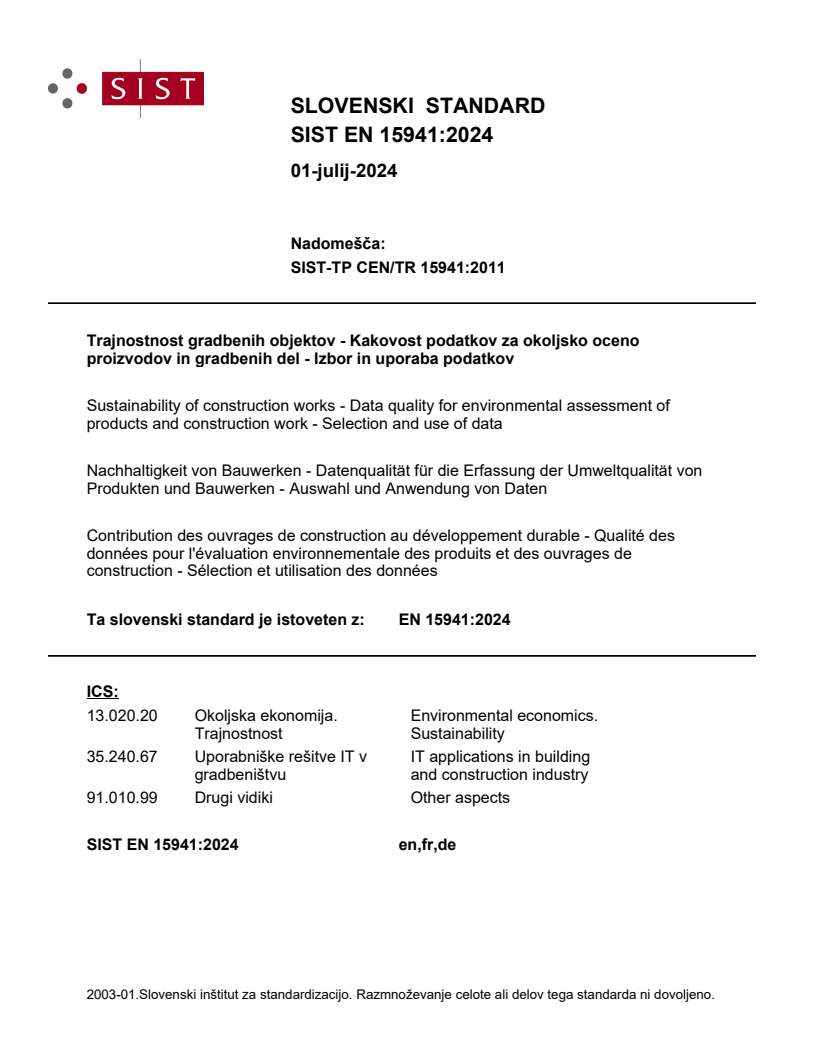
SLOVENSKI STANDARD
01-julij-2024
Nadomešča:
SIST-TP CEN/TR 15941:2011
Trajnostnost gradbenih objektov - Kakovost podatkov za okoljsko oceno
proizvodov in gradbenih del - Izbor in uporaba podatkov
Sustainability of construction works - Data quality for environmental assessment of
products and construction work - Selection and use of data
Nachhaltigkeit von Bauwerken - Datenqualität für die Erfassung der Umweltqualität von
Produkten und Bauwerken - Auswahl und Anwendung von Daten
Contribution des ouvrages de construction au développement durable - Qualité des
données pour l'évaluation environnementale des produits et des ouvrages de
construction - Sélection et utilisation des données
Ta slovenski standard je istoveten z: EN 15941:2024
ICS:
13.020.20 Okoljska ekonomija. Environmental economics.
Trajnostnost Sustainability
35.240.67 Uporabniške rešitve IT v IT applications in building
gradbeništvu and construction industry
91.010.99 Drugi vidiki Other aspects
2003-01.Slovenski inštitut za standardizacijo. Razmnoževanje celote ali delov tega standarda ni dovoljeno.
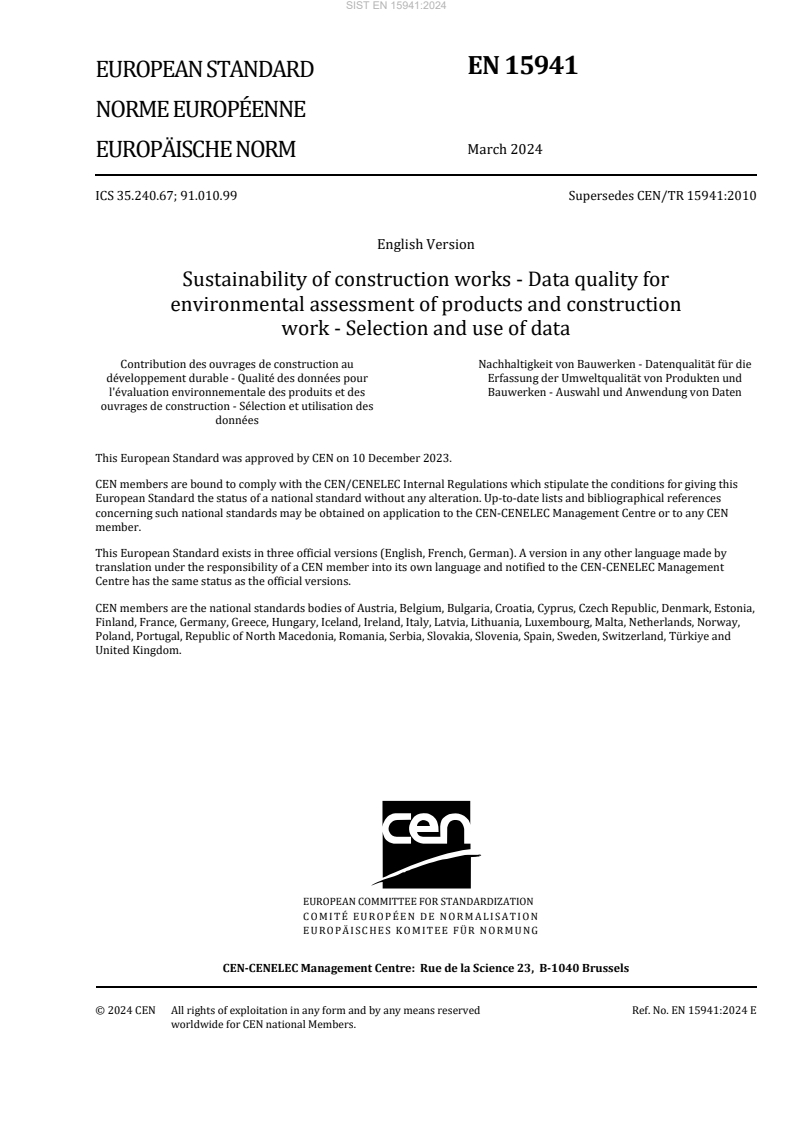
EN 15941
EUROPEAN STANDARD
NORME EUROPÉENNE
March 2024
EUROPÄISCHE NORM
ICS 35.240.67; 91.010.99 Supersedes CEN/TR 15941:2010
English Version
Sustainability of construction works - Data quality for
environmental assessment of products and construction
work - Selection and use of data
Contribution des ouvrages de construction au Nachhaltigkeit von Bauwerken - Datenqualität für die
développement durable - Qualité des données pour Erfassung der Umweltqualität von Produkten und
l'évaluation environnementale des produits et des Bauwerken - Auswahl und Anwendung von Daten
ouvrages de construction - Sélection et utilisation des
données
This European Standard was approved by CEN on 10 December 2023.
CEN members are bound to comply with the CEN/CENELEC Internal Regulations which stipulate the conditions for giving this
European Standard the status of a national standard without any alteration. Up-to-date lists and bibliographical references
concerning such national standards may be obtained on application to the CEN-CENELEC Management Centre or to any CEN
member.
This European Standard exists in three official versions (English, French, German). A version in any other language made by
translation under the responsibility of a CEN member into its own language and notified to the CEN-CENELEC Management
Centre has the same status as the official versions.
CEN members are the national standards bodies of Austria, Belgium, Bulgaria, Croatia, Cyprus, Czech Republic, Denmark, Estonia,
Finland, France, Germany, Greece, Hungary, Iceland, Ireland, Italy, Latvia, Lithuania, Luxembourg, Malta, Netherlands, Norway,
Poland, Portugal, Republic of North Macedonia, Romania, Serbia, Slovakia, Slovenia, Spain, Sweden, Switzerland, Türkiye and
United Kingdom.
EUROPEAN COMMITTEE FOR STANDARDIZATION
COMITÉ EUROPÉEN DE NORMALISATION
EUROPÄISCHES KOMITEE FÜR NORMUNG
CEN-CENELEC Management Centre: Rue de la Science 23, B-1040 Brussels
© 2024 CEN All rights of exploitation in any form and by any means reserved Ref. No. EN 15941:2024 E
worldwide for CEN national Members.
prEN 15941:2023 (E)
Contents Page
European foreword . 6
1 Scope . 7
2 Normative references . 7
3 Terms and definitions . 8
4 Abbreviations . 10
5 Types of data at product, building and construction works level . 10
5.1 General. 10
5.2 Sources of generic data for use at product, building and construction works level. 11
5.3 Examples of data and their uses at building and construction works level . 11
5.4 Types of EPD . 14
6 Data quality criteria and aspects for products and construction works . 17
6.1 General. 17
6.2 International Reference Life Cycle Data System data . 17
6.3 Time-related coverage . 17
6.3.1 General. 17
6.3.2 General time related criteria . 18
6.3.3 Time-related criteria for construction products and buildings . 18
6.3.4 Time related meta-data for ILCD data sets . 19
6.4 Geographical coverage . 20
6.4.1 General geography related criteria . 20
6.4.2 Geography related criteria for construction products and buildings . 21
6.4.3 Geography related meta-data for ILCD data sets. 21
6.5 Technological coverage . 22
6.5.1 General. 22
6.5.2 Technology-related criteria at product level . 22
6.5.3 Technology related criteria for data quality at building level . 22
6.5.4 Technology related meta-data for ILCD data sets . 23
6.6 Aspect of Precision . 24
6.6.1 General. 24
6.6.2 Precision related meta-data for ILCD data sets . 25
6.7 Aspect of Completeness . 25
6.7.1 General. 25
6.7.2 Aspect of Completeness at product level . 26
6.7.3 Aspect of Completeness at building level . 26
6.7.4 Completeness related meta-data for ILCD data sets . 27
6.8 Aspect of Consistency . 27
6.8.1 General. 27
6.8.2 Consistency related meta-data for ILCD data sets . 28
6.9 Sources of the data . 30
6.10 Meta-data for ILCD data sets related to Sources of data . 30
7 Data Quality at Product level . 31
7.1 Assessing Data Quality at product level . 31
7.1.1 General. 31
7.1.2 Relevant data . 31
7.1.3 Assessing data quality of average or specific data. 32
7.1.4 Assessing data quality of generic data . 33
7.1.5 Assessing data quality of the final EPD . 33
7.2 Selecting and Collecting data at product level . 33
7.2.1 General . 33
7.2.2 Selecting raw data . 34
7.2.3 Selection of specific and generic data . 36
7.3 Reporting data quality at Product Level . 39
7.3.1 General . 39
7.3.2 Reporting data quality in the project report . 39
7.3.3 Reporting data quality in the EPD . 40
7.3.4 Other data quality information in the EPD . 42
7.3.5 Providing the EPD in ILCD format . 42
8 Data quality at building level . 42
8.1 General . 42
8.2 Assessment during specific design and decision steps/stages . 43
8.3 Assessing data quality at building level . 43
8.3.1 General . 43
8.3.2 Time related . 44
8.3.3 Geography related . 44
8.3.4 Technology Related . 44
8.3.5 Completeness . 45
8.3.6 Consistency . 47
8.3.7 Plausibility . 48
8.3.8 Precision . 48
8.4 Selection of quantity data, environmental data and other information . 48
8.4.1 General . 48
8.4.2 Selecting data to describe the building . 48
8.4.3 Selection of quantity data for the building assessment . 49
8.4.4 Selection of environmental data for products and processes for the building
assessment . 50
8.5 Data quality of the assessment results of the building’s environmental performance
................................................................................................................................................................... 53
8.5.1 General . 53
8.5.2 Data quality evaluation of quantification . 53
8.5.3 Data quality evaluation during Type 1 and Type 2 Assessments . 54
8.5.4 Data quality evaluation during Type 2, Type 3 and Type 4 assessments . 54
8.5.5 Summarizing data quality . 55
8.6 Databases, data set providers and tools . 56
8.7 Reporting data quality generally at building level . 56
8.8 Verification and review . 59
9 Data quality at civil engineering works level . 59
Annex A (informative) Overview of definitions used in this document and those in EN 15804
and PEF and Level(s) . 60
A.1 Overview of definitions . 60
A.2 Foreground and background data . 65
A.3 Raw data . 65
A.4 Specific and generic data . 65
Annex B (informative) Mass Balance at product level . 66
Annex C (informative) Examples of reporting data quality in EPD . 69
Annex D (informative) Examples of the use of a data selection at building level depending on
goal and scope and data quality assessment . 71
D.1 General. 71
D.2 Early-stage design – no materials chosen . 71
D.3 Early-stage design – Some materials chosen . 72
D.4 Detailed Design Stage – Cladding comparison . 73
D.5 Building Assessment for planning or regulatory purposes . 74
D.6 Building Completion - As built assessment . 74
Annex E (normative) Avoiding double counting in the selection of specific and generic data
for energy at product and building level . 75
E.1 General. 75
E.1.1 General guidance . 75
E.1.2 Overarching requirements for avoiding double counting in the selection of specific
and generic data for energy at product and building level . 75
E.1.2.1 Avoiding double counting . 75
Ensuring transparency . 75
Use of Contractual instruments . 75
E.2 Avoiding double counting in the selection of specific and generic data for energy at
product and building level . 75
E.2.1 Overarching Principles . 75
E.2.1.1 General. 75
E.2.1.2 Requirements for contractual instruments . 76
E.2.1.3 Requirement for residual mix . 77
E.2.1.4 Recommendation for consistent use of contractual instruments and residual mix . 78
E.2.2 Product level Electricity – modelling foreground, upstream and downstream
processes within control of the manufacturer(s) . 78
E.2.2.1 General. 78
E.2.2.2 Electricity from the grid . 78
E.2.2.3 Electricity from a directly connected supplier . 78
E.2.2.4 Internally generated electricity . 79
E.2.2.5 Requirement for modelling of electricity with contractual instruments . 79
E.2.2.6 Requirement for transparency . 79
E.2.3 Product level Biogas and the gas network – modelling foreground, upstream and
downstream data within the control of the manufacturer(s) . 79
E.2.3.1 General. 79
E.2.3.2 Biogas from the gas network . 79
E.2.3.3 Biogas from a directly connected supplier . 79
E.2.3.4 Internally generated biogas . 80
E.2.3.5 Requirement for modelling of biogas with contractual instruments . 81
E.2.3.6 Requirement for transparency . 81
E.2.4 Product level - Other energy – modelling foreground, upstream and downstream data
in the control of the manufacturer(s) . 81
E.2.4.1 General . 81
E.2.4.2 Requirement for modelling of other energy with contractual instruments . 81
E.2.4.3 Requirement for transparency . 81
E.2.5 Product level - Energy – modelling upstream data (A1-A3) not in the control of the
manufacturer(s) . 81
E.2.6 Product Level Energy – modelling downstream data (A4-C4 and Module D) . 81
E.2.7 Building Level Energy – modelling energy use in the building in the Construction
Stage, Use Stage, End-of-life stage and Module D2 . 82
E.2.8 Transparency . 82
E.2.8.1 Reporting at product level in the Project Report . 82
E.2.8.2 Reporting in EPD . 83
E.2.8.3 Reporting at Building Level in the Project Report . 83
E.2.8.4 Reporting in Building Level Communication . 83
Annex F (informative) Data quality scheme for building level based on Level(s) . 84
Bibliography . 85
European foreword
This document (EN 15941:2024) has been prepared by Technical Committee CEN/TC 350 “Sustainability
of construction works”, the secretariat of which is held by AFNOR.
This European Standard shall be given the status of a national standard, either by publication of an
identical text or by endorsement, at the latest by August 2024, and conflicting national standards shall be
withdrawn at the latest by August 2024.
Attention is drawn to the possibility that some of the elements of this document may be the subject of
patent rights. CEN shall not be held responsible for identifying any or all such patent rights.
This document supersedes CEN/TR 15941:2010.
In comparison with the previous edition, the following technical modifications have been made. The
document:
— addresses both specific and generic data;
— addresses the assessment of data quality in relation to time, geography, technology, precision,
completeness, consistency and sources of data;
— addresses the selection of data based on the assessment of data quality through guidance on the
generation of a hierarchy;
— addresses the assessment, selection and use of data at both product and building level, and its
applicability to all construction works including civil engineering works;
— addresses the avoidance of double counting through the selection of data, particularly in relation to
electricity;
— addresses the reporting of data quality at product level in the Project Report and in the
Environmental Product Declaration (EPD);
— addresses ease of data transfer at product level by addressing the use of a common Life Cycle
Inventory (LCI) – nomenclature;
— addresses the reporting and communication of data quality information at building level;
— addresses the responsibilities of data providers to make data quality information available;
— no longer provides guidance on the pre-verification of generic data.
This document has been prepared under a Mandate given to CEN by the European Commission and the
European Free Trade Association.
Any feedback and questions on this document should be directed to the users’ national standards body.
A complete listing of these bodies can be found on the CEN website.
According to the CEN-CENELEC Internal Regulations, the national standards organisations of the
following countries are bound to implement this European Standard: Austria, Belgium, Bulgaria, Croatia,
Cyprus, Czech Republic, Denmark, Estonia, Finland, France, Germany, Greece, Hungary, Iceland, Ireland,
Italy, Latvia, Lithuania, Luxembourg, Malta, Netherlands, Norway, Poland, Portugal, Republic of North
Macedonia, Romania, Serbia, Slovakia, Slovenia, Spain, Sweden, Switzerland, Türkiye and the United
Kingdom.
1 Scope
This document specifies the data quality assessment and selection of data for Environmental Product
Declarations (EPD) according to the core product category rules of EN 15804 and for the environmental
performance assessment of buildings according to EN 15978 in a consistent way. It can also be used to
assess and select data for the environmental assessment of civil engineering works according to
EN 17472.
It defines data quality requirements with respect to temporal, technological and geographical
representativeness for the data used to calculate the Life Cycle Assessment (LCA) based indicator results
of the EPD and for construction works when applying EPD, life cycle inventory data or other LCA based
information, and gives guidance for the generation of a hierarchy to support the selection of the most
appropriate data regarding data quality. It also addresses the reporting of data quality at product and
building level.
2 Normative references
The following documents are referred to in the text in such a way that some or all of their content
constitutes requirements of this document. For dated references, only the edition cited applies. For
undated references, the latest edition of the referenced document (including any amendments) applies.
EN 15804:2012+A2:2019, Sustainability of construction works - Environmental product declarations - Core
rules for the product category of construction products
EN 15978, Sustainability of construction works - Assessment of environmental performance of buildings -
Calculation method
CEN ISO/TS 14071, Environmental management — Life cycle assessment — Critical review processes
and reviewer competencies: Additional requirements and guidelines to ISO 14044:2006 (ISO/TS 14071)
EN ISO 14021, Environmental labels and declarations - Self-declared environmental claims (Type II
environmental labelling) (ISO 14021)
EN ISO 14044, Environmental management - Life cycle assessment - Requirements and guidelines
(ISO 14044)
EN ISO 14067:2018, Greenhouse gases - Carbon footprint of products - Requirements and guidelines for
quantification (ISO 14067:2018)
ISO 21930:2017, Sustainability in buildings and civil engineering works — Core rules for environmental
product declarations of construction products and services
European Commission — Joint Research Centre — Institute for Environment and Sustainability.
International Reference Life Cycle Data System (ILCD) Handbook — Nomenclature and other conventions.
2010. EUR 24384 EN. Luxembourg. Publications Office of the European Union; 2010, ISBN 978-92-79-
15861-2
3 Terms and definitions
For the purposes of this document, the following terms and definitions apply.
ISO and IEC maintain terminological databases for use in standardization at the following addresses:
— ISO Online browsing platform: available at https://www.iso.org/obp
— IEC Electropedia: available at https://www.electropedia.org/
NOTE Annex A provides an overview of how the definitions in this document differ from those in EN 15804, PEF
and Level(s).
3.1
average data
calculated mean of data based on a representative sample for a construction product or construction
service, provided by one or more manufacturer, either from their multiple plants or based on multiple
similar construction products of the manufacturer(s)
[SOURCE: ISO 21930:2017, 3.5.6, modified – reference to calculated mean has been added, the term
“supplier” has been changed to “manufacturer”, the term “fully” has been deleted and note 1 to entry has
been deleted]
3.2
average EPD
EPD based on average data (3.1)
Note 1 to entry: The term collective EPD is equivalent to average EPD of more than one manufacturer.
[SOURCE: ISO 21930:2017, 3.1.12, modified – Note 1 to entry has been added]
3.3
construction element
building component
building element
component or a set of assembled components incorporated in a building or construction works
[SOURCE: EN 15643:2021, 3.15]
3.4
downstream process
process that follows a given life cycle process
[SOURCE: EN 15804:2012+A2:2019, 3.34, modified – upstream process has been deleted and the term
“stage” has been changed to “process”]
3.5
driving process
product, material or process contributing significantly to at least 80 % of any environmental indicators
included in the building or civil engineering works assessment, over the life cycle modules assessed
3.6
generic data
data that is not site or enterprise specific
Note 1 to entry: This refers to data that is not directly collected, measured, or estimated by a company, but sourced
from a third party LCI database or other sources. Generic data includes industry average data (e.g. from published
production data, government statistics, and industry associations), literature studies, engineering studies and
patents, and may also be based on financial data, and contain proxy data, and other generic data.
3.7
product system
collection of unit processes with elementary and product flows, performing one or more defined
functions, and which models the life cycle of a product
[SOURCE: EN ISO 14040:2006, 3.28]
3.8
raw data
data determined by direct measurement, estimation or calculation from the original source
[SOURCE: Sonnemann & Vigon (Ed.), UN 2011]
3.9
scenario
collection of assumptions and information concerning an expected sequence of possible future events
[SOURCE: EN 15804:2012+A2:2019, 3.28]
3.10
specific data
data representative of a product, product group or construction service, provided by one supplier
[SOURCE: EN 15804:2012+A2:2019, 3.31]
3.11
unit process
smallest element considered in the life cycle inventory analysis for which input and output data are
quantified
Note 1 to entry: Data processed by mathematical relations from raw data [Sonnemann and Vigon (Ed.), UN 2011].
[SOURCE: EN ISO 14040:2006, 3.34, modified – Note 1 to entry has been added]
3.12
upstream process
process that precedes a given life cycle stage
[SOURCE: EN 15804:2012+A2:2019, 3.34, modified – downstream process deleted]
3.13
proxy data
substitute data used to approximate for system specific data (3.10) or generic data (3.6) if they are not
available
EXAMPLE Data for production of acetic acid used in lieu of data for production of formic acid or selection of a
generic data set of electricity from one region to represent another region.
Note 1 to entry: Data can be site specific or average.
[SOURCE: ISO 21930:2017, 3.5.5, modified – definition clarified]
3.14
reference service life
RSL
service life of a construction product which is known to be expected under a set of reference in-use
conditions and which can form the basis for estimating the service life under other in-use conditions
[SOURCE: EN 15804:2012+A2:2019, 3.26, modified – note 1 to entry and note 2 to entry have been
deleted]
4 Abbreviations
ADP Abiotic Depletion Potential
CHP Combined Heat and Power
EPD Environmental Product Declaration
GO Guarantee of Origin
GWP Global Warming Potential
HVAC Heating, Ventilation and Air Conditioning
ILCD International Reference Life Cycle Data System
LCA Life Cycle Assessment or Life Cycle Analysis
LCI Life Cycle Inventory
PCR Product Category Rule
PEF Product Environmental Footprint
PV Photovoltaic
RSL Reference Service Life
5 Types and sources of data at product, building and construction works level
5.1 General
This clause describes different categories of data and some different data sources that are commonly used
in developing EPD and in the environmental performance assessment of buildings and construction
works.
5.2 Sources of generic data for use at product, building and construction works level
Examples of sources for generic data for upstream processes include:
— Collective EPD according to Table 2 (e.g. industrial sector EPD);
— Industry average life cycle data from LCI databases that have been critically reviewed;
— Manufacturer specific EPD, if representative, used as proxy data where there is no collective EPD;
— EN ISO 14044 LCA studies that have been critically reviewed;
— Other data sets according to EN 15804 that have not been critically reviewed or verified;
— Industry average life cycle data from LCI databases that have not been critically reviewed;
— Industry association reports and governmental statistics;
— Data from literature, scientific papers, literature studies, engineering studies and patents;
— Data sets generated by data set providers in the absence of industry provided data;
— Proxy data from other sectors.
The selection of data are dependent on the context of its use.
Note The list contains sources for generic data. This does not mean that sources like a collective EPD is
“automatically” generic data.
5.3 Examples of data and their uses at building and construction works level
In addition to the sources of generic data listed in 5.2, Table 1 provides a detailed overview of examples
of data used at building and construction works level based on the different life cycle stages according to
EN 15804 and EN 15978.
Table 1 — Examples of data for use at building and construction works level
Life Cycle Environmental LCA- Type of data and Examples of data use
Modules based data for: quantities of products
A1–A3 Construction products Specific, generic or Use in building
average data on assessment
Building components
production processes
HVAC-Systems
Amount of products
included
A4 Transport processes Transport mode and Specification of scenarios
vehicle type for the transport stage of
the building assessment
Transport distance
Capacity utilization
Fuel type/energy source
Life Cycle Environmental LCA- Type of data and Examples of data use
Modules based data for: quantities of products
A5 Construction processes Type of construction Specification of scenarios
process for the construction stage
of the building
Resource consumption
assessment
for construction process
Amount of waste and its
further handling
B1 Non-energy related Type and amount of Identification of
emissions construction products dangerous substances
with interior or exterior
Aging of products
surfaces and their
emissions to the
environment
Carbonation
Fugitive emission of
refrigerant HVAC system
B2 Maintenance processes Frequency Maintenance strategy
Type and amount of Service level
activity
B3 Repair processes Frequency Repair Strategy
Construction processes Probability of repair
Type and amount of
activity
B4 Like A1-A3, A4, A5, Like A1-A3, A4, A5, Replacement strategy
C1, C2, C3, C4 and D1 C1, C2, C3, C4 and D1
B5 Like A1-A3, A4, A5, Like A1-A3, A4, A5, Refurbishment strategy
C1, C2, C3, C4 and D1 C1, C2, C3, C4 and D1
B6.1 Operational energy Energy demand (heating, Climate conditions
supply cooling, air conditioning,
User behaviour
hot water supply,
Management quality
lighting)
B6.2 Operational energy Energy demand (e.g. User behaviour
supply elevator)
B6.3 Operational energy User related energy User behaviour
supply demand (e.g. cooking,
electricity use for
computers)
B7 Water supply Water demand User behaviour
Wastewater treatment Wastewater collection
Life Cycle Environmental LCA- Type of data and Examples of data use
Modules based data for: quantities of products
B8 Transport processes Transport mode and Specification of scenarios
vehicle type for the use stage of the
Other processes and
building assessment
services Transport distance
Goods associated with
activities relating to the
buildings intended use
C1 Deconstruction Type and amount of Deconstruction strategy
processes deconstruction processes (demolition versus
deconstruction)
C2 Transport processes Transport mode and Specification of scenarios
vehicle type for the end-of-life stage
of the building
Transport distances
assessment
C3 Waste processing Type of processes and Strategy
amount of material
C4 Disposal processing Type of processes and Strategy
amount of material
(Coefficients for transfer
to environment)
D1 Potential benefits and Type and amount of Deconstruction strategy
loads from reuse, materials for reuse and (demolition versus
recycling and energy recycling deconstruction)
recovery resulting from
Type and amount of Understanding the
the net flows of materials
substituted processes potential benefit and
exiting the system
loads from reuse,
boundary
recycling and energy
recovery resulting from
the net flows of materials
exiting the system
boundary
D2 Potential benefits and Type and amount of Understanding the
loads from exported exported energy and potential benefit of
utilities exiting the potentially avoided exported energy
system boundary emissions occurring
beyond the system
boundary
Other data such as technical characteristics are not covered here. Average data for a product group should
not be used to represent a narrower product group with significantly higher impact.
NOTE Modules A4-D2 are scenario based. In some countries these modules use pre-defined defaults.
5.4 Types of EPD
Table 2 provides a detailed description of the different types of EPD in terms of their scope and describes
the range of specific and average EPD, together with examples. It can be used to describe the scope of
EPD in a standardized way.
NOTE This classification by scope is different from the types of EPD with respect to life cycle stages described
in EN 15804:2012+A2:2019, 5.2.
Average data for a product group should not be used to represent a narrower product group with
significantly higher impact.
This needs to be justified in the project report and in the EPD. Examples are given in Annex C.
Table 2 — Types of EPD with respect to their scope (adapted from ISO 21930:2017, Annex B)
Type of product Description Examples
1. Manufacturer specific EPD Specific product 1A Declaration of a specific product from EPD for a specific concrete mix produced at a
a single plant. single ready-mix plant of one manufacturer.
(1 manufacturer)
(1 product, 1 plant)
1B Declaration of a specific product as an EPD of a specific concrete mix produced at several
average from several of the (or all) of the plants of one manufacturer.
manufacturer’s plants.
This can include different sites of one company
(1 product, > 1 plant) with the same production processes.
Average product 1C Declaration of an average product EPD of the average concrete (or a group of
from a manufacturer’s plant. concretes) produced at a single ready-mix plant of
one manufacturer.
(average product, 1 plant)
1D Declaration of an average product as EPD of the average concrete mix (or a group of
an average from several of the concretes) produced at several (or all) of the
manufacturer’s plants. plants of one manufacturer. This can include
different sites with different production
(average product, > 1 plant)
processes.
Typical 1E Declaration of the impact of a typical, A manufacturer can select a (typical) product
representative representative product to represent the which is representative for a certain product
impact of a product group from a group and declare the environmental impacts for
product
manufacturer’s plant. it as representing the entire product class. The
choice of representative product needs to be
(typical representative product, 1 plant)
justified.
1F Declaration of the impact of a typical, A manufacturer can select a (typical) product
representative product to represent the which is representative for a certain product
impact of a product group from several group and declare the environmental impacts for
of the manufacturer’s plants. it as representing the entire product class
(representative EPD). The choice of
(typical, representative product, > 1
representative product needs to be justified.
plant)
Type of product Description Examples
2. More than 1 manufacturer Specific product 2A Declaration of a specific product as an Declaration of an extruded polystyrene insulation
EPD average from several manufacturers’ product as an average from plants of a certain
plants. number of manufacturers within an association.
(from > 1 manufacturer,
associations, sector,
Average product 2B Declaration of an average product as EPD for an average across a range of different
equivalent to a collective
an average from several manufacturers’ densities of insulation material averaged across all
EPD)
plants. products produced by a defined number of
members of an association of insulation
manufacturers.
Typical, 2C Declaration of the impact of a typical, Manufacturers or trade association can select a
representative product to represent the (typical) produc
...
Frequently Asked Questions
EN 15941:2024 is a standard published by the European Committee for Standardization (CEN). Its full title is "Sustainability of construction works - Data quality for environmental assessment of products and construction work - Selection and use of data". This standard covers: This document supports the data quality assessment and selection of data for product-level Environmental Product Declarations (EPD) according to the core product category rules of EN 15804 and for the environmental performance assessment of buildings according to prEN 15978 1 in a consistent way. It can also be used to assess and select data for the environmental assessment of civil engineering works according to EN 17472. It defines data quality requirements with respect to temporal, technological and geographical representativeness for the data used to calculate the Life Cycle Assessment (LCA) based indicator results of the EPD and for construction works when applying EPD, life cycle inventory data or other LCA based information, and generates a hierarchy to support the selection of the most appropriate data with regard to data quality. It also addresses the reporting of data quality at product and building level.
This document supports the data quality assessment and selection of data for product-level Environmental Product Declarations (EPD) according to the core product category rules of EN 15804 and for the environmental performance assessment of buildings according to prEN 15978 1 in a consistent way. It can also be used to assess and select data for the environmental assessment of civil engineering works according to EN 17472. It defines data quality requirements with respect to temporal, technological and geographical representativeness for the data used to calculate the Life Cycle Assessment (LCA) based indicator results of the EPD and for construction works when applying EPD, life cycle inventory data or other LCA based information, and generates a hierarchy to support the selection of the most appropriate data with regard to data quality. It also addresses the reporting of data quality at product and building level.
EN 15941:2024 is classified under the following ICS (International Classification for Standards) categories: 35.240.67 - IT applications in building and construction industry; 91.010.99 - Other aspects. The ICS classification helps identify the subject area and facilitates finding related standards.
EN 15941:2024 has the following relationships with other standards: It is inter standard links to CEN/TR 15941:2010. Understanding these relationships helps ensure you are using the most current and applicable version of the standard.
EN 15941:2024 is associated with the following European legislation: Standardization Mandates: M/350 AMDT. When a standard is cited in the Official Journal of the European Union, products manufactured in conformity with it benefit from a presumption of conformity with the essential requirements of the corresponding EU directive or regulation.
You can purchase EN 15941:2024 directly from iTeh Standards. The document is available in PDF format and is delivered instantly after payment. Add the standard to your cart and complete the secure checkout process. iTeh Standards is an authorized distributor of CEN standards.
La norme EN 15941:2024, intitulée "Durabilité des travaux de construction - Qualité des données pour l'évaluation environnementale des produits et des travaux de construction - Sélection et utilisation des données", constitue un cadre essentiel pour évaluer et sélectionner la qualité des données pour les déclarations environnementales des produits (DEP) au niveau des produits, conformément aux règles de catégorie de produits de base de la norme EN 15804. Elle est également pertinente pour l'évaluation de la performance environnementale des bâtiments selon la norme prEN 15978, ainsi que pour les travaux d'ingénierie civile selon la norme EN 17472. L'un des nombreux points forts de cette norme est sa capacité à définir des exigences de qualité des données en termes de représentativité temporelle, technologique et géographique. Cela assure que les résultats des indicateurs basés sur l'évaluation du cycle de vie (ACV) des DEP et des travaux de construction sont fondés sur des données précises et pertinentes. De plus, la norme hiérarchise les données pour faciliter la sélection des informations les plus appropriées en fonction de la qualité des données, un aspect crucial pour garantir une évaluation environnementale robuste et fiable. La pertinence de cette norme pour le secteur de la construction ne peut être sous-estimée. En intégrant des critères spécifiques pour le rapport de la qualité des données au niveau des produits et des bâtiments, elle aide à renforcer la transparence et la responsabilité environnementale dans le secteur de la construction. Ainsi, la norme EN 15941:2024 contribue à un avenir plus durable en fournissant des directives claires pour l'utilisation de données de haute qualité pour l'évaluation environnementale, tant au niveau des produits qu'au niveau des constructions.
Die Norm EN 15941:2024 befasst sich mit der Nachhaltigkeit von Bauwerken und bietet eine strukturierte Vorgehensweise zur Beurteilung und Auswahl von Datenqualitäten für Umweltbewertungen von Produkten und Bauwerken. Sie ist besonders relevant für die Erstellung von Umweltproduktdeklarationen (EPD), die gemäß den grundlegenden Produktkategorievorgaben der EN 15804 sowie für die Umweltleistungsbewertung von Gebäuden nach prEN 15978 genutzt werden. Ein besonderes Augenmerk liegt auf den in der Norm definierten Anforderungen an die Datenqualität, die hinsichtlich zeitlicher, technologische und geographischer Repräsentativität spezifiziert sind. Diese Anforderungen sind entscheidend für die Berechnung der Lebenszyklusanalyse (LCA)-basierten Indikatorergebnisse der EPD. Darüber hinaus wird eine Hierarchie zur Auswahl der am besten geeigneten Daten in Bezug auf die Datenqualität generiert. Dies ermöglicht eine konsistente und fundierte Entscheidung bei der Bewertung von Umweltleistungen. Die Norm trägt nicht nur zur Qualitätssicherung bei, sondern unterstützt auch den Prozess der Datenberichterstattung auf Produkt- und Gebäudeebene. Ihre Anwendung ist nicht auf die Bauindustrie beschränkt, sondern erstreckt sich auch auf Ingenieurbauwerke nach EN 17472, was ihren Umfang und ihre Relevanz im Bereich der nachhaltigen Baupraktiken unterstreicht. Insgesamt stärkt die EN 15941:2024 die Transparenz und Verlässlichkeit bei der Erstellung von Umweltbewertungen und trägt dazu bei, die ökologischen Auswirkungen von Bauprodukten und -leistungen präziser zu erfassen und zu bewerten.
SIST EN 15941:2024 표준은 건설 작업의 지속 가능성을 평가하기 위한 핵심 문서로, 환경 성과 평가와 관련된 데이터 품질을 일관되게 지원합니다. 이 문서는 제품 수준의 환경 제품 선언(EPD)을 위한 데이터 품질 평가 및 데이터 선택을 통해 EN 15804의 핵심 제품 범주 규칙에 부합하는 방법을 제공합니다. 또한, prEN 15978 1에 따라 건물의 환경 성과를 평가하는 데도 사용될 수 있으며, EN 17472에 따른 토목 공사의 환경 평가를 위한 데이터 선택 및 평가에도 적용될 수 있습니다. 이 표준의 주된 강점 중 하나는 데이터 품질 요구 사항을 정의한다는 점입니다. 이는 특정한 기간, 기술적, 지리적 대표성을 고려하여 EPD와 건설 작업에서 수명의 전과정 평가(LCA) 기반 지표 결과를 계산하는 데 사용되는 데이터의 신뢰성을 보장합니다. 표준은 데이터를 선택할 때 가장 적절한 데이터를 지원하기 위한 계층 구조를 생성하여 데이터 품질을 강조합니다. 또한, 제품 및 건물 수준에서 데이터 품질을 보고하는 방법도 다루고 있어, 이해관계자들이 투명하게 정보를 제공할 수 있도록 돕습니다. 이러한 특성은 시스템적 접근을 통해 건설 산업의 지속 가능성을 강화하는 데 큰 기여를 하며, 최신 환경 규범을 준수하는 데 필요한 기준을 제공합니다. SIST EN 15941:2024는 건설 및 환경 분야 전문가들에게 매우 중요한 자료이며, 데이터 선택 및 평가의 일관성을 통해 지속 가능한 건설 작업을 위한 디딤돌이 될 것입니다.
The standard EN 15941:2024 provides essential guidance on the data quality requirements for environmental assessments in the context of construction works. Its scope is comprehensive, focusing on the selection and use of data for Environmental Product Declarations (EPD) aligned with EN 15804's core product category rules, as well as the environmental performance assessments of buildings outlined in prEN 15978 1. Additionally, it extends to the environmental assessment of civil engineering works in accordance with EN 17472. A significant strength of EN 15941:2024 lies in its thoroughness in establishing data quality requirements concerning temporal, technological, and geographical representativeness. By addressing these critical aspects, the standard facilitates the calculation of Life Cycle Assessment (LCA) based indicator results, which are crucial for accurate EPDs and the assessment of construction works. This clarity ensures that stakeholders can select and apply the best quality data available, simultaneously promoting transparency and reliability in environmental assessments. The standard's generation of a hierarchy for data selection is another notable feature. This hierarchy provides clear guidance on identifying the most suitable data regarding quality, which is particularly valuable for practitioners seeking to enhance the credibility of their LCA results. Furthermore, addressing the reporting of data quality at both product and building levels ensures that users can effectively communicate the integrity of their environmental assessments. EN 15941:2024 is highly relevant in today's construction industry, where sustainability practices and environmental accountability are increasingly prioritized. By standardizing the criteria for data quality in environmental assessments, this document supports the broader objectives of promoting sustainability in construction works and contributes to the continuous improvement of environmental performance across the sector. Overall, it serves as a vital resource for ensuring consistent and high-quality data application in the assessment of the environmental impacts of construction products and works.
SIST EN 15941:2024は、建設作業の持続可能性に関する重要な基準であり、製品および建設作業の環境評価のためのデータ品質を確保するための道筋を示しています。この標準は、EN 15804のコア製品カテゴリルールに基づく製品レベルの環境製品宣言(EPD)のためのデータ品質評価とデータ選択を支援し、さらにprEN 15978に基づく建物の環境パフォーマンス評価にも一貫して適用されることを目的としています。 この文書の強みは、データの時間的、技術的、地理的な代表性に関する具体的なデータ品質要件を定義している点にあります。これにより、EPDやライフサイクルインベントリデータ、その他のライフサイクルアセスメント(LCA)に基づく情報を用いて建設作業の環境評価を行う際に、最も適切なデータの選択を支援するための階層が生成されます。このアプローチは、建設業界における環境への影響を正確に評価するために不可欠であり、持続可能な開発を推進する上でも重要な役割を果たします。 また、この基準は、製品レベルおよび建物レベルでのデータ品質の報告を取り扱い、透明性を確保するための手段を提供します。これにより、建設関係者は、持続可能な建材や工法を選択する際に必要なデータの信頼性と整合性を確認できるようになります。 SIST EN 15941:2024は、環境評価の精度を高め、持続可能な建設の基盤を強化するために不可欠な文書であり、建設業界におけるデータ品質の重要性を再認識させるものです。この基準の採用は、環境への影響を減少させるための取り組みを支える上で、企業や政策立案者にとっても非常に価値あるものとなります。
Questions, Comments and Discussion
Ask us and Technical Secretary will try to provide an answer. You can facilitate discussion about the standard in here.
Loading comments...