


EN ISO 14096-2:2026
(Main)Non-destructive testing - Qualification of radiographic film digitisation systems - Part 2: Minimum requirements (ISO 14096-2:2026)
General Information
- Abstract
This document specifies three film-digitisation quality classes for the requirements of non-destructive testing. The user specifies one of these quality classes for the respective film digitisation task. The digitisation parameters depend on the radiation energy, the material thickness penetrated and the quality level of the original radiographic film. This document does not address signal processing, display and storage of the digitised data.
For the application of this document, ISO 14096-1 provides definitions and measurement procedures.
- Status
- Not Published
- Publication Date
- 15-Sep-2026
- Technical Committee
- CEN/TC 138 - Non-destructive testing
- Drafting Committee
- CEN/TC 138/WG 1 - Ionizing radiation testing
- Current Stage
- 6060 - Definitive text made available (DAV) - Publishing
- Start Date
- 16-Sep-2026
- Completion Date
- 16-Sep-2026

Overview
EN ISO 14096-2:2026 is an international standard that establishes the minimum requirements for the qualification of radiographic film digitisation systems used in non-destructive testing (NDT). Developed by CEN and ISO under the reference ISO 14096-2:2026, this standard specifically defines three film-digitisation quality classes (DS, DB, DA) to ensure the accurate conversion of radiographic film data into digital format. The system class selection depends on factors such as radiation energy, material thickness penetrated, and the original film quality. EN ISO 14096-2:2026 does not address processing, display, or storage of digitised data, but focuses exclusively on the minimum requirements of the digitisation step.
Key Topics
Digitisation Quality Classes:
The standard classifies all radiographic film digitisation systems into three quality classes:- DS: Enhanced technique for digital archiving with insignificant degradation of image quality.
- DB: High-quality technique suitable for analysis, with limited image quality reduction.
- DA: Basic technique, allowing for a further reduced spatial resolution, used primarily for digital analysis.
Selection Criteria:
The choice of digitisation class depends on:- Radiation energy level (X- or gamma rays)
- Thickness of the material tested
- Quality category of the original radiographic film
Minimum Performance Parameters:
Each class specifies thresholds for:- Density range: Minimum and maximum optical densities
- Digital resolution: Minimum number of bits for analogue-to-digital conversion
- Density contrast sensitivity: Smallest detectable difference in film density
- Spatial resolution: Basic spatial resolution required, varying with energy and application
System Identification:
Digitisation systems must be clearly identified by their digitisation class and working density ranges, ensuring consistent application across NDT operations.
Applications
EN ISO 14096-2:2026 is crucial for sectors reliant on non-destructive testing with radiographic films, facilitating reliable digital conversion for quality control, documentation, and archival purposes. Typical application areas include:
- Industrial Quality Assurance: Reliable digitisation is vital in industries such as aerospace, automotive, pipeline, heavy machinery, and welded structures, where NDT assures safety and regulatory compliance.
- Film Archiving and Digital Analysis: The standard’s stringent requirements for the DS class support long-term archiving of high-quality digital records, while DB and DA classes enable effective digital analysis and data sharing.
- Regulatory Compliance: By establishing clear minimum requirements for digitisation, organizations can align with international best practices and meet legal or customer-specific specifications.
Related Standards
EN ISO 14096-2:2026 is part of a broader standards landscape relevant to non-destructive testing and film digitisation, including:
- ISO 14096-1: Provides definitions, measurement procedures and reference films for NDT film digitisation systems.
- ISO 17636-1: Specifies procedures for radiographic testing of welds using film techniques.
- EN 12681-1: Covers radiographic examination of castings with film.
- ISO 19232-5: Details image quality measurement using duplex wire indicators.
- ISO 5579: Outlines general rules for radiographic testing of metallic materials.
Practical Value
By implementing EN ISO 14096-2:2026, organizations standardize their radiographic film digitisation process, ensuring:
- Consistent and reproducible digital image quality
- Reliable archiving and analysis of historical NDT data
- Improved data traceability and compliance with industry best practices
- Facilitation of digital transformation in NDT workflows
Keywords: EN ISO 14096-2:2026, radiographic film digitisation, non-destructive testing, NDT, quality classes, digital archiving, film digitiser, minimum requirements, spatial resolution, density contrast, industrial inspection standards.
Relations
- Effective Date
- 19-Jul-2023
- Effective Date
- 17-Sep-2026
- Effective Date
- 17-Sep-2026
- Consolidated By
ISO 14096-2:2026 - Non-destructive testing — Qualification of radiographic film digitisation systems — Part 2: Minimum requirements - Effective Date
- 12-Feb-2026
Get Certified
Connect with accredited certification bodies for this standard

IMP NDT d.o.o.
Non-destructive testing services. Radiography, ultrasonic, magnetic particle, penetrant, visual inspection.
Inštitut za kovinske materiale in tehnologije
Institute of Metals and Technology. Materials testing, metallurgical analysis, NDT.
Q Techna d.o.o.
NDT and quality assurance specialist. 30+ years experience. NDT personnel certification per ISO 9712, nuclear and thermal power plant inspections, QA/
Sponsored listings
Frequently Asked Questions
EN ISO 14096-2:2026 is a draft published by the European Committee for Standardization (CEN). Its full title is "Non-destructive testing - Qualification of radiographic film digitisation systems - Part 2: Minimum requirements (ISO 14096-2:2026)". This standard covers: This document specifies three film-digitisation quality classes for the requirements of non-destructive testing. The user specifies one of these quality classes for the respective film digitisation task. The digitisation parameters depend on the radiation energy, the material thickness penetrated and the quality level of the original radiographic film. This document does not address signal processing, display and storage of the digitised data. For the application of this document, ISO 14096-1 provides definitions and measurement procedures.
This document specifies three film-digitisation quality classes for the requirements of non-destructive testing. The user specifies one of these quality classes for the respective film digitisation task. The digitisation parameters depend on the radiation energy, the material thickness penetrated and the quality level of the original radiographic film. This document does not address signal processing, display and storage of the digitised data. For the application of this document, ISO 14096-1 provides definitions and measurement procedures.
EN ISO 14096-2:2026 is classified under the following ICS (International Classification for Standards) categories: 19.100 - Non-destructive testing; 37.040.25 - Radiographic films. The ICS classification helps identify the subject area and facilitates finding related standards.
EN ISO 14096-2:2026 has the following relationships with other standards: It is inter standard links to EN ISO 14096-2:2020, EN 14096-1:2003, EN ISO 14096-1:2020, ISO 14096-2:2026. Understanding these relationships helps ensure you are using the most current and applicable version of the standard.
EN ISO 14096-2:2026 is available in PDF format for immediate download after purchase. The document can be added to your cart and obtained through the secure checkout process. Digital delivery ensures instant access to the complete standard document.
Standards Content (Sample)
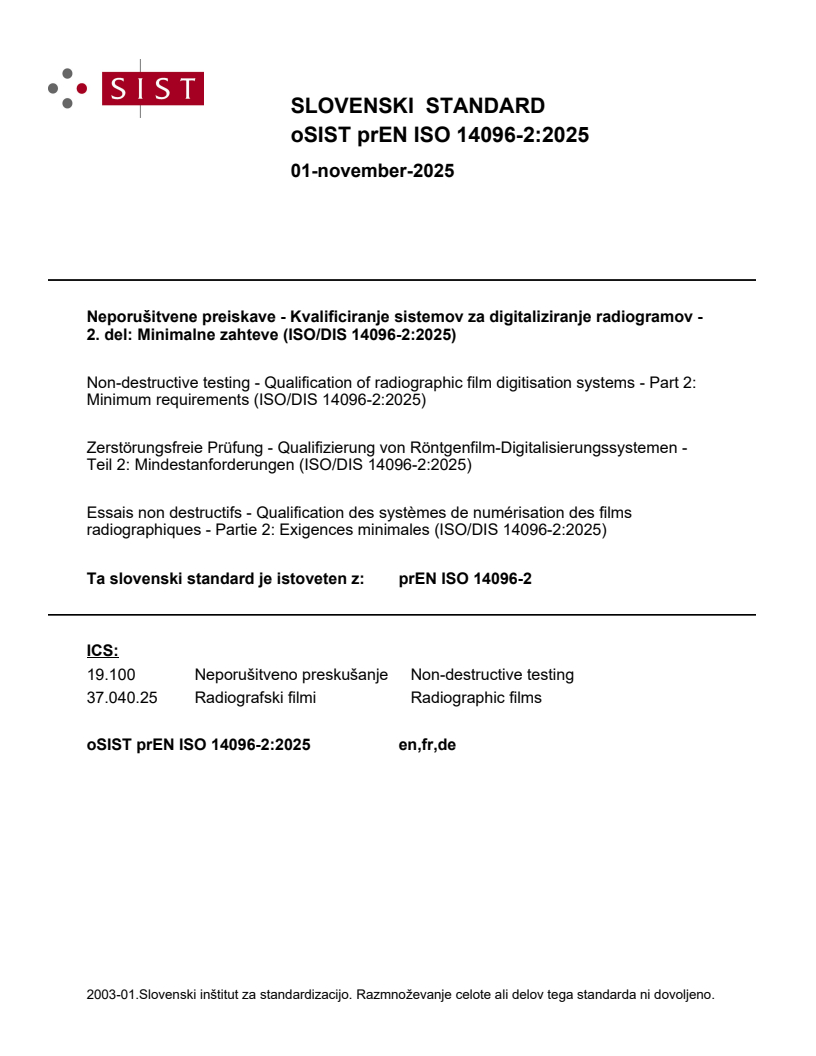
SLOVENSKI STANDARD
oSIST prEN ISO 14096-2:2025
01-november-2025
Neporušitvene preiskave - Kvalificiranje sistemov za digitaliziranje radiogramov -
2. del: Minimalne zahteve (ISO/DIS 14096-2:2025)
Non-destructive testing - Qualification of radiographic film digitisation systems - Part 2:
Minimum requirements (ISO/DIS 14096-2:2025)
Zerstörungsfreie Prüfung - Qualifizierung von Röntgenfilm-Digitalisierungssystemen -
Teil 2: Mindestanforderungen (ISO/DIS 14096-2:2025)
Essais non destructifs - Qualification des systèmes de numérisation des films
radiographiques - Partie 2: Exigences minimales (ISO/DIS 14096-2:2025)
Ta slovenski standard je istoveten z: prEN ISO 14096-2
ICS:
19.100 Neporušitveno preskušanje Non-destructive testing
37.040.25 Radiografski filmi Radiographic films
oSIST prEN ISO 14096-2:2025 en,fr,de
2003-01.Slovenski inštitut za standardizacijo. Razmnoževanje celote ali delov tega standarda ni dovoljeno.
oSIST prEN ISO 14096-2:2025
oSIST prEN ISO 14096-2:2025
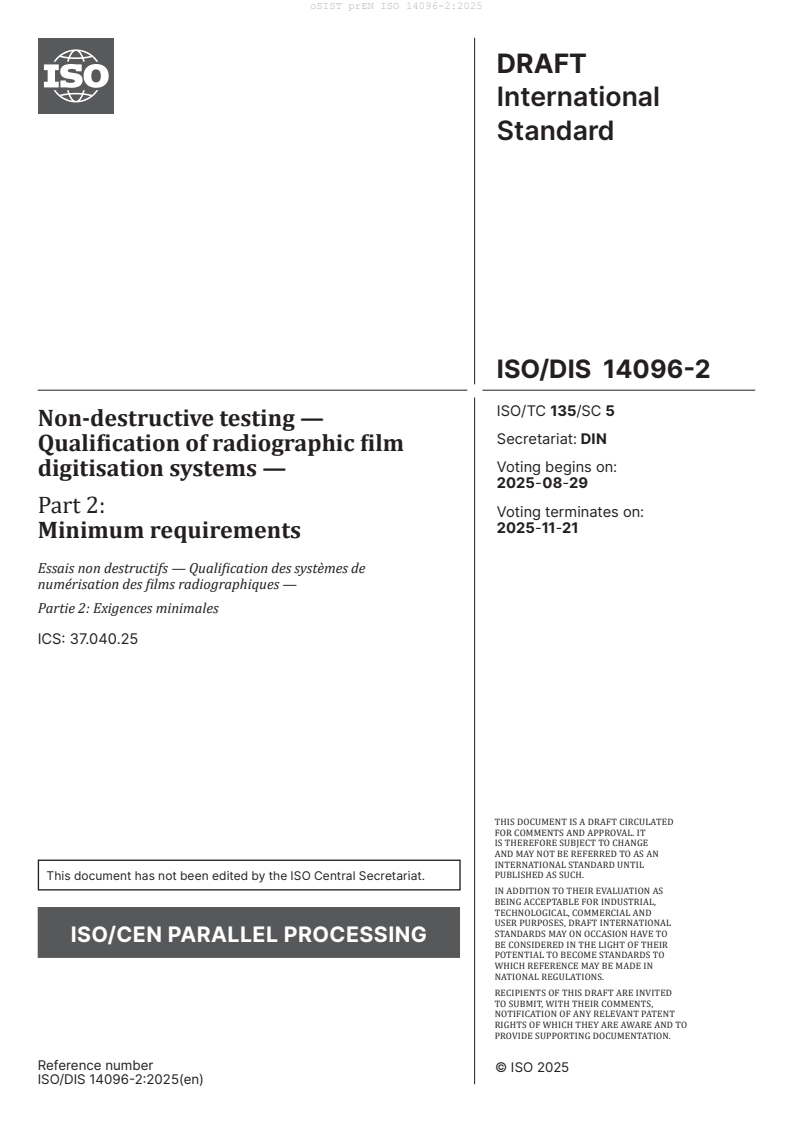
DRAFT
International
Standard
ISO/DIS 14096-2
ISO/TC 135/SC 5
Non-destructive testing —
Secretariat: DIN
Qualification of radiographic film
Voting begins on:
digitisation systems —
2025-08-29
Part 2:
Voting terminates on:
2025-11-21
Minimum requirements
Essais non destructifs — Qualification des systèmes de
numérisation des films radiographiques —
Partie 2: Exigences minimales
ICS: 37.040.25
THIS DOCUMENT IS A DRAFT CIRCULATED
FOR COMMENTS AND APPROVAL. IT
IS THEREFORE SUBJECT TO CHANGE
AND MAY NOT BE REFERRED TO AS AN
INTERNATIONAL STANDARD UNTIL
PUBLISHED AS SUCH.
This document has not been edited by the ISO Central Secretariat.
IN ADDITION TO THEIR EVALUATION AS
BEING ACCEPTABLE FOR INDUSTRIAL,
TECHNOLOGICAL, COMMERCIAL AND
USER PURPOSES, DRAFT INTERNATIONAL
STANDARDS MAY ON OCCASION HAVE TO
ISO/CEN PARALLEL PROCESSING
BE CONSIDERED IN THE LIGHT OF THEIR
POTENTIAL TO BECOME STANDARDS TO
WHICH REFERENCE MAY BE MADE IN
NATIONAL REGULATIONS.
RECIPIENTS OF THIS DRAFT ARE INVITED
TO SUBMIT, WITH THEIR COMMENTS,
NOTIFICATION OF ANY RELEVANT PATENT
RIGHTS OF WHICH THEY ARE AWARE AND TO
PROVIDE SUPPORTING DOCUMENTATION.
Reference number
ISO/DIS 14096-2:2025(en)
oSIST prEN ISO 14096-2:2025
DRAFT
ISO/DIS 14096-2:2025(en)
International
Standard
ISO/DIS 14096-2
ISO/TC 135/SC 5
Non-destructive testing —
Secretariat: DIN
Qualification of radiographic film
Voting begins on:
digitisation systems —
Part 2:
Voting terminates on:
Minimum requirements
Essais non destructifs — Qualification des systèmes de
numérisation des films radiographiques —
Partie 2: Exigences minimales
ICS: 37.040.25
THIS DOCUMENT IS A DRAFT CIRCULATED
FOR COMMENTS AND APPROVAL. IT
IS THEREFORE SUBJECT TO CHANGE
AND MAY NOT BE REFERRED TO AS AN
INTERNATIONAL STANDARD UNTIL
PUBLISHED AS SUCH.
This document has not been edited by the ISO Central Secretariat.
IN ADDITION TO THEIR EVALUATION AS
BEING ACCEPTABLE FOR INDUSTRIAL,
© ISO 2025
TECHNOLOGICAL, COMMERCIAL AND
USER PURPOSES, DRAFT INTERNATIONAL
All rights reserved. Unless otherwise specified, or required in the context of its implementation, no part of this publication may
STANDARDS MAY ON OCCASION HAVE TO
ISO/CEN PARALLEL PROCESSING
be reproduced or utilized otherwise in any form or by any means, electronic or mechanical, including photocopying, or posting on
BE CONSIDERED IN THE LIGHT OF THEIR
the internet or an intranet, without prior written permission. Permission can be requested from either ISO at the address below
POTENTIAL TO BECOME STANDARDS TO
WHICH REFERENCE MAY BE MADE IN
or ISO’s member body in the country of the requester.
NATIONAL REGULATIONS.
ISO copyright office
RECIPIENTS OF THIS DRAFT ARE INVITED
CP 401 • Ch. de Blandonnet 8
TO SUBMIT, WITH THEIR COMMENTS,
CH-1214 Vernier, Geneva
NOTIFICATION OF ANY RELEVANT PATENT
Phone: +41 22 749 01 11
RIGHTS OF WHICH THEY ARE AWARE AND TO
PROVIDE SUPPORTING DOCUMENTATION.
Email: copyright@iso.org
Website: www.iso.org
Published in Switzerland Reference number
ISO/DIS 14096-2:2025(en)
ii
oSIST prEN ISO 14096-2:2025
ISO/DIS 14096-2:2025(en)
Contents Page
Foreword .iv
Introduction .v
1 Scope . 1
2 Normative references . 1
3 Terms and definitions . 1
4 Digitisation quality classes . . 3
5 Minimum requirements for digitisation quality classes . 3
5.1 Density range and working ranges of the radiographic film digitisation system .3
5.2 Minimum basic spatial resolution of radiographic film digitisation systems .4
5.3 Digitisation quality class depending on the radiographic testing class .4
iii
oSIST prEN ISO 14096-2:2025
ISO/DIS 14096-2:2025(en)
Foreword
ISO (the International Organization for Standardization) is a worldwide federation of national standards
bodies (ISO member bodies). The work of preparing International Standards is normally carried out through
ISO technical committees. Each member body interested in a subject for which a technical committee
has been established has the right to be represented on that committee. International organizations,
governmental and non-governmental, in liaison with ISO, also take part in the work. ISO collaborates closely
with the International Electrotechnical Commission (IEC) on all matters of electrotechnical standardization.
The procedures used to develop this document and those intended for its further maintenance are described
in the ISO/IEC Directives, Part 1. In particular, the different approval criteria needed for the different types
of ISO documents should be noted. This document was drafted in accordance with the editorial rules of the
ISO/IEC Directives, Part 2 (see www.iso.org/directives).
ISO draws attention to the possibility that the implementation of this document may involve the use of (a)
patent(s). ISO takes no position concerning the evidence, validity or applicability of any claimed patent
rights in respect thereof. As of the date of publication of this document, ISO had not received notice of
patents which may be required to implement this document. However, implementers are cautioned that
this may not represent the latest information, which may be obtained from the patent database available at
www.iso.org/patents. ISO shall not be held responsible for identifying any or all such patent rights.
Any trade name used in this document is information given for the convenience of users and does not
constitute an endorsement.
For an explanation of the voluntary nature of standards, the meaning of ISO specific terms and expressions
related to conformity assessment, as well as information about ISO's adherence to the World Trade
Organization (WTO) principles in the Technical Barriers to Trade (TBT), see www.iso.org/iso/foreword.html.
This document was prepared by Technical Committee ISO/TC 135, Non-destructive testing, Subcommittee
SC 5, Radiation methods.
This second edition cancels and replaces the first edition (ISO 14096-2:2005), which has been technically
revised.
The main changes are as follows:
— definitions of terms 3.4 and 3.5 updated;
— definitions of terms “spatial frequency” and “modulation transfer function” removed;
— in clause 3.4, definition of term “basic spatial resolution” added;
— values in Table 1, Table 2 and Table 3 updated;
— editorial updated.
A list of all parts in the ISO 14096 series can be found on the ISO website.
Any feedback or questions on this document should be directed to the user’s national standards body. A
complete listing of these bodies can be found at www.iso.org/members.html.
iv
oSIST prEN ISO 14096-2:2025
ISO/DIS 14096-2:2025(en)
Introduction
Radiographic film systems are used for industrial inspection by X- and gamma rays. To apply modern means
of computer support for analysis, transmission and storage the information stored in the radiographic film
should be converted into digital data (digitisation). This document defines minimum requirements to ensure
that the relevant information for evaluation of the digital data is preserved during the film digitisation
process.
v
oSIST prEN ISO 14096-2:2025
oSIST prEN ISO 14096-2:2025
DRAFT International Standard ISO/DIS 14096-2:2025(en)
Non-destructive testing — Qualification of radiographic fi
...