


EN 12393-1:2013
(Main)Foods of plant origin - Multiresidue methods for the determination of pesticide residues by GC or LC-MS/MS - Part 1: General considerations
Foods of plant origin - Multiresidue methods for the determination of pesticide residues by GC or LC-MS/MS - Part 1: General considerations
This European Standard gives general considerations for the determination of pesticide residues in foods of plant origin.
Each method specified in this European Standard is suitable for identifying and quantifying a definite range of those organohalogen, and/or organophosphorus and/or organonitrogen pesticides which occur as residues in foodstuffs of plant origin.
This European Standard contains the following methods that have been subjected to interlaboratory studies and/or are adopted throughout Europe:
- method M: Extraction with acetone and liquid liquid partition with dichloromethane/light petroleum, if necessary clean-up on Florisil® 1) [1], [2], [3];
- method N: Extraction with acetone, liquid liquid partition with dichloromethane or cyclohexane/ethyl acetate and clean-up with gel permeation and silica gel chromatography [4], [5];
- method P: Extraction with ethyl acetate and, if necessary, clean-up with gel permeation chromatography [6].
The applicability of the three methods M, N and P for residue analysis of organohalogen, organophosphorus and organonitrogen pesticides, respectively, is given for each method.
Pflanzliche Lebensmittel - Multiverfahren zur Bestimmung von Pestizidrückständen mit GC oder LC-MS/MS - Teil 1: Allgemeines
Diese Europäische Norm gibt allgemeine Hinweise zur Bestimmung von Pestizidrückständen in pflanzlichen Lebensmitteln.
Jedes in dieser Europäischen Norm festgelegte Verfahren ist zur Identifizierung und Quantifizierung einer jeweils definierten Anzahl an Organohalogen- und/oder Organophosphor- und/oder Organostickstoff-Pestiziden geeignet, die als Rückstände in pflanzlichen Lebensmitteln vorkommen.
Diese Europäische Norm enthält die folgenden Verfahren, die in Ringversuchen erfolgreich geprüft worden und/oder in ganz Europa anerkannt sind:
Verfahren M: Extraktion mit Aceton und Flüssig/flüssig-Verteilung mit Dichlormethan/Petroleumbenzin, falls erforderlich Reinigung mit Florisil ) [1], [2], [3];
Verfahren N: Extraktion mit Aceton, Flüssig/flüssig-Verteilung mit Dichlormethan oder Cyclohexan/Ethylacetat und Reinigung durch Gelpermeations- und Kieselgelchromatographie [4], [5];
Verfahren P: Extraktion mit Ethylacetat und, falls erforderlich, Reinigung durch Gelpermeations-Chromatographie [6].
Die Anwendbarkeit der drei Verfahren M, N und P zur Rückstandsanalyse von Organohalogen-, Organophosphor- und Organostickstoff-Pestiziden ist für jedes Verfahren angegeben.
Aliments d'origine végétale - Méthodes multirésidus de détermination de résidus de pesticides par CPG ou CL-SM/SM - Partie 1: Généralités
La présente Norme européenne donne des considérations générales concernant la détermination des résidus de pesticides dans les aliments d'origine végétale.
Chaque méthode spécifiée dans la présente Norme européenne est adaptée à l'identification et à la quantification d'une gamme bien définie de pesticides organohalogénés et/ou organophosphorés et/ou organoazotés qui sont présents à l'état de résidus dans les produits alimentaires d'origine végétale.
La présente Norme européenne contient les méthodes suivantes qui ont été soumises à des études interlaboratoires et/ou qui sont adoptées dans toute l'Europe :
méthode M : extraction à l'acétone, partage liquide-liquide au dichlorométhane/éther de pétrole et purification au Florisil®, le cas échéant1) [1], [2], [3] ;
méthode N : extraction par acétone, partage liquide-liquide par dichlorométhane ou cyclohexane/acétate d'éthyle et purification par chromatographie par perméation de gel et de gel de silice [4], [5] ;
méthode P : extraction avec acétate d'éthyle et, si nécessaire, purification par chromatographie par perméation de gel [6].
L'applicabilité des trois méthodes M, N et P pour l'analyse des résidus de pesticides organohalogénés, organophosphorés et organoazotés, respectivement, est précisée pour chaque méthode.
Živila rastlinskega izvora - Multirezidualne metode za določevanje ostankov pesticidov s plinsko kromatografijo (GC) ali tekočinsko kromatografijo (LC) z masno selektivno detekcijo (MS/MS) - 1. del: Splošno
Ta evropski standard določa splošne vidike določevanja ostankov pesticidov v živilih rastlinskega izvora. Vsaka metoda iz tega evropskega standarda je primerna za določitev in količinsko opredelitev določenega razpona organohalogenskih in/ali organofosfornih in/ali organodušikovih pesticidov, ki se pojavljajo kot ostanki v živilih rastlinskega izvora. Ta evropski standard zajema naslednje metode, ki so bile predmet medlaboratorijskih študij in/ali so sprejete po vsej Evropi: – metoda M: ekstrakcija z acetonom in ločitev tekoče-tekoče z diklorometanom/lahkim bencinom, po potrebi čiščenje s Florisil® 1) [1], [2], [3]; – metoda N: ekstrakcija z acetonom, ločitev tekoče-tekoče z diklorometanom ali cikloheksanom/etil acetatom ter čiščenje z gelsko permeacijsko in silikagelsko kromatografijo [4], [5]; – metoda P: ekstrakcija z etil acetatom in po potrebi čiščenje z gelsko permeacijsko kromatografijo [6]. Uporabnost vseh treh metod M, N in P za analizo ostankov organohalogenskih, organofosfornih in organodušikovih pesticidov je navedena za vsako metodo.
General Information
- Status
- Published
- Publication Date
- 12-Nov-2013
- Withdrawal Date
- 30-May-2014
- Technical Committee
- CEN/TC 275 - Food analysis - Horizontal methods
- Drafting Committee
- CEN/TC 275/WG 3 - Pesticides and PCB's in foods of animal origin
- Current Stage
- 9060 - Closure of 2 Year Review Enquiry - Review Enquiry
- Start Date
- 04-Mar-2025
- Completion Date
- 04-Mar-2025
Relations
- Effective Date
- 08-Jun-2022
Overview
EN 12393-1:2013 - Foods of plant origin: Multiresidue methods for the determination of pesticide residues by GC or LC‑MS/MS - Part 1: General considerations provides the general framework for multiresidue pesticide analysis in plant‑based foods. It sets out common principles for extraction, clean‑up, instrumental determination and confirmation applicable to the validated multi‑residue methods included in the EN 12393 series. The standard supports reliable identification and quantification of organohalogen, organophosphorus and organonitrogen pesticide residues in fruits, vegetables and derived products.
Key topics and technical requirements
- Scope and method families: Covers general considerations for methods M, N and P, which have been subjected to interlaboratory studies and are used across Europe.
- Method M: acetone extraction + liquid–liquid partition (dichloromethane / light petroleum); optional Florisil® clean‑up.
- Method N: acetone extraction + partition (dichloromethane or cyclohexane/ethyl acetate); gel permeation and silica gel clean‑up.
- Method P: ethyl acetate extraction; optional gel permeation clean‑up.
- Four‑stage analytical workflow: extraction → clean‑up → determination → confirmation (with some stages combinable where justified).
- Instrumental determination: Guidance on using GC (ECD, NPD, FPD, AED, MS and GC‑MS/MS) and LC with tandem MS (LC‑MS/MS) for screening and quantitative determination.
- Confirmation and quality control: Emphasizes identity confirmation (especially when MRLs may be exceeded), method validation, ongoing performance verification and calibration following European Commission guidance.
- Reagents and materials: Requirements for reagent and solvent purity, adsorbent activation and checks, use and storage of analytical standards (recommendation ≥95% purity), and advisories on PTFE storage and light protection.
- Use of internal standards: Recommended for checking losses, correcting recovery and improving quantification, ideally chemically similar to analytes.
- Safety and handling: Practical safety measures for toxic pesticides and hazardous solvents (ventilation, PPE, handling, disposal).
Applications and users
EN 12393-1 is intended for:
- Food testing laboratories performing routine pesticide residue monitoring and surveillance.
- Regulatory authorities enforcing maximum residue limits (MRLs) and compliance testing.
- Method developers and validation scientists applying multiresidue GC‑ or LC‑MS/MS workflows.
- Quality assurance teams implementing method performance verification and interlaboratory comparability.
Practical uses include routine screening of fruits and vegetables, confirmatory testing when MRLs are approached or exceeded, method validation, and laboratory accreditation activities.
Related standards
- EN 12393-2:2013 - Methods for extraction and clean‑up (detailed procedures for methods M, N, P)
- EN 12393-3:2013 - Determination and confirmatory tests (instrumental and confirmation protocols)
Keywords: pesticide residues, multiresidue methods, GC‑MS/MS, LC‑MS/MS, foods of plant origin, extraction, clean‑up, residue analysis, MRL, method validation.

Frequently Asked Questions
EN 12393-1:2013 is a standard published by the European Committee for Standardization (CEN). Its full title is "Foods of plant origin - Multiresidue methods for the determination of pesticide residues by GC or LC-MS/MS - Part 1: General considerations". This standard covers: This European Standard gives general considerations for the determination of pesticide residues in foods of plant origin. Each method specified in this European Standard is suitable for identifying and quantifying a definite range of those organohalogen, and/or organophosphorus and/or organonitrogen pesticides which occur as residues in foodstuffs of plant origin. This European Standard contains the following methods that have been subjected to interlaboratory studies and/or are adopted throughout Europe: - method M: Extraction with acetone and liquid liquid partition with dichloromethane/light petroleum, if necessary clean-up on Florisil® 1) [1], [2], [3]; - method N: Extraction with acetone, liquid liquid partition with dichloromethane or cyclohexane/ethyl acetate and clean-up with gel permeation and silica gel chromatography [4], [5]; - method P: Extraction with ethyl acetate and, if necessary, clean-up with gel permeation chromatography [6]. The applicability of the three methods M, N and P for residue analysis of organohalogen, organophosphorus and organonitrogen pesticides, respectively, is given for each method.
This European Standard gives general considerations for the determination of pesticide residues in foods of plant origin. Each method specified in this European Standard is suitable for identifying and quantifying a definite range of those organohalogen, and/or organophosphorus and/or organonitrogen pesticides which occur as residues in foodstuffs of plant origin. This European Standard contains the following methods that have been subjected to interlaboratory studies and/or are adopted throughout Europe: - method M: Extraction with acetone and liquid liquid partition with dichloromethane/light petroleum, if necessary clean-up on Florisil® 1) [1], [2], [3]; - method N: Extraction with acetone, liquid liquid partition with dichloromethane or cyclohexane/ethyl acetate and clean-up with gel permeation and silica gel chromatography [4], [5]; - method P: Extraction with ethyl acetate and, if necessary, clean-up with gel permeation chromatography [6]. The applicability of the three methods M, N and P for residue analysis of organohalogen, organophosphorus and organonitrogen pesticides, respectively, is given for each method.
EN 12393-1:2013 is classified under the following ICS (International Classification for Standards) categories: 67.050 - General methods of tests and analysis for food products; 67.080.01 - Fruits, vegetables and derived products in general. The ICS classification helps identify the subject area and facilitates finding related standards.
EN 12393-1:2013 has the following relationships with other standards: It is inter standard links to EN 12393-1:2008. Understanding these relationships helps ensure you are using the most current and applicable version of the standard.
You can purchase EN 12393-1:2013 directly from iTeh Standards. The document is available in PDF format and is delivered instantly after payment. Add the standard to your cart and complete the secure checkout process. iTeh Standards is an authorized distributor of CEN standards.
Standards Content (Sample)
2003-01.Slovenski inštitut za standardizacijo. Razmnoževanje celote ali delov tega standarda ni dovoljeno.Pflanzliche Lebensmittel - Multiverfahren zur Bestimmung von Pestizidrückständen mit GC oder LC-MS/MS - Teil 1: AllgemeinesAliments d'origine végétale - Méthodes multirésidus de détermination de résidus de pesticides par CPG ou CL-SM/SM - Partie 1: GénéralitésFoods of plant origin - Multiresidue methods for the determination of pesticide residues by GC or LC-MS/MS - Part 1: General considerations67.080.01Sadje, zelenjava in njuni proizvodi na splošnoFruits, vegetables and derived products in general67.050Splošne preskusne in analizne metode za živilske proizvodeGeneral methods of tests and analysis for food productsICS:Ta slovenski standard je istoveten z:EN 12393-1:2013SIST EN 12393-1:2014en,fr,de01-januar-2014SIST EN 12393-1:2014SLOVENSKI
STANDARDSIST EN 12393-1:20091DGRPHãþD
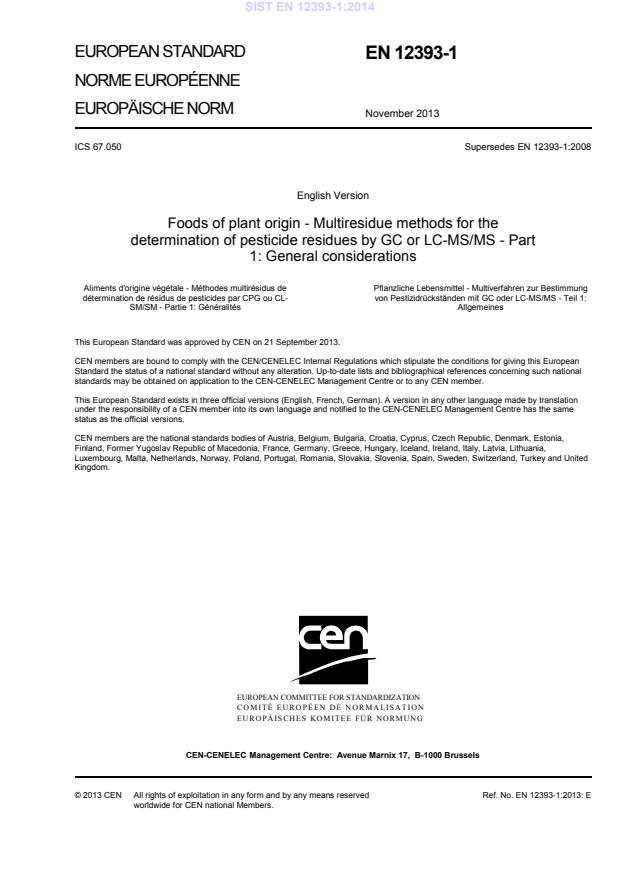
EUROPEAN STANDARD NORME EUROPÉENNE EUROPÄISCHE NORM
EN 12393-1
November 2013 ICS 67.050 Supersedes EN 12393-1:2008English Version
Foods of plant origin - Multiresidue methods for the determination of pesticide residues by GC or LC-MS/MS - Part 1: General considerations
Aliments d'origine végétale - Méthodes multirésidus de détermination de résidus de pesticides par CPG ou CL-SM/SM - Partie 1: Généralités
Pflanzliche Lebensmittel - Multiverfahren zur Bestimmung von Pestizidrückständen mit GC oder LC-MS/MS - Teil 1: Allgemeines This European Standard was approved by CEN on 21 September 2013.
CEN members are bound to comply with the CEN/CENELEC Internal Regulations which stipulate the conditions for giving this European Standard the status of a national standard without any alteration. Up-to-date lists and bibliographical references concerning such national standards may be obtained on application to the CEN-CENELEC Management Centre or to any CEN member.
This European Standard exists in three official versions (English, French, German). A version in any other language made by translation under the responsibility of a CEN member into its own language and notified to the CEN-CENELEC Management Centre has the same status as the official versions.
CEN members are the national standards bodies of Austria, Belgium, Bulgaria, Croatia, Cyprus, Czech Republic, Denmark, Estonia, Finland, Former Yugoslav Republic of Macedonia, France, Germany, Greece, Hungary, Iceland, Ireland, Italy, Latvia, Lithuania, Luxembourg, Malta, Netherlands, Norway, Poland, Portugal, Romania, Slovakia, Slovenia, Spain, Sweden, Switzerland, Turkey and United Kingdom.
EUROPEAN COMMITTEE FOR STANDARDIZATION
COMITÉ EUROPÉEN DE NORMALISATION EUROPÄISCHES KOMITEE FÜR NORMUNG
CEN-CENELEC Management Centre:
Avenue Marnix 17,
B-1000 Brussels © 2013 CEN All rights of exploitation in any form and by any means reserved worldwide for CEN national Members. Ref. No. EN 12393-1:2013: ESIST EN 12393-1:2014
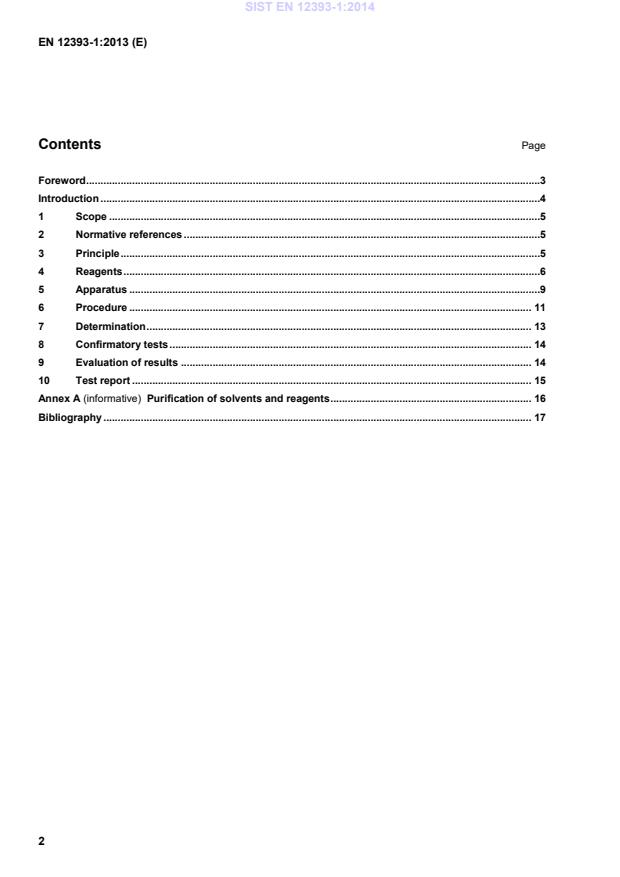
Purification of solvents and reagents . 16 Bibliography . 17
is divided into three parts: Part 1 "General considerations" provides general considerations with regard to reagents, apparatus, gas chromatography, etc., applying to each of the selected analytical methods; Part 2 "Methods for extraction and clean-up" presents methods M, N and P for the extraction and clean-up using techniques such as liquid-liquid partition, adsorption column chromatography or gel permeation column chromatography, etc.; Part 3 "Determination and confirmatory tests" gives some recommended techniques for the qualitative and the quantitative measurements of residues and the confirmation of the results. According to the CEN-CENELEC Internal Regulations, the national standards organizations of the following countries are bound to implement this European Standard: Austria, Belgium, Bulgaria, Croatia, Cyprus, Czech Republic, Denmark, Estonia, Finland, Former Yugoslav Republic of Macedonia, France, Germany, Greece, Hungary, Iceland, Ireland, Italy, Latvia, Lithuania, Luxembourg, Malta, Netherlands, Norway, Poland, Portugal, Romania, Slovakia, Slovenia, Spain, Sweden, Switzerland, Turkey and the United Kingdom. SIST EN 12393-1:2014
Introduction This European Standard comprises a range of multi-residue methods of equal status: no single method can be identified as the prime method because, in this field, methods are continuously developing. The selected methods included in this European Standard have been validated and/or are widely used throughout Europe. Because these methods can be applied to the very wide range of food commodities/pesticide combinations, using different systems for determination, there are occasions when variations in equipment used, extraction, clean-up and chromatographic conditions are appropriate to improve method performance, see 3.1. SIST EN 12393-1:2014
1)
Florisil® is an example of a suitable product available commercially. This information is given for the convenience of users of this European Standard and does not constitute an endorsement by CEN of this product. SIST EN 12393-1:2014
3.5 Confirmation Procedures to confirm the identity and quantity of observed residues should be used, particularly in those cases where it would appear that the maximum residue limit (MRL) has been exceeded.
3.6 Use of internal standards An internal standard may be added in a constant amount to samples, the blank and calibration standards. This substance can be used for checking critical points of methods (e.g. volatile or unstable compounds) and/or for quantification purposes, if appropriate. This is done to correct for the loss of analyte during sample preparation and sample clean-up or to check reproducibility of final determination steps by GC or LC. The internal standard should be preferably a compound that has very similar physico-chemical and chemical properties compared to the analyte.
4 Reagents 4.1 General Use reagents of purity suitable for pesticide residue analysis and check their purity (see 4.2). If required, purify water and solvents used, e.g. as described in Annex A, and check their purity (see 4.2). Purify and periodically activate adsorbents according to the requirements of the different analytical methods; check their purity (see 4.2). Take every precaution to avoid possible contamination of water, solvents, adsorbents, etc. from plastics and rubber materials. SIST EN 12393-1:2014
4.2.2 Water Extract 10 parts by volume of water with one part by volume of n-hexane or light petroleum, dichloromethane or any other non-water miscible solvent used in the method. Separate the organic phase, concentrate by the factor involved in the respective method and test for purity under the same conditions as used in the method. The chromatogram should not show any interfering impurity. 4.2.3 Inorganic salts Extract inorganic salts, for example sodium chloride, after purification according to Annex A or the requirements of the different analytical methods. Extract the salts and any aqueous solution used, with n-hexane or light petroleum, dichloromethane or any other non-water miscible solvent used in the method. Concentrate the extract by the factor involved in the respective method and test the purity under the same conditions as used in the method. The chromatogram should not show any interfering impurity. 4.2.4 Adsorbents Elute an amount of adsorbent equal to that used in the analytical method with the corresponding type and volume of solvent or solvent mixture. Concentrate the eluate as indicated in the analytical method and test for purity. The chromatogram should not show any interfering impurity. Check the activity of adsorbents regularly as described in the methods M to P (see EN 12393-2). 4.2.5 Standard materials and solutions Use standard materials of at least 95 % purity and traceable quality as standards for residue analysis. Ensure dilute solutions are prepared and checked frequently, and that standard solutions are stored in glass bottles in a refrigerator and every precaution is taken to avoid possible contamination from plastics or rubber materials. Ensure that the standard solutions are not directly exposed to sunlight or ultraviolet light for prolonged periods of time. Examine analytical standards for impurities. When stored at -20 °C, standard materials are generally stable for at least a year. To allow equilibration, it is recommended to allow the standards to come up to room temperature before the containers are opened. Stock solutions of concentration 1 mg/ml, if kept in a freezer (at about -20 °C), are usually stable for 6 months, but the influence of repeated uses has to be checked. Changes in volume due to solvent evaporation, for example through the space between a glass stopper and the neck of a flask, can be a source of error. Therefore, the use of polytetrafluoroethylene (PTFE) screw-cap flasks is recommended for the storage of stock and standard solutions. Experience has shown that errors introduced in the preparation, handling and storage of standards and standard solutions are major sources of inaccuracies. Experiences obtained by other national, European and international bodies should be observed [7], [8]. 4.3 Safety aspects associated with reagents 4.3.1 General The analysis of pesticide residues in a food matrix includes the use of several hazardous chemicals. Safety precautions as given in 4.3.2 and 4.3.3 shall be observed at all times. SIST EN 12393-1:2014
Highly flammable Forms explosive peroxides with oxidising agents. Use an effective fume removal device. Acetonitrile Toxic Avoid contact with skin and eyes. Use an effective fume removal device. Cyclohexane Highly flammable
Use an effective fume removal device. Dichloromethane Toxic Avoid contact with eyes and avoid breathing vapours. Use an effective fume removal device. Diethyl ether Extremely flammable Unstable peroxides can form upon long standing or exposure to sunlight in bottles. Store protected from light. Use an effective fume removal device. See also the warning on peroxides. Ethanol
Flammable
Use an effective fume removal device when heating or evaporating. Ethyl acetate Flammable, especially when being evaporated Irritating to eyes and respiratory tract. Use an effective fume removal device. n-Hexane Highly flammable Toxic
Use an effective fume removal device. Iso-octane Highly flammable
Use an effective fume removal device. Light petroleum Extremely flammable
Use an effective fume removal device. Methanol Flammable
Toxic Avoid contact with eyes. Avoid breathing the vapours. Use an effective fume removal device.
SAFETY MEASURES: Peroxides form in diethyl ether, dioxane, and other ethers during storage. They are explosive and have to be destroyed before distillation or evaporation. Exposure to light increases peroxide formation in ethers. Filtration through activated aluminium oxide is reported to be effective in removing peroxides. 5 Apparatus 5.1 Glassware: General Thoroughly clean glassware shall be used for residue analysis. There is a risk of carry-over of pesticides through use of glassware and other laboratory equipment. This should be taken into account, particularly when employing laboratory washing machines. Hot detergent solution (with no interfering compounds) may be used for cleaning, but afterwards the glassware shall be well rinsed with distilled water and acetone before drying. Before being washed in a washing machine, the glassware shall be rinsed with acetone, then with water. Wash it in the machine with non-chlorinated detergent, rinse with water and dry. In both cases, verify that the detergent does not leave any interfering impurity. It is also advisable to rinse glassware again with the solvent to be used immediately before use. Common laboratory glassware or equipment such as beakers, round-bottomed flasks, watch glasses, pipettes, filter papers, glass wool, glass rods and glass beads, etc. are not listed in the apparatus clause of each method in detail. SIST EN 12393-1:2014
...
The article discusses the European Standard EN 12393-1:2013, which provides general considerations for determining pesticide residues in plant-based foods. The standard includes specific methods for identifying and quantifying different types of pesticides in food samples. These methods have undergone interlaboratory studies and are widely used throughout Europe. The article mentions three specific methods: method M, which involves extraction with acetone and liquid-liquid partition; method N, which involves extraction with acetone and further purification using gel permeation and silica gel chromatography; and method P, which involves extraction with ethyl acetate and purification using gel permeation chromatography. Each method is suitable for analyzing specific types of pesticides.
The article discusses the European Standard EN 12393-1:2013, which provides general considerations for determining pesticide residues in plant-based foods. The standard includes methods for identifying and quantifying specific types of pesticides that may be present in these food items. Three methods (M, N, and P) are outlined, each with its own extraction and clean-up processes. The methods have undergone interlaboratory studies and are widely adopted throughout Europe. The article highlights the applicability of each method for analyzing different types of pesticides.
이 기사는 유기할로겐, 유기인산 및 유기질소 농약의 잔류물을 식물 기원 식품에서 결정하기 위한 다중잔류물 방법에 대한 일반적인 고려 사항을 제공하는 유럽 표준 EN 12393-1:2013에 대해 논의하고 있습니다. 이 유럽 표준에 명시된 각각의 방법은 식물 기원 식품의 잔류물로서 나타나는 일정 범위의 유기할로겐 및/또는 유기인산 및/또는 유기질소 농약을 식별하고 정량화하는 데 적합합니다. 이 유럽 표준에는 다음과 같은 방법이 포함되어 있으며, 이들은 국제 실험실 연구에 따라 개발되었거나 유럽 전역에서 채택되었습니다: - 방법 M: 아세톤 추출 및 디클로로메탄/경유에 대한 액체 추출, 필요한 경우 Florisil®이용 정화 [1], [2], [3]; - 방법 N: 아세톤 추출, 디클로로메탄 또는 사이클로헥산/에틸아세테이트에 대한 액체 추출, 그리고 젤 침투 및 실리카 젤 크로마토그래피로 정화 [4], [5]; - 방법 P: 에틸아세테이트 추출 및 필요한 경우 젤 침투 크로마토그래피로 정화 [6]. 유기할로겐, 유기인산 및 유기질소 농약의 잔류물 분석을 위한 각각의 방법 M, N 및 P의 적용 가능성이 각 방법에 대해 제공됩니다.
この記事では、植物由来の食品中の農薬残留物を決定するための多残留物分析法について、欧州標準EN 12393-1:2013に一般的な考慮事項を示しています。この欧州標準で指定されたそれぞれの方法は、食品中に残留する有機ハロゲン、有機リン、有機窒素農薬の一定範囲を特定し、定量化するのに適しています。この欧州標準には、相互試験やヨーロッパ全体で採用されている次の方法が含まれています: - 方法M:アセトンでの抽出とジクロロメタン/軽油での液液分配、必要に応じてFlorisil® [1]、[2]、[3]でのクリーンアップ; - 方法N:アセトンでの抽出、ジクロロメタンまたはシクロヘキサン/エチルアセテートでの液液分配、ゲル浸透とシリカゲルクロマトグラフィでのクリーンアップ [4]、[5]; - 方法P:エチルアセテートでの抽出、必要に応じてゲル浸透クロマトグラフィでのクリーンアップ [6]。 各方法M、N、およびPがそれぞれ有機ハロゲン、有機リン、有機窒素農薬の残留物分析に適用可能であることが、各方法ごとに示されています。
この記事は、食品の植物由来品における農薬残留物の測定に関する一般的な考慮事項を示しているヨーロッパ標準であるEN 12393-1:2013について述べています。このヨーロッパ標準には、食品中に残留物として存在する特定の有機ハロゲン、有機リン、および有機窒素系農薬を同定および定量化するための各方法が適用されています。このヨーロッパ標準には、次の方法が含まれており、相互試験が行われたり、ヨーロッパ全域で採用されたりしています: - 方法M:アセトンでの抽出およびジクロロメタン/軽油での液液分配、必要に応じてフロリシルでのクリーンアップ[1]、[2]、[3]。 - 方法N:アセトンでの抽出、ジクロロメタンまたはシクロヘキサン/エチルアセテートでの液液分配、ゲル透析およびシリカゲルクロマトグラフィによるクリーンアップ[4]、[5]。 - 方法P:エチルアセテートでの抽出、必要に応じてゲル透析クロマトグラフィによるクリーンアップ[6]。 各方法がそれぞれ有機ハロゲン、有機リン、有機窒素系農薬の残留物分析に適用可能であることが示されています。
이 기사는 식물 기반 식품에서 농약 잔류물을 결정하기 위한 일반적인 고려사항을 제공하는 유럽 표준 EN 12393-1:2013 에 대해 다루고 있습니다. 이 표준에는 이러한 식품에 잔류물로 존재하는 일부 유기 할로겐, 유기 인, 그리고 유기 질소 농약을 식별하고 정량화하는데 적합한 각 방법이 명시되어있습니다. 이 유럽 표준에는 다음과 같은 방법들이 포함되어 있으며 또한 상호연구소 시험을 거친 방법이거나 유럽 전역에서 채택된 방법입니다: - 방법 M: 아세톤 추출 및 디클로로메탄/경유 분리, 필요한 경우 Florisil™로 정화 [1], [2], [3]; - 방법 N: 아세톤 추출, 디클로로메탄 또는 사이클로헥산/에틸아세테이트로 액체 분리, 젤 침투 및 실리카겔 크로마토그래피를 통해 정화 [4], [5]; - 방법 P: 에틸아세테이트로 추출하고 필요한 경우 젤 침투 크로마토그래피로 정화 [6]. 각 방법에 대한 유기 할로겐, 유기 인, 유기 질소 농약의 잔류물 분석에 대한 적합성이 제공됩니다.
Questions, Comments and Discussion
Ask us and Technical Secretary will try to provide an answer. You can facilitate discussion about the standard in here.
Loading comments...