

EN 17748-1:2022
(Main)Foundational Body of Knowledge for the ICT Profession (ICT BoK) - Part 1: Body of Knowledge
General Information
- Abstract
This document provides a reference of 42 knowledge units as required and applied in the Information and Communication Technology (ICT) professional work environment that can be understood across Europe. An intrinsic link with the EN 16234-1 (e-CF) is an essential characteristic of this document.
The document is created for application by:
— educational institutions, learning programme and certification providers of all types including:
• Vocational and Educational Training (VET);
• Higher education (HE);
• Continuous Professional Development (CPD);
— ICT service, user and supply organisations;
— ICT professionals, managers and human resource (HR) departments;
— social partners (trade unions and employer associations), professional associations, accreditation, validation and assessment bodies;
— market analysts and policy makers; and
— other organisations and stakeholders in public and private sectors.
This document is provided as one fundamental building block of ICT Professionalism for Europe.
The prime objective of this document is to provide a significant contribution to the broad concept of ICT professionalism founded upon four building blocks, body of knowledge, e-CF competence, professional ethics and education and training. Complementary to the EN 16234-1 (e-CF) that provides an efficient and broadly accepted common European language about ICT professional competence, the European ICT Foundational Body of Knowledge (ICT BoK) makes an additional contribution to ICT professional knowledge, increasing transparency and maturity of the ICT Profession across Europe.
Specifically, the document provides a structured library of knowledge elements applicable to ICT professionals across a broad spectrum of disciplines. The knowledge elements are identified as either:
a) common knowledge applicable to all ICT professionals regardless of speciality;
b) base knowledge that provides a foundation and underpins each of a range of different disciplines/specialisms;
c) specialised knowledge pertaining to in-depth, very specific expert knowledge.
Although providing and adding value to all stakeholders, knowledge defined by this document, provides a particularly useful perspective and entry point for educational institutions seeking to participate in ICT professional competence development. As a natural extension to EN 16234-1 (e-CF) dimension 4 knowledge examples, this document further facilitates the use of the shared European language for ICT Professional competence. By expanding the knowledge content of the EN 16234-1 (e-CF), it adds value to its application alongside further connected references.
- Status
- Published
- Publication Date
- 19-Apr-2022
- Withdrawal Date
- 30-Oct-2022
- Current Stage
- 6060 - Definitive text made available (DAV) - Publishing
- Start Date
- 20-Apr-2022
- Due Date
- 21-Jul-2022
- Completion Date
- 20-Apr-2022


Overview
EN 17748-1:2022 - Foundational Body of Knowledge for the ICT Profession (ICT BoK) - Part 1: Body of Knowledge is a European standard that defines a structured library of knowledge for ICT professionals. Published by CEN in April 2022, the standard provides a reference of 42 knowledge units organized to be interoperable with the EN 16234-1 (e-CF) common European competence framework. The ICT BoK clarifies what ICT professionals need to know at common, base, and specialised levels and supports transparency and maturity of the ICT profession across Europe.
Key Topics and Requirements
- 42 Knowledge Units: A core index of knowledge elements relevant across ICT roles and sectors.
- Three knowledge levels:
- Common knowledge - applicable to all ICT professionals.
- Base knowledge - foundational concepts underpinning multiple specialisms.
- Specialised knowledge - in-depth topics with pointers to further sources.
- Tagging and views: Knowledge units are cross-referenced by:
- Traditional knowledge domains
- EN 16234-1 (e-CF) areas / ICT processes
- EN 16234-1 (e-CF) competences
- CWA 16458 European ICT Professional Role Profiles
- Knowledge Unit Template: Standardized template for consistent description, examples of application, and relationships between knowledge levels.
- Normative references: Intrinsic linkage with EN 16234-1:2019 (e-CF) and CWA 16458.
- Complementary guidance: Part 2 (CEN/TR 17748-2:2022) provides user guidance and methodology for applying the ICT BoK.
Practical Applications and Who Would Use It
EN 17748-1:2022 is designed for broad uptake across education, industry and policy:
- Educational institutions & trainers: VET, higher education (HE), and CPD providers can use the ICT BoK to design curricula and mapping to professional competences.
- Certification & assessment bodies: Use the structured knowledge units to develop assessment criteria and validation processes.
- Employers, HR & managers: Define job profiles, career pathways, role expectations and learning plans that align with European ICT competence language.
- ICT organisations & professionals: Support professional development, skills gap analysis and role-specialisation strategies.
- Policy makers & market analysts: Inform workforce planning, benchmarking and policy for ICT professionalism.
- Social partners & professional associations: Use as a common reference for negotiations, accreditation and codes of practice.
Related Standards (if applicable)
- EN 16234-1:2019 (e-CF) - e-Competence Framework (mandatory reference for competence language).
- CWA 16458 - European ICT Professional Role Profiles (role mapping).
- CEN/TR 17748-2:2022 - ICT BoK Part 2: User Guide and Methodology (practical application guidance).
Keywords: EN 17748-1:2022, ICT BoK, Foundational Body of Knowledge, EN 16234-1, e-CF, ICT professionals, knowledge units, VET, higher education, CPD, CWA 16458.
Relations
- Effective Date
- 28-Jan-2026
- Effective Date
- 28-Jan-2026
- Effective Date
- 28-Jan-2026
- Effective Date
- 28-Jan-2026
- Effective Date
- 28-Jan-2026
- Effective Date
- 28-Jan-2026
- Effective Date
- 28-Jan-2026
Get Certified
Connect with accredited certification bodies for this standard

BSI Group
BSI (British Standards Institution) is the business standards company that helps organizations make excellence a habit.

Bureau Veritas
Bureau Veritas is a world leader in laboratory testing, inspection and certification services.

DNV
DNV is an independent assurance and risk management provider.
Sponsored listings
Frequently Asked Questions
EN 17748-1:2022 is a standard published by the European Committee for Standardization (CEN). Its full title is "Foundational Body of Knowledge for the ICT Profession (ICT BoK) - Part 1: Body of Knowledge". This standard covers: This document provides a reference of 42 knowledge units as required and applied in the Information and Communication Technology (ICT) professional work environment that can be understood across Europe. An intrinsic link with the EN 16234-1 (e-CF) is an essential characteristic of this document. The document is created for application by: — educational institutions, learning programme and certification providers of all types including: • Vocational and Educational Training (VET); • Higher education (HE); • Continuous Professional Development (CPD); — ICT service, user and supply organisations; — ICT professionals, managers and human resource (HR) departments; — social partners (trade unions and employer associations), professional associations, accreditation, validation and assessment bodies; — market analysts and policy makers; and — other organisations and stakeholders in public and private sectors. This document is provided as one fundamental building block of ICT Professionalism for Europe. The prime objective of this document is to provide a significant contribution to the broad concept of ICT professionalism founded upon four building blocks, body of knowledge, e-CF competence, professional ethics and education and training. Complementary to the EN 16234-1 (e-CF) that provides an efficient and broadly accepted common European language about ICT professional competence, the European ICT Foundational Body of Knowledge (ICT BoK) makes an additional contribution to ICT professional knowledge, increasing transparency and maturity of the ICT Profession across Europe. Specifically, the document provides a structured library of knowledge elements applicable to ICT professionals across a broad spectrum of disciplines. The knowledge elements are identified as either: a) common knowledge applicable to all ICT professionals regardless of speciality; b) base knowledge that provides a foundation and underpins each of a range of different disciplines/specialisms; c) specialised knowledge pertaining to in-depth, very specific expert knowledge. Although providing and adding value to all stakeholders, knowledge defined by this document, provides a particularly useful perspective and entry point for educational institutions seeking to participate in ICT professional competence development. As a natural extension to EN 16234-1 (e-CF) dimension 4 knowledge examples, this document further facilitates the use of the shared European language for ICT Professional competence. By expanding the knowledge content of the EN 16234-1 (e-CF), it adds value to its application alongside further connected references.
This document provides a reference of 42 knowledge units as required and applied in the Information and Communication Technology (ICT) professional work environment that can be understood across Europe. An intrinsic link with the EN 16234-1 (e-CF) is an essential characteristic of this document. The document is created for application by: — educational institutions, learning programme and certification providers of all types including: • Vocational and Educational Training (VET); • Higher education (HE); • Continuous Professional Development (CPD); — ICT service, user and supply organisations; — ICT professionals, managers and human resource (HR) departments; — social partners (trade unions and employer associations), professional associations, accreditation, validation and assessment bodies; — market analysts and policy makers; and — other organisations and stakeholders in public and private sectors. This document is provided as one fundamental building block of ICT Professionalism for Europe. The prime objective of this document is to provide a significant contribution to the broad concept of ICT professionalism founded upon four building blocks, body of knowledge, e-CF competence, professional ethics and education and training. Complementary to the EN 16234-1 (e-CF) that provides an efficient and broadly accepted common European language about ICT professional competence, the European ICT Foundational Body of Knowledge (ICT BoK) makes an additional contribution to ICT professional knowledge, increasing transparency and maturity of the ICT Profession across Europe. Specifically, the document provides a structured library of knowledge elements applicable to ICT professionals across a broad spectrum of disciplines. The knowledge elements are identified as either: a) common knowledge applicable to all ICT professionals regardless of speciality; b) base knowledge that provides a foundation and underpins each of a range of different disciplines/specialisms; c) specialised knowledge pertaining to in-depth, very specific expert knowledge. Although providing and adding value to all stakeholders, knowledge defined by this document, provides a particularly useful perspective and entry point for educational institutions seeking to participate in ICT professional competence development. As a natural extension to EN 16234-1 (e-CF) dimension 4 knowledge examples, this document further facilitates the use of the shared European language for ICT Professional competence. By expanding the knowledge content of the EN 16234-1 (e-CF), it adds value to its application alongside further connected references.
EN 17748-1:2022 is classified under the following ICS (International Classification for Standards) categories: 03.100.30 - Management of human resources; 35.020 - Information technology (IT) in general. The ICS classification helps identify the subject area and facilitates finding related standards.
EN 17748-1:2022 has the following relationships with other standards: It is inter standard links to EN 16234-1:2019, EN 18109:2025, CEN/TS 17699:2022, EN ISO 9073-5:2025, EN ISO 9073-13:2023, CEN/TR 17748-2:2022, EN ISO 9073-1:2023. Understanding these relationships helps ensure you are using the most current and applicable version of the standard.
EN 17748-1:2022 is available in PDF format for immediate download after purchase. The document can be added to your cart and obtained through the secure checkout process. Digital delivery ensures instant access to the complete standard document.
Standards Content (Sample)
SLOVENSKI STANDARD
01-junij-2022
Osnovni nabor znanj za poklic IKT (ICT BoK) - 1. del: Nabor znanj
Foundational Body of Knowledge for the ICT Profession (ICT BoK) - Part 1: Body of
Knowledge
Europäischer Grundwissensbestand für den IKT-Beruf (ICT BoK) - Teil 1: Der
Wissensbestand
Corps de connaissance fondamental pour les professionnels des technologies de
l'information et de la communication (ICT BoK) - Partie 1 : Corps de connaissance
Ta slovenski standard je istoveten z: EN 17748-1:2022
ICS:
03.100.30 Vodenje ljudi Management of human
resources
35.020 Informacijska tehnika in Information technology (IT) in
tehnologija na splošno general
2003-01.Slovenski inštitut za standardizacijo. Razmnoževanje celote ali delov tega standarda ni dovoljeno.
EN 17748-1
EUROPEAN STANDARD
NORME EUROPÉENNE
April 2022
EUROPÄISCHE NORM
ICS 03.100.30; 35.020
English Version
Foundational Body of Knowledge for the ICT Profession
(ICT BoK) - Part 1: Body of Knowledge
Corps de connaissance fondamental pour les Europäischer Grundwissensbestand für den IKT-Beruf
professionnels des technologies de l'information et de (ICT BoK) - Teil 1: Der Wissensbestand
la communication (ICT BoK) - Partie 1 : Corps de
connaissance
This European Standard was approved by CEN on 25 March 2022.
CEN members are bound to comply with the CEN/CENELEC Internal Regulations which stipulate the conditions for giving this
European Standard the status of a national standard without any alteration. Up-to-date lists and bibliographical references
concerning such national standards may be obtained on application to the CEN-CENELEC Management Centre or to any CEN
member.
This European Standard exists in three official versions (English, French, German). A version in any other language made by
translation under the responsibility of a CEN member into its own language and notified to the CEN-CENELEC Management
Centre has the same status as the official versions.
CEN members are the national standards bodies of Austria, Belgium, Bulgaria, Croatia, Cyprus, Czech Republic, Denmark, Estonia,
Finland, France, Germany, Greece, Hungary, Iceland, Ireland, Italy, Latvia, Lithuania, Luxembourg, Malta, Netherlands, Norway,
Poland, Portugal, Republic of North Macedonia, Romania, Serbia, Slovakia, Slovenia, Spain, Sweden, Switzerland, Turkey and
United Kingdom.
EUROPEAN COMMITTEE FOR STANDARDIZATION
COMITÉ EUROPÉEN DE NORMALISATION
EUROPÄISCHES KOMITEE FÜR NORMUNG
CEN-CENELEC Management Centre: Rue de la Science 23, B-1040 Brussels
© 2022 CEN All rights of exploitation in any form and by any means reserved Ref. No. EN 17748-1:2022 E
worldwide for CEN national Members.
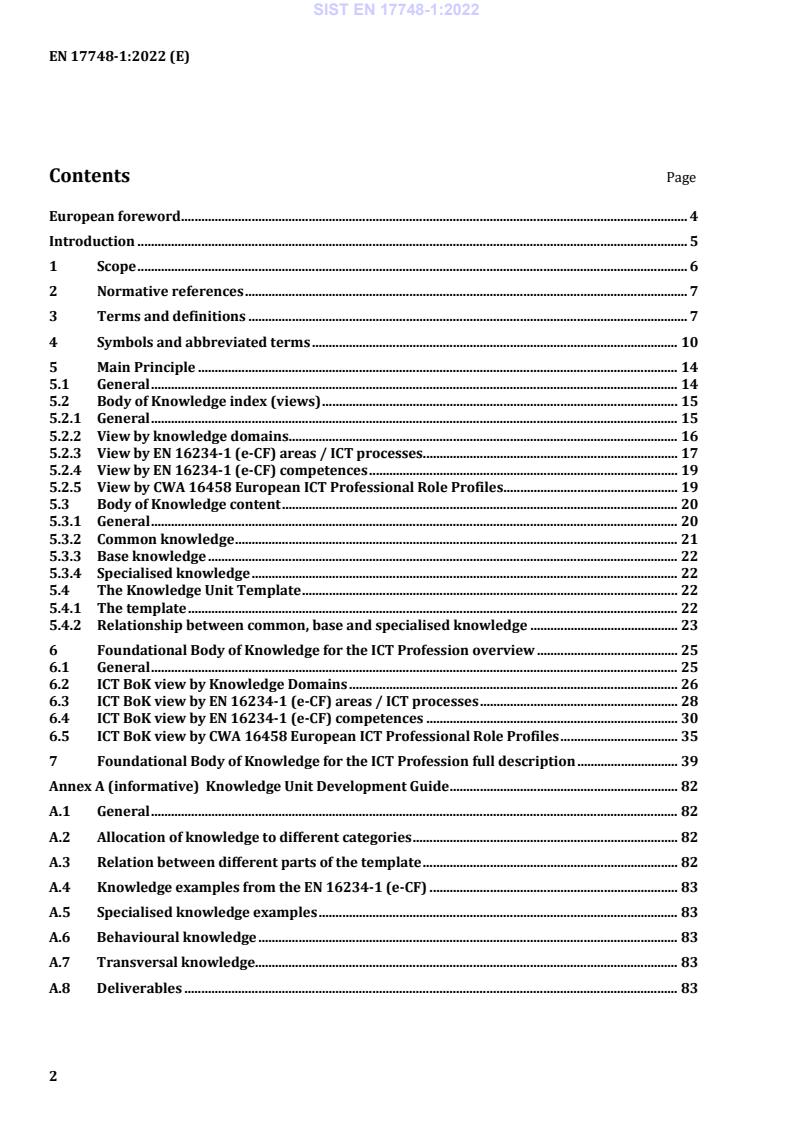
Contents Page
European foreword . 4
Introduction . 5
1 Scope . 6
2 Normative references . 7
3 Terms and definitions . 7
4 Symbols and abbreviated terms . 10
5 Main Principle . 14
5.1 General . 14
5.2 Body of Knowledge index (views) . 15
5.2.1 General . 15
5.2.2 View by knowledge domains. 16
5.2.3 View by EN 16234-1 (e-CF) areas / ICT processes. 17
5.2.4 View by EN 16234-1 (e-CF) competences . 19
5.2.5 View by CWA 16458 European ICT Professional Role Profiles. 19
5.3 Body of Knowledge content . 20
5.3.1 General . 20
5.3.2 Common knowledge . 21
5.3.3 Base knowledge . 22
5.3.4 Specialised knowledge . 22
5.4 The Knowledge Unit Template . 22
5.4.1 The template . 22
5.4.2 Relationship between common, base and specialised knowledge . 23
6 Foundational Body of Knowledge for the ICT Profession overview . 25
6.1 General . 25
6.2 ICT BoK view by Knowledge Domains . 26
6.3 ICT BoK view by EN 16234-1 (e-CF) areas / ICT processes . 28
6.4 ICT BoK view by EN 16234-1 (e-CF) competences . 30
6.5 ICT BoK view by CWA 16458 European ICT Professional Role Profiles . 35
7 Foundational Body of Knowledge for the ICT Profession full description . 39
Annex A (informative) Knowledge Unit Development Guide . 82
A.1 General . 82
A.2 Allocation of knowledge to different categories . 82
A.3 Relation between different parts of the template . 82
A.4 Knowledge examples from the EN 16234-1 (e-CF) . 83
A.5 Specialised knowledge examples . 83
A.6 Behavioural knowledge . 83
A.7 Transversal knowledge. 83
A.8 Deliverables . 83
Annex B (informative) Linking e-CF knowledge and skills examples with ICT BoK
Knowledge Units . 84
Bibliography . 99
European foreword
This document (EN 17748-1:2022) has been prepared by the Technical Committee CEN/TC 428 “ICT
professionalism and digital competences”, the secretariat of which is held by UNI.
This European Standard shall be given the status of a national standard, either by publication of an
identical text or by endorsement, at the latest by October 2022, and conflicting national standards shall
be withdrawn at the latest by October 2022.
Attention is drawn to the possibility that some of the elements of this document may be the subject of
patent rights. CEN shall not be held responsible for identifying any or all such patent rights.
This series consists of two parts:
— EN 17748-1:2022, Foundational Body of Knowledge for the ICT Profession (ICT BoK) - Part 1: The
Body of Knowledge, published as a European Norm (EN).
— CEN/TR 17748-2:2022, Foundational Body of Knowledge for the ICT Profession (ICT BoK) - Part 2:
User Guide and Methodology, published as a CEN Technical Report (TR).
Any feedback and questions on this document should be directed to the users’ national standards body.
A complete listing of these bodies can be found on the CEN website.
According to the CEN-CENELEC Internal Regulations, the national standards organisations of the
following countries are bound to implement this European Standard: Austria, Belgium, Bulgaria,
Croatia, Cyprus, Czech Republic, Denmark, Estonia, Finland, France, Germany, Greece, Hungary, Iceland,
Ireland, Italy, Latvia, Lithuania, Luxembourg, Malta, Netherlands, Norway, Poland, Portugal, Republic of
North Macedonia, Romania, Serbia, Slovakia, Slovenia, Spain, Sweden, Switzerland, Turkey and the
United Kingdom.
Introduction
This document provides a tool to support mutual understanding and provide transparency of language
through the articulation of knowledge required and deployed by Information and Communication
Technology (ICT) professionals.
Complementary to the EN 16234-1 (e-CF), that provides a common European language for ICT
professional competence, this document, EN 17748-1:2022 (ICT BoK) makes an additional contribution
to increasing transparency and maturity of the ICT Profession across Europe.
This document identifies knowledge and sub divides each knowledge unit into three elements:
a) common knowledge applicable to all ICT professionals regardless of speciality;
b) base knowledge that provides a foundation and underpins each of a range of different disciplines/
specialisms;
c) specialised knowledge pertaining to in-depth, very specific expert knowledge.
For c) specialised knowledge, where applicable, sources of further specialist knowledge are signposted
as examples to relevant in-depth complementary sources.
To support users of this document, the following narrative provides an overview of the design
philosophy and principles adopted during the standard’s construction. In addition, these underpinning
principles will provide guidance for future document updates.
The Guiding Principles:
This document is an enabler; it is designed to be a tool to empower users, not to restrict them.
This document provides a structure and content for application by many types of users from
organisations in the private and public sector, educational institutions, learning program and
certification providers of all categories including Vocational and Educational Training (VET), Higher
education (HE) and Continuous Professional Development (CPD) and ICT organisations from the
demand and supply side, social partners, professional associations and individuals. In this broad
application context, this document is designed to support common understanding, it is not intended to
mandate the use of each and every word used in the document.
This document is an integrated component of the four building blocks of ICT professionalism for
Europe and offers the identification of essential knowledge elements common to the ICT profession.
This document is neutral and intrinsically linked to the EN 16234-1 (e-CF). It does not follow the
specific interests of a few major influencers; it has been developed and will be maintained through the
CEN standards process.
This document expresses common, base and specialised knowledge of relevance to the ICT
profession in the following context; knowledge, alongside skill and attitude, is an integrated
component of competence as defined in the EN 16234-1 (e-CF).
Knowledge units are the core structure of this document; they are labelled to enable easy access
from viewpoints relevant to the user. Flexibility of application is supported by tagging from four
perspectives; the EN 16234-1 (e-CF) areas and competences, CWA 16458 (European ICT Professional
Role Profiles) and from traditional knowledge domains.
Knowledge units are articulated at a general level of granularity and each is further detailed by the
provision of knowledge elements presented in a common template. Knowledge elements are
accompanied by examples of the application of each.
1 Scope
This document provides a reference of 42 knowledge units as required and applied in the Information
and Communication Technology (ICT) professional work environment that can be understood across
Europe. An intrinsic link with the EN 16234-1 (e-CF) is an essential characteristic of this document.
The document is created for application by:
— educational institutions, learning programme and certification providers of all types including:
• Vocational and Educational Training (VET);
• Higher education (HE);
• Continuous Professional Development (CPD);
— ICT service, user and supply organisations;
— ICT professionals, managers and human resource (HR) departments;
— social partners (trade unions and employer associations), professional associations, accreditation,
validation and assessment bodies;
— market analysts and policy makers; and
— other organisations and stakeholders in public and private sectors.
This document is provided as one fundamental building block of ICT Professionalism for Europe.
The prime objective of this document is to provide a significant contribution to the broad concept of ICT
professionalism founded upon four building blocks, body of knowledge, e-CF competence, professional
ethics and education and training. Complementary to the EN 16234-1 (e-CF) that provides an efficient
and broadly accepted common European language about ICT professional competence, the European
ICT Foundational Body of Knowledge (ICT BoK) makes an additional contribution to ICT professional
knowledge, increasing transparency and maturity of the ICT Profession across Europe.
Specifically, the document provides a structured library of knowledge elements applicable to ICT
professionals across a broad spectrum of disciplines. The knowledge elements are identified as either:
a) common knowledge applicable to all ICT professionals regardless of speciality;
b) base knowledge that provides a foundation and underpins each of a range of different
disciplines/specialisms;
c) specialised knowledge pertaining to in-depth, very specific expert knowledge.
Although providing and adding value to all stakeholders, knowledge defined by this document, provides
a particularly useful perspective and entry point for educational institutions seeking to participate in
ICT professional competence development. As a natural extension to EN 16234-1 (e-CF) dimension 4
knowledge examples, this document further facilitates the use of the shared European language for ICT
Professional competence. By expanding the knowledge content of the EN 16234-1 (e-CF), it adds value
to its application alongside further connected references.
2 Normative references
The following documents are referred to in the text in such a way that some or all of their content
constitutes requirements of this document. For dated references, only the edition cited applies. For
undated references, the latest edition of the referenced document (including any amendments) applies.
EN 16234-1:2019, e-Competence Framework (e-CF) - A common European Framework for ICT
Professionals in all sectors - Part 1: Framework
CWA 16458 (all parts), European ICT Professional Role Profiles
3 Terms and definitions
For the purposes of this document, the following terms and definitions apply.
ISO and IEC maintain terminological databases for use in standardisation at the following addresses:
— IEC Electropedia: available at https://www.electropedia.org/
— ISO Online browsing platform: available at https://www.iso.org/obp
3.1
Information and Communication Technology
ICT
digital computers and internet (communication) systems, including software, hardware and
networks
[SOURCE: EN 16234-1:2019, definition 3.1]
3.2
Information and Communication Technology
ICT
cross sector of enterprises, including manufacturers, product suppliers or
service providers relating to the ICT field
[SOURCE: EN 16234-1:2019, definition 3.2]
3.3
ICT professional
person having the competence to plan, build, run, enable and/or manage Information and
Communication Technology and having a professional ICT qualification and/or ICT occupational
experience, including both employees of ICT companies and ICT employees of organisations in all other
sectors (they are in the scope of this document)
[SOURCE: EN 16234-1:2019, definition 3.3]
3.4
ICT user
person having the competence to use devices, software and systems to support his/her private,
educational, civic or work activities and normally having no professional ICT qualification or ICT
occupational experience (they are not in the scope of this document)
[SOURCE: EN 16234-1:2019, definition 3.4]
3.5
competence
demonstrated ability to apply knowledge, skills and attitudes for achieving observable results
[SOURCE: EN 16234-1:2019, definition 3.5]
3.6
knowledge
theoretical or practical understanding and awareness of phenomena such as facts, terminology,
concepts, models or theories
Note 1 to entry: Knowledge as defined in the EN 16234-1 (e-CF) is rooted in competence and the work- based
focus of the document itself. Building on this for the educational and training sector a revised definition of
knowledge is provided to incorporate the more theoretical aspects of knowledge which are covered in education
and to emphasise the importance of understanding.
3.7
common knowledge
knowledge shared by all ICT professionals
3.8
base knowledge
knowledge required for a particular area of ICT expertise as represented by CWA 16458 (all parts) (ICT
Professional Role Profiles)
3.9
specialised knowledge
detailed knowledge required at a high level of proficiency for an area of ICT expertise as represented by
CWA 16458 (all parts) (ICT Professional Role Profiles)
3.10
knowledge domain
high-level representation of an area of knowledge
3.11
knowledge unit
representation of a particular section of knowledge at a higher level of granularity than a knowledge
domain
3.12
knowledge element
representation of a particle of knowledge at a higher level of granularity than a knowledge unit
3.13
knowledge example
specific instance of a knowledge element
3.14
knowledge item
any piece of knowledge that has a granularity level of a knowledge element (as described in 3.12) or
knowledge example (as described in 3.13) and can potentially be found in any ICT related knowledge
source
3.15
body of knowledge
structured set of information including, terminology, concepts, models and theories which represent
the accepted and agreed upon core knowledge base required by a particular profession, the aim of
which is to foster a shared vision of the profession and a clear codification of the required expertise
3.16
skill
ability to carry out managerial or technical tasks, and they may be cognitive or practical (know how to
do it)
[SOURCE: EN 16234-1:2019, definition 3.7]
3.17
attitude
representing the human element of an e-competence and reflecting the way an ICT professional
integrates knowledge and skills and applies them in a contextually appropriate manner
[SOURCE: EN 16234-1:2019, definition 3.8]
3.18
transversal aspects
cross-cutting topics that are relevant to all competences defined by the EN 16234-1 (e-CF)
3.19
transversal knowledge
knowledge that is coupled to one of the transversal aspects as defined in EN 16234-1 (e-CF): T1
Accessibility, T2 Ethics, T3 ICT legal issues, T4 Privacy, T5 Security, T6 Sustainability and T7 Usability
3.20
behavioural skills
interactive skills used to successfully engage with situations in the workplace, and may refer to work
quality, social interaction or emotion; examples include, communication, empathy, attention to detail,
reliability and integrity
[SOURCE: EN 16234-1:2019, definition 3.10]
3.21
behavioural knowledge
non-technical knowledge that is in support of behavioural skills on how to successfully engage with
situations in the workplace and may refer to social interaction and methodological thinking; examples
include theory related to communication, cooperation and problem solving
3.22
proficiency level
level indicating the degree of mastery that allows an ICT professional to meet requirements in the
performance of a competence, characterized in EN 16234-1 (e-CF) by a combination of levels of
influence within a community, context complexity, autonomy, and typical behaviour expressed by
examples of action verbs (EN 16234-1 (e-CF) incorporates proficiency levels e-1 through to e-5)
[SOURCE: EN 16234-1:2019, definition 3.11]
3.23
learning level
level indicating a grading and may be represented by a formal qualification; they generally derive from
an education system or indicate a grading in a taxonomy of intellectual or learning behaviours (like
memorising, applying, interpreting) and have a relationship with proficiency levels but are to be
distinguished from these
[SOURCE: EN 16234-1:2019, definition 3.12]
4 Symbols and abbreviated terms
ADSL Asymmetric Digital Subscriber Line
ACC [ICT BoK KU] Accessibility [T1]
AI Artificial Intelligence
ALU Arithmetic Logic Unit
API Application Programming Interface
APS [ICT BoK KU] Application Software
AR Augmented Reality
ARQ Automatic Repeat Request
BIOS Basic Input/Output System
BK Behavioural Knowledge
BoK Body of Knowledge
BPMN Business Process Model and Notation
BUS [ICT BoK KU] Business Processes
COAX Coaxial Cable
COL [ICT BoK KU] Collaboration
COM [ICT BoK KU] Communication
CPD Continuous Professional Development
CPU Central Processing Unit
CSR Corporate Social Responsibility
CU Control Unit
DAN [ICT BoK KU] Data Analytics
DAP Daily Agreed Procedures
DCO [ICT BoK KU] Data Communication
DevOps Development and Operations
DIG [ICT BoK KU] Digitalisation
DMA [ICT BoK KU] Data Management
DOC [ICT BoK KU] Documentation
DRY Do not Repeat Yourself
DSDM Dynamic systems development method
DSS Data Security Standard
e-CF e-Competence Framework
ENA [ICT BoK KU] Enterprise Architecture
ESG Environmental, Social, and Corporate Governance
ETH [ICT BoK KU] Ethics [T2]
FAIR Findability, Accessibility, Interoperability, Reusability
FinTech Financial Technology
FPU Floating Point Unit
FSNP Forming-Storming-Norming-Performing
FTP File Transfer Protocol
GOV [ICT BoK KU] ICT Governance
HE Higher Education
HR Human Resources
HRW [ICT BoK KU] Hardware
HTML hypertext mark-up language
HTTP Hypertext Transfer Protocol
IaaS Infrastructure as a Service
IAM Identity and Access Management
ICT Information and Communication Technology
ICT BoK Foundational Body of Knowledge for the ICT Profession
IEC International Electrotechnical Commission
IFR [ICT BoK KU] ICT Infrastructure
IMAP Internet Message Access Protocol
INM [ICT BoK KU] Information Management
IOR [ICT BoK KU] ICT in Organisations
IoT Internet of Things
IP Internet Protocol
IS Information Systems
ISD [ICT BoK KU] Information Systems Development
ISDN Integrated Services Digital Network
ISO International Organisation for Standardisation
KM Knowledge Management
KNM [ICT BoK KU] Knowledge Management
KU Knowledge Unit
LAN Local Area Network
LEA [ICT BoK KU] Leadership
LEG [ICT BoK KU] ICT Legal Issues [T3]
MR Mixed Reality
NET [ICT BoK KU] Networks and Network Services
OLA Operational Level Agreement
ORD [ICT BoK KU] Organisation Design
OSI Open Systems Interconnection
PaaS Platform as a Service
PERT Programme Evaluation and Review Technique
POP Post Office Protocol
PRI [ICT BoK KU] Privacy [T4]
PRM [ICT BoK KU] ICT Project Management
PRO [ICT BoK KU] Programming
PSO [ICT BoK KU] Problem Solving
QUA [ICT BoK KU] ICT Quality
RAD Rapid Application Development
RAM Random Access Memory
RAS [ICT BoK KU] Requirements Analysis and Specifications
RegTech Regulatory Technology
RIS [ICT BoK KU] ICT Risk Management
RPA Robotic Process Automation
SaaS Software as a Service
SAD [ICT BoK KU] Systems Administration
SDE [ICT BoK KU] Software Design
SDG Sustainable Development Goals
SDS [ICT BoK KU] Service Delivery and Support
SEC [ICT BoK KU] Security [T5]
SLA Service Level Agreement
SMS Service Management System
SMTP Simple Mail Transfer Protocol
SNMP Simple Network Management Protocol
SOC [ICT BoK KU] ICT and Society
SOLID Single Responsibility, Open-Closed
SOU [ICT BoK KU] Sourcing
SSO [ICT BoK KU] Systems Software
STP Shielded Twisted Pair
STR [ICT BoK KU] ICT Strategy
SUS [ICT BoK KU] Sustainability [T6]
SWOT Strengths, Weaknesses, Opportunities, and Threats
T1-T7 EN 16234-1 (e-CF) Transversal Aspect 1 - 7
TCP Transmission Control Protocol/
TCP/IP Transmission Control Protocol/ Internet Protocol
TES [ICT BoK KU] Testing
TK Transversal Knowledge
TQM Total Quality Management
UC Underpinning Contract
UDP User Datagram Protocol
UID [ICT BoK KU] User Interface and Web Design
URL Uniform Resource Locator
USA [ICT BoK KU] Usability [T7]
UTP Unshielded Twisted Pair
VR Virtual Reality
WAMDIA We All Make Digital Information Accessible
WAN Wide Area Network
WAP Wireless Application Protocol
WCAG Web Content Accessibility Guidelines
WiFi Wireless Fidelity
WLAN Wireless Local Area Network
xHF Extra High Frequency
XML extensible mark-up Language
XP Experience Points
XR Extended Reality
YAGNI You Aren't Gonna Need It
5 Main Principle
5.1 General
This document, providing a Foundational Body of Knowledge for the ICT Profession, is not and cannot
be an exhaustive and complete representation of all ICT knowledge. The wider Body of Knowledge is
the universe of knowledge of all articles, books, papers, presentations, statements, etc., that are subject
to continuous change and update.
This document is a useful guide to the world of ICT knowledge.
From this viewpoint, this document provides a snapshot of the wider non-exhaustive universe of
knowledge. It is intended to provide a useful picture or map of ICT knowledge and to provide
navigational guidance through the map. In this way, this document and its ICT BoK map provide a
simplified guide through a complex landscape with information on routes and points of interest.
As an analogy, in a geographic map the level of detail must be appropriate to the expected use of the
map, a mountaineer needs more detail than a motorway driver, and each user will accept different
trade-offs for ease of use and detail.
Likewise, lists of knowledge elements in this document (common, base and specialised) are not
exhaustive. This document presents a general overview of the knowledge in the ICT field, grouped in
general domains and then further detailed in associated Knowledge Units. Organisation of knowledge
into domains and knowledge units provides a snapshot from a particular perspective and therefore is
not necessarily a universally accepted categorisation.
In this document the level of granularity chosen is a compromise between ease of use and the level of
detail that is fit for purpose. For example, if a higher level of granularity had been chosen it would have
led to more Knowledge Units, but at the expense of a manageable overview.
This document is composed of 42 Knowledge Units relevant to ICT professionals. The knowledge unit
content is provided at three levels of detail and application defined as common, base and specialised as
further described in 6.3. This document follows a systematic knowledge identification approach and
complements the knowledge examples incorporated within the EN 16234-1 (e-CF).
Access to each Knowledge Unit is facilitated through a flexible tagging system that assists users to find
appropriate Knowledge Units regardless of their environment or perspective. Users familiar with either
the EN 16234-1:2019 (e-CF) or CWA 16458:2018 (European ICT Professional Role Profiles) are
provided with links to knowledge units and additionally a traditional domain index has been structured
to offer a further access path.
This document is an integrated component of the four ICT professionalism building blocks for Europe.
Figure 1 positions this document with regard to the foundations required for a European ICT
Profession. It illustrates the connectivity between the four key elements; e-Competences from the
EN 16234-1 (e-CF), professional Ethics and this document, and education, training, assessment and
recognition processes.
Figure 1 — The ICT BoK and connections with other ICT Professionalism building blocks for
Europe
5.2 Body of Knowledge index (views)
5.2.1 General
This document can be accessed through different entry points. This provides access to the Foundational
Body of Knowledge from the different perspectives offered by compatible structures: EN 16234-1 (e-
CF) and its different dimensions, CWA 16458 (European ICT Professional Role Profiles), and
additionally from ICT knowledge domain viewpoints as described in the following clauses. The
overview tables in Clause 6 illustrate the Knowledge Units mapping for each particular view.
These different entry points support different user perspectives and assist in navigation across the
Body of Knowledge as illustrated in Figure 2.
The entry points are referred to as tags and each Knowledge Unit lists four tag category views. The tags
from Knowledge Domain, e-CF areas, e-CF competences and Professional Role Profiles are limited to the
most relevant links. It is possible to include numerous tagged associations between specific Knowledge
Units, however, only the most relevant have been listed to aid navigation. As is the case for competence,
knowledge is context sensitive and the environment in which knowledge is applied influences the
strength of relationship between the Knowledge Unit and tag category.
Figure 2 — The Foundational Body of Knowledge index: access to each knowledge unit by four
different entry points
Each Knowledge Unit is labelled and can be viewed from four index conceptual attributes:
— Knowledge domains (7 in total);
— EN 16234-1 (e-CF) competences (41 in total);
— EN 16234-1 (e-CF) competence areas (5 in total);
— CWA 16458 (European ICT Professional Role Profiles) (30 in total).
The views are less relevant at the level of common knowledge. Every ICT professional regardless role or
competences, must possess some knowledge of each knowledge unit, as described at the common level.
The entry points refer mainly to the level of base knowledge.
There is no hierarchy in views and each Knowledge Unit can be accessed by the perspective that is most
meaningful and valuable to the individual ICT BoK user.
5.2.2 View by knowledge domains
One entry point to this document is through ICT BoK defined knowledge domains linked to knowledge
Units. Knowledge units can be linked to more than one knowledge domain and knowledge domains
represent a clustering of knowledge units of coherence. Seven knowledge domains have been named as
illustrated in Figure 3.
Figure 3 — The ICT BoK seven knowledge domains
1. Transversal knowledge; this is knowledge directly related to the transversal aspects of the
EN 16234-1 (e-CF): T1 Accessibility, T2 Ethics, T3 ICT legal issues, T4 Privacy, T5 Security, T6
Sustainability and T7 Usability. See 5.3.2 for a more detailed explanation of this domain.
2. Behavioural knowledge; refers to non-technical knowledge that underpins behavioural skills
required to successfully engage in workplace situations. Behavioural skills may refer to social
interaction and methodological thinking; examples include, theory related to communication,
cooperation and problem solving.
3. Architecture; this knowledge domain contains knowledge that relates to the overarching design
and construction of the technical infrastructure.
4. Networks; in this domain knowledge about devices and the interconnection of devices used for
communication is central.
5. Software; this knowledge domain contains knowledge about applications, programs and operating
information that instructs a computer or other device.
6. Data; this domain relates to knowledge about models, methods and techniques for capturing,
organising, analysing, exploiting and communicating data and information.
7. Business; in this category falls knowledge of all the activities that relate to the organisation’s
primary processes, supporting processes and management processes.
The ICT BoK view by Knowledge Domains is provided in 6.2.
5.2.3 View by EN 16234-1 (e-CF) areas / ICT processes
The ICT Professional competence standard EN 16234-1 (e-CF) (see Table 1) offers a primary route
entry point into the European Foundational Body of Knowledge for the ICT Profession.
Table 1 — EN 16234-1 (e-CF) overview in dimensions 1, 2 and 3
As knowledge units are linked to EN 16234-1 (e-CF) competences (see 5.2.4) they are also linked to e-
CF dimension 1 areas: A. Plan B. Build C. Run D. Enable E. Manage. This ICT BoK index access provides a
quick overview of the relevant knowledge for each e-competence area. Derived from the ICT macro
processes the view by e-CF areas adds also a valuable process perspective.
The ICT BoK view by e-CF areas is provided in 6.3.
5.2.4 View by EN 16234-1 (e-CF) competences
The definition of competence within the EN 16234-1 (e-CF) is that ‘Competence is a demonstrated
ability to apply knowledge, skills and attitudes for achieving observable results’.
Knowledge, as an integral component of competence is therefore represented within each of the 41
competences of the e-CF. Dimension 4 of the e-CF uses the terminology ‘knowledge examples’ to
recognise that knowledge is contextual and related to different specific applications (see Figure 4).
Figure 4 — EN 16234-1 (e-CF) e-Competence example including Dimension 4
Furthermore, multiple and various competence applications result in the potential for numerous
knowledge elements. For these reasons the e-CF, to retain its simplicity and flexibility, offers examples
rather than comprehensive knowledge units.
In this context the Foundational Body of Knowledge is an addition to the knowledge examples of the e-
CF. It provides a systematic expansion of the knowledge required to fulfil the achievement of individual
competences. Complementary to the e-CF this ICT BoK standard provides the link to the broader
knowledge base that is required for competence articulation. In consequence this natural connection
between the e-CF and the ICT Bok enables simple and logical connections between the two.
The ICT BoK view by e-CF competences is provided in 6.4.
5.2.5 View by CWA 16458 European ICT Professional Role Profiles
The 30 ICT Professional Role Profiles are another important entry point to this document (see Figure
5). This viewpoint allows searching for knowledge that forms the base of a specific professional role
profile.
Figure 5 — European ICT Professional Role Profiles overview
The knowledge that is essential to a specific ICT Professional Role Profile, at a base level is linked to the
specific profile.
The base knowledge is complemented by common knowledge required by all ICT Professional Role
Profiles. In addition, specialised knowledge (out of scope for this document) is referenced by identifying
examples of in-depth specialist knowledge repositories and the provision of signposts.
This viewpoint, by combining common and base knowledge (plus reference to specialised knowledge
sources) provides visualisation of the knowledge units a professional in a specific role requires.
The ICT BoK view by ICT Professional Role Profiles is provided in 6.5.
5.3 Body of Knowledge content
5.3.1 General
This clause covers how the knowledge in this document is defined, organised and structured. It
incorporates a definition of how knowledge is structured in the ICT BoK and the 42 Knowledge Units in
terms of the level of abstraction and how these levels are related. It also includes details of how
knowledge is organised within the structure and the different access points which can be used to view
the knowledge. Common knowledge is shared amongst all ICT professionals whilst Base knowledge is
knowledge needed by an ICT professional operating in a particular area of ICT expertise as represented
by the CWA 16458 (European ICT Professional Role Profiles).
The knowledge content of this Foundational Body of Knowledge and within each knowledge unit is
considered at three levels:
— common knowledge shared by all ICT Professionals;
— base knowledge within areas of ICT expertise; and
— specialised knowledge within areas of in-depth expertise.
This is illustrated in Figure 6 below.
Figure 6 — EU ICT BoK design principles of common, base and specialised knowledge and areas
of ICT expertise as represented by the ICT Professional Role Profiles
5.3.2 Common knowledge
The common knowledge section of the ICT BoK contains the knowledge in general terms that every ICT
professional should have. This can be understood as a shared common level of awareness and
understanding, a ‘knowing about’, but not necessarily an in depth understanding. This knowledge is
defined as common and it is intended to provide a shared base line for all ICT professionals to enable
them to communicate and work effectively with ICT colleagues and across the wider organisation.
EN 16234-1 (e-CF) articulates seven transversal aspects common to all competences, see below Figure
7.
Figure 7 — EN 16234-1 (e-CF) Transversal Aspects applying across all e-CF competences
The Transversal Aspects are relevant to the common knowledge content of the Foundationsal Body of
Knowledge. This connection is represented in the ICT BoK by transversal knowledge; this relationship
is further explained as follows:
— Transversal knowledge represents the knowledge components of transversal aspects that are
articulated in the EN 16234-1 (e-CF). Transversal aspects are applicable to each of the 41
competences within the e-CF. They support dimension 2 competence descriptions and are applied
with different emphasis, dependent upon context and granularity requirements. Transversal
aspects and associated transversal knowledge are relevant to every organisation and
consequently they bridge organisational processes and individual employee competences.
— Common knowledge, base knowledge and specialised knowledge provide sub divided knowledge
elements within each knowledge unit. Common knowledge is defined as knowledge to be shared
by all ICT professionals regardless of speciality. This division of Knowledge Units into role related
knowledge requirements results in a natural division of granularity with common knowledge
providing the most general level of detail.
Given that transversal aspects and associated transversal knowledge are applicable to every
EN 16234-1 (e-CF) competence, there is natural linkage to the philosophy and scope of this document
which provides a structured library of knowledge. In other words, this document is relevant to ICT
professionals providing a Foundational Body of Knowledge and the EN 16234-1 (e-CF) is relevant to
ICT professionals providing an ICT professional competence standard. The incorporation of
transversal knowledge, relevant to all competences ensures congruence between the e-CF and the ICT
BoK. To reinforce the relevance of transversal aspects and transversal knowledge these items are
incorporated in this document as an identified transversal knowledge domain (see also 5.2.2).
The EN 16234-1 (e-CF) transversal aspects are represented within the transversal knowledge units of
the ICT BoK and considered common knowledge.
5.3.3 Base knowledge
The base knowledge section provides the knowledge that provides the basics for an ICT Professional
Role Profile. Base knowledge is the underpinning knowledge that forms the foundation of ICT
disciplines represented by ICT Role Profiles. It should be noted that the granularity of base knowledge
is variable being framed by the variability of knowledge unit descriptions and the associated role
connections.
5.3.4 Specialised knowledge
Specialised knowledge is not a part of this document for the ICT profession. However, the ICT BoK
points to further reliable sources as examples of further detailed information.
5.4 The Knowledge Unit Template
5.4.1 The template
Each knowledge unit is described in the same way, using a knowledge unit template (see Table 2). The
sections of this template are described below.
• Unit name, description and acronym
Each knowledge unit is given a title, an acronym and a general description. The acronym serves as an
identifier, it is an a
...