

EN 15969-2:2022
(Main)Tanks for transport of dangerous goods - Digital interface for the data transfer between tank vehicle and with stationary facilities - Part 2: Commercial and logistic data
- Abstract
This document specifies the data structure needed for tour management, scheduling orders of measured and unmeasured products online to the truck. Processed orders are transferred back to the host in the office at once or later every time the truck is online.
It specifies the transfer of commercial and logistic data between transport vehicle equipment, on board computer of the tank vehicle and stationary facilities for all communication channels between these parties.
This document is used in conjunction with EN 15969-1 and does not modify or override any of the requirements of EN 15969-1.
- Status
- Published
- Publication Date
- 01-Nov-2022
- Technical Committee
- CEN/TC 296 - Tanks for transport of dangerous goods
- Drafting Committee
- CEN/TC 296/WG 8 - Electronic equipment and products
- Current Stage
- 6060 - Definitive text made available (DAV) - Publishing
- Start Date
- 02-Nov-2022
- Due Date
- 06-Nov-2022
- Completion Date
- 02-Nov-2022


Overview
EN 15969-2:2022 - "Tanks for transport of dangerous goods - Digital interface for the data transfer between tank vehicle and with stationary facilities - Part 2: Commercial and logistic data" (CEN) specifies the digital data structure and message formats needed to manage commercial and logistic information exchanged between a tank vehicle’s on‑board computer (Tank Vehicle Equipment / OBC) and stationary host systems. It covers online scheduling of measured and unmeasured product orders, tour management, pricing, invoicing data and master data synchronization over all communication channels (FTL, FTP, TCP/IP).
Key topics and technical requirements
- Data structure and file types: Defines record and file types for articles, customers, tours, locations, orders, order lines, taxes, drivers, text modules and annotations (e.g., A, C, H, LC, LR, O, P, T, R, S, X, Y).
- Tour management: Formats for multi‑order batch processing, handling planned/unplanned deliveries, pseudo‑tours and multiple concurrent tours.
- Pricing and invoice rules: Price calculation formats including low‑volume surcharge handling, pricing of packed products/containers/pieces and tax (VAT) fields for invoicing.
- Special field types: Support for UTF‑8 strings, geo‑coordinates, text module references and process identification indices.
- Communication and compatibility: Intended for Fuel Truck Link (FTL) and TCP/IP hosts; includes FTP examples and backward compatibility notes (LC vs L files).
- Protocol relationship: To be used in conjunction with EN 15969-1 (Part 1: Protocol specification - control, measurement and event data). EN 15969‑2 does not override Part 1 requirements.
Practical applications and users
Who uses EN 15969-2:
- Fleet operators and dispatchers planning tours and delivery schedules for hazardous liquid/gaseous products.
- Fuel and chemical suppliers integrating truck telemetry with ERP, billing and depot systems.
- On‑board computer (OBC) and telematics vendors implementing standardized commercial data exchanges.
- Tank manufacturers, system integrators and software developers ensuring interoperability between vehicles and office hosts.
- Regulatory and safety teams ensuring robust recordkeeping for dangerous goods transport.
Common applications:
- Online scheduling and automated order upload/download to vehicles.
- Batch processing of multiple delivery orders and immediate or deferred upload of processed orders.
- Automated invoicing, tax handling and surcharge calculations at point of delivery.
- Synchronizing master data (products, customers, drivers) between office systems and tank vehicles.
Related standards
- EN 15969-1:2022 - Protocol specification (control, measurement and event data)
- EN 14116 - Digital interface for product recognition devices for liquid fuels
- Other related CEN standards for tank equipment, overfill prevention and service interfaces
Keywords: EN 15969-2:2022, digital interface, tank vehicle, Fuel Truck Link (FTL), tour management, commercial data, logistic data, dangerous goods transport, on‑board computer, invoicing, pricing.
Relations
- Effective Date
- 16-Sep-2020
- Effective Date
- 28-Jan-2026
- Effective Date
- 28-Jan-2026
Get Certified
Connect with accredited certification bodies for this standard

BSI Group
BSI (British Standards Institution) is the business standards company that helps organizations make excellence a habit.

CIS Institut d.o.o.
Personal Protective Equipment (PPE) certification body. Notified Body NB-2890 for EU Regulation 2016/425 PPE.
Institut za varilstvo d.o.o. (Welding Institute)
Slovenia's leading welding institute since 1952. ISO 3834, EN 1090, pressure equipment certification, NDT personnel, welder qualification. Only IIW Au
Sponsored listings
Frequently Asked Questions
EN 15969-2:2022 is a standard published by the European Committee for Standardization (CEN). Its full title is "Tanks for transport of dangerous goods - Digital interface for the data transfer between tank vehicle and with stationary facilities - Part 2: Commercial and logistic data". This standard covers: This document specifies the data structure needed for tour management, scheduling orders of measured and unmeasured products online to the truck. Processed orders are transferred back to the host in the office at once or later every time the truck is online. It specifies the transfer of commercial and logistic data between transport vehicle equipment, on board computer of the tank vehicle and stationary facilities for all communication channels between these parties. This document is used in conjunction with EN 15969-1 and does not modify or override any of the requirements of EN 15969-1.
This document specifies the data structure needed for tour management, scheduling orders of measured and unmeasured products online to the truck. Processed orders are transferred back to the host in the office at once or later every time the truck is online. It specifies the transfer of commercial and logistic data between transport vehicle equipment, on board computer of the tank vehicle and stationary facilities for all communication channels between these parties. This document is used in conjunction with EN 15969-1 and does not modify or override any of the requirements of EN 15969-1.
EN 15969-2:2022 is classified under the following ICS (International Classification for Standards) categories: 13.300 - Protection against dangerous goods; 23.020.10 - Stationary containers and tanks; 35.240.60 - IT applications in transport. The ICS classification helps identify the subject area and facilitates finding related standards.
EN 15969-2:2022 has the following relationships with other standards: It is inter standard links to EN 15969-2:2017, EN ISO 11979-2:2024, EN ISO 11979-7:2024. Understanding these relationships helps ensure you are using the most current and applicable version of the standard.
EN 15969-2:2022 is available in PDF format for immediate download after purchase. The document can be added to your cart and obtained through the secure checkout process. Digital delivery ensures instant access to the complete standard document.
Standards Content (Sample)
SLOVENSKI STANDARD
01-december-2022
Nadomešča:
SIST EN 15969-2:2018
Cisterne za prevoz nevarnega blaga - Digitalni vmesnik za prenos podatkov med
cisterno in stacionarnimi napravami - 2. del: Komercialni in logistični podatki
Tanks for transport of dangerous goods - Digital interface for the data transfer between
tank vehicle and with stationary facilities - Part 2: Commercial and logistic data
Tanks für die Beförderung gefährlicher Güter - Digitale Schnittstelle für den
Datenaustausch zwischen Tankfahrzeugen und stationären Einrichtungen - Teil 2:
Kommerzielle und logistische Daten
Citernes destinées au transport de matières dangereuses - Interface numérique pour le
transfert de données entre des véhicules-citernes et des installations fixes - Partie 2 :
Données commerciales et logistiques
Ta slovenski standard je istoveten z: EN 15969-2:2022
ICS:
13.300 Varstvo pred nevarnimi Protection against dangerous
izdelki goods
23.020.10 Nepremične posode in Stationary containers and
rezervoarji tanks
35.240.60 Uporabniške rešitve IT v IT applications in transport
prometu
2003-01.Slovenski inštitut za standardizacijo. Razmnoževanje celote ali delov tega standarda ni dovoljeno.
EN 15969-2
EUROPEAN STANDARD
NORME EUROPÉENNE
November 2022
EUROPÄISCHE NORM
ICS 13.300; 23.020.10; 35.240.60 Supersedes EN 15969-2:2017
English Version
Tanks for transport of dangerous goods - Digital interface
for the data transfer between tank vehicle and with
stationary facilities - Part 2: Commercial and logistic data
Citernes destinées au transport de matières Tanks für die Beförderung gefährlicher Güter - Digitale
dangereuses - Interface numérique pour le transfert de Schnittstelle für den Datenaustausch zwischen
données entre des véhicules-citernes et des Tankfahrzeugen und stationären Einrichtungen - Teil
installations fixes - Partie 2 : Données commerciales et 2: Kommerzielle und logistische Daten
logistiques
This European Standard was approved by CEN on 5 September 2022.
CEN members are bound to comply with the CEN/CENELEC Internal Regulations which stipulate the conditions for giving this
European Standard the status of a national standard without any alteration. Up-to-date lists and bibliographical references
concerning such national standards may be obtained on application to the CEN-CENELEC Management Centre or to any CEN
member.
This European Standard exists in three official versions (English, French, German). A version in any other language made by
translation under the responsibility of a CEN member into its own language and notified to the CEN-CENELEC Management
Centre has the same status as the official versions.
CEN members are the national standards bodies of Austria, Belgium, Bulgaria, Croatia, Cyprus, Czech Republic, Denmark, Estonia,
Finland, France, Germany, Greece, Hungary, Iceland, Ireland, Italy, Latvia, Lithuania, Luxembourg, Malta, Netherlands, Norway,
Poland, Portugal, Republic of North Macedonia, Romania, Serbia, Slovakia, Slovenia, Spain, Sweden, Switzerland, Türkiye and
United Kingdom.
EUROPEAN COMMITTEE FOR STANDARDIZATION
COMITÉ EUROPÉEN DE NORMALISATION
EUROPÄISCHES KOMITEE FÜR NORMUNG
CEN-CENELEC Management Centre: Rue de la Science 23, B-1040 Brussels
© 2022 CEN All rights of exploitation in any form and by any means reserved Ref. No. EN 15969-2:2022 E
worldwide for CEN national Members.
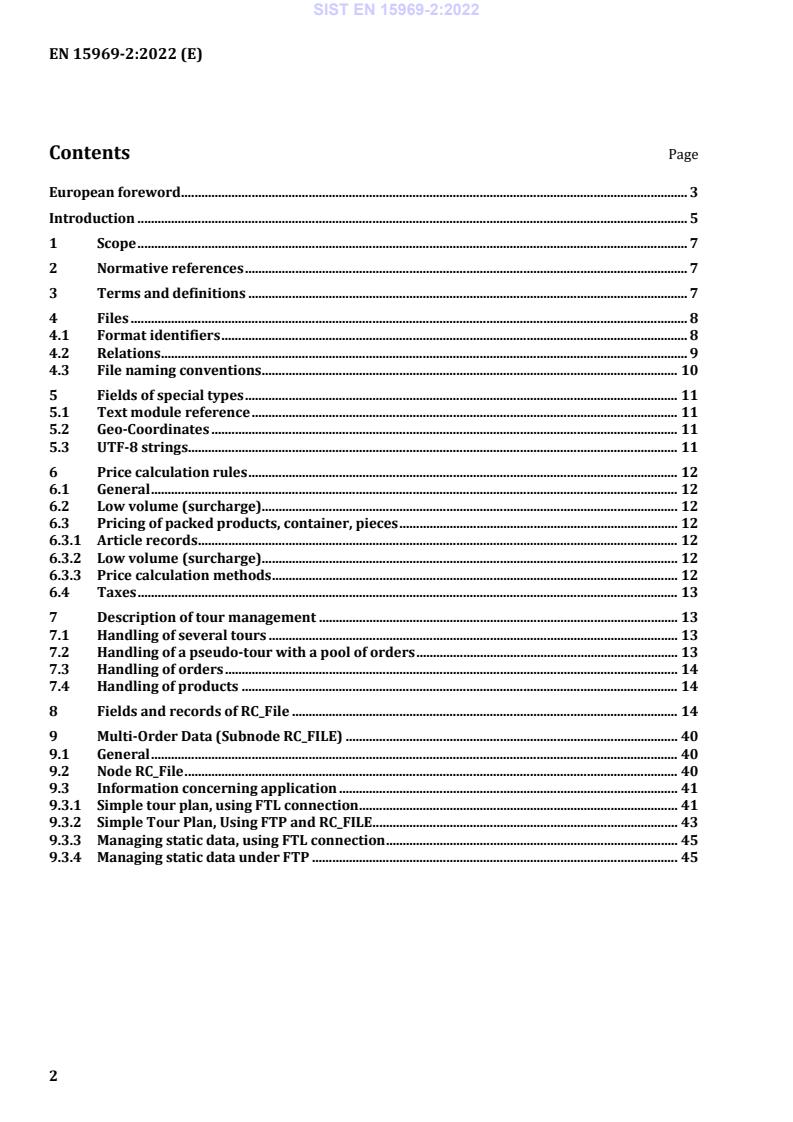
Contents Page
European foreword . 3
Introduction . 5
1 Scope . 7
2 Normative references . 7
3 Terms and definitions . 7
4 Files . 8
4.1 Format identifiers . 8
4.2 Relations . 9
4.3 File naming conventions . 10
5 Fields of special types . 11
5.1 Text module reference . 11
5.2 Geo-Coordinates . 11
5.3 UTF-8 strings . 11
6 Price calculation rules . 12
6.1 General . 12
6.2 Low volume (surcharge) . 12
6.3 Pricing of packed products, container, pieces . 12
6.3.1 Article records . 12
6.3.2 Low volume (surcharge) . 12
6.3.3 Price calculation methods . 12
6.4 Taxes . 13
7 Description of tour management . 13
7.1 Handling of several tours . 13
7.2 Handling of a pseudo-tour with a pool of orders . 13
7.3 Handling of orders . 14
7.4 Handling of products . 14
8 Fields and records of RC_File . 14
9 Multi-Order Data (Subnode RC_FILE) . 40
9.1 General . 40
9.2 Node RC_File . 40
9.3 Information concerning application . 41
9.3.1 Simple tour plan, using FTL connection . 41
9.3.2 Simple Tour Plan, Using FTP and RC_FILE . 43
9.3.3 Managing static data, using FTL connection . 45
9.3.4 Managing static data under FTP . 45
European foreword
This document (EN 15969-2:2022) has been prepared by Technical Committee CEN/TC 296 “Tanks for
the transport of dangerous goods”, the secretariat of which is held by AFNOR.
This European Standard shall be given the status of a national standard, either by publication of an
identical text or by endorsement, at the latest by May 2023, and conflicting national standards shall be
withdrawn at the latest by May 2023.
Attention is drawn to the possibility that some of the elements of this document may be the subject of
patent rights. CEN shall not be held responsible for identifying any or all such patent rights.
This document supersedes EN 15969-2:2017.
With regard to EN 15969-2:2017 the following fundamental changes are given:
— fields for air craft refilling added;
— Index C09 “process identification” included;
— Index O32 “process identification” amended;
— Index P42 “delivery path” included.
The EN 15969 series, Tanks for transport of dangerous goods - Digital interface for the data transfer
between tank vehicle and with stationary facilities, consists of the following 2 parts:
— Part 1: Protocol specification - Control, measurement and event data;
— Part 2: Commercial and logistic data.
This document forms part of a coherent standards programme comprising the following standards:
— EN 13616-1, Overfill prevention devices for static tanks for liquid fuels - Part 1: Overfill prevention
devices with closure device;
— EN 13616-2, Overfill prevention devices for static tanks for liquid fuels - Part 2: Overfill prevention
devices without a closure device;
— EN 13922, Tanks for transport of dangerous goods - Service equipment for tanks - Overfill prevention
systems for liquid fuels;
— EN 14116, Tanks for transport of dangerous goods - Digital interface for product recognition devices
for liquid fuels;
— EN 15207, Tanks for the transport of dangerous goods - Plug/socket connection and supply
characteristics for service equipment in hazardous areas with 24 V nominal supply voltage;
— EN 15208, Tanks for transport of dangerous goods - Sealed parcel delivery systems - Working principles
and interface specifications;
— EN 15969-1, Tanks for transport of dangerous goods - Digital interface for the data transfer between
tank vehicle and with stationary facilities - Part 1: Protocol specification - Control, measurement and
event data.
Any feedback and questions on this document should be directed to the users’ national standards body.
A complete listing of these bodies can be found on the CEN website.
According to the CEN-CENELEC Internal Regulations, the national standards organisations of the
following countries are bound to implement this European Standard: Austria, Belgium, Bulgaria, Croatia,
Cyprus, Czech Republic, Denmark, Estonia, Finland, France, Germany, Greece, Hungary, Iceland, Ireland,
Italy, Latvia, Lithuania, Luxembourg, Malta, Netherlands, Norway, Poland, Portugal, Republic of North
Macedonia, Romania, Serbia, Slovakia, Slovenia, Spain, Sweden, Switzerland, Türkiye and the United
Kingdom.
Introduction
FTL is an acronym for Fuel Truck Link, the interface between electronic system(s) on board of a tank
truck (Tank-Vehicle-Equipment) and any external computer, Part 2 mainly for a host installed in the
office and connected via Internet (TCP/IP); for illustration, see Figure 1.
This document specifies data format for all interconnecting communication paths for commercial issues.
This document offers the user following features:
— multiple orders (batch processing);
— pricing;
— master data (e.g. products, customers, drivers, taxes);
— additional texts for the printout;
— information for the drivers;
— tour management;
— data for invoicing with surcharge;
— data for delivery packaged goods;
— handle planned and unplanned deliveries.
Key
→ direction of communication (client → server)
a may be either two independent units or one single unit which incorporates both functions OBC and TVE
Figure 1 — Communication structure
1 Scope
This document specifies the data structure needed for tour management, scheduling orders of measured
and unmeasured products online to the truck. Processed orders are transferred back to the host in the
office at once or later every time the truck is online.
It specifies the transfer of commercial and logistic data between transport vehicle equipment, on board
computer of the tank vehicle and stationary facilities for all communication channels between these
parties.
This document is used in conjunction with EN 15969-1 and does not modify or override any of the
requirements of EN 15969-1.
2 Normative references
The following documents are referred to in the text in such a way that some or all of their content
constitutes requirements of this document. For dated references, only the edition cited applies. For
undated references, the latest edition of the referenced document (including any amendments) applies.
EN 14116, Tanks for transport of dangerous goods - Digital interface for product recognition devices for
liquid fuels
EN 15969-1:2022 , Tanks for transport of dangerous goods - Digital interface for the data transfer between
tank vehicle and with stationary facilities - Part 1: Protocol specification - Control, measurement and event
data
EN ISO 3166-1, Codes for the representation of names of countries and their subdivisions - Part 1: Country
code (ISO 3166-1)
ISO 639-1, Codes for the representation of names of languages — Part 1: Alpha-2 code
ISO 4217, Codes for the representation of currencies
ISO/IEC 10646:2020, Information technology — Universal coded character set (UCS)
3 Terms and definitions
For the purposes of this document, the terms and definitions given in EN 15969-1:2022 and the
following apply.
ISO and IEC maintain terminological databases for use in standardization at the following addresses:
— IEC Electropedia: available at https://www.electropedia.org/
— ISO Online browsing platform: available at https://www.iso.org/obp
3.1
dispatcher
person who planes tour at the host system
Under preparation. Stage at the time of publication: FprEN 15969-1:2022.
3.2
operator
driver
person who operates the truck and the truck management computer
3.3
tour
set of at least one 'Order Record' and related records, which describes a collection of stops at different
customers and the ordered products, so that the driver knows where to go and what to deliver
3.4
article
goods and/or services provided
4 Files
4.1 Format identifiers
Format identifiers are specified in EN 15969-1.
If the tank vehicle accepts LC-files (see Table 1) for backwards compatibility it shall also treat L-files from
the office as LC-files. Record identifier and file type according to Table 1.
NOTE The change from L-files to LC-files in this edition of this document was required because EN 15969-1
and EN 15969-2 used the same name (L) for different types of files.
Table 1 — Record identifier and file type
Record Short Description of file contents and Primary Key Deletion
identifier description possible destinations of the file Identifier
List of all goods and/or services a_art_id a_deleted
A Article
provided
C Customer Customer database c_cus_id c_deleted
Record type used to mark batch — —
a
FB FTLbatch commands inside RC_file; see
Table 11
A tour consists of a list of tour stops, h_tour_no h_deleted
which could be stops at customers
H Tour
(typ. unloading) or depots (typ.
loading)
LC Location All locations (depots, customers, etc.) lc_loc_id lc_deleted
Restrictions for a location (time lr_loc_id lr_deleted
Location
LR windows, vehicle accessibility,
restriction
permitted actions)
Notes that can be specified for any n_ref_obj n_deleted
object
N Notes n_obj_id
n_seq_no
Represents a stop in a tour. This o_tour_no o_deleted
O Order
could be both a loadstop and an
o_ord_no
orderstop. Per stop, several actions
Record Short Description of file contents and Primary Key Deletion
identifier description possible destinations of the file Identifier
can be performed. These are specified
in the p-records of this o-record.
If field o_ord_id is 0, the order is
unplanned
Extension to O-File for aviation oa_tour_no oa_deleted
Order Aviation
OA
specific delivery and scheduling data
Extension
oa_ord_no
Order Aviation Extension to OA-File for aviation of_tour_no of_deleted
OF Extension for specific frequently changed order and
of_ord_no
real time data scheduling information data
Order Order restrictions, used for or_ord_id or_deleted
OR
restrictions scheduling and routing
Specifies the goods and services to be p_tour_no p_deleted
delivered at this stop (o-record)
P Order lines p_ord_no
p_pos_no
R Driver List of all drivers r_drv_id r_deleted
Static texts for any object. Provides s_ref_obj s_deleted
Text-module text module references, to add a
s_obj_id
S
reference variable number of static texts to an
s_seq_no
object for printout
Different applicable VAT rates, used t_tax_id t_deleted
T Tax
for invoice calculation
Texts which are repetitively used may x_blk_id x_deleted
be stored in this database and
x_lang_id
X Text modules
referred to by a three-digit numeric
code in the S-record
Optional annotations to any other y_ann_obj y_deleted
type, these annotations are used to
y_obj_id
add manufacturer specific fields to
y_ann_key
Y Annotations any record, which trigger an action on
the truck and are not only used for
printout. It is not allowed to define
fields of type y within this standard
a
FTL batch - Commands of Fuel Truck Link according to EN 15969-1.
4.2 Relations
Figure 2 shows the relations between the different record types and contains only the fields relevant for
these relations.
Key
PK primary key
FK foreign key
R reference
one-to-one relationship, both objects shall exist
one-to-one relationship, the object on the right side is optional (zero or one)
one-to-many relationship, both objects shall exist
one-to-many relationship, the object on the right side is optional (zero, one or many)
Figure 2 — Work data and master data
4.3 File naming conventions
When files are being transferred using FTP connection, the file(s) shall be named
RC_CCYYMMDDhhmmss.FTL. CCYYMMDDhhmmss is the timestamp according to EN 15969-1:2022 ,
Table 3.
If more than one file is transferred, they shall be processed in ascending order of file names.
5 Fields of special types
5.1 Text module reference
Table 2 — Text module reference
Type Size Explanation
R N4.1 Text module reference
Text module fields according to Table 2 have the special functionality described below.
The text module selection will be done by a key number. Each record of type X can be used as a single line
or as a set of lines. To differentiate between single line and set, the pointer has a special structure.
The text module reference s_txt_id is defined as a numeric value with the size: 4.1.
The leading 4 digit number is the key-field of the record of type X (field x_txt_id). The 1 digit number
behind the decimal point counts the number of records following the first record, i.e. this number is used
to increment the pointer.
EXAMPLE
Value Explanation
99.0 Only record no. 99 is printed.
99.2 Record no. 99, 100, 101 are printed.
5.2 Geo-Coordinates
Geo-coordinate fields shall be according to Table 3.
Table 3 — Geo-coordinate field
Type Size Explanation
G N4.6 Longitude and latitude values shall be in degrees and decimal fractions of degree:
— negative value of longitude is west of Greenwich; positive value is east of
Greenwich;
— positive value of latitude is north of equator; negative value is south of equator.
Examples for longitude GPS:
+007.512500 = 7,512500° E = 7° 30′ 45” E = 7° 0,750’ E
7. 5125 = 7,512500° E = 7° 30′ 45” E
−007. 512500 = 7,512500° W = 7° 30′ 45” W
Examples for latitude GPS:
+07.512500 = 7,512500° N = 7° 30′ 45” N
5.3 UTF-8 strings
UTF-8 strings according to Table 4.
Table 4 — UTF-8 string field
Type Explanation
Ux Text with maximum length of x printable characters coded in UTF-8 according to
ISO/IEC 10646:2020. At most, x-times four bytes are required for storage.
6 Price calculation rules
6.1 General
All prices shall be net prices.
For the definitions of all mentioned fields (e.g p_del_qty, p_unit_price and a_prc_fac) in Clause 6 see
Table 5.
6.2 Low volume (surcharge)
In the event of the actual delivered volume being less than the planned delivered volume, negative price
discounts (surcharges) may be applied.
These fields are used to calculate the applicable surcharges. Two surcharge levels may be used, depending
on the difference between the actual delivered volume and the planned delivered volume. For example,
if this difference is between “p_low_vol1” and “p_low_vol2” then surcharge “p_sur_vol1” shall be used, and
if between “p_low_vol2” and “p_low_vol3” then surcharge “p_sur_vol2” shall be used.
In any of these cases the driver has the possibility to change from invoice to delivery note.
Where the actual delivered volume is so small that it is less than “p_low_vol3”, (the limit of prior agreed
surcharges) then no price calculation shall be made and only a delivery ticket issued.
Formula:
Price = p_del_qty ∙ p_unit_price / a_prc_fac
Surcharge = p_del_qty ∙ p_sur_voln / a_prc_fac
6.3 Pricing of packed products, container, pieces
6.3.1 Article records
Packed goods can also be delivered, packed goods have a_met_prod = 0, a_met_prod is the reference to
the metered product on the truck.
6.3.2 Low volume (surcharge)
For this type of product there are also quantity limits available. The conditions are the same as for liquid
products.
6.3.3 Price calculation methods
— by piece ('a_prc_code' = 0)
If a_pck_cnt = 0 the driver inputs the number of pieces, which is stored in p_del_qty. If a_pck_cnt > 0,
the driver inputs the number of packings, the quantity is calculated by a multiplication of the number
of packings and a_pck_cnt is stored in the data field p_del_qty. The price will be the unit price
p_unit_prc. The a_prc_fac shall be taken into consideration. The text for unit of measure is given in
a_unit_txt, e.g. can.
Price-Formula:
price = p_del_qty ∙ p_unit_prc / a_prc_fac
— by quantity ('a_prc_code' = 1)
If a_case_cnt > 0, a special calculation shall be made to get the delivered quantity 'p_del_qty'. The text
for unit of measure is given in 'p_unit_msr'. If a_case_cnt = 0, the driver inputs the quantity directly.
Formula:
p_del_qty = number of packings ∙ a_pck_cnt
price = p_del_qty ∙ p_unit_prc / a_prc_fac
— by fixed price ('a_prc_code' = 2)
A price calculation is not needed because this price is negotiated. No quantity input is necessary, the
delivered quantity is the preset quantity, text for unit of measure is given in 'p_unit_msr'.
Formula:
price = p_unit_prc
6.4 Taxes
Taxes are defined in the 'Tax Records' and will be referenced by the ordered products and thereby
ordered article (a_tax_id). If tax id is zero, this product is tax free.
The tax records contain an expiration date that defines the start of a new tax value that is also defined in
this record.
Formula:
tax = (price ∙ t_tax_val1) / 100
If expiration date is reached:
tax = (price ∙ t_tax_val2) / 100
7 Description of tour management
7.1 Handling of several tours
Any number of orders of record type O, combined in tours of record type H, can be transferred to the
truck. Each order record may be followed by 0 to n product records of type P.
The operator selects one of the pre-planned tours at the truck. This tour record is duplicated into the
return data, filled with the actual data and saved. The internal tour number h_tour_no in the return data
starts at 1 and is incremented by 1 at every tour. The internal tour number in the return data are not
related with the internal tour number in the planned data. In the office, the correlation of the planned
data to the return data are shown in field h_tour_id. If field h_tour_id is empty, it is an unplanned tour. If
a planned tour is selected repetitively, field h_tour_id in the return data contains the original information.
The field h_tour_id is unique in the planned data, but it may not be unique in the return data.
7.2 Handling of a pseudo-tour with a pool of orders
It is also possible to work with only one (pseudo-) tour with a pool of orders. The office deletes executed
orders and adds new orders or modifies existing orders of this pool, but always within this tour. This tour
is a pseudo-tour and always contains the orders for the next few hours. There is no need to select a tour
at the truck. This option is configurable at the truck. Within the return data, the tour data contains the
completed orders in chronological sequence, e.g. by day, or by shift, after a driver change.
7.3 Handling of orders
Within a tour, 0 to n orders exist. The operator chooses one of the given orders at the truck, this order
record is duplicated into the return data and will be filled with the actual processed data and saved. The
internal order number o_ord_no within the tour is created in the return data, starts at 1 and is
incremented by 1 at every order. The internal order number in the return data are not related to the
internal order number in the planned data. In the office, the correlation of the planned data to the return
data are shown in the field o_ord_id. If field o_ord_id is empty, it is an unplanned order, which shall be
processed manually. If a planned order is selected a second time, e.g. because the first processing was not
completed, field o_ord_id in the return data contains the original information. The field o_ord_id is unique
in the planned data and may not be unique in the return data. If the field o_ord_id is empty, this order
shall be handled manually in the office.
7.4 Handling of products
Within an order, 0 to 99 product records may exist. The operator chooses one of the given product
records at the truck. This record is duplicated into the return data, filled with the actual data of the
transaction (loading or delivery), and saved. The internal number p_pos_no within the order is created in
the return data, starts at 1 and is incremented by 1 for every product record. The internal number in the
return data are not related with the internal number in the planning data. In the office, the correlation of
the planned data to the return data are shown in field p_pos_id. If field p_pos_id is empty, it is an
unplanned product record. If a planned product record is chosen a second time, e.g. because the first time
failed, field p_pos_id in the return data contains the original information. The field p_pos_id is unique in
the planned data and may not be unique in the return data. If an order contains unplanned product
records or product records which are handled twice, shall be processed in the office.
8 Fields and records of RC_File
A record container (RC) file may contain records of one or more different types.
Fields and records of RC_File according to Table 5.
Table 5 — Fields and records of RC_File
Index Fieldname Data Required DEST Description Detailed description
Type
A-Article
Goods and service description
A00 a_deleted B X — Cancelled-flag If this Boolean is set to “1”, this record shall be deleted
from the list of records on the destination system.
If an article record is deleted, all corresponding S records
shall be deleted automatically!
A01 a_art_id C16 PK T Unique article identification. e.g. SAP product no.
primary key.
A02 a_art_no N3 U T Short product code number, as Short product no, used for manual input from driver, e.g.
defined by the host system CPDP code
A03 a_art_txt U30 X T Article name —
A04 a_pck_cnt N4.2 — T Content of packing in unit, as —
given in #A07 for pricing
A05 a_ovr_pck N4 — — Number of items in overpack e.g. 20 cans per box (only for information, not used for any
calculation)
A06 a_tare_wgh N5.2 — T Empty weight of packing (in —
kg)
A07 a_unit_txt U6 X T Abbreviation of unit of measure e.g. 'L', 'kg', 'm3', 'pieces'
(SI units shall be used when
applicable)
A08 a_unit_msr N1 X T Unit of measure See #L1007 of EN 15969-1:2022
A09 a_pck_txt U30 — T Packing name e.g. “Pieces2”, “Drum”,…
A10 a_prc_fac N4 — T Unit price factor This factor will typically be 1, 10, 100 or 1000
Index Fieldname Data Required DEST Description Detailed description
Type
A11 a_prc_code N1 — T Price code This code indicates how to handle 'a_unit_prc' within
calculations:
0 = piece, the multiplier for 'p_unit_prc' ist field #P14
1 = quantity, the multiplier for 'p_unit_prc' is field #P14
2 = fixed price, the field #P07 'p_unit_prc' is the valid price.
No calculations will take place.
A12 a_unit_prc N5.4 — T Price for unplanned delivery —
A13 a_tax_id C16 — T Tax reference links to #T01.
A14 a_met_prod N3 X T Metered product code 0 - all unmetered products
1 to 99 — metered products (met_prod) according to
EN 14116
A15 a_add_id C16 — T Product code of additive that links to #A01.
shall be injected
A16 a_add_ppm N5 — T Ratio in ppm Ratio concerning #A14; may be used to set on board
injection system
A17 a_sup_id C16 — T Code of supplementary product links to #A01. The article referenced may be added when
that might be added this article is delivered. e.g. deposit, ADR surcharge, see
#A18
A18 a_sup_cat B — T Category of supplementary If a supplementary product is specified in #A17 this field
product specifies whether it is:
0 – mandatory
1 – optional
A19 a_art_cat N1 — T Category of product 0 – available product
1 – common product (frequently used)
2 – fixed charge incurred (common supplementary
product)
Index Fieldname Data Required DEST Description Detailed description
Type
A20 a_fp_cl C2 — T Flashpoint classes A1: flashpoint < 21 °C
A2: flashpoint ≥ 21 °C, < 55 °C
A3: flashpoint ≥ 55 °C
A21 a_crny_sym C3 — T Currency symbol according to ISO 4217, e.g. EUR, GBP, DKK, SEK, …
A22 a_dens_15c N4.1 — HT Density at 15 °C
kg m
A23 a_prt_grs B — T Print gross quantity 0 – not print gross quantity, only net quantity
1 - print both, gross and net quantity
In accordance with national regulations
A24 a_pid_grd N3 X — PID - Grade according to EN 14116,
0 non oil products
A25 a_p_compc N5 X — Company code Unique oil company code according to EN 14116
0 not specified
> 0 specific company code
A26 a_p_prodc N10 X — Product code Company specific unique product code according to
EN 14116.
0 not specified
> 0 specific product code
A27 a_lead_r N3 — T Lead rate mg/l
A28 a_sulphur N4 — T Sulphur content Unit PPM
A29 a_lubr N4 — T Lubricant agent Unit PPM
A30 a_freez N4 — T Anti-freezing agent Unit PPM
Index Fieldname Data Required DEST Description Detailed description
Type
A31 a_dye_c N1 — T Dye code Dyed product
d = 0: unknown – don’t care
d = 1: undyed product
d = 2: dyed product, red
d = 3: dyed product, green
d = 4: dyed product, blue
d = 5: dyed product, yellow
d = 6: dyed product, purple
d = 7: dyed product, brown
A32 a_dye_r N3 — T Dye ratio Unit PPM
C – Customer
Customer data
C00 c_deleted B X T Cancelled-flag If this Boolean is set to “1”, this record shall be deleted
from the list of records on the destination system.
If a customer record is deleted, all corresponding S, N
records shall be deleted automatically.
C01 c_cus_id C16 PK T Customer number —
C02 c_loc_id C16 X T Invoice address links to #LC01
C03 c_match U30 — T Match code —
C04 c_vat B — T VAT identification: yes or no 0 = customer shall be charged for VAT
1 = customer is VAT exempted
C05 c_tax_no C15 — T European community tax —
identification number
C06 c_comp_id N3 — HT Company identification used for several applications.
0 = default company (setup at truck computer)
Index Fieldname Data Required DEST Description Detailed description
Type
C07 c_bra_id N3 — HT Branch identification used for several applications.
0 = default branch (setup at truck computer)
C08 c_pay_mode N1 — HT Payment mode For description see #O15.
C09 c_proc_id N — T Process identification According to #O32
H – Tour header
H00 h_deleted B X — Cancelled-flag If this Boolean is set to “1”, this record shall be deleted
from the list of records on the destination system.
If a tour is deleted, the corresponding O- and P-records
shall be deleted automatically!
H01 h_tour_id C16 U HT External tour number This number shall be unique in the planned data and may
not be unique in the return data.
H02 h_tour_no N6 PK HT Internal tour no links to #O02
H03 h_tourtext U30 — T Short information about the —
tour
H04 h_drv_id C16 X HT Driver identification number see #R01
H05 h_veh_id C16 X HT Truck ID number Tractor or rigid vehicle
H06 h_trail_id C16 — HT Trailer ID Semi-trailer or draw-bar trailer
H07 h_start_ts S — HT Timestamp of tour start —
H08 h_end_ts S — HT Timestamp of tour end —
H09 h_veh_reg C30 — HT Truck's registration number —
H10 h_trai_reg C30 — HT Trailer's registration number —
H11 h_no_del N4 — HT Total number of orders Total account of orders that shall be / have been delivered
(number of o-records for this tour)
H12 h_no_err N4 — H Total numbers of errors Account of errors that occurred when driving this tour.
Index Fieldname Data Required DEST Description Detailed description
Type
LC – Location
Static: Location data
LC00 l_deleted B X T Cancelled-flag If this Boolean is set to “1”, this record shall be deleted
from the list of records on the destination system.
LC01 l_loc_id C16 PK T Unique location ID —
LC02 l_name01 U30 — T Name of customer —
LC03 l_name02 U30 — T Name of customer, line 2 —
LC04 l_name03 U30 — T Name of customer, line 3 —
LC05 l_housenm U30 — T House name e.g. “Medical centre”
LC06 l_street U30 — T Street name —
LC07 l_streetno U10 — T House number e.g. “2a”
LC08 l_area U30 — T Area Part of town
LC09 l_zipcode U10 — T Post code —
LC10 l_city U30 — T Name of town —
LC11 l_county U30 — T County, district —
LC12 l_state U30 — T Federal state —
LC13 l_cntry U30 — T Country —
LC14 l_cntrycd C2 — T Country code Two letter code according to EN ISO 3166-1
LC15 l_supplmt U30 — T Supplement e.g. “near station”
LC16 l_phone1 U30 — T Phone number e.g. land line
LC17 l_phone2 U30 — T Phone number e.g. mobile phone
LC18 l_fax_no U30 — T Fax number —
Index Fieldname Data Required DEST Description Detailed description
Type
LC19 l_email U30 — T Email address —
LC20 l_geo_long G — T Longitude See #L0802 of EN 15969-1:2022 .
Positive value is east of Greenwich; negative value is west
of Greenwich.
LC21 l_geo_lat G — T Latitude See #L0803 of EN 15969-1:2022 .
Positive value is north of equator; negative value is south
of equator.
LC22 l_geo_hght N4 — T Altitude See #L0804 of EN 15969-1:2022 .
metres above sea level
Index Fieldname Data Required DEST Description Detailed description
Type
LC23 l_geo_qlty N — T Geo quality See #L0805 of EN 15969-1:2022 .
Quality of position data
0 no position data or unknown quality
1 Matching Postcode only
2 Matching Town only
3 Matching Postcode and Town (uncertain)
4 Matching Postcode and Town (exact match)
5 Matching up to Town district (uncertain)
6 Matching up to Street (uncertain)
7 Matching up to Street No. (uncertain)
8 Matching up to Town District (exact match)
9 Matching up to Street (exact match)
10 Matching up to Street No. (exact match)
11 GPS positioning (unknown quality)
12 Manually assigned in digital map
13 GPS positioning (dead reckoning)
14 GPS positioning (single measurement)
15 GPS positioning (differential)
16 GPS positioning (averaged)
LC24 l_max_dst N8 — T Maximum distance between —
TVE position and position given
by #LC20 and #LC21
Index Fieldname Data Required DEST Description Detailed description
Type
LR – Location restriction
Restrictions for a location (time windows, vehicle accessibility, permitted actions)
LR00 lr_deleted B X T Cancelled-flag If this Boolean is set to “1”, this record shall be deleted
from the list of records on the destination system.
LR01 lr_loc_id C16 PK T Unique location ID links to #LC01
LR02 lr_stat_ok N1 — T geofencing See EN 15969-1:2022 , Table 11
0 use TVE defaults
1 manual override by OBC
2 correct position detected by
OBC
LR03 lr_stat_ty N1 — T 0 tank vehicle See EN 15969-1:2022 , Table 11
1 gantry
2 refinery
3 workshop
4 service station
5 client
6 trailer
LR04 lr_op_flgs H1 — T Permitted operations See EN 15969-1:2022 , Table 11.
Bit0: discharge permitted
Bit1: loading permitted
Bit2: service functions
permitted (e.g. workshop)
LR05 lr_bypass H2 — T Explicit allowed bypass See EN 15969-1:2022 , Table 11
Bit0: magnetic product code
Bit1: electrical product code
(PID according to EN 14116)
Bit2: overfill protection system
assignment
Index Fieldname Data Required DEST Description Detailed description
Type
Bit3: vapour recovery hose
assignment
Bit4: overfill protection system
present
Bit5: vapour recovery hose
present
Bit6: hose supervision system
present
LR06 lr_defbyp H2 — T Shall be bypassed for this See EN 15969-1:2022 , Table 11.
location
List according to #LR05
LR07 lr_nevbyp H2 — T May in no case be bypassed See EN 15969-1:2022 , Table 11.
List according to #LR05
LR08 lr_tw1_beg S — T Time window 1: Begin —
LR09 lr_tw1_end S — T Time window 1: End —
LR10 lr_tw1_dow H2 — T Time window 1: Day of Week SUN = 6, SAT = 5, FRI = 4, THU = 3, WED = 2, TUE = 1,
MON = 0
LR11 lr_tw2_beg S — T Time window 2: Begin —
LR12 lr_tw2_end S — T Time window 2: End —
LR13 lr_tw2_dow H2 — T Time window 2: Day of week SUN = 6, SAT = 5, FRI = 4, THU = 3, WED = 2, TUE = 1,
MON = 0
LR14 lr_veh_size N — T Max. vehicle size —
LR15 lr_hose_lg N — T Necessary hose length In metres. Truck delivering this order position shall have a
hose at least this long.
LR16 lr_prep_tm N4 — T Additional time in minutes —
LR17 lr_trailer B — T Trailer allowed —
Index Fieldname Data Required DEST Description Detailed description
Type
LR18 lr_trk_col N — T Desired vehicle colour —
N – Notes
Arbitrary dynamic notes for any object
N00 n_deleted B X T Cancelled-Flag If this Boolean is set to “1”, this record shall be deleted
from the list of records on the destination system
N01 n_ref_obj C2 PK T specifies type of referenced e.g. “A”, “O”, “P”, …
record
N02 n_obj_id C16 PK T referenced object ID e.g. content of o_ord_id if an O record is the referenced
object
N03 n_seq_no N PK T Reference No, identifies a note e.g. this is note “No. 1” for this order
N04 n_note U30 X T Text string —
O – Order record
O00 o_deleted B X T Cancelled-Flag If this Boolean is set to “1”, this record shall be deleted
from the list of records on the destination system.
If an order is deleted, the corresponding P-, S-, N-, OA-, OF-
and OR-records shall be deleted automatically!
O01 o_ord_id C16 U HT Order number Order number from host system. This number shall be
unique in the planned data and may not be unique in the
return data.
O02 o_tour_no N6 PK HT Tour ID links to #H01.
O03 o_ord_no N6 PK HT Internal order number Internal order number for reference between order and
items of the order.
O04 o_pos_no N X HT Number of products in this Sends and returns the number of valid entries in the
order 'Ordered Product Database' for this order, including
unplanned products.
Index Fieldname Data Required DEST Description Detailed description
Type
O05 o_cus_id C16 X HT Customer/depot/refinery links to #C01
number
O06 o_ca_id C16 — — Contact person links to #LC01
O07 o_da_id C16 X — Delivery address links to #LC01
O08 o_comp_id N3 — HT Company identification used for several applications.
0 = default company (setup at truck computer)
O09 o_bra_id N3 — HT Branch identification used for several applications.
0 = default branch (setup at truck computer)
O10 o_cord_no U30 — HT Customer order number Order number given by customer
O11 o_rcpt_id N1 — HT Kind of receipt 0 = delivery note without price
1 = delivery note with price
2 = invoice.
O12 o_cpy_amnt N1 — HT Amount (number) of copies Amount of documents (delivery notes/invoices) to be
printed after issuing the printout interaction of the
operator. More than these copies can be initialized by the
operator (depends on truck system).
O13 o_inv_no N6 — HT Invoice number Sequence number of the invoice. If only a delivery note is
printed, this field is returned empty to the host.
O14 o_del_no N6 — HT Delivery note number Sequence number of the delivery note If only an invoice
and no delivery note was printed, this field is returned
empty to the host.
O15 o_pay_mode N1 — HT Payment mode At the beginning of the delivery a message shall inform the
operator of how the customer should pay. This opens the
possibility to interrupt the deliv
...