

EN 1230-2:2009
(Main)Paper and board intended to come into contact with foodstuffs - Sensory analysis - Part 2: Off-flavour (taint)
General Information
- Abstract
This European Standard specifies whether a paper or board sample contains substances which may be trans-mitted through the air space to a test substance and affect its taste. It is applicable to all kinds of paper and board, including coated and printed material, intended to come into contact with foodstuffs. It is not applicable for the determination of consumers' preference.
- Status
- Published
- Publication Date
- 03-Nov-2009
- Withdrawal Date
- 30-May-2010
- Technical Committee
- CEN/TC 172 - Pulp, paper and board
- Current Stage
- 9093 - Decision to confirm - Review Enquiry
- Start Date
- 30-Jan-2026
- Completion Date
- 23-Sep-2026


Overview
EN 1230-2:2009 is a European Standard developed by CEN for evaluating paper and board materials intended to come into contact with foodstuffs. Specifically, this part of the standard outlines procedures for the sensory analysis of off-flavour (taint) that may be transmitted from the material to a test substance, potentially affecting taste through airborne substances. The method addresses all types of paper and board, including coated and printed materials, used in food packaging and related applications. It does not assess consumer preference, but rather focuses on the detection and measurement of undesirable taints.
Effective sensory analysis as outlined by EN 1230-2:2009 ensures food safety and product quality by identifying papers and boards that could adversely impact the taste of food. This facilitates regulatory compliance and product acceptance within the food industry and related sectors.
Key Topics
- Sensory Analysis Methodology: EN 1230-2 describes established sensory testing methods, including the triangle test, extended triangle test, and multicomparison test, to detect off-flavours with statistical validity.
- Sample Preparation and Test Conditions: The standard prescribes rigorous controls for sample storage, panel training, and test environment, minimizing contamination and ensuring reliable results.
- Applicability: Suitable for all paper and board types, regardless of coatings or printing, where there is the possibility of food contact.
- Panel Requirements: Mandates the use of trained sensory assessors, with a minimum number and performance guidelines to ensure consistency and accuracy.
- Data Handling: Specifies methods for expressing and reporting results, including statistical significance and the intensity of off-flavour, aiding in decision-making regarding material suitability.
Applications
EN 1230-2:2009 is highly relevant for:
- Food Packaging Manufacturers: Ensures that paper and board packaging materials do not impart undesirable off-flavours to food, supporting product safety and regulatory compliance.
- Food Producers and Brand Owners: Assists in material selection to preserve the intended taste and quality of food products throughout shelf life.
- Quality Control and Compliance Laboratories: Provides standardized testing protocols for sensory evaluation of packaging, enabling consistent quality assurance.
- Material Suppliers: Allows communication of verified sensory neutrality of their products to customers in the food industry.
- Regulatory Bodies and Auditors: Offers a recognized method for assessing material suitability for food contact during inspections and certification procedures.
Typical materials evaluated under EN 1230-2 include cartons, paper wraps, trays, and containers, especially for sensitive products such as dairy, confectionery, bakery goods, and ready-to-eat foods.
Related Standards
- EN 1230-1: Paper and board intended to come into contact with foodstuffs - Sensory analysis - Part 1: Odour
- EN ISO 186: Paper and board - Sampling to determine average quality
- ISO 5492: Sensory analysis - Vocabulary
- ISO 8586: Sensory analysis - Selection and training of assessors
- ISO 8589: Sensory analysis - Design of test rooms
- CEN/TR 15645-2 and CEN/TR 15645-3: Calibration protocols for off-flavour testing with fatty and dry foods, respectively
By adhering to EN 1230-2:2009 and related international standards, companies can ensure that paper and board in food contact applications meet stringent sensory requirements, reducing the risk of off-flavour transfer, enhancing product quality, and maintaining consumer trust.
Relations
- Effective Date
- 08-Jun-2022
- Effective Date
- 07-Nov-2009
- Effective Date
- 28-Jan-2026
Get Certified
Connect with accredited certification bodies for this standard

BSI Group
BSI (British Standards Institution) is the business standards company that helps organizations make excellence a habit.

Bureau Veritas
Bureau Veritas is a world leader in laboratory testing, inspection and certification services.

DNV
DNV is an independent assurance and risk management provider.
Sponsored listings
Frequently Asked Questions
EN 1230-2:2009 is a standard published by the European Committee for Standardization (CEN). Its full title is "Paper and board intended to come into contact with foodstuffs - Sensory analysis - Part 2: Off-flavour (taint)". This standard covers: This European Standard specifies whether a paper or board sample contains substances which may be trans-mitted through the air space to a test substance and affect its taste. It is applicable to all kinds of paper and board, including coated and printed material, intended to come into contact with foodstuffs. It is not applicable for the determination of consumers' preference.
This European Standard specifies whether a paper or board sample contains substances which may be trans-mitted through the air space to a test substance and affect its taste. It is applicable to all kinds of paper and board, including coated and printed material, intended to come into contact with foodstuffs. It is not applicable for the determination of consumers' preference.
EN 1230-2:2009 is classified under the following ICS (International Classification for Standards) categories: 55.040 - Packaging materials and accessories; 67.250 - Materials and articles in contact with foodstuffs; 85.060 - Paper and board. The ICS classification helps identify the subject area and facilitates finding related standards.
EN 1230-2:2009 has the following relationships with other standards: It is inter standard links to EN 1230-2:2001, EN 1230-2:2001/AC:2002, EN ISO 186:2002. Understanding these relationships helps ensure you are using the most current and applicable version of the standard.
EN 1230-2:2009 is available in PDF format for immediate download after purchase. The document can be added to your cart and obtained through the secure checkout process. Digital delivery ensures instant access to the complete standard document.
Standards Content (Sample)
2003-01.Slovenski inštitut za standardizacijo. Razmnoževanje celote ali delov tega standarda ni dovoljeno.*HVFKPDFNVEHUWUDJXQJPaper and board intended to come into contact with foodstuffs - Sensory analysis - Part 2: Off-flavour (taint)85.060Papir, karton in lepenkaPaper and board67.250Materiali in predmeti v stiku z živiliMaterials and articles in contact with foodstuffsICS:Ta slovenski standard je istoveten z:EN 1230-2:2009SIST EN 1230-2:2010en,fr,de01-februar-2010SIST EN 1230-2:2010SLOVENSKI
STANDARDSIST EN 1230-2:2002/AC:2003SIST EN 1230-2:20021DGRPHãþD
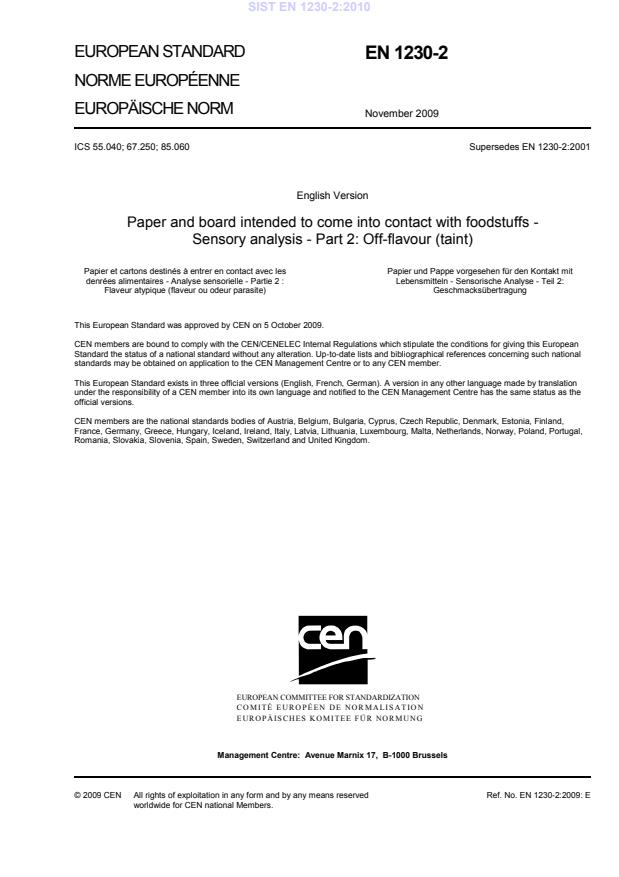
EUROPEAN STANDARD NORME EUROPÉENNE EUROPÄISCHE NORM
EN 1230-2
November 2009 ICS 55.040; 67.250; 85.060 Supersedes EN 1230-2:2001English Version
Paper and board intended to come into contact with foodstuffs -Sensory analysis - Part 2: Off-flavour (taint)
Papier et cartons destinés à entrer en contact avec les denrées alimentaires - Analyse sensorielle - Partie 2 : Flaveur atypique (flaveur ou odeur parasite)
Papier und Pappe vorgesehen für den Kontakt mit Lebensmitteln - Sensorische Analyse - Teil 2: Geschmacksübertragung This European Standard was approved by CEN on 5 October 2009.
CEN members are bound to comply with the CEN/CENELEC Internal Regulations which stipulate the conditions for giving this European Standard the status of a national standard without any alteration. Up-to-date lists and bibliographical references concerning such national standards may be obtained on application to the CEN Management Centre or to any CEN member.
This European Standard exists in three official versions (English, French, German). A version in any other language made by translation under the responsibility of a CEN member into its own language and notified to the CEN Management Centre has the same status as the official versions.
CEN members are the national standards bodies of Austria, Belgium, Bulgaria, Cyprus, Czech Republic, Denmark, Estonia, Finland, France, Germany, Greece, Hungary, Iceland, Ireland, Italy, Latvia, Lithuania, Luxembourg, Malta, Netherlands, Norway, Poland, Portugal, Romania, Slovakia, Slovenia, Spain, Sweden, Switzerland and United Kingdom.
EUROPEAN COMMITTEE FOR STANDARDIZATION
COMITÉ EUROPÉEN DE NORMALISATION EUROPÄISCHES KOMITEE FÜR NORMUNG
Management Centre:
Avenue Marnix 17,
B-1000 Brussels © 2009 CEN All rights of exploitation in any form and by any means reserved worldwide for CEN national Members. Ref. No. EN 1230-2:2009: ESIST EN 1230-2:2010
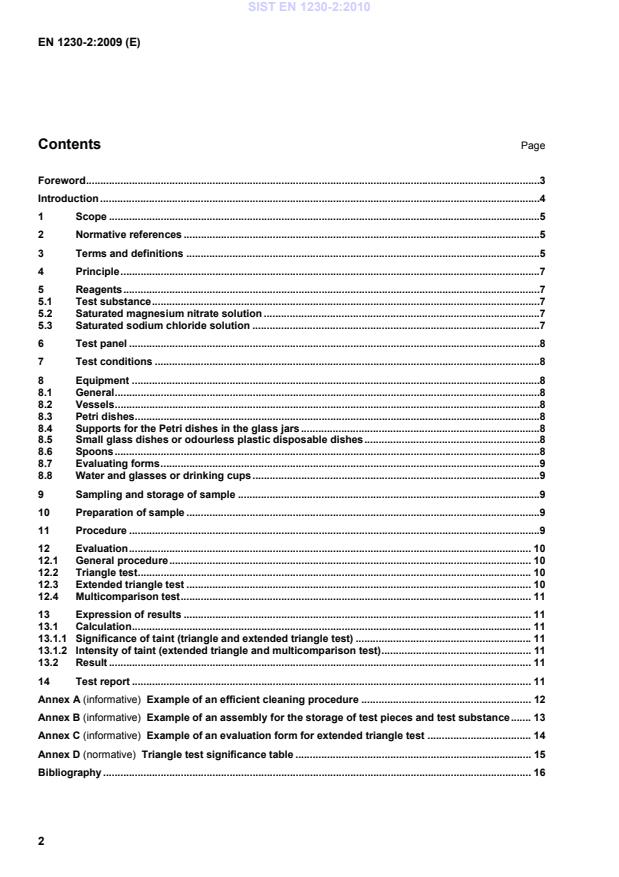
Example of an efficient cleaning procedure . 12Annex B (informative)
Example of an assembly for the storage of test pieces and test substance . 13Annex C (informative)
Example of an evaluation form for extended triangle test . 14Annex D (normative)
Triangle test significance table . 15Bibliography . 16 SIST EN 1230-2:2010
Introduction The taint test is valid for evaluation of whether the material to be tested may bring about a change in the taste (flavour) of the food to be in contact with the material. The test serves for evaluating the possible off-flavour transmitted from a paper and board intended for food packaging or otherwise to come into contact with foodstuffs. According to the results conclusions may be drawn as to the suitability of the material tested for packaging of foodstuffs. For evaluation of the test substance three alternative testing procedures are described: a) the triangle test; b) the extended triangle test; c) the multicomparison test. It is recommended to use the triangle test when rating of the intensity of taint is not needed. This test is less affected by the presence of atypical data than the multicomparison test. The multicomparison test may be preferred when a large number of samples are to be tested, as this procedure is less time consuming compared to the triangle tests. It is also the most common sensory test applied for evaluation of paper and board. The method is statistically less efficient than the triangle test. NOTE The triangle and the extended triangle tests are described in detail in ISO 5492. The multicomparison test is not described in any ISO Standard. In order to give reliable results this test should be performed by selected assessors. The result may be influenced by the time elapsed between manufacturing and testing as well as by the storage conditions of the paper or board. "Part 1: Odour" comprises the corresponding method for the estimation of odour originating from paper or board intended for food contact. SIST EN 1230-2:2010
1 Scope This European Standard specifies whether a paper or board sample contains substances which may be trans-mitted through the air space to a test substance and affect its taste. It is applicable to all kinds of paper and board, including coated and printed material, intended to come into contact with foodstuffs. It is not applicable for the determination of consumers' preference. 2 Normative references The following referenced documents are indispensable for the application of this document. For dated references, only the edition cited applies. For undated references, the latest edition of the referenced document (including any amendments) applies. EN ISO 186:2002, Paper and board — Sampling to determine average quality (ISO 186:2002) 3 Terms and definitions For the purposes of this document, the following terms and definitions apply. 3.1 taste sensations perceived by the taste organ when stimulated by certain soluble substances
[ISO 5492:2008] 3.2 flavour complex combination of the olfactory, gustatory and trigeminal sensations perceived during tasting NOTE The flavour may be influenced by tactile, thermal, painful and/or kinaesthesic effects. [ISO 5492] 3.3 taint taste or odour foreign to the product
[ISO 5492:2008] 3.4 off-flavour atypical flavour often associated with deterioration or transformation of the product
[ISO 5492:2008] NOTE For simplicity, taste and flavour are used as synonyms in this European Standard, though this is not exactly in accordance with ISO 5492. The same regards taint and off-flavour. 3.5 sample the aggregate of all the specimens taken from the lot to provide information on the average quality of the lot and possibly serve as a basis for a decision on the lot
[EN ISO 186:2002] SIST EN 1230-2:2010
[ISO 5492:2008] 3.8.1 test portion for analysis the quantity of test substance which has been stored along with the test pieces 3.8.2 test portion for control the quantity of test substance which has been stored in the same way but without test piece 3.9 assessor any person taking part in a sensory test
[ISO 5492:2008] 3.10 selected assessor assessor chosen for his/her ability to perform a sensory test
[ISO 5492:2008] 3.11 triangle test method of difference testing involving the simultaneous presentation of three coded samples, two of which are identical NOTE The assessor is asked to select the sample perceived as different. [ISO 5492] 3.12 extended triangle test triangle test where one portion is a test portion for analysis, and two are test portions for control NOTE The assessor is asked to give a rating of the sample which he/she finds odd. 3.13 multicomparison test test where the assessor is asked to give a rating of the intensity of the difference in taste between test portions for analysis and a known test portion for control SIST EN 1230-2:2010
...