

EN IEC 60335-2-7:2023
(Main)Household and similar electrical appliances - Safety - Part 2-7: Particular requirements for washing machines
General Information
- Abstract
This European Standard deals with the safety of electric washing machines for household and similar use, that are intended for washing clothes and textiles, their rated voltage being not more than 250 V for single-phase appliances and 480 V for other appliances.
- Status
- Published
- Publication Date
- 09-Nov-2023
- Technical Committee
- CLC/TC 61 - Safety of household and similar electrical appliances
- Drafting Committee
- CLC/TC 61 - Safety of household and similar electrical appliances
- Current Stage
- 6060 - Document made available - Publishing
- Start Date
- 10-Nov-2023
- Completion Date
- 10-Nov-2023
Overview
EN IEC 60335-2-7:2023 is the European adoption of IEC 60335-2-7:2019, published by CENELEC/CLC. It establishes safety requirements for household and similar electric washing machines intended for washing clothes and textiles. The standard applies to appliances with rated voltages up to 250 V for single‑phase and 480 V for other appliances. EN IEC 60335-2-7:2023 is used together with IEC 60335-1 (Part 1) to form the complete safety specification for washing machines.
Key topics and technical requirements
The standard supplements and modifies Part 1 with washing‑machine‑specific provisions. Key topics include:
- Scope and classification of washing machine types (definitions for various machine types are added).
- Electrical safety: leakage current, electric strength tests, transient overvoltages and limits at operating temperature.
- Thermal safety: heating element controls, revised temperature limits for external accessible surfaces, and maximum surface temperature measurement procedures.
- Moisture resistance and spillage tests: updated procedures to verify safe operation under wet conditions.
- Mechanical safety: stability, mechanical hazards, mechanical strength and construction requirements to protect users during normal and abnormal operation.
- Programmable electronic controls: additional requirements for software‑controlled machines, including limitations on energising multiple heating elements and motors simultaneously and software evaluation (Annex R).
- Endurance and abnormal operation testing to verify long‑term reliability and safe behaviour under fault conditions.
- Special items and annexes: detergent specifications (Annex AA), ageing tests for elastomeric parts (Annex BB), requirements for detergent‑free electrolyser washing machines (Annex CC), and guidance for machines with wringers (Annex DD).
Practical applications and who uses this standard
EN IEC 60335-2-7:2023 is essential for:
- Washing machine manufacturers and design engineers to ensure product safety, compliance and CE marking in Europe.
- Test laboratories and conformity assessment bodies performing type testing, verification and certification.
- Regulators and procurement teams specifying safety requirements for household appliances.
- R&D teams developing software‑controlled and steam‑assisted washing technologies who must meet specific control and thermal safety provisions.
Implementing this standard reduces electrical, thermal and mechanical hazards, supports regulatory compliance and helps demonstrate conformity for market access.
Related standards
- IEC 60335-1 (Household and similar electrical appliances - Safety - Part 1: General requirements) - mandatory companion standard.
- EN IEC 60335-2-7:2023/A11:2023 - associated amendments referenced in the European foreword.
Relations
- Effective Date
- 01-Oct-2019
- Effective Date
- 01-Oct-2019
- Effective Date
- 01-Oct-2019
- Effective Date
- 01-Oct-2019
- Effective Date
- 10-Feb-2026
- Refers
EN 4855-02:2020 - Aerospace series - ECO efficiency of catering equipment - Part 02: Oven equipment - Effective Date
- 09-Feb-2026
- Effective Date
- 03-Feb-2026
- Effective Date
- 03-Feb-2026
- Effective Date
- 09-Feb-2026
- Effective Date
- 09-Feb-2026
- Effective Date
- 01-Oct-2019
- Effective Date
- 09-Apr-2024
Get Certified
Connect with accredited certification bodies for this standard

ANCE
Mexican certification and testing association.

CIS Institut d.o.o.
Personal Protective Equipment (PPE) certification body. Notified Body NB-2890 for EU Regulation 2016/425 PPE.

Intertek Slovenia
Intertek testing, inspection, and certification services in Slovenia.
Sponsored listings
Frequently Asked Questions
EN IEC 60335-2-7:2023 is a standard published by CLC. Its full title is "Household and similar electrical appliances - Safety - Part 2-7: Particular requirements for washing machines". This standard covers: This European Standard deals with the safety of electric washing machines for household and similar use, that are intended for washing clothes and textiles, their rated voltage being not more than 250 V for single-phase appliances and 480 V for other appliances.
This European Standard deals with the safety of electric washing machines for household and similar use, that are intended for washing clothes and textiles, their rated voltage being not more than 250 V for single-phase appliances and 480 V for other appliances.
EN IEC 60335-2-7:2023 is classified under the following ICS (International Classification for Standards) categories: 13.280 - Radiation protection; 33.100.01 - Electromagnetic compatibility in general. The ICS classification helps identify the subject area and facilitates finding related standards.
EN IEC 60335-2-7:2023 has the following relationships with other standards: It is inter standard links to EN 60335-2-7:2010/A11:2013, EN 60335-2-7:2010, EN 60335-2-7:2010/A1:2013, EN 60335-2-7:2010/A2:2019, ISO 1817:2015, EN 4855-02:2020, EN 60584-1:2013, EN IEC 60730-2-12:2019, EN 12976-1:2017, EN 12976-1:2021, EN IEC 60335-2-7:2023/A11:2023, prEN IEC 60335-2-7:2025. Understanding these relationships helps ensure you are using the most current and applicable version of the standard.
EN IEC 60335-2-7:2023 is associated with the following European legislation: EU Directives/Regulations: 2014/35/EU; Standardization Mandates: M/511. When a standard is cited in the Official Journal of the European Union, products manufactured in conformity with it benefit from a presumption of conformity with the essential requirements of the corresponding EU directive or regulation.
EN IEC 60335-2-7:2023 is available in PDF format for immediate download after purchase. The document can be added to your cart and obtained through the secure checkout process. Digital delivery ensures instant access to the complete standard document.
Standards Content (Sample)
SLOVENSKI STANDARD
01-januar-2024
Gospodinjski in podobni električni aparati - Varnost - 2-7. del: Posebne zahteve za
pralne stroje (IEC 60335-2-7:2019)
Household and similar electrical appliances - Safety - Part 2-27: Particular requirements
for washing machine (IEC 60335-2-7:2019)
Sicherheit elektrischer Geräte für den Hausgebrauch und ähnliche Zwecke - Teil 2-7:
Besondere Anforderungen für Waschmaschinen (IEC 60335-2-7:2019)
Appareils électrodomestiques et analogues - Sécurité - Partie 2-7: Règles particulières
pour les machines à laver le linge (IEC 60335-2-7:2019)
Ta slovenski standard je istoveten z: EN IEC 60335-2-7:2023
ICS:
13.120 Varnost na domu Domestic safety
97.060 Aparati za nego perila Laundry appliances
2003-01.Slovenski inštitut za standardizacijo. Razmnoževanje celote ali delov tega standarda ni dovoljeno.
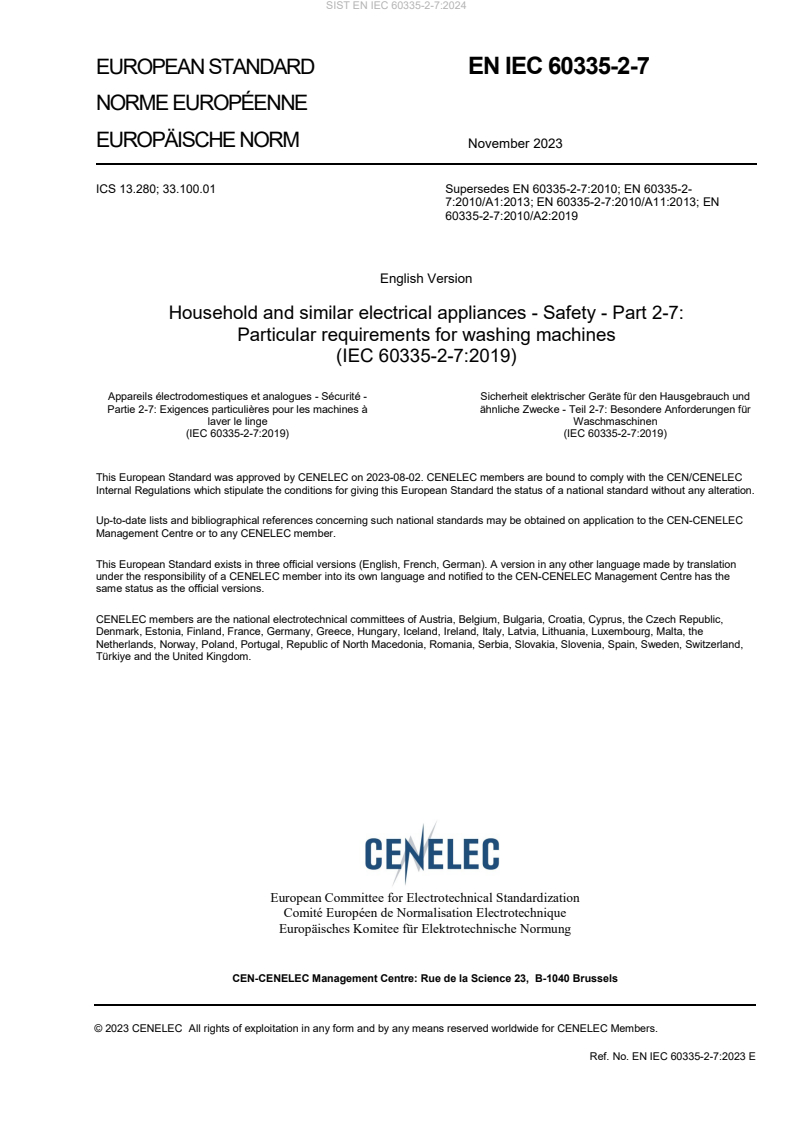
EUROPEAN STANDARD EN IEC 60335-2-7
NORME EUROPÉENNE
EUROPÄISCHE NORM November 2023
ICS 13.280; 33.100.01 Supersedes EN 60335-2-7:2010; EN 60335-2-
7:2010/A1:2013; EN 60335-2-7:2010/A11:2013; EN
60335-2-7:2010/A2:2019
English Version
Household and similar electrical appliances - Safety - Part 2-7:
Particular requirements for washing machines
(IEC 60335-2-7:2019)
Appareils électrodomestiques et analogues - Sécurité - Sicherheit elektrischer Geräte für den Hausgebrauch und
Partie 2-7: Exigences particulières pour les machines à ähnliche Zwecke - Teil 2-7: Besondere Anforderungen für
laver le linge Waschmaschinen
(IEC 60335-2-7:2019) (IEC 60335-2-7:2019)
This European Standard was approved by CENELEC on 2023-08-02. CENELEC members are bound to comply with the CEN/CENELEC
Internal Regulations which stipulate the conditions for giving this European Standard the status of a national standard without any alteration.
Up-to-date lists and bibliographical references concerning such national standards may be obtained on application to the CEN-CENELEC
Management Centre or to any CENELEC member.
This European Standard exists in three official versions (English, French, German). A version in any other language made by translation
under the responsibility of a CENELEC member into its own language and notified to the CEN-CENELEC Management Centre has the
same status as the official versions.
CENELEC members are the national electrotechnical committees of Austria, Belgium, Bulgaria, Croatia, Cyprus, the Czech Republic,
Denmark, Estonia, Finland, France, Germany, Greece, Hungary, Iceland, Ireland, Italy, Latvia, Lithuania, Luxembourg, Malta, the
Netherlands, Norway, Poland, Portugal, Republic of North Macedonia, Romania, Serbia, Slovakia, Slovenia, Spain, Sweden, Switzerland,
Türkiye and the United Kingdom.
European Committee for Electrotechnical Standardization
Comité Européen de Normalisation Electrotechnique
Europäisches Komitee für Elektrotechnische Normung
CEN-CENELEC Management Centre: Rue de la Science 23, B-1040 Brussels
© 2023 CENELEC All rights of exploitation in any form and by any means reserved worldwide for CENELEC Members.
Ref. No. EN IEC 60335-2-7:2023 E
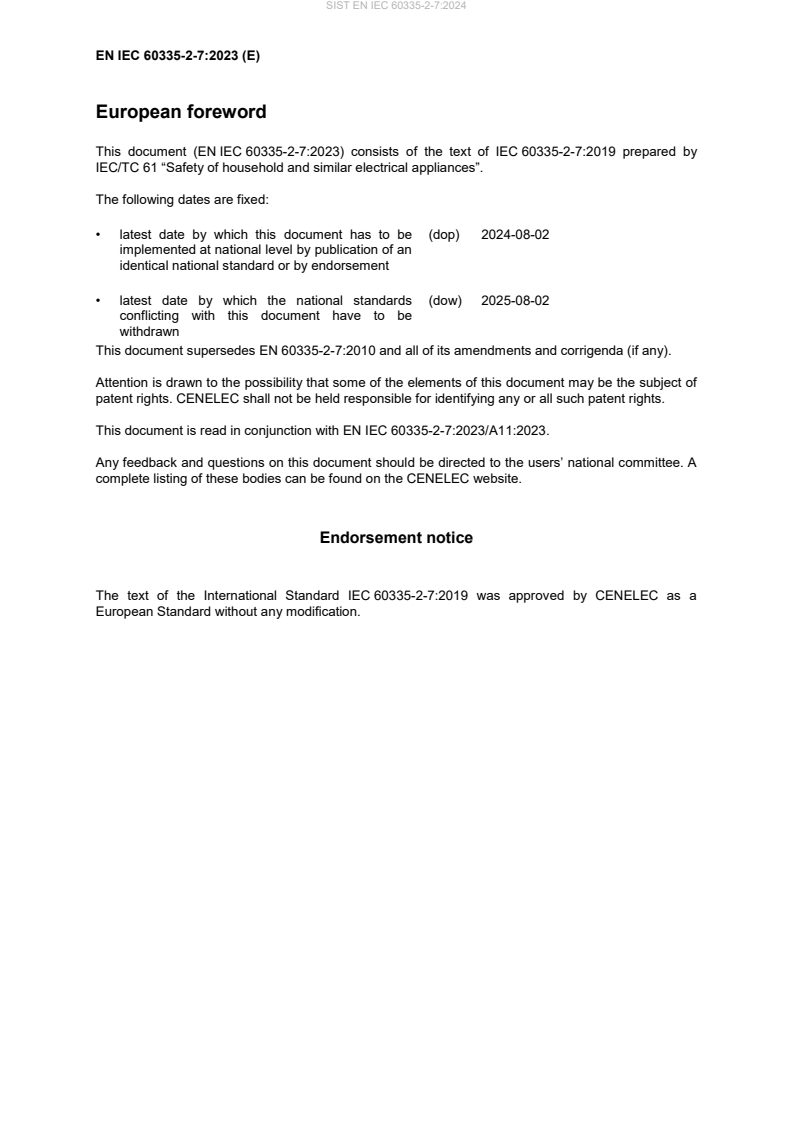
European foreword
This document (EN IEC 60335-2-7:2023) consists of the text of IEC 60335-2-7:2019 prepared by
IEC/TC 61 “Safety of household and similar electrical appliances”.
The following dates are fixed:
• latest date by which this document has to be (dop) 2024-08-02
implemented at national level by publication of an
identical national standard or by endorsement
• latest date by which the national standards (dow) 2025-08-02
conflicting with this document have to be
withdrawn
This document supersedes EN 60335-2-7:2010 and all of its amendments and corrigenda (if any).
Attention is drawn to the possibility that some of the elements of this document may be the subject of
patent rights. CENELEC shall not be held responsible for identifying any or all such patent rights.
This document is read in conjunction with EN IEC 60335-2-7:2023/A11:2023.
Any feedback and questions on this document should be directed to the users’ national committee. A
complete listing of these bodies can be found on the CENELEC website.
Endorsement notice
The text of the International Standard IEC 60335-2-7:2019 was approved by CENELEC as a
European Standard without any modification.
IEC 60335-2-7 ®
Edition 8.0 2019-05
INTERNATIONAL
STANDARD
NORME
INTERNATIONALE
Household and similar electrical appliances – Safety –
Part 2-7: Particular requirements for washing machines
Appareils électrodomestiques et analogues – Sécurité –
Partie 2-7: Exigences particulières pour les machines à laver le linge
INTERNATIONAL
ELECTROTECHNICAL
COMMISSION
COMMISSION
ELECTROTECHNIQUE
INTERNATIONALE
ICS 97.060; 13.120 ISBN 978-2-8322-6889-6
– 2 – IEC 60335-2-7:2019 © IEC 2019
CONTENTS
FOREWORD . 4
INTRODUCTION . 7
1 Scope . 8
2 Normative references . 8
3 Terms and definitions . 9
4 General requirement . 10
5 General conditions for the tests . 10
6 Classification . 11
7 Marking and instructions . 11
8 Protection against access to live parts . 12
9 Starting of motor-operated appliances . 12
10 Power input and current . 12
11 Heating . 12
12 Void . 14
13 Leakage current and electric strength at operating temperature . 14
14 Transient overvoltages . 14
15 Moisture resistance . 14
16 Leakage current and electric strength . 16
17 Overload protection of transformers and associated circuits . 16
18 Endurance . 16
19 Abnormal operation . 17
20 Stability and mechanical hazards . 19
21 Mechanical strength . 21
22 Construction . 22
23 Internal wiring . 24
24 Components . 24
25 Supply connection and external flexible cords . 24
26 Terminals for external conductors . 24
27 Provision for earthing . 25
28 Screws and connections . 25
29 Clearances, creepage distances and solid insulation . 25
30 Resistance to heat and fire . 25
31 Resistance to rusting . 25
32 Radiation, toxicity and similar hazards . 25
Annexes . 27
Annex R (normative) Software evaluation . 28
Annex AA (normative) Detergent . 29
Annex BB (normative) Ageing test for elastomeric parts . 30
Annex CC (normative) Detergent free electrolyser washing machines . 32
Annex DD (informative) Washing machines incorporating a power driven wringer . 36
Bibliography . 38
IEC 60335-2-7:2019 © IEC 2019 – 3 –
Figure 101 – Probe for measuring surface temperatures . 26
Table 101 – Maximum temperature rises for external accessible surfaces under normal
operating conditions . 14
– 4 – IEC 60335-2-7:2019 © IEC 2019
INTERNATIONAL ELECTROTECHNICAL COMMISSION
____________
HOUSEHOLD AND SIMILAR ELECTRICAL APPLIANCES –
SAFETY –
Part 2-7: Particular requirements for washing machines
FOREWORD
1) The International Electrotechnical Commission (IEC) is a worldwide organization for standardization comprising
all national electrotechnical committees (IEC National Committees). The object of IEC is to promote
international co-operation on all questions concerning standardization in the electrical and electronic fields. To
this end and in addition to other activities, IEC publishes International Standards, Technical Specifications,
Technical Reports, Publicly Available Specifications (PAS) and Guides (hereafter referred to as “IEC
Publication(s)”). Their preparation is entrusted to technical committees; any IEC National Committee interested
in the subject dealt with may participate in this preparatory work. International, governmental and non-
governmental organizations liaising with the IEC also participate in this preparation. IEC collaborates closely
with the International Organization for Standardization (ISO) in accordance with conditions determined by
agreement between the two organizations.
2) The formal decisions or agreements of IEC on technical matters express, as nearly as possible, an international
consensus of opinion on the relevant subjects since each technical committee has representation from all
interested IEC National Committees.
3) IEC Publications have the form of recommendations for international use and are accepted by IEC National
Committees in that sense. While all reasonable efforts are made to ensure that the technical content of IEC
Publications is accurate, IEC cannot be held responsible for the way in which they are used or for any
misinterpretation by any end user.
4) In order to promote international uniformity, IEC National Committees undertake to apply IEC Publications
transparently to the maximum extent possible in their national and regional publications. Any divergence
between any IEC Publication and the corresponding national or regional publication shall be clearly indicated in
the latter.
5) IEC itself does not provide any attestation of conformity. Independent certification bodies provide conformity
assessment services and, in some areas, access to IEC marks of conformity. IEC is not responsible for any
services carried out by independent certification bodies.
6) All users should ensure that they have the latest edition of this publication.
7) No liability shall attach to IEC or its directors, employees, servants or agents including individual experts and
members of its technical committees and IEC National Committees for any personal injury, property damage or
other damage of any nature whatsoever, whether direct or indirect, or for costs (including legal fees) and
expenses arising out of the publication, use of, or reliance upon, this IEC Publication or any other IEC
Publications.
8) Attention is drawn to the Normative references cited in this publication. Use of the referenced publications is
indispensable for the correct application of this publication.
9) Attention is drawn to the possibility that some of the elements of this IEC Publication may be the subject of
patent rights. IEC shall not be held responsible for identifying any or all such patent rights.
International Standard IEC 60335-2-7 has been prepared by IEC technical committee 61:
Safety of household and similar electrical appliances.
This eighth edition cancels and replaces the seventh edition published in 2008,
Amendment 1: 2011 and Amendment 2:2016. This edition constitutes a technical revision.
This edition includes the following significant technical changes with respect to the previous
edition:
– requirements for steam generators in 3.1.9, 3.6.101, 19.101, 22.106, 22.107;
– additional definitions for washing machine types in 3.5.101,3.5.102, 3.5.103;
– revised temperature limits for external accessible surfaces in 11.3 and 11.8;
– revised test procedure for the spillage test in 15.2;
IEC 60335-2-7:2019 © IEC 2019 – 5 –
– additional requirements for appliances that are controlled by programmable electronic
circuits that limit the number of heating elements and motors from being energised at the
same time, Subclause 22.108.
The text of this International Standard is based on the following documents:
FDIS Report on voting
61/5798/FDIS 61/5839/RVD
Full information on the voting for the approval of this International Standard can be found in
the report on voting indicated in the above table.
This document has been drafted in accordance with the ISO/IEC Directives, Part 2.
A list of all parts of the IEC 60335 series, under the general title: Household and similar
electrical appliances – Safety, can be found on the IEC website.
This part 2 is to be used in conjunction with the latest edition of IEC 60335-1 and its
amendments. It was established on the basis of the fifth edition (2010) of that standard.
NOTE 1 When “Part 1” is mentioned in this standard, it refers to IEC 60335-1.
This part 2 supplements or modifies the corresponding clauses in IEC 60335-1, so as to
convert that publication into the IEC standard: Safety requirements for washing machines.
When a particular subclause of Part 1 is not mentioned in this part 2, that subclause applies
as far as is reasonable. When this standard states “addition”, “modification” or “replacement”,
the relevant text in Part 1 is to be adapted accordingly.
NOTE 2 The following numbering system is used:
– subclauses, tables and figures that are numbered starting from 101 are additional to those in Part 1;
– unless notes are in a new subclause or involve notes in Part 1, they are numbered starting from 101, including
those in a replaced clause or subclause;
– additional annexes are lettered AA, BB, etc.
NOTE 3 The following print types are used:
– requirements: in roman type;
– test specifications: in italic type;
– notes: in small roman type.
Words in bold in the text are defined in Clause 3. When a definition concerns an adjective, the adjective and the
associated noun are also in bold.
The committee has decided that the contents of this document will remain unchanged until the
stability date indicated on the IEC website under "http://webstore.iec.ch" in the data related to
the specific document. At this date, the document will be
• reconfirmed,
• withdrawn,
• replaced by a revised edition, or
• amended.
NOTE 4 The attention of National Committees is drawn to the fact that equipment manufacturers and testing
organizations may need a transitional period following publication of a new, amended or revised IEC publication in
which to make products in accordance with the new requirements and to equip themselves for conducting new or
revised tests.
It is the recommendation of the committee that the content of this publication be adopted for implementation
nationally not earlier than 12 months or later than 36 months from the date of publication.
– 6 – IEC 60335-2-7:2019 © IEC 2019
The following differences exist in the countries indicated below.
– 3.1.9: Different size cloths are used. The initial water temperature for machines without heating elements and
without a wringer is 71 °C (USA).
– 6.2: IPX0 appliances are allowed (USA).
– 11.7: The test durations are different (USA).
– 15.101: The test is different (USA).
– 19.7: Appliances without a programmer are operated until steady conditions are established (USA).
– 19.101: A redundant set of contacts is not required (USA).
– 22.6: The test is different (USA).
– 22.101: The test is different (USA).
– Annex AA: The detergent and rinsing agent are different (USA).
– Annex BB: Different tests are carried out (USA).
IEC 60335-2-7:2019 © IEC 2019 – 7 –
INTRODUCTION
It has been assumed in the drafting of this International Standard that the execution of its
provisions is entrusted to appropriately qualified and experienced persons.
This standard recognizes the internationally accepted level of protection against hazards such
as electrical, mechanical, thermal, fire and radiation of appliances when operated as in
normal use taking into account the manufacturer's instructions. It also covers abnormal
situations that can be expected in practice and takes into account the way in which
electromagnetic phenomena can affect the safe operation of appliances.
This standard takes into account the requirements of IEC 60364 as far as possible so that
there is compatibility with the wiring rules when the appliance is connected to the supply
mains. However, national wiring rules may differ.
If an appliance within the scope of this standard also incorporates functions that are covered
by another part 2 of IEC 60335, the relevant part 2 is applied to each function separately, as
far as is reasonable. If applicable, the influence of one function on the other is taken into
account.
When a part 2 standard does not include additional requirements to cover hazards dealt with
in Part 1, Part 1 applies.
NOTE 1 This means that the technical committees responsible for the part 2 standards have determined that it is
not necessary to specify particular requirements for the appliance in question over and above the general
requirements.
This standard is a product family standard dealing with the safety of appliances and takes
precedence over horizontal and generic standards covering the same subject.
NOTE 2 Horizontal and generic standards covering a hazard are not applicable since they have been taken into
consideration when developing the general and particular requirements for the IEC 60335 series of standards. For
example, in the case of temperature requirements for surfaces on many appliances, generic standards, such as
ISO 13732-1 for hot surfaces, are not applicable in addition to Part 1 or part 2 standards.
An appliance that complies with the text of this standard will not necessarily be considered to
comply with the safety principles of the standard if, when examined and tested, it is found to
have other features that impair the level of safety covered by these requirements.
An appliance employing materials or having forms of construction differing from those detailed
in the requirements of this standard may be examined and tested according to the intent of
the requirements and, if found to be substantially equivalent, may be considered to comply
with the standard.
– 8 – IEC 60335-2-7:2019 © IEC 2019
HOUSEHOLD AND SIMILAR ELECTRICAL APPLIANCES –
SAFETY –
Part 2-7: Particular requirements for washing machines
1 Scope
This clause of Part 1 is replaced by the following.
This International Standard deals with the safety of electric washing machines for household
and similar use, that are intended for washing clothes and textiles, their rated voltage being
not more than 250 V for single-phase appliances and 480 V for other appliances.
This standard also deals with the safety of electric washing machines for household and
similar use employing an electrolyte instead of detergent. Additional requirements for these
appliances are given in Annex CC.
NOTE 101 Guidance is given in Annex DD for requirements that can be used to ensure an acceptable level of
protection against electrical and thermal hazards for washing machines fitted with a power driven wringer.
Appliances not intended for normal household use but which nevertheless may be a source of
danger to the public, such as appliances intended to be used by laymen in shops, in light
industry and on farms, are within the scope of this standard.
NOTE 102 Examples of such appliances are washing machines for communal use in blocks of flats or in
launderettes.
As far as is practicable, this standard deals with the common hazards presented by washing
machines that are encountered by all persons in and around the home. However, in general, it
does not take into account
– persons (including children) whose
• physical, sensory or mental capabilities; or
• lack of experience and knowledge
prevents them from using the appliance safely without supervision or instruction;
– children playing with the appliance.
NOTE 103 Attention is drawn to the fact that
– for washing machines intended to be used in vehicles or on board ships or aircraft, additional requirements
may be necessary;
– in many countries additional requirements are specified by the national health authorities, the national
authorities responsible for the protection of labour, the national water supply authorities and similar
authorities.
NOTE 104 This standard does not apply to
– washing machines intended exclusively for industrial purposes (ISO 10472-2);
– appliances intended to be used in locations where special conditions prevail, such as the presence of a
corrosive or explosive atmosphere (dust, vapour or gas);
– washing machines incorporating steam generating devices in which steam is produced at a pressure
exceeding 50 kPa.
2 Normative references
This clause of Part 1 is applicable except as follows.
IEC 60335-2-7:2019 © IEC 2019 – 9 –
Addition:
IEC 60584-1, Thermocouples – Part 1: EMF specifications and tolerances
IEC 60730-2-12:2015, Automatic electrical controls for household and similar use – Part 2:
Particular requirements for electrically operated door locks
ISO 1817:2015, Rubber, vulcanized or thermoplastic – Determination of the effect of liquids
3 Terms and definitions
This clause of Part 1 is applicable except as follows.
3.1 Definitions relating to physical characteristics
Replacement:
3.1.9
normal operation
operation of the appliance under the following conditions.
The appliance is filled with dry textile material having a mass equal to the maximum mass
stated in the instructions, and with the maximum quantity of water for which it is constructed.
However, if the power input or current is higher when only 50 % of the textile material is used,
the appliance is operated with this load instead if this gives more unfavourable conditions
than the full load during the test of Clause 11.
Note 101 to entry: For some appliances incorporating a programmer, using the 50 % reduced load may result in
automatic selection of a reduced wash programme.
The temperature of the water is
• 65 C ± 5 °C for appliances without heating elements;
• 15 °C ± 5 °C for appliances without heating elements and intended for connection to the
cold water supply only;
• 15 °C ± 5 °C for other appliances.
If the appliance does not incorporate a programmer, the water is heated to 90 °C ± 5 °C or as
high as the construction will allow if lower, before starting the first washing period.
The textile material consists of pre-washed double-hemmed cotton sheets having dimensions
2 2
approximately 700 mm × 700 mm and a specific mass between 140 g/m and 175 g/m in the
dry condition.
For impeller washing machines, if the textile material does not move properly during
operation,
• the quantity of textile material may be reduced until the maximum power input of the motor
is attained; or
• a textile material comprising pre-washed double-hemmed cotton sheets, having
dimensions of approximately 900 mm × 900 mm and a mass between 90 g/m and
110 g/m in the dry condition, may be used.
However, for impeller washing machines, in case of doubt, the test is carried out using the
reduced quantity of textile material.
– 10 – IEC 60335-2-7:2019 © IEC 2019
A steam generator intended to be filled by hand is filled according to the instructions, water
being added to maintain the steam generation.
A steam generator intended to be filled automatically is connected to the water mains.
3.5 Definitions relating to types of appliances
3.5.101
agitator washing machine
washing machine in which the textiles are substantially immersed in the washing water, the
mechanical action being produced by a device moving about or along its vertical axis with a
reciprocating motion (an agitator)
Note 1 to entry: This device usually extends above the maximum water level.
3.5.102
impeller washing machine
washing machine in which the textiles are substantially immersed in the washing water, the
mechanical action being produced by a device rotating about its axis continuously or which
reverses after a number of revolutions (an impeller)
Note 1 to entry: The uppermost point of this device is substantially below the minimum water level.
3.5.103
drum washing machine
washing machine in which the textiles are placed in either a horizontal drum or a drum that is
inclined up to and including 45° from the horizontal and the textile is partially immersed in the
washing water, the mechanical action being produced by rotation of the drum about its axis,
the movement being either continuous or periodically reversed
3.6 Definitions relating to parts of an appliance
3.6.101
steam generator
device in which steam is produced at a pressure not exceeding 50 kPa and in which the
pressure drops to atmospheric pressure when the steam is not supplied
4 General requirement
This clause of Part 1 is applicable.
5 General conditions for the tests
This clause of Part 1 is applicable except as follows.
5.2 Addition:
The relevant tests of 21.101, 21.102 and 22.104 shall be carried out on the same appliance
as that used for the test of Clause 18.
5.3 Addition:
The test of 15.101 is carried out before the test of 15.3.
The relevant tests of 21.101 and 21.102 are carried out before the test of Clause 18. The test
of 22.104 is carried out after the test of Clause 18.
IEC 60335-2-7:2019 © IEC 2019 – 11 –
5.7 Addition:
Doubt is considered to exist if the temperature of the water is within 6 K of the boiling point
and the difference between the temperature rise of the relevant part and the limit specified
does not exceed 25 K minus the room temperature.
6 Classification
This clause of Part 1 is applicable except as follows.
6.1 Modification:
Appliances shall be of class I, class II or class III.
6.2 Addition:
Appliances shall be at least IPX4.
7 Marking and instructions
This clause of Part 1 is applicable except as follows.
7.1 Addition:
Appliances without automatic water level control shall be marked with the maximum water
level.
Appliances not intended for connection to the hot water supply and not provided with heating
elements shall be marked with the substance of the following:
CAUTION: Do not connect to the hot water supply.
7.10 Addition:
If the off position is only indicated by letters, the word "off" shall be used.
7.12 Addition:
The instructions shall specify the maximum mass of dry cloth in kilograms to be used in the
appliance.
The instructions shall include the substance of the following:
This appliance is intended to be used in household and similar applications such as:
– staff kitchen areas in shops, offices and other working environments;
– farm houses;
– by clients in hotels, motels and other residential type environments;
– bed and breakfast type environments;
– areas for communal use in blocks of flats or in launderettes.
If the manufacturer wants to limit the use of the appliance to less than the above, this shall be
clearly stated in the instructions.
– 12 – IEC 60335-2-7:2019 © IEC 2019
7.12.1 Addition:
For washing machines having ventilation openings in the base, the installation instructions
shall state that the openings must not be obstructed by a carpet.
7.15 Addition:
The caution relating to connection to the hot water supply shall be on the appliance at its
point of attachment to the water supply.
8 Protection against access to live parts
This clause of Part 1 is applicable.
9 Starting of motor-operated appliances
This clause of Part 1 is not applicable.
10 Power input and current
This clause of Part 1 is applicable except as follows.
10.1 Addition:
The selected representative period is the period, such as filling with water, washing, rinsing,
water extraction, spinning or braking, during which the power input is the highest.
10.2 Addition:
The selected representative period is the period, such as filling with water, washing, rinsing,
water extraction, spinning or braking, during which the current is the highest.
11 Heating
This clause of Part 1 is applicable except as follows.
11.3 Addition:
Where the external accessible surfaces are suitably flat and access permits, then the test
probe of Figure 101 may be used to measure the temperature rises of external accessible
surfaces specified in Table 101. The probe is applied with a force of 4 N ± 1 N to the surface
in such a way that the best possible contact between the probe and the surface is ensured.
The measurement is performed after a contact period of 30 s.
The probe may be held in place using a laboratory stand clamp or similar device. Any
measuring instrument giving the same results as the probe may be used.
11.7 Replacement:
Appliances incorporating a programmer are operated for three cycles with the programme that
results in highest temperature rises, with a rest period of 4 min between cycles.
IEC 60335-2-7:2019 © IEC 2019 – 13 –
Other appliances are operated for three cycles, with a rest period of 4 min between cycles.
Each cycle consists of the following operations:
– for appliances without means for water washing;
extraction and for washing machines with a
hand-operated wringer,
– for appliances having a single drum for washing followed by water extraction;
washing and water extraction,
– for appliances having separate drums for washing and water extraction
washing and water extraction that cannot be separated by an additional 4 min rest
used simultaneously, period;
– for appliances having separate drums for washing together with water extraction
washing and water extraction that can be so that the operations terminate
used simultaneously, simultaneously;
– for appliances having a single drum for
washing, water extraction and drying
washing followed by water extraction,
• that allow the same quantity of textile
followed by drying;
material to be washed and dried in the
drum,
• that, according to the instructions, only washing followed by water extraction
followed by two drying periods, with
allow a portion of the washed textile
material to be dried in the drum, an additional rest period of 4 min
before each drying period. In this case
only two cycles of operation are
carried out.
For appliances incorporating a timer, the washing period, the water extraction period and the
drying period are equal to the maximum period allowed by the timer.
For appliances without a timer,
– the washing period has a duration of
• 6 min, for impeller washing machines;
• 18 min, for agitator washing machines;
• 25 min for drum washing machines unless a longer period is stated in the instructions;
– the water extraction period has a duration of 5 min.
The rest period, including any braking time, has a duration of 4 min.
After the specified sequence of operation, discharge pumps that are driven by a separate
motor and switched on and off manually, are subjected to three operating periods separated
by rest periods of 4 min. Each operating period is equal to 1,5 times the period necessary to
empty the appliance when filled to the maximum normal water level. The outlet of the water
discharge pipe is 900 mm above the floor.
11.8 Addition:
During the test, the temperature rises are monitored continuously for one cycle and shall not
exceed the values shown in Table 101.
– 14 – IEC 60335-2-7:2019 © IEC 2019
Table 101 – Maximum temperature rises
for external accessible surfaces under normal operating conditions
a
Surface
Temperature rise of external accessible surfaces
K
Surfaces of appliances situated not more than 850 Surfaces situated more
mm above the floor after installation than 850 mm above the
b
floor after installation
b
Front surfaces
Other surfaces
Bare metal 38 42 42
c
42 49 49
Coated metal
Glass and ceramic 51 56 56
Plastic and plastic 58 62 62
d, e
coating > 0,4 mm
a
Temperature rises are not measured on
– the underside of appliances intended to be used on a working surface or floor, where these surfaces
are inaccessible to a 75 mm diameter probe having a hemispherical end, applied with a force not
exceeding 1 N,
– the rear surface of appliances which, according to the instructions, shall be placed against a wall and
where these surfaces are inaccessible to a 75 mm diameter probe having a hemispherical end, applied
with a force not exceeding 1 N,
– hot water supply fittings and hoses,
– surfaces within 25 mm from air outlets values can be increased by 10 K.
b
If these values are exceeded, the test is allowed to be repeated with the appliance moved away from the test
corner wall. The test is repeated for 1 cycle.
c
Metal is considered coated when a coating having a minimum thickness of 90 µm made by enamel or
non-substantially plastic coating is used.
d
The temperature rise limit of plastic also applies for plastic material having a metal finish of thickness less
than 0,1 mm.
e
When the thickness of the plastic coating does not exceed 0,4 mm, the temperature rise limits of coated
metal for underlying metal apply or the temperature rise limits for glass or ceramic material for underlying
glass or ceramic material apply.
12 Void
13 Leakage current and electric strength at operating temperature
This clause of Part 1 is applicable except as follows.
13.2 Modification:
For stationary class I appliances, the leakage current shall not exceed 3,5 mA, or 1 mA/kW
of rated power input with a limit of 5 mA, whichever is greater.
14 Transient overvoltages
This clause of Part 1 is applicable.
15 Moisture resistance
This clause of Part 1 is applicable except as follows.
IEC 60335-2-7:2019 © IEC 2019 – 15 –
15.2 Replacement:
Appliances shall be constructed so that spillage of liquid in normal use does not affect their
electrical insulation even if an inlet valve fails to close.
Compliance is checked by the following test.
Appliances with type X attachment, except those having a specially prepared cord, are fitted
with the lightest permissible type of flexible cord of the smallest cross-sectional area specified
in Table 13.
Appliances intended to be filled with water by the user are completely filled with water
containing approximately 1 % NaCl. A further quantity of this solution equal to 15 % of the
capacity of the appliance or 0,25 l, whichever is greater, is poured in steadily over a period of
1 min.
Other appliances are operated until the maximum water level is reached, and 5 g of the
detergent specified in Annex AA is added for each litre of water in the appliance. Each inlet
valve is held open and the filling is continued for 15 min after first evidence of overflow or until
the inflow is automatically stopped by other means. The appropriate tests being applied one
at a time to each inlet valve.
For appliances that are loaded from the front, the door is then opened if this can be achieved
manually and without damage to the door interlock system.
For all appliances, 0,5 l of a solution comprising water containing approximately 1 % NaCl and
0,6 % of rinsing agent, is rapidly poured over the top of the appliance so that the spillage
solution flows over the surfaces of the appliance that incorporate controls, the controls being
placed in the on position. The controls are then operated through their working range, this
operation being repeated after a period of 5 min.
Any commercially available non-ionic rinsing agent may be used, but if there is any doubt with
regards to the test results, the rinsing agent shall have the following properties:
• viscosity, 17 mPa⋅s;
• pH, 2,2 (1 % in water)
and its composition shall be
Substance Parts by mass
%
Plurafac ® LF 221 15,0
Cumene sulfonate (40 % solution) 11,5
Citric acid (anhydrous) 3,0
Deionized water 70,5
The appliance shall then withstand the electric strength test of 16.3 and inspection shall show
that there is no trace of water on insulation that could result in a reduction of clearances or
creepage distances below the values specified in Clause 29.
15.101 Appliances shall be constructed so that foaming does not affect electrical insulation.
___________
Plurafac ® LF 221 is the trade name of a product supplied by BASF. This information is given for the
convenience of users of this document and does not constitute an endorsement by IEC of this product.
– 16 – IEC 60335-2-7:2019 © IEC 2019
Compliance is checked by the following test that is carried out immediately after that of 15.2.
The appliance is operated under the conditions specified in Clause 11 but at rated voltage for
one complete cycle with the programme that results in the longest period of operation. A
quantity of detergent necessary to cause foaming is added. The composition of the detergent
is specified in Annex AA.
For appliances incorporating a detergent dispenser, the solution is added manually at the
point in the cycle when it would normally be dispensed automatically. For other appliances,
the solution is added before starting the cycle.
The appliance shall then withstand the electric strength test of 16.3.
The appliance is kept in a test room having a normal atmosphere for 24 h before being
subjected to the test of 15.3.
16 Leakage current and electric strength
This clause of Part 1 is applicable.
17 Overload protection of transformers and associated circuits
This clause of Part 1 is applicable.
18 Endurance
This clause of Part 1 is replaced by the following.
18.101 Appliances shall be constructed so that the lid or door interlock withstands the
stresses to which it may be exposed in normal use.
Compliance is checked by the following test.
The lid or door is opened as in normal use and the force applied to the handle, or actuating
means of the release mechanism, is measured. The force required to close the lid or door is
also measured.
The lid or door is then subjected to 10 000 cycles of opening and closing. For the first
6 000 cycles, the appliance is supplied at rated voltage and operated so that the interlock
mechanism is energized and de-energized each cycle. For the last 4 000 cycles, the
appliance is not connected to the supply mains. For appliances having a drying function, the
total number of cycles is increased to 13 000, the first 9 000 cycles being carried out with the
interlock mechanism energized and de-energized each cycle.
If the interlock complies with IEC 60730-2-12, the appliance is not connected to the supply
mains during this test. If the interlock operates more than once during normal operation, it is
operated for this number of times during each cycle.
Lids are opened each time by approximately 45° and doors by 90°, the speed of opening
being approximately 1,5 m/s. The force applied to open the lid or door is twice the measured
opening force, with a minimum of 50 N and a maximum of 200 N.
Doors are closed at a speed of approximately 1,5 m/s, the force applied being five times the
measured closing force, with a minimum of 50 N and a maximum of 200 N. Lids are allowed to
IEC 60335-2-7:2019 © IEC 2019 – 17 –
close under their own weight but if they fail to latch, a force of five times the measured closing
force is applied, with a minimum of 50 N and a maximum of 200 N.
After the tests, compliance with the relevant requirements of 20.103 to 20.105 shall not be
impaired.
18.102 The braking mechanism of appliances having a lid that can be opened during the
water extraction period shall withstand the stresses to which they may be exposed in normal
use.
Compliance is checked by the following test.
The appliance is supplied at 1,06 times rated voltage and operated under normal operation
until the motor has reached its highest speed. The lid is then fully opened. The test is
repeated after the drum has been at rest for a period long enough to ensure that the
appliance does not attain an excessive temperature.
The test is carried out 1 0
...