

IEC 60544-2:2012
(Main)Electrical insulating materials - Determination of the effects of ionizing radiation on insulating materials - Part 2: Procedures for irradiation and test
General Information
- Abstract
IEC 60544-2:2012 specifies the controls maintained over the exposure conditions during and after the irradiation of insulating materials with ionizing radiation prior to the determination of radiation-induced changes in physical or chemical properties. This standard specifies a number of potentially significant irradiation conditions as well as various parameters which can influence the radiation-induced reactions under these conditions. The objective of this standard is to emphasize the importance of selecting suitable specimens, exposure conditions and test methods for determining the effect of radiation on appropriately chosen properties. Since many materials are used either in air or in inert environments, standard exposure conditions are recommended for both of these situations. It should be noted that this standard does not consider measurements which are performed during the irradiation. This edition includes the following significant technical changes with respect to the previous edition: - alignment with standards recently developed by SC 45A as well as with other parts in the IEC 60544 series.
- Status
- Published
- Publication Date
- 08-Jul-2012
- Technical Committee
- TC 112 - Evaluation and qualification of electrical insulating materials and systems
- Drafting Committee
- WG 2 - TC 112/WG 2
- Current Stage
- PPUB - Publication issued
- Start Date
- 09-Jul-2012
- Completion Date
- 15-Aug-2012
Buy Documents
IEC 60544-2:2012 - Electrical insulating materials - Determination of the effects of ionizing radiation on insulating materials - Part 2: Procedures for irradiation and test Released:7/9/2012
Overview
IEC 60544-2:2012 is an international standard published by the International Electrotechnical Commission (IEC) that specifies procedures for the irradiation and testing of electrical insulating materials exposed to ionizing radiation. This third edition harmonizes test methods with recently developed standards and complements other parts of the IEC 60544 series. It provides detailed requirements for controlling exposure conditions before and after irradiation to accurately determine radiation-induced changes in the physical and chemical properties of insulating materials.
The focus of IEC 60544-2 is on standardized sample preparation, controlled irradiation environments (air, inert gases, vacuum, or high pressure), and test procedures. The standard addresses the influence of critical parameters such as dose rate, temperature, mechanical and electrical stresses during irradiation, and guides the selection of appropriate specimens and test methods for key insulating material properties.
Key Topics
- Irradiation Controls: Guidance on maintaining and documenting parameters like radiation type, dose-rate control, temperature control, and environment (air, inert, vacuum, high pressure) during irradiation.
- Sample Preparation: Procedures for selecting and preparing specimens to ensure representative and reproducible test results.
- Test Procedures: Methods to evaluate materials post-irradiation including mechanical, electrical, and chemical property measurements.
- Environmental Influences: Discussion on effects of oxygen presence (dose-rate effect), temperature synergy, and mechanical/electrical stresses on radiation-induced aging.
- Post-Irradiation Effects: Control and testing of materials after irradiation to assess long-term radiation resistance and changes in performance.
- Evaluation Criteria: Guidelines for determining end-point criteria for material qualification based on absorbed dose and resultant property changes.
- Reporting Requirements: Standards for documenting materials, irradiation conditions, test procedures, and results in formal test reports, including example reports for various insulating materials.
Applications
IEC 60544-2:2012 is essential for industries and organizations involved in selecting, qualifying, and certifying electrical insulating materials destined for radiation environments. Typical applications include:
- Nuclear Power Plants: Insulating materials in electrical systems exposed to radiation require reliable qualification for safety and longevity.
- Medical Equipment: Devices exposed to radiation in diagnostic or therapeutic contexts benefit from tested insulation durability.
- Aerospace Electronics: Insulators used in spacecraft and satellites must withstand cosmic radiation, necessitating precise testing procedures.
- Radiation Processing Facilities: Equipment exposed to controlled radiation doses requires materials that are rigorously tested with this standard.
- Research Laboratories: Material scientists utilize IEC 60544-2 for structured experimental evaluation of radiation effects on polymers and composites.
By adhering to IEC 60544-2, manufacturers and researchers ensure that insulating materials meet proven resistance criteria, contributing to enhanced reliability and safety in radiation-exposed electrical systems.
Related Standards
IEC 60544-2 is part of the IEC 60544 series addressing radiation effects on electrical insulating materials. Other relevant standards include:
- IEC 60544-1: General principles for determining effects of ionizing radiation on insulating materials.
- IEC 60544-3: Specific guidance on dosimetry and measurement of absorbed doses.
- IEC 60544-4: Methods for assessing chemical changes in insulating materials after radiation exposure.
- IEC SC 45A Standards: Complementary standards developed by the IEC subcommittee for nuclear instrumentation and related applications.
- ISO/IEC Directives: Overarching guidelines followed for drafting and revising IEC standards ensuring international harmonization.
Compliance with these standards ensures comprehensive evaluation of electrical insulating materials’ performance under ionizing radiation, facilitating global acceptance of test results and qualification.
By implementing IEC 60544-2:2012, professionals can systematically control irradiation and testing variables to obtain reliable, reproducible data on the durability and performance of electrical insulating materials in radiation environments-vital for maintaining integrity and safety in critical electrical systems worldwide.
Buy Documents
IEC 60544-2:2012 - Electrical insulating materials - Determination of the effects of ionizing radiation on insulating materials - Part 2: Procedures for irradiation and test Released:7/9/2012
Get Certified
Connect with accredited certification bodies for this standard

IMQ S.p.A. (Certification)
Italian electrical product certification.

SLG Prüf- und Zertifizierungs GmbH
German testing and certification body.

UL Solutions
Global safety science company with testing, inspection and certification.
Sponsored listings
Frequently Asked Questions
IEC 60544-2:2012 is a standard published by the International Electrotechnical Commission (IEC). Its full title is "Electrical insulating materials - Determination of the effects of ionizing radiation on insulating materials - Part 2: Procedures for irradiation and test". This standard covers: IEC 60544-2:2012 specifies the controls maintained over the exposure conditions during and after the irradiation of insulating materials with ionizing radiation prior to the determination of radiation-induced changes in physical or chemical properties. This standard specifies a number of potentially significant irradiation conditions as well as various parameters which can influence the radiation-induced reactions under these conditions. The objective of this standard is to emphasize the importance of selecting suitable specimens, exposure conditions and test methods for determining the effect of radiation on appropriately chosen properties. Since many materials are used either in air or in inert environments, standard exposure conditions are recommended for both of these situations. It should be noted that this standard does not consider measurements which are performed during the irradiation. This edition includes the following significant technical changes with respect to the previous edition: - alignment with standards recently developed by SC 45A as well as with other parts in the IEC 60544 series.
IEC 60544-2:2012 specifies the controls maintained over the exposure conditions during and after the irradiation of insulating materials with ionizing radiation prior to the determination of radiation-induced changes in physical or chemical properties. This standard specifies a number of potentially significant irradiation conditions as well as various parameters which can influence the radiation-induced reactions under these conditions. The objective of this standard is to emphasize the importance of selecting suitable specimens, exposure conditions and test methods for determining the effect of radiation on appropriately chosen properties. Since many materials are used either in air or in inert environments, standard exposure conditions are recommended for both of these situations. It should be noted that this standard does not consider measurements which are performed during the irradiation. This edition includes the following significant technical changes with respect to the previous edition: - alignment with standards recently developed by SC 45A as well as with other parts in the IEC 60544 series.
IEC 60544-2:2012 is classified under the following ICS (International Classification for Standards) categories: 17.240 - Radiation measurements; 29.035.01 - Insulating materials in general; 33.060.30 - Radio relay and fixed satellite communications systems. The ICS classification helps identify the subject area and facilitates finding related standards.
IEC 60544-2:2012 is available in PDF format for immediate download after purchase. The document can be added to your cart and obtained through the secure checkout process. Digital delivery ensures instant access to the complete standard document.
Standards Content (Sample)
IEC 60544-2 ®
Edition 3.0 2012-07
INTERNATIONAL
STANDARD
NORME
INTERNATIONALE
Electrical insulating materials – Determination of the effects of ionizing radiation
on insulating materials –
Part 2: Procedures for irradiation and test
Matériaux isolants électriques – détermination des effets des rayonnements
Ionisants sur les matériaux isolants –
Partie 2: Méthodes d'irradiation et d'essai
All rights reserved. Unless otherwise specified, no part of this publication may be reproduced or utilized in any form
or by any means, electronic or mechanical, including photocopying and microfilm, without permission in writing from
either IEC or IEC's member National Committee in the country of the requester.
If you have any questions about IEC copyright or have an enquiry about obtaining additional rights to this publication,
please contact the address below or your local IEC member National Committee for further information.
Droits de reproduction réservés. Sauf indication contraire, aucune partie de cette publication ne peut être reproduite ni
utilisée sous quelque forme que ce soit et par aucun procédé, électronique ou mécanique, y compris la photocopie et les
microfilms, sans l'accord écrit de la CEI ou du Comité national de la CEI du pays du demandeur.
Si vous avez des questions sur le copyright de la CEI ou si vous désirez obtenir des droits supplémentaires sur cette
publication, utilisez les coordonnées ci-après ou contactez le Comité national de la CEI de votre pays de résidence.
IEC Central Office Tel.: +41 22 919 02 11
3, rue de Varembé Fax: +41 22 919 03 00
CH-1211 Geneva 20 info@iec.ch
Switzerland www.iec.ch
About the IEC
The International Electrotechnical Commission (IEC) is the leading global organization that prepares and publishes
International Standards for all electrical, electronic and related technologies.
About IEC publications
The technical content of IEC publications is kept under constant review by the IEC. Please make sure that you have the
latest edition, a corrigenda or an amendment might have been published.
Useful links:
IEC publications search - www.iec.ch/searchpub Electropedia - www.electropedia.org
The advanced search enables you to find IEC publications The world's leading online dictionary of electronic and
by a variety of criteria (reference number, text, technical electrical terms containing more than 30 000 terms and
committee,…). definitions in English and French, with equivalent terms in
It also gives information on projects, replaced and additional languages. Also known as the International
withdrawn publications. Electrotechnical Vocabulary (IEV) on-line.
IEC Just Published - webstore.iec.ch/justpublished Customer Service Centre - webstore.iec.ch/csc
Stay up to date on all new IEC publications. Just Published If you wish to give us your feedback on this publication
details all new publications released. Available on-line and or need further assistance, please contact the
also once a month by email. Customer Service Centre: csc@iec.ch.
A propos de la CEI
La Commission Electrotechnique Internationale (CEI) est la première organisation mondiale qui élabore et publie des
Normes internationales pour tout ce qui a trait à l'électricité, à l'électronique et aux technologies apparentées.
A propos des publications CEI
Le contenu technique des publications de la CEI est constamment revu. Veuillez vous assurer que vous possédez
l’édition la plus récente, un corrigendum ou amendement peut avoir été publié.
Liens utiles:
Recherche de publications CEI - www.iec.ch/searchpub Electropedia - www.electropedia.org
La recherche avancée vous permet de trouver des Le premier dictionnaire en ligne au monde de termes
publications CEI en utilisant différents critères (numéro de électroniques et électriques. Il contient plus de 30 000
référence, texte, comité d’études,…). termes et définitions en anglais et en français, ainsi que
Elle donne aussi des informations sur les projets et les les termes équivalents dans les langues additionnelles.
publications remplacées ou retirées. Egalement appelé Vocabulaire Electrotechnique
International (VEI) en ligne.
Just Published CEI - webstore.iec.ch/justpublished
Service Clients - webstore.iec.ch/csc
Restez informé sur les nouvelles publications de la CEI.
Just Published détaille les nouvelles publications parues. Si vous désirez nous donner des commentaires sur
Disponible en ligne et aussi une fois par mois par email. cette publication ou si vous avez des questions
contactez-nous: csc@iec.ch.
IEC 60544-2 ®
Edition 3.0 2012-07
INTERNATIONAL
STANDARD
NORME
INTERNATIONALE
Electrical insulating materials – Determination of the effects of ionizing radiation
on insulating materials –
Part 2: Procedures for irradiation and test
Matériaux isolants électriques – détermination des effets des rayonnements
Ionisants sur les matériaux isolants –
Partie 2: Méthodes d'irradiation et d'essai
INTERNATIONAL
ELECTROTECHNICAL
COMMISSION
COMMISSION
ELECTROTECHNIQUE
PRICE CODE
INTERNATIONALE
CODE PRIX S
ICS 17.240; 29.035.01 ISBN 978-2-83220-223-4
– 2 – 60544-2 © IEC:2012
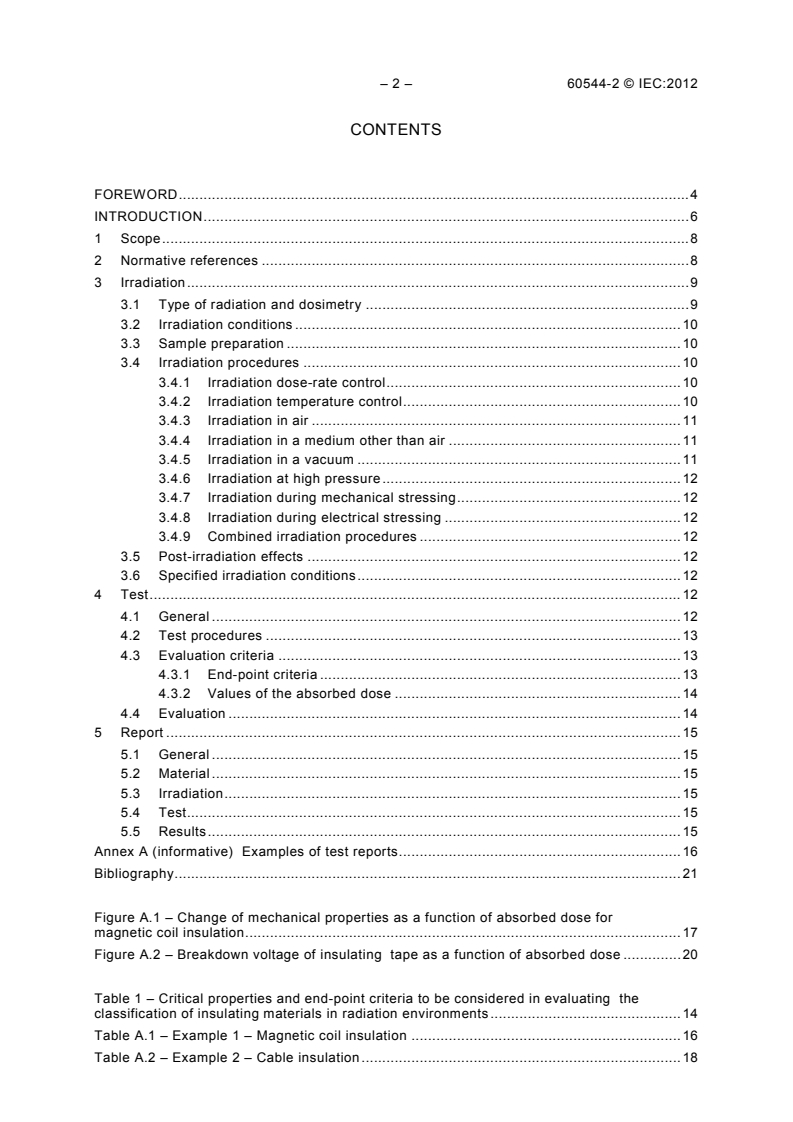
CONTENTS
FOREWORD . 4
INTRODUCTION . 6
1 Scope . 8
2 Normative references . 8
3 Irradiation . 9
3.1 Type of radiation and dosimetry . 9
3.2 Irradiation conditions . 10
3.3 Sample preparation . 10
3.4 Irradiation procedures . 10
3.4.1 Irradiation dose-rate control . 10
3.4.2 Irradiation temperature control . 10
3.4.3 Irradiation in air . 11
3.4.4 Irradiation in a medium other than air . 11
3.4.5 Irradiation in a vacuum . 11
3.4.6 Irradiation at high pressure . 12
3.4.7 Irradiation during mechanical stressing . 12
3.4.8 Irradiation during electrical stressing . 12
3.4.9 Combined irradiation procedures . 12
3.5 Post-irradiation effects . 12
3.6 Specified irradiation conditions . 12
4 Test . 12
4.1 General . 12
4.2 Test procedures . 13
4.3 Evaluation criteria . 13
4.3.1 End-point criteria . 13
4.3.2 Values of the absorbed dose . 14
4.4 Evaluation . 14
5 Report . 15
5.1 General . 15
5.2 Material . 15
5.3 Irradiation . 15
5.4 Test . 15
5.5 Results . 15
Annex A (informative) Examples of test reports . 16
Bibliography . 21
Figure A.1 – Change of mechanical properties as a function of absorbed dose for
magnetic coil insulation . 17
Figure A.2 – Breakdown voltage of insulating tape as a function of absorbed dose . 20
Table 1 – Critical properties and end-point criteria to be considered in evaluating the
classification of insulating materials in radiation environments . 14
Table A.1 – Example 1 – Magnetic coil insulation . 16
Table A.2 – Example 2 – Cable insulation . 18
60544-2 © IEC:2012 – 3 –
Table A.3 – Example 3 – Insulating tape . 19
– 4 – 60544-2 © IEC:2012
INTERNATIONAL ELECTROTECHNICAL COMMISSION
____________
ELECTRICAL INSULATING MATERIALS –
DETERMINATION OF THE EFFECTS OF IONIZING
RADIATION ON INSULATING MATERIALS –
Part 2: Procedures for irradiation and test
FOREWORD
1) The International Electrotechnical Commission (IEC) is a worldwide organization for standardization comprising
all national electrotechnical committees (IEC National Committees). The object of IEC is to promote
international co-operation on all questions concerning standardization in the electrical and electronic fields. To
this end and in addition to other activities, IEC publishes International Standards, Technical Specifications,
Technical Reports, Publicly Available Specifications (PAS) and Guides (hereafter referred to as “IEC
Publication(s)”). Their preparation is entrusted to technical committees; any IEC National Committee interested
in the subject dealt with may participate in this preparatory work. International, governmental and non-
governmental organizations liaising with the IEC also participate in this preparation. IEC collaborates closely
with the International Organization for Standardization (ISO) in accordance with conditions determined by
agreement between the two organizations.
2) The formal decisions or agreements of IEC on technical matters express, as nearly as possible, an international
consensus of opinion on the relevant subjects since each technical committee has representation from all
interested IEC National Committees.
3) IEC Publications have the form of recommendations for international use and are accepted by IEC National
Committees in that sense. While all reasonable efforts are made to ensure that the technical content of IEC
Publications is accurate, IEC cannot be held responsible for the way in which they are used or for any
misinterpretation by any end user.
4) In order to promote international uniformity, IEC National Committees undertake to apply IEC Publications
transparently to the maximum extent possible in their national and regional publications. Any divergence
between any IEC Publication and the corresponding national or regional publication shall be clearly indicated in
the latter.
5) IEC itself does not provide any attestation of conformity. Independent certification bodies provide conformity
assessment services and, in some areas, access to IEC marks of conformity. IEC is not responsible for any
services carried out by independent certification bodies.
6) All users should ensure that they have the latest edition of this publication.
7) No liability shall attach to IEC or its directors, employees, servants or agents including individual experts and
members of its technical committees and IEC National Committees for any personal injury, property damage or
other damage of any nature whatsoever, whether direct or indirect, or for costs (including legal fees) and
expenses arising out of the publication, use of, or reliance upon, this IEC Publication or any other IEC
Publications.
8) Attention is drawn to the Normative references cited in this publication. Use of the referenced publications is
indispensable for the correct application of this publication.
9) Attention is drawn to the possibility that some of the elements of this IEC Publication may be the subject of
patent rights. IEC shall not be held responsible for identifying any or all such patent rights.
International Standard IEC 60544-2 has been prepared by IEC technical committee 112:
Evaluation and qualification of electrical insulating materials and systems.
This third edition cancels and replaces the second edition, published in 1991, and constitutes
a technical revision.
This edition includes the following significant technical changes with respect to the previous
edition:
– alignment with standards recently developed by SC 45A as well as with other parts in the
IEC 60544 series.
60544-2 © IEC:2012 – 5 –
The text of this standard is based on the following documents:
FDIS Report on voting
112/208/FDIS 112/216/RVD
Full information on the voting for the approval of this standard can be found in the report on
voting indicated in the above table.
This publication has been drafted in accordance with the ISO/IEC Directives, Part 2.
A list of all parts of the IEC 60544 series can be found, under the general title Electrical
insulating materials – Determination of the effects of ionizing radiation on insulating materials,
on the IEC website.
Future standards in this series will carry the new general title as cited above. Titles of existing
standards in this series will be updated at the time of the next edition.
The committee has decided that the contents of this publication will remain unchanged until
the stability date indicated on the IEC web site under "http://webstore.iec.ch" in the data
related to the specific publication. At this date, the publication will be
• reconfirmed,
• withdrawn,
• replaced by a revised edition, or
• amended.
– 6 – 60544-2 © IEC:2012
INTRODUCTION
When selecting insulating materials for applications in radiation environments, the component
designers should have available reliable test data to compare candidate materials. To be
meaningful, the performance data should be obtained on each material by standardized
procedures, and the procedures should be designed to demonstrate the influence that
variations of the service conditions have on the significant properties. This point is of
particular concern where in normal service conditions low dose rates exist and where the
insulation materials have been selected from radiation endurance data obtained from tests
conducted at high dose rates.
Environmental conditions shall be well controlled and documented during the measurement of
radiation effects. Important environmental parameters include temperature, reactive medium
and mechanical and electrical stresses present during the irradiation. If air is present,
radiation-induced species can enter into reactions with oxygen that would not occur in its
absence. This is responsible for an observed influence of the absorbed dose rate for certain
types of polymers if irradiated in air. As a result, the resistance may be several orders of
magnitude lower than when the sample is irradiated under vacuum or in the presence of inert
gas. This is generally called the "dose-rate effect", which is described and reviewed in
references [1] to [14] .
NOTE For the user of this Part of IEC 60544 who wants to go into more detail, the cited references are listed in
the Bibliography. Where these are not publications in internationally available journals, addresses where the cited
scientific reports can be obtained are given at the end of the references.
The irradiation time can become relevant because of time-dependent complications caused by:
a) physical effects such as diffusion-limited oxidation [8], [10]; and
b) chemical phenomena such as rate-determining hydroperoxide breakdown reactions [10],
[14].
Typical diffusion-limited effects are commonly observed in radiation studies of polymers in air.
Their importance depends upon the interrelationship of the geometry of the polymer with the
oxygen permeation and consumption rates, both of which depend upon temperature [10]. This
means that the irradiation of thick samples in air may result in oxidation only near the air-
exposed surfaces of the sample, resulting in material property changes similar to those
obtained by irradiation in an oxygen-free environment. Therefore, when the material is to be
used in air for a long period of time at a low dose rate, depositing the same total dose at a
high dose rate in a short exposure period may not determine its durability. Previous
experiments or considerations of sample thickness combined with estimates of oxygen
permeation and consumption rates [8], [10] may eliminate such concerns. A technique that
may be useful for eliminating oxygen diffusion effects by increasing the surrounding oxygen
pressure is under investigation [8].
Radiation-induced reactions will be influenced by temperature. An increase in reaction rate
with temperature can result in a synergistic effect of radiation and heat. In the case of the
more commonly used thermal ageing prediction, the Arrhenius method is employed; this
makes use of an equation based on fundamental chemical kinetics. Despite considerable
ongoing investigations of radiation ageing methodologies, this field is much less developed [9].
General equations involving dose, time, Arrhenius activation energy, dose rate and
temperature are being tested for modelling of ageing experiments [10-12]. It should be noted
that sequential application of radiation and heat, as it is frequently practised, can give very
different results depending on the order in which they are performed, and that synergistic
effects may not be properly simulated [13], [14].
The electrical and mechanical properties required of insulating materials and the acceptable
amount of radiation-induced changes are so varied that it is not possible to establish
___________
References in square brackets refer to the bibliography.
60544-2 © IEC:2012 – 7 –
acceptable properties within the framework of a recommendation. The same holds for the
irradiation conditions. Therefore, this standard recommends only a few properties and
irradiation conditions which previous experience has shown to be appropriate. The properties
recommended are those that are especially sensitive to radiation. For a specific application,
other properties may have to be selected.
Part 1 of IEC 60544 constitutes an introduction dealing very broadly with the problems
involved in evaluating radiation effects. It also provides a guide to dosimetry terminology,
several methods of determining the exposure and absorbed dose, and methods of calculating
the absorbed dose in any specific material from the dosimetry method applied. The present
part describes procedures for irradiation and test. Part 4 of IEC 60544 defines a classification
system to categorize the radiation endurance of insulating materials. It provides a set of
parameters characterizing the suitability for radiation service. It is a guide for the selection,
indexing and specification of insulating materials. The earlier Part 3 of IEC 60544 has been
incorporated into the present Part 2.
– 8 – 60544-2 © IEC:2012
ELECTRICAL INSULATING MATERIALS –
DETERMINATION OF THE EFFECTS OF IONIZING
RADIATION ON INSULATING MATERIALS –
Part 2: Procedures for irradiation and test
1 Scope
This Part of IEC 60544 specifies the controls maintained over the exposure conditions during
and after the irradiation of insulating materials with ionizing radiation prior to the
determination of radiation-induced changes in physical or chemical properties.
This standard specifies a number of potentially significant irradiation conditions as well as
various parameters which can influence the radiation-induced reactions under these
conditions.
The objective of this standard is to emphasize the importance of selecting suitable specimens,
exposure conditions and test methods for determining the effect of radiation on appropriately
chosen properties. Since many materials are used either in air or in inert environments,
standard exposure conditions are recommended for both of these situations.
It should be noted that this standard does not consider measurements which are performed
during the irradiation.
2 Normative references
The following documents, in whole or in part, are normatively referenced in this document and
are indispensable for its application. For dated references, only the edition cited applies. For
undated references, the latest edition of the referenced document (including any
amendments) applies.
IEC 60093, Methods of test for volume resistivity and surface resistivity of solid electrical
insulating materials
IEC 60167, Methods of test for the determination of the insulation resistance of solid
insulating materials
IEC 60212, Standard conditions for use prior to and during the testing of solid electrical
insulating materials
IEC 60243-1, Electrical strength of insulating materials –Test methods – Part 1: Tests at
power frequencies
IEC 60544-1, Electrical insulating materials – Determination of the effects of ionizing radiation
– Part 1: Radiation interaction and dosimetry
IEC 60544-4, Electrical insulating materials – Determination of the effects of ionizing radiation
– Part 4: Classification system for service in radiation environments
– Determination of tensile stress-strain
ISO 37, Rubber, vulcanized or thermoplastic
properties
60544-2 © IEC:2012 – 9 –
ISO 48, Rubber, vulcanized or thermoplastic – Determination of hardness (hardness between
10 IRHD and 100 IRHD)
ISO 178, Plastics – Determination of flexural properties
ISO 179 (all parts), Plastics – Determination of Charpy impact properties
ISO 527 (all parts), Plastics – Determination of tensile properties
ISO 815 (all parts), Rubber, vulcanized or thermoplastic – Determination of compression set
ISO 868, Plastics and ebonite – Determination of indentation hardness by means of a
durometer (Shore hardness)
3 Irradiation
3.1 Type of radiation and dosimetry
The following types of radiation are covered by the standard:
– X- and γ-rays;
– electrons;
– protons;
– neutrons;
– combined γ-rays and neutrons ("reactor" radiation).
In general, the radiation effects may be different for different types of radiation. However, in
many practical applications, it has been found that with analogous experimental conditions,
equal absorbed dose and equal linear energy transfer, the changes in properties will be only
slightly dependent on the type of radiation [15-17]. Thus, the preferred type of radiation
should be one for which the absorbed dose measurement is simple and precise, for example
Co γ-rays or fast electrons. For a comparison of the effect of reactor radiation with γ-rays or
fast electrons, specimens with the same chemical composition can be irradiated with these
various types of radiation and the radiation-induced changes can be compared.
Radiation-induced changes are related to the absorbed radiation energy, expressed by the
absorbed dose. Recommended methods of dosimetry are listed in IEC 60544-1. The
definitions of absorbed dose, absorbed dose rate and the units are also given in IEC 60544-1
and repeated here for convenience.
The absorbed dose, D, is the quotient of dε by dm, where dε is the mean energy imparted by
ionizing radiation to the matter in a volume element and dm is the mass of the matter in that
volume element.
dε
D=
dm
The absorbed dose rate, D, is the increment of the absorbed dose dD in the time interval dt.
dD
D=
dt
Units
The SI unit of absorbed dose is the gray (Gy);
– 10 – 60544-2 © IEC:2012
1 Gy = 1 J/kg (= 10 rad).
Usual multiples for higher doses are the kilogray (kGy) or megagray (MGy).
The SI unit of absorbed dose rate is the gray per second;
1 Gy/s = 1 W/kg (=10 rad/s = 0,36 Mrad/h).
3.2 Irradiation conditions
The irradiation conditions which must be established are as follows:
– type and energy of the radiation;
– absorbed dose;
– absorbed dose rate;
– surrounding medium;
– temperature;
– mechanical, electrical and other stresses;
– sample thickness.
It is preferable to use γ-rays, X-rays or electrons for the irradiation (see 3.1). Their energy
should be so chosen that the homogeneity of the absorbed dose in the sample is within ±15 %.
3.3 Sample preparation
The test specimens shall be carefully prepared in accordance with the appropriate IEC and
ISO standards, because a variation in test results may be due to differences in the quality of
test specimens.
Because the effect of radiation can depend on the dimensions of the specimens, these shall
be uniform for all comparison studies. It is preferable to irradiate the test specimens in the
geometry needed for subsequent tests. If, however, the test specimens have to be cut from a
larger irradiated test piece, the position of the specimen in the test piece shall be reported.
Non-irradiated control specimens shall be produced in the same manner and subjected to the
same conditioning and post-irradiation treatment as the irradiated specimens.
3.4 Irradiation procedures
3.4.1 Irradiation dose-rate control
The exposure rate is usually non-uniform in the radiation field. In addition, it is reduced by the
energy absorption in the specimen itself. Therefore, the absorbed dose cannot be
homogeneous. Improvements in homogeneity may be achieved by filtering methods, by
irradiation of the specimens from several directions, by traversing the radiation field at a
constant rate or by scanning the specimen with the radiation beam. The homogeneity of the
absorbed dose rate should be improved rotating or moving the sample during the irradiation,
for example, by means of suitable equipments. It is expected that variations in dose rate
within ±15 % will not appreciably affect the results (see 3.2); variations outside this
recommended value shall be reported.
3.4.2 Irradiation temperature control
The specimens shall be conditioned at the irradiation temperature for 48 h, or until an
approximate equilibrium with the irradiation temperature is ensured.
The temperatures shall be chosen from the standardized series given in IEC 60212.
60544-2 © IEC:2012 – 11 –
The temperature of the specimens during irradiation shall be determined by the use of a
supplementary specimen containing a temperature-measuring device, irradiated under the
same conditions as the other specimens. The measuring device and its position in the
specimen have to be carefully chosen so to avoid that the irradiation influences the
temperature measurements.
The temperature variations are a function of the actual temperature of the experiment. Larger
tolerances (e.g. ±5 K) are allowed at ambient temperatures up to approximately 40 °C,
smaller tolerances (e.g. ±2 K) are reasonable at higher temperatures where temperature
control is used. Deviations of more than ±2 K shall be reported.
Irradiation at high dose rates may cause the temperature to rise. The temperature may be
controlled in any way that does not affect the material properties or radiation conditions.
Irradiations in the region of a transition (e.g. melting, glass or secondary transition) shall be
noted, since degradation behaviour can change significantly as a material passes through
such a transition.
3.4.3 Irradiation in air
Specimens to be irradiated in air shall be arranged so that free access to air is ensured on all
sides. The build-up of radiation-induced reaction products is to be prevented (e.g. by a flow of
fresh air over the specimen), except in cases where it is desirable to determine whether the
products (e.g. O or HCl) affect the material properties.
If the nature of the radiation source requires that the specimens be enclosed in a container,
package the specimens in the standard atmosphere. In general, the conditions in the
container (e.g. pressure and chemical composition of atmosphere) will be changed by
irradiation. This could seriously affect the results. Therefore, the air within the container
should be changed frequently. It shall be stated in the report that irradiation was made in a
closed container, the material of which the container was made, the ratio between the
volumes of specimens and air, and how often the air was renewed. The possibility of a
pressure rise by heating or by reaction products is to be considered in the design of the
container so that this effect is minimized.
3.4.4 Irradiation in a medium other than air
Specimens to be irradiated in a gas other than air shall be conditioned in a container at a
-5
pressure of ≤1 Pa (10 bar) for at least 8 h, followed by three flushes with the gas. After
flushing, the specimens shall remain in the container filled with gas at the temperature of the
irradiation until an approximate equilibrium of the specimens with the gas is ensured. During
irradiation it is best to maintain a continuous flow of gas through the specimen container.
When necessary, a sealed container may be used if the gas is changed periodically. Sealing
the container for the entire exposure is permitted only if it is unavoidable due to the nature of
the source. The details of the method shall be reported.
Specimens to be irradiated in a liquid medium shall be immersed for a sufficient period of time
to reach approximate equilibrium with the liquid before the irradiation. The radiation
resistance may be influenced by swelling induced during the conditioning time. During the
entire period of irradiation the specimens shall be completely immersed in the liquid. Stirring
of the liquid, streaming or other methods used to supply new liquid to the specimen shall be
reported.
3.4.5 Irradiation in a vacuum
Specimens to be irradiated in a vacuum shall be conditioned in a container at a pressure of
-5
≤1 Pa (10 bar) for at least 24 h and that pressure shall not be exceeded throughout the
irradiation.
– 12 – 60544-2 © IEC:2012
3.4.6 Irradiation at high pressure
Specimens to be irradiated at high pressure shall be conditioned in a container at that
pressure for sufficient lengths of time to reach approximate equilibrium, and the selected
pressure shall be maintained throughout the irradiation. A possible technique for irradiation
under oxygen pressure is described in [8]. Details of the exposure conditions shall be
reported.
3.4.7 Irradiation during mechanical stressing
The specimens shall be arranged on a suitable fixture so that they will be subject to a
mechanical stress during irradiation. A description of the method shall be reported.
3.4.8 Irradiation during electrical stressing
The specimens shall be arranged on a suitable fixture so that they will be subject to an
electrical stress during irradiation. A description of the method shall be reported.
3.4.9 Combined irradiation procedures
When any combination of two or more of the variables listed in the above procedures is used,
the combined procedure shall incorporate all the appropriate features of the separate
procedures involved.
3.5 Post-irradiation effects
The irradiation of polymers results in the formation of free radicals or other reactive species.
The rate at which some of these are formed may be much greater than their reaction rate; this
leads to the accumulation of reactive species within the irradiated material and to the
possibility of continuing reactions after the specimen has been removed from the radiation
field. Because of this effect, specimens shall be tested as soon as possible (preferably within
one week) after the end of irradiation.
3.6 Specified irradiation conditions
Problems related to assessing the effects at long-term service conditions by short-term
laboratory tests are discussed in the Introduction. Two irradiation conditions are given below
which are intended to provide a measure of the time-related oxygen effects:
– Short time exposure in non-oxidizing conditions, e.g. either in the absence of oxygen or for
thick samples at high absorbed dose rates usually in excess of 1 Gy/s.
Since radiation heating can occur at high dose rates, the upper limit is governed by the
specified test temperature.
– Long time exposure conditions in the presence of oxygen (ambient air) at low dose rates
-2
up to 3 × 10 Gy/s.
NOTE The recommended long time exposure employs a dose rate that was chosen as a compromise between
long-term field service conditions and practical test durations. It can still be several orders of magnitude higher
than the dose rate that occurs in many long-term applications of interest. Further significant dose rate effects may
apply due to these differences, and the size will depend on the polymer type and sample thickness. At present, test
-2
procedures predicting life times at much lower dose rates than 3 × 10 Gy/s are subject to research [9 – 12].
For application in nuclear reactor service, it is preferable to irradiate the specimens at two
temperatures: room temperature (23 ±5) °C and 80 °C. Consideration should be given to 3.4.2.
4 Test
4.1 General
The radiation resistance can be characterized by:
60544-2 © IEC:2012 – 13 –
– the absorbed dose required to produce a predetermined change in a property (see 4.3.1),
or
– the amount of change in a property produced by a fixed value of absorbed dose (see
4.3.2).
To establish radiation resistance the following points shall be defined:
– irradiation conditions (see Clause 3);
– properties whose changes may be evaluated (see 4.2);
– end-point criteria of properties and/or values of absorbed dose (see 4.3).
The tests are intended to determine permanent changes in the properties of the material.
Transient changes occurring during the irradiation are not dealt with in this standard.
4.2 Test procedures
Some properties which may be considered for monitoring radiation effects are listed in
Table 1 together with the appropriate test procedures. Although electrical properties can
change drastically when a material fails, they are much less sensitive than mechanical
properties for monitoring damage built up before failure [18], [19]. Mechanical properties may
be improved initially in plastics which crosslink, but with higher absorbed doses most plastics
become brittle and technically unusable. This process of becoming brittle should be
considered when the properties to be tested are chosen.
For normal application, experience has shown that the most appropriate mechanical
properties are
– the flexural stress at maximum load for rigid plastics, and
– the percentage elongation at break for flexible plastics and elastomers.
Should the application warrant it, the user may specify an alternative property taken from
Table 1 or any alternative procedure. Also, since the radiation source and container have a
limited volume over which the radiation field is sufficiently uniform, this may imply restrictions
in sample size.
4.3 Evaluation criteria
4.3.1 End-point criteria
The end-point criterion may be expressed as an absolute property value or a percentage of
the initial value. Either method may be used to classify materials for radiation resistance.
Table 1 provides examples of ranking materials using a percentage of the initial value. The
assessment of a radiation index is given in IEC 60544-4.
For a specific application or service condition, a more appropriate end-point value may be
selected that will reflect end-use requirements.
– 14 – 60544-2 © IEC:2012
Table 1 – Critical properties and end-point criteria to be considered in evaluating
the classification of insulating materials in radiation environments
Type of Test End-point
Properties to be tested
a
material procedures criteria
Rigid plastics – Flexural strength ISO 178 50 %
– Tensile strength at yield ISO 527 50 %
– Tensile strength at break ISO 527 50 %
– Impact strength ISO 179 50 %
– Volume and surface resistivity IEC 60093 10 %
– Insulation resistance IEC 60167 10 %
– Electrical strength IEC 60243-1 50 %
Flexible plastics – Elongation at break ISO 527 50 %
– Tensile strength at yield ISO 527 50 %
– Tensile strength at break ISO 527 50 %
– Impact strength ISO 179 50 %
– Volume and surface resistivity IEC 60093 10 %
– Insulation resistance IEC 60167 10 %
– Electrical strength IEC 60243-1 50 %
Elastomer – Elongation at break ISO 37 50 %
– Tensile strength at break ISO 37 50 %
– Hardness/IRHD ISO 48
Change of
10 units
– Hardness/Shore A ISO 868
– Compression set ISO 815 50 %
– Volume and surface resistivity IEC 60093 10 %
– Insulation resistance IEC 60167 10 %
– Electrical strength IEC 60243-1 50 %
a
The values given in per cent are expressed as a percentage of the initial value.
4.3.2 Values of the absorbed dose
Radiation resistance may also be determined by exposing a material to a specified absorbed
dose which has been agreed upon or has been established in a material standard. In such a
case the end-point criteria may not be reached at the final dose.
The recommended absorbed dose values to use when following property changes are
3 4 5 5 6 6 7 7 8
10 , 10 , 10 , 3 × 10 , 10 , 3 × 10 , 10 , 3 × 10 , 10 Gy.
7 8
NOTE In many cases, it is expedient to use as a limit the absorbed dose of 10 Gy, or in special cases 10 Gy.
4.4 Evaluation
The properties of the irradiated and control specimens are determined according to the
relevant standards, and the changes are reported as the difference in or ratio between the
values of the property in the irradiated and in the control specimens.
To determine the absorbed dose which produces a given change in a property (end-point
criterion, see 4.3), the values of the property or changes in the values are plotted against the
absorbed dose. The absorbed dose corresponding to the end-point criterion for a property is
then determined by interpolation (see Example 1 in Annex A).
NOTE Determination by extrapolation of an absorbed dose which produces a given change is possible only in a
very limited way because the values of the properties do not change with increasing absorbed dose according to
any simple mathematical expression.
60544-2 © IEC:2012 – 15 –
5 Report
5.1 General
The report shall include a reference to this standard, report any deviations from the
recommended procedures of this standard and list the following information:
5.2 Material
The description of the material under test shall include as much of the following information
as is available:
– type of polymer and preparation method;
– supplier;
– formulation and compounding data, such as: fillers (including size and form), plasticizers,
stabilizing agents, light absorbers, etc.;
– physical properties: density, melting point, glass transition temperature, crystallinity,
orientation, solubility, etc.
5.3 Irradiation
– Description of the radiation source:
Type, activity or beam power, kind and energy spectrum of radiation. For reactor
irradiation, the proportion of γ-rays, thermal, epithermal and fast neutrons.
– Specification of the absorbed dose:
Method of dosimetry, absorbed dose rates (with tolerances), period of irradiation and
absorbed dose of the different specimens. For accelerators, list pulse repetition rate, pulse
length and maximum flux density. Also list the traverse cycle of the specimen and "in-time"
and "out-time".
For reactors and other neutron sources, make the calculation of absorbed dose rate on the
basis of the flux density, determined separately for thermal, epithermal and fast neutrons,
and for γ-rays.
– Conditioning and irradiation procedure, including pertinent details, for example
temperature, atmosphere or medium, pressure, stress on specimen, container.
– Special post-irradiation treatment.
– Date of irradiation.
5.4 Test
Properties tested and relevant test standards and, as appropriate (see 4.3):
– end-point criteria;
– specified absorbed dose.
5.5 Results
As appropriate (see 4.4):
– absorbed dose required to reach the specified end-point criterion, or a graph;
– values of the properties in the irradiated specimens and control specimens, as well as the
property changes.
Date of property test.
Examples of test reports are given in Annex A for (1) magnet coil insulation, (2) cable
insulation, (3) insulating tape.
– 16 – 60544-2 © IEC:2012
Annex A
(informative)
Examples of test reports
EXAMPLE 1 – Magnet coil insulation
Radiation test report according to the IEC 60544 series
1. Material: Epoxy – Phenol – Novolac – Bisphenol A resin
Composition: Resin EPN 1138 + MY745 + CY221 (50:50:20),
hardener: HY905 (120),
accelerator: XB2687 (0,3)
Curing: 24 h at 120 °C
Application: Magnet coil insulation
Supplier: NN
2. Irradiation
Pool reactor, in water, 40 °C
12 2
Fast neutron flux (E > 1 MeV): 3 × 10 n/cm s
12 2
Thermal neutron flux: 5 × 10 n/cm s
Gamma dose rate: 400 Gy/s
6 7 7 7
Absorbed doses: 5 × 10 , 1 × 10 , 2,5 × 10 , 5 × 10 Gy
Dosimetry method: Calorimeter and activation detectors
Irradiation date: xy
3. Test
Method: Flexural strength ISO 178
Sample size: 80 mm × 10 mm × 4 mm
Critical property: Flexural strength at maximum load
End-point criterion: 50 % of initial value
Test date: xy
4. Results: See Table A.1 and Figure A.1.
Table A.1 – Example 1 – Magnetic coil insulation
Characteristics Mechanical properties
Tangent
Flexural Deflection
Absorbed
modulus
N°
Cur
...