

ISO 33400:2026
(Main)Reference materials — Vocabulary
General Information
- Abstract
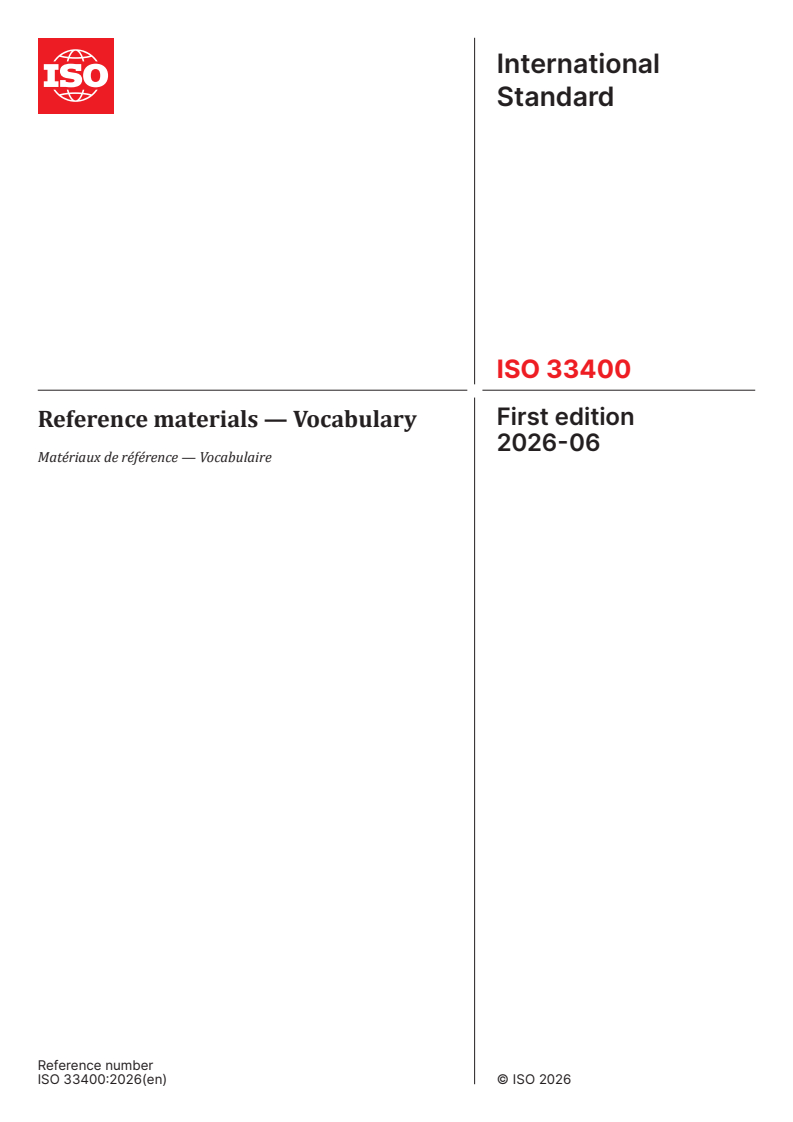
This document defines terms related with the production and use of reference materials including certified reference materials.
- Status
- Published
- Publication Date
- 21-Jun-2026
- Technical Committee
- ISO/TC 334 - Reference materials
- Drafting Committee
- ISO/TC 334/WG 10 - RM Terms and definitions
- Current Stage
- 6060 - International Standard published
- Start Date
- 22-Jun-2026
- Due Date
- 08-Jan-2027
- Completion Date
- 22-Jun-2026
Overview
ISO 33400:2026, Reference materials - Vocabulary is an international standard developed by the International Organization for Standardization (ISO). This document provides a comprehensive set of terms and definitions crucial for the production, characterization, and use of reference materials (RMs), including certified reference materials (CRMs). Clear and consistent terminology is essential for laboratories, accreditation bodies, and organizations working with reference materials to ensure accuracy and reliability in measurement, calibration, and quality control processes.
ISO 33400:2026 replaces previous editions (such as ISO Guide 30:2015), offering updated definitions and a regrouped structure to align with current practices in reference material development and application worldwide.
Key Topics
- Reference Materials (RMs): Defined as materials, homogeneous and stable for one or more specified properties, which are established to be fit for a particular use.
- Certified Reference Materials (CRMs): A key subset of RMs, CRMs have one or more property values certified by a metrologically valid procedure, including statements of uncertainty and metrological traceability.
- Indicative Value: A value assigned to a property of a reference material that does not fully meet certification requirements, but is suitable for specific, defined uses.
- Reference Material Documentation: Includes reference material certificates for CRMs, product information sheets for non-certified RMs, and detailed production and certification reports.
- Production and Characterization: Terms cover all aspects of reference material production, the role of producers and subcontractors, and the steps involved in characterizing material properties, assessing homogeneity and stability, and assigning certified values.
- Use of Reference Materials: Guidance on intended use, period of validity, minimum sample size, and concepts such as commutability for ensuring application-related relevance of RMs.
Applications
ISO 33400:2026 ensures that everyone working with reference materials uses the same language, reducing ambiguity and supporting effective communication in:
- Calibration of Measuring Systems: RMs and CRMs are used to calibrate instruments across various fields, ensuring traceability and comparability of measurement results.
- Validation of Measurement Methods: Laboratories use RMs to verify that analytical procedures produce accurate and reliable results.
- Quality Control in Laboratories: Routinely applying RMs and CRMs helps laboratories monitor and maintain the precision and accuracy of their analyses.
- Accreditation and Compliance: Organizations seeking laboratory accreditation under ISO/IEC 17025 or ISO 17034 rely on standardized terminology to demonstrate compliance and technical competence.
- Harmonization of Testing: Internationally recognized terminology helps harmonize test results across borders and disciplines, ensuring shared understanding in inter-laboratory comparisons and proficiency testing.
Related Standards
Users of ISO 33400:2026 may also benefit from familiarity with these related ISO and IEC standards:
- ISO/IEC Guide 99: International vocabulary of metrology - Basic and general concepts and associated terms (VIM)
- ISO 17034: General requirements for the competence of reference material producers
- ISO 33401: Reference materials - Contents of certificates, labels, and accompanying documentation
- ISO 33403: Reference materials - Requirements and recommendations for use
- ISO 33405: Reference materials - Approaches for characterization and assessment of homogeneity and stability
- ISO 33406:2024: Production of reference materials with qualitative properties
- ISO/IEC 17000:2020: Conformity assessment - Vocabulary and general principles
- ISO 17511:2020: In vitro diagnostic medical devices - Requirements for establishing metrological traceability
Practical Value
Implementing ISO 33400:2026 supports:
- Consistent communication among producers, users, and assessors of reference materials
- Reliable laboratory calibration and quality assurance
- Facilitation of global trade by ensuring measurement comparability
- Confidence in laboratory results for regulatory, research, and industrial applications
For organizations involved in producing or utilizing reference materials, ISO 33400:2026 is an essential vocabulary resource supporting best practices and regulatory acceptance worldwide.
Relations
- Effective Date
- 11-Jan-2025
Get Certified
Connect with accredited certification bodies for this standard

ECOCERT
Organic and sustainability certification.

Eurofins Food Testing Global
Global leader in food, environment, and pharmaceutical product testing.

Intertek Bangladesh
Intertek certification and testing services in Bangladesh.
Sponsored listings
Frequently Asked Questions
ISO 33400:2026 is a standard published by the International Organization for Standardization (ISO). Its full title is "Reference materials — Vocabulary". This standard covers: This document defines terms related with the production and use of reference materials including certified reference materials.
This document defines terms related with the production and use of reference materials including certified reference materials.
ISO 33400:2026 is classified under the following ICS (International Classification for Standards) categories: 01.040.71 - Chemical technology (Vocabularies); 71.040.30 - Chemical reagents. The ICS classification helps identify the subject area and facilitates finding related standards.
ISO 33400:2026 has the following relationships with other standards: It is inter standard links to ISO Guide 30:2015. Understanding these relationships helps ensure you are using the most current and applicable version of the standard.
ISO 33400:2026 is available in PDF format for immediate download after purchase. The document can be added to your cart and obtained through the secure checkout process. Digital delivery ensures instant access to the complete standard document.
Standards Content (Sample)
International
Standard
ISO 33400
First edition
Reference materials — Vocabulary
2026-06
Matériaux de référence — Vocabulaire
Reference number
© ISO 2026
All rights reserved. Unless otherwise specified, or required in the context of its implementation, no part of this publication may
be reproduced or utilized otherwise in any form or by any means, electronic or mechanical, including photocopying, or posting on
the internet or an intranet, without prior written permission. Permission can be requested from either ISO at the address below
or ISO’s member body in the country of the requester.
ISO copyright office
CP 401 • Ch. de Blandonnet 8
CH-1214 Vernier, Geneva
Phone: +41 22 749 01 11
Email: copyright@iso.org
Website: www.iso.org
Published in Switzerland
ii
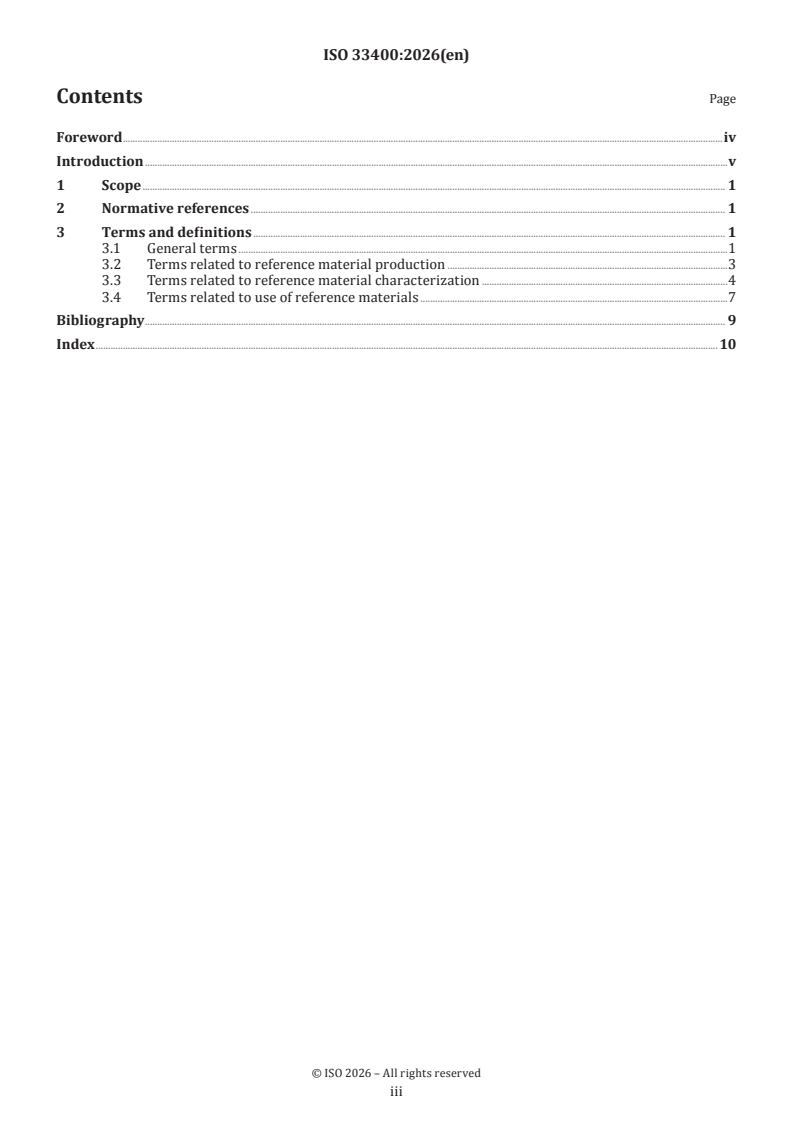
Contents Page
Foreword .iv
Introduction .v
1 Scope . 1
2 Normative references . 1
3 Terms and definitions . 1
3.1 General terms .1
3.2 Terms related to reference material production .3
3.3 Terms related to reference material characterization .4
3.4 Terms related to use of reference materials .7
Bibliography . 9
Index . 10
iii
Foreword
ISO (the International Organization for Standardization) is a worldwide federation of national standards
bodies (ISO member bodies). The work of preparing International Standards is normally carried out through
ISO technical committees. Each member body interested in a subject for which a technical committee
has been established has the right to be represented on that committee. International organizations,
governmental and non-governmental, in liaison with ISO, also take part in the work. ISO collaborates closely
with the International Electrotechnical Commission (IEC) on all matters of electrotechnical standardization.
The procedures used to develop this document and those intended for its further maintenance are described
in the ISO/IEC Directives, Part 1. In particular, the different approval criteria needed for the different types
of ISO document should be noted. This document was drafted in accordance with the editorial rules of the
ISO/IEC Directives, Part 2 (see www.iso.org/directives).
ISO draws attention to the possibility that the implementation of this document may involve the use of (a)
patent(s). ISO takes no position concerning the evidence, validity or applicability of any claimed patent
rights in respect thereof. As of the date of publication of this document, ISO had not received notice of (a)
patent(s) which may be required to implement this document. However, implementers are cautioned that
this may not represent the latest information, which may be obtained from the patent database available at
www.iso.org/patents.ISO shall not be held responsible for identifying any or all such patent rights.
Any trade name used in this document is information given for the convenience of users and does not
constitute an endorsement.
For an explanation of the voluntary nature of standards, the meaning of ISO specific terms and expressions
related to conformity assessment, as well as information about ISO's adherence to the World Trade
Organization (WTO) principles in the Technical Barriers to Trade (TBT), see www.iso.org/iso/foreword.html.
This document was prepared by Technical Committee ISO/TC 334, Reference materials.
This first edition cancels and replaces the third edition (ISO Guide 30:2015), which has been technically
revised.
The main changes are as follows:
— order of presentation of the terms and definitions has been revised and regrouped;
— definitions of certified reference material and certified value have been revised;
— definition of indicative value has been revised to be more consistent with the typical characteristics and
intended uses of such values.
Any feedback or questions on this document should be directed to the user’s national standards body. A
complete listing of these bodies can be found at www.iso.org/members.html.
iv
Introduction
Reference materials (RMs) are widely used for the calibration of measuring systems, for the evaluation of
measurement procedures, and for the internal or external quality control of measurements and laboratories.
They can also enable the expression of functional properties in arbitrary units, for instance in certain
cases relevant for biology or material sciences. RMs play an important role in national and international
standardization activities and in the accreditation of laboratories.
This document defines terms used in connection with the production and use of RMs and certified reference
materials (CRMs). It aims to ensure use of consistent terminology by organizations worldwide that work
with RMs and CRMs.
v
International Standard ISO 33400:2026(en)
Reference materials — Vocabulary
1 Scope
This document defines terms related with the production and use of reference materials including certified
reference materials.
2 Normative references
There are no normative references in this document.
3 Terms and definitions
ISO and IEC maintain terminology databases for use in standardization at the following addresses:
— IEC Electropedia: available at http:// www .electropedia .org/
— ISO Online browsing platform: available at http:// www .iso .org/ obp
3.1 General terms
3.1.1
reference material
RM, noun
material, sufficiently homogeneous and stable with respect to one or more specified properties, which has
been established to be fit for its intended use (3.4.1)
Note 1 to entry: The specified properties can be quantitative or qualitative (nominal property (3.3.5) or ordinal
property (3.3.6)).
[1]
Note 2 to entry: ISO/IEC Guide 99:2007 has an analogous definition (5.13).
3.1.2
certified reference material
CRM, noun
reference material (3.1.1) that has at least one certified value (3.1.3)
Note 1 to entry: A certified reference material can also have one or more indicative values (3.1.4).
3.1.3
certified value
certified property value, noun
value, determined by a metrologically valid procedure and accompanied by an uncertainty statement and a
statement of metrological traceability, assigned to a property of a reference material (3.1.1) and identified as
such in the reference material document (3.1.5)
Note 1 to entry: Certified values can be suitable for, for example, calibration of a measurement system, validation of
measurement procedures, assessing precision and/or accuracy of a method, and assessing stability of the composition
of materials to which they are assigned. Additional information on uses of certified values can be found in ISO 33403
[2]
.
Note 2 to entry: In the case of a quantitative property, the uncertainty statement is a reported measurement
[3]
uncertainty. ISO 33405 gives further details of measurement uncertainty and metrological traceability for
quantitative certified values.
Note 3 to entry: In the case of a qualitative (nominal or ordinal) property, the uncertainty statement can be a statement
of confidence, and the statement of metrological traceability refers to the metrological traceability of measured values
used in assigning the qualitative value, together with information on qualitative reference materials or data used in
[4]
assigning the value. ISO 33406:2024 gives further information on statements of confidence and traceability for
qualitative reference materials.
Note 4 to entry: The uncertainty statement for a certified value generally includes contributions from reference
material characterization (3.3.1) and assessment of reference material homogeneity (3.3.8) and reference material
stability (3.3.11).
Note 5 to entry: Examples of metrologically valid procedures for reference material characterization (3.3.1) are
[3]
described in ISO 33405 .
3.1.4
indicative value, noun
information value, noun
value, assigned to a property of a reference material (3.1.1), that does not fulfil all the requirements of a
certified value (3.1.3), but is warranted as suitable for specific purposes as identified in the reference material
document (3.1.5)
Note 1 to entry: Indicative values can be suitable for, for example, comparison of laboratory results with an average
or consensus from other laboratories, use in method harmonization, assessing precision of a method, and assessing
stability of the composition of materials to which they are assigned. Because indicative values do not fulfil all the
requirements of a certified value, they are not usually suitable for use in calibration.
Note 2 to entry: Terms other than those listed can be used to refer to indicative values (e.g., assessed value, informative
value, reference value, and non-certified value).
3.1.5
reference material document
RM document, noun
document containing all the information that is essential for using a reference material (3.1.1)
[5]
Note 1 to entry: The required and recommended content of a reference material document is described in ISO 17034
[6]
and ISO 33401 . For the purposes of this definition, the required content is regarded as information that is essential
for using a reference material (3.1.1).
Note 2 to entry: Reference material producers (3.2.2) can use different terms to describe a reference material document,
including certificate, reference material certificate (3.1.6), certificate of analysis, or product information sheet (3.1.7).
3.1.6
reference material certificate
RM certificate, noun
reference material document (3.1.5) for a certified reference material (3.1.2), stating the certified value (3.1.3)
and confirming that the necessary procedures have been carried out to ensure its validity and metrological
traceability
3.1.7
product information sheet
reference material document (3.1.5) for a reference material (3.1.1) that is not a certified reference material
(3.1.2)
3.1.8
reference material production report
production report, noun
document giving detailed descriptions of all the steps taken in reference material production (3.2.1) of a
reference material (3.1.1) that is not a certified reference material (3.1.2)
Note 1 to entry: Information in a reference material production report can include descriptions of the preparation of
the reference material (3.1.1), methods of measurement, factors affecting accuracy, and statistical treatment of results.
3.1.9
reference material certification report
certification report, noun
document giving detailed descriptions of all the steps taken in reference material production (3.2.1) of a
certified reference material (3.1.2)
Note 1 to entry: Information in a reference material certification report can include descriptions of the preparation
of the certified reference material (3.1.2), methods of measurement, factors affecting accuracy, statistical treatment of
results, and the way in which metrological traceability has been established.
Note 2 to entry: The reference material producer (3.2.2) can include descriptions pertaining to indicative values (3.1.4)
in the reference material certification report.
3.2 Terms related to reference material production
3.2.1
reference material production
RM production, noun
production, noun
activities and tasks that are necessary in the development of a reference material (3.1.1) leading to, and
including, the reference material (3.1.1) becoming available to the user
Note 1 to entry: Necessary activities can include, for example, project planning, material handling and storage,
material processing, assessment of reference material homogeneity (3.3.8), assessment of reference material stability
(3.3.11), reference material characterization (3.3.1), where applicable, assignment of property values and statements of
their uncertainties and metrological traceability, and authorization and issue of a reference material document (3.1.5).
[5]
Note 2 to entry: Requirements for reference material production are described in ISO 17034 .
3.2.2
reference material producer
RM producer, noun
RMP, noun
body that is fully responsible for the reference material production (3.2.1)
Note 1 to entry: The body can be any organization or company, public or private.
3.2.3
subcontractor
body that undertakes selected aspects of reference material production (3.2.1) under its own management
system on behalf of the reference material producer (3.2.2)
Note 1 to entry: Aspects of reference material production that may be subcontracted by the reference material producer
[5]
(3.2.2) are specified in ISO 17034 .
Note 2 to entry: Subcontractors can be paid or unpaid.
Note 3 to entry: Advisors, who can be asked for recommendat
...