


ISO/FDIS 24142
(Main)Safe design aspects for machinery in feed processing mills
Safe design aspects for machinery in feed processing mills
This document specifies safety aspects for the design of machinery used for production of formulated feed in feed processing mills. Relevant hazards are identified with recommended solutions so as to provide the best options for the safe design during the life cycle of the machine types identified. Existing standards for safe machine design are not duplicated as machinery use for the production of feed for animals has been significantly addressed by other industries. Significant hazards that are unique to machinery found in feed mills and feed processing facilities are addressed in this standard. Excluded from this standard are explosive environment; noise testing; and hazards not inherent to the design of the machines typically found in feed mills. This document excludes machinery intended for liquid feed, and wet and semi-moist pet foods. This document excludes machinery intended for the processing of food for human consumption. This document is not applicable to machinery intended for feed processing mills manufactured before the date of its publication.
Aspects liés à la sécurité de la conception des machines dans les usines de transformation des aliments pour animaux
General Information
- Status
- Not Published
- Technical Committee
- ISO/TC 293 - Feed machinery
- Drafting Committee
- ISO/TC 293 - Feed machinery
- Current Stage
- 5020 - FDIS ballot initiated: 2 months. Proof sent to secretariat
- Start Date
- 22-May-2026
- Completion Date
- 22-May-2026
Buy Documents
ISO/FDIS 24142 - Safe design aspects for machinery in feed processing mills

REDLINE ISO/FDIS 24142 - Safe design aspects for machinery in feed processing mills
Overview
ISO/FDIS 24142 provides essential requirements for the safe design of machinery in feed processing mills. Developed by ISO Technical Committee 293, this international standard addresses the unique hazards presented by machinery used in the manufacture of formulated animal feed in feed mills and feed processing facilities. The document aims to minimize risks to personnel by identifying significant hazards and recommending proven solutions for safe machinery design, covering the entire machine lifecycle.
ISO/FDIS 24142 does not duplicate existing general machinery safety standards, but instead focuses on issues not thoroughly addressed elsewhere, specific to feed mill machinery. The standard excludes aspects such as explosive atmospheres, noise testing, hazards unrelated to machine design, and equipment intended for other food processing or for human food production.
Key Topics
Identification and Mitigation of Hazards
- Highlights hazards unique to feed processing mill machinery.
- Provides solutions for mitigating risks throughout the machine lifecycle by applying risk reduction strategies as outlined in ISO 12100.
Mechanical, Electrical, and Control System Safety
- Requirements for guarding moving parts, interlocking doors, managing rotating parts, and ensuring operational stability.
- Ensures conformity with international safety standards for electrical equipment (IEC 60204-1) and safety-related control systems (IEC 62061), considering static electricity management and safe electrical enclosure design.
Handling Rejected Materials
- Specifies design features to safely manage spillages and rejected materials, aiming to protect operators during maintenance or cleaning.
Control of High Pressure and Temperature
- Recommends insulation, protective devices, and warning signs to manage risks related to high-pressure fluids and extreme temperatures.
Explosion and Fire Risk Reduction
- Addresses prevention of dust explosions and fire through design features such as explosion venting, dust control, grounding, and use of non-combustible materials.
- Aligns with ISO 19353 for fire prevention and ISO 80079-36, IEC 60079-0, and IEC 60079-14 for explosion protection.
User Safety, Stability, and Ergonomics
- Covers slip, trip, and fall prevention through non-slip surfaces, clear access routes, and safe platform design in accordance with ISO 14122.
- Emphasizes the use of safety signage and ergonomic design considerations.
Applications
ISO/FDIS 24142 is intended for:
Machinery Manufacturers
Applies to new machinery designed for feed processing mills, ensuring compliance with international best practices and regional safety regulations.Feed Mill Operators and Facility Designers
- Guides the selection, installation, and operation of equipment to reduce workplace incidents and foster a safer working environment.
Health and Safety Regulators and Inspectors
- Serves as a reference for evaluating the conformity of feed processing machines to recognized safety norms.
Maintenance Providers
- Ensures that maintenance and cleaning tasks can be performed safely through suitable design.
Adhering to this standard facilitates regulatory compliance, reduces incident rates, and enhances workplace safety for all stakeholders involved in animal feed manufacturing.
Related Standards
ISO/FDIS 24142 references and aligns with several established standards, including:
- ISO 12100: General principles for design and risk assessment of machinery
- ISO 13857: Safety distances to prevent hazard zones being reached
- ISO 14119, ISO 14120: Guarding and interlock design for machinery
- ISO 14122 series: Safe access to machinery
- ISO 19353: Fire prevention and protection for machinery
- IEC 60204-1: Safety of electrical equipment of machines
- IEC 62061: Functional safety of safety-related control systems
- ISO 80079-36, IEC 60079 series: Equipment for explosive atmospheres
For a complete, applicable risk management program, users should consider these related standards alongside ISO/FDIS 24142 for comprehensive safety compliance in feed processing environments.
Keywords: feed processing mill machinery safety, ISO feed machinery standard, explosion prevention in feed mills, safe design for animal feed machinery, ISO/FDIS 24142
Buy Documents
ISO/FDIS 24142 - Safe design aspects for machinery in feed processing mills
REDLINE ISO/FDIS 24142 - Safe design aspects for machinery in feed processing mills
Get Certified
Connect with accredited certification bodies for this standard

Control Union Certifications
Global certification for agriculture and sustainability.

ECOCERT
Organic and sustainability certification.

FSC International
Forest Stewardship Council certification.
Sponsored listings
Frequently Asked Questions
ISO/FDIS 24142 is a draft published by the International Organization for Standardization (ISO). Its full title is "Safe design aspects for machinery in feed processing mills". This standard covers: This document specifies safety aspects for the design of machinery used for production of formulated feed in feed processing mills. Relevant hazards are identified with recommended solutions so as to provide the best options for the safe design during the life cycle of the machine types identified. Existing standards for safe machine design are not duplicated as machinery use for the production of feed for animals has been significantly addressed by other industries. Significant hazards that are unique to machinery found in feed mills and feed processing facilities are addressed in this standard. Excluded from this standard are explosive environment; noise testing; and hazards not inherent to the design of the machines typically found in feed mills. This document excludes machinery intended for liquid feed, and wet and semi-moist pet foods. This document excludes machinery intended for the processing of food for human consumption. This document is not applicable to machinery intended for feed processing mills manufactured before the date of its publication.
This document specifies safety aspects for the design of machinery used for production of formulated feed in feed processing mills. Relevant hazards are identified with recommended solutions so as to provide the best options for the safe design during the life cycle of the machine types identified. Existing standards for safe machine design are not duplicated as machinery use for the production of feed for animals has been significantly addressed by other industries. Significant hazards that are unique to machinery found in feed mills and feed processing facilities are addressed in this standard. Excluded from this standard are explosive environment; noise testing; and hazards not inherent to the design of the machines typically found in feed mills. This document excludes machinery intended for liquid feed, and wet and semi-moist pet foods. This document excludes machinery intended for the processing of food for human consumption. This document is not applicable to machinery intended for feed processing mills manufactured before the date of its publication.
ISO/FDIS 24142 is classified under the following ICS (International Classification for Standards) categories: 13.110 - Safety of machinery; 65.060.01 - Agricultural machines and equipment in general. The ICS classification helps identify the subject area and facilitates finding related standards.
ISO/FDIS 24142 is available in PDF format for immediate download after purchase. The document can be added to your cart and obtained through the secure checkout process. Digital delivery ensures instant access to the complete standard document.
Standards Content (Sample)
FINAL DRAFT
International
Standard
ISO/TC 293
Safe design aspects for machinery
Secretariat: SAC
in feed processing mills
Voting begins on:
Aspects liés à la sécurité de la conception des machines dans les 2026-05-22
usines de transformation des aliments pour animaux
Voting terminates on:
2026-07-17
RECIPIENTS OF THIS DRAFT ARE INVITED TO SUBMIT,
WITH THEIR COMMENTS, NOTIFICATION OF ANY
RELEVANT PATENT RIGHTS OF WHICH THEY ARE AWARE
AND TO PROVIDE SUPPOR TING DOCUMENTATION.
IN ADDITION TO THEIR EVALUATION AS
BEING ACCEPTABLE FOR INDUSTRIAL, TECHNO
LOGICAL, COMMERCIAL AND USER PURPOSES, DRAFT
INTERNATIONAL STANDARDS MAY ON OCCASION HAVE
TO BE CONSIDERED IN THE LIGHT OF THEIR POTENTIAL
TO BECOME STAN DARDS TO WHICH REFERENCE MAY BE
MADE IN NATIONAL REGULATIONS.
Reference number
FINAL DRAFT
International
Standard
ISO/TC 293
Safe design aspects for machinery
Secretariat: SAC
in feed processing mills
Voting begins on:
Aspects liés à la sécurité de la conception des machines dans les
usines de transformation des aliments pour animaux
Voting terminates on:
RECIPIENTS OF THIS DRAFT ARE INVITED TO SUBMIT,
WITH THEIR COMMENTS, NOTIFICATION OF ANY
RELEVANT PATENT RIGHTS OF WHICH THEY ARE AWARE
AND TO PROVIDE SUPPOR TING DOCUMENTATION.
© ISO 2026
IN ADDITION TO THEIR EVALUATION AS
All rights reserved. Unless otherwise specified, or required in the context of its implementation, no part of this publication may
BEING ACCEPTABLE FOR INDUSTRIAL, TECHNO
LOGICAL, COMMERCIAL AND USER PURPOSES, DRAFT
be reproduced or utilized otherwise in any form or by any means, electronic or mechanical, including photocopying, or posting on
INTERNATIONAL STANDARDS MAY ON OCCASION HAVE
the internet or an intranet, without prior written permission. Permission can be requested from either ISO at the address below
TO BE CONSIDERED IN THE LIGHT OF THEIR POTENTIAL
or ISO’s member body in the country of the requester.
TO BECOME STAN DARDS TO WHICH REFERENCE MAY BE
MADE IN NATIONAL REGULATIONS.
ISO copyright office
CP 401 • Ch. de Blandonnet 8
CH-1214 Vernier, Geneva
Phone: +41 22 749 01 11
Email: copyright@iso.org
Website: www.iso.org
Published in Switzerland Reference number
ii
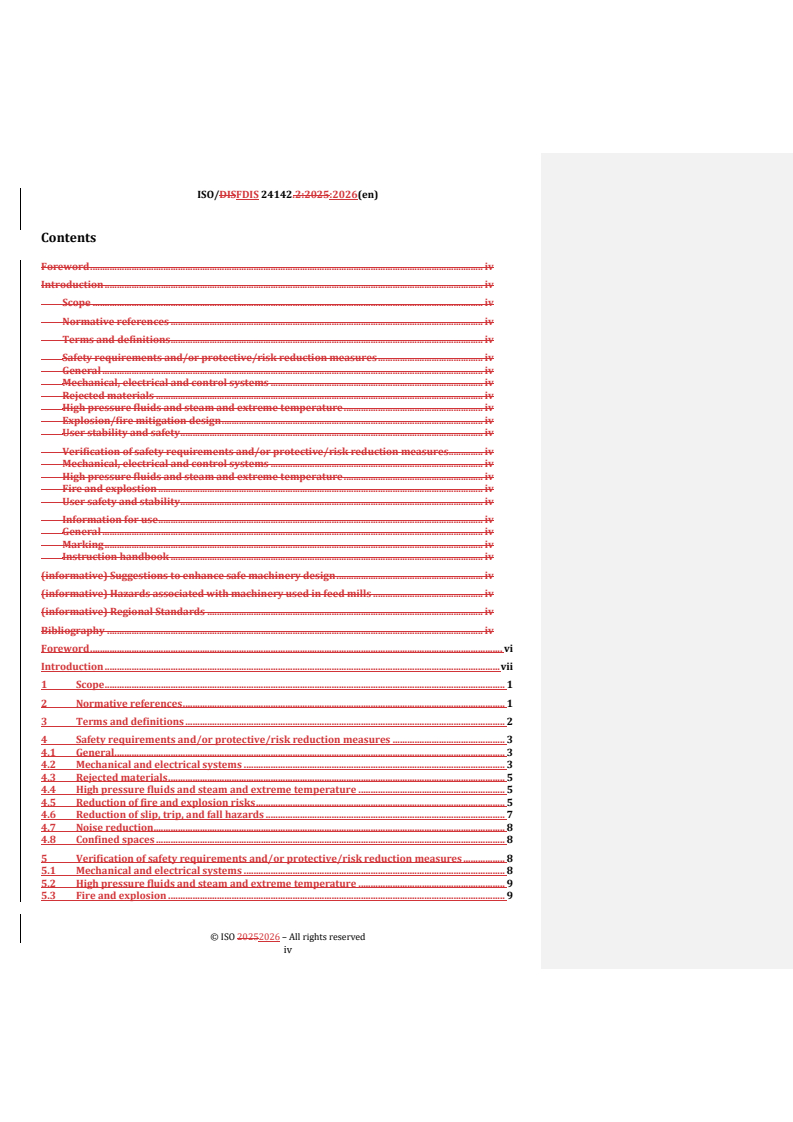
Contents Page
Foreword .iv
Introduction .v
1 Scope . 1
2 Normative references . 1
3 Terms and definitions . 2
4 Safety requirements and/or protective/risk reduction measures . 3
4.1 General .3
4.2 Mechanical and electrical systems .3
4.2.1 Mechanical .3
4.2.2 Electrical.3
4.3 Rejected materials.4
4.4 High pressure fluids and steam and extreme temperature .4
4.5 Reduction of fire and explosion risks .4
4.5.1 General .4
4.5.2 Explosion and fire prevention .5
4.5.3 Static electricity .5
4.6 Reduction of slip, trip, and fall hazards .5
4.7 Noise reduction .6
4.8 Confined spaces .6
5 Verification of safety requirements and/or protective/risk reduction measures . 6
5.1 Mechanical and electrical systems .6
5.2 High pressure fluids and steam and extreme temperature .6
5.2.1 High pressure fluids and steam .6
5.2.2 Extreme temperature .6
5.3 Fire and explosion .6
5.3.1 Static electricity .7
5.4 User safety and stability .7
5.4.1 Noise reduction . .7
5.4.2 Ergonomic design .7
5.4.3 Confined spaces .7
6 Information for use . 7
6.1 General .7
6.2 Marking .7
6.3 Instruction handbook.7
Annex A (informative) Suggestions to enhance safe machinery design . 8
Annex B (informative) Hazards associated with machinery used in feed mills .15
Annex C (informative) Regional Standards .22
Bibliography .23
iii
Foreword
ISO (the International Organization for Standardization) is a worldwide federation of national standards
bodies (ISO member bodies). The work of preparing International Standards is normally carried out through
ISO technical committees. Each member body interested in a subject for which a technical committee
has been established has the right to be represented on that committee. International organizations,
governmental and non-governmental, in liaison with ISO, also take part in the work. ISO collaborates closely
with the International Electrotechnical Commission (IEC) on all matters of electrotechnical standardization.
The procedures used to develop this document and those intended for its further maintenance are described
in the ISO/IEC Directives, Part 1. In particular, the different approval criteria needed for the different types
of ISO document should be noted. This document was drafted in accordance with the editorial rules of the
ISO/IEC Directives, Part 2 (see www.iso.org/directives).
ISO draws attention to the possibility that the implementation of this document may involve the use of (a)
patent(s). ISO takes no position concerning the evidence, validity or applicability of any claimed patent
rights in respect thereof. As of the date of publication of this document, ISO had not received notice of (a)
patent(s) which may be required to implement this document. However, implementers are cautioned that
this may not represent the latest information, which may be obtained from the patent database available at
www.iso.org/patents. ISO shall not be held responsible for identifying any or all such patent rights.
Any trade name used in this document is information given for the convenience of users and does not
constitute an endorsement.
For an explanation on the meaning of ISO specific terms and expressions related to conformity assessment,
as well as information about ISO's adherence to the World Trade Organization (WTO) principles in the
Technical Barriers to Trade (TBT) see the following URL: www.iso.org/iso/foreword.html.
This document was prepared by Technical Committee ISO/TC 293, Feed machinery.
Any feedback or questions on this document should be directed to the user’s national standards body. A
complete listing of these bodies can be found at www.iso.org/members.html.
iv
Introduction
[1]
This document is a type-C standard as stated in ISO 12100 .
This document is of relevance, in particular, for the following stakeholder groups representing the market
players with regard to machinery safety:
— machine manufacturers (small, medium and large enterprises);
— health and safety bodies (e.g. regulators, accident prevention organizations, market surveillance).
Others can be affected by the level of machinery safety achieved with the means of the document by the
above-mentioned stakeholder groups:
— machine users/employers (small, medium and large enterprises);
— machine users/employees (e.g. trade unions, organizations for people with special needs);
— service providers, e.g. for maintenance (small, medium and large enterprises);
— consumers (in case of machinery intended for use by consumers).
The above-mentioned stakeholder groups have been given the opportunity to participate at the drafting
process of this document.
The machinery concerned and the extent to which hazards, hazardous situations and events are covered are
indicated in the scope of this document. These hazards are specific to machinery used in feed mills and feed
processing facilities.
When requirements of this type-C standard are different from those which are stated in type-A or type-B
standards, the requirements of this type-C standard take precedence over the requirements of the other
standards for machines that have been designed and built according to the requirements of this type-C
standard.
v
FINAL DRAFT International Standard ISO/FDIS 24142:2026(en)
Safe design aspects for machinery in feed processing mills
1 Scope
This document specifies safety aspects for the design of machinery used for production of formulated feed
in feed processing mills. Relevant hazards are identified with recommended solutions so as to provide the
best options for the safe design during the life cycle of the machine types identified. Existing standards
for safe machine design are not duplicated as machinery used for the production of feed for animals has
been significantly addressed by other industries. Significant hazards that are unique to machinery found in
feed mills and feed processing facilities are addressed in this document. Excluded from this document are
explosive environment, noise testing, and hazards not inherent to the design of the machines typically found
in feed mills.
This document excludes machinery intended for liquid feed, and wet and semi-moist pet foods. This
document excludes machinery intended for the processing of food for human consumption.
This document is not applicable to machinery intended for feed processing mills manufactured before the
date of its publication.
2 Normative references
The following documents are referred to in the text in such a way that some or all of their content constitutes
requirements of this document. For dated references, only the edition cited applies. For undated references,
the latest edition of the referenced document (including any amendments) applies.
ISO 284, Conveyor belts — Electrical conductivity — Specification and test method
ISO 3746, Acoustics — Determination of sound power levels and sound energy levels of noise sources using sound
pressure — Survey method using an enveloping measurement surface over a reflecting plane
ISO 4413, Hydraulic fluid power — General rules and safety requirements for systems and their components
ISO 4414, Pneumatic fluid power — General rules and safety requirements for systems and their components
ISO 12100:2010, Safety of machinery — General principles for design — Risk assessment and risk reduction
ISO 13857, Safety of machinery — Safety distances to prevent hazard zones being reached by upper and lower
limbs
ISO 14119, Safety of machinery — Interlocking devices associated with guards — Principles for design and
selection
ISO 14120, Safety of machinery — Guards — General requirements for the design and construction of fixed and
movable guards
ISO 14122-1, Safety of machinery — Permanent means of access to machinery — Part 1: Choice of fixed means
and general requirements of access
ISO 14122-2, Safety of machinery — Permanent means of access to machinery — Part 2: Working platforms and
walkways
ISO 19353:2019, Safety of machinery — Fire prevention and fire protection
ISO 19353, Safety of machinery — Fire prevention and fire protection
ISO 24378, Feed machinery — Vocabulary
ISO 80079-36, Explosive atmospheres — Part 36: Non-electrical equipment for explosive atmospheres — Basic
method and requirements
IEC 60079-0, Explosive atmospheres - Part 0: Equipment - General requirements
IEC 60079-14, Explosive atmospheres - Part 14: Electrical installation design, selection and installation of
equipment, including initial inspection
IEC 60204-1, Safety of machinery - Electrical equipment of machines - Part 1: General requirements
IEC 60204-1:2016 ED6: 2016, Safety of machinery - Electrical equipment of machines - Part 1: General
requirements
IEC 60529, Degrees of protection provided by enclosures (IP Code)
3 Terms and definitions
For the purposes of this document, the terms and definitions given in ISO 24378 and ISO 12100:2010 apply.
ISO and IEC maintain terminology databases for use in standardization at the following addresses:
— ISO Online browsing platform: available at http:// www .iso .org/ obp
— IEC Electropedia: available at http:// www .electropedia .org/
3.1
confined space
enclosed or partially enclosed space or area, where ventilation or access, or both, can be limited
3.2
explosive atmosphere
mixture with air, under atmospheric conditions, of combustible substances in the form of gas, vapour, mist
or dust in which, after ignition, permits self-sustaining propogation
[2]
[SOURCE: IEC 60079-0:2017 , 3.38, modified — “flammable” substituted by “combustible”]
3.3
liquid feed
feed product not solid and not aeriform
Note 1 to entry: A liquid feed contains sufficient moisture to flow readily and can contain molasses.
[3]
[SOURCE: EN ISO 6498:2012 , 2.3.14]
3.4
normal operation
situation when the equipment is operating within its design parameters
Note 1 to entry: Normal operation also includes possible expected operational disturbances (e.g. tearing off of a bag)
or the release of dust. Normal operation also includes the startup and shutdown of plants and activities such as local
cleaning, minor adjustments, inspection and testing.
3.5
semi-moist pet food
meat-based feed product for pets or aquatic animals that has been partially dried to prevent microbial
decomposition
[4]
[SOURCE: ISO 20588:2019 , 3.2.46]
3.6
tramp material
part of the machinery, or outer equipment, capable of falling into the feed stream
4 Safety requirements and/or protective/risk reduction measures
4.1 General
Machinery shall comply with the safety requirements and/or protective/risk reduction measures of this
clause. In addition, the machine shall be designed according to the principles of ISO 12100:2010 for relevant
but not significant hazards which are not dealt with by this document. Specific hazards associated with
machinery used in the manufacture of animal feed are found in informative Annex B .
Risks shall be reduced for all phases of the life cycle of the machine, using the hazard control hierarchy given
in ISO 12100:2010 . This document purposely omits the reference of any standard cited in the normative
references to avoid duplication and confusion. Documents listed in ISO 12100:2010 shall be followed as
requirements as they relate to the specific needs of feed machinery design. As such the normative references
listed in this document have been identified as specific to the feed industry machinery rather than general
machinery.
NOTE There are regional regulations that can state further requirements. See Annex C for information on regional
standards which can provide additional guidance.
4.2 Mechanical and electrical systems
4.2.1 Mechanical
4.2.1.1 Rotating parts
Regarding feed machines with internal rotating parts, the rotating direction shall be clearly marked.
4.2.1.2 Moving parts
All exposed moving parts (except rotary screens, vibrating screens and pan sifters) shall be equipped with
protective devices, the structure of which shall ensure that the safe distance from upper and lower limbs of
the operator to the hazardous area shall be in accordance with the provisions of ISO 13857 as referenced in
normative references.
4.2.1.3 Reduction of mechanical risks
Hazardous movements shall be safeguarded, conforming with ISO 14120 and ISO 14119 for interlocking.
Machine design shall ensure that the door body and parts do not fall when the equipment is cleaned, parts
are replaced, or when the equipment has abnormal working conditions, which includes the following.
a) Positioning the door of conditioners to ensure that the door does not fall when opened for cleaning
inside the conditioner.
b) Installing a screen bed fall protection device for the vibration grading screen to avoid wire fracture
which can result in the screen bed falling.
c) Designing the lifting device for pellet mill ring dies and rollers for manual replacement of ring dies and
rollers so as to reduce the risk of ring dies and rollers falling.
d) Designing coolers with a flip plate positioning protection device to ensure that the flip plate position is
stable and reliable and it does not fall when the cooler is cleaned.
e) Designing an impeller positioning protection device for the airlock to avoid rotation of the impeller
causing harm to personnel when the airlock is blocked and manually cleaned.
4.2.2 Electrical
Electrical equipment shall conform with IEC 60204-1 .
The protection level for electrical enclosures shall be selected on the basis of the environment in which
the machine will be used and the anticipated cleaning method for the machine and its environment. The
adequate degree of protection shall be determined by IEC 60529 .
NOTE If fluids other than water are used for cleaning or the water contains a detergent, it can be necessary to use
a higher IP rating than indicated by that standard. If fluids other than water are used to clean the machine, the level of
protection provided by an electrical enclosure can be reduced over the course of time.
On machines where hazards can arise from the generation of static electricity, the machine shall be
provided with sufficient earth bonding or static elimination equipment to ensure that hazardous levels of
static electricity do not occur. Any electrostatic discharge shall lead neither to an injury nor to the ignition of
potentially explosive atmospheres or combustible substances.
4.3 Rejected materials
Feed processing machines shall be fitted with trays or dumps to collect spillages or rejected material from
the machine. Risk reduction for the operator shall be taken into consideration in the design when a spillage
tray is removed as the operator can be exposed to hazards inside the machine.
4.4 High pressure fluids and steam and extreme temperature
High temperature surfaces shall be equipped with heat insulation devices and warning signs.
A heating device shall be equipped with a temperature monitoring device.
Insulation on heat exchangers shall be made of non-combustible materials and shall have handgrips/handles
for cleaning and repairing.
4.5 Reduction of fire and explosion risks
4.5.1 General
The electrical equipment and installation shall be in accordance with IEC 60204-1:2016 , Clause 18. The
documentation of electrical systems shall conform with IEC 60204-1, Clause 17. In the area of fires and
explosions, the feed industry has requirements not used in other industries due to the hazard of dust
explosion. More specific equipment parameters and options are outlined in Annex A.
The principles of ISO 19353 shall apply to avoid fire hazards.
Where potentially explosive atmosphere can occur in the machine, the design shall conform with the
requirements of ISO 80079-36 ,IEC 60079-0 , and IEC 60079-14 .
Where it is reasonably foreseeable, that potentially hazardous explosive atmosphere is generated within
the machine envelope, this shall be prevented e.g. by providing an extraction system. The extraction system
shall operate continuously or be started when a detection system indicates the generation of a hazardous
concentration.
In case of malfunction of the extraction system the machine shall stop, and potential electrical ignition
sources shall be switched off. Hazardous explosive atmosphere shall be extracted before starting the
machine again.
NOTE Methods to eliminate the hazard(s) or minimize the risk(s) of the hazard(s) can be found in guides,
regulations and standards such as National Fire Protection Association (NFPA – US) or Atmosphères Explosibles (ATEX
– EU) and IECEx (IEC System for Certification to Standards Relating to Equipment for Use in Explosive Atmospheres).
Where potentially hazardous explosive atmosphere and/or ignition source cannot be excluded, measures
shall be taken which reduce the harm resulting from an explosion.
4.5.2 Explosion and fire prevention
Preventive explosion protection shall be structured as follows:
— Primary explosion protection: avoidance of an explosive atmosphere. Explosion resistant design
strategies shall be used to minimize the release of dust into the atmosphere;
— Secondary explosion protection: avoidance of effective ignition sources. Electrical equipment shall be
approved for the hazardous location;
— Tertiary explosion protection: to minimize the risk of the propagation of an explosion or its effects,
consider the inclusion of explosion pressure relief venting for explosion suppression and isolation.
NOTE Explosion relief venting is a commonly used form of explosion protection to protect silos, filters, and closed
machinery equipment from the overpressure generated by dust explosions. Dust explosions occur when combustible
dust builds up in the air and combusts rapidly, causing a strong pressure.
Design requirements include:
a) For non-metallic materials and wear-resistant lining boards used in silos, equipment, and pipes that
come in contact with feed materials and dust, use antistatic materials and ground them.
b) Design the inner walls of equipment to be flat and smooth so the internal structural parts do not
accumulate dust easily and are easy to clean.
c) Design with non-combustible materials in the body of the equipment.
d) Design the body of the equipment, outer cover, observation windows/gates, maintenance windows/
gates, chutes, and vents to be connected tightly and firmly.
e) Take effective dust control measures for open chutes and equipment.
f) Equip conveying belts of conveyors with a reliable tensioning device.
g) Adopt anti-static belts (e.g. conveyor belts, transmission belts) if used in the dust explosion hazard zone
according to ISO 284.
h) Design moving parts of the machine to ensure reasonable tolerances to minimize unintended contact.
i) Position bearings and rails of equipment to avoid grain flow and dust accumulation.
4.5.3 Static electricity
Ensure that static electricity does not build up to a hazardous level by providing a conductive path to ground.
All metal parts of the machine shall be bonded and grounded.
For non-electrical explosion protection methods and requirements for design and testing on non-electrical
equipment and systems, manufacturers shall follow ISO 80079-36.
Risk assessment to identify fire hazards from machinery intended for use in explosive atmospheres and for
fire prevention shall follow ISO 19353.
4.6 Reduction of slip, trip, and fall hazards
Where access is required to operate, adjust, clean, disinfect, inspect, or maintain a machine in a position
which cannot be reached from the floor, the manufacturer shall design or specify a safe means of access.
Slip trip and fall hazards shall be reduced. This includes the following.
a) Design access platforms which are slip resistant.
b) Design the machine to avoid obstacles at low level that are likely to cause a trip accident.
c) Route cables and pipe work so they do not pose a tripping hazard.
d) Means of access shall be selected conforming with ISO 14122-1.
e) The design of work platforms and steps shall conform with ISO 14122-2.
f) Provide a spillage tray or barrier to contain liquids, steam or solids that could spill onto the floor or
working platforms around the machine.
4.7 Noise reduction
Machines shall be designed to reduce noise at source to the lowest level. Where minimizing the generation of
or eliminating noise at the source is not feasible, risk reduction measures to minimize noise emissions shall
be applied.
[5]
NOTE Additional design measures can be found in EN ISO 11688-1 ISO/TR 11688-1:1998.
4.8 Confined spaces
Where access to areas with hazardous gas concentrations in the machine is foreseeable, access shall be
prevented if hazardous concentrations are present. As an example, this can be achieved by guard locking in
combination with an extraction system or a monitoring system together with detailed instructions on safe
entry.
NOTE The manufacturer is not responsible for safe entry procedures.
5 Verification of safety requirements and/or protective/risk reduction measures
5.1 Mechanical and electrical systems
[6]
Evaluation of machine vibration under normal operation can be determined using ISO/DIS 20816-3 .
The tests for electrical enclosures stipulated by IEC 60529 shall apply when water is used.
5.2 High pressure fluids and steam and extreme temperature
5.2.1 High pressure fluids and steam
The safety requirements and/or protective/risk reduction measures of hydraulic components and piping
shall be verified in accordance with ISO 4413.
The safety requirements and/or protective/risk reduction measures of pneumatic components and piping
shall be verified in accordance with ISO 4414.
5.2.2 Extreme temperature
The temperature shall be tested by the built-in temperature sensors in the feed machinery if they are
applicable. Otherwise, non-contact methods (e.g. infrared thermometer) shall be used to determine the
temperature of the feed machinery.
5.3 Fire and explosion
Visual inspection of the machine to verify appropriate dust containment and mitigation shall be required.
Validation shall be made using ISO 19353:2019, 6.2.6.
Regional and internationally available standards and guides are available for use and reference. Examples of
such organizations are NFPA and ATEX.
5.3.1 Static electricity
For non-electrical explosion protection methods and requirements for design and testing on non-electrical
equipment and systems, manufacturers shall follow ISO 80079-36.
5.4 User safety and stability
5.4.1 Noise reduction
Sound power levels of various noise sources in feed machinery shall be determined by ISO 3746.
5.4.2 Ergonomic design
Verify appropriate design using visual inspection of machine openings for height limitations or reach for
loading, inspection, or maintenance of the machine.
5.4.3 Confined spaces
Monitor air quality for verification of safe levels based on regionally determined requirements, visual
inspection of obstructions for entanglement or injury or engulfment.
6 Information for use
6.1 General
Information for use shall be provided in accordance with ISO 12100:2010, 6.4.
6.2 Marking
The feed machinery shall be marked with the following:
a) designation of the feed machinery;
b) series or type of the feed machinery;
c) name and address of the manufacturer and, where applicable, business name and full address of the
authorized representative;
d) year of manufacturing;
e) mass of the feed machinery;
f) key parameters of the feed machinery (e.g. power, dimension, applicable feedstocks, and yields of the
feed machinery).
6.3 Instruction handbook
The instructions shall conform with and contain the information listed in ISO 12100:2010 where the
equivalent hazard exists. In addition, the instructions shall contain the information that is specific to the
machines in the scope of this document.
[7]
NOTE See also ISO 20607 for structuring and presentation of information for use.
Annex A
(informative)
Suggestions to enhance safe machinery design
A.1 General
Information in this annex is not required for conformance with this document. Suggestions are considered
best management practices to enhance safe design and which are encouraged for inclusion as manufacturing
options.
The following listed equipment (Clause A.2 to Clause A.5) is regularly utilized in feed mills. As such, there are
design variations used around the world. Final designs depend on the country, regulations of that country or
region, and the manufacturers’ proprietary designs. This list is prepared as an informative guide under each
type of machine or equipment noted and is not exhaustive of options but rather represents the best practices
in design.
A.2 Handling equipment
A.2.1 Bucket elevators
a) The bucket elevator with the hazard of dust explosion should adopt one or more explosive control
measures, such as explosion relief and explosion suppression.
b) When the explosion relief measures are adopted, the explosion relief port should be set at the head
section and boot section, with the explosion relief area increased as much as possible at the head section.
c) When the machine boot section is located in the basement and the explosion relief port cannot be
directly connected to the outside, it is recommended to adopt the non-flame explosion relief port.
d) Depending on the height of the elevator, the vertical section of the body should be equipped with the
explosion relief port at the appropriate position. Multiple explosion relief ports can be needed based on
the height.
e) Buckets should be made of non-metallic materials and measures should be taken to prevent electrostatic
accumulation.
f) The bucket and bucket belt should be firmly connected to prevent bucket separation or collision.
g) Grates and magnets should be installed at the intake to bucket elevators to prevent the introduction of
tramp material.
h) The elevator boot section should be provided with an appropriate cleaning port.
i) There should be an inspection port at the head section for inspection of the head section panel, bucket,
bucket belts, and discharging outlet.
j) Brakes and non-return devices should be installed to prevent equipment reversal.
k) Prevention devices, alarms and automatic shutdown switches should be installed in case of belt slippage.
1) Sensing equipment such as belt slip monitoring devices should be installed.
2) Sensing equipment such as bearing temperature monitoring devices should be installed.
3) Sensing equipment such as belt misalignment monitoring devices should be installed.
4) Sensing equipment such as plug condition monitoring devices should be installed.
5) As a best practice, elevator legs should be designed for optional leg monitoring equipment
installation.
l) The body of the equipment, head section, and boot section of the elevators should be grounded reliably.
m) Explosion isolation valves should be installed at the discharging outlet of bucket elevators.
n) The driving wheels of elevators should be covered with a flame retardant and anti-static coating.
A.2.2 Chutes, vents, and buffer hoppers
Chutes, vents and buffer hoppers should be connected to prevent friction during movement, and all joints
should be sealed to limit dust emission.
A.2.3 Shock-absorber
A device to reduce the flow speed of materials should be installed when a vertical drop is excessive to protect
the integrity of the chute.
A.2.4 Screw conveyor and drag conveyor
a) The helix should rotate freely and without interference. The conveyor should stop automatically when
the discharging outlet is blocked.
b) When the scraper chain of the drag conveyor enters the head wheel, it should engage correctly and
securely.
c) Drag conveyors should be equipped with an alarm that signals a broken chain or the stalling of the tail
wheel which stops the conveyor.
d) Drag conveyors should stop automatically when the discharging outlet is blocked.
e) If the drag conveyor uses wear-resistant and antistatic ultra-high molecular plastic guide plates, the
guide plate interfaces should be aligned, and there should be no scraping, collision, or sticking.
f) Sensing equipment such as bearing temperature monitoring devices should be installed.
A.3 Processing equipment
A.3.1 Magnetic separator
a) Magnetic separators should be installed before the hammer mill, the mixer, the pellet mill and the
extruder.
b) Magnetic separators should be equipped with automatic cleaning equipment.
A.3.2 Batching scale, mixer and buffer hopper
a) Vents should be used to connect the batching scale, mixer and buffer hopper to ensure that the pressure
of the mixer can be released during feeding, the air flow can be closed during running, and the pressure
balance between the mixer and the buffer hopper can be achieved during feed discharging.
b) The gate between the batching scale, the mixer and the buffer hopper should be sealed.
c) The soft connection of the batching scale hopper should be kept in good condition and should not be
damaged.
d) The cleaning door of a mixer should be equipped with an interlock protection device. When the cleaning
door is open, the mixer should stop working or be unable to be started.
e) The blades on the rotor of a mixer should not be in contact with the machine body.
A.3.3 Hammer mill
The access door and the machine cabinet of a hammer mill should resist all foreseeable mechanical loads, e.g.
from an ejected broken hammer or from other ejected materials. A safe distance between rotating hammers
should be guaranteed to prevent collision. The rotor and grading wheel of a fine grinder and the rotor of a
hammer mill should be checked for dynamic balance. A hammer mill should be equipped with stone or iron
removal device. In the chamber of a hammer mill, the rotor bearing should be equipped with a temperature
detector and over-limit alarm in order to shut down the equipment when the temperature is too high or
exceeds a set limit.
A.3.4 Pellet mill
There should be a method to protect the die in the event of unexpected overload.
EXAMPLE A bypass door is set at the feeding inlet of a pellet mill to open automatically for discharging (and
recovering material) while the machine is in operation.
A.3.5 Heating device
a) A safety valve should be installed in heat-transfer devices using air, steam or heat transfer liquids to
release excess pressure.
b) The thermal-protective coating of the heat exchanger should be made of non-combustible material and
should have suitable manholes for cleaning and maintenance.
c) Heat exchangers should be arranged to prevent combustible dust from entering heaters or other hot
surfaces.
d) The heating device of the heat transfer system should be equipped with reliable temperature control.
A.3.6 Extruder
a) The die should be strong enough that it will not break or fly out in the case of plugging.
b) The strength of the cutting hood and its connection with the head should be sufficient to withstand the
pressure of the die bursting.
c) The cutting device should be equipped with a safety switch, so that the cutting motor is unable to start
when the cutting device is not in position.
d) When the main body of an extruder or the cutting device is not started, the conditioner should not be
able to feed the extruder.
A.3.7 Conditioning equipment
a) The conditioner with a steam jacket should be equipped with a safety valve, pressure gauge and drain
outlet.
b) For the conditioner without a jacket, safety valves and traps can be designed on the steam piping system.
c) If the feeder and conditioner are not independent of each other, the feeder motor, the conditioner motor
and the main motor of the pellet mill should be linked in a specified sequence.
d) Insulation material on an electric heating structure should be flame retardant.
A.3.8 Liquid addition and coating system
a) Liquid storage tanks should be equipped with a liquid level display and control device which should
have a level alarm function.
b) Liquid storage tanks with a heating device should be equipped with temperature display and an
automatic control device, and the heating pipes should have heat insulation measures.
c) The liquid storage tank with heating function should be equipped with an exhaust device.
A.3.9 Dryer
a) When the whole fan body is in the drying case, a heat-resistant fan and wires should be used. A
circulating air filter screen should be installed before the heat exchanger.
b) A cleaning opening should be set for the dryer air screen to clean the settling dust.
c) A dryer should be equipped with a device for drying temperature detection, display, and alarm.
d) An alarm should be raised when the monitored temperature exceeds the equipment rating.
e) When the outlet is blocked, the dryer should automatically stop and an alarm should be raised.
A.3.10 Stabilizing and cooling equipment
a) A stabilizing bin should be equipped with a clogging alarm device.
b) A cooler should be equipped with a feeding level alarm device.
c) The stabilizing and cooling equipment should be equipped with temperature monitoring and display
devices, which monitor and display the temperature inside the stabilizing and cooling bins.
d) When it is necessary to clean or examine the cooling and cooking chamber while the discharging device
is in operation, a movable protection device separating the discharge device should be installed in the
chamber in order to prevent hands or feet being drawn into the machine.
A.3.11 Cleaning and grading equipment
a) If a flexible connection design is applied, it should be well sealed.
b) Plane rotary screens with steel wire rope should be equipped with detection and protection devices in
case of steel wire rope fracture.
A.4 Electrical equipment to control explosion
A.4.1 General
a) Areas classified for explosive dust atmosphere are divided into zone 20, zone 21 and zone 22, which are
identified according to the frequency and duration of the occurrence of explosive dust atmosphere, and
the zones are categorized according to the following definitions:
1) Zone 20: a place in which an explosive dust atmosphere, in the form of a cloud of dust in air, is
present continuously, or for long periods or frequently.
2) Zone 21: a place in which an explosive dust atmosphere, in the form of a cloud of dust in air, is likely
to occur in normal operation occasionally.
3) Zone 22: area in which an explosive dust atmosphere, in the form of a cloud of combustible dust in
air, is not likely to occur in normal operation but, if it does occur, will persist for a short period only.
b) Types of electrical equipment installed in environments where there is risk of feed dust explosion sho
...
Style Definition: Heading 2: Indent: Left: 0 cm, First
ISO/DISFDIS 24142.2
line: 0 cm
ISO/TC 293
Style Definition: Heading 3: Indent: Left: 0 cm, First
line: 0 cm
Secretariat: SAC
Style Definition: Heading 4: Font: Bold, Indent: Left: 0
cm, First line: 0 cm
Date: 20252026-05-2207
Style Definition: Heading 5: Font: Bold, Indent: Left: 0
cm, First line: 0 cm, Tab stops: 6.35 cm, List tab
Style Definition: Heading 6: Font: Bold, Indent: Left:
6.35 cm, Hanging: 1.27 cm, Tab stops: 7.62 cm, List tab
Style Definition: IntroHeading1: Font: Bold, Indent:
Left: 0 cm, First line: 0 cm
Safe design aspects for machinery in feed processing mills
Style Definition: IntroHeading2: Font: Bold, Indent:
Left: 0 cm, First line: 0 cm
DISAspects liés à la sécurité de la conception des machines dans les usines de transformation des aliments pour
Style Definition: IntroHeading3: Font: Bold, Indent:
animaux
Left: 0 cm, First line: 0 cm
Style Definition: IntroHeading4: Font: Bold, Indent:
Left: 0 cm, First line: 0 cm
Style Definition: IntroHeading5: Font: Bold, Indent:
Left: 0 cm, First line: 0 cm
Style Definition: IntroHeading6
Style Definition: IntroHeading7
Style Definition: IntroHeading8
Style Definition: IntroHeading9
FDIS stage
Style Definition: List Continue 2: Indent: Left: 0.71 cm,
Hanging: 0.71 cm, Bulleted + Level: 1 + Aligned at: 0
cm + Indent at: 0.63 cm
Style Definition: TermNum2: Font: Bold, Indent: Left: 0
Warning for WD’s and CD’s
cm, First line: 0 cm
This document is not an ISO International Standard. It is distributed for review and comment. It is subject to change
Style Definition: TermNum3: Font: Bold, Indent: Left: 0
without notice and may not be referred to as an International Standard.
cm, First line: 0 cm
Recipients of this draft are invited to submit, with their comments, notification of any relevant patent rights of which
Style Definition: TermNum4: Font: Bold, Indent: Left: 0
they are aware and to provide supporting documentation.
cm, First line: 0 cm
Style Definition: TermNum5: Font: Bold, Indent: Left: 0
cm, First line: 0 cm, Tab stops: 6.35 cm, List tab
Style Definition: TermNum6: Font: Bold, Indent: Left:
6.35 cm, Hanging: 1.27 cm, Tab stops: 7.62 cm, List tab
ISO/DISFDIS 24142.2:2025:2026(en)
All rights reserved. Unless otherwise specified, or required in the context of its implementation, no part of this publication
may be reproduced or utilized otherwise in any form or by any means, electronic or mechanical, including photocopying,
or posting on the internet or an intranet, without prior written permission. Permission can be requested from either ISO
at the address below or ISO’s member body in the country of the requester.
ISO copyright office
CP 401 • Ch. de Blandonnet 8
CH-1214 Vernier, Geneva
Phone: + 41 22 749 01 11
Formatted: French (France)
E-mail: copyright@iso.org
Website: www.iso.org
Published in Switzerland
iii
ISO/DISFDIS 24142.2:2025:2026(en)
Contents
Foreword . iv
Introduction . iv
Scope . iv
Normative references . iv
Terms and definitions . iv
Safety requirements and/or protective/risk reduction measures . iv
General . iv
Mechanical, electrical and control systems . iv
Rejected materials . iv
High pressure fluids and steam and extreme temperature . iv
Explosion/fire mitigation design . iv
User stability and safety . iv
Verification of safety requirements and/or protective/risk reduction measures . iv
Mechanical, electrical and control systems . iv
High pressure fluids and steam and extreme temperature . iv
Fire and explostion . iv
User safety and stability . iv
Information for use . iv
General . iv
Marking . iv
Instruction handbook . iv
(informative) Suggestions to enhance safe machinery design . iv
(informative) Hazards associated with machinery used in feed mills . iv
(informative) Regional Standards . iv
Bibliography . iv
Foreword . vi
Introduction . vii
1 Scope . 1
2 Normative references . 1
3 Terms and definitions . 2
4 Safety requirements and/or protective/risk reduction measures . 3
4.1 General . 3
4.2 Mechanical and electrical systems . 3
4.3 Rejected materials . 5
4.4 High pressure fluids and steam and extreme temperature . 5
4.5 Reduction of fire and explosion risks . 5
4.6 Reduction of slip, trip, and fall hazards . 7
4.7 Noise reduction . 8
4.8 Confined spaces . 8
5 Verification of safety requirements and/or protective/risk reduction measures . 8
5.1 Mechanical and electrical systems . 8
5.2 High pressure fluids and steam and extreme temperature . 9
5.3 Fire and explosion . 9
iv
ISO/DISFDIS 24142.2:2025:2026(en)
5.4 User safety and stability . 9
6 Information for use . 9
6.1 General . 9
6.2 Marking . 10
6.3 Instruction handbook . 10
Annex A (informative) Suggestions to enhance safe machinery design. 11
Annex B (informative) Hazards associated with machinery used in feed mills . 19
Annex C (informative) Regional Standards . 27
Bibliography . 28
v
ISO/DISFDIS 24142.2:2025:2026(en)
Foreword
ISO (the International Organization for Standardization) is a worldwide federation of national standards
bodies (ISO member bodies). The work of preparing International Standards is normally carried out through
ISO technical committees. Each member body interested in a subject for which a technical committee has been
established has the right to be represented on that committee. International organizations, governmental and
non-governmental, in liaison with ISO, also take part in the work. ISO collaborates closely with the
International Electrotechnical Commission (IEC) on all matters of electrotechnical standardization.
The procedures used to develop this document and those intended for its further maintenance are described
in the ISO/IEC Directives, Part 1Part 1. In particular, the different approval criteria needed for the different
types of ISO documentsdocument should be noted. This document was drafted in accordance with the editorial
rules of the ISO/IEC DirectivesIEC Directives, Part 2Part 2 (see www.iso.org/directives).
Field Code Changed
Attention is drawnISO draws attention to the possibility that some of the elementsimplementation of this
document can bemay involve the subjectuse of (a) patent(s). ISO takes no position concerning the evidence,
validity or applicability of any claimed patent rights. in respect thereof. As of the date of publication of this
document, ISO had not received notice of (a) patent(s) which may be required to implement this document.
However, implementers are cautioned that this may not represent the latest information, which may be
obtained from the patent database available at www.iso.org/patents. ISO shall not be held responsible for
identifying any or all such patent rights. Details of any patent rights identified during the development of the
document will be in the Introduction and/or on the ISO list of patent declarations received (see
www.iso.org/patents).
Any trade name used in this document is information given for the convenience of users and does not
constitute an endorsement.
For an explanation on the meaning of ISO specific terms and expressions related to conformity assessment, as
well as information about ISO's adherence to the World Trade Organization (WTO) principles in the Technical
Barriers to Trade (TBT) see the following URL: www.iso.org/iso/foreword.html.
This document was prepared by Technical Committee ISO/TC 293, Feed machinery.
Any feedback or questions on this document should be directed to the user’s national standards body. A
complete listing of these bodies can be found at www.iso.org/members.html.
vi
ISO/DISFDIS 24142.2:2025:2026(en)
Introduction
This document is a type-C standard as stated in ISO 12100:2010.ISO 12100.
This document is of relevance, in particular, for the following stakeholder groups representing the market
players with regard to machinery safety:
— machine manufacturers (small, medium and large enterprises);
— health and safety bodies (e.g. regulators, accident prevention organizations, market surveillance).
Others can be affected by the level of machinery safety achieved with the means of the document by the above-
mentioned stakeholder groups:
— machine users/employers (small, medium and large enterprises);
— machine users/employees (e.g. trade unions, organizations for people with special needs);
— service providers, e.g. for maintenance (small, medium and large enterprises);
— consumers (in case of machinery intended for use by consumers).
The above-mentioned stakeholder groups have been given the opportunity to participate at the drafting
process of this document.
The machinery concerned and the extent to which hazards, hazardous situations and events are covered are
indicated in the scope of this document. These hazards are specific to machinery used in feed mills and feed
processing facilities.
When requirements of this type-C standard are different from those which are stated in type-A or type-B
standards, the requirements of this type-C standard take precedence over the requirements of the other
standards for machines that have been designed and built according to the requirements of this type-C
standard.
vii
ISO/DISFDIS 24142.2:2025:2026(en)
Safe design aspects for machinery in feed processing mills
1 Scope
This document specifies safety aspects for the design of machinery used for production of formulated feed in
feed processing mills. Relevant hazards are identified with recommended solutions so as to provide the best
options for the safe design during the life cycle of the machine types identified. Existing standards for safe
machine design are not duplicated as machinery used for the production of feed for animals has been
significantly addressed by other industries. Significant hazards that are unique to machinery found in feed
mills and feed processing facilities are addressed in this standarddocument. Excluded from this
standarddocument are explosive environment;, noise testing;, and hazards not inherent to the design of the
machines typically found in feed mills.
This document excludes machinery intended for liquid feed, and wet and semi-moist pet foods. This document
excludes machinery intended for the processing of food for human consumption.
This document is not applicable to machinery intended for feed processing mills manufactured before the date
of its publication.
2 Normative references
The following documents are referred to in the text in such a way that some or all of their content constitutes
requirements of this document. For dated references, only the edition cited applies. For undated references,
the latest edition of the referenced document (including any amendments) applies.
ISO 284, Conveyor belts — Electrical conductivity — Specification and test method
ISO 3746, Acoustics — Determination of sound power levels and sound energy levels of noise sources using sound
pressure — Survey method using an enveloping measurement surface over a reflecting plane
ISO 3864-2, Graphical symbols — Safety colours and safety signs — Part 2: Design principles for product safety
labels
ISO 4413, Hydraulic fluid power — General rules and safety requirements for systems and their components
ISO 4414, Pneumatic fluid power — General rules and safety requirements for systems and their components
ISO 7010:2019/DAmd 138, Graphical symbols — Safety colours and safety signs — Registered safety signs —
Amendment 138: Safety sign M071: Use anti-tip restraints
ISO 12100:2010, Safety of machinery — General principles for design — Risk assessment and risk reduction
ISO 13857, Safety of machinery — Safety distances to prevent hazard zones being reached by upper and lower
limbs
ISO 14119, Safety of machinery — Interlocking devices associated with guards — Principles for design and
selection
ISO 14120, Safety of machinery — Guards — General requirements for the design and construction of fixed and
movable guards
ISO 14122-1, Safety of machinery — Permanent means of access to machinery — Part 1: Choice of fixed means
and general requirements of access
ISO/DISFDIS 24142.2:2025:2026(en)
ISO 14122-2:2016, Safety of machinery — Permanent means of access to machinery — Part 2: Working
platforms and walkways
ISO 19353:2019, Safety of machinery — Fire prevention and fire protection
ISO 19353, Safety of machinery — Fire prevention and fire protection
ISO 24378, Feed machinery — Vocabulary
ISO 80079-36:2016/Cor 1, Explosive atmospheres — Part 36: Non-electrical equipment for explosive
atmospheres — Basic method and requirements — Technical Corrigendum 1
ISO 80079-36:2016/Cor 1:2019IEC 60079-0, Explosive atmospheres —- Part 36: Non-electrical equipment for
explosive0: Equipment - General requirements
IEC 60079-14, Explosive atmospheres — Basic method- Part 14: Electrical installation design, selection and
requirements — Technical Corrigendum 1installation of equipment, including initial inspection
IEC 60204-1, Safety of machinery - Electrical equipment of machines - Part 1: General requirements
IEC 60204-1:2016 ED6:2016, Safety of machinery - Electrical equipment of machines - Part 1: General
requirements
IEC 60529, Degrees of protection provided by enclosures (IP Code)
IEC 62061, Safety of machinery - Functional safety of safety-related control systems
3 Terms and definitions
For the purposes of this document, the terms and definitions given in ISO 24378 and ISO 12100:2010 apply.
ISO and IEC maintain terminologicalterminology databases for use in standardization at the following
addresses:
— ISO Online browsing platform: available at http://www.iso.org/obp
Field Code Changed
— IEC Electropedia: available at http://www.electropedia.org/
— ISO Online browsing platform: available at http://www.iso.org/obp
Field Code Changed
3.1
confined space
enclosed or partially enclosed space or area, where ventilation or access, or both, can be limited
3.2
explosive atmosphere
mixture with air, under atmospheric conditions, of combustible substances in the form of gas, vapour, mist or
dust in which, after ignition, permits self-sustaining propagation
[SOURCE: IEC 60079-0:2017, 3.38, modified — “flammable” substituted by “combustible”]
3.3
liquid feed
feed product not solid and not aeriform
Note 1 to entry: A liquid feed contains sufficient moisture to flow readily and maycan contain molasses.
ISO/DISFDIS 24142.2:2025:2026(en)
[SOURCE: ISO 6498:2012(en),EN ISO 6498:2012, 2.3.14]
3.33.4
normal operation
condition in which systems are usedsituation when the equipment is operating within theirits design
parameters
Note 1 to entry: Normal operation also includes possible expected operational disturbances (e.g. tearing off of a bag) or
the release of dust. Normal operation also includes the startup and shutdown of plants and activities such as local
cleaning, minor adjustments, inspection and testing.
[SOURCE: ISO 12100, Table B.3]
3.43.5
semi-moist pet food
meat-based feed product for pets or aquatic animals that has been partially dried to prevent microbial
decomposition
[SOURCE: ISO 20588:2019(en),ISO 20588:2019, 3.2.46]
3.53.6
tramp material
partspart of the machinery, or outer equipment, capable of falling into the feed stream
3.6
wet pet food
product containing greater than or equal to 65% moisture
4 Safety requirements and/or protective/risk reduction measures
4.1 General
Machinery shall comply with the safety requirements and/or protective/risk reduction measures of this
clause. In addition, the machine shall be designed according to the principles of ISO 12100:2010 for relevant
but not significant hazards which are not dealt with by this document. Specific hazards associated with
machinery used in the manufacture of animal feed are found in informative Annex B .
Risks shall be reduced for all phases of the life cycle of the machine, using the hazard control hierarchy given
in ISO 12100:2010 . This document purposely omits the reference of any standard cited in ISO 12100the
normative references to avoid duplication and confusion. Documents listed in ISO 12100:2010 shall be
followed as requirements as they relate to the specific needs of feed machinery design. As such the normative
references listed in this document have been identified as specific to the feed industry machinery rather than
general machinery.
Manufacturers shall be aware of options that NOTE There are required in regions where they are selling
Formatted: Note
their equipment. Customers shall be offered options to meet regional and local standardsregulations that can state
further requirements. See Annex C for safety. See Annex C for suggestedinformation on regional standards which maycan
provide additional guidance.
4.2 Mechanical, and electrical and control systems
4.2.1 Mechanical
4.2.1.1 Rotating parts
Regarding feed machines with internal rotating parts, the rotating direction shall be clearly marked.
ISO/DISFDIS 24142.2:2025:2026(en)
4.2.1.2 Door interlocking
The doors used for quick inspection or operation shall be equipped with reliable interlocking protection with
the power supply of the equipment. The power supply shall initiate a safety related stop and raise an alarm
when the inspection door or operating door is open or not in place.
4.2.1.34.2.1.2 Moving parts
All exposed moving parts (except rotary screens, vibrating screens and pansifterspan sifters) shall be
equipped with protective devices, the structure of which shall ensure that the safe distance from upper and
lower limbs of the operator to the hazardous area shall be in accordance with the provisions of ISO
13857:2019 as referenced in ISO 12100normative references.
4.2.1.4 Examples
4.2.1.3 Reduction of mechanical risks
Hazardous movements shall be safeguarded, conforming with ISO 14120 and ISO 14119 for interlocking.
Machine design shall ensure that the relevant door body and parts do not fall when the equipment is cleaned,
parts are replaced, or when the equipment has abnormal working conditions, which includes the following.
a) Conditioners -Positioning the side door should be positionedof conditioners to ensure that the door does
Formatted: Numbered + Level: 1 + Numbering Style: a,
not fall when the side door is opened for cleaning inside the conditioner.
b, c, … + Start at: 1 + Alignment: Left + Aligned at: 0
cm + Indent at: 0 cm
b) There should beInstalling a screen bed fall protection device for the vibration grading screen to avoid wire
Formatted: Numbered + Level: 1 + Numbering Style: a,
fracture which can result in the screen bed falling.
b, c, … + Start at: 2 + Alignment: Left + Aligned at: 0
cm + Indent at: 0 cm
c) Regarding a pellet mill,Designing the lifting device for pellet mill ring dies and rollers should be designed
Formatted: Numbered + Level: 1 + Numbering Style: a,
for manual replacement of ring dies and rollers so as to reduce the risk of ring dies and rollers falling.
b, c, … + Start at: 3 + Alignment: Left + Aligned at: 0
cm + Indent at: 0 cm
d) Coolers should be designedDesigning coolers with a flip plate positioning protection device to ensure that
Formatted: Numbered + Level: 1 + Numbering Style: a,
the flip plate position is stable and reliable and it does not fall when the cooler is cleaned.
b, c, … + Start at: 4 + Alignment: Left + Aligned at: 0
cm + Indent at: 0 cm
e) AnDesigning an impeller positioning protection device should be designed for the airlock to avoid rotation
of the impeller causing harm to personnel when the airlock is blocked and manually cleaned.
Formatted: Numbered + Level: 1 + Numbering Style: a,
b, c, … + Start at: 5 + Alignment: Left + Aligned at: 0
4.2.2 Electrical
cm + Indent at: 0 cm
Electrical equipment shall complyconform with IEC 60204-1:2016 ED6:2016 and EN IEC 62061:2021 for
controller safety design .
The protection level for electrical enclosures shall be selected on the basis of the environment in which the
machine will be used and the anticipated cleaning method for the machine and its environment. The adequate
degree of protection shall be determined by IEC 60529 .
NOTE If fluids other than water are used for cleaning or the water contains a detergent, it can be necessary to use a
higher IP rating than indicated by that standard. If fluids other than water are used to clean the machine, the level of
protection provided by an electrical enclosure can be reduced over the course of time.
On machines where hazards maycan arise from the generation of static electricity, the machine shall be
provided with sufficient earth bonding or static elimination equipment to ensure that hazardous levels of
static electricity do not occur. Any electrostatic discharge shall lead neither to an injury nor to the ignition of
potentially explosive atmospheres or combustible substances.
ISO/DISFDIS 24142.2:2025:2026(en)
NOTE If fluids other than water are used for cleaning or the water contains a detergent, it can be
Formatted: Body Text
necessary to use a higher IP rating than indicated by that standard. If fluids other than water are used to clean
the machine, the level of protection provided by an electrical enclosure can reduce in the course of time. This
should be considered for the choice of materials, for the construction and the instructions for maintenance.
4.3 Rejected materials
Feed processing machines shall be fitted with trays or dumps to collect spillages or rejected material from the
machine. Risk reduction for the operator shall be taken into consideration in the design when a spillage tray
is removed as the operator can be exposed to hazards inside the machine.
4.4 High pressure fluids and steam and extreme temperature
High temperature surfaces shall be equipped with heat insulation devices and warning signs.
A heating device shall be equipped with a reliable temperature monitoring device.
Insulation on heat exchangers shall be made of non-combustible materials and shall have handgrips/handles
for cleaning and repairing.
4.5 Explosion/Reduction of fire mitigation designand explosion risks
4.5.1 General
The electrical equipment and installation shall be in accordance with IEC 60204-1:2016 ED6:2016, Clause 18.
The documentation of electrical systems shall complyconform with IEC 60204-1:2016 ED6:2016, Clause 17.
In the area of fires and explosions, the feed industry has requirements not used in other industries due to the
hazard of dust explosion. More specific equipment parameters and options are outlined in Annex A.Annex A.
Where a significantThe principles of ISO 19353 shall apply to avoid fire hazards.
Where potentially explosive atmosphere can occur in the machine, the design shall conform with the
requirements of ISO 80079-36 ,IEC 60079-0 , and/or explosion hazard IEC 60079-14 .
Where it is actually onreasonably foreseeable, that potentially hazardous explosive atmosphere is generated
within the machine envelope, this shall be prevented e.g. by providing an extraction system. The extraction
system shall operate continuously or be started when a detection system indicates the generation of a machine
but not described, the manufacturer shall use appropriate methodshazardous concentration.
In case of malfunction of the extraction system the machine shall stop, and potential electrical ignition sources
shall be switched off. Hazardous explosive atmosphere shall be extracted before starting the machine again.
NOTE Methods to eliminate the hazard(s) or minimize the risk(s) of the hazard(s) by referring to safeguarding
Formatted: Note
solutions in relevant can be found in guides, regulations and standards. such as National Fire Protection Association
(NFPA – US) or Atmosphères Explosibles (ATEX – EU) and IECEx (IEC System for Certification to Standards Relating to
Equipment for Use in Explosive Atmospheres).
IfWhere potentially hazardous explosive atmosphere and/or ignition sourcessource cannot be sufficiently
avoided, engineering and designexcluded, measures shall be implemented. Manufacturers shall provide taken
which reduce the harm resulting from an explosion and fire prevention designs as an option to meet regional
and local standards.
ISO/DISFDIS 24142.2:2025:2026(en)
4.5.2 Explosion and fire prevention
Preventive explosion protection shall be structured as follows:
— Primary explosion protection: Avoidanceavoidance of an explosive atmosphere. Explosion- resistant
Formatted: List Continue 1
design - strategies shall be used to minimize the release of dust into the atmosphere.;
— Secondary explosion protection: Avoidanceavoidance of effective ignition sources. Electrical equipment
shall be approved for the hazardous location.;
— Tertiary explosion protection - Explosion: to minimize the risk of the propagation of an explosion or its
effects, consider the inclusion of explosion pressure relief venting - Explosionfor explosion suppression
and isolation.
NOTE Explosion relief venting is a commonly used form of explosion protection to protect silos, filters, and closed
machinery equipment from the overpressure generated by dust explosions. Dust explosions occur when combustible
dust builds up in the air and combusts rapidly, causing a strong pressure.
Examples:
NonDesign requirements include:
a) For non-metallic materials and wear-resistant lining boards used in silos, equipment, and pipes that come
Formatted: Numbered + Level: 1 + Numbering Style: a,
in contact with feed materials and dust shall be made of, use antistatic materials and groundedground
b, c, … + Start at: 1 + Alignment: Left + Aligned at: 0
them. cm + Indent at: 0 cm
b) TheDesign the inner walls of equipment shallto be flat and smooth, and so the internal structural parts
Formatted: Numbered + Level: 1 + Numbering Style: a,
shalldo not accumulate dust easily and shall beare easy to clean.
b, c, … + Start at: 2 + Alignment: Left + Aligned at: 0
cm + Indent at: 0 cm
c) The body of the equipment shall be made ofDesign with non-combustible materials in the body of the
Formatted: Numbered + Level: 1 + Numbering Style: a,
equipment.
b, c, … + Start at: 3 + Alignment: Left + Aligned at: 0
cm + Indent at: 0 cm
d) TheDesign the body of the equipment, outer cover, observation windows/gates, maintenance
Formatted: Numbered + Level: 1 + Numbering Style: a,
windows/gates, chutes, and vents shallto be connected tightly and firmly.
b, c, … + Start at: 4 + Alignment: Left + Aligned at: 0
cm + Indent at: 0 cm
e) EffectiveTake effective dust control measures shall be taken for open chutes and equipment.
Formatted: Numbered + Level: 1 + Numbering Style: a,
f) TheEquip conveying belts of conveyors shall be equipped with a reliable tensioning device. b, c, … + Start at: 5 + Alignment: Left + Aligned at: 0
cm + Indent at: 0 cm
g) If beltAdopt anti-static belts (e.g. conveyor belts, transmission isbelts) if used in the dust explosion hazard
Formatted: Numbered + Level: 1 + Numbering Style: a,
zone, anti-static belts shall be adopted according to ISO 284.
b, c, … + Start at: 6 + Alignment: Left + Aligned at: 0
cm + Indent at: 0 cm
h) The design ofDesign moving parts of the machine shallto ensure reasonable tolerances to minimize
Formatted: Numbered + Level: 1 + Numbering Style: a,
unintended contact.
b, c, … + Start at: 7 + Alignment: Left + Aligned at: 0
cm + Indent at: 0 cm
i) BearingsPosition bearings and rails of equipment shallto avoid grain flow and dust accumulation.
Formatted: Numbered + Level: 1 + Numbering Style: a,
b, c, … + Start at: 8 + Alignment: Left + Aligned at: 0
4.5.3 Static electricity
cm + Indent at: 0 cm
Ensure that static electricity does not build up to a hazardous level by providing a conductive path to ground.
Formatted: Numbered + Level: 1 + Numbering Style: a,
All metal parts of the machine shall be bonded and grounded. Refer to regional regulations and standards for
b, c, … + Start at: 9 + Alignment: Left + Aligned at: 0
recommended limits.
cm + Indent at: 0 cm
For non-electrical explosion protection methods and requirements for design and testing on non-electrical
equipment and systems, manufacturers shall follow ISO 80079-36:2016/Cor 1:2019.
ISO/DISFDIS 24142.2:2025:2026(en)
Risk assessment to identify fire hazards from machinery intended for use in explosive atmospheres and for
fire prevention shall follow ISO 19353.
4.6 User stability and safety
4.6.1 General
A safely designed machine or piece of equipment should not have obvious safety issues relating to operation
of the machine or for the user upon an initial visual inspection.
Examples:
a) A machine’s serrated open bar grating floors, or top surface resin bonded abrasive grit floors, should be
used in preference to plate floors with a coefficient of friction of less than 0.6.
b) The design of the machine should avoid obstacles at low level that are likely to cause a trip accident.
c) The instructions for use should stress the importance of routing cables and pipe work so they do not pose
a tripping hazard.
4.6.2 Signage
The design of safety labels for products shall conform to ISO 3864-2 to alert persons to a specific hazard and
to identify how the hazard can be avoided.
For the purposes of accident prevention, fire protection, health hazard information and emergency
evacuation, ISO 7010:2019/DAmd 138 shall be used for the identification of all locations where safety issues
related to people should be addressed.
4.6.3 Noise containment
Preventive maintenance and noise barriers are suggested ways of reducing noise produced by machinery.
Local and regional standards for noise levels vary widely. Manufacturers shall provide noise hazard
prevention designs as an option to meet regional and local standards or regulations.
Manufacturers shall reduce the potential noise hazards by maintaining and lubricating machinery and
equipment (e.g. oil bearings); place a barrier between the noise source and employee (e.g. insulation) and or
enclosing or isolating the noise source.
4.6.4 Ergonomic and safety design
The machine design shall ensure that:
a) Liquids, steam or solids that could spill onto the floor or working platforms around the machine are
contained, e.g. in spillage trays.
b) The design of work platforms and steps that are likely to become covered with water or other liquids
during operation or cleaning shall be provided with an enhanced slip resistant surface as required by ISO
14122-2:2016, Clause 4.1.2 b as referenced in ISO 12100:2010.
4.6 Reduction of slip, trip, and fall hazards
c) Where access is required to operate, adjust, clean, disinfect, inspect, or maintain a machine in
Formatted: Body Text, No bullets or numbering
a position which cannot be reached from the floor, the manufacturer shall design or specify a safe means of
access to these areas.
ISO/DISFDIS 24142.2:2025:2026(en)
d) The manufacturer shall follow the hierarchy in as referenced in ISO 14122-1 as referenced in ISO
12100:2010 when selecting or designing the means of access.
4.6.5 Confined spaces
Where a feed processing machine emits gases e.g. nitrogen or carbon dioxide,Slip trip and fall hazards shall be
reduced. This includes the following.
a) Design access platforms which are slip resistant.
b) Design the machine to avoid obstacles at low level that are likely to reduce oxygen levelscause a trip
accident.
c) Route cables and pipe work so they do not pose a tripping hazard.
d) Means of access shall be selected conforming with ISO 14122-1.
e) The design of work platforms and steps shall conform with ISO 14122-2.
f) Provide a spillage tray or barrier to contain liquids, steam or solids that could spill onto the floor or
working platforms around the machine, the manufacturer shall provide information in user manuals on
how safe levels of oxygen can be maintained to prevent suffocation of operators working near.
4.7 Noise reduction
Machines shall be designed to reduce noise at source to the machine, e.g. adequate ventilation and lowest level.
Where minimizing the generation of or eliminating noise at the source is not feasible, risk reduction measures
to minimize noise emissions shall be applied.
NOTE Additional design measures can be found in EN ISO 11688-1 ISO/TR 11688-1:1998.
4.8 Confined spaces
Where access to areas with hazardous gas concentrations in the machine is foreseeable, access shall be
prevented if hazardous concentrations are present. As an example, this can be achieved by guard locking in
combination with an extraction system or a monitoring of oxygen levelssystem together with detailed
instructions on safe entry.
NOTE The manufacturer shall design ais not responsible for safe system within the machine with the intent to reduce
Formatted: Note
potential toxicityentry procedures.
5 Verification of safety requirements and/or protective/risk reduction measures
5.1 Mechanical, and electrical and control systems
Evaluation of machine vibration under normal operation maycan be determined using ISO 20816-
3:2022.ISO/DIS 20816-3.
The tests for electrical enclosures stipulated by IEC 60529:1989/AMD2:2013/COR1:2019 ED2:2019 shall
apply when water is used.
ISO/DISFDIS 24142.2:2025:2026(en)
5.2 High pressure fluids and steam and extreme temperature
5.2.1 High pressure fluids and steam
The safety requirements and/or protective/risk reduction measures of hydraulic components and piping shall
be verified based onin accordance with ISO 4413:2010.
The safety requirements and/or protective/risk reduction measures of pneumatic components and piping
shall be verified based onin accordance with ISO 4414:2010.
5.2.2 Extreme temperature
The temperature shall be tested by the built-in temperature sensors in the feed machinery if they are
applicable. Otherwise, noncontactnon-contact methods (e.g. infrared thermometer) shall be used to
determine the temperature of the feed machinery.
5.3 Fire and explostionexplosion
Visual inspection of the machine to verify appropriate dust containment and mitigation shall be required.
Validation shall be made using ISO 19353:2019, 6.2.6.
Regional and internationally available standards and guides are available for use and reference. Examples of
such organizations are NFPA and ATEX.
5.3.1 Static electricity
For non-electrical explosion protection methods and requirements for design and testing on non-electrical
equipment and systems, manufacturers shall follow ISO 80079-36:2016/Cor 1:2019.
5.4 User safety and stability
5.4.1 Signage
Signage is verified by visual inspection per the standard requirements.
5.4.25.4.1 Noise containmentreduction
Sound power levels of various noise sources in feed machinery shall be determined by ISO 3746:2010.
5.4.35.4.2 Ergonomic design
Verify appropriate design using visual inspection of machine openings for height limitations or reach for
loading, inspection, or maintenance of the machine.
5.4.45.4.3 Confined spaces
Monitor air quality for verification of safe levels based on regionally determined requirements, visual
inspection of obstructions for entanglement or injury or engulfment.
6 Information for use
6.1 General
Information for use shall be provided in accordance with ISO 12100:2010, 6.4.
ISO/DISFDIS 24142.2:2025:2026(en)
6.2 Marking
The feed machinery shall be marked with the following:
a) designation of the feed machinery;
Formatted: Numbered + Level: 1 + Numbering Style: a,
b, c, … + Start at: 1 + Alignment: Left + Aligned at: 0
b) series or type of the feed machinery; cm + Indent at: 0 cm
Formatted: Numbered + Level: 1 + Numbering Style: a,
c) name and address of the manufacturer and, where applicable, business name and full address of the
b, c, … + Start at: 2 + Alignment: Left + Aligned at: 0
authorized representative;
cm + Indent at: 0 cm
Formatted: Numbered + Level: 1 + Numbering Style: a,
d) year of manufacturing;
b, c, … + Start at: 3 + Alignment: Left + Aligned at: 0
cm + Indent at: 0 cm
e) mass of the feed machinery;
Formatted: Numbered + Level: 1 + Numbering Style: a,
f) key parameters of the feed machinery (e.g. power, dimension, applicable feedstocks, and yields of the feed b, c, … + Start at: 4 + Alignment: Left + Aligned at: 0
cm + Indent at: 0 cm
machinery).
Formatted: Numbered + Level: 1 + Numbering Style: a,
6.3 Instruction handbook
b, c, … + Start at: 5 + Alignment: Left + Aligned at: 0
cm + Indent at: 0 cm
The manufactuer shall provide an instruction hand book in accordance with ISO 12100:2010, 6.4.5.
Formatted: Numbered + Level: 1 + Numbering Style: a,
b, c, … + Start at: 6 + Alignment: Left + Aligned at: 0
The instructions shall conform with and contain the information listed in ISO 12100:2010 where the
cm + Indent at: 0 cm
equivalent hazard exists. In addition, the instructions shall contain the information that is specific to the
machines in the scope of this document.
NOTE See also ISO 20607 for structuring and presentation of information for use.
ISO/DISFDIS 24142.2:2025:2026(en)
Annex A
(informative)
Suggestions to enhance safe machinery design
A.1 General
Information in this annex is not required for complianceconformance with this document. Suggestions are
considered best management practices to enhance safe design and which are encoura
...