

ISO/PRF 44008
(Main)Collaborative business relationship management — Guidance for collaboration in achieving the United Nations Sustainable Development Goals
- Abstract
This document provides guidance for governments, businesses, and other stakeholders in using the 12 principles of collaborative business relationships provided in ISO/TR 44000 to improve their capability to align their aims and objectives to contribute to the UN Strategic development goals.
- Status
- Not Published
- Technical Committee
- ISO/TC 286 - Collaborative business relationship management
- Drafting Committee
- ISO/TC 286/WG 8 - Strategic Collaboration for sustainability
- Current Stage
- 5020 - Proof sent to secretariat or FDIS ballot initiated: 8 weeks - 50 Approval
- Start Date
- 17-Nov-2026
Buy Documents

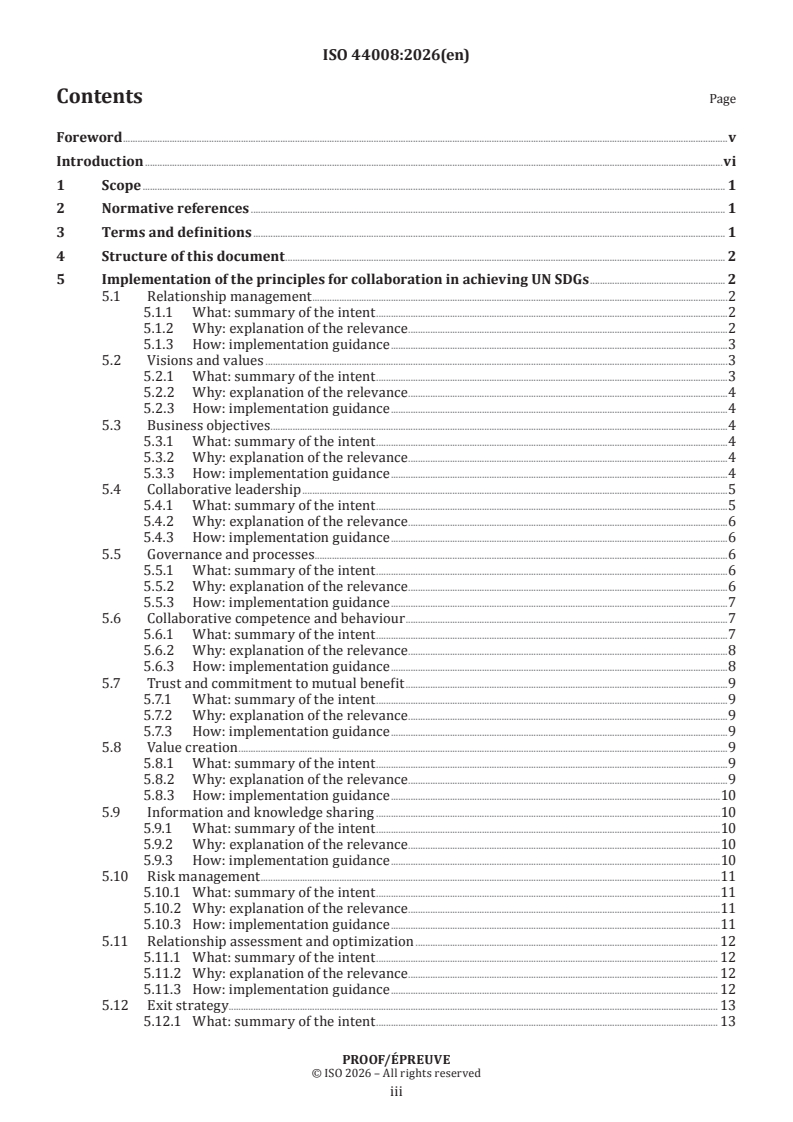

ISO/PRF 44008 - Collaborative business relationship management — Guidance for collaboration in achieving the United Nations Sustainable Development Goals
REDLINE ISO/PRF 44008 - Collaborative business relationship management — Guidance for collaboration in achieving the United Nations Sustainable Development Goals
ISO/PRF 44008 is an ISO document that gives guidance for collaborative business relationship management focused on the United Nations Sustainable Development Goals (SDGs). It is intended for governments, businesses and other stakeholders who want to align aims, objectives and working methods so they can contribute to one or more SDGs. The document builds on the 12 principles of collaborative business relationships in ISO/TR 44000.
What does ISO/PRF 44008 specify?
ISO/PRF 44008 gives guidance for using collaborative business relationships to support the SDGs. Clause 1 sets the scope, and Clause 4 shows that the document is organized around 12 principles, each explained through what, why and how.
The document is structured as follows:
- Clause 1 - Scope
- Clause 2 - Normative references
- Clause 3 - Terms and definitions
- Clause 4 - Structure of this document
- Clause 5 - Implementation of the principles for collaboration in achieving UN SDGs
- Annex A - Sustainability values to value opportunities through collaboration
- Annex B - Sustainability partnering maturity matrix
| Annex | What it covers |
|---|---|
| Annex A | Suggested sustainability value areas and opportunity themes for collaboration |
| Annex B | A maturity matrix for assessing sustainability partnering across the 12 principles |
What are the key requirements of ISO/PRF 44008?
ISO/PRF 44008 is guidance, so the main points are recommendations on how partners should organize, manage and review collaboration. The practical message is that SDG-related collaboration works best when it is planned, shared, documented and reviewed as an ongoing relationship.
Build a joint relationship management approach - Clause 5.1 says partners should identify relevant interested parties, including indirect ones, and set up a joint management team and a relationship management plan (RMP). In practice, this gives the collaboration one agreed place for roles, responsibilities, objectives, governance, communication and escalation.
Align vision, values and business objectives with the SDGs - Clauses 5.2 and 5.3 say the collaboration should share values, resolve value conflicts, and integrate business objectives with sustainability objectives. The document asks partners to link objectives to one of the 17 SDGs or 169 SDG targets, use shared key performance indicators (KPIs), and review progress at planned intervals. This matters because sustainability work is treated as part of normal business planning, not a side project.
Use senior leadership and clear governance - Clauses 5.4 and 5.5 call for empowered senior leaders, defined decision rights, sufficient resources, and a governance framework that covers reporting, issue management and dispute resolution. In practice, this means people know who can decide, who must be consulted and how problems are escalated before they damage the relationship.
Develop collaborative competence and behaviour - Clause 5.6 says partners should identify, train and monitor the skills and behaviours needed for collaborative work, including cross-cultural awareness. The document treats competence and behaviour as part of performance, so organizations need to develop people who can work across different sectors, cultures and operating styles.
Create and maintain trust and mutual benefit - Clause 5.7 makes trust a central condition of collaboration, supported by openness, aligned ethics and ongoing monitoring. This matters because the standard treats trust as something to manage, not just hope for, and because low trust quickly reduces engagement, speed of decision-making and innovation.
Manage value creation and information sharing carefully - Clauses 5.8 and 5.9 say partners should jointly define value, build learning organizations, and establish rules for information, knowledge and intellectual property. The document also asks partners to classify information, set access rights, define confidential-information procedures and address exit-related data responsibilities. In practice, this protects sensitive information while still letting the collaboration use shared knowledge.
Handle risk, review performance and plan the exit from the start - Clauses 5.10, 5.11 and 5.12 require joint risk management, relationship assessment, maturity review and a jointly agreed exit strategy. The collaboration should keep a risk register, review behaviours and outcomes, and document trigger criteria, asset transfer, liabilities and post-exit follow-up. This helps partners avoid surprises when the collaboration changes or ends.
What terms does ISO/PRF 44008 define?
The document defines key terms in Clause 3 and uses them consistently in the guidance.
- Collaboration - A structured partnership among two or more interested parties that jointly design and implement activities to achieve one or more SDGs.
- Partner - An individual or organization that works with other interested parties in structured efforts to contribute to one or more SDGs.
- Interested party - A person or organization that can affect, be affected by, or perceive itself to be affected by a sustainability collaboration.
- Relationship management - The planned, coordinated and continually improved use of systems, processes, engagement mechanisms and evaluation methods to sustain effective collaboration and achieve agreed outcomes.
- United Nations Sustainable Development Goals (SDGs) - The 17 global goals named in the introduction, used here as the sustainability framework for collaborative action.
- Relationship management plan (RMP) - The joint plan used throughout Clause 5 to capture objectives, governance, communication, risk, information handling and exit arrangements.
- Key performance indicators (KPIs) - Shared measures used to track progress against collaboration objectives and SDG-related outcomes.
Who uses ISO/PRF 44008?
ISO/PRF 44008 is meant for governments, businesses and other stakeholders involved in sustainability collaboration. It is also relevant to organizations that work with suppliers, regulators, civil society, non-governmental organizations, investors, academic institutions, industry associations and local communities.
In practice, the document supports people who design or run collaborative initiatives, such as senior leaders, partnership managers, governance teams, procurement and supply-chain teams, sustainability teams, and those responsible for risk, information sharing and relationship review. It is useful when they need to set shared objectives, build governance, manage trust, handle data, and assess whether a collaboration is working.
Which standards are used with ISO/PRF 44008?
- ISO/TR 44000:2019 - Clause 4 says this document is based on the 12 principles of ISO/TR 44000, and the scope says those principles are used to improve capability to align aims and objectives to the SDGs.
- ISO 44002:2019 - Clause 2 refers to this document in the text. It provides guidelines on implementing ISO 44001 and supports the implementation approach used here.
- ISO 44001:2017 - Listed in the bibliography as the collaborative business relationship management systems standard that sits behind the wider series.
What does the ISO/PRF 44008 document contain?
The main body gives a practical framework for collaboration through 12 principles, each expanded with what, why and how guidance. It covers stakeholder mapping, shared vision and values, business objectives, collaborative leadership, governance, competence, trust, value creation, information sharing, risk management, relationship assessment and exit planning.
Annex A adds tables A.1 to A.10, which suggest sustainability value areas such as sustainable development, stakeholder inclusion, environment, natural resources, human resources, governance, ethical trade, economic and social change, operations and globalization. These tables help organizations identify where collaboration can create direct or indirect value.
Annex B provides a maturity matrix for the 12 principles. It gives a structured way to assess whether a collaboration is limited, low, medium or high maturity across relationship management, vision and values, business objectives, leadership, governance, competence, trust, value creation, information sharing, risk management, relationship assessment and exit strategy.
Buy Documents
ISO/PRF 44008 - Collaborative business relationship management — Guidance for collaboration in achieving the United Nations Sustainable Development Goals
REDLINE ISO/PRF 44008 - Collaborative business relationship management — Guidance for collaboration in achieving the United Nations Sustainable Development Goals
Get Certified
Connect with accredited certification bodies for this standard

BSI Group
BSI (British Standards Institution) is the business standards company that helps organizations make excellence a habit.

Bureau Veritas
Bureau Veritas is a world leader in laboratory testing, inspection and certification services.

DNV
DNV is an independent assurance and risk management provider.
Sponsored listings
Frequently Asked Questions
ISO/PRF 44008 is a draft published by the International Organization for Standardization (ISO). Its full title is "Collaborative business relationship management — Guidance for collaboration in achieving the United Nations Sustainable Development Goals". This standard covers: This document provides guidance for governments, businesses, and other stakeholders in using the 12 principles of collaborative business relationships provided in ISO/TR 44000 to improve their capability to align their aims and objectives to contribute to the UN Strategic development goals.
This document provides guidance for governments, businesses, and other stakeholders in using the 12 principles of collaborative business relationships provided in ISO/TR 44000 to improve their capability to align their aims and objectives to contribute to the UN Strategic development goals.
ISO/PRF 44008 is classified under the following ICS (International Classification for Standards) categories: 03.100.02 - Governance and ethics; 13.020.20 - Environmental economics. Sustainability. The ICS classification helps identify the subject area and facilitates finding related standards.
ISO/PRF 44008 is available in PDF format for immediate download after purchase. The document can be added to your cart and obtained through the secure checkout process. Digital delivery ensures instant access to the complete standard document.
Standards Content (Sample)
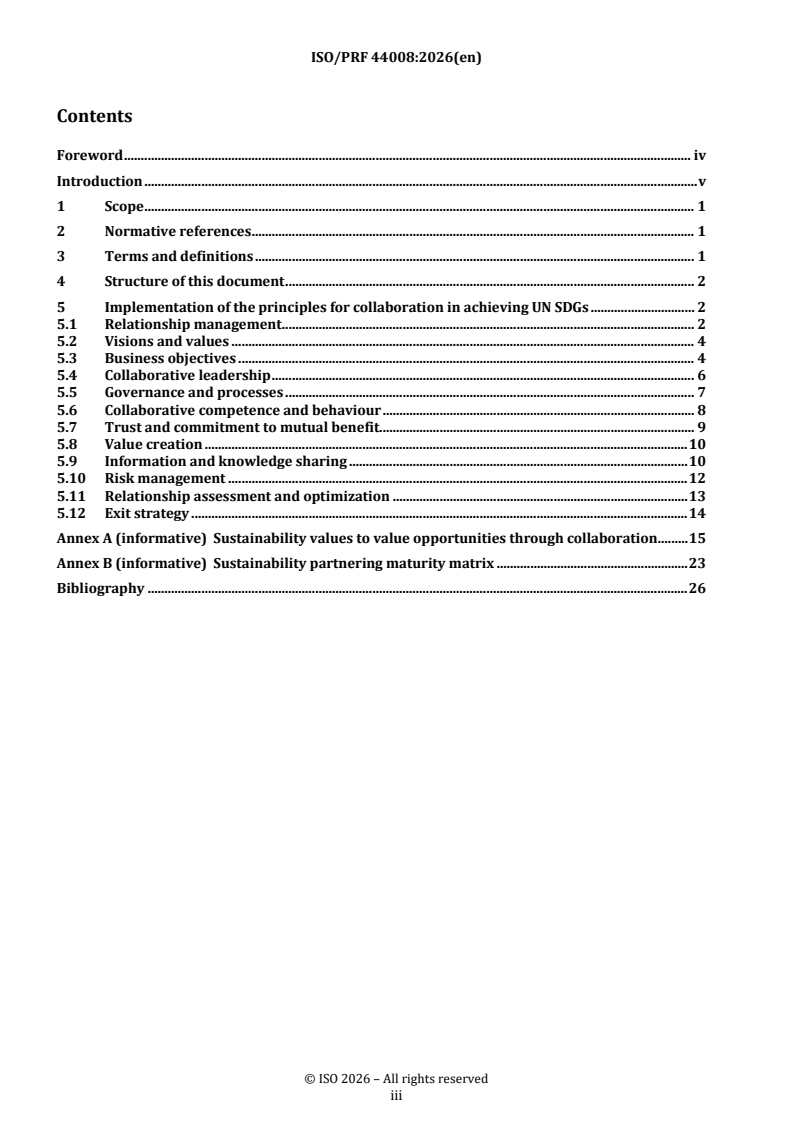
Contents
- Introduction
- 1 Scope
- 2 Normative references
- 3 Terms and definitions
- 3.1 collaboration
- 3.2 partner
- 3.3 interested party
- 3.4 relationship management
- 4 Structure of this document
- 5 Implementation of the principles for collaboration in achieving UN SDGs
- 5.1 Relationship management
- 5.2 Visions and values
- 5.3 Business objectives
- 5.4 Collaborative leadership
- 5.5 Governance and processes
- 5.6 Collaborative competence and behaviour
- 5.7 Trust and commitment to mutual benefit
- 5.8 Value creation
- 5.9 Information and knowledge sharing
- 5.10 Risk management
- 5.11 Relationship assessment and optimization
- 5.12 Exit strategy
- Annex A
- Annex B
- 5.1 Relationship Relationship Relationship Relationship man- Relationship manage-
- 5.4 Collaborative Leaders frequently Leaders possess Leaders are Leaders model and
- 5.5 Governance and Some governance Necessary Governance Governance and
- 5.6 Collaborative Appropriate skills Collaborative Collaborative compe- Collaborative
- 5.7 Trust and Partner Trust and Trust and Trust and commit-
- 5.8 Value creation Little to no focus on Processes are in Value is Value creation is
- 5.9 Information and Communications are Communications An effective Proactive information
- 5.11 Relationship Engagement, Engagement, Leading and lagging Metrics are fully
- 5.12 Exit strategy Little to no Change/exit is Change/exit is Change/exit
- Bibliography
Introduction
Sustainability affects all levels of society, including governments, businesses, non-profits and civil society organizations. Influencing factors for social development include environmental, economic and governance factors. The United Nations Sustainable Development Goals (UN SDGs) capture the following 17 key areas for organizations to consider:
- 1. No Poverty. End poverty in all its forms everywhere.
- 2. Zero Hunger. End hunger, achieve food security and improved nutrition and promote sustainable agriculture.
- 3. Good Health and Well-being. Ensure healthy lives and promote well-being for all at all ages.
- 4. Quality Education. Ensure inclusive and equitable quality education and promote lifelong learning opportunities for all.
- 5. Gender Equality. Achieve gender equality and empower all women and girls.
- 6. Clean Water and Sanitation. Ensure availability and sustainable management of water and sanitation for all.
- 7. Affordable and Clean Energy. Ensure access to affordable, reliable, sustainable and modern energy for all.
- 8. Decent Work and Economic Growth. Promote sustained, inclusive and sustainable economic growth, full and productive employment and decent work for all.
- 9. Industry, Innovation and Infrastructure. Build resilient infrastructure, promote inclusive and sustainable industrialization and foster innovation.
- 10. Reduced Inequalities. Reduce inequality within and among countries.
- 11. Sustainable Cities and Communities. Make cities and human settlements inclusive, safe, resilient and sustainable.
- 12. Responsible Consumption and Production. Ensure sustainable consumption and production patterns.
- 13. Climate Action. Take urgent action to combat climate change and its impacts.
- 14. Life below Water. Conserve and sustainably use the oceans, seas and marine resources for sustainable development.
- 15. Life on Land. Protect, restore and promote sustainable use of terrestrial ecosystems, sustainably manage forests, combat desertification, and halt and reverse land degradation and halt biodiversity loss.
- 16. Peace, Justice and Strong Institutions. Promote peaceful and inclusive societies for sustainable development, provide access to justice for all and build effective, accountable and inclusive institutions at all levels.
- 17. Partnerships for the Goals. Strengthen the means of implementation and revitalize the global partnership for sustainable development.
Today’s increasingly complex and interdependent world requires collaborative efforts to achieve these goals, as they cannot be accomplished in isolation. The seventeenth goal emphasizes partnership, urging organizations and individuals to collaborate effectively to address challenges, manage change and align benefits. Yet the terms “partnership” and “collaboration” can mean different things to each partner. ISO 44001 offers a framework for partners to jointly explore and define these concepts, whether through formal or informal arrangements.
This document seeks to inspire innovation and progress among partners and interested parties involved in or affected by the implementation of sustainable initiatives supporting the UN SDGs. PROOF/ÉPREUVE
International Standard ISO 44008:2026(en) Collaborative business relationship management — Guidance for collaboration in achieving the United Nations Sustainable Development Goals
1 Scope
This document gives guidance for governments, businesses and other stakeholders on using the 12 principles of collaborative business relationships provided in ISO/TR 44000 to improve their capability to align their own aims and objectives to contribute to the United Nations (UN) Sustainable Development Goals (SDGs).
2 Normative references
The following documents are referred to in the text in such a way that some or all of their content constitutes requirements of this document. For dated references, only the edition cited applies. For undated references, the latest edition of the referenced document (including any amendments) applies. ISO 44002:2019, Collaborative business relationship management systems — Guidelines on the implementation of ISO 44001
3 Terms and definitions
For the purposes of this document, the terms and definitions given in ISO 44002:2019 and the following apply.
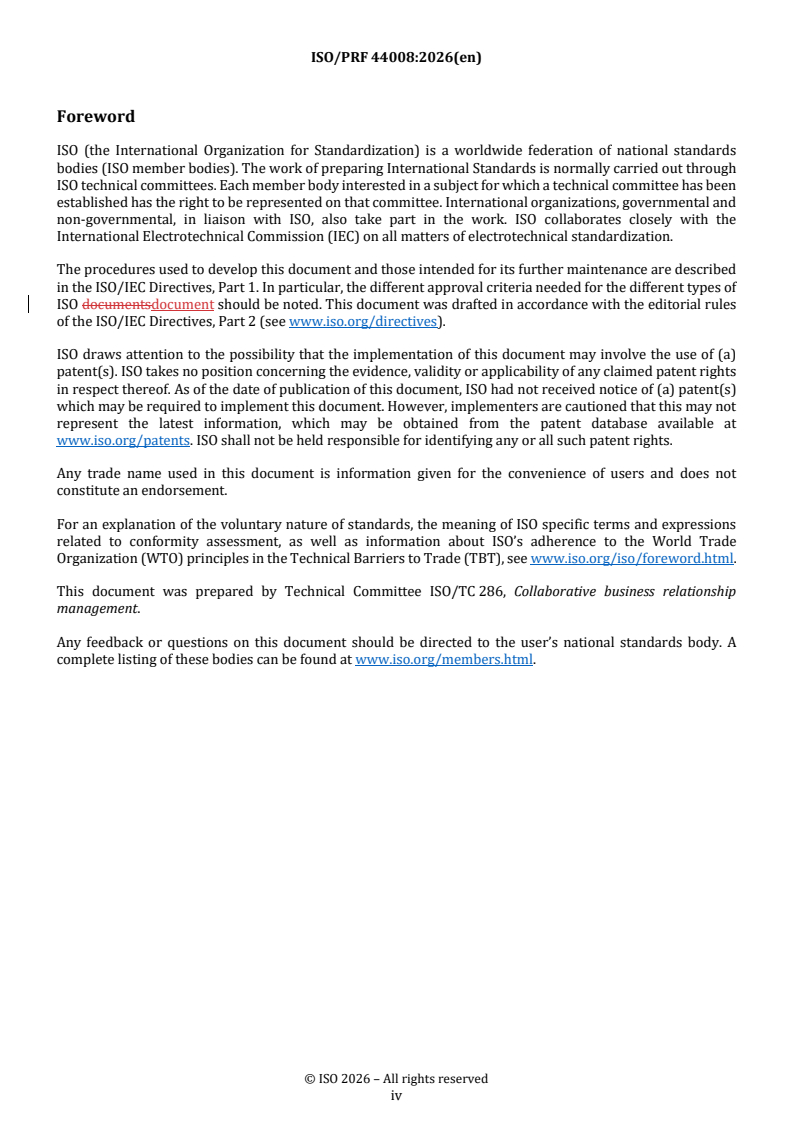
ISO and IEC maintain terminology databases for use in standardization at the following addresses:
- ISO Online browsing platform: available at https:// www .iso .org/ obp
- IEC Electropedia: available at https:// www .electropedia .org/
3.1 collaboration
structured partnership among two or more interested parties (3.3) that jointly design and implement activities aimed at achieving one or more of the 17 United Nations Sustainable Development Goals (SDGs)
3.2 partner
individual or organization that collaborates with other interested parties (3.3) in structured efforts to contribute to one or more of the 17 United Nations Sustainable Development Goals (SDGs) EXAMPLE Governments, suppliers, regulators, civil society and special-interest groups, non-governmental organizations, businesses, academic institutions, industry associations, local communities, investors.
3.3 interested party
<sustainability> person or organization that can affect, be affected by, or perceive itself to be affected by a decision or activity related to sustainability collaboration (3.1) EXAMPLE Customers, communities, suppliers, regulators, non-governmental organizations, investors, employees. Note 1 to entry: To “perceive itself to be affected” means the perception has been communicated to the organization. PROOF/ÉPREUVE
ISO 44008:2026(en)
3.4 relationship management
planned, coordinated and continually improved application of systems, processes, engagement mechanisms and evaluation methods that enable partners (3.2) to sustain an effective collaboration (3.1) and achieve their agreed outcomes in support of the United Nations Sustainable Development Goals (SDGs)
4 Structure of this document
This document is based on the 12 principles of ISO/TR 44000.
The principles are as follows:
- 1. Relationship management.
- 2. Visions and values.
- 3. Business objectives.
- 4. Collaborative leadership.
- 5. Governance and processes.
- 6. Collaborative competence and behaviour.
- 7. Trust and commitment to mutual benefit.
- 8. Value creation.
- 9. Information and knowledge sharing.
- 10. Risk management.
- 11. Relationship assessment and optimization.
- 12. Exit strategy.
For each principle, there are the following three main subclauses:
- What: a summary of the intent of the principle.
- Why: an explanation of its potential application in sustainability.
- How: guidance on its implementation.
5 Implementation of the principles for collaboration in achieving UN SDGs
5.1 Relationship management
5.1.1 What: summary of the intent
The principle of relationship management is essential to sustaining collaborative relationships that are focused, ethical and socially responsible. These relationships are foundational to the long-term success of any SDG-aligned initiative. While the process need not be complex, it should clearly capture the shared vision and objectives of all participating parties. It should also be easily understood, accessible and communicated to all stakeholders, whether directly or indirectly involved in the collaboration.
5.1.2 Why: explanation of the relevance
Different stakeholders often have varying goals and pressures, which can lead to differing priorities. To promote success, each initiative should focus on building and managing strong, collaborative relationships. This can be achieved by agreeing on a shared engagement process that aligns with common goals and PROOF/ÉPREUVE
ISO 44008:2026(en) desired outcomes. A structured approach to relationship management supports consistency and continual improvement, especially as circumstances and personnel change. It also enables individuals to make informed decisions while respecting the expectations and responsibilities of others. A jointly agreed relationship management framework helps align focus, build trust and establish a culture of shared accountability.
5.1.3 How: implementation guidance
5.1.3.1 Identifying relationships
Effective collaboration between sustainability partners begins with a clear understanding of the initiative’s context and the identification of relevant interested parties. These may be government agencies, legislators, businesses, supply chain partners, trade associations, investors, developers, planners, local communities, non-governmental organizations (NGOs), academics, special interest groups and other commercial or civil societies.
In addition to primary participants, it is equally important to identify and recognize indirect interested parties, i.e. those who can be affected by or benefit from the outcomes of the initiative. A comprehensive stakeholder map should be developed to ensure all relevant voices are considered, thereby promoting transparency, inclusivity and long-term support. When mapping both direct and indirect interested parties, partners should also consider power dynamics and ensure that marginalized voices are adequately represented.
5.1.3.2 Establishing organization and leadership
The participating organizations should form a joint management team that includes members of the organization’s senior leadership or persons with clear delegation from senior leadership. This team should clearly identify the senior administrative personnel, or their designated representatives, who will be responsible for overseeing the initiative. Additionally, the team should define each member’s role, responsibilities and decision-making authority. The joint management team should build and create the environment to support the implementation of any initiative, including, but not limited to, the resources, equipment, property, personnel and risk management. The joint management team should ensure continual management and focus on the objectives and governance requirements. The joint management team may engage additional collaborative partners as the initiative develops so that all partners can benefit from it.
5.1.3.3 Establishment of the relationship management plan
Partners should develop a joint relationship management plan (RMP) to clarify the objectives of partners and stakeholders and their environment, including the external and internal elements of achieving their objectives. The RMP should also include designation of the partners, the collaboration environment and interested party expectations. Typical RMPs may also include governance models, escalation processes, metrics by which to measure progress and communication mechanisms. The formulation of a joint RMP may be an iterative and continual optimization process.
5.2 Visions and values
5.2.1 What: summary of the intent
The visions and values of a collaboration should be co-created and reflect the alignment of objectives, concepts and the nature of collaborative work, avoiding ethical or moral clashes, and should articulate the future direction, culture and values required to work effectively with partners. At the same time, organizational values should be actively cascaded throughout the organization to ensure that decisions and actions consistently reflect them, even when they conflict with internal processes, incentives and performance targets. Regular review should reconcile such conflicts and confirm that the shared vision continues to support the partnership’s sustainability goals.
PROOF/ÉPREUVE
ISO 44008:2026(en)
5.2.2 Why: explanation of the relevance
Vision and values serve as guiding principles for organizations, individuals, partners and interested parties. They help ensure alignment in areas such as development strategy, culture, ethical standards and overall behaviour. Consistent expression of shared values builds trust, strengthens internal focus, sets expectations with partners, and enhances the reputation and credibility of the partnership among the broader community of interested parties.
5.2.3 How: implementation guidance
5.2.3.1 Articulating the organizational visions and values
The core values of an organization influence its culture, decisions and partnerships. Identifying what matters most, internally and externally, is essential for clarity of focus and impact. This process should include input from all levels of the organization to ensure values are authentically reflected in daily operations. When entering into collaborative partnerships, organizations should assess the compatibility of values with those of their partners to establish a strong foundation for effective cooperation.
5.2.3.2 Implementing the visions and values of collaboration
The joint visions and values of all parties should be recognized throughout the collaboration, so that they are reflected in all activities, management and governance. Examining areas of alignment and difference in vision and values is an important step in understanding the underlying impetus for establishing collective aims that align with SDG targets and support the activities of both partners and the needs of wider stakeholder communities and interested parties.
5.3 Business objectives
5.3.1 What: summary of the intent
The aims of sustainability and the SDGs should be developed together within the context of the business objectives of the partners to ensure that collaborative working is not constrained by conflicting priorities. Where sustainable outcomes can contribute to business outcomes, there will be a greater probability of success. For example, many underlying aspects of the SDGs can drive positive commercial returns as well as beneficial social impacts from industry and government investment. Therefore, business objectives and sustainable outcomes should be treated as one integrated value proposition, supported by shared key performance indicators (KPIs) and reviewed at agreed intervals, so that neither is pursued in isolation.
5.3.2 Why: explanation of the relevance
A clear, shared statement of the collaboration objectives directly drives consistent actions and behaviour across all parties. The effectiveness and feasibility of these objectives form the basis for optimizing limited resources, enhancing competitive advantage and creating shared value for every partner and all interested parties. The clarity of the objectives is the basis for effective collaboration and provides guidance on the implementation of activities, key decisions, development direction and behaviour for all parties. Integrating measurable contributions to the SDGs ensures that sustainability targets are not treated as lower priorities, and instead stimulate innovation while supporting traditional measures of performance and success. Regular review keeps objectives aligned with changing context and partner priorities.
5.3.3 How: implementation guidance
5.3.3.1 Establishing collective objectives
All the parties need to have a clear and consistent understanding of their objectives and should consider the value of participating in the collaborative arrangement. In the context of sustainability objectives, it is likely that partners can and should be involved in representing different sectors of interested parties. Encouraging cross-sector participation where applicable can provide diverse contributions to innovation and change. PROOF/ÉPREUVE
ISO 44008:2026(en) This diversity will also likely lead to a spectrum of objectives that should be harmonized through dialogue and material alignment to ensure they are not in conflict.
Each party should define its own objectives, understand the objectives of others, and work toward a shared framework of joint objectives that promotes compatibility, mutual benefit and inclusive participation. Objectives should be aligned with one of the 17 SDGs or the 169 SDG targets. The agreed objectives should be captured in an objective matrix within the RMP, linked to shared KPIs and reviewed at planned intervals to reflect progress and changing context.
5.3.3.2 Coordinating preparation
All parties should state and align their objectives and values if the collaboration is to be effective and deliver outcomes that are collectively supported. Defining and documenting objectives in advance ensures that the collaborative approach can be carried out constructively to improve the effectiveness of the relationship in order to achieve and maximize desired outcomes. Each party should recognize the actual context and consider the risks in a holistic manner according to the relevant conditions of the collaboration cycle, so that risks are shared, managed and, where possible, reduced. The agreed objectives, values and key risks should be incorporated into the RMP and reviewed at planned intervals to reflect progress and changing circumstances.
5.3.3.3 Refining objectives
Objectives should be refined iteratively, setting phased goals that distinguish between short-term wins, medium-term progress indicators and long-term strategic outcomes. These objectives should be measurable, time-bound and linked to transparent milestones and KPIs. Refinement should occur through structured review cycles that incorporate partner input, external factors and feedback from interested parties.
5.3.3.4 Implementing objectives
The parties should formulate clear joint action plans that are directly linked to the agreed objectives. In the process of implementation, it is necessary to effectively communicate progress and issues transparently to all interested parties. The creation of joint action plans should fully assess the actual capabilities and relative influencing factors for each party to ensure that the plans can be executed, quantified, assessed and adjusted through shared KPIs and review points.
5.3.3.5 Adjusting targets
In the process of achieving the objectives, the partners should operate a clear, jointly agreed revision mechanism for adjusting targets, including evaluating their impact on achieving the SDG targets. The mechanism should consider:
- the conditions that trigger a review (e.g. scope change, new requirements, SDG policy shifts);
- who can propose a change and how proposals are documented;
- the decision path and timeline for approving or rejecting revisions;
- how updated targets are recorded and communicated to all parties.
5.4 Collaborative leadership
5.4.1 What: summary of the intent
The success of any collaborative venture relies on the commitment of senior leadership and its skill in collaborative leadership, i.e. leadership that facilitates rather than directs, builds consensus and models transparency and trust. Partners should appoint senior leaders who are accountable and empowered to remove internal barriers, supporting the sustainable initiatives both collectively and within their own organizations, and creating an environment conducive to collaboration. PROOF/ÉPREUVE
ISO 44008:2026(en) For specific joint programmes or projects, the senior leaders appoint a leader and team drawn from across the collaboration who are empowered with clear decision rights, responsible for facilitating and coordinating consensus and modelling transparency and trust, and are fully supported to deliver the targeted outcomes.
...
Contents
- Introduction
- 1 Scope
- 2 Normative references
- 3 Terms and definitions
- 3.1 collaboration
- 3.2 partner
- 3.3 interested party
- 3.4 relationship management
- 4 Structure of this document
- 5 Implementation of the principles for collaboration in achieving UN SDGs
- 5.1 Relationship management
- 5.2 Visions and values
- 5.3 Business objectives
- 5.4 Collaborative leadership
- 5.5 Governance and processes
- 5.6 Collaborative competence and behaviour
- 5.7 Trust and commitment to mutual benefit
- 5.8 Value creation
- 5.9 Information and knowledge sharing
- 5.10 Risk management
- 5.11 Relationship assessment and optimization
- 5.12 Exit strategy
- Annex A
- Annex B
- 5.1 Relationship Relationship Relationship Relationship Relationship
- 5.4 Collaborative Leaders frequently Leaders possess Leaders are Leaders model and
- 5.5 Governance and Some governance Necessary Governance Governance and
- 5.6 Collaborative Appropriate skills Collaborative Collaborative Collaborative
- 5.7 Trust and Partner Trust and Trust and Trust and
- 5.8 Value creation Little to no focus on Processes are in Value is Value creation is at
- 5.9 Information and Communications Communications An effective Proactive
- 5.11 Relationship Engagement, Engagement, Leading and lagging Metrics are fully
- Bibliography
Introduction
Sustainability impactsaffects all levels of society, including governments, businesses, non-profits and civil society organizations. Influencing factors for social development range frominclude environmental, economic and governance factors. The United Nations Sustainable Development Goals (UN SDGs) capture the following 17 key areas for organizations to consider:
- 1. No Poverty. End poverty in all its forms everywhere.
- 2. Zero Hunger. End hunger, achieve food security and improved nutrition and promote sustainable agriculture.
- 3. Good Health and Well-being. Ensure healthy lives and promote well-being for all at all ages.
- 4. Quality Education. Ensure inclusive and equitable quality education and promote lifelong learning opportunities for all.
- 5. Gender Equality. Achieve gender equality and empower all women and girls.
- 6. Clean Water and Sanitation. Ensure availability and sustainable management of water and sanitation for all.
- 7. Affordable and Clean Energy. Ensure access to affordable, reliable, sustainable and modern energy for all.
- 8. Decent Work and Economic Growth. Promote sustained, inclusive and sustainable economic growth, full and productive employment and decent work for all.
- 9. Industry, Innovation and Infrastructure. Build resilient infrastructure, promote inclusive and sustainable industrialization and foster innovation.
- 10. Reduced Inequalities. Reduce inequality within and among countries.
- 11. Sustainable Cities and Communities. Make cities and human settlements inclusive, safe, resilient and sustainable.
- 12. Responsible Consumption and Production. Ensure sustainable consumption and production patterns.
- 13. Climate Action. Take urgent action to combat climate change and its impacts.
- 14. Life below Water. Conserve and sustainably use the oceans, seas and marine resources for sustainable development.
- 15. Life on Land. Protect, restore and promote sustainable use of terrestrial ecosystems, sustainably manage forests, combat desertification, and halt and reverse land degradation and halt biodiversity loss.
- 16. Peace, Justice and Strong Institutions. Promote peaceful and inclusive societies for sustainable development, provide access to justice for all and build effective, accountable and inclusive institutions at all levels.
- 17. Partnerships for the Goals. Strengthen the means of implementation and revitalize the global partnership for sustainable development.
Today’s increasingly complex and interdependent world requires collaborative efforts to achieve these goals, as they cannot be accomplished in isolation. The seventeenth goal emphasizes partnership, urging
ISO/PRF 44008:2026(en) organizations and individuals to collaborate effectively to address challenges, manage change and align benefits. Yet the terms “partnership” and “collaboration” can mean different things to each partner. ISO 44001 offers a framework for partners to jointly explore and define these concepts, whether through formal or informal arrangements.
This document seeks to inspire innovation and progress among partners and interested parties involved in or affected by the implementation of sustainable initiatives supporting the UN SDGs.
Collaborative business relationship management — Guidance for collaboration in achieving the United Nations SustainabilitySustainable Development Goals
1 Scope
This document gives guidance for governments, businesses and other stakeholders on using the 12 principles of collaborative business relationships provided in ISO/TR 44000 to improve their capability to align their own aims and objectives to contribute to the United Nations (UN) Sustainable Development Goals (SDGs).
2 Normative references
There are no normative references in this document.
The following documents are referred to in the text in such a way that some or all of their content constitutes requirements of this document. For dated references, only the edition cited applies. For undated references, the latest edition of the referenced document (including any amendments) applies. ISO 44002:2019, Collaborative business relationship management systems — Guidelines on the implementation of ISO 44001
3 Terms and definitions
For the purposes of this document, the following terms and definitions apply in addition to those given in ISO 44002:2019 Collaborative business relationship management – Guidelines on the implementation of ISO 44001 and the following apply.
ISO and IEC maintain terminology databases for use in standardization at the following addresses:
- ISO Online browsing platform: available at https://www.iso.org/obp
- IEC Electropedia: available at https://www.electropedia.org/
3.1 collaboration
In the context of this document, a structured partnership among two or more interested parties (3.3) that jointly design and implement activities aimed at achieving one or more of the 17 United Nations Sustainable Development Goals (SDGs)
3.2 partner
In the context of this document, an individual or organization that collaborates with other interested parties (3.3) in structured efforts to contribute to one or more of the 17 United Nations Sustainable Development Goals (SDGs) EXAMPLE Governments, suppliers, regulators, civil society and special-interest groups, non-governmental organizations, businesses, academic institutions, industry associations, local communities, investors.
3.3 interested party
In <sustainability, a> person or organization that can affect, be affected by, or perceive itself to be affected by a decision or activity related to sustainability collaboration (3.1) EXAMPLE Customers, communities, suppliers, regulators, non-governmental organizations, investors, employees.
ISO/PRF 44008:2026(en) Note 1 to entry: To “perceive itself to be affected” means the perception has been communicated to the organization.
3.4 relationship management
planned, coordinated and continually improved application of systems, processes, engagement mechanisms and evaluation methods that enable partners (3.2) to sustain an effective collaboration (3.1) and achieve their agreed outcomes in support of the United Nations Sustainable Development Goals (SDGs)
4 Structure of this document
This document is based on the 12 principles of ISO/TR 44000.
The principles are as follows:
- 1. Relationship management.
- 2. Visions and values.
- 3. Business objectives.
- 4. Collaborative leadership.
- 5. Governance and processes.
- 6. Collaborative competence and behaviour.
- 7. Trust and commitment to mutual benefit.
- 8. Value creation.
- 9. Information and knowledge sharing.
- 10. Risk management.
- 11. Relationship assessment and optimization.
- 12. Exit strategy.
For each principle, there are the following three main subclauses:
- What: a summary of the intent of the principle.
- Why: an explanation of its potential application in sustainability.
- How: guidance on its implementation.
5 Implementation of the principles for collaboration in achieving UN SDGs
5.1 Relationship management
5.1.1 What: summary of the intent
The principle of relationship management is essential to sustaining collaborative relationships that are focused, ethical and socially responsible. These relationships are foundational to the long-term success of any SDG-aligned initiative. While the process need not be complex, it should clearly capture the shared vision and
ISO/PRF 44008:2026(en) objectives of all participating parties. It should also be easily understood, accessible and communicated acrossto all stakeholders, whether directly or indirectly involved in the collaboration.
5.1.2 Why: explanation of the relevance
Different stakeholders often have varying goals and pressures, which can lead to differing priorities. To promote success, each initiative should focus on building and managing strong, collaborative relationships. This can be achieved by agreeing on a shared engagement process that aligns with common goals and desired outcomes. A structured approach to relationship management supports consistency and continual improvement, especially as circumstances and personnel change. It also enables individuals to make informed decisions while respecting the expectations and responsibilities of others. A jointly -agreed-upon relationship management framework helps align focus, build trust and establish a culture of shared accountability.
5.1.3 How: implementation guidance
5.1.3.1 Identifying relationships
Effective collaboration between sustainability partners begins with a clear understanding of the initiative’s context and the identification of relevant interested parties. These may be government agencies, legislators, businesses, supply chain partners, trade associations, investors, developers, planners, local communities, nongovernmentgovernmental organizations (NGOs), academics, special interest groups and other commercial or civil societies.
In addition to primary participants, it is equally important to identify and recognize indirect interested parties, i.e. those who can be affected by or benefit from the outcomes of the initiative. A comprehensive stakeholder map should be developed to ensure all relevant voices are considered, thereby promoting transparency, inclusivity and long-term support. When mapping both direct and indirect interested parties, partners should also consider power dynamics and ensure that marginalized voices are adequately represented.
5.1.3.2 Establishing organization and leadership
The participating organizations should form a joint management team that includes members of the organization’s senior leadership of the organization or persons with clear delegation from the senior leadership. This team should clearly identify the senior administrative personnel, or their designated representatives, who will be responsible for overseeing the initiative. Additionally, the team should define each member’s role, responsibilities and decision-making authority. The joint management team should build and create the environment to support the implementation of any initiative, including, but not limited to, the resources, equipment, property, personnel and risk management. The joint management team should ensure continual management and focus on the objectives and governance requirements. The joint management team may engage additional collaborative partners as the initiative develops so that all partners can benefit from it.
5.1.3.3 Establishment of the relationship management plan
Partners should develop a joint relationship management plan (RMP) to clarify the objectives of partners and stakeholders and their environment, including the external and internal elements of achieving their objectives. The RMP should also include designation of the partners, the collaboration environment and interested party expectations. Typical RMPs may also include governance models, escalation processes, metrics by which to measure progress and communication mechanisms.
The formulation of a joint RMP may be an iterative and continual optimization process.
ISO/PRF 44008:2026(en)
5.2 Visions and values
5.2.1 What: summary of the intent
The visions and values of a collaboration should be co-created and reflect the alignment of objectives, concepts and the nature of collaborative work, avoiding ethical or moral clashes, and should articulate the future direction, culture and values required to work effectively work with partners. At the same time, organizational values need toshould be actively cascaded throughout the organization to ensure that decisions and actions consistently reflect them, even when they can at times conflict with internal processes, incentives and performance targets. Regular review should reconcile such conflicts and confirm that the shared vision continues to support the partnership’s sustainability goals.
5.2.2 Why: explanation of the relevance
Vision and values serve as guiding principles for organizations, individuals, partners and interested parties. They help ensure alignment in areas such as development strategy, culture, ethical standards and overall behaviour. Consistent expression of shared values builds trust, strengthens internal focus, sets expectations with partners, and enhances the reputation and credibility of the partnership among the broader community of interested parties.
5.2.3 How: implementation guidance
5.2.3.1 Articulating the organizational visions and values
The core values of an organization influence its culture, decisions and partnerships. Identifying what matters most, internally and externally, is essential for clarity of focus and impact. This process should include input from all levels of the organization to ensure values are authentically reflected in daily operations. When entering into collaborative partnerships, organizations should assess the compatibility of values with those of their partners to establish a strong foundation for effective cooperation.
5.2.3.2 Implementing the visions and values of collaboration
The joint visions and values of all parties should be recognized throughout the collaboration, so that they are reflected in all activities, management and governance. Examining areas of alignment and difference in vision and values is an important step in understanding the underlying impetus for establishing collective aims that align towith SDG targets and support the activities of both partners and the needs of wider stakeholder communities and interested parties.
5.3 Business objectives
5.3.1 What: summary of the intent
The aims of sustainability and the SDGs should be developed together within the context of the business objectives of the partners to ensure that collaborative working is not constrained by conflicting priorities. Where sustainable outcomes can contribute to business outcomes, there will be a greater probability of success. For example, many underlying aspects of the SDGs can drive positive commercial returns as well as beneficial social impacts from industry and government investment. Therefore, business objectives and sustainable outcomes should be treated as one integrated value proposition, supported by shared key performance indicators (KPIs) and reviewed at agreed intervals, so that neither is pursued in isolation.
5.3.2 Why: explanation of the relevance
A clear, shared statement of the collaboration objectives directly drives consistent actions and behaviour across all parties. The effectiveness and feasibility of these objectives form the basis for optimizing limited resources, enhancing competitive advantage and creating shared value for every partner and all interested parties. The clarity of the objectives is the basis for effective collaboration and provides guidance on the
ISO/PRF 44008:2026(en) implementation of activities, key decisions, development direction and behaviour for all parties. Integrating measurable contributions to the SDGs ensures that sustainability targets are not treated as lower priorities, and instead stimulate innovation while supporting traditional measures of performance and success. Regular review keeps objectives aligned with changing context and partner priorities.
5.3.3 How: implementation guidance
5.3.3.1 Establishing collective objectives
All the parties need to have a clear and consistent understanding of their objectives and should consider the value of participating in the collaborative arrangement. In the context of sustainability objectives, it is likely that partners can and should be involved in representing different sectors of interested parties. Encouraging cross-sector participation where applicable can provide diverse contributions to innovation and change. This diversity will also likely lead to a spectrum of objectives whichthat should be harmonized through dialogue and materiallymaterial alignment to ensure they are not in conflict. Each party should define its own objectives, understand the objectives of others, and work toward a shared framework of joint objectives that promotes compatibility, mutual benefit and inclusive participation. Objectives should be aligned with one of the 17 SDGs or the 169 SDG targets. The agreed objectives should be captured in an objective matrix within the RMP, linked to shared KPIs and reviewed at planned intervals to reflect progress and changing context.
5.3.3.2 Coordinating preparation
All parties should state and align their objectives and values if the collaboration is to be effective and deliver outcomes that are collectively supported. Defining and documenting objectives upfrontin advance ensures that the collaborative approach can be carried out constructively to improve the effectiveness of the relationship in order to achieve and maximize desired outcomes. Each party should recognize the actual context and consider the risks in a holistic manner according to the relevant conditions of the collaboration cycle, so that risks are shared, managed and, where possible, reduced. The agreed objectives, values and key risks shallshould be incorporated into the RMP and reviewed at planned intervals to reflect progress and changing circumstances.
5.3.3.3 Refining objectiveobjectives
Objectives should be refined iteratively, setting phased goals that distinguish between short-term wins, medium-term progress indicators and long-term strategic outcomes. These objectives should be measurable, time-bound, and linked to transparent milestones and KPIs. Refinement should occur through structured review cycles that incorporate partner input, external factors and feedback offrom interested parties.
5.3.3.4 Implementing objectives
The parties should formulate clear joint action plans that are directly linked to the agreed objectives. In the process of implementation, it is necessary to effectively communicate progress and issues transparently to all interested parties. The creation of joint action plans should fully assess the actual capabilities and relative influencing relative factors offor each party to ensure that the plans can be executed, quantified, assessed and adjusted through shared KPIs and review points.
5.3.3.5 Adjusting targettargets
In the process of achieving the objectives, the partners should operate a clear, jointly -agreed revision mechanism for adjusting targets, including evaluating their impact on achieving the SDG targets. The mechanism should consider:
- the conditions that trigger a review (e.g. scope change, new requirements, SDG policy shifts);
ISO/PRF 44008:2026(en) - who can propose a change and how proposals are documented; - the decision path and timeline for approving or rejecting revisions; - how updated targets are recorded and communicated to all parties.
5.4 Collaborative leadership
5.4.1 What: summary of the intent
The success of any collaborative venture relies on the commitment of senior leadership and its skill in collaborative leadership, i.e. leadership that facilitates rather than directs, builds consensus and models transparency and trust. Partners should appoint senior leaders who are accountable and empowered to remove internal barriers, supporting the sustainable initiatives both collectively and within their own organizations, and creating an environment conducive to collaboration. For specific joint programmes or projects, the senior leaders appoint a leader and team drawn from across the collaboration who are empowered with clear decision rights, responsible for facilitating and coordinating consensus and modeling modelling transparency and trust, and are fully supported to deliver the targeted outcomes.
...